|
|
| Home | Marine Aquariums |
Freshwater Aquariums |
Planted Aquariums |
Brackish Systems |
Ponds,
lakes & fountains |
Turtles & Amphibians |
Aquatic Business |
Aquatic Science |
Ask the WWM Crew a Question |
| Please visit our Sponsors | ||||
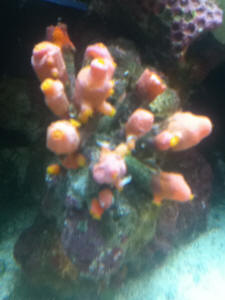
Tubastrea aurea... Rambling re SW stkg... reefs
4/14/10 Re: Tubastrea aurea, reef stkg., Lysmata amboinensis
comp.... 4/15/10
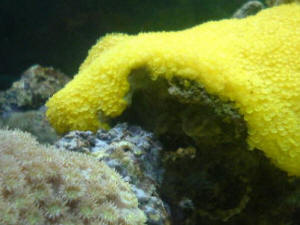
Dyed Cup Coral? - 04/07/07 Hi gang, <Hi Chuck.> My usually-very-good LFS just brought in two VERY yellow cup corals. . . <Mmm...if Turbinaria peltata then it almost certainly dyed, however it could be Turbinaria reniformis which, unlike T. Peltata can exhibit such color. T. Peltata however is unfortunately dyed yellow very often.> with color hue/chroma/intensity very similar to that displayed by my healthy yellow tang. <If it's that bright then I'd say the chances of foul-play may be growing.> What makes me somewhat suspicious -- besides the relative intensity of the color -- is that that 'skeletal' portion also displays the uniform bright yellow color, even with the polyps retracted. . . <Could be a recent...and thorough dye job, if is in fact dyed.> whereas the picture of a yellow I'd seen here on WWM seemed to indicate bright yellow polyps on a close-to-brown skeleton. <Depends on the exact species...but if dyed recently then the animal would be yellow all over.> Is it likely these corals HAVEN'T been dyed? <Mmm it's not possible to give you a 100% firm answer, but from what you have told me I would assume it is dyed.> I'd love to think they were real. . . <That's how "they" reel you in...> Chuck <Adam J.> Tubastrea micracantha -- 03/17/07 What's up everyone?, <<Hello>> Brandon here, <<Eric here>> I was wondering, have any of you ever come across Tubastraea micracantha? <<Only on the Internet>> I cannot find it in a store to save my life. <<I don't think it is a widely available>> As of recent, I have apparently been Tubastraea farming. <<Beautiful organisms>> So I was thinking, perhaps something other than yellow/orange might be kind of cool. <<Indeed'¦though T. micracantha is reportedly very difficult to sustain>> I have seen various images of this so called Black Sun Coral before I ever bought regular Tubastraea. So I got to asking, and I found out that I could have it ordered. <<Yes, would imagine your LFS could find/get it for you'¦or you could order it off the Net>> The thing is, that the person that can do this told me quote, "There is no way that you will ever be able to get it to survive." <<That does seem to be the general consensus'¦though I do seem to remember an individual from a few years back who reportedly had good success by removing the colony from her tank and placing in a bowl to feed, ensuring 'each' individual polyp received 'adequate' quantities of vitamin-fortified foodstuffs'¦definitely a high-maintenance animal>> The same person that told me that Aiptasia is actually a rock anemone. <<Hmm, possibly just a subjective 'common' description'¦but I get what you mean>> Needless to say I am a bit skeptical. <<I see>> Anyone know why it has such a bad reputation, and perhaps why it is "so hard to keep alive"? <<From what I have read, I gather the water flow and nutritive requirements are higher (or maybe just different/not well understood) for T. micracantha than for the other Tubastraea species'¦or maybe the species is too sensitive to collection/handling for captive keeping>> Further than that is anyone keeping it currently? If so what's the secret? <<You might try posting these last two questions on the reef message boards>> I am going to give it a go any way, perhaps I will discover something. <<Do share with us/let us know how things fare>> Thanks everyone, Brandon <<Regards, EricR>> Re: coral advice... comp. f'? 3/21/07 Thanks Brandon, for the quick and detailed response. <No problem.> After reading your reply and researching further, I have come to the conclusion that this is not the right coral for me, or rather; I am not the right keeper for this coral. <Sorry to hear that. They can be quite rewarding.> But after more consideration, I think I would prefer to spend some time to try to get this animal healthy, and sell or trade it to another enthusiast who WILL make an appropriate keeper. <There are quite a few.> If I just it back to the LFS they will likely just throw it back in with their semi-cured Live rock. <Not uncommon.> Now, unless another person spots it AND recognizes it AND is willing to make the effort to properly maintain it, this would be basically like throwing it away. That just would not feel right. <Agreed.> Here is what I am considering: I have a 2.5 gallon HEX tank with UG filter and lights. I would like to set up a solitaire habitat for this coral, and spend the next few weeks giving the daily or bi-daily feedings it requires. I would like to use the 2.5 gallon for this, but will never find a skimmer that would fit. I do think that it would be easy enough to change 25 to 50 percent of the water two to three times weekly. For filtration, I would be using an air driven UG plate with a bio-pad from my existing filer placed underneath and cover it with crushed coral. I have small submersible 50w heater that will fit in the tank as well. This Sun Coral would be the only organism in this tank and it will be a temporary situation. <Hmmmm.> Does this sound like something that might work? <I think that it would be easier on you and the coral alike to try something a little different. Get a deep bowl and place the coral in it. When you want to feed it all you have to do is remove the bowl (water still inside), and feed it that way. The left over food can be discarded, and you can then place the bowl with the coral in it, back into the tank. This method was proposed to me when I was inquiring about keeping Tubastrea Micracantha. Brandon.> Green Tubastraea sp. Captive Care of Tubastraea micrantha 2/4/07 Hello All! <Greetings! Mich here.> Recently, after some extensive research I have decided to purchase a nice piece of Sun Coral. My hesitation was due to the fact that each polyp needed to be fed quite regularly. <Regular feeding is imperative.> I began shopping for a Sun Coral recently and came across a dark green one! I have never seen one or even heard of it in such a color. I purchased it after taking the advise of the LFS's manager that it was no different than the other Sun Corals. My question basically is, was he right? <Not so much. It is in the same genus, but the species is different. It sounds like you have Tubastraea micrantha. It could possibly be Tubastraea diaphana, but I will assume it is the former. More info here: http://www.wetwebmedia.com/dendrophylliidae.htm This coral has a notoriously poor survival record and requires a very fast current and large amounts of food. I do hope you have a great protein skimmer.> I have tried researching on the Internet and yes, WetWebMedia.com and was not able to find any one mention a Sun Coral of this color, although, there was a website with professional photography of reefs around the world showing a green Sun Coral similar to mines, but no mention of it otherwise. The coral came with some smaller YELLOW polyps beginning to grow around it. I will be feeding this coral at least three times a week or can I cut down on the feedings. <Should be fed daily.> I culture my own phytoplankton and add about one full plastic cup a day, 1/2 in the morning and 1/2 at night, can this substitute the feedings? <Malnutrition is the biggest challenge these corals face in captivity, daily targeted feedings with mysids, diced fish, and zooplankton soaked in Selcon would be most appropriate.> In addition, I have been getting conflicting information on where I can place the coral, in caves, dark areas, or in a lighted area? <Where it can be most easily fed without getting so much light that it get overgrown with algae.> I would have liked to place the coral higher up in my 24" tall 90 gallon tank where water flow is more abundant, only problem is, I'm afraid the 150w halides may burn the coral? <Shouldn't burn it. I'd be more concerned about water flow and feedings.> Just so you know, I have an LPS dominant tank, 90 gallons with a 50 gallons tank used as a refuge with Caulerpas and Chaetomorpha. Thank you for any advice you can provide. <Hope you're up for a challenge my friend! -Mich> Dyed yellow Turbinaria 2/26/03 Greetings to the crew. Your site has helped me so much I can never repay you enough except to say that my 55g reef is doing well now and will buy all your books (not a plug) in the future. <thanks kindly <G>> I did make the mistake of purchasing a yellow Turbinaria p. From your site I now know this animal has probably been dyed. <not too bad... it is on of the few corals that can survive dying because you can feed it (and must)> The LFS of course told me it was a rare specimen and at 25% off I would kick myself if I didn't buy it. <wow... that clerk was a real scumbag> Now I am kicking myself right in the.... Anyway the specimen looks mostly a pale brown color except for the extended polyps that are bright yellow. My question; the polyps extend every day and they seem to be accepting food <excellent! that's most of the battle> (I use a blender to mix krill and phytoplankton then turkey baste). I noticed today a small, about 1/2' round area on the very edge of the animal that is turning red. <I have seen some specimens issue a red/burgundy growth edge instead of a doughy pale colored one> Any thoughts on what this might be and what measures I should take? <if the tissue doe not look necrotic, it may be natural. Do send a picture if you can> There are no other bothersome fish or animals in the tank. Water checks out great, skimmate daily, some iodine and calcium added weekly. PH 8.4, calc 475, sg 1.024, etc.... Any help would be appreciated. <keep strong turbulent (not linear) water flow over this specimen too for optimal polyp extension. Anthony> Coral ID and Reef Husbandry 1/23/05 Dear Bob and Crew, <howdy!> My name is Dean and I am an aquaholic. <I like to drink water too... every day. No worries> I have what my LFS identifies as a cup coral in my 55 gallon Tank. <yep... Turbinaria peltata. A very hardy coral that favors feeding small meaty foods like mysids once weekly for starters> It is some type of plating coral. I watched this coral for several weeks at the LFS before I purchased it. I feel confident that if it could survive in their tanks, then it would survive in mine. <This Turbinaria is an excellent starter coral indeed.> I have extensively researched your site and to no avail at an accurate identity. Would you please review the attached picture for me. I have this coral at the top of my tank. It is approximately four inches from the top of the water and the lights are sitting directly on the cover glass. <moderate to strong turbulent water flow is the key with this species> It is probably six inches from the light source. This coral has been in my tank since August 2004 and I did quarantine it for four weeks... <excellent to hear! Thank you> ...before introducing it to my display tank. When you look down at this coral from the top, it appears that some of the tissue is receding. <not uncommon... a bit of damage or lack of feeding over time. Resume good water quality and feeding and it will heal fast> But if you look closely at the picture along the lower edges, you can see a new row of polyps starting to grow and the tissue is spreading on the non-light portions of the rock. What are your thoughts? <I like natural vanilla (bean) ice-cream... thanks for asking> Tank Parameters: 55 Gallon Oceanic Flat Back Hex Tank. It has been in operation for two years. Lighting consists of two 40 watt 20K Coral Life bulbs. <change these every 6-10 months for best coral health> Penguin 400 filter. HOT Magnum Canister Filter. DIY Downdraft Protein Skimmer. About one cup of tea color skimmate every one/two days. <good start... do dry smaller bubbles or a lower active foam/water interface in the skimmer neck to be able to collect darker/more dense skimmate> 20 percent water change per month. 150 pounds of base rock mostly covered with pink coralline algae. Plenum with three inches of aragonite on top. Several Yuma Ricordea Mushrooms. One Ptergogorgia guadalupensis. One three inch Coral Beauty. One Four inch Yellow Tang. One four inch Lawn Mower Blenny. One Coral Banded Shrimp. Too many button polyps and sun polyps to count. Started with only one sun polyp and four button polyps free from the LFS. Ammonia has always tested "0". Nitrite has always tested "0". Nitrate "0" to only a trace. Calcium normally runs 350. pH is normally 8.2/8.3 during the day. I did test it early one morning this weekend, before the lights came on, and it tested about 8.0. <do raise this to 8.3 minimum> Alkalinity test normal to high with a Red Sea pH/Alkalinity test kit. I drip Kalkwasser for the make-up water. I currently have a small trumpet coral in my quarantine tank to be moved to my display tank next week. Could you recommend a location after reviewing the full view if my tank. I really enjoyed the CMA. I have read it several times from cover to cover. I also have a copy of your Reef Invertebrates in the mail for my birthday. Your help would be appreciated. Thanks Dean <best of luck and life to you my friend. Anthony> |
|

|
Features: |
|
| Featured Sponsors: |
.JPG)