 |
|
| Home | Marine Aquariums |
Freshwater Aquariums |
Planted Aquariums |
Brackish Systems |
Ponds,
lakes & fountains |
Turtles & Amphibians |
Aquatic Business |
Aquatic Science |
Ask the WWM Crew a Question |
| Please visit our Sponsors | ||||
Yet another question - Heliofungia care --
10/07/11 2 clowns, a Toby, and a Fungia coral - 07/21/08 Hi Crew! <Howie> Congratulations on such an amazing site! I currently have a 45 gallon saltwater tank housing just a valentini puffer approximately 1 and half inches long. I would really like to add a couple of ocellaris clownfish and an anemone but I know that my tank won't be able to meet the demands of an anemone. So I looked around on the internet and came across the Fungia coral. Would the Fungia survive in the tank with the Toby (would the Toby nip at its tentacles), and would there be a chance that it could host a couple of ocellaris clowns? Cheers, Howie. <Mmm... this is sufficient volume for a plate coral... but there are a few other questions, concerns... Please read here: http://wetwebmedia.com/fungiidae.htm and the linked files above. Bob Fenner>
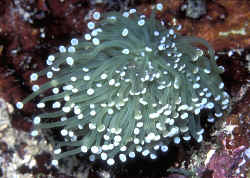
LPS Coral Help, Fungiid, lack of knowledge, fixing... 5/31/07 I'm fairly new to the saltwater community, but I've had a tank up and running for a couple of months now. I've wanted to do coral, and bought my first one yesterday. I got an LPS Plate Coral (pink tentacles and tips) from my local pet store. I got it home and did the typical tank acclimation before putting it in. It has a nice spot in the sand and near my spray bar from my sump. I'm a little worried because even this morning, it has yet to extend any of the tentacles or any sign of moment in the tank. <Fungiids... and most Scleractinia take a while (days to weeks) to settle in...> The closest thing to movement has been a whitish wispy material that has been extending from the coral. The top of the coral looks mostly blue and pink. The material seems to be growing in size and does seem to be attached to the plate still. I'm afraid that it may be damaged or dying, and I'm still pretty new at this and haven't had a lot of luck about finding help. <Easy to find... there are some very good sites, BB's, books...> I've tested the water , Nitrates were a 0. Ammonia was at 0.25 ppm (which I realize is not great), pH around 8.2 and normal alkalinity. Water temp is around 82. I have been adding trace elements, calcium and iodine to the water, thought I haven't regularly been adding calcium until now. <? Any, all of such you are adding need to be tested for... I would also record the dates, results... and study re interactions... They are antagonistic/synergistic in many cases...> Right now the only other tank mates are 2 Clownfish and a Coral Bonded Shrimp and a couple of turbo snails. It's only a 29 gallon aquarium, <Hard to keep such small systems optimized and stable...> with a 10 gallon wet/dry trickle sump using bioballs. I've got a CoralLife 50/50 florescent light geared towards reef tanks (I'm sure this is not the world's best lighting, <Mmm, no... and not useful for a Plate Coral (which needs to be set on the substrate) at this depth...> but at the moment, it's all I have). Do you have any suggestions on anything else I can/should do, or is my first coral experience likely to end badly? <Mmm, just apparently a bit reckless and uninformed... Please start reading here: http://www.wetwebmedia.com/marine/index.htm Try the "Corals..." heading, scroll down to Stony Corals, read re Fungiids, Systems... and the linked files there> Thank you, Rob Yull <Bob Fenner> Heliofungia actiniformis - Signed Death Warrant 6/1/06 Ladies and gentlemen of WWM the service you perform is spectacular. <Wowzah! High praise indeed!> I have what appears to be a huge problem with a Purple Plate Coral. The specimen that I received has either been epoxied or puttied to a piece of live rock. <!> The rock is situated in such a way that the tissue of the coral is not rubbing against it. Because of the delicate nature of the plate coral I am reluctant to try to remove it from the rock, but everything I have read, especially here, tells me that it is a goner! <Likely so. Not a sturdy aquarium species.> I can place the specimen in such a way that tissue is not touching any rock other than the piece it is mounted to. <This is best> Do you think I should try to dislodge it, or just try to make it as comfortable as possible until the end? <This latter> It seems to be eating. I feed it a blended mixture (to try to minimize the particle size) of DT's plankton and oyster eggs, Sweetwater zooplankton, and either mysis shrimp, SF's Reef Plankton every or some other meaty foods every other day. The coral puts out it's mucus web and traps the food and takes it in. What do you think I should do? Thanks Roy <Perhaps this specimen will dislodge itself... or reproduce through fission or via acanthocauli... For browsers, our coverage: http://wetwebmedia.com/fungiids2.htm Bob Fenner> Feathers and Fungia 11/22/05 Hi guys <Hey, Mike G with you tonight.> I was hoping you could help me with a few problems I'm experiencing. <Absolutely.> Firstly, I have a 47g reef with a Eheim 2026 pro II filter <I tend to look at (canister) filters on reef aquaria as more harm than good. Sediment, etc. gets trapped (as it should) in its media and contributes to a buildup of nitrates. They're so effective at this that they've been dubbed "nitrate factories" by reef aquarists. I'd remove it unless you have a really good reason not to.> an Aqua-C Remora running off a Maxi-Jet 1200 <Great skimmer.> 3 X Maxi-Jet 900s (1 with rotating head) <They come with those? And to think: all this time I've relied on PowerSweeps, the lowest of low submersible pumps, for a sweeping water motion.> a couple of 150W heaters and an Arcadia over tank Luminaire with 156 Watts of daylight and blue actinic (together with moonlights - all on timers). In the tank, I have about 30 Kilo live rock (on a buried DIY platform) and 3" of CaribSea Aragonite sand. <Sounds like a very nice setup.> As for live-stock, I have 2 very small Percula Clowns, 2 small Green Chromis, 1 small Andaman Damselfish and 1 small Royal Gramma <I'd say you're near maxxed out in terms of fish.> as well as about 12 dwarf hermits, about 25 mixed snails, 2 Peppermint Shrimps, 2 Feather Dusters, some Clove Polyps, Yellow Polyps and a Disc Coral. <Fungia?> The tank is only 3 or 4 months old though most parameters are fine - nil Ammonia, Nitrite, Phosphate and Organics. Nitrate <5 ppm, Temp 24 - 26C, PH about 8.1/8.2, SG 1.025, Oxygen 7 mg/l, and Carbonate Hardness high at 13 dKH, with Calcium low at 300 mg/l (I'm using a buffer but am going to have to consider using 2-part or Kalkwasser). <C-Balance works wonders.> Phew, now for the questions; firstly, my Feather Dusters seem to be receiving regular haircuts as their 'feathers' are being gradually shortened - any ideas who could be the culprit(s)? <Yes: themselves. Featherdusters will shed their crown when stressed or starving, the latter being the case most often. Home aquaria simply do not contain enough (or the right kind) of the food they require (and we don't even know what, specifically they require!). Phytoplankton (I like DT's) can help sustain them, but, unfortunately, most large featherdusters won't survive very long in home aquaria.> Secondly, the Disc Coral was placed on a rock yet seems to be slowly heading south - IYO would it be better placed on the substrate? <Absolutely. Fungia (if that is, indeed what you are referring to) are substrate-dwellers by nature. Could also be a condition with your lighting setup - 156w of Power Compacts is not too much light, especially when some of it is actinic. Try upping the lighting, moving to substrate, not necessarily in that order, and see how it does.> Next, I lost a Green Chromis which was rapidly devoured by the hermits, Shrimp and snails. <Totally, completely, normal.> However, they left the head and skeleton which has disappeared within the sand. Do you see any potential problems with it remaining there? <Nope.> Finally - and the biggie - I have always had a problem with heaters! I have gone through about 5 now (all at 150W and including digitally switched heaters) trying to find 1 that keeps the tank at the temperature indicated. During summer months the temperature remained pretty stable although I always had to set the heater at a very low indicated temperature to obtain the correct range. <Very strange, indeed.> Now that it's much colder however, I have had to turn the heater up, although the temperature indicated is still below the actual temperature and it fluctuates wildly! Would you suggest perhaps going for a 200W or 300W heater or maybe stick with the second heater I've installed (1 at each end) bearing in mind that the tank is already cramped with equipment? <I'd recommend you go with one larger heater of a different brand (this one does not seem too reliable).> Any help with these problems would make you the best thing since 'The Conscientious Marine Aquarist' <That honor goes to Bob.> many thanks, Steve Morse. <Best of luck. Mike G.> Long Tentacle Plate Feeding 11/27/04 I recently heard of a long tentacle plate coral eating a Coris Wrasse. Is this possible? Thanks for the reply. Sam Reef <I find this very unlikely. My understanding is that Gut studies of long tentacle plate corals show tiny plankton, not large prey. Hope this helps. AdamC.> Re: water change, Clown-Coral interaction Thanks for the response, I appreciate you taking the time to answer my question. Unfortunately, the precipitate made me nervous so I dumped the water and started over. I did the same procedure as before, but added 1/2 tsp buffer and the prescribed amount of pro buffer to bring pH to 8.4 and alk to 3.2meq/L. I don't currently have a calcium test (mine expired) so I don't have a reading there. One is on the way.... <Okay... very likely whichever brand synthetic mix you are using, the calcium will be fine.> You mentioned that it seemed a lot for my 65 gal tank, what about it seems like too much. Too many fish, or too many coral or both. What would you suggest, I really thought it was the right amount, but your advice would be appreciated. <Too many fishes... when they grow, there will be issues of inter-species antagonism, as well as pollution from food, wastes for your cnidarians> Another question, does the clownfish bother the plate coral? <Can, yes... some Clowns are so aggressive in their pairing with non-anemones that they do cause real damage> He seems to like it a lot and is always swimming in it, and bumping it on the sides and towards the bottom, just like he would an anemone. The plate coral seems to be affected by it, but not too negatively, but I am still not sure. It seems that the clownfish could injure some of the lower tentacles if he bumped them against the "plate" of the plate coral. What do you think? The LFS said it would be fine, but you know how that goes.... <I'd just keep an eye on these two> Thanks so much for your time! <Thank you for writing, your concern. Bob Fenner> Fungia dying? Hey there folks! Hope your weekend is less rainy and dreary than mine :) Actually I like the rain! << Great fall weather here. >> On to my question... I purchased 4 Fungia of various sizes and colors last week from one of the LFS's. << I wouldn't recommend adding so many corals at once. >> The largest is about 3.5" across, the smallest less than 2K (when 'deflated'). They all appeared fine; expanding/contracting with the day light cycles. Yesterday, however, the largest did not open all day and had a large strange bump or lesion of some sort. I watched it closely for more than 24 hours. While the other three opened/closed daily, this one did not. As well, the 'bump' started to darken: sort of greyish-brown. << Hmmm, not good. >> I was going to put it in my QT tank, but two things struck me as funny; it hadn't opened up in close to 36 hours and it had a distinct odor (almost putrid) that was immediately evident even in the brief second it was out of the water going into a transport container. << I'd keep it out of the display tank. >> So I assumed those facts in conjunction with the bump/lesion convinced me this one died yesterday sometime. My water tested as follows after removing the organism: amm/trite/trate: 0, PH: 8.4, Phos: 0.1, SG: 1.045, Ca: 450, Alk/DKH: 3.77/10.6, Temp low/hi: 79.4/80.6. Doing 10 changes/hr, big skimmer, adding ESV B-Ionic 2 part Ca/Alk daily and Mg. All my livestock, softs and LPS's show no signs of anything like the Fungia suffered. Do you guys think I did the right thing throwing that Fungia out on assumption of death? << I wouldn't throw it out. There are never dead. I would keep it in a QT tank, but not throw it out. >> I guess I was primarily concerned for the rest of my livestock . Thanks in advance for the amazing site and never-ending patience you guys appear to have :) -Jeff << Blundell >> Heliofungia care 10/05/04 Hi Anthony: <cheers, Greg> Hope all is well (and the various writing projects are coming along). <plugging away feverishly at times <G>> It's been a while since I needed to solicit your advice, but.... I have a beautiful Heliofungia actinoformis (bright green body with white-tipped brown tentacles) that has begun to look very odd. At least to me. <beautiful coral... but rather difficult to keep and extremely sensitive to damage and mishandling. They must be kept on fine (sugar-sized, oolitic) sand and favor deep mature sand beds (over 4" and over 1year old) to thrive if not survive! Never place them on rocks for any reason. They are also only satisfied by zooxanthellate symbiosis less than 80%... that means heavy feeding. Yet you cannot easily target feed them organismally (particles). Rather, they need nanoplankton which aquarists cannot readily supply... short of sand stirring of that deep mature DSB, etc. You begin to see the challenges of this coral and why many starve to death slowly in captivity after some months> I have had him on a soft sand bottom in my 110g reef tank (24" deep) for approximately a month. The tank has dual 250w MH 10K lighting and I have been feeding him fine foods two or three times a week. <all sounds good... although the lights may be a tad bright for this specimen> The problem is that he has begun to show mesenterial filaments from the base of about a dozen of his tentacles. It's as if he has a bunch of tiny holes in him. <perhaps some nibbling by a Centropyge or Zebrasoma in the tank? Common> If this had happened initially I would have though "mishandling." But it seems strange that this would show up after he has looked so good for a month. I know that's not long really, but the little "holes" are confusing me. Also, he is in light flow, so I don't think the current has caused the "injury." <Hmmm... you really do seem aware of its needs and have done the right things IMO> Any ideas would be greatly appreciated. As always, thank you and all the other volunteers for sharing your time and opinions. Certainly service to the greater good! Take care, Greg <I'm wondering if it isn't just finally showing signs of wear from the rigors or import. My advice here is to simply let it be. You are doing all the right things as far as I can tell. Best to leave the stressed beast rest quietly. Do look for possible nibblers in the meantime. kindly, Anthony> Heliofungia care II 10/05/04 Thanks for the response. I do have an Eibli in the tank, but he has been in with various species of Euphyllia, Nemenzophyllia, and Plerogyra and Physogyra for about six months <six months is hardly a track record, my friend... not safe yet <G>> and I have not had any problems with them or noticed him nipping at any of them (he is my personal fave...I'd hate to remove him without knowing he's the culprit). In your experience, do the Centropyge pick on Heliofungia more than other LPS? <they are in fact more prone to nipping corals than most other Centropyge... this is a strong candidate here> (Maybe he's mad I added something to "his" tank without proper consultation!!) As to the lights, I mounted them about 16" above the tank due to my love for the LPS, <ah, good> I hope this is high enough...that's the advice I got from various sources when I had the opportunity to pick up the lights on the cheap. <I agree with the distance... but doubt the savings on the initial purchase can compare to the expense of extra/unnecessary ongoing cost of operation> I bought the 250s because I am planning to set up a longer SPS tank in the near future and thought I could lower the lights to the proper height at that time and "strategically place" my LPS corals toward the edges of the tank so they would get bright indirect light. <yes... perhaps :)> Also, you gave me a thought. I have been feeding the Helio with zooplankton, but also with finely crushed Formula One. <both are likely too large... Cyclop-eeze might even be a little big, but very good if taken> It seems to eat both, but do you think that maybe the Formula One was too large and could have caused a massive outbreak of bacteria that has had a deleterious effect on him? <too large, yes> Just a thought. I have read several sources (including the BOCP, I believe) that said "finely shredded" ocean meats were appropriate for these corals. Anyway, what do you think? <true... very fine matter> Finally, the coral is definitely taking a turn for the worse. Everyday, fewer and fewer of his tentacles are coming out and he has started to get an abnormally thick mucus layer. <aieee! The mucus layer (if clear) is a feeding strategy! Please do not remove. Fungiids produce this daily... wait for bacteria and nanoplankton to stick to it... then suck it back in to digest it> I siphon this off, but do you think an iodine bath or other therapy might be appropriate at this point. <almost never... more harm than good (stress)> Or should I just leave him to his fate and continue "supportive therapy"? Thanks for the support. Good luck with the books. Take care, Greg <always welcome my friend> P.S., if this coral doesn't make it, I would like to try again (after an appropriate grieving period of course... reading and learning more than grieving, but still). Do you have any recommendations as to where/who has the appropriate knowledge/technique to supply well-handled, healthy specimens? <always/only local... never buy this one sight unseen> Or would your advice be to leave these guys in the ocean and break out the scuba gear? Thanks again. <there are definitely better Fungiids. DO check out Cycloseris species... some bright orange ones are imported. Anthony> Broken Polyphyllia 8/19/04 Aaaaahhh! I've had a rockslide! I feel terrible! I was sure my rocks were stable, but apparently I was wrong! <Happens to the best of us! Black plastic cable ties, underwater epoxy and plastic rods work wonders to help prevent this.> A fairly large rock that had a Montipora capricornis attached to it fell. The Monti broke, but only in two large pieces that I reattached. I'm pretty sure it'll be fine. <Agreed. These are very hardy animals. Many of my fragments have been created in such an accident!> My big emergency is that the rock fell right on top of a tongue coral (Polyphyllia sp.). It snapped in two. It was about four inches long, but now it's in two pieces that are three and two inches. (It broke diagonally.) I can't find any information on what to do for this poor little guy. Will both pieces die? What can I do? <I would give each piece a slightly better than 50/50 chance. Do be sure that the broken edges stay open to the water and don't get buried in the sand. I am personally not a fan of dips, etc. unless there is a specific reason.> Thank you so much for your assistance! Though this is my first catastrophe, I have found your site to be indispensable in researching potential tank inhabitants. Sincerely, Conni <Glad you have benefited from WWM and the crew. Good luck! AdamC.> Fragging Fungiids 8/11/04 Hi Mr. Calfo <cheers, my friend> I read today that people can frag a Fungia coral. <this is true... quite easy too by a number of different ways/means> I have one that is 9" across and it would be cool if I could frag it. I've only frags zoanthids and xenia and also my colt coral. Can you tell me how I can do this to my Fungia please. Thanks you, JJ <you can simply saw this animal in half (or in more pieces by pie shaped wedges following the ridges of the septa) with a Dremel. With good water flow, the pieces will heal in days to weeks, and growth to complete the "circle" will occur in mere months. These are hardy and wonderful corals to keep/work with. Please do take pictures if you do this and share them with us. Kindly, Anthony> Heliofungia long-tentacled plate coral Hi guys--Love this site. Trying to decide on above coral, offered by my LFS, for my 65 gal, 24" deep tank, 2X96watt 50/50 bulbs, 15 gal refuge, etc. Question: I have Trachyphyllia, xenia, some 'shrooms, bubble, finger leather, cabbage leather (one of each)--will Helio be compatible, should I place in sand or on LR, how far from Trachy should it be (also now in sand)?? Thanks for your anticipated response....Barry << I would read up on them in some different books to see what is recommended. For me, I prefer to keep them in lower water motion, but higher lighting. I personally wouldn't put one in a tank with two 96 watt pc.s. I would probably recommend them for halide users. If you do get one, I would put it close to the lights, on the rock work. Hope that helps. >> << Adam Blundell >> <Note: It is NOT typically recommended to put Fungia on rocks. Ideally, they should be placed on flat surfaces, on sand or crushed coral. Placing the Fungia on rocks to make up for insufficient lighting is not good long term practice. -Sara M.> Fungia illness? 6/2/04 I am concerned about my Fungia. I have had it for a month now, and it seems to be doing fine. <I do hope it is placed on a soft sandy bottom and not on rock (critical for long term success). Also, do feed it finely minced meaty foods of marine origin (Mysid shrimp, Pacifica plankton, etc) weekly or more often> A week or two ago I noticed a couple small brown and grey lumps around the mouth. Now they are bigger, have a rough appearance, are still brown and grey, and seem to be forming on the skeleton, not the tissue. I also noticed this afternoon that the tissue was retracted (tentacles in, tissue retracted) but I am not sure if this is being caused by the lumps. <tough to say without a pic. But in the worst case scenario of denuded "skeleton", still do not give up... Fungia are remarkably regenerative and may very well at least produce buds from the stripped skeleton> Also, just to let you know, I added CALXMAX by Warner Marine today. If you are not familiar with it part it forms these whitish clumps, and some stuck to my Fungia and he swallowed them (I saw no harm). <yikes! chemical burn is quite possible here. Fully dissolve all supplements in water outside of the tank before adding> I also have an over-curious peppermint shrimp, but I don't think he is pestering the Fungia. <Lysmata shrimp very commonly attack large polyped stony corals. Do not rule this shrimp out either. You will find many references to such shrimp attacking coral in our WWM archives and abroad on the Internet> Thanks, Andrew <best of luck, Anthony> Fungiids must be placed on sand bottom 5/21/04 Hi, <howdy> I have a 70 gallon corner tank with a hanging pendant which has a 250 watt 12,000k metal halide and two 36 watt actinic bulbs in it. I recently purchased a Fungia to go in my tank (I currently have some LPS and soft corals). When I brought it home I placed it on my sand bed at first. <very good... they must be placed on the sand bottom. They will die in time if placed on rock. Many possible reasons: abrasion from polyp cycles against rock, lack of DSB micronutrients, etc.> However, I have a yellow-headed Jawfish that is constantly moving my sand around, so I was considering moving the Fungia up about 4-5 inches on a flat piece of rock. <please don't. And no worries... Fungiids naturally shed this sand. They derive nutrition from it too> The rock itself is pretty flat with a few perforations. <no matter... the Fungiid will likely die on/from it in time> I just wanted your opinion about putting the Fungia on the rock. Accommodations can be made to keep it on the sand but I would like to have your opinion. Thanks! Andy <best regards, Anthony> Fraggin' Fungia! 4/1/04 (the action, not the expletive) hello, <howdy> I have a fairly hardy Fungia sp. specimen and I would like to know if it is possible to frag these creatures? <well documented yes in the popular hobby literature (magazines, message boards threads, books like my Book of Coral Propagation, etc)> If so, what is the best way to do so and are they hardy enough to withstand fragmenting? <yes, easily so. And many techniques for it... A Dremel with a stainless steel cutoff wheel following the septa to make pie shaped wedges works best/very well> thanks for you help <best of luck! Anthony> Baby Plate corals - anthocauli in Fungiids 2/17/04 [The "baby" corals of which you speak are anthocauli (buds) on Fungiid corals. It is a common misconception that many Fungia never recover after they seem to have died (become denuded of tissue). Most in fact will begin to decalcify and issue these daughter satellites after just a few months. Leave those skeletons in the tank! When the clones grow big enough in the ocean, wave action/erosion and boring organisms dissolve the stem under the new bud and it breaks away to become free-living like its parent. The parent then continues to produce new buds. We have an article on this subject here at wetwebmedia.com at: http://www.wetwebmedia.com/trachyreproart.htm best regards, Anthony Calfo> From Travis: Hi Alison, that sounds like you got a nice surprise after what must have been disappointing to see happen to your plate. From what I've heard, the babies will grow their own skeletons and detach on their own. If they're anything like their close cousins the Euphylliids, they will recognize each other as the same species and not sting each other. However, I'm going to forward this to the most knowledgeable and helpful group of folks I know, Bob Fenner and company at wetwebmedia.com They should be able to elaborate on this with more information and more expertise than I have to offer. Best of luck with your babies, and keep me posted! They are quite the beautiful corals, I have avoided them up until now because they are so easily damaged in transport, and rarely seem to recover. Travis Joanne Moore writes: > Hi Travis, I have a question for ya about plate corals. I have a long tentacled plate coral that recently died; however, it now has about 100 baby plates on it or " daughters." I know they are it's baby's because they each look like little plates, each having their own mouths and each being about the size of my pinky fingernail now. My question was, what happens when they get bigger, will they just walk off the parent plate or release into the water and attach somewhere else or what. I can't get anyone who knows anything about this. I love plates, but they are so toxic to the other corals if too close, so I worry about what will happen if they attach anywhere. I was also wondering, if I use a toothpick maybe that would work, because I have some reef friends and family who would like a few if I could get them off. Thanks for your time. Sincerely, Alison Moore of lake Stevens, Washington. Plate coral Hi, I have a 80 gallon eclipse tank with about 60-80 pounds of live rock and 40 pounds of coral substrate not a sand type of bottom. I also have 1 three stripe damsel, 1 yellow damsel, 1 Gregory damsel ,and a Clarki clown. Well I was wondering if I were able to put a plate coral into my system; however I only have 80 watts of illumination in blue and white spectrums. But, I do have the tank near a kitchen sliding door where natural light shines on the tank. not direct sunlight. Some websites say that the plate coral need a sandy bottom is this true, because I really don't want to go through the hassle of removing all of the substrate and replacing it. I also add some Kent liquid calcium daily for my live rock. Overall will this set up be sufficient enough to support these corals. If not is there an other sorts of corals or invertebrates that would survive in my situation. <I would stay away from most coral except maybe some mushrooms of polyps. You will need more lighting for most coral except the ones mentioned above. There is tons of info on this at www.wetwebmedia.com Cody> - Plate Coral Squirtin' Out Stuff - Hello, This is my 10th day with a plate coral. It was doing fine in the pet shop. After the third day in my house it has excreted out a white substance. <Maybe just poo?> The tentacles are often retracted, which I understand to be either unhappiness or a sign of sickness. Can you please help me understand what is going on? I have gone on the Internet, read referenced several books, consulted with various pet representatives. We do not have a good answer. <Well, a "plate coral" is usually one of two things; a Heliofungia or a Fungia. Heliofungia sp. have long tentacles and do very poorly in captivity, usually due to damage and subsequent infection. Fungia have short tentacles and are pretty bullet proof. Please identify this critter so I can give you a better answer; Aquarium Corals by Borneman or Corals: a quick reference guide by sprung are quick and easy references for an easy ID such as this. -Kevin> Thanks for your help. Jim Tongue corals 3/30/03 hello, I was wondering what the care is for a tongue coral, like the water flow, lighting, how often to feed them thanks jim <there are several genera called by this name. All need to be kept on the sand and fed weekly with fine meaty foods. Water flow should be moderate to strong random turbulent. Lighting depends on the depth of the tank and fixtures used. Please read through the articles in our archives at wetwebmedia.com for more info on reef lighting. Kind regards, Anthony> Heliofungia Plate Coral 3/6/03 Great site...very informative! <thanks kindly> I have a Fungia plate coral bought like a week ago. I have him in a 90 gal, w/live rock, and various fish. He is on the sandy bottom. He mainly opens up at night. I have 265wat power compact lighting with actinic too.....Why does he only open at night, <planktivorous... when plankton is out> and my main question is this.....When I 1st got him, his mouth was visible...now, there is a hole there, and bare coral skeleton is visible. <Yikes... a sign of severe stress. Perhaps light shock if you did not QT in subdued light first.> He seems to no longer be able to accept food, but is putting off very little mucus, and is still puffing up at night... <the latter being a good sign> Is it just a matter of time, or is he ok do u think...thx a lot guys Tim <its a little scary... gaping is often a rather bad sign. My advice though is to not move or stress this animal at all... it is likely very weak and will not tolerate a change well. Patience and diligence are required here. Do keep offering food in small amounts and give it time to acclimate. Be sure nothing is bothering it (another coral nearby... fishes, crabs in the tank, etc). Anthony> Fungiid problems - 2/24/03 I have had this plate coral for a few weeks now. the tentacles only come out at night and I keep getting a stringy discharge <Could be zooxanthellae bailout (bleaching event) or just passed food stuffs> all over the top here lately. also my main concern the edges are pink and they are turning white are clear on the edges is there something wrong or something I should be doing? <Check here: http://www.wetwebmedia.com/fungiidfaqs.htm and here: http://www.wetwebmedia.com/fungiidae.htm Be sure to feed this coral mysis shrimp and krill (frozen is fine) when there is polyp extension, and place this coral on the substrate. The feeding may help the potential bleaching that is occurring (the pink edges turning white)>water tests are fine. <OK> also I would kill for a good book if you know of any... <No need to kill. Know of a great many books...... I personally really enjoy and found most informative, Anthony Calfo's "Book on Coral Propagation Vol. 1" (which is why I am here) and I really enjoy Eric Borneman's' "Aquarium Corals". They can be found locally as well as online in many places. Another source of good information is to check reef boards as often as possible as well....much information to process there. Check the links above, leave the coral in the substrate and feed often. Water changes are in order here as well, in my experience. Good luck! Paul> Thanks Carlos Damaged Plate Coral 2/6/03 Hi guys, I added a Plate coral about 2 weeks ago. On occasion, his tentacles deflate while extended. I also noticed that his mouth is open wider than usual (picture attached) - I believe this is a sign of stress. <correct although it does not look too severe in this image> There is also a sandy looking something covering a small(3/4" x 1/4") section of the plate (pictures attached). I was wondering what this is, and if there is anything I can do. <a slight tear in the polyp and possible nuisance growth attacking the exposed septa> I already tried to siphon and blow the stuff off of him, but it won't move. <understood... still a good move on your part> Please also see the pic of my substrate. It is aragonite, but has some larger grains (pebbles) in it, I was wondering if this could be part of the problem, and if it could actually cause problems in as little as two weeks. <not too terrible. No larger though please for Fungiids> My lighting is 165 watts actinic and 165 watts 10,000K on a 90 gallon. Calcium is 360 Alk is 3.5 Ammonia, nitrite and nitrate are 0 pH 8.1 Salinity 1.024 Temp 74 All fine except pH if that's a day time reading... do get it up a little higher> Branching Frogspawn is doing fine (my only other coral). <my guess if that your coral was acquired with a little bit of damage (common on fresh imports). It will likely heal or become fatally infected within mere weeks. Just keep up with good water quality, good water flow (random turbulent) and occasional feedings with fine food> Thanks again, you guys are great, Adam Karp <thanks kindly, Anthony> Asexual Planulation in Fungia Anthony, I thanks for the reply. About that Fungia coral I was telling you about, well guess what... I found a baby Fungia in my tank just yesterday! <Outstanding!> I'm pretty excited to say the least. Yes I took plenty pics. The baby Fungia polyp was actually on top of one of my green open brain corals. <do see if you can remove it promptly. Attached or no?> I don't know if it was trying to attach there or what, but I got him isolated in one of those hang-on-in-tank deals. <Aha..> I put a little chunk of rock in there in case he wants to attach, >no need... it is a free-living coral. Some planulated specimens live attached briefly. Yours is already out of the nest so to speak. Do keep it on sand> but I don't know if they are free living as a juvenile or what. Anything you could recommend to me to keep this guy alive and not become fish food would be great. <occasional feedings would help a lot. Several times weekly with fresh hatched baby brine shrimp would be great. Frozen if you must (baby brine only... not adult). Even better would be frozen Cyclop-Eeze if you can get your hands on it> I kind of don't know what to do with it , very tiny ya know...thanks , <no worries... it will be fine. Kudos to you for the good husbandry. Please do share some pictures when you can. Hi-res digital or scans if you can.> Steelers did indeed play nobly this weekend. <Thanks kindly for saying so :) It was a fine game to watch. Very sporting. Best regards, Anthony> Fungia and carbon question hey crew, hope all is well with you guys. <Howdy!> I have a Fungia coral, it is on the bottom of my 90 gal. reef tank, the other day it was going through these contractions and expelling a reddish, brownish stuff. Tried to take pictures, we'll see if they turn out. <awesome... please do share them with us> Anywho... I'm hopping it was either digested food or going through reproduction and not expelling its zooxanthellae. <easy to tell... digestion is most likely if you have been feeding this very hungry coral 3-5 times weekly or better. Else, little or no food on the bottom of a 24" tank is not a good situation for this weakly zooxanthellate coral. By some estimates, about 30% of its diet cannot be met daily by even the best lighting> My water quality is great and all others are doing well. The Fungia is doing well also--looks great, its eating minced seafood and swells up at night and moves around a little bit, so I would venture to say what ever it was doing was not a bad thing. <agreed... all sounds good> Maybe an opinion of yours would be great. <OK... I think the Pittsburgh Steelers had a fine season all told and they played hard and nobly this past weekend. Kudos to the coach, Tommy Maddox and my favorite- Heinz Ward... Hard working athletes <G>> Also for my 90 gal. reef I'm wondering how much carbon per gallon should I have placed in my sump and how much should I change weekly. thanks a bunch as always gentlemen..... I would use 2-4 ounces of carbon weekly to start with. See if that is enough to keep all discolorants out of the water (look for yellow in a glass of aquarium water against bright white paper). Add more if necessary. Best regards, Anthony> Algae eating Fungia? Hi Anthony, I have a Fungia I recently purchased, I don't know the species. I can give a vague description, wish the damned camera worked. Here goes: shag green carpet color, and speaking of shag...it's feeding polyps are about 1/2" long, it's fleshy mantle extends appx 1/3" over the edge of it's skeleton, it has a purple mouth. in shape, the fleshy mantle somewhat resembles the common heart symbol, only slightly flattened. Here's the interesting part, it ignores meaty food, but put a piece of wakame on it, and it goes to town. I've watched it ignore fish, shrimp, and squid, but like I said, put a piece of wakame on it, and it sucks it down like nobody's business. Thought you might like to know, Mike <Dude... thanks for sharing. To be certain... were the meaty foods extremely small (minced)? Particle size is everything with all types of planktivores. True- some Fungia can and will take large chunks of food... but they are rare. Do consider that the largest zooplankton this coral is ever likely to see on a reef is an amphipod... and not many of them. Most zooplankton is smaller and like most anemones, Fungia can reject large chunks of food. My thought/suspicion on the matter. Actually... I'm quite certain of it: form follows function. Large stinging aspects the 1/2 tentacles, etc) evolve for a reason... and its not for catching microscopic phyto. Sheets of algae do not drift nightly on a reef, but a bazillion zooplankters do come out like clockwork :)Ciao, bub. Anthony> Tank With Problems? (Cont'd) A Fungia isn't expanding as much as he was and seems to be white around the mouth (while writing this just after moving him he doesn't seem as white around his mouth but hasn't expanded more!). He was shedding mucus earlier and I moved him to a better current. Does this sound like the problem with him? >> <Well, Fungiids will eat a wide variety of foods, and in nature they tend to cast a mucous net in order to capture food. This could be a simply a normal behaviour of a hungry specimen. On the other hand, excessive mucous shedding could be a sign of injury or stress. I am assuming that this specimen is located on the sand? Fungiids should always be placed on soft sand substrates, not on the rocks, where they are susceptible to injury. You probably already know this, but I just thought I'd bring it up as another possibility..> Yes he's on coral gravel. I don't think the mucus is excessive, but I wouldn't know. When I added some food his tentacles didn't expand if he is hungry. But with no light (when he expanded most at first) he still looks deeper purple and this includes inside his mouth which seems white in the daytime but pink at night. <I've seen this color "change" before; I believe that it's a normal reaction to the lighting.> The Trochus, Physogyra and all the macroalgae seem to be ok, and the tests do say the water is ok. <Phosphate as well, yes?> I don't know. I asked for it checked for all that mattered. Phosphate wasn't mentioned, just nitrate, alkalinity, calcium, magnesium and iodine. I have the first three test kits myself but for some reason despite exactly following what he does, I get several times the nitrate reading with the same brand of nitrate test kit. I thought it was 50 but its actually less than 10.. <Well, these corals can certainly tolerate, even thrive, in those conditions. I mentioned phosphate because studies have shown that high levels of phosphate can impede calcification...and both the Fungiids and Penicillus utilize calcium...> The Penicillus though, is now a stump but started losing green colour and stiffness before). I know Penicillus grows in sand but I have coral gravel. Does this matter? <I've seen it grow in crushed coral. Sand is better, but the crushed coral should be okay, as long as other conditions are acceptable to the algae> Are there any special conditions? I use hw Marinemix and don't use additives since calcium and hardness were raised to acceptable and the iodine came back as saturated. <I believe that the conditions that you're providing are fine for this species...I'd give it some time to make a "comeback"> If my aquarium is a 23 UK gallon then could I add a Kole tang to clear the Cyanobacteria if it returns? I know it seems a bit small. <Yep- I think that the tank is too small for a tang. Besides, tangs tend not to eat Cyanobacteria, in my experience. Koles do a nice job on diatoms, both in the sand and on the rocks/glass, however.> I've never had diatoms. <That's great!> Alternatively is three Fluval + 2 internal filters enough water movement for this size of tank if I keep Physogyra and Fungia? <Yes- these should be fine for these species. Remember, you don't want too much current on the Physogyra, as they can be damaged in a direct, high current situation. > The water flow seems biased to the top, could this be why Cyanobacteria was growing along the bottom (but also on taxifolia)? <Excellent observation, and quite correct, IMO. Among other things, lack of circulation is a contributing factor to a thriving Cyanobacteria population!> Im really worried now about what might be wrong. <I'd keep an eye on all water conditions in this tank, maintain a good maintenance protocol (i.e.; regular water changes, protein skimming and skimmer maintenance, etc.>, and consistent environmental conditions...look beyond the obvious if you are seeing continuous decline of your animals. With patient attention to water quality, you should see your animals improve steadily.> There's just my Fungia seems less healthy now and he seems to be streaming for food. I've been feeding him every couple or three days - perhaps I should feed him more? <If the specimen is demonstrating this behaviour, you certainly could try feeding a bit more, although these corals are not particularly demanding about feeding...Keep up the observing and learning. It really sounds to me like you've got a good handle on things. Regards, Scott F> Coral placement (Plate Anemone Coral) Hello, I have a Heliofungia actiniformis placed about 8 inches below a Euphyllia ancora. Both apparently healthy with skeletal growth and extension. <hmmm... is the Helio on the sand bottom... must be to survive long term. They are free-living corals and will suffer if kept on rock and likely die within a year or so> Lately the Helio. Has extended its tentacles towards the Euphyllia (only towards this coral, all other tentacles remain similar previous length). Is it "targeting" the Euphyllia? <indeed... quite possibly modified sweeper tentacles in defense of the very aggressive (tentacles and allelopathic secretions) ancora Hammer coral> If so, do you have any personal experience with placement of these species you could share? Best, Michael <popular thinking is 6-10" for non-aggressive species, 10"+ for aggressive. Be sure to feed both (especially the Euphyllia) very very fine minced meaty foods 3-5 times weekly for long term success. Best regards, Anthony> Bubble coral feeding question / Fungia question, too I have a bubble coral that used to put out what I thought were feeding tentacles almost every night after the lights went out, <and they were most likely... bubbles retract and tentacles/vesicles come out at night> and I was feeding it small bits of cocktail shrimp 2-3x/week. Recently, however, it just shrivels up to almost nothing every night. <increase in water flow will do it> It seems fine during the day, maybe not inflating quite as much, but basically fine and sometimes accepts food in the daytime. <they can feed anytime they sense food in the water. Do add a small bit if meaty juice 15 minutes prior to target feeding to get tentacles out> No change in h2o quality: temp=80, SG=1025.5, Ca=460, alk=9.3, pH=8.4, no3=about 2, no2=0, po4=almost 0(need a new test kit I think). <all sounds fine... Ca is getting a little bit scary high... its fine now but don't push higher for ear of precipitating Alk> Every week I add one tsp each of Kent's Tech-I, CoralVite, and Essential Elements/ oh, it's a 46 gallon, Does this sound like a problem or a normal variation? <not normal... they feed heavily and daily for survival> Should I keep feeding it during the day, if it doesn't put out the feeder tentacles at night? <no problem at all... please do if you prefer> Now, I'm feeding it much less often, maybe once very 7-10 days. <Yikes! Your bubble will last maybe 2 years this way before starving to death. several times weekly for maintenance. Daily feeding for growth> Other corals all doing fine except a Fungia who never puts out any tentacles any more (for many months); I was sure it was dying, but it, too, still accepts tiny bits of shrimp if I put them right by it's mouth. <Fungia is one of the hardiest corals... but also one of the hungriest. Under "perfect" lights it can still only get less than 80% of its daily food/carbon from photosynthesis... the rest comes from food. This coral needs to be fed almost daily. If so, it will grow and reproduce wonderfully and live for many years> I'd appreciate any ideas. Thanks in advance! <best regards, my friend. Anthony> Bubble coral feeding question/Fungia question, too Thanks, Anthony, but when you say "increased water flow will do it", do you mean cause it to shrivel up or to open up? <exactly... they are easily inhibited by direct/laminar water flow in excess> In any case the water flow situation hasn't changed at all since I've had it, but its behavior has changed dramatically, so I'm still puzzled, but will resume more frequent feedings of the bubble and the Fungia. <very good> The LFS where I bought the Fungia thought I could be overfeeding it, and therefore causing it to not "need" to extend its tentacles! <wow... that is ridiculous. Not likely or possible. Do feed small amounts daily for optimum care> Sound like you're advising daily/almost daily feedings for both, yes? thanks, again. <exactly. Most corals do not need such feedings... but LPS as a rule do and these two are documented to need it in particular. Best regards, Anthony> Heliofungia Actiniformis: Plate Coral on Rock: never Buenos dias. <greetings my friend!> I have a plate coral that is in trouble due to an accident. I recently purchased it and it was doing great for the first couple of days. Then I injured it by dropping the top of it against the glass while moving it. It has not opened up fully for about a week now and it is deteriorating. <alas... do keep it on the sand bottom with moderate to strong water movement on the edges. Siphon away decay as necessary. Add iodine as per mfg suggested dose if you do not already. Remove if decay seems rapid (to QT tank hopefully)> It is pulling back from the edges and I can see the skeleton in the middle too. <it may recover in time> I tried moving it closer to the MH and higher current for a few days but that didn't help. <yikes! Not possible, my friend. First of all... moving a stressed or damaged coral to brighter light is very stressful and sometimes fatal. Lower light and increased feeding is always better. Furthermore... Heliofungia can never be placed on rock. That will sign its death certificate. They only occur on sift sand in the wild and will suffer from abraded tissue with polyp cycles on rock. Always keep on soft sand. Feed this species 3-5 times weekly minimum too with very finely minced meaty foods> I now have it in my refugium under low lighting and moderate current. <OK... and perhaps stronger current would be better> While transferring it I noticed the bottom of it has a reddish spot covering about half of the underside. Is there anything I can do to save this coral? My water chemistry is good. Temp fluctuates between 77.5 and 78.5. Lighting in tank is 3x 150 watt HQI MH (tank is 24 " deep). <all water quality is fine, my friend... keep up the good work!> By the way, did Mr. Fenner go to Mexico for the aquaculture conference? I translated some documents for him and was just curious if he got them back. It was a while ago. Thanks. <Gerardo... we thank you so much for your help with the translations. Alas, the trip fell through. The organizers must have had some trouble. They did not answer any of our requests for travel and contact information and did not try to contact us by phone for travel arrangements until 2 days before the event. By that point we assumed the event was long since canceled and made other plans in our schedules. It is unfortunate... we were really looking forward to seeing that beautiful city in Mexico. But again, we thank you for your help in trying to contact the committee.> Gerardo Gomez <with kind regards, Anthony> Re: Heliofungia Actiniformis, Dilution is the Solution to Pollution: High ALK I will try what you suggested to revive the plate coral. I mentioned my water chemistry was good but I hadn't checked my calcium hardness and it is WAY too high. I have checked it twice and it is reading over 20dKH with a LaMotte kit (it actually reads it as CaCO3 at 4515 ppm). <YIKES!> My pH is steady at 8.2 and Alkalinity is 2.75 meq/L. I have a calcium reactor hooked up filled with Korallith and water flowing through it but I have yet to connect the C02 tank. When I originally filled the tank I overdosed on Seachem's Marine buffer to the point that a precipitate formed all over everything (I am still trying to remove it). <ahhh, yes... I see> I did a water change but have been adding Marine Buffer to replacement water (RODI) to bring pH to same level. <agreed... but do aerate before any buffer or salt> Any suggestions on what I should do next? <indeed... a string of large water changes. As they say, "Dilution is the Solution to Pollution."> Sorry to hear the trip to Mexico fell through. It sounded like it would have been interesting. <yes... I was dreadfully sorry to miss it. We were so surprised to get a call 2 days before the event!> Thank you again. Regards, Gerardo <my pleasure, Anthony> Plate coral I recently bought a plate coral from my LFS. 4 days into him being in my tank, it is "melting" on one side and it's white "skeleton" is extruding. all I'm really asking is if it's dead? <indeed suffering from damage that could be fatal... maintain good to strong water movement around the coral. Skim well and siphon loose necrotic tissue when possible. The coral may stabilize and heal in time... death is unmistakable and fast... tissue rots away within a few days to leave a denuded corallum ("skeleton"). These corals (Heliofungia) suffer damage easily on import. A common cause of death after import is the keeping of this species on rock. Heliofungia must always be kept on soft sand... placement on rock will cause a tear or abrasion in soft tissue with regular polyp cycles that can lead to infection and death> I brought it out of the water to smell it but it didn't have a fowl smell to it. thanks, Jason <if the coral survives... be sure to feed this animal very finely minced food weekly. See here http://www.wetwebmedia.com/fdreefinverts.htm Best regards, Anthony> Re: plate coral I've read your FAQs and I do not have it
on rock, although I know this is a bad thing, I do have it on crushed
coral. That's the only substrate I have. <ahhh... yes. In the
long run this will/would be too coarse for Heliofungia to live on.
Finer sand is a must else tissue is easily abraded from polyps
cycles> I read about a type of plate coral that if it dies you
can leave the skeleton in the tank and it will still daughter polyps
after a couple of months of just sitting in the tank. <yes...
anthocauli produced in Fungiids. Not yet reported in your Heliofungia
although seems possible> <=can't recall exactly what I read.)
If this does in fact die, would you suggest doing this? <in a
separate aquarium/QT tank perhaps... not here though> I'm kind
of worried that it will raise my ammonia level? (but I may be wrong).
<agreed> -Jason |
|

|
Features: |
|
| Featured Sponsors: |