 |
|
| Home | Marine Aquariums |
Freshwater Aquariums |
Planted Aquariums |
Brackish Systems |
Ponds,
lakes & fountains |
Turtles & Amphibians |
Aquatic Business |
Aquatic Science |
Ask the WWM Crew a Question |
| Please visit our Sponsors | ||||
Fungiid Compatibility
4/5/10
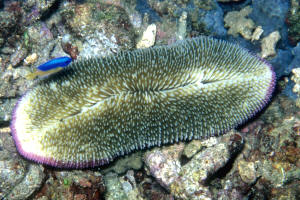
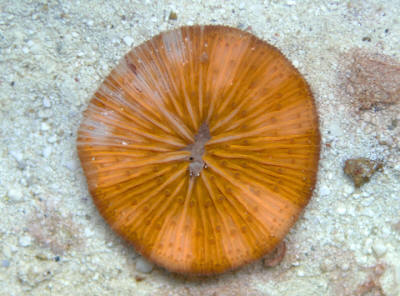
Plate Coral placement and feather duster 3/21/07 Hope you are doing well! <Quite! And wish you the same!> I have a question about my plate coral. I have had this coral in my 55gal. tank for well over 6 months, and it seems to be doing great. It has grown some, eats like crazy, and inflates greatly during the day, almost doubling in size with tentacles extending to an inch or so. Inflated, I would say that this coral is about 5-6in. in diameter and looks most like the Fungia fungites specimen pictured on the following link, with the pink outer rim and maybe a little more greenish tint: http://www.wetwebmedia.com/fungiidae.htm http://www.wetwebmedia.com/fungiidae.htm Mine also seems a little "meatier" during the day, with longer tentacles. My first question is about how big do these corals generally get in an aquarium? <Depends, can get pretty big.> I try to do plenty of research before buying my corals, but I haven't been able to find their maximum size. Secondly, when my coral is fully inflated, it is somewhat scrunched up against a rock and also pressed against the side of the glass. So I am curious if I should manually move the coral, when it is deflated of course? I know that these corals often move themselves, so I am reluctant to move it due to the fact that if they can move and it is unhappy, wouldn't it just move itself? To me it appears "happy" just a little scrunched during the day. <Yes, leave it be.> Finally, I have a couple places I can move this coral, one being next to my giant feather duster and a candy cane coral. Can the tentacles of my plate coral damage the FD or the stalk of the candy cane? <I would not place here... irritants> Any suggestions and guidance is greatly appreciated as always! <I wouldn't disturb, is happy, don't mess up a good thing.> Thank you in advance for your help and a wonderful website!!! <Welcome and thank you for your kind words. -Mich> Nick Nips on Crocea Clam and Plate Coral 7/25/06 I have a small crocea clam and a short tentacle plate coral (Fungia fungites) that recently have been getting half-circle shaped nips, about 2mm wide. They occur at night, and usually there are just 2-3 nips on each. The nips are on the edges of the clam mantle, and on the tops of the ridges on the plate coral. Both the clam and the plate coral have been in the tank for about 9 months, and have been healthy and growing, and thus far, regrow the nipped areas very quickly. I have not added any new live rock or coral in at least 6 months, so I doubt I have a new hitch-hiker. <Perhaps an old, getting-larger, hungrier one...> Fish - Ocellaris Clown, Chalk Basslet, Longnose Hawkfish, Horned Blenny (Parablennius spp.), and a Hawaiian Fourline Wrasse (Pseudocheilinus tetrataenia). <These last two might be the culprit here> Invertebrates - Sally Lightfoot Crab (Percnon gibbesi), (2) small blue-legged hermits (Clibanarius tricolor) and a larger zebra hermit (Calcinus laevimanus), Margarite snails (Margarites pupillus), Nassarius snails. <Mmm, note, genera are capitalized... I'll do this for you before posting> I never see any of these animals on, or hanging around the clam or plate coral. All of the fish & invertebrates have been in the tank for 1 year+, except the blenny and the basslet. The crab & the blenny are at the tops of my suspect list, but I don't know how to verify this. Any suggestions? <Well... the Percnon is "nippy", but doesn't leave crescent bite marks... I suspect one of the mentioned fishes... number one suspect the blenny... Could remove to elsewhere and see if the bite marks cease... Bob Fenner> Steve Re: Nips on Crocea Clam and Plate Coral 7/25/06 Would it be normal for any of these suspects to show absolutely no interest in the clam or plate coral during the day, and then munch on them at night? <<Lisa here. Yes, that is quite possible.>> Coral placement (Plate Anemone Coral) Hello, I have a Heliofungia actiniformis placed about 8 inches below a Euphyllia ancora. Both apparently healthy with skeletal growth and extension. <hmmm... is the Helio on the sand bottom... must be to survive long term. They are free-living corals and will suffer if kept on rock and likely die within a year or so> Lately the Helio. Has extended its tentacles towards the Euphyllia (only towards this coral, all other tentacles remain similar previous length). Is it "targeting" the Euphyllia? <indeed... quite possibly modified sweeper tentacles in defense of the very aggressive (tentacles and allelopathic secretions) ancora Hammer coral> If so, do you have any personal experience with placement of these species you could share? Best, Michael <popular thinking is 6-10" for non-aggressive species, 10"+ for aggressive. Be sure to feed both (especially the Euphyllia) very very fine minced meaty foods 3-5 times weekly for long term success. Best regards, Anthony> - Plate Coral Squirtin' Out Stuff - Hello, This is my 10th day with a plate coral. It was doing fine in the pet shop. After the third day in my house it has excreted out a white substance. <Maybe just poo?> The tentacles are often retracted, which I understand to be either unhappiness or a sign of sickness. Can you please help me understand what is going on? I have gone on the Internet, read referenced several books, consulted with various pet representatives. We do not have a good answer. <Well, a "plate coral" is usually one of two things; a Heliofungia or a Fungia. Heliofungia sp. have long tentacles and do very poorly in captivity, usually due to damage and subsequent infection. Fungia have short tentacles and are pretty bullet proof. Please identify this critter so I can give you a better answer; Aquarium Corals by Borneman or Corals: a quick reference guide by sprung are quick and easy references for an easy ID such as this. -Kevin> Thanks for your help. Jim Re: water change, Clown-Coral interaction Thanks for the response, I appreciate you taking the time to answer my question. Unfortunately, the precipitate made me nervous so I dumped the water and started over. I did the same procedure as before, but added 1/2 tsp buffer and the prescribed amount of pro buffer to bring pH to 8.4 and alk to 3.2meq/L. I don't currently have a calcium test (mine expired) so I don't have a reading there. One is on the way.... <Okay... very likely whichever brand synthetic mix you are using, the calcium will be fine.> You mentioned that it seemed a lot for my 65 gal tank, what about it seems like too much. Too many fish, or too many coral or both. What would you suggest, I really thought it was the right amount, but your advice would be appreciated. <Too many fishes... when they grow, there will be issues of inter-species antagonism, as well as pollution from food, wastes for your cnidarians> Another question, does the clownfish bother the plate coral? <Can, yes... some Clowns are so aggressive in their pairing with non-anemones that they do cause real damage> He seems to like it a lot and is always swimming in it, and bumping it on the sides and towards the bottom, just like he would an anemone. The plate coral seems to be affected by it, but not too negatively, but I am still not sure. It seems that the clownfish could injure some of the lower tentacles if he bumped them against the "plate" of the plate coral. What do you think? The LFS said it would be fine, but you know how that goes.... <I'd just keep an eye on these two> Thanks so much for your time! <Thank you for writing, your concern. Bob Fenner> |
|

|
Features: |
|
| Featured Sponsors: |