|
FAQs about Fungiid Coral Health/Disease
1
FAQs on Fungiid Disease:
Fungiid Disease 1, Fungiid Disease 2, Fungiid Disease 3, Fungiid Disease 4, Fungiid Health 5,
Fungiid Health 6, Fungiid Health 7, Fungiid Health
FAQs on Fungiid Disease by Category:
Diagnosing,
Environmental (Pollution/Poisoning,
Lighting...), Nutritional,
Social (Allelopathy),
Trauma,
Pathogenic (Infectious, Parasitic, Viral)
Predatory/Pest, Treatments
Related Articles: Coral Pests and Disease; pests, predators,
diseases and conditions by Sara Mavinkurve, Fungiid Corals,
FAQs on Stony Coral Disease: Stony Coral Disease 1, Stony Coral Disease 2, Stony Coral Disease 3, Stony Coral Disease 4, Stony Coral Disease 5, Stony Coral Disease 6, Stony Coral Disease 7, Stony Coral Disease 8, Stony Coral Disease 9, Stony Coral Disease 10, Stony Coral Disease 11, Stony Coral Disease
12, Stony Coral Disease 13,
Stony Coral Disease 14,
Stony Coral Disease 15, Stony Coral
Disease ,
FAQs on Stony Coral Disease by Category: Diagnosing:
Environmental (Pollution/Poisoning, Lighting...),
Nutritional, Social (Allelopathy),
Trauma,
Pathogenic (Infectious, Parasitic, Viral)
Predatory/Pest,
Treatments
FAQs on Stony Coral Disease by Family: Acroporid Disease, Acroporid Disease 2, Acroporid Disease 3, Acroporid Disease 4..., Caryophyllid Disease, Caryophyllid Disease 2..., Elegance Coral Disease/Pests, Dendrophylliid Disease, Faviid Disease, Faviid Disease 2,
Mussid Disease, Mussid Health 2, Poritid Health, Trachyphylliid Disease, Trachyphyllia Disease 2,
FAQs on Stony Coral Disease by Type: Brown Jelly Disease, RTN,
|
|
Plate coral injury - 05/16/2006 Hello, I found
your site on Google and ready many of the articles on plate corals
(very useful for future reference, bookmarked it) but still haven't
found an answer to this: We bought a plate coral yesterday and after
acclimating it we put it into out 24 gal Nano, <Fungiids are not
easily kept in small volumes... too unstable> along with a small
frogspawn, 2 true Percs, a 6-line wrasse, 4 hermits, 1 fire shrimp and
three snails. The coral was damaged on one edge (seemed like the tissue
was bumped during transport) and the tissue around this area looked
dead. <Not good> The rest of the plate inflated, looked great and
full and the Percs took right to 'hosting' in it. The wrasse,
the two larger hermits and the shrimp, however, began to pick at the
dead area and now (24 hours later) that area has been picked clean of
dead tissue (and some live tissue as well I think), <... you need to
remove one group or the other here... the predators or prey...> all
the way down to the white skeleton. The damage was made worse by the
hermits crawling across it and dragging their shells on the healthy
areas as they picked at the edge of the 'tear'. So my question
is a two-parter: will the coral recover from this, and if so, <Not
likely if not moved> once it does will the offending creatures leave
it be? <... not likely> I have placed a 4" high plastic ring
around the coral (still on the sand) to keep the crabs and shrimp off
of it, <Good technique, move> this is as unsightly as it sounds
and I'm also hoping you have a better suggestion to keep it safe
while it (hopefully) heals. The damaged area is about 1/10 of the
total, like a piece of pie was cut off of the coral, all the way to the
center. Thanks a lot. Alex Miller Carrboro, NC P.S. Chemistry is all
good, frogspawn doing great as are all the other animals. <Mmm,
well... most Fungiids have a dismal captive survival rate... and yours
starting off damaged, predated, in such a small system... I'm
inclined to encourage you to return it (if possible) or trade it in.
Bob Fenner>
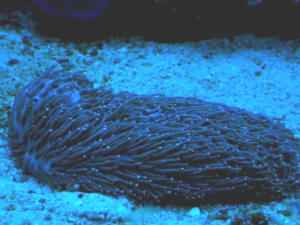
Heliofungia actiniformis - 01/01/2006 Hi,
<Evenin' Lloyd.> I've read through the website &
FAQs, but was hoping for a prognosis on one of my corals. Picture
is attached. <Ok.> I have had a Heliofungia plate in my tank
for about 6 weeks. For the first few weeks it was ok, then it had a
couple of incidents when it inflated like a balloon. Then it
excreted a lot of white mucus and little by little all the polyps
shriveled away until now only the mouth is left. <Any other
corals nearby?> What is weird is that the vertical coral
'fins' appear to have advanced into the center at the same
time, but maybe they are just more apparent now that all the polyps
are gone. <Yep.> Recently it looks like algae has started
growing on the fins. Is it dead? <Afraid so.> Is there
anything you can suggest to revive it? <No. They are very
capable of regeneration, but I think this one is too far gone.>
I don't really want to try this again until I have a plausible
theory for what went wrong. It is possible that the brine shrimp
type food was wrong based on what I have subsequently read.
<Yes, also much else that could've caused this.> Facts
& Figures: Approx 6 month old tank. Plate is on sand at the
bottom of a 280g tank, 26" from the surface. Lighting is
4x175W 5500 MH with PC fluorescents. Lots of light but a deep tank.
Approx 100 lbs of Fiji live rock. All the water chemistry is ok,
except nitrates showing 20ppm, and Ca is only 340ppm. Am still
researching Ca alternatives based on the advice from your website.
Thanks in advance for any suggestions you can make. I am something
of a novice at this. <Well, it seems like you're on point
with your thoughts (water quality that needs correcting, diet).
Make sure not to place these in high flow areas and away from other
corals. Other than that, just research more on this before a second
try.> Regards,
Lloyd Spencer.
<Better luck next time. - Josh> |
|
|
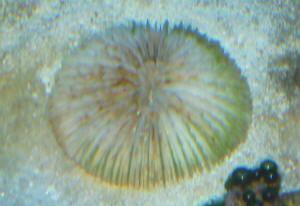
| Tongue Coral with "tumor"-like swelling
8.24.05 Hi, and thank you for all the help I have already
gotten from reading your site. I have a question about a
tongue coral, and have not been able to find information on your
site, other sites, from other local reefers, or fish stores. My
Tank: *75 Gallon *40 gallon refugium * live sand * 75 pounds of
GARF Aragocrete arches seeded with 25 pounds of GARF grunge *
Ammonia/nitrite- 0 * nitrate-5 *alkalinity- 4.5 *pH 8.3
*calcium 420. The coral: *Tongue coral (Polyphyllia) *Has been in
tank for about 4 months) *In the last few weeks has developed what
looks like a tumor on it's left side * When the clown fish bump
it, it jiggles, like it's full of liquid. * tongue has been
behaving the same as always I have attached a picture. I
took it this morning with only the actinics on because it is easier
to see when it's not fully expanded. I find this to be such a
strangely interesting coral, I am not sure if this is something
strange that they do and I have not seen, or if it has a
problem. Any information would be greatly
appreciated! Thank you <The symptom appears to be a sort of
polyp bailout... often caused by stress or damage (could be
excessive water flow on that side, the coral got bumped/mishandled,
light shock with new lights or sudden use of carbon after an absent
period, etc.). Regardless, with good water quality and regular
feeding (you do know that this coral like most Fungiids needs fed
weekly if not more often... else they will starve slowly) the coral
will resume normal behavior. In fact, its not uncommon for the
whole coral to swell up (often at night) as a natural mucus feeding
strategy. Anthony> |
|
|
|
Re: Tongue coral with bubble/"tumor" 8.25.05
Anthony, Thank you for your speedy response. Nothing
has changed in my tank, and the tongue has not been disturbed (at least
to my knowledge). Do you think that perhaps my clowns
hosting in it are bothering it? (they go back and forth from my tongue
and toadstool leather). <Yes... indeed. This is an
unnaturally repetitive irritation and could easily stimulate polyp
ejection on a stony coral. We have seen this cause and effect with
clowns in Goniopora, Euphylliids, etc.> No new lights, although we
did add carbon after having none for a few weeks, but that was a while
ago, would the effects be instant? Never fear about
this coral getting fed. I do daily spot feedings to my
Tubastraea, Swiftia, and electric flame scallop, and the tongue (along
with my torch, brain etc) is fed every few days directly.
<Excellent to hear! Kudos to you :)> I have noticed that one side
of the tongue has slowly been moving closer to the glass, perhaps it is
unhappy with the current somehow (it has been in this spot the whole
time). <Nope... not necessarily. It is
simply a motile Family (Fungiidae)> I'll move it up a bit, and
keep an eye. Our water quality is great, so I am not
concerned about that. Thank you again. You guys and gals
rock! Sara <best of luck/life. Anthony>
|
| Plate coral trouble... ID, health bad news 7/12/05 Hello
crew, I hope that you can help me identify this coral as either
Heliofungia or simply a Fungia. It is seven inches wide, 18 inches
from 356 watts of VHO lighting, resting on the sandbed. It seems
that a turbo snail or possibly even a blue legged hermit crab has
ripped a hole in him. I have given him an iodine dip and tried
feeding him DT's live phytoplankton and minced shrimp and
scallops. Its mucus has caught the food up, but has yet to swallow
it. Any help is appreciated. Thanks. <Take a look: http://www.wetwebmedia.com/fungiidae.htm and the linked
files at top... almost certainly a Heliofungia. Bob Fenner> |
|
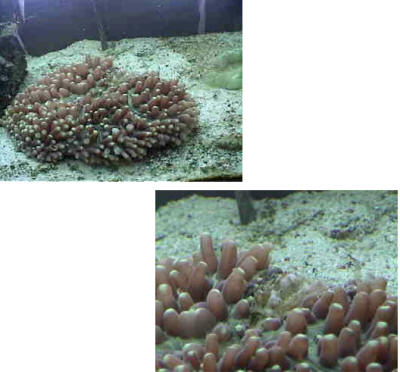
Plate coral I recently bought a plate coral from my LFS. 4
days into him being in my tank, it is "melting" on one side
and it's white "skeleton" is extruding. all I'm
really asking is if it's dead? <indeed suffering from
damage that could be fatal... maintain good to strong water movement
around the coral. Skim well and siphon loose necrotic tissue when
possible. The coral may stabilize and heal in time... death is
unmistakable and fast... tissue rots away within a few days to leave a
denuded corallum ("skeleton"). These corals (Heliofungia)
suffer damage easily on import. A common cause of death after import is
the keeping of this species on rock. Heliofungia must always be kept on
soft sand... placement on rock will cause a tear or abrasion in soft
tissue with regular polyp cycles that can lead to infection and
death> I brought it out of the water to smell it but it didn't
have a fowl smell to it. thanks, Jason <if the coral survives... be
sure to feed this animal very finely minced food weekly. See here
http://www.wetwebmedia.com/fdreefinverts.htm Best regards,
Anthony>
Re: plate coral I've read your FAQs and I do not have it
on rock, although I know this is a bad thing, I do have it on crushed
coral. That's the only substrate I have. <Ahhh... yes. In the
long run this will/would be too coarse for Heliofungia to live on.
Finer sand is a must else tissue is easily abraded from polyps
cycles> I read about a type of plate coral that if it dies you
can leave the skeleton in the tank and it will still daughter polyps
after a couple of months of just sitting in the tank. <yes...
anthocauli produced in Fungiids. Not yet reported in your Heliofungia
although seems possible> <=can't recall exactly what I read.)
If this does in fact die, would you suggest doing this? <in a
separate aquarium/QT tank perhaps... not here though> I'm kind
of worried that it will raise my ammonia level? (but I may be
wrong).
Heliofungia actiniformis: Plate Coral on Rock: never Buenos
dias. <greetings my friend!> I have a plate coral that is
in trouble due to an accident. I recently purchased it and it was doing
great for the first couple of days. Then I injured it by dropping the
top of it against the glass while moving it. It has not opened up fully
for about a week now and it is deteriorating. <alas... do keep
it on the sand bottom with moderate to strong water movement on the
edges. Siphon away decay as necessary. Add iodine as per mfg suggested
dose if you do not already. Remove if decay seems rapid (to QT tank
hopefully)> It is pulling back from the edges and I can see the
skeleton in the middle too. <it may recover in time> I
tried moving it closer to the MH and higher current for a few days but
that didn't help. <yikes! Not possible, my friend. First
of all... moving a stressed or damaged coral to brighter light is very
stressful and sometimes fatal. Lower light and increased feeding is
always better. Furthermore... Heliofungia can never be placed on rock.
That will sign its death certificate. They only occur on sift sand in
the wild and will suffer from abraded tissue with polyp cycles on rock.
Always keep on soft sand. Feed this species 3-5 times weekly minimum
too with very finely minced meaty foods> I now have it in my
refugium under low lighting and moderate current. <OK... and perhaps
stronger current would be better> While transferring it I noticed
the bottom of it has a reddish spot covering about half of the
underside. Is there anything I can do to save this coral? My water
chemistry is good. Temp fluctuates between 77.5 and 78.5. Lighting in
tank is 3x 150 watt HQI MH (tank is 24 " deep). <all
water quality is fine, my friend... keep up the good work!> By the
way, did Mr. Fenner go to Mexico for the aquaculture conference? I
translated some documents for him and was just curious if he got them
back. It was a while ago. Thanks. <Gerardo... we thank you so much
for your help with the translations. Alas, the trip fell through. The
organizers must have had some trouble. They did not answer any of our
requests for travel and contact information and did not try to contact
us by phone for travel arrangements until 2 days before the event. By
that point we assumed the event was long since canceled and made other
plans in our schedules. It is unfortunate... we were really looking
forward to seeing that beautiful city in Mexico. But again, we thank
you for your help in trying to contact the committee.> Gerardo Gomez
<with kind regards, Anthony>
Re: Heliofungia Actiniformis, Dilution is the Solution to
Pollution: High ALK I will try what you suggested to revive the
plate coral. I mentioned my water chemistry was good but I hadn't
checked my calcium hardness and it is WAY too high. I have checked it
twice and it is reading over 20dKH with a LaMotte kit (it actually
reads it as CaCO3 at 4515 ppm). <YIKES!> My pH is steady at 8.2
and Alkalinity is 2.75 mEq/L. I have a calcium reactor hooked up filled
with Korallith and water flowing through it but I have yet to connect
the C02 tank. When I originally filled the tank I overdosed on
Seachem's Marine buffer to the point that a precipitate formed all
over everything (I am still trying to remove it). <Ahhh,
yes... I see> I did a water change but have been adding Marine
Buffer to replacement water (RODI) to bring pH to same level.
<agreed... but do aerate before any buffer or salt> Any
suggestions on what I should do next? <indeed... a string of
large water changes. As they say, "Dilution is the Solution to
Pollution."> Sorry to hear the trip to Mexico fell through. It
sounded like it would have been interesting. <yes... I was
dreadfully sorry to miss it. We were so surprised to get a call 2 days
before the event!> Thank you again. Regards, Gerardo <my
pleasure, Anthony>
Fungiid problems - 2/24/03 I have had this plate
coral for a few weeks now. the tentacles only come out at night and I
keep getting a stringy discharge <Could be Zooxanthellae bailout
(bleaching event) or just passed food stuffs> all over the top here
lately. also my main concern the edges are pink and they are turning
white are clear on the edges is there something wrong or something I
should be doing? <Check here: http://www.wetwebmedia.com/fungiidfaqs.htm
and here: http://www.wetwebmedia.com/fungiidae.htm
Be sure to feed this coral Mysis shrimp and krill (frozen is fine) when
there is polyp extension, and place this coral on the substrate. The
feeding may help the potential bleaching that is occurring (the pink
edges turning white)>water tests are fine. <OK> also I would
kill for a good book if you know of any... <No need to kill. Know of
a great many books...... I personally really enjoy and found most
informative, Anthony Calfo's "Book on Coral Propagation Vol.
1" (which is why I am here) and I really enjoy Eric
Borneman's' "Aquarium Corals". They can be found
locally as well as online in many places. Another source of good
information is to check reef boards as often as possible as
well....much information to process there. Check the links above, leave
the coral in the substrate and feed often. Water changes are in order
here as well, in my experience. Good luck! Paul> Thanks
Carlos
Damaged Plate Coral 2/6/03 Hi guys, I added a
Plate coral about 2 weeks ago. On occasion, his tentacles
deflate while extended. I also noticed that his mouth is
open wider than usual (picture attached) - I believe this is a sign of
stress. <correct although it does not look too severe in
this image> There is also a sandy looking something covering a
small(3/4" x 1/4") section of the plate (pictures attached).
I was wondering what this is, and if there is anything I can
do. <a slight tear in the polyp and possible nuisance
growth attacking the exposed septa> I already tried to siphon and
blow the stuff off of him, but it won't move.
<understood... still a good move on your part> Please also see
the pic of my substrate. It is aragonite, but has some
larger grains (pebbles) in it, I was wondering if this could be part of
the problem, and if it could actually cause problems in as little as
two weeks. <not too terrible. No larger though please for
Fungiids> My lighting is 165 watts actinic and 165 watts 10,000K on
a 90 gallon. Calcium is 360 Alk is 3.5 Ammonia, nitrite and nitrate are
0 pH 8.1 Salinity 1.024 Temp 74 All fine except pH if that's a day
time reading... do get it up a little higher> Branching Frogspawn is
doing fine (my only other coral). <my guess if that your coral was
acquired with a little bit of damage (common on fresh imports). It will
likely heal or become fatally infected within mere weeks. Just keep up
with good water quality, good water flow (random turbulent) and
occasional feedings with fine food> Thanks again, you guys are
great, Adam Karp <thanks kindly, Anthony>
Heliofungia Plate Coral 3/6/03 Great site...very informative!
<thanks kindly> I have a Fungia plate coral bought like a week
ago. I have him in a 90 gal, w/live rock, and various fish. He is on
the sandy bottom. He mainly opens up at night. I have 265wat power
compact lighting with actinic too.....Why does he only open at night,
<planktivorous... when plankton is out> and my main question is
this.....When I 1st got him, his mouth was visible...now, there is a
hole there, and bare coral skeleton is visible. <Yikes... a sign of
severe stress. Perhaps light shock if you did not QT in subdued light
first.> He seems to no longer be able to accept food, but is putting
off very little mucus, and is still puffing up at night... <the
latter being a good sign> Is it just a matter of time, or is he ok
do u think...thx a lot guys Tim <its a little
scary... gaping is often a rather bad sign. My advice though is to not
move or stress this animal at all... it is likely very weak and will
not tolerate a change well. Patience and diligence are required here.
Do keep offering food in small amounts and give it time to acclimate.
Be sure nothing is bothering it (another coral nearby... fishes, crabs
in the tank, etc). Anthony>
Fungia illness? 6/2/04 I am concerned about my
Fungia. I have had it for a month now, and it seems to be
doing fine. <I do hope it is placed on a soft sandy
bottom and not on rock (critical for long term success). Also, do feed
it finely minced meaty foods of marine origin (Mysid shrimp, Pacifica
plankton, etc) weekly or more often> A week or two ago I noticed a
couple small brown and grey lumps around the mouth. Now they
are bigger, have a rough appearance, are still brown and grey, and seem
to be forming on the skeleton, not the tissue. I also
noticed this afternoon that the tissue was retracted (tentacles in,
tissue retracted) but I am not sure if this is being caused by the
lumps. <tough to say without a pic. But in the worst
case scenario of denuded "skeleton", still do not give up...
Fungia are remarkably regenerative and may very well at least produce
buds from the stripped skeleton> Also, just to let you know, I added
CALXMAX by Warner Marine today. If you are not familiar with
it part it forms these whitish clumps, and some stuck to my Fungia and
he swallowed them (I saw no harm). <yikes! chemical burn
is quite possible here. Fully dissolve all supplements in water outside
of the tank before adding> I also have an over-curious peppermint
shrimp, but I don't think he is pestering the Fungia. <Lysmata
shrimp very commonly attack large polyped stony corals. Do not rule
this shrimp out either. You will find many references to such shrimp
attacking coral in our WWM archives and abroad on the Internet>
Thanks, Andrew <best of luck, Anthony>
Broken Polyphyllia 8/19/04
Aaaaahhh! I've had a rockslide! I feel
terrible! I was sure my rocks were stable, but apparently I
was wrong! <Happens to the best of us! Black plastic
cable ties, underwater epoxy and plastic rods work wonders to help
prevent this.> A fairly large rock that had a Montipora capricornis
attached to it fell. The Monti broke, but only in two large
pieces that I reattached. I'm pretty sure it'll be
fine. <Agreed. These are very hardy
animals. Many of my fragments have been created in such an
accident!> My big emergency is that the rock fell right on top of a
tongue coral (Polyphyllia sp.). It snapped in
two. It was about four inches long, but now it's
in two pieces that are three and two inches. (It broke
diagonally.) I can't find any information on what to do for this
poor little guy. Will both pieces die? What can I do? <I
would give each piece a slightly better than 50/50
chance. Do be sure that the broken edges stay open to the
water and don't get buried in the sand. I am personally
not a fan of dips, etc. unless there is a specific reason.> Thank
you so much for your assistance! Though this is my first
catastrophe, I have found your site to be indispensable in researching
potential tank inhabitants. Sincerely, Conni <Glad you
have benefited from WWM and the crew. Good
luck! AdamC.>
Fungia dying? Hey there folks! Hope your weekend is less
rainy and dreary than mine :) Actually I like the rain! << Great
fall weather here. >> On to my question... I purchased 4 Fungia
of various sizes and colors last week from one of the LFS's.
<< I wouldn't recommend adding so many corals at once.
>> The largest is about 3.5" across, the smallest less than
2K (when 'deflated'). They all appeared fine;
expanding/contracting with the day light cycles. Yesterday, however,
the largest did not open all day and had a large strange bump or lesion
of some sort. I watched it closely for more than 24 hours. While the
other three opened/closed daily, this one did not. As well, the
'bump' started to darken: sort of greyish-brown. << Hmmm,
not good. >> I was going to put it in my QT tank, but two things
struck me as funny; it hadn't opened up in close to 36 hours and it
had a distinct odor (almost putrid) that was immediately evident even
in the brief second it was out of the water going into a transport
container. << I'd keep it out of the display tank. >>
So I assumed those facts in conjunction with the bump/lesion convinced
me this one died yesterday sometime. My water tested as follows after
removing the organism: Amm/trite/trate: 0, PH: 8.4, Phos: 0.1, SG:
1.045, Ca: 450, Alk/DKH: 3.77/10.6, Temp low/hi: 79.4/80.6. Doing 10
changes/hr, big skimmer, adding ESV B-Ionic 2 part Ca/Alk daily and Mg.
All my livestock, softs and LPS's show no signs of anything like
the Fungia suffered. Do you guys think I did the right thing throwing
that Fungia out on assumption of death? << I wouldn't throw
it out. There are never dead. I would keep it in
a QT tank, but not throw it out. >> I guess I was primarily
concerned for the rest of my livestock . Thanks in advance for the
amazing site and never-ending patience you guys appear to
have :) -Jeff
<< Blundell >>
Plate Coral, Again The new long-tentacled plate coral looked
great for three weeks--almost always inflated to over twice the
diameter of its calcareous plate and three times the thickness. It
started declining this weekend. It has a small dead spot on one side,
and only 3/4 of it inflates now. It started acting weird this
weekend, but I thought I'd leave it alone and see if it rallied. It
looks like it is doing the same thing the last one did--sometimes
rapidly deflating, but not retracting, its tentacles. I've read on
the internet that these corals tend to do well for a while and then
just crash suddenly. My water has been good--I checked it today and had
ammonia, nitrite, nitrate and phosphates all "0".
<<Starved chemically. RMF>> Calcium got
low this weekend--to 300 ppm--and I'm getting it back up with
supplements pending receipt of the reactor. I've managed to get it
back to around 360, but can't seem to get it any higher than
that. Aren't these supposed to be some of the easier corals to take
care of? <Not necessarily... highly variable on the basis of
immediate past histories, damage from falling, rubbing/touching other
organisms, water quality and changes (likely here), light/lighting,
parasites...> This specimen is on the bottom of the tank in live
sand. The water is moderately turbulent in that location. Lighting is
VHO--2 actinic white and 2 actinic blue--440 watts total over the 115
gal DAS. What is this coral telling me, other than perhaps
these species are not as easy to take care of as I thought? What
should I do? (I've tried to refrain from moving it when it looked
weird, due to stress--I thought the "collapse" if its
polyps may have been due to the lowered calcium level.) <It
will move itself if it can in your system... if it wants>
Incidentally, I did try feeding it some krill this weekend. The last
plate coral I tried went into decline right after I tried to feed it
krill--but I'm thinking this is a coincidence and that this is
environmental or lighting-related. Thanks for your thoughts, once
again. <Need to write up this part of an upcoming book (a section on
the Fungiids). Hopefully something will "come up" from that
endeavor... Finishing the Anabantoids today... Bob Fenner>
--James Deets
Re: Plate Coral, Again Thanks for the quick reply--I think
the best course here is to keep the Ca level up and watch and wait.
Incidentally, I went back last night and reviewed our correspondence in
relation to the last plate coral problem (that are posted in the
Fungiid FAQ section of WWM). The one factor (besides the feeding) in
common to the rapid decline of both of these corals is that there was a
significant "crash" in the Ca level right before the decline
began. In both cases, Ca dropped to 300 ppm or lower, and then the
decline began rapidly. Could be coincidence, but I'd advance the
hypothesis that the low Ca was at least a contributing factor, if not
the cause of the initial decline, which in each case led to a recession
of tissue around the edge, creating a "portal" for infection
that quickly consumes the coral. <Yes, likely a cause-effect>
Related to the Ca drop is another possibility (which I wasn't aware
of until installing a pH monitor on Monday) and which is probably even
more likely. And that is stress from the pH swing caused by use of the
calcium supplement. Although the instructions on the product say that
it won't affect pH, the first time I supplemented after installing
the pH monitor, the pH dropped 0.25 (from 8.14 to 7.89 in a matter of
minutes). So the Ca drop, in and of itself, may not be as much the
cause as the pH swings from using the supplement. <Yes> If this
plate coral doesn't pull through, no more LPS until the Ca reactor
(which is arriving today) is up and everything is stabilized, and the
coralline algae begins to really flourish. . . <Ah, you're
learning...> On the positive side, at least I'm perhaps
providing some more fodder for your piece on the Fungiids, as well as
some additional material for the FAQs on these species. (although
I'd certainly rather be reading the FAQs to learn from someone
else's mistakes). Maybe someone will learn from mine, however.
<Yes my friend.> I'll let you know what my numbers look like
after one week of using the Ca reactor. Thanks again! (And also, thanks
for your agreement about the ID of the Cirrhilabrus cyanopleura--I
guess I really am learning something here--and it's a great fish!)
<Very good. Bob Fenner>
Plate Coral The plate coral I wrote about on Monday night
looked particularly bad yesterday. It was clearly dying where it was
located in the tank. In an effort to save it, I moved it off of the
substrate onto some live rock halfway up in the tank, near the flow
from a power head. More light and more circulation. The stuff that was
caked on one side was detritus--from dying polyps of the coral. I know
these particular species do best on the substrate and that I'm
risking damage to the tissues on the edges by placing this one on the
rock, <Not really... Fungiids are "moving corals"... and
are often found on top of rock, various places in/on reefs...> but I
didn't think I had much of a choice under the circumstances. It did
look somewhat better this morning with the added circulation, and most
of the dead tissue had washed away. Are these species likely to
recover, and will the polyps that have died grow back over time? (Time
will tell, I guess, but I'd like to at least know what to expect
with this one.) Any thoughts on this one? <Of stony corals, the
family is amongst the most resilient> I also wanted to confirm my
conclusions on another issue. I did a full range of water tests last
night to rule out water contamination as the reason for the decline of
this specimen. Ammonia, nitrite and nitrates were all 0. Phosphates
were also 0. Ca was 380--still trying to get it back up around
400-420. <No worries on the 380...> Alkalinity was 4.5, but
pH was 8.0. In the past I've always had pH readings of 8.2 in the
evening and 8.0-8.1 in the mornings before the lights come on. I
checked pH this morning and it was 7.9. Based on my reading and
research, I think the reason for the low pH is an excessive amount of
CO2 dissolved in the water. <Mmmm, and corresponding
paucity/lack of buffer to the contrary...> And my guess is that the
elevated levels of CO2 are due to the calcium dosing I've been
doing this week to get the Ca level back up, as the Tropic-Marin
product states that it releases CO2 in the water to aid in synthesis of
the Ca by the symbiotic algae. <Careful here... it is very
easy to obsess about such matters, and cause yourself and your system
grief in over-reacting...> So I'm thinking I need to increase
aeration, either by placing an airstone or turning up the air supply on
the skimmer, at least until I get the Ca level back up. (And I'm
going to start gathering supplies this weekend for a DIY calcium
reactor. . .) Does this sound like a reasonable theory as to the cause
of the lowered pH and an acceptable course of action, or am I missing
something? <Many other plausible explanations... but the short term
addition of aeration is a good idea... and the long term one on using a
calcium reactor an excellent one> I'm fairly sure that the
suspected CO2 buildup is not from livestock load--the only fish I have
in the 115 gal tank are three tangs (large, med and small), 3 bicolor
Chromis and one small yellow-tail damsel (in addition to various
inverts like crabs, shrimp, snails, sand stars, etc., none of which
should be a major factor). <Actually... it IS due to the
livestock... think of the balance of photosynthetic activity during the
illuminated hours, the dark reaction during "night" along
with the metabolism of your non-photosynthetic life... all utilizing
oxygen and other "oxidizers"... Oxygen is not nearly as
soluble in water/seawater as carbon dioxide... the reductive nature of
all this is that pH trends down in the dark> Also, I think you
implied this in your prior email, but I wanted to confirm that it is ok
to mix the Tropic-Marin product with top-off water, and then add it to
the pre-filter chamber on my DAS. (The filter chamber just past the
skimmer and before the biological filter chamber.) <Yes...> I
can't seem to get even one scoop of the Ca powder to dissolve in a
day's supply of top-off water (RO/DI), and it looks like I'm
going to have to add 3 scoops a day to achieve a balance in the Ca
level. I can't pour the top-off water with the Ca directly into the
tank without clouding the water for several hours. <Perhaps consider
removing part of the water daily and mixing the material "off
site" in a dedicated container... with a submersible pump or
powerhead... and changing this back and forth with your main
tank...> When I pour it into the prefilter chamber, I don't get
any clouding at all. <Yes> Once again, thanks for your kind
counsel and guidance. <You're welcome my friend. Your success is
mine as well. Bob Fenner> James A. Deets
Plate Coral Things are going well--got the Aiptasia taken
care of with a freshwater soak. I decided I didn't really want to
add any livestock right now (i.e., predators), and I'm relatively
certain there were only 4 and they were isolated to two live rocks. Now
a couple of other problems. <Oh?> I added a small greenish plate
coral a couple of weeks ago. It was doing OK--not great, but acceptable
for a new addition--over the past two weeks. It is on the bottom of the
tank on top of the live sand. It never looked completely healthy from
the time that I put it in, however (although it seemed to look great at
the LFS. . .). It was more ecru colored at the LFS, but has since
changed to a very pale aqua. <This happens, varying mainly with
light spectral mix, intensity> This weekend, I added another plate
coral. The new one has brownish tentacles with lighter, straw-colored
tips. It is a little larger than the first one. I moved the first one
over--it was previously in medium current, and now it is in more still
waters. The new plate coral is where the old one was before. <Ones
that have lost their color... oh, I see, you answer this...> Since I
moved the older plate coral over, it has not done well at all.
Sometimes it just instantaneously "shrivels" up--it
doesn't retract its polyps, but they just collapse and shrivel very
quickly. Some of the polyps extend pretty full (but they've never
been completely "full" since it was added to the tank--always
looking more full at the tips and more deflated or wrinkled closer to
the base). The quick deflations look almost like a reaction to
something in the water. Also, the fleshy tissue looks like it's
pulling away from the stony plate at the edges, and the vertical stony
ridges are sticking out in some places. On one side, it's got
something that looks like detritus on top of it near the edge, and the
polyps in that spot are not extending at all. It seemed to be doing
pretty good until I moved it over and added the other plate coral.
(Jealousy???) The two corals are about 12 inches apart on the bottom of
the tank. <Not a factor... you have read MCRA v.2? The Modern Coral
Reef Aquarium books by Fossa and Nilsen would/will bring you much joy,
and understanding> The only things that have changed are the
addition of the new plate coral and moving the one that seems sickly to
calmer waters. Lighting is 4 48" VHOs, two actinic white and two
actinic blues. It's a 115-gal DAS setup. 150# of LR. (I did try to
feed the ailing plate coral a small piece of frozen krill last
weekend--and it took it into its mouth but about 30 minutes later,
rejected it back into the water. . . The new plate coral was added the
same day--so I'm not sure if the problem might be related to
something about the krill it spit back up, or the new coral. . . I
ended up removing two pieces of krill from the tank, because once the
coral rejected it, the fish weren't interested in eating it,
either.) The older (sick) plate coral was under metal halide lights at
the LFS. <Do best, look good there> I'm really worried about
this coral--it has seemed to decline very rapidly over the past three
days. <Already was in decline> The new one I added is doing fine
and hasn't deflated since it was added to the tank, even at night
when the lights are off. My numbers have been fine--ammonia, nitrite
and nitrate have all been zero. SG is 1.0235. I finally achieved
phosphates of zero this weekend as well. I did a 10% water change on
Saturday with 2-day old synthetic water. Late last week, the Ca dropped
to 320, but I've been supplementing daily now with the Tropic-Marin
to keep that up around 400. Alkalinity has been consistently at 4. (The
other corals don't seem to have been adversely affected from the
drop in Ca.) Any ideas on this one? <Have rendered them... more
current might help.> On a final note--on the end of the tank where
I've been adding the Ca powder--some of the powder will settle on a
piece of LR and I'm getting black slime algae on that rock, but no
other rocks. I know the Tropic Marin product has something in it to
promote synthesis of the Ca by algae--might this slime outbreak in that
isolated location be caused by the collection of Ca on that particular
rock? I only have been seeing it on that rock--no others--and I've
been using a net to scrape it off the rock and remove the loose pieces.
It's pretty ugly stuff. (But, looking at the brighter side, it
seems to oxygenate the water well. . .) <Shouldn't be any
"powder" introduced to the tank as such... either completely
dissolve ahead of introduction, or place the powder in a setting where
it will dissolve ahead of introduction (part of the DAS or added
filtration. The deleterious conditions where the powder is settling are
killing off the organisms there, allowing BGA and decomposers to
flourish in their stead.> I'm still trying to find the best way
to get the Ca in the tank without burning the corals like I did a
couple of weeks ago. This end of the tank is pretty calm and I've
been adding it there to avoid getting too much particulate Ca flying
around through the power heads, but this may not work too good, either.
. . (A Ca reactor is starting to look really good--no dosing issues or
Ca crashes. . .) <Yes...> I tried mixing the Ca with water
first but couldn't get it to dissolve adequately. I'm now
adding a few scoops every day, although I'm still looking for the
best spot to put it in and avoid the problems with burning the corals.
Once again, thanks for your kind thoughts. --jd <And you're
welcome. Bob Fenner>
Plate Coral--HELP! Urgent update. The plate coral that had
been declining gave up the ghost today. I removed it--it smelled foul.
Also I tested the water and had slightly less than 0.2 ppm ammonia.
Should I test again in the morning or do an immediate water
change? <Just keep testing... once, twice a day... unless this
goes over 0.5 ppm the change may do more harm than good... hold off on
feeding anything in the meanwhile... the ammonia should "go to
zero" in a few days> (I'm already drawing up water, which
will take several hours. . .) I have an elegance coral that was closed
up today--so I knew something was wrong with the water, and the finger
leather, while it has its polyps fully extended, looked
"wilted." Other corals seem unaffected. Should I also suspend
feeding for a day or so? HELP! <An Elegance? Catalaphyllias are not
easy to keep nowadays... WWM ref... Go SLOW my friend. Bob
Fenner>
Re: Plate Coral--HELP! Thanks for the speedy response. I know
Elegance is not a good choice. . . Over the past few weeks I've
read everything on WWM that pertains to this species, including the
narrative pages and every single one of the FAQs. I'd have probably
not chosen this species for the tank, but significant others have a way
of wanting things and talking you into getting them. <Hmm... hoping
that reason, persuasion will prevail henceforth...> So we're
trying one. . . We did find a medium-sized specimen that looked
relatively healthy at a local LFS, where we have had very good luck
with coral specimens, for $49. It's been in the system for a couple
of weeks and seems to be doing well--located in the LFS at the bottom
of the tank on its side. Until the plate coral demise, its polyps were
staying completely extended, even at night. The sand sifting stars,
however, have had to learn the hard way to steer clear. . . <I
see.> I haven't tested the water yet today--but the tank looks
relatively back to normal. The elegance is opened up again, not quite
all the way, but almost, and the toadstool leather, which had seemed
slightly distressed over the past few days, is back to normal. I'll
be testing the water again this afternoon--I had guessed last night
that the right thing to do would be to watch and wait, since nothing
was in acute distress, and I really didn't want to change with
newly-mixed synthetic water. The good side is that I now have enough
water mixed up for two water changes! <Ahh, very good... You'll
soon be able to take over for me here!> Thanks again for your kind
counsel. (P.S.--when are you going to put some info and FAQs on there
about brain corals???) <Thank you for this/these promptings... they
are directional. Have the new Veron and Borneman books out, and several
thousand images... hundreds of articles to wade through to post much of
anything (significant, accurate, meaningful) on the fifteen families of
Scleractinians (stony/true corals)... This is not too far away (on the
side burner?), but prep. for some presentations, normal correspondence
must take precedence for now. Be chatting. Your friend in fish, Bob
Fenner>
Peace When I got home today, everything seemed normal. And
the maroon clown we added this weekend (after a freshwater dip) had
associated with the plate coral. Is this normal, or am I just very
lucky? <Perhaps both> I'll let you know how the levels do
when all the Ca reactor stuff gets here--all was ordered online today
and should arrive this weekend or Monday. And thanks for your
understanding. <And you for your endeavors and communication. Bob
Fenner
Sick Fungia Plate Bob, I have a Fungia Plate Coral in my tank
that appears to be on the decline. I have had it for a couple of weeks
and until a few days ago was doing well. Now the membrane is recessed
and pulling away from the skeleton. Where it is pulling away, the
skeleton is turning white. Is there anything I can do for this guy?
<Yes... do you know that your water has sufficient calcium,
alkalinity? Do you utilize iodide supplementation?> I bought a
hammer at the same time and it appears to have a bacterial infection. I
am preparing a malachite dip for it to see if I can heal it. Could this
infection have spread to the plate coral as well?
<Doubtful> I also have an open brain, elegant, mushroom, and some
polyps that are all doing very well. Is it possible to use the
malachite dip on the plate coral too? <Yes> Or should this
be avoided. My calcium levels appear to be acceptable (but just to be
safe I added some more). Thanks for your help. Chad <How much
Calcium? What do/did you add? Bob Fenner>
Re: Sick Fungia Plate Parameters are as follows: PH = 8.2
Alkalinity = 3.5 mEq/L Nitrate = 5 mg/l Calcium = +- 500 mg/l I do
utilize Kent Tech-I as my iodine supplement. <And do you test
for same?> I am currently using Coralife Invertebrate Calcium
Supplement for calcium addition, though I will probably start using
Kent Liquid Calcium instead when the Coralife is gone. <Good
idea> One thing that I suspect may be the culprit is that he was
placed in a high flow area in the tank initially. I have moved him to a
position higher in the tank and out of direct flow of the power head.
For now I will wait and see if this helps unless you think the
malachite dip or something else might be better at this point. <Hmm,
and know that these corals do ambulate... that is, they are capable of
moving... if in good health... to conditions they more favor. Bob
Fenner> Thanks.
Re: Sick Fungia Plate I currently do not test for Iodine. I
use the recommended dosage and make sure that it doesn't stress the
coral. The slow drip method seems to help with this. <Yes... much
more valuable than a colorimetric assay> I do know that these corals
can move on their own. Which makes me wonder if this guy didn't get
acclimated as well as the others or he would have moved somewhere else.
We shall see. <Agreed. Good point of view. Bob Fenner>
Thanks.
Re: Sick Fungia Plate (dip procedure) The malachite dip I
prepared killed the Fungia. As soon as I put it back in the tank it
started completely disintegrating. The skin floated away from it's
skeleton in the current. I am aghast. I followed the instructions in
your faq as follows: 1 gallon of fresh (RO) water <A NOTE: I
mis-read this: Please re-contact me here/WWM... this is NOT freshwater?
But freshly made up and spg adjusted synthetic seawater? Please tell me
the latter...> 1 teaspoon of baking soda 4 drops of Nox-Ich
which is (1% malachite green and sodium chloride) <Very strange...
this amount of malachite, the prepared water should not have
"caused" the observed result... I suspect the animal was
dead, decomposing (to an extent) ahead of the protocol> 10 minutes
in this solution and then back to the tank. What I am afraid of here is
that this same process will hurt the hammer in the same way as the
Fungia. I hate to think that my efforts to save them have ended up
making matters worse and killing them. <I share your concern, but
will assure you that I have used the same procedure on thousands of
specimens and know of companies that do the same. Bob Fenner>
FAQ correction Bob--a question about one of the FAQs today.
(I see mine made it up there--lessons to be learned there. . .) On the
last question, regarding the Heliofungia sp. coral dip. I thought the
proper procedure for a malachite green dip for a coral called for
lowered SG (1.018) for the dip (not freshwater). At least that's
what I remember reading, but I can't remember if I read it in CMA
or WWM or both. Am I remembering incorrectly here? <Curse my lazy
mind James! I "casually" read the message as "freshly
made-up seawater" with RO... You're absolutely correct....
Hope I can find the original sender's e-address or he writes back
after viewing your input here... Yes to using dilute seawater, not
freshwater...> I went home with the Magnum at lunch, and the water
had already cleared up significantly from where it was this morning on
its own. I hung the filter on the sump. (What did I ever do before I
had a sump. . . LOL) Once it's cleared a little more and I can see
what I'm doing in there, I'll do a water change to vacuum all
the "snow" off the LR to get as much of it as I can out of
the tank. <You might try hooking up your gravel vacuum to the
Magnum... sure to need a few cleanings, but a very handy way to more
quickly remove the "dust"> Hopefully no more crises this
week! Chat soon. --jd <Indeed. Bob Fenner> James A. Deets
Plate Coral (Heliofungia) Hi. Just a question about my plate
coral. It's a brand new purchase. <FYI this coral is actually a
rather delicate (primarily with regard for handling) species. NOT
recommended for beginners by any stretch of the imagination. Actually
significantly dependent on organismal and absorptive feedings as well.
Even with "perfect" lights, this animal may only be satisfied
by up to 80% (by some estimates) by photosynthesis. So, without
feeding, most are remitted to slow starvation and death by 10-18
months. Do take heed and research if you were not already familiar.
They must also be kept on a soft sand bottom. Never on rock (a surefire
way to kill them: cycling polyp tissue abrades, or the animal simply
inflates, falls and gets torn> The coral is beautiful and expanded.
I was wondering about it's color and some spots on the tentacles.
The color is almost exactly the same as my BTA. The coral is a light
brown with lighter tips. Does this tell what part of the reef it came
from or better yet, narrow down it's lighting requirements?
<neither> I thought the brighter the specimen, the more light it
needs. <nope... many highly iridescent coral are from very
deep water. Pigmentation can be used to reflect light away or refract
weak light within (amplify, sort of)> I was thinking medium.
<OK> The spots I noticed, after I got it home of coarse, almost
look like small tears or weak spots on the tentacles. The spots are
darker brown on the outside, and look like weekend tissue on the
inside. Any thoughts on this would be nice. <indeed... many
wholesalers and retailers do not know how to handle this animal. If you
bought it off of a perched rock or placed it so... it could get a
little rough. > Also, do I need to place this coral on the
substrate? <absolutely critical for survival> I know they
move around, and have read about them climbing rocks. Thanks! -Becky
<best regards, Anthony>
Plate Coral Hi guys. I bought a LT plate coral about a week
ago. I put it on the substrate in the tank and it wouldn't open up.
I moved it to a rock higher up in the tank and it looks great. I know
it can inflate and fall over or even tear growing tissue there.
<This is still dangerous, my friend for many reasons. And they are
never found on rock/hard substrates in the wild> Is this an
indication of too little lighting? <could be, or it just
needed time to acclimate to the new lighting. Read here:
http://www.wetwebmedia.com/acclimcoralslight.htm> I have a 120 with
300 watts of PC. <this is indeed modest lighting. The tank is
too deep to support this animal with these lights possibly and it WILL
die within a year if you move it up onto the rocks. This is really not
a beginners coral. Please do research this animal more. Daily feedings
of finely shredded meats are necessary. Else it will die of attrition
within a year just the same> This coral is sooo pretty. BTW my flame
angle seems to like picking at it. <and will do so until the
coral dies. They must be separated> Thanks for the help! -Becky
<please do read, learn more before you buy such animals>
Plate Coral Stressed Hi Bob, <cheers mate, Anthony Calfo
in your service> I'm from England and a regular reader of your
fantastic web site, but this is the first time I've had to
post. <a pleasure to hear from you> I bought a Long
Tentacle Plate (Pink Tipped) coral about a month and half ago and
everything was fine until this week end. All the tentacles have
retracted and I don't know why, I've done all water parameter
tests and everything is fine. The body of the coral swells up and the
tentacles swell up a little then after about two minutes they retract
again, its like it is trying to force the tentacles out but something
is stopping it from doing it. Any help in this matter would be much
appreciated. Keep up the excellent work. <two things come to mind:
Fungiids like your Heliofungia plate coral are categorically
free-living creatures. Some like your plate coral about living on a
sandy bottom that even a few days of living perched atop a hard
substrate can be fatal as tissue abrades with normal polyp cycles.
Plate coral must live on a soft sand bottom. If yours has without
exception, please disregard. The second thing that comes to mind if
actually favorable. Fungiids commonly employ mucus net feeding
strategies and balloon without tentacles extending after capturing
food. If your tank is fed heavily, fed with a messy food or has a very
messy feeding fish, perhaps the coral is stimulated frequently. Do
consider if either common event is applicable to you.> Regards, John
<with kind regards, Anthony Calfo>
Plate coral Hi Anthony, <cheers, John> Thanks for the
quick reply, unfortunately the plate coral didn't survive. I've
got real fine gravel substrate not sand do you think this was the cause
of the death of the plate coral. <indeed, yes... gravel and
rock can be quite abrasive on a plate corals daily polyp cycles>
I've also got a piece of living rock that was next to it and its
got a hairy crab inside. I've looked on a lot of marine forums and
they say that this crab could kill corals, would this be
possible. <very possible! As a rule, most crabs are predatory
or at least opportunistic omnivores. VERY few herbivores in the trade.
Legend has it that is the crab has a hairy carapace or dark tipped
claws then it is a great risk> I've been told by a lot of people
that I should get the crab out of the rock and dispose of it, what is
your opinion on this. <I would remove it to a sump, refugium
or fish only tank. They are still good scavengers> I'd like to
finish off by thanking yourself and your team for the excellent work
you do and even though the plate coral died, it as not put me off from
getting another one. Regards, John <education and fellowship are
passions for us. Thank you my friend, carry on gently and wiser.
Anthony>
Torch Coral I am writing regarding the addition and now poor
condition of a torch coral (Heliofungia actiniformis). Prior to
its addition, my tank was doing great. I added the torch coral
one week ago and it started out fine, but has deteriorated over the
past three-four days. The tentacles have deflated, the skeleton
is apparent and a beige film has formed over the tentacles and
skeleton. The film can be removed and the tentacles still have
color. Do you have any advice or is my coral dead? Thanks!
Here's the parameters of my tank: 15 H with 2 16 watt bulbs (blue
and natural sunlight) and Eclipse system Ammonia, Nitrite and Nitrates
low to none, Calcium 480-500 Changed filter and 1/5th of tank water
yesterday in effort to help the torch coral. Contains assorted mushroom
anemones, star polyps, Zoanthids, Stereonephthya spp. on an oyster, a
blood shrimp and two green Chromis fish. -Johanna
<<Greetings Johanna, Craig Watson answering while Bob and
Friends are away at the MACNA conference. The coral you identify
by name is Heliofungia Actiniformis, which is a plate anemone coral.
Torch Corals are branched LPS corals of the Euphylliid family, aka
Candy or Trumpet Coral. The plate anemone coral lives on the substrate
(sand) and while most corals of this family require moderate intensity
light in shallow displays and more intense light in deeper displays,
this particular variety, Heliofungia Actiniformis, is more demanding of
intense lighting. One weakness of the Eclipse hoods is the inherently
low light output from the supplied fixture. This is further
exasperated by the depth of your tank. To keep your Heliofungia will
require a lighting upgrade either for the existing hood (CSL makes a
compact fluorescent retrofit as does AH lighting supply) or the
purchase of a new lighting hood with the type and intensity of light
required. I kept a 15H with some corals with similar requirements
and I used a 96watt smart lamp. I would advise around that wattage in
compact fluorescent lighting, either a smart lamp or separate lamps of
around 96 watts combined, one white, one actinic blue. There are
kits made specifically for Eclipse hoods that can supply the light
needed. Your other corals will benefit as well. Fungiids
produce mucous for feeding that covers them. This is normal. They
don't like too much water movement as it will remove this mucous.
They are relatively aggressive feeders that require feeding with all
kinds of treats like shrimp, mussel, scallop, etc. Set the food
on the net/mucous in feeding mode. This would especially be true
in low lighting, although this variety is less dependent on feeding and
more dependent on light. You don't mention alkalinity or pH, but I
would test both and maintain in normal limits, i.e.: pH
8.3-8.4 and 4-5 mEq/L. I hope this helps get things
back in order! Craig>>

