 |
|
| Home | Marine Aquariums |
Freshwater Aquariums |
Planted Aquariums |
Brackish Systems |
Ponds,
lakes & fountains |
Turtles & Amphibians |
Aquatic Business |
Aquatic Science |
Ask the WWM Crew a Question |
| Please visit our Sponsors | ||||
Bubble coral problems 9/2/05 Hello, I've been an avid reader of your site for almost as long as I've been in the saltwater fish world (it took me a while to find your site!) and it's been a world of help - and now I need your help again. <Glad to hear!> I've had a good sized (about 4 inches in diameter shriveled) piece of bubble coral. Over the past two months or so, it has spent most of its time 'shriveled' up, and the tissue has started receding and more and more of the skeleton is becoming bare. When I got it the 'stem' was almost half covered with tissue, now, there's no more tissue on the stalk at all - just the top. Sometime the coral will be fully expanded for a whole day, and then boom, shrinkage city for another four days. I have a candy coral that's doing great, as well as a red bubble tip anemone int he tank that's thriving. Nitrate, nitrite and ammonia are at 0. My ph is 8.0 and my Ca is 420... Any ideas on why my poor coral is slowly dieing? Please help! -Pauli <A few things come to mind. First... if you have a lot of mushroom anemones or large soft corals, they may be producing a lot of defensive chemicals. Second, you did not mention alkalinity. Alkalinity is just as important as calcium, but often neglected. Lastly, nipping fish. Dwarf angels, blennies and even some tangs can be culprits here. Hope this helps. Best Regards. AdamC.> Battling corals 1/11/05 I have searched and posted on the forum for this, got no answers. <OK> My tank- 90 gal, 135 lbs LR, 2 x 250 HQI Ushio 10K halides + 1 96 watt 50/50/PC, G-2x skimmer, 2000 gph closed loop( adding an additional 1800 gph pump with SCWD soon), 77.5 F, 1.024 SG, 0 Amm, 0 trite and trate, 9 alk, 375 calcium. <all fine> My branching torch coral is placed about 5 inches off the bottom, got it 2 months ago. 1 month ago, I noticed one tentacle was extremely bloated, and I found another tonight. It has been doing OK since I got it, but has never been as extended as it was in the display tank at the LFS. All my other SPS, LPS, encrusting, and plate corals are doing very well. What is causing this? <the sensation of competitive species of coral in the tank. It can be tempered by more aggressive chemical filtration (Chemi-pure or Poly-filters) and/or ozone use... all good> Also- is there any known amount of calcium in a 2 teaspoon to 1 gallon Kalk solution? <do check the reef chemistry forum at reefcentral.com... lots of good info on types of Kalk there in Randy's archived answers and directs to articles> I have 2 new SPS placed high, is it safe to assume that if the polyps are fully extended (they are), that they are content? <not an indicator... only one of water flow, not "happiness"> Sorry to add the last 2 questions, but they have been bugging me-:) Thank you so much for your time, it is appreciated! James <you've described a wicked assortment of unnatural tankmates my friend... please do consider being a little more focused with species selection by family or biotope for starters and you will enjoy better long term success. Else, the escalating levels of chemical warfare/allelopathy will be a source of continued frustration for you in the future. With kind regards, Anthony> Elegance issues Hi
Crew I have had an elegance coral for about 6 months now. everything
has been great with it until recently. We have had 3 hurricanes in may
area and the last 2 have caused power outages. I had a generator going
but it was only enough to run the pumps on my 90 reef and 200 FOWLR,
and run the lights some. I didn't run the chiller and to my dismay
the temp in the 90 reef went to 85 The power was out for 2 days. a week
after the power was restored I noticed in the center branch of the 3
branch elegance some of its tentacles missing, like they had been
eaten? I then noticed the same on the left branch. The left branch has
regenerated its tentacles but the center has deteriorated. much of the
flesh has receded and exposed the skeleton. the tissue left looks fine
and healthy, but there seems to be more exposed skeleton every day. the
other branches seem healthy. what should I do?? >>I would do
nothing other than your regular routine. Anything different will stress
the coral more and it sounds like the damage is done, so best leave it
alone to heal. Also, I am not aware of a branching elegance - perhaps
what you have is actually a hammer or a torch or a frogspawn.
Rich>> Treating a sick torch coral Hi, crew. Back again
with a question. I have a torch coral that suddenly went
from looking happy and lush to having 3 of its branches covered in
nothing but that brown jelly I have seen described on your site.
<< Frustrating thing to have happen. >> Based
on a search of similar problems on the WWM site, I moved the torch to a
QT tank, and am on my way to buy Lugol's solution and give some
dips a try. My question is, how long of a process is this?
<< Wow, risky. I'd say it is only takes a couple
days in a hospital tank to make or break the coral. >> Any
special instructions? When do you know if the coral has
turned a corner and/or should be returned to the tank? << You
never know, but I think lighting is so important that I'd move it
back after one day. >> And what would cause such a sudden
event? It's not a new coral, nor have I added anything
to the tank in several months. I need to know if I'm
doing something wrong or what things to investigate. << I'd
check water quality of course, as well as water motion and the health
of all other corals. >> Thanks, as always. Will let
you know either way what happens. Laura
<< Blundell >><.... a posseur for sure> Bubble Coral color 9/9/03 I have a bubble coral that had a 1/2 exposed skeleton when I bought it. I have been feeding my coral 1/4'" pieces of shrimp. For a while after feeding the coral was growing and looking great. <excellent and as it should be. Kudos> It is now starting to get a red tint and some bubbles stay small and week looking. I also add BioPlankton every other day. Is this anything to worry about and if so do you know what I can do to help the coral. Thank you, David <no worries... the pigment does not sound at all problematic. Variation is quite common Plerogyra... blue and green individuals too. A function of light quality and feeding/foods. Keep feeding well and regularly and all will be fine. Best regards, Anthony> Bubble in LPS coral tissue 7/15/03 Hi all, just a brief question. My candy cane coral has formed a bubble on one of the polyps. Any idea what this means or why this happened? <It is never a good sign when they appear, but it is not often/always fatal either. The least worrisome explanation is that a polyp ball is forming for polyp bailout due to another coral stinging it or simply being placed too close. A bigger concern is if they coral is suffering light shock from being new and placed too bright or too shallow without proper acclimation... or... if it is established, but the tank has seen a sudden increase in light (fresh carbon, large water changes, cleaning dirty lamps or lenses/canopies, new bulbs, etc)> Other than this it seems to be doing ok. Tentacles extend at night.. has multiplied nicely over the year. Thanks Angelo <no worries... but do watch closely and try to determine the cause to prevent reoccurrence. Anthony> Bubble Coral Hi There, <Hey! Scott F. with you today!> I have an x-large bubble coral. It has white spots on the bubbles. It is not opening up the way it did before. I wasn't feeding it formula one until recently. It started opening up better after I started feeding it but wasn't sure if it got weak and fell ill because of malnutrition. Are there any antibiotics that might help if it is a fungus? I don't know which ones might help............ Chet <Well, Chet - lots of possibilities here. I don't like the idea of medicating unless you know exactly what your working with. This may not even be a disease. If you suspect that it is- and, if you deem it appropriate, you could employ a dip in saltwater with Lugol's solution (iodine in potassium iodide) may be effective, but it can be dangerous if the coral is left in too long. The recommended concentration is usually 5-10 drops of 10% solution per liter of water, and the coral can be left in for about 10 minutes. Again-if you go this route- watch the coral carefully. This is not a panacea, but it can be effective at reducing some pathogenic microorganisms. Alternatively, you could use a freshwater dip, with similar cautions. All in all, I'd recommend watching the coral carefully for a while before embarking on a course of treatment that could be more problematic than effective! Good luck! Regards, Scott F> Brown Jelly and Hawkfish 7/28/05 Hello, <Hello, Mike G with you tonight.> How are today? <Good. Big storm's coming this way. Doing my part to answer a few queries before the power goes out.> Well, I have two quick questions today. First, I have a torch with about twelve heads on it, and one is closed up and a brown mucus is forming on it. <Yikes. It's called "Brown Jelly." Brown Jelly is a bacterial infestation of many species that often takes the lives of its victims. To halt it, you could try first gently siphoning as much of the "jelly" as you possibly can. Next, remove the coral from its tank and treat it with an Iodine solution. Lugol's Solution is said to work in this instance. Return the coral to the main tank. Keep your water quality up, a water change could not hurt at this point. Repeat if necessary.> I have never seen this before, and wondered what to do? <See above.> Second, is it aggravating for corals if a hawk fish sits on them frequently? <Yes.> Thanks for the help. <You're very welcome. Good luck with the jelly. Mike G> Bubble coral 7/27/05 Hello all, <Justina> Just a quick question about my bubble coral. I have a 40 gallon tank which I relocated two weeks ago, everything has been looking great until today I noticed a piece of the bubble coral has either detached itself from the base or has grown out and is hanging "in the wind" - should I be alarmed? <Mmm, not necessarily. Are other organisms fine? This sort of "breaking off" behavior is one clever means of distribution in space and time (i.e. reproduction)> My ph 8.2, temp 79.9, calcium was low several days ago however I did a 40% water change and it is currently at 320. <A bit low, but not likely a problem. Please take the read re the family, Caryophyllidae... on WWM: http://wetwebmedia.com/caryophyllids.htm and the linked files above... Bob Fenner> Thanks all Justina Fading Frogspawn 7/15/05 Hello all. I just recently purchased a frog spawn coral from my local fish store. It's pretty small with only 2 branches coming off. I've had it for about a week now. Everything looked good until last night. I noticed that one of the branches closed up totally the other is still open and looks great. Today when i came home it looked even worse it looks like it's melted or something. This is the first time I've ever had one of these so I'm not sure what's going on. It looked good at the store and looked even better in my tank. I have MH lighting and the levels are all great (just tested to make sure) the other 2 corals are doing fine and I've had them for a while. Can you please help me? I really don't want it to die. <... At times like this, it is often suggested to break/frag the remaining healthy part of the phaceloid skeleton... and toss the bad. Please read here: http://www.wetwebmedia.com/carydisfaqs.htm and the linked files above... till you understand. Bob Fenner> Frogspawn coral health... much worse... crowded, mis-stocked, poorly filtered, too-small system thanks for the comfort on my xenia.. It's doing great now it was just adjusting itself i guess. Now I Have a real problem. I bought a frogspawn about 1 wk ago it had 3 heads (maybe two heads an one that was on the verge of being it's own branch). I bought it from Liveaquaria.com which is a very respectable company great reviews. It was supposed to be a green one but when i got it it was brown with a green hue and white tips. with in 2 or three days one of the head suddenly shriveled up and died with the brown mucus stuff and everything. I cleaned off the dead parts <Mmm, a note... sometimes better to break off the dead parts... or alternatively the live parts and toss the other> and hoped the other two heads wouldn't get affected. I also lowered the frogspawn to the bottom of the tanks thinking the light was burning it. during the same day the other head that was slightly connected died as well.. I cleaned both heads off completely so that there wouldn't be an ammonia spike and did a water change. the third head never fully came out so today i moved him in an even shadier spot <... not a good idea to keep moving stony corals (or other cnidarians for that matter)> so he most definitely isn't going to be burned. I have on ly one other LPS which is a bubble coral and it's doing great all my other corals are softies or SPS. <... these may not be (easily) mix-able> I have had one other LPS ( a Hammer) it also died with similar symptoms <Very similar biology to the Frogspawn...> but i attributed it to being stung by a rose BTA. <... this is in the same system?> the anemone is far from the frogspawn so there is no way it could have stung it. <Not really... please read on WWM...> here is a little background on my tanks it's a 16 curved front tank <?> with 175 MH 20K and 36w PC they are placed about 20 inches from the tanks in a 24 inch canopy there my temperature stays at 80degrees and i have a protein skimmer Lees <Piece of junk> big enough for a 40 gallon tank. <No...> I also have a Bak pak filtration system for a 50 gallon tank. (adds about 2 more gallons ) in the tank I have a bubble coral, green hairy mushroom, Montipora Capricorn (orange), bird's nest, Crocea clam, xenia, greenstar polyps and some Zoanthids. I have 3 Hawaiian feather dusters, and a flame scallop. 2 clownfish with a Rose BTA , 1 mandarin and 1 tiny (half-dollar sized) regal tang... Everything is doing great except the frogspawn. I'm at a loss. <And soon to be more, in the way of livestock. What you have is an aquatic time-bomb... The mix, jamming of the listed species (I take it you're not joking here) is incompatible, the filtration gear feeble and the tank way too small... My advice? Keep doing water changes, get/use a quarantine system for all new livestock, buy none of the above, READ on WWM, other sites re the life history, husbandry of the species you list... You need to do some investigating, soul-searching before "just buying" this and that because you think it's neat, can afford it... Would like to help you, but only you can educate yourself, make reasonable choices. What you have currently is... a mess. Bob Fenner> Euphyllia Health Hello. <Hello Mark> I have 75 gallon established reef tank, water parameters just fine except for nitrates about 10-15 ppm, which I'm not losing much sleep over. Two to three weeks ago I bought a torch coral and what was supposed to be a hammerhead coral (its a close relative, anyway), and large areas have closed up and died within the last couple days. They had been doing great. There are only two things I can think of: 1) lack of invert specific food, although that wouldn't' account for the partial die off (I think) and in any case I feed every 3 days with a mixture of Selcon soaked flake food and newly hatched brine shrimp. <No need to feed that often, healthy corals produce most of their own food.> 2) I add 2-3 gallons of RO water the day before the corals closed up. I poured the water directly into the tank in a high current area. I've never had any trouble with this before. Would a brief exposure to hyposaline water (at 75 degrees vs. the 83 degrees in the tank) kill Euphyllia type coral? <Shouldn't. May be your lighting. You don't state lighting being used. James (Salty Dog)> Thanks very much. I appreciate your help over the years. Mark Demise of Euphyllia Hello. I have 360 watts of power
compacts, 1/2 10,000K and 1/2 actinic. I should probably add that I
have a plate coral, a hundred mushrooms, and a pearl coral, all of
which are growing and otherwise doing fine. I went from 130 to 360
watts, over a week, about two months ago; no apparent ill affects that
I can see. Also, the brine shrimp and Selcon soaked flakes are also for
the fish: four clowns, and a few tangs, who eat most of it, of course.
The current also seems to be around right: enough to move the polyps
around, but not enough to knock them flat, so to speak. I'm
wondering if disease would be the reason, but it seems strange that it
would affect both corals at exactly the same time and not bother the
pearl coral, for instance, at all. <It's also quite possible
that the coral was handled improperly. Not necessarily by
you, but somewhere up the line. The tissue is very sensitive
and if a hand/finger presses the tissue against the skeleton, damage to
the coral could take place. I'll ask Anthony to take a
look at this. James (Salty Dog)> Mark Battling Brown Jelly Hello, <Hey, Mike G with you this
afternoon.> I have a frogspawn frag, and in about a 24 hour span it
has closed up completely. This is very unusual for this coral. As of
this morning, the coral looks ragged, and has what appears to be a hunk
of brownish dead tissue hanging from it. <Ouch.> Is this the
dreaded brown jelly disease? <Sounds like it.> What is my best
option for treating it? Thank you. <Brown jelly is a pretty vicious
disease, and takes many corals as its victims. To halt it, you could
try first gently siphoning as much of the "jelly" as you
possibly can. Next, remove the coral from its tank and treat it with an
Iodine solution. Lugol's Solution is said to work in this instance.
Return the coral to the main tank. Keep your water quality up, a water
change could not hurt at this point. Repeat if necessary. Hope this
helps.> Hammerhead coral Hello - I am having a couple of problems. First my branching hammerhead coral has slowly been receding. I have had it for about 3 years, started it out w/ just four 4' fluoro tubes and it did great, opened huge, etc. I upgraded to pc's (6 - 55w), but I mostly just run 4 - 55w (55g tank) and it was OK. But for some reason, possibly due to moving the tank or others, it has slowly been shrinking away -- seems I have already lost about 2 heads. Also, my mushroom corals don't seem to open as much either. All the way around my coral health has slowly gone downhill, and I have only made improvements to the tank, refugium, RO water (I never used RO water before). Any ideas how to get the corals to open back? Calcium is at OK levels etc. Also I have a big problem right now w/ bubble algae -- what should I do? All I have been doing is pulling rock out scraping it off and rinsing and putting back in. Any other thoughts etc...? <Brad, you should be adding some strontium and iodide in your system and feed the corals with DT's phytoplankton or Cyclop-Eeze. The corals do manufacture most of their own food but do require some supplemental feedings to thrive for any length of time. As to the dreaded bubble algae you need to keep nitrates/phosphates down. The emerald crab is known and used to munch down bubble algae. James (Salty Dog)>
Tissue Damage on Bubble Coral How ya doin, guys? <Just fine> Quick question: is it normal for the sharp skeleton of a bubble coral to pierce through its tissue? I've had this coral for 5 days now. It already looked like this when I bought it (though I failed to notice this at LFS. Noticed it a few hours after I placed it in my tank). The coral seems fine, its bubbles have been expanding well, sweeper tentacles go out at night. I'm just concerned that it might die much later of "tissue damage". LFS reassured me I can swap it for a different coral before the end of the month. Should I return it to them? <I'm thinking that the tissue got damaged from handling. You shouldn't handle the tissue part at all when transferring from bag to tank or tank to bag. It does tear easily. With good conditions it should be OK, but the choice will be yours to make. James (Salty Dog)> Thanks. <You're welcome> Infected coral 3/11/05 I have a torch coral (not sure what kind), <a phaceloid "Euphyllia glabrescens"> I don't know what is happening to it. Is it dying? <yes.. polyp loss in the photo> A week ago it was fine and it was extended out of all 3 skeletons, and the last 3 days, 2 have stopped coming out. You can still see the tips of them. <Hmmm... I see little in the pics> I just had my water tested by the LFS and everything was excellent. (nitrate, nitrite, salt, phosphate, ph, ammonia, calcium, temp.) Did I miss any? <lack of QT and an infection that spread to other heads/polyps... and often spreads to other corals fro Euphyllia species (very common). Please be sure to always QT new livestock in isolation for 4 weeks before adding to the display... if only to protect the lives of your other animals from disease, parasites, infection, etc.> Should I move it? <not at this point... feed well instead. Do read through our archives on coral feeding> My lighting is Coralife Lunar Aqualight 192 watts. ( 46 bow front). I do add supplements as well (strontium, Molybdenum, Iodine, Zooplex, Phytoplex, DT's Phytoplankton), and I feed brine shrimp. <this coral needs larger zooplankton... very little of the food above is being eaten by this LPS coral. Try thawed Mysid shrimp, DTs Natural Diet Oyster eggs, minced krill, etc instead> All other corals are fine. Please no criticism, help only. Please help! I'm attaching a photo, I hope it helps. Also, how do you get rid of green hair algae? <algae control is writ about at great length in our archives, my friend... much better than I can summarize briefly here. Please take the time to read and learn at: www.wetwebmedia.com and navigate into the many subjects that interest you. Kindly, Anthony> Hammer coral question Hello WWM Crew, I am very new to this
hobby and have learned so much from you! (I need to apologize upfront
for my run-on paragraphs - my kids spilled on my laptop and the Return
key does not work-he..he..). <Yikes... do either take it apart or
have someone show you how to do this... can be cleaned, dried...> I
have a 75 gal reef tank that just cycled. I bought 7 Turbos, 5 hermits,
and 2 scarlet cleaner shrimp from my LFS about a week ago (after cycle)
for a green algae problem. All my water parameters are fine (78
degrees; pH 8.2; 0 on Ammo., NO2,
NO3; Alk-Normal; Calcium-460) so my LFS said I
could add a Hammer Coral and pair of Percula at the same time.
Everything was fine until yesterday. I added a 3rd Powerhead (CAP 800)
the day before, and while positioning it, it blew some sugar fine sand
all over-including a little on the Hammer. It seemed fine, but
yesterday half of it retracted into its base and now all of it is
retracted. Was it the sand? <Very likely yes> I am wondering if
the current is bothering it now? <Not if it is not too brisk,
direct> I adjusted the temp cooler for the algae problem and now the
temp of the tank fluctuates from 77-82 when the two 250watt
14KMH lights are on - Is that a problem? <Mmm, yes... five degrees
is a bit much... three is acceptable diurnally... you'd do well to
look into fans for cooling the tank while the lights are on. To say
this in another way, the daily temperature shift is likely adding too
much stress> The Hammer is sitting on the sand for now, so I was
wondering if I should pick it up and gently shake it to get the sand
out, leave it alone, or what? <Leave it alone... Has
mechanisms for "dusting itself off"> Also, I plan to get a
jawfish and watchman goby eventually, so I'd like to move the
Hammer from the sand to a ledge. How high should I put it and how much
current? Thank you in advance for your advice! -Stellaboom <Wait a
good month before touching the Euphyllia, can be positioned about
midway in depth here. Medium to low water current. Bob Fenner> |
|

|
Features: |
|
| Featured Sponsors: |
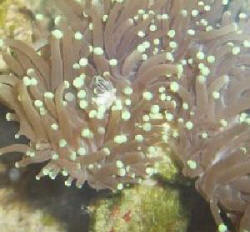 a Cirripedian;
not a problem. B
a Cirripedian;
not a problem. B