|
FAQs about Caryophyllid Coral Disease, Pests,
Predation 6
Related Articles:
Coral Pests and
Disease; pests, predators, diseases and conditions by Sara
Mavinkurve, Caryophyllid
Corals, Elegance
Coral,
FAQs on Euphylliid Disease:
Caryophyllid Disease 1, Caryophyllid Disease 2, Caryophyllid Disease 3, Caryophyllid Disease 4, Caryophyllid Disease 5,
Caryophyllid Disease 7, Euphylliid Health 8, Euphylliid Health 9, Euphylliid Health 10, & Elegance Coral Disease/Pests,
FAQs on Euphylliid Disease by Category:
Diagnosing,
Environmental (Pollution/Poisoning, Lighting...),
Nutritional, Social (Allelopathy),
Trauma,
Pathogenic (Infectious, Parasitic, Viral)
Predatory/Pest, Treatments
FAQs on Stony Coral Disease by Category: Diagnosing,
Environmental (Pollution/Poisoning, Lighting...),
Nutritional, Social (Allelopathy),
Trauma,
Pathogenic (Infectious, Parasitic, Viral)
Predatory/Pest,
Treatments
Caryophylliids 1, Caryophylliids 2, Caryophylliids 3, Caryophylliids 4, Caryophyllid ID, Caryophyllid Compatibility, Caryophyllid Systems, Caryophyllid Selection, Caryophyllid Behavior, Caryophyllid Feeding, Caryophyllid Propagation/Reproduction,
|
.JPG)
|
|
Vermetid Snail Mucus Causing Frogspawn Polyp Ejection? -
11/14/07 Hello Wet Web Media, Since launching my 24g nano
earlier this year, I have been an avid reader of your site. Thank
you for contributing so much information to the reef-keeping
world. <our pleasure, thank you> Your site has helped me to
diagnose a problem, but now I need input on how, or whether, to
"solve" it. The pride of my tank is a bright florescent
frogspawn that I added about five months ago. Since that time,
two remarkable things have happened: first, the frogspawn has
rapidly divided: from four heads to ten or twelve, and dividing
still. <wow> Loving my frogspawn as I do, I was initially
enthused by its reproduction. I've placed this coral in a
nice space where it can expand and be a real showpiece in the
tank. But I recently read a post by Anthony Calfo on this site
that described polyp ejection (featuring the clear bubble that
has developed on a few of my frogspawn heads as they've
split) as a "stress induced strategy of asexual
reproduction." <Interesting, but I'm not yet
convinced that this is what is happening here with your coral.
There is certainly plenty of reason and academic research to
support the notion that polyp bail out is a response to stress
(and method of asexual reproduction). Polyp bail out is when the
soft tissue of a polyp detaches and drops out of the coral
skeleton. If conditions are right, these dropped polyps will form
new skeleton, and ultimately new colonies. (see "Polyp
Bail-Out: An Escape Response to Environmental Stress and a New
Means of Reproduction in Corals" by Paul W. Sammarco,
published in Marine Ecology, Vol. 10: 57-65, 1982). Thus, if your
corals polyps were bailing out, I'd expect them to be dropped
from the mother colony and forming new colonies (not forming new
branches on the same colony).> This got me thinking about the
second remarkable thing that has happened since I acquired the
frogspawn: in the last several weeks, a great deal of mucus or
webbing has accumulated around the stalk or stem of this coral.
Today, with the help of your site, I at last found the likely
cause of this mucus: the frogspawn came with what I originally
believed to be two tube worms attached, but what I now believe to
be Vermetid snails. A small colony of Vermetids has since grown
up on the frogspawn and the surrounding live rock. (Perhaps they
thrive on the phyto I feed my feather duster.) Recently the web
of Vermetid mucus has grown pretty thick on the frogspawn and has
even trapped a bit of detritus. <Indeed, this is what the webs
are for. If you watch them, you can actually see them
"reeling in" these webs to collect their catch.> So
now I am wondering: could this mucus web be irritating the
frogspawn, resulting in stress-induced asexual reproduction?
<It's *possible* but I'm not sure how likely...> If
so, is that a bad for the long-term health of the coral?
<It's hard to say since I'm still not sure your coral
is truly stressed. Could you send in some pictures maybe?> If
so, what if anything should I do to prevent it? Would you
recommend or advise against an effort to baste or vacuum some of
this mucus off the coral? <Likely a futile effort...the snails
will just make more.> Dare I attempt to remove the snails?
Some sort of dip? <Eek, don't dip it. If you MUST kill the
snails, use a needle/syringe to inject vinegar/Kalk/etc. into the
tubes.> Thank you very much for your time and expertise. Ben
Irvin <De nada, Sara M.>
Attn Sara M: Vermetid Snail Mucus Causing Frogspawn Polyp
Ejection? -11/14/07 Hello Sara, Thank you again for your time and
insight. So, if polyp ejection or bail out results in a complete
detachment of the polyp, that is definitely not what is happening
to my frogspawn. However, some, but not all, of the heads that
have divided on my frogspawn have developed a clear bubble
similar to the one pictured on this page:
http://www.wetwebmedia.com/caryfCorlsaqs.htm And the frogspawn
does seem to be splitting very fast. <Yeah, this is odd...>
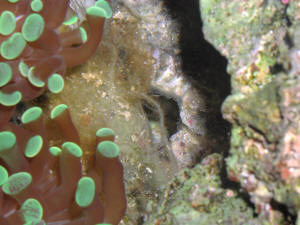
Here are two pictures: the first, #546, shows the frogspawn from
below. You can the see largest, green worm-like structure, as
well as a web of greenish-whitish mucus-like material
accumulating on the coral and the rock. <That actually
doesn't look like Vermetid snail mucus web. If anything it
kind of looks like sponge.> The second, #550, shows the
frogspawn from above and behind. You can see more worm-like
structures, as well as a web of mucus-like material that is
catching detritus. This is the first I've noticed, but there
seems to be some algae now growing on the mucus-like material as
well. <That wouldn't happen with Vermetid snail mucus.>
One last thing that perhaps I should have mentioned earlier: this
frogspawn is hosted by two true Percs. <Hmmmm... interesting.
Normally I would tell you that clown hosting is very stressful to
corals. But this is such an odd thing with your coral growing so
fast.> I'll confess, I thought I had it all figured out,
so I await your judgment: is this bad for the coral? need it be
addressed? if so, how? <I'll be honestly with you, I'm
a little baffled myself. Hosting clowns usually stress out corals
quite a bit. But if your coral is growing this fast, and if it
keeps growing this fast, I'd question how stressed it must
be. Typically, stressed corals don't grow so fast (if much at
all). Let me ask you, do the clowns feed the coral?> Thanks
once again. Ben Irvin <Thanks for writing, Sara M.>
Re: Attn Sara M: Vermetid Snail Mucus Causing Frogspawn
Polyp Ejection?-11/14/07 Hi Sara, It's really nice of you
to take the time, and I'm happy to respond, even at risk of
showing my ignorance, so long as I am not taking up too much of
your attention. <Not at all... I quite enjoy hearing from
other people about their experiences with their corals.> I,
too, wondered about the possibility of a sponge, but was at a
loss to explain the worm-like structures in the gauzy, mucusy
material. <I know it doesn't look like your typical
sponge, but I'm 98% sure it's some kind of sponge.
Sponges can be mucus-y, web-like, gauzy... all the things
you're describing are not inconsistent with some kinds of
sponges.> To give you a better sense of what this looks like,
if I saw it growing in my fridge, or in a garbage can, I'd
think that it was mold. It is whitish-greenish in color, it
clings to (possibly grows on) the adjacent rocks. It has
developed worm- or tube-like structures in it. It seems to cling
to, or grow on, the lower, green portion of the stalk rather than
on the white portions of the heads. Now, ugh, here's my
ignorance: in response to your question, do the clowns feed
the coral, my answer is, I don't know what that means. I feed
my clowns Mysis and Cyclopeeze every third day, a reduced feeding
schedule that is aimed at reducing nutrients in the tank. (I also
add a few mg of phyto twice per week.) I occasionally squirt some
of the Cyclopeeze in the general direction the frogspawn, but in
general I don't target feed it. The clowns stay close to the
frogspawn and swim in and around its heads at night. <Just
like how clowns bring food to anemones in which they might be
hosting, they will often also bring food to any coral in which
they are hosting. This is what I mean by "feeding.">
Again, I acquired this coral in May. It had four heads when I
obtained it, and I suspect I'll have sixteen soon
enough, each heading having split and many now splitting again.
<Dear lord that's a lot of splitting. Do you have any
pictures of the whole coral colony? I'm just curious to see
this thing now.> This coral had been fragged off of a specimen
the size of a basketball in my LFS's show tank. So perhaps it
is just a quick grower. <Oh cool... I was just going to say
that it would be interesting to see if the coral grew just as
fast without the clowns (and/or in a different tank). So, if a
frag of it in a different tank is growing just as fast, that
might tell us something. But I'm afraid I still don't
have a real answer for you as to why it's growing so fast. I
suppose it could have some sort of genetic "defect"
that is causing this. But I honestly don't know. Please do
record all this though (take pictures and make notes of
observations).> But I want to be sure that whatever is
growing/clinging to its trunk is not an irritant. <If
you're worried, and if you can easily remove it, go ahead.
Better safe than sorry I suppose.> Your insight is greatly
appreciated. Ben <De nada, Sara M.>
Re: Attn Sara M: Vermetid Snail Mucus Causing Frogspawn
Polyp Ejection? -11/14/07 Hi Sara, Unless you recommend
otherwise, I will put some light water pressure (turkey baster)
on what we think is the sponge. If it blows off, great, but if it
doesn't budge, I probably won't risk any kind of
intervention. <Sounds like a good plan. You could also use a
pair of tweezers to try and gently pull it off if the baster
doesn't work.> Later this evening, I will send you two
pics of the coral, one opened and one closed. <Cool,
thanks!> Have I told you that I appreciate your expertise?
<Hehe, yes, and thank you again for sharing with us.> Ben
<Best, Sara M.>
Re: Attn Sara M: Vermetid Snail Mucus Causing Frogspawn
Polyp Ejection? -11/14/07 Thanks for the advice, Sara. During
a regularly scheduled water change this evening, I attempted
first to suction and later to blow this unidentified material off
the frogspawn. I was able to remove a little of the detritus and
what looked like a bit of brownish hair algae, but the mystery
material stayed put. So, since you haven't identified it as
fatal coral-killing death stuff, I'm going to let it be.
<Yeah, I'd just let it go for now. Most sponges don't
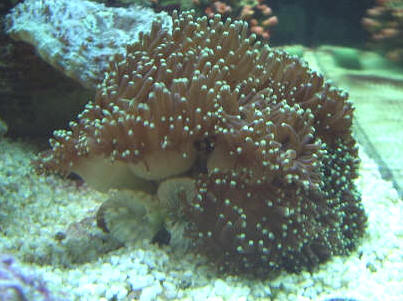
pose any real threat to stony corals.> I've attached two
pix: the first, #556, shows the whole coral as it's
beginning to retract for the evening. For scale, the whole thing
cuts an arc a little bit bigger than a soft ball.
<Thanks for the pics, looks like a healthy coral. :-)> The
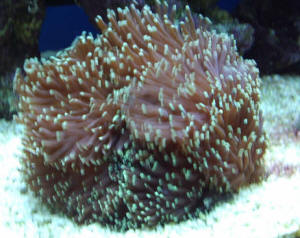
second pic, #566, shows the coral closed up a bit. I had hoped
to show you a picture of the coral closed all the way, so
that you could distinguish the separating heads, but the
frogspawn doesn't seem inclined to close up tight tonight.
But, just for example, the two heads at the far right of the
picture have each developed two mouths and the splits seem
imminent. Likewise, on the far left, what appears to be one big
head is actually four. It's really been amazing to watch.
<Indeed, very interesting.> But so long as it is not an
unhealthy response, I'm happy! <Corals are still so
mysterious to us humans. All I can really say is that the coral
looks plenty healthy. I'm not going to promise you that
there's no chance this accelerated splitting isn't a
result of some kind of stress. But I don't have any reason to
say it is either. And even if it were, it's obviously not
killing the coral. So I say just keep doing what you're doing
and keep an eye on it.> (Also, in the background of 566, you
can see a bit of pink sponge in the vicinity, so maybe this is a
sponge-worthy rock.) <LOL... "sponge-worthy"--too
funny.> And speaking of rock, you rock. Thanks for all your
help. If you ever need a totally noobtastic second opinion, be in
touch. <Fabulous, my pleasure.> Best wishes,
Ben Irvin
<Best,
Sara M.>
|
|
|
Torch coral, no sweeper tentacles - 10/07/2007 Hey
guys, I was hoping for some help. <Hi Brian> I got a torch coral
about 1 month ago. It seems to be doing well during the day. It is nice
and big, but at night I haven't seen any sweeper tentacles. I have
tried putting enriched mysis shrimp on his non-sweeper tentacles and
eventually it seems to slowly let go of it. I have it under 175 metal
halide and 2*65watt actinic. Could it be getting enough energy from
light? Is it just unhealthy and that is why the sweeper tentacles
don't come out? What should I do? Thank you guys/girls are the best
and my main source of information. <LPS corals use the sweeper
tentacles for defense against other encroaching corals. They can sense
a coral near buy and will move their sweepers to that area in an effort
to sting the coral and defend it's space. I have seen Euphyllia sp.
go after mushroom corals very aggressively. If your LPS does not
capture the mysis but is opened with good color then it is still
healthy. The polyps will show you when they are stressed by receding to
the skeleton. If the polyps come out with the lights everyday then I
would not worry. Try to feed about an hour after lights out. My Hammer
and Torch corals don't accept mysis either but are growing very
well while my other LPS feed heavily on mysis! Water parameters
are most paramount. Make sure Calcium levels are maintained above
400ppm and Alkalinity is near 3.0meq/l or above 8 DKH. Keep nitrates
and phosphates low with resins, activated carbon, and regular water
changes.-Rich...aka-Mr.Firemouth>
Frogspawn coral bubble - 10/07/2007 I recently
bought a 3 headed frogspawn coral from my LFS. For the first few days
it opened up completely - more so than in the LFS - and I was shocked
at its size. <... had you studied re Euphylliids...> The question
at hand is, today it has not opened nearly as much and there appears to
be large bubble sacks in the center of two of the three heads. Are
these normal? <Likely so> Doing a search using bubble and
Euphyllia just brings up mixed results of bubble corals and frogspawn
corals, but I couldn't find anything on this particular feature. I
seem to have misplaced my camera, but if I can find it today I will
send a photo as well. I just want to know if this is normal, or
something I should be concerned about. <Mmmm> While writing this
email, the two heads have retracted to almost night time sizes, while
the bubble sacks remain the same size. Thanks as always for your
insight, Josh <I would keep an eye on this colony, and keep reading.
http://wetwebmedia.com/caryophyllids.htm and the linked files above.
BobF>
Dying bubble coral... Poor system and species
mix 9/26/07 Good Morning Crew. I wanted to thank you for all
the valuable info you provide, without it I would be lost! Here is my
question though. We have a 40 gal. tank with 1 3" maroon clown who
hosts in our Condy, <A poor match... will likely kill this Caribbean
animal with growth, time...> a lawnmower blenny, a Mandarin goby, a
Magenta Gramma, a Pajama cardinal,, 4 astrea snails, 4 hermit crabs,
Various polyps, and a Bubble coral. <Quite a blend... these last two
are not compatible in such small volumes> There is about 35 lbs. of
live rock, and 2" to 3" in. of live sand. We have had the
Bubble coral for about 5 months, and up until a month ago it was doing
great, looked extremely full, and all calcified parts were completely
covered. It is now slowly retracting from it's rock and is down to
about half the original size. <Not surprising...> where it looked
like it had three separate mouths, it now only has two, and one is
totally shriveled up. It also has some reddish brown spots on some of
it's bubbles, but it still has a healthy appetite. Please help, I
don't know what is wrong! <Cnidarian allelopathy> Temp
between 79and 81 Specific gravity 1.024 PH 7.8 Alkalinity ideal
Nitrites 0 Nitrates a little high ( 40 ppm on quick dip test strip?)
<Need to be at most half this> but the nitrates have been at this
level the entire time the tank has been here ( 1 year, running 4 years
total) Thanks for your time, any input would be helpful! <Read on...
start here: http://www.wetwebmedia.com/cnidcomp5.htm and the files
above... the search tool, indices... You need to re-think your stocking
"plan"... Read about the needs/systems and compatibility of
what you have, intend to keep... What you have now is untenable. Bob
Fenner>
Torch Coral... hlth.
9/12/07 Hi Bob, <Hi Cameron, Mich filling in tonight.> I
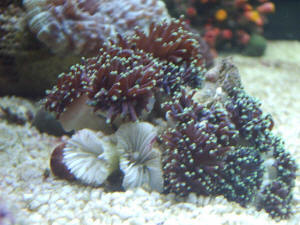
have a torch coral that I have recently noticed missing two polyps
next to each other. <Aye! Doesn't look happy!> The last
time I noticed tissue there was around 3 - 4 days ago. Is it
possible that it could disintegrate that quickly without my
noticing? <I highly doubt that it disintegrated without you
noticing... it's usually a pretty nasty process. Trust me, been
there done that. Sometimes when the coral is really unhappy it will
bail its polyps. I suspect that's what may have happened here.
It is possible for the polyp to survive detached from the skeletal
base, but it is uncommon. But if you look in the nooks and crannies
of your tank you may find these two missing heads floating around
somewhere in the LR. More here:
http://www.wetwebmedia.com/carydisfaqs.htm
http://www.wetwebmedia.com/corldisfaqs.htm > Or perhaps some
other explanation? The rest of the coral appears healthy and
normal. <Mmm, I don't know that I would say that. Looks
rather deflated and unhappy to me. This coral should be fuller and
fatter. I suspect allelopathy is at work here. You may need to
relocate this coral or one of its neighbors. More here:
http://www.wetwebmedia.com/carycompfaqs.htm A water change and
adding carbon likely wouldn't hurt either. I would also check
your calcium levels. I suspect they may be low.> I hope you
receive my photo ok. <Yes.> Also I have a question regarding
Tubastrea (sun coral) feeding; I have been using Tropic Marin's
Pro-Coral Zooton. A substitute for zooplankton feeders, is this
enough to sustain the coral or continue with feeding with Mysis
shrimp? <I am not familiar with Zooton, which makes me question
it's nutritional value, I suspect you would have more success
with Mysis or other finely minced fresh seafoods or if you're
looking for something prepared then perhaps Cyclop-eeze. If you
really want to go crazy with feeding see the method employed here:
read about Re: Feeding of Tubastrea.. Follow up to Baby Tubastrea
Timeline 8/7/07 on this page:
http://www.wetwebmedia.com/dendroreprofaqs.htm > Cameron Teague
Tasmania, Australia
<Michelle Lemech
Pennsylvania, USA> |
|
|
Re: Torch Coral-Health 9/13/07 Hi Mich,
<Hello again Cameron!> Just to let you know my corals are
fine. I took the photo last night, I turned the light on for 5
minutes for a shot. I guess they were 'asleep'. <Ahh,
they do look better in today's photos.> I can't find the
polyps anywhere, is it possible to have been eaten by anything??
<Always a possibility.> The only thing I can think of is my
snowflake eel. <I guess anything is possible.> Also is there
anyway to entice a sleeper goby to sift the gravel? <Hmmm, not
that I'm aware of... likely similar to the old adage about
leading a horse to water....> Cameron
<Mich> |
|
|
|
|