|
|
| Home | Marine Aquariums |
Freshwater Aquariums |
Planted Aquariums |
Brackish Systems |
Ponds,
lakes & fountains |
Turtles & Amphibians |
Aquatic Business |
Aquatic Science |
Ask the WWM Crew a Question |
| Please visit our Sponsors | ||||
Disappearing Mushroom and Ricordea Polyps --
04/14/08 I awoke this morning, looked into my tank, and to my
horror I saw that all my coral polyps had been eaten.
<<'¦!>> I had just put in my tank a red mushroom,
a green Ricordea, and a blue/purple Ricordea within the past week. The
livestock in my tank is as follows: 1 Yellow Tang 1 Tomato Clownfish 1
Lawn mower Blenny 3 Damsels 1 Neon Goby ! Coral Beauty Angelfish 10
Blue Leg Hermit Crabs 2 Turbo Snails 25 Cerith Snails 5 Scarlet Leg
Hermit Crab 1 Condy Anemone I thought all theses critters were reef
safe. <<Depends on your definition res a relative
term, very few organisms are totally so>> Checked again today on
the internet to confirm my belief. Any ideas who the culprit could be?
<<Are you certain the Corallimorphs were eaten? Nothing you have
listed comes to mind as being 'fond' of the noxious organisms
that you say are missing>> I must also mention that the tank is
45 gallons. <<Yeeikes!'¦much too small for the Tang and
the Angel. If the polyps were truly eaten, then perhaps this was a
manifestation of behavioral retardation by the Tang or Angel due to the
too-small confines of the tank>> I know a bit overstocked.
<<More than 'a bit'>> I have been trying to
downsize by sacrificing the Damsels but they are hard to catch.
<<A better start would be to find a new home for the Tang>>
Could the overcrowding be a culprit as well? <<Indeed>>
There appears plenty of stuff (algae, diatoms, etc.) for the inverts. I
must also mention that I received a shipment (10 of the Cerith Snails
and the Scarlet Leg Hermit Crabs) 36 hours ago from a reputable on-line
source that I have used many times with no problems. Could be
coincidental but the shipment may be the problem but I can't be
sure. <<The Cerith Snails are not the issue here. The Hermit
Crabs are quite opportunistic, and if not well fed before/after
acquisition>> I don't want to make this
mistake again that's for sure. Any ideas? <<A
stated'¦ But another thought perhaps you have a
nocturnal hitchhiker/predator. A Mollusk of some sort with a taste for
Corallimorphs maybe. Seems strange the Polyps would disappear overnight
without you noticing anything if the fishes were at fault>>
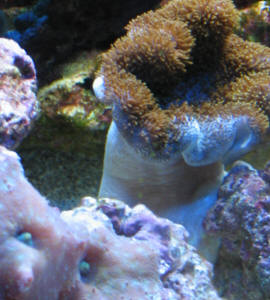
Thanks <<Regards, EricR>> Cnid. compatibility with butterflies 3/30/08 Hi, I went through the FAQs and articles in the website. Not able to get a clear picture so asking you folks by email (Sorry for the trouble). Can I keep the following inverts with butterflies? 1. Leather coral 2. Mushrooms 3. Sea Fan 4. Palythoa 5. cucumber 6. Xenia 7. Anything else I can keep? <Sure, an ocean full> I do know that LPS will be totally out but what of SPS like Acropora? How many butterfly types can I mix in a 120 gal tank? <Depends on the species... two-three> Cheers Ranjith <And you! B> Micromussa'¦ Thoughts on Combating Allelopathy -- 03/07/08 Hi Crew, <Hi Sam, Mich here.> I tried to get a picture but my Kodak just does not get it clear even when I use the setting that says it is for less than 27 inches away. <Look for a "Macro" setting, the symbol often looks like a daisy or a flower.> Anyway, I want to know if what I bought is in fact a Micromussa. <Hard to say with out a photo.> The person who sold it to me sent me a picture first <How about this picture? Does it look more like this: http://images.google.com/images?um=1&hl=en&safe=off&client=safari&rls=en&q=Micromussa&btnG=Search+Images or more like this: http://images.google.com/images?um=1&hl=en&safe=off&client=safari&rls=en&q=blastomussa&btnG=Search+Images > but what I got does not look like the picture. <Often the case, but does not necessarily mean deception is involved.> But I do like it and just want to know. <Is responsible to know the animal you are caring for.> The polyps are smaller than a dime and are an orangey (no such word) <Nope, but I understand what you are saying!> tan color with the centers a brighter orange. <OK.> The tell tale sign of what this is, is what I saw this morning. I could see some tiny tentacles that I would not notice except that I was looking for it. And the mouth was not just a dot in the center as it usually is but was elongated like it had a nose shaped like a funnel sticking out about 1/8 of an inch (O>). <Sounds like the tin man!> On another topic, most tanks with corals have this chemical warfare going on. <Mmm, I'd go as far as saying most tanks with coral have allelopathic issues!> It would be nice if someone came up with a test to show it <I suspect it would be similar to allergy testing, could be done, but doing it repeatedly isn't terrible helpful or informative. We are aware that many corals kept in captivity produce toxic compounds, and that these compounds are present in our systems.> and an antidote to equalize it. <We have the "antidote". The simplest, easiest, most cost effective way to limit the effects of these toxins is frequent water changes. For example, why would you test your hands for potential infective agents and then cover your hands with multiple expensive antibiotics when simple hand washing is more effective, easier and most economical? I should also mention that activated carbon can be useful. More here: http://www.wetwebmedia.com/chemFiltrMar.htm > Thanks Sam <Welcome, Mich> About corals and anemones in a two month old tank... Not a joke? A mis-mix w/ no pix, useful info... 2/19/08 I have been trying to figure out if it is a soft coral or an anemone. It looks exactly like a brown colt coral, that is as close as I can get to finding a soft coral that looks like this. It is in my friends tank, but she says that the pet store told her it was an anemone. <... do you have an image?> I have looked at many different types of anemones but none that look or resemble this, that is what led me to believe it was a colt coral. She said that she can touch it and move it around, which leads me to believe it is a soft coral as well. Though it looks and flows like it is floppy and it has edged itself underneath a rock, so it is very hard to get picture of it. There is a damsel and a royal Gramma that swim extremely close to it as well and doesn't seem bothered by it at all. There is also an anemone is her tank that is off white at the base and the tentacles are a deep purple, I have not been able to indentify it either. <... you have read on WWM re Anemones, their identification?> I have come close to matching it with a purple Condy. However at the ends of the tentacles, there are tiny hook like tentacles, and sometimes the tentacles look a bit shriveled. I have searched and the Condy is the closest match, any ideas on that one? <... Please read here: http://wetwebmedia.com/marine/inverts/cnidaria/anthozoa/anemones.htm and peruse the above linked ID FAQs files> And, she just purchased a tube anemone, <...?! I hope not a Cerianthid... very incompatible... see WWM re...> But this one is very bright almost fluorescent pink in color. Could this be natural or do you think it has been dyed? <... My friend, what is this? A guessing game? Send photos> Two more questions, she said she saw a 4 inch white fuzzy thing come out of the live rock that she has never seen before, any ideas to what that could be? And she is going on vacation for a week, is it safe to leave the tank that long without them being fed or should she have someone come over to feed? She feeds the tube anemone every other day and the purple one about every three days. She also puts some type of liquid food in for the colt coral look a like thing about every three days. Thank you so much for tolerating my questions, I am more of a novice in this as she is and I just want to help her out as well as educate myself. <Have just skipped down... your answers and much more that needs to be made known is posted/archived on WWM. Do yourself, your friend and esp. the livestock in both your care the giant favor of learning to/using the indices, search tool... Bob Fenner>
Re: Coral eater 2/4/08 Hi, I have Halichoeres chrysus. Could the fire fish be eating my corals? <Microdesmids rarely chew on Cnidarians> Also can the hermit crabs be a predator? <Oh yes. B> Regards, PraKash SW questions, Cnid. comp. and NO3 reduction -- 1/26/08 Hi Crew, My first question is about lighting. I have a 10 gallon which is almost 5 years old. It has 4 different candy canes with a total of about 40 heads. Also four hairy mushrooms (browns with blue lines) that are from one original. <Would be very big trouble if introduced all at once...> All my other mushrooms (reds, greens and blues) have shrunk and just disappeared. <To be expected> In fact there always seems to be one that does great and the others either just hang in or start shrinking. <Bingo> I have 65w PC's. The bulb I currently have is 10k and it will need to be replaced soon. Should I continue with this or can I go with a 50/50. <I would not change> I plan on staying with candy canes and mushrooms. <And not add any more/other Cnidarians> I have lots of coralline on the glass and very little on the rock although it has started to increase on the rock lately. My second question relates to nitrates. I am under the impression that it takes a DSB to have bacteria to process nitrates and if I do not have a DSB then water changes and/or a skimmer will help reduce it, water by dilution and a skimmer by eliminating the source pollutants. <Actually, not so... for biological conversion (denitrification) requires some/any sort of hypo- to an-aerobic setting/media, very low flow rate through, thereabouts... Doesn't have to be... a DSB> The first 3 years that I had my tank my nitrates were usually around .20. But for the last 2 years it is zero and I do not have a skimmer and I change 1 gallon every week. Does that mean I do have some nitrate eating bacteria or is my test kit on the blink. I use one of the cheap test kits (AP's master kit). Thanks <Likely there is no appreciable NO3... Bob Fenner> Chemical warfare - 1/24/08 Dear Crew, <Wesley> Thanks for the great site. I wish I had spent more time reading before I bought my corals! First I'll give you my tank specs: 50g, 2 x 150 watt MH (20k), protein skimmer, 60 lb live rock, 40 lb sand. 0 ammonia, 0 nitrite, 0 nitrate, <0.01 ppm Phos, 1280 Mg, 8.3 pH when measured toward the end of my 10 hr light cycle. One maroon clown, 1 sand- sifting goby and no plans for anymore fish. <Sounds good and nicely under stocked> I think there's a war going on in my tank, here's why: 9 months ago I upgraded to metal halides so I could start keeping clams and Acros. I sold all my corals except a rock with Zoanthids, some pulsing xenias and a Hydnophora. Added a clam, 3 across and 2 Montipora to the tank over the span of three months. Then I added a RBTA... <Boom, problem solved, too many corals of different Class in a space too small!> This set up lasted for about 3 months with no problems, then the Montipora started to bleach. My phosphates were high so I bought a RO/DI system, started thoroughly washing frozen food, and attributed this to the Montipora deaths. Then two weeks ago about half of my snails died and now some of the across are bleaching. The only thing that has changed since adding the RBTA is the number of Zoanthids. Started at about 30 and is now closer to 200, maybe more. A chemical war between the Zoanthids and the RBTA is my guess. The xenias are nearest the bleaching corals, could that be a problem too? <Xenia in an SPS tank is never a good idea if long-term success is planned, I'd take it all out and swap it for credit, has a nasty habit of taking over! The same goes for the Zoanthids, which are notoriously toxic, and in a comparatively small space they can wreak havoc. If you want SPS success then I would remove all other corals and also the RBTA which will either injure itself or your other inhabitants, most likely both from its untimely demise from the above. With only SPS in the tank it will allow you to build back up your stock levels and get a real feel for how to run an SPS tank and then attempt if you wish a few other less chemically-intrusive corals, namely LPS appropriately distanced of course> What do I need to do to save my tank? <As above, remove all corals other than SPS and focus on the care requirements of these alone for a while. Credit the rest of the stock in, but if you cant bare to let it all go, the Xenia should be your primary concern along with the RBTA. Also some Polyfilter and PO4 remover will help> I'm going to do a water change and remove the Zoanthids while awaiting your reply. <Perfect start, but Xenia!!> Thanks, Wesley <Hope this helps, you were obviously off to a good start as SPS healthy for months initially shows a good grasp to build on! Olly> Re: chemical warfare, Cnid.s 1/25/08
Dear Crew, <Hi again Wesley> Thank you so much for the quick
reply. Just a few more questions: You said remove everything but the
SPS corals, does this include the clams? I don't have another tank
which I can remove them to other than a five gallon bucket I use for
mixing / aerating salt water - currently in use by the Zoanthids. And
about the Hydnophora / horn coral; is this ok to leave in the tank? The
horn coral and Acros next to it have all faired well, granted they were
at the other end of the tank and near their own power head. <The
clams can stay in the tank as their interaction with the SPS will be
negligible and the Hydnophora can also remain> Maintenance: I do
have some ROWA ready to use that I can put in. The reason its not in is
because the phosphates are low right now. Do I understand you correctly
that this may also help with other chemicals/toxins in the water? <A
Polyfilter would be more useful in that capacity but you can run PO$,
especially ROWA, constantly without negative effect to withdrawn any
phosphate that does and will occur> Also my lights; I'm using
USHIO 20k 150 watt HQI's, they are about 9 months old now. Do these
need to be changed? I haven't experienced any increased algae
growth, but I've read this doesn't necessarily mean the lights
haven't 'shifted' to a less beneficial spectrum. I know 14k
or 10K would be better but I don't have room to add actinics, and
find the 20k pleasing. <I don't recall the depth of your tank
and it is possible to maintain SPS perfectly well with 20k bulbs but
the PAR output as you probably know is quite low. As this is your first
venture into keeping these coral then I would change to 10k or 14k, I
imported the Phoenix 14k DE and have been very very pleased with that
and the colour it gives will please you so that would be my
recommendation. At this early stage whilst you are getting to grips
with how an SPS tank works I feel more help from your lights in terms
of coral nutrition will leave you more time to concentrate on the other
critical elements> While healthy SPS is my priority, eventually you
said LPS might be ok. Really the only thing I would care to risk is a
brain coral. Would this be ok? <Definitely. I run an SPS system and
the only other coral that I have in it are my collection of
Trachyphyllia and as long as their tentacles aren't within reach
you should be fine here> Finally, removing the xenias and Zoanthids
means removing about 1/3 of the live rock. Any concerns about bioload?
As I indicated in the previous email I'm on essentially a Berlin
system; just sand, rocks, Eheim canister filter, and a protein skimmer.
<Is it not possible to chisel the inhabited areas off the rock, of
course taking care not to leave any metal deposits? The bioload should
cope as long as you don't add anything else for a while, increase
flow if possible and keep running the ROWA as this will take care of
the phosphate that is released when you start shifting rock structures
around -- detritus agitation> End of questions, I know that was a
lot hah. Thank you for the advice and quick response. On my way to the
LFS with a bucket of Zoanthids and xenia right now! <Good to hear
it, hope all this is helping and I think we're almost sorted>
Best regards, Wesley
Re: Calcium vs. Alkalinity, now Cnid. incomp. - 12/12/07 Thanks for your previous feedback. <<My pleasure>> I have noticed both in the WWM site as well as your response to my posting, that soft corals and anemones are not considered compatible. <<I don't recommend them be mixed with 'any' sessile inverts due to the anemone's tendency to 'wander' and come in physical contact re...but additionally, most soft corals also prove to be very noxious to the anemone>> I am a bit surprised that I have not been under this impression previously and I know at least a couple of fellow aquarists that also have been keeping such co-inhabitants. <<Mmm, yes...I know more then a 'few'...even did it myself in my younger days. And have even witnessed such displays at public aquariums.>> Are there different degrees of compatibility? <<Compatibility?...no Tolerance?...probably>> Am I causing harm to either of these creatures? <<To some degree...most assuredly. These creatures are all aware of each others presence...and likely in constant combat-mode. The soft corals exude noxious chemicals...the anemones release stinging-cells in to the water column...all of which is made worse by the confines of a closed system>> They seem rather successful. <<Maybe... But consider that these creatures are expending energies on attack and defense that could be going toward increased health and vigor, growth, even reproduction>> In actuality, I am keeping many mushrooms, 3 medium sized leathers along with the one (hard?) Acropora which has been unintentionally fragmented into several pieces. My anemones are 3 rose's and one very large sebae (white w/lavender tips). <<Yikes, not a good idea to mix anemone species either... Even a group of conspecifics can be a problem unless they are clones>> What would you recommend for the future of my creatures? I am not in this to cause harm. <<Ideally, the anemones would be housed in species specific systems designed for their 'long-term' health>> It seems strange that we get attached to aquarium creatures!! <<Indeed...though maybe not to the same extent as that for a beloved dog or cat. But I do believe aquarists should at least have compassion for the creatures they keep>> Gratefully, Wes J <<Happy to share my opinions. EricR>> Re: Unintentionally Kill New Finger Leather? Shroom incomp. 11/23/07 Hello again, WWM! <Daryl> Unfortunately, the finger leather coral we chatted about earlier didn't make it. However, I now know about the seriousness of allelopathy! <Ah, good> Now, I would like to add a new coral or two to my established tank. However, I still have mushrooms everywhere! Do I have to remove these mushrooms to have any chance of successfully introducing a new coral? <Mmm, there are techniques for gradually/getting used to such established settings... in another tank... with some water moved from the existing... perhaps a few of the Corallimorphs...> The mushrooms are everywhere, like I said. Do you have any suggestions as to how I can move these mushrooms to several loose rocks so I can sell/give some of them away? <Mmm, likely the existing rock can be cut/broken... with polyps on parts... or a chisel type tool can be employed to sheer part of the rock and bases off...> After looking in the tank, there has to be at least 50 2-3" mushrooms in this 75 gal tank! Also, I've successfully fragged two more heads from my toadstool leather. One of them is nearly 3" tall after only a couple months! Perhaps I should see if the local LFS would like some mushrooms and a toadstool for some new coral?!? <A very good idea. BobF> Thanks for all your help! Daryl Re: moving and improving... and sugg.s for the Cnid. incomp. art./ppt 11/23/07 Hey Bob, Sorry it has taken me so long to reply and take a look at your presentation, we are finally at the coast now getting ready to move the tank now. We have been VERY busy. I would love to show you the changes. We have been having some great luck with the aquarium lately. While we are out of town I have someone feeding the tank every day for me with frozen prepared foods I set up in an ice tray. I thawed brine shrimp, Cyclop Eeze, and Mysid shrimp added garlic extreme, Zoe and Selcon, let that all soak for an hour then froze them so all that needs to be done is to pop them out, thaw and feed. <Good technique> My fiancé© was so excited the other day to see a few Chitons in the tank 2 of them had some really cool color to them, our starfish (Fromia sp.) is doing quite well in our tank, it has been 3 months now and it seems happy as can be, I am looking forward to watching it grow and hopefully continue to thrive in this tank. I have some really interesting photos of unidentified critters to show you as well, once I get my computer set back up. I am taking a look at your ppt presentation and I like the direction you are taking with this, great information! One thing I am having trouble with is reading the black type against that blue background. <I think I will change the rest to the off-light-green then> In general the page layouts are nice. I like the photos you picked, very good demonstrations. The layering effect is nice as well. Overall a wonderful presentation, all I can think of here is more contrast between the type and the background, and a nice dark background to compliment the photos rather than compete with them, the blue "steals the spotlight", and makes the type hard to focus on, black backgrounds work well for that, perhaps with white type? Maybe use bold font as well? On page 2 I noticed some size variation in the photos, have you thought of balancing the bottom two photos height wise? That may make a difference in the flow of the page. I think the whole thing is great! So are you working on any new projects (books) or planning on such? <Always a few> I would love to have more of your works, they have been like bibles to me while learning about my aquatic pets, and teaching my fiancé© how to care for them as well. I have gotten the whole family into this stuff now, we often go tide pooling out here, tomorrow is a -1.8 should be nice. We go out and capture critters such as octopus, eels, shrimps, crabs, snails, starfish, urchins etc and take good looks at them, discuss differences in certain animals / species being careful not to harm them and always return them safely to exactly where we got them, sometimes we save a few unfortunate critters from certain doom as well. I look forward to sharing my moving experience with you soon, have a great thanks giving! Sincerely, Brian Crenshaw <Thank you for sharing and your input Bri. BobF> Cnid. incomp., crowding... refugium use
11/19/07 hello again Hi all! Two purposes to this email, one as an
update, in case it helps others, and two, to ask a couple of questions:
Background info: Main tank - 65 gal, with 4X96 watt lights, one 6700,
one 10000, one 460 nm, and one 420 nm. I use a Hydor ETH 300 external
heater (I love this unit, very reliable and constant heat input to
tank). Lots of live rock, two Phosban reactors used for activated
carbon (I switch between them every month - very firm believer in the
benefits of activated carbon). Protein skimmer - skimmer, carbon etc.
in wet dry sump. Refugium is a 37 gal. glass tank that I installed
acrylic baffles into (acrylic didn't bond well to silicon- it holds
well and is strong, but water passes by silicon). <Right, silicone
shouldn't be used to bond acrylic to glass.) In the main tank I
have two rapidly expanding star polyp colonies, lots of pulsating Xenia
(started from one colony, now I'm up to about 10), Pavona cactus,
hammer coral (one fragment, now expanded to 6 separate clusters),
branching Montipora (started from a 1" fragment rubber banded to a
rock, now about 3" in diameter and growing, two colonies of
Nephthea (or Capnella, not sure), two Sarcophyton elegans, and some
mushrooms (on a cluster of rock). <Ugh, why would you put a
Sarcophyton in with a Euphyllia? Sarcophytons are notoriously toxic to
a lot of large polyp stony corals.> Finally two very small Zoanthid
polyp rocks, that seem to hold their own, with some small expansion.
Buying fragments works out well for me, they're cheaper, and they
seem to me to be very hardy. <...and more "environmentally
friendly." :-)> As for other organisms, have three serpent
stars, one Echinometra matthei (hitchhiker who's growing up),
multiple hermit crabs, one blue-green Chromis, one Sebae clown, one
coral beauty and one keyhole angel (have had these angels for years,
seem to leave corals alone), one yellow clown goby, one lawnmower
blenny, and one pearly Jawfish. <All these in a 65g tank? It's
going to get crowded as these fish grow (I'm assuming the angel and
Sebae haven't reached full size yet).> Also have a large
Featherduster at the base of my rock (have had for over two years),
within the last year, the Sebae clown has started a symbiotic
relationship with this feather duster. <Yeah, these clowns will
apparently try to bond with anything.> 1) Update - I've been
running a fishless refugium now for a year and a half (thanks to Eric
R. for some good advice). What I noticed is that there is way more
stability in my display tank, and everything is hardy and growing well.
The refugium is really neat to look at as well, lots of life in there
in the form of worms, micro stars, copepods, Mysids, feather dusters,
Sycon sponges, etc. <Cool. Refugiums are great.> I run a DSB
section in my refugium, with live rock and I try to harvest out algae
at some frequency (lots of green hair algae, though I've added
Chaetomorpha and am not sure how to make this catch on better).
<Maybe this will help: http://www.wetwebmedia.com/greenalg.htm>
Does Chaeto grow quickly or do I need to really stock up a larger
quantity to get started? <It just depends on how much light you put
on it, availability of nutrients, etc. Most people report that it grows
pretty fast.> Even if my phosphates are low (near zero) and I try to
reduce the time the lights are on in the refugium, I seem to get the
hair algae (very bright green, long, dense). <Your phosphates might
be zero (or near zero) BECAUSE you have hair algae growing. Also,
phosphate test kits only measure inorganic phosphates. Growing
macroalgae in the refugium should help.> I've recently noticed a
near explosion of white limpets in my refugium, with some making their
way over into my display tank. From what I've read, I don't
*think* I should be concerned, but I wanted to mention it in case you
disagree. The only livestock I've ever added to the refugium are
three small turbo snails, some small micro stars, and a green sea hare.
(maybe Elysia?) I drain water off of my display tank, with a suction
pump in the charge side of the refugium, and then pump back to my main
tank with a pump from the discharge side. I have some safeties in the
form of level switches to make sure I don't overflow anywhere, so
far have had no problems. I cannot stress enough what a positive
experience the refugium has been. <Excellent... please spread the
word.> I chart my tank chemistry in MS Excel, and I can see exactly
where my nitrates dropped to zero once I brought the refugium on-line.
<cool> I also just recently got up enough courage to remove my
bio-balls from my main tank wet-dry sump, I will update if anything
changes, though I don't expect it to. I have stopped almost all
tank supplements, other than Kalkwasser (with a 3 mL vinegar boost to
one liter of Kalk solution from an Aquadoser per Julian Sprung's
Reef Aquarium Vol. 3), occasional Lugol's sol'n for iodine and
once in a while an HBH Balance block (probably not necessary?) -
I've given up on all pollution in a bottle! <fabulous> I
really feel that I get a large portion of phyto and zooplankton from my
refugium. I run RDP on the refugium, probably a little overpowered on
lights, 96 watt dual daylight/actinic on about 37 gal. tank, but I
re-used these lights from my main tank when I upgraded it. I enjoyed
building the refugium, the family likes it, and the livestock in my
display tank certainly like it. I also enjoy looking for new and never
before seen microorganisms in this tank as time goes on. I've never
had this healthy a system before. Those out there considering, please
give it a try, using this site as a reference, as well as the
Calfo/Fenner Marine Invertebrates book - they have a great section on
all the different types of refugiums you can build. <yep> My
tattered book is currently on loan to my brother/sister-in-law, as I
think they've decided to give a refugium a try after keeping an eye
on mine. <Great!> 2) Now some questions. I've always had my
corals pretty well spread out, and have taken care to relocate some
(figured out my Nephthea were probably attacking my Zoanthids). So I
had pretty good spacing. And everything is growing very well. However,
two areas concern me. My hammer coral is expanding heartily toward my
Pavona and my xenia. I've noticed that the xenia are moving away
from the hammer. I just noticed the hammer is now touching the Pavona.
Perhaps the carbon helps reduce the chemical warfare, but I'm
assuming I need to cut back a couple of stalks to give away, or else
move the hammer? <You can do either. But the Euphyllia will hurt the
Pavona if it touches it.> My star polyps expand in a thick mat
everywhere. They've surrounded the base of the Sarcophyton elegans
and the mat has moved some way up the stalks. Other than that the
elegans both look ok, but will there be a problem here? <Possibly,
star polyps can get to be a nuisance.> Do I need to pull that mat
back away, or do you think they will find equilibrium somewhere? It
looks like the mat never makes it up the shafts, but maybe the elegans
are expending valuable energy growing upwards to try and get away from
the star polyps? <They're competing for space. I doubt either is
enjoying it. Are you asking me who will win? I don't know. If it
were me, I'd remove the Sarcophyton (b/c they are often toxic to
stony corals).> Sorry for the long email - thanks again for all the
great info, hope this helps somebody else, and if you're reading
this and on the fence about refugiums.......go build one!!! You
won't regret it! <Haha... definitely. Best,
New Fishes, New Problems (Problems With New Fish Additions) -- 09/23/07 Good morning crew. <Hi there! Scott F. in today!> First, I just want to say thank you for donating your time like this!! I have found so much useful information and contribute the success of the tank to some articles on your site! <Thanks for the kind words. We have a top notch crew of talented volunteers here on WWM, and I'm proud to be associated with them!> I have a 75 gallon tank coral/fish and is doing pretty well. Ammonia - 0 Nitrate - 0 Nitrite - 0 PH - 8.2 Alk - Normal Tank mates include: Clownfish Black and White Damsel Diamond Goby Coral Banded Shrimp Atlantic Anemone Bubble Coral Christmas Coral Assorted Polyps 4 turbo snails Assorted blue and red crabs 2 feather dusters <Interesting mix...> The Polyps tend to flourish in my tank growing larger and larger everyday. The anemone, bubble and Christmas tree all seem to sustain life but don't seem to flourish like the polyps. <Well, anemones do have rather demanding husbandry requirements and you really are better off creating a system to cater to their specific needs. Categorically, they don't do well in mixed aquariums in the long run for most people.> I can't seem to keep alive additional fish in the tank. I added a Cardinal who lasted a few weeks then passed. I immediately tested the tank and all levels were 0. Not trusting my tests I took my water to the LFS and all levels were perfect. I tried again with a Foxface and same result. <Curious. BTW, I think that a Foxface needs more space than this aquarium can afford, but I don't see that as the reason why the fish died.> The current fish seem to do great and love life. There does not seem to be any aggression towards anything. I have read about other 75 gallon tanks that have twice as much livestock. <I'm sure that there are systems out there like that. However, think about this for a second: I have lots of friends who drive their cars though twisty canyon at ridiculous speeds, and they never get into accidents...Does that mean that I should also be driving outrageously fast on the same roads? Maybe a bad analogy, but you get the picture. For optimum success, create an environment that provides all of your specimens conditions that they need to thrive, including conservative stocking levels. Who cares what "other guys" do? You do what you feel is right for your animals. That's what got you where you are!> I attribute this to my actual water quantity. It's a 75 gallon tank with almost 90-100 lbs of live rock and about 75 lbs of sand. My displacement is about 8-10 gallons. My canister filter and remora protein skimmer are the only devices that add water quantity to the system. In your opinion have I reached my tanks capacity? I would like additional fish but not at the expense of their lives. <I commend you on your philosophy. I believe that you could probably keep one or two additional small fish in this system. I'm more concerned about your mix of inverts that I am about your fish. It's hard to say why the fishes that you introduced died. Could be stress from acclimation, transport, etc. It sounds like overt aggression from other tankmates and water quality were not factors. It really sounds like an issue related to the new fish themselves. Review your selection process, quarantine procedure, and fish source. Another, rather distant possibility is that there is some sort of pathogen in your system that the existing inhabitants have developed an immunity to, but that the new fishes were unable to withstand. Personally, I'm leaning towards the new fishes themselves. Do review the issues that I pointed out, and perhaps you'll have better luck in the future! Regards, Scott F.> Tank trouble... Allelopathy amongst Cnidarians?
7/21/07 Hey guys, <Melissa> I have something crazy going on
in my tank. Overnight all of my stony corals started to bleach. Within
two days most of them were dead. <Yeeikes!> Also my clowns look
like they have some type of film on them. Lastly, my Coral Beauty angel
is missing half of her tail and her dorsal fin. It resembles peeling
after a sunburn. I have no idea what could be happening. This tank was
started in January of 2007. <Something very wrong...> My tank
specs: 150 gallon reef with two built in overflows Wet/dry filter,
slowly replacing bio balls with live rock to bring nitrates down
Protein skimmer Wavemaker system Nothing new has been added to the tank
in at least 3 months Fish: Sailfin tang, regal tang, two clowns, Naso
tang, Pseudochromis, watchman goby and a coral, beauty angel Coral:
open brain, maze brain, bubble coral, green polyp birds nest, xenia,
frogs spawn, pipe organ, star polyps, trumpet coral, plate coral, and a
variety of mushrooms and button polyps. Well, this is what I did have.
Inverts: two cleaner shrimp, turbo snails, clam, hermits, spiny oyster
and two feather dusters I did two water changes since this all began on
Sunday (20%). Should I do more? <Mmmmmm, maybe... but not with the
salt mix you've been using perhaps. Have you tried adding some
chemical filtrants... Activated carbon, Polyfilter... I would> The
strange thing is that the soft corals look fine. <Mmm, they may
indeed be the source of the trouble here> I would appreciate any
assistance. I really want to save anything that I can. pH-7.8
<Low> ammonia-0 nitrites-0 nitrates- under 20 Thanks, Melissa
<I would move the "mal-affecteds"/what you can if you have
space elsewhere... Please read here:
http://wetwebmedia.com/softcrlcompfaqs.htm Bob Fenner> |
|

|
Features: |
|
| Featured Sponsors: |