|
FAQs about Caryophyllid Coral Disease, Pests,
Predation 4
Related Articles:
Coral Pests and
Disease; pests, predators, diseases and conditions by Sara
Mavinkurve, Caryophyllid
Corals, Elegance
Coral,
FAQs on Euphylliid Disease:
Caryophyllid Disease 1, Caryophyllid Disease 2, Caryophyllid Disease 3,
Caryophyllid Disease 5, Caryophyllid Disease 6, Caryophyllid Disease 7, Euphylliid Health 8, Euphylliid Health 9, Euphylliid Health 10, & Elegance Coral Disease/Pests,
FAQs on Euphylliid Disease by Category:
Diagnosing,
Environmental (Pollution/Poisoning, Lighting...),
Nutritional, Social (Allelopathy),
Trauma,
Pathogenic (Infectious, Parasitic, Viral)
Predatory/Pest, Treatments
FAQs on Stony Coral Disease by Category: Diagnosing,
Environmental (Pollution/Poisoning, Lighting...),
Nutritional, Social (Allelopathy),
Trauma,
Pathogenic (Infectious, Parasitic, Viral)
Predatory/Pest,
Treatments
&
Caryophylliids 1, Caryophylliids 2, Caryophylliids 3, Caryophylliids 4, Caryophyllid ID, Caryophyllid Compatibility, Caryophyllid Systems, Caryophyllid Selection, Caryophyllid Behavior, Caryophyllid Feeding, Caryophyllid Propagation/Reproduction,
|

|
Weird frogspawn coral
question... likely burned by a Galaxea neighbour 3/6/08
Good Evening, <Am here now for me> I have scoured this site and
the internet for two weeks now with no answer to this puzzling
question, although you guys have answered my 10,000 other questions
without me even having to ask. Its all here for the taking. <Ah,
yes> All comments on my methods/system are welcome. Anyway, back to
the problem at hand. I have a frogspawn coral which I purchased three
weeks ago and it is losing tentacles. About one tentacle is lost from
each of its five polyps each day. <Mmmm, bad> The tentacles
constrict at the base and eventually pinch off completely and float
away. Otherwise, the polyps look fairly good. They extend each day,
close at night, and eat mysis shrimp every other day. Also, the polyps
are not receding where they attach to the skeleton. I suspect that this
may be a response to the different lighting I have them under, as the
colors are becoming richer as the days pass. <... could be> The
store used 14000K 175 watt or 150, I forgot) metal halides, with about
7 watts per gallon. I have two 100 watt 6700K screw-in compact
fluorescents, which give me 12 watts per gallon. I have used these
bulbs on the tank since it was created 14 months ago; I have replaced
them once already. I suppose some other background info will help also.
The tank is 16 gallons, tiny, but I have failed twice with larger ones.
I have about 40 pounds of live rock <! not much room left for
water> in there with 3.5 inches of crushed coral substrate. I am
using a sulphur based denitrification media in the lower layers of the
substrate. <Mmm, this could be...> My protein skimmer is a
SeaClone 100, which I have had for years and I like it due to its
simplicity. I use no other filters. Parameters are as follows: SG 1.023
Temp 80F pH 8.3 Ammonia 0 Nitrites 0 Nitrates 0 never a problem because
of the reduction of NO3 <Need to have some...> KH 10 Ca 450 ppm
<A bit high...> I do about a 25 percent water change every week
with a peristaltic pump to add water at the same time I remove it. I
realize this is not as good as removing water then adding, but coral
placement does not allow for it. I actually add a 5 gallon bucket of
new water made from Oceanic salt mix, but some is removed due to the
simultaneous siphoning out of tank water (the 25% I roughly
calculated). I do not supplement any trace elements, as I perform such
frequent water changes. <Good technique for small volumes> I also
do nothing special to keep the parameters as they are. I do top off
with RO water which has been remineralized with 10 micron powered
aragonite and a dose of "purple-up" from CaribSea. <I
would discontinue this immediately> Water flow is medium too low for
the frogspawn and is multidirectional. It is placed lower in the tank,
about 10 inches from the lights. Other livestock: 1 galaxy coral,
rapidly growing, opposite side from the frogspawn <D'oh!
Oculinids are very "stingy"... THIS is most likely the cause
of trouble here> 1 Kenya tree, also growing, <Secondarily
allelopathogenic...> 1 orange Fungia, 2 inches across, doing great
on the sand bed. various mushrooms, Zoanthids, a little anthelia 1
green banded goby 1 Firefish 1 yellowtail damsel 1 brittle star snails
and crabs All of these are long term inhabitants having been in the
tank longer than 9 months (except the frogspawn). None of the corals
have direct contact with each other via sweeper tentacles. Any
suggestions, comments, and criticism is welcomed, as I want to solve
the disappearing tentacle problem. Best Regards, Ken <Oh, I see by
your titling below you have some life-science backgd.. There are a few
possibilities, sources of potential loss of vitality that you hint
at... But definitely read here: http://wetwebmedia.com/cnidcompppt.htm
and the linked files above. Bob Fenner>
Torch Coral
Symptom--Conflicting Information (Umm'¦Not Really The Case) --
03/04/08 First, let me thank you for your hard work on a great
site. <<We are pleased to be of assistance>> I am now into
my second year of reef keeping and have come a long way thanks to WWM.
<<Gratifying to know>> A couple weeks ago, I noticed that
two of my green mushrooms were shrinking considerably and appeared to
be shriveling up with some kind of curly, spaghetti-like filamentous
stuff. <<Hmm'¦sounds like Mesenterial
fibers'¦and possibly a response to encroachment/aggression
from another organism>> Yesterday I noticed my metallic green
torch had a small ball of the same stuff near the mouth on one of the
heads. <<I wonder what the 'proximity' is between these
animals'¦>> Today it looks like it has expanded into the
mouth/insides of this head. I found these photos on WWM of a torch that
has the same stuff on it. <<I see it, and I agree with
Sara'¦looks to be digestive organs>> The problem is that
in one case it appears that the poster is being told the problem is
predatory Nudibranchs and in the other that this is a normal occurrence
(mesentery material) and of no concern. Here are the photos and the
links. http://www.wetwebmedia.com/carydisf7.htm
http://www.wetwebmedia.com/carydisfaq3.htm Any direction you can offer
is appreciated. Many thanks, Tom <<Well Tom, first let me point
out that this is NOT an instance of two conflicting opinions for the
same query/issue (not that it can't be found here [grin]). These
questions and photos were submitted by different people nearly
18-months apart'¦and do appear to be two different issues. The
first photo is quite good and very much appears to be a case of exposed
Mesenterial fibers. Whether or not this is anything to worry about may
well be up for debate, but I would suggest making sure this very
aggressive Euphylliid is placed well away from those very noxious
Corallimorpharians'¦if this issue matches your situation. The
second photo is much less distinct, but close scrutiny does seem to
bear out the presence of 'frilly rolled-flaps' that appear much
different than the Mesenterial fibers and would support Bob's
suggestion that they may be predatory Nudibranchs and thus require
immediate steps to eradicate to save the coral'¦again, if this
issue matches your situation. So hopefully you see this is not a case
of contradiction, but more a case of two seemingly different issues
with differing solutions. Bottom line'¦without a sharp,
close-up photo of your problem, along with the 'details' of
your system and livestock, about all any of us can do is guess. As it
stands, you are in the best position to determine which of these two
issues pertains to you. Regards, Eric Russell>>
Re: Torch Coral
Symptom--Conflicting Information (Umm...Not Really The Case) -
03/04/08 Thank you for your reply and the clarification!
<<Always welcome, mate. EricR>>
|
Re: Coral eater 2/24/08 Hi, Yesterday I
didn't feed my tank for the night and by today morning, I
lost half my frog spawn. The frog spawn was 100 bucks. Can you
tell me how to catch the predator or can you point to a list of
predators for reef? Any help would be appreciated guys. <Are
you sure the coral isn't just dying? Hermits can be predators
when they get hungry enough, but I'm not sure how likely it
is that they'd eat half a coral colony overnight. And most
things that eat coral you would have likely witnessed already
(especially if it were consuming so much so quickly).>
Regards, PraKash <Best, Sara M.>
Re: Coral eater -02/24/08 Hi Sara, Thanks
for the quick reply. If the coral was dying how could it have
died so much over night? <It's quite possible. It's
not unusual for corals to suffer something called "Rapid
Tissue Necrosis" or "RTN." Once they get this,
they can completely die within less than 24hrs. Here's some
more info on the condition:
http://www.reefs.org/library/article/rtn.html > I have removed
6-7 hermits from the tank 2 weeks ago thinking they were the
predators. Can long nose hawk, sail fin tang, Anthias fishes be
predators? <highly unlikely> If the coral was dying what
could be the cause? Ca 500PPM, 11dkh, 8.2 Ph. I have never
checked for Mg. Can you please help? <Oh geez, it could be a
lot of things. What is your salinity, temp? It could simply be
the shock of being in a new tank if it wasn't acclimated
slowly enough. How old is the tank? Are there any other corals
near the Euphyllia? Btw, unless this is a rather large colony,
$100 more than I'd pay for this coral.> Regards, PraKash
<Best, Sara M.>
Re: Coral eater -02/25/08 Hi Sara, I think
it was RTN. So there is no cure for this disease is it?
<Unfortunately, no, not really. You can just hope and prey it
stops. And if your coral is still alive by tomorrow, it probably
has stopped (or wasn't RTN). Or, you can frag off the rapidly
dying parts of the coral (if it's still dying).> My
salinity is 1.233. My temperature is always 80-81. <Your
salinity is too low for corals/marine inverts. It should be
closer to 1.025-1.026. You should raise it slowly.> As always
thanks. <De nada and good luck, Sara M.>
|
Bubble Coral/Health
2/19/08 Hello, <Hi FJ> I have a Bubble Coral that I added
about a month ago. About two weeks ago I noticed it had reddish brown
algae on the four highest tips of the plates on the skeleton. I assume
that there was some damage to the plates somewhere in-between
collection and me. Do I/ should I do anything to remove the algae or
should I leave it alone. If so, what is the safest way to remove it.
<I'd leave alone, more bad than good may result. If nutrient
control is practiced, there shouldn't be any problem with the algae
spreading.> Thanks, <You're welcome. James (Salty Dog)>
FJ
|
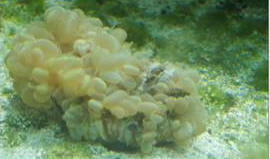
Bubble Coral Disease? (Or Maybe Environmental
Issues) -- 02/02/08 Hi Eric! <<Morning Don!>>
Sorry to bother you again but any chance of telling me what's
going on with this Bubble coral? I have had it for about 2 months
and the last week it has been looking like this. Thanks again.
<<Hmm'¦It is hard for me to discern much from this
photo (too small, too distant), but it appears the coral is
experiencing polyp bailout. This is usually a result of
stinging/poisoning from another coral in too-close proximity, a
result of 'light-shock' (either from being placed too
high in the aquarium or as a result of new bulbs, or maybe just
clarifying of the water from the addition/changing of filter
carbon), or a result of a decline in water quality or an
imbalance/deficiency of Earth/alkaline elements. If the coral is
not too close to another (or not being harassed by a fish), and
if lighting is not the issue, then look to your water
quality/chemistry. Ensure Nitrates are below 5ppm and that
Magnesium/Calcium/Alkalinity are all within NSW levels.
Also'¦have you been feeding this coral? Plerogyra
species are quite voracious predators and usually require
supplemental feeding for their long-term wellbeing (as do most
ALL corals, in my opinion). Small meaty foods like frozen mysis
(twice a week) are a good supplemental food for this coral.
EricR>>
|
|
|
|
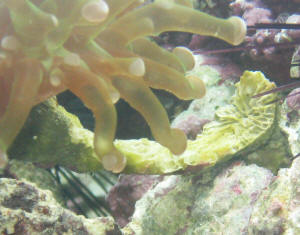
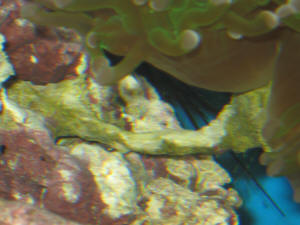
Frogspawn stalk question... hlth.
mostly, and a "blue" light LED f' --
1/26/08 Hi there, I have a seemingly healthy and happy
frogspawn that has grown from three heads to seven in about 5
months (he loves mysis shrimp). <Mmm, needs more than this,
nutrition and water quality supplement-wise> I have the 5 inch
stalk stuffed into a hole in one of my rocks to anchor it. well..
something is eating away at the stalk and it is looking pretty
weak at this point so I have two questions. 1) what do I do once
it breaks? <Re-orient, place it> and 2) what is eating the
stalk? <Perhaps nothing. Have you observed a predator?> I
have two ridiculously large black urchins, <Mmm, could be
poking it> 1 scooter blenny, 1 fox face (he came after this
started) 4 green chromis, 1 mandarin, two tank bred percula
clowns, and something that is 1/2 pink 1/2 yellow his make eludes
me at the moment. I add calcium occasionally <How and why?>
and an all in one nutrient supplement once every week or two.
<... of what constituency, and how do you test for?>
I'll admit that I almost never change my water but I seem to
have a high evaporation rate and add a gallon of distilled water
per day( not sure if that is good or not but it certainly stopped
my algae issues). <And your stony coral health evidently> I
used to test my water constantly but now I do it rarely because
all looks well. <... can be deceiving. I "measure"
such events in life by "results"> I do have a
bristle worm problem that I am trying to solve. <Small
possibility that these polychaetes might be involved as
well...> Thanks in advance. <Ummm, well... there could be
"something" chewing et al. here... but could just as
well be an anomaly of water quality and/or nutrition at play...
making the skeleton of the Euphylliid "soft"... Need
more/real data to assess better... Or you might read:
http://wetwebmedia.com/carydisfaqs.htm and the linked files
above...> P.S. would you consider the PowerBrite 460 led blue
light a moon light? <Sure> I just bought it today and the
salesmen said it was a moonlight but it says its for growth??
<Mmm, blue? What wavelengths? See WWM re... will not likely
boost growth, or photosynthesis period. Bob Fenner>
Re: frogspawn stalk question -- 1/28/08 Thanks for the
response. Here is more info including photos to help with the
diagnosis. <Good ones too> My tank is 90 gallons. It's
been up for about 8 mo.s since we moved to Florida and prior to
that about 1 yr. My lights are CF, 3 10,oook, 2 50/50 actinic, 1
6700k (accidental purchase). GH 180, KH 80-120, Ph 7.5,
<Yikes... way too low... unable to biomineralize...>
Nitrite 0, Nitrate 10, temp 78. I did pluck a tiny star fish off
my frogspawn last night and another was on the rock nearby. I
have removed 6-8 over the last 6 months or so. I read that they
were a nuisance. Do you think they could be the problem? Stacy T.
<Could be some aspect of predation, but the pH... is a huge
issue here. Could be "it" alone... please... read re:
on WWM and nutrition of Euphylliids/Caryophylliids... RMF>
|
|
  Dissolving. Dissolving.
|
Injured pearl bubble coral 1/19/08 I
have a "pearl bubble coral" that was absolutely gorgeous
when I bought him about a year and a half ago for my first reef
tank, a 29g tank. I took good care of him, fed him, and gave him a
home where he seemed happy for several months - expanding up to six
inches above his skeleton. About 4 months after having him (and
only 5 months experience with reef systems) I let a friend watch my
system for a week while I was out of town. This friend made one
vital mistake, and she explained to me exactly what happened. She
had forgotten to mix some ph buffer with the top off water, and so
thought it would be fine to just add the powder directly to the
tank. It didn't dissolve as she had hoped (duh) and landed
directly into the middle section of my gorgeous coral.
<Yikes> I have to admit I thought he was a goner for a while,
but I tried my best to nurse him back. He was completely white and
sickly looking for about three months. It has now been nearly a
year since the incident, and the coral has regained some of its
color and still feeds regularly. It has also been moved into a 75
gallon tank and has been in there for about 6 months. It does not
however extend nearly as much as it used to (maybe only 2 inches at
the most now) and the middle section is very clearly dead. I am
extremely strict on my water quality and there is little to no
variation from my current parameters. I do a 5 gallon water change
every 2-3 days, with 1 ten gallon change once a week. 1.25
salinity, 0 ph4, 0 no3/no4, 0 ammonia, ph 8.3, 79-80 F. I would
love to see a full recovery of this animal, but am starting to fear
that it may not happen. I have given him a whole corner of the tank
to himself <Actually... your pic shows a polypoid life form to
the upper left of this Physogyra> to avoid any further stress
from other corals, and he is sitting in the sand, where he has
always seemed happiest. There is an Aiptasia anemone on the
backside of his skeleton <Ah yes> which I have tried to kill
several times, only to have him reappear (sometimes with a twin!).
The tentacles of the pest do not reach the flesh of the coral
however. <I do think they or their assigns do...> You can see
in the photo the right half of him is still alive and partially
extended. The middle section is dead (I approximate 2 mouths lost).
And there is still a single mouth on the far left that is still
alive. I just happen to have this photo on my computer at work, but
can get a clearer one if you'd like. I guess there are
several questions here. Is there a chance he will ever fully
recover? Will the dead section ever regenerate? <Possibly times
two> If not, would it be safe to cut him into two through the
dead skeleton in the middle? <Could try, but I wouldn't at
this stage... too weak, and may re-populate this area given better
conditions, time> (there is no fleshy part here) Is there
anything more I can do to help him out? <Mmm, yes. Principally
the removal of the pest anemone... See WWM re... and iodide/ate
applications, feeding... the use of a refugium....> I would love
to see him as happy as he was in the past. Any insight or
suggestions are greatly appreciated. <All are posted, expanded
upon on WWM> Also have in this tank: variety of xenia, colt,
variety of zoanthids, Fungia plate, green cup coral, mushrooms,
frog spawn; pacific cleaner shrimp, 2 perc clowns, purple firefish,
Swissguard basslet, 3 green chromis, yellow watchman goby, variety
snails and hermits. As always, thanks for helping with the headache
of understanding how to manage an oceanic world in our living
rooms! A wonderful resource that all aquarists would benefit from!
Josh <Mmm, do see WWM re the Glass Anemone removal et al.. And
this spiffy ppt. pres. re what's going on here:
http://wetwebmedia.com/cnidcompppt.htm
Bob Fenner> |
|

|
LPS
Lighting (One More Time!) - 05/18/06 Dear Eric R. <<Hello
Diane>> It's been a long time since I've written in and
the first time to you. <<Welcome back>> I have been trying
to follow Bob's advice; read, read, read some more, then make up
your own darn mind. (To paraphrase). <<Indeed>>
Well, I got the first part down. However, just when I
thought I had this lighting figured out I went to a different LFS and
POOF! here we go again. <<Ha!...nature of the
beast/hobby...opinions abound!>> If you would be so kind to go
over what I have and help me straighten this out. <<Would be glad
to provide my input>> We have a 125 gal. acrylic tank 72" X
18" X 20" with a 6" DSB. Lights
hang 11 to 12" above the water line and can be raised or lowered
as needed. <<Ok>> The lights are two 36" Power
Compacts, the left-one is SunPaq 10,000K/460-Actinic and the right-one
is SunPaq Dual-Daylight 6,700/10,000K. The
halides are 3 X 175 watts. Left is 6500K, middle is 20,000K
and right is 14,000K. <<Mmm, why the variation across the length
of the tank? Are you attempting to create differing
"zones/niches"?>> The yellow of the daylight halide is
tempered by the blue of the actinic and the blue of the 14K Halide is
tempered by the yellow of the daylight PCs (the 20K is because I have
read so many raves and Anthony's book BOCP says for LPS you can go
bluer.) <<Ok>> Well yesterday we went to a different LFS
and they had the MOST beautiful corals! We purchased several
and during the selection and bagging process I questioned the manager
as to his procedures for maintenance and lighting. He told me that 15K
are THE best and that my 6500K should only be used for high light SPS.
<<Too "general" a statement...I disagree>> Now
Drs. Foster and Smith will let me return bulbs for replacement but am I
that far off with my lights? <<I don't know, what are you
keeping/trying to accomplish with this lighting?>> There
can't be that much difference between 14K and 15K! <<Or even
20K...agreed>> However, I am not sure about the 6500K and the
20K. <<A marked difference in spectral output...but the 6500K
still contains enough "blue light" for most all
corals>> We have: (all bought yesterday),1 6" green Bubble
(Plerogyra sinuosa), 1 6" Favites (?) shared corallite walls.
<<Favites, yes...a shared wall between the calyces>> They
are both under the 65K with the Favites on the sand and the Bubble
three inches higher, on a rock. <<It may be fine, but keep an eye
on the Bubble coral. Plerogyra are not high light requiring
corals, if the "bubbles" looks to be turning brown or stop
expanding, do move it lower/to a more subdued lighting location>>
One 4" green Long Tentacle Plate/Disc (Fungia scutaria) on the
sand under the 20K with the most gorgeous green Fox (Nemenzophyllia
turbida) also under the 20K but under a ledge. To the right
of them are 2 separate pieces of Branching Hammer (Euphyllia parancora)
consisting of 8 and 9 heads respectively (after adaptation, thought of
moving apart under different lights to experiment?).
<<Sure>> They are also placed just three inches above the
sand bed, however the highest two heads are 6" below the water
line and they are centered between the 20K and the 14K. Now,
under the 14K is my baby, an Open Brain coral (Trachyphyllia geoffroyi)
whom I've had 2 years now. She is not the vivid color
when I purchased her (bright green and deep maroon) but I would swear
in the last few days her red is coming back! <<Maybe had
"too much" light before hand. It's not a hard
and fast rule by any means, but many LPS with "red" pigments
require/demand lower light levels than those with "green"
pigments>> The new bulbs are either more to her liking or else
the color was always there and I just couldn't see it under the old
5500Ks. <<A bit of both>> After all that I
guess my questions are, is the 6500K that bad?
<<Nope...especially considering the wattage/distance you have the
bulbs above the tank. That's not to say I think it's
the best bulb for your particular selection of
livestock. Speaking for me...for an LPS dominant tank I
would go with a higher Kelvin rating...10000K is a good "all
around" spectrum...but in this instance I would be tempted to go
with a quality 14000K or 20000K bulb for each fixture. Much
depends on your own sense of aesthetics and what your trying replicate
in your system>> (I have a 10K that I can replace it with but it
is WHITE!) Am not interested in SPS (never say never).
<< <grin> >> Is the 20K a good bulb for LPS?
<<With enough intensity, yes. If you go with 20000K I
recommend you move the lights to within 6-8 inches of the water's
surface>> The blue look is nice and the corals are beautiful
under them but I want what is best for the animals (short of leaving
them in the oceans of course). <<...of course>> These are
the only corals I want with the possible addition of a nice Hammer (E.
ancora) and maybe, sometime down the road a ways, I would love to have
an Elegance (Catalaphyllia jardinei). <<Do please read
up/research the Catalaphyllia well (you can begin here:
http://www.wetwebmedia.com/elegance.htm). This is not an
easy coral to keep, and is best tried in a specie specific system
designed to/for its care>> Thank you so much for your time and
patience. All of you are appreciated and I hope one day you
will all know how much! <<Thank you for the kind
words...we're happy to assist>> Wishing you the best of life,
Diane. <<And to you in kind, Eric Russell>> P.S. the LFS is
ATM in Las Vegas, Nevada the one on the corner of Patrick and Sandhill
in the Southeast part of the valley. Beautiful corals and
good prices. <<Hmm, will have to make a point to stop in next
time I'm in Vegas. EricR>>
LPS
Lighting (One More Time!) II - 05/20/06 Polyp Bailout in Branching
Hammer Dear Eric, Thank you so much for answering so quickly. You guys
(yes, and gals) are great! <<You're welcome...and thank
you>> But it seems quick as you were problems arise quicker!
<<Uh oh>> The Branching Hammer has just been dissolving
continuously since adding them to the tank. I have been
reading for two days now and since 2 a.m. this morning, But
other than photo shock (?) which I didn't think happened that
quickly, I am at a loss. I have also siphoned off two more
gooey brown heads of the Hammer. <<Mmm, photo shock
"can" have a rapid effect, especially if the coral was
already stressed...but from the "gooey brown" description,
I'm inclined to suspect a bacterial/protozoa
infection. Though admittedly pure speculation, but have you
read through our coral disease FAQs?>> I separated the two
pieces, leaving the best (?) of the two in its original location and
moving the other to the far left end where I have removed the 6500K
halide (to be replaced by another 14K Thank You
<<welcome>>). I also dipped this piece in an
iodine mix of one quart aquarium water and ten drops Lugol's for
ten minutes. It only has two heads, out of nine, that look
even halfway viable so I figured we had nothing to lose. The
other piece has two heads that look great and two that look iffy.
<<I would dip "both" pieces in the iodine
solution: http://www.wetwebmedia.com/iodfaqs.htm
>> We bought these corals on the 17th of May and this is the
first day the Green Bubble has inflated but it is no longer the
fluorescent green it was in the store, but rather a much paler green.
<<Hmmm, would have thought the bubble coral to inflate before
now...possibly telling (something in your water
parameters?). The color is "possibly" a function
of the lighting...maybe the LFS had more "actinic" over the
coral in the store>> The Long Tentacled Plate is starting to show
himself and the Fox looks to be doing O.K. Only the E.
parancora crashed (but I know it's still real early in the
game). At the LFS the corals were in maybe six inches of
water approximately 18 inches under 175 watt 14 and 20K
(3). The salinity was 1.025 but I forgot to ask about
pH. Anyhow I drip acclimated them over four plus hours and
swore I would not move them around for at least 2 weeks if at
all. But I'll probably move the Bubble lower when the
new bulb gets here. <<Okay>> Right now it is about 16
inches to the left of 20K, 5 inches below the water surface and 15
inches under the 10K/actinic P.C. My water parameters are
temp. 80 ; salinity 1.025; my pH was 8.3 at 6:30 last night and 8.0 at
7 this morning. <<Is fine>> I had added 1 tsp. Seachem Reef
builder directly to the tank in an effort to get my alk. up from
2.5. Added it last night and this morning my alk is
3. Amm. is 0, nitrites are 0, but my nitrates are 10.
<<Mmm...possibly a result of the decomposing Euphylliid...or an
indication something else is amiss>> I have a 6 inch DSB and
never had a problem with nitrate. I use a Turboflotor-Multi
HOB skimmer and (temporarily) an Aquaclear 110 with 2 new bags
Chemi-pure and one Polyfilter. <<Both good stuff>> My
iodine kit showed no iodine even after a couple of small water changes
(approx. 20%) over 2 days so I added 4 drops Lugol's, still nothing
on the test so I added 3 more drops, still nothing this morning.
<<Hmmm...>> I use I.O. salt and the new water tests at .05
iodine, (perhaps the chemical filtration). <<Ah...yes>>
Water movement is with 3 Aquaclear 70s
<<...? Aquaclear 70 power filters? How
often do you clean these...should be done "at least"
weekly>> and 1 Seio 820. <<Some additional
"vigorous" water movement would likely do this tank some good
as well>> I don't know what else to do except maybe another
small water change today to get the nitrates back to zero. <<I
recommend a 30-40 percent water change>> I did not think my
set-up was that different from the LFS where all the corals looked
fantastic! Do you have any suggestions. <<Mmm,
yes...dip both Euphylliids again (remove any diseased/dieing heads
first), perform a 40% water change, and keep monitoring water
quality/performing water changes as needed>> The sad thing is I
truly love the Euphylliid family and could easily picture a tank of
just them. <<Would be beautiful I'm
sure. Don't give up...get over this hurdle, learn from
the experience, and pursue your dream tank>> One more
thing. Do they dye corals? <<Some...mainly
"soft" coral species...a terrible practice>> The Bubble
was a very vivid neon green and the Fox is bright, almost fluorescent
green. (But the Hammer is/was a more normal brown and green).
<<Is rather unlikely these were/are dyed corals...have not heard
of this being attempted with stony/LPS corals. Regards, Eric
Russell>> <Unfortunately... I have. RMF>
Bubble
Coral health, systems - 05/17/2006 Hello everyone, I have
read and read on your site and others about my problem. I
have been in the hobby of reef aquariums for approximately two
years. I cannot seem to keep a bubble coral
alive. Everything I read states they are a hardy, good
beginner coral. I have a 110 gallon with approximately
160-200 pounds of live rock, various fish and many
corals. Nitrite, ammonia, are zero, calcium 360-400, ph 8.3
to 84, alkalinity (test kit is in high range color), nitrate
20-30ppm. I dose every morning with B-Ionic and add 16 drops
of iodine daily. I installed a refugium around three months
ago. I also have an Excalibur skimmer, chiller, 400 watts of
MH in addition to actinic blue lights. I do a 20 to 30%
water change weekly, with RO water, aerate it for couple of days, heat
water to same temp. in aquarium, etc. My bubbles always do great for
four to six weeks. Then, the septa's begin turning black
and ½ to ¾ of the bubble stops opening
up. I feed the bubble nightly with Mysid
shrimp. Each time this has happened, the bubble coral was on
the bottom of the tank. The last time this happened I moved
it about half way up the tank. The remaining few bubbles did
fine for around two months, then the bubbles just stopped inflating and
died. I am very stubborn and determined to get a bubble to
live. This time I have purchased a large bubble coral and am
hoping for the best. What am I doing wrong? I
have an elegance coral and other more difficult corals doing very
well. Any help would be very much appreciated.
Thank you, Robin R. Shelton <<Robin: Do you know
specifically what species you have? In general, Bubble
Corals like moderate light and low to med flow. With your
lighting, I would think they would like a quiet place on the
sand. As you know, many reefers regularly get their tanks to
0 Nitrates. Thus, for corals 20-30 ppm would be considered
quite high. For me, having a skimmer solved part of the
problem. The rest was solved by growing Chaeto algae in the
sump. For you, switching from RO to RO/DI should also help.
Why are you dosing iodine? Most people don't and a general rule of
thumb is don't add something you can't test
for. Until you resolve your nitrate problem, you it would be
better off not to introducing more corals into your
tank. Take a look at the links I have
attached. Given your previous luck with Bubbles, I think a
smaller one would better handle the transition to a new tank than a big
one that spent a long time living somewhere else. Best of
luck, Roy http://www.wetwebmedia.com/nitratesmar.htm
http://www.advancedaquarist.com/issues/august2003/chem.htm>>
Damaged Frogspawn ...
prop., health 4/25/06 Hi all, <Debi> Well
to make this short and not so sweet. I was cleaning my tank,
46 bow front salt, changing water etc, when I stupidly decided to
shorten the stem on my very pretty Frogspawn. The LFS told
me I could just break off the end and made it sound simple so I did,
but I had to put more force on it than I expected and when it broke off
it banged it's head (sort of opened up) on a rock and several
little green pieces broke off. <Mmm, best/better by far to do such
"operations" outside the main tank... with the animal shaken
(not stirred?) a few moments ahead to cause the polyps to
retract...> Needless to say, it immediately retracted in
shock and I also retracted from the tank in shock. I had no idea what
to do so I repositioned it in the same place it had been, quickly
finished my tasks and decided to leave it alone, either to die or
recover. My question is whether or not I can do
anything else for it (anything good) aside from leaving it
alone. Should I take it out and put it in the QT tank of
which I am not so sure it is ready? <Mmm, I would not... given just
the information presented here. Much more likely to cause further
trouble at this point likely> Should it be dosed with Iodine and can
that be done in the show tank? <This is likely best>
I feel awful, he was so pretty and now he's just all sucked in and
I have no idea if he is beyond repair or not. Thanks <Euphylliids
are very tough if/once established... I give you good odds of complete
recovery. Bob Fenner>
| Losing my torch coral (semi-urgent) and treating a clown
goby - 5/5/2006 against ich... Hi Mr. Fenner, Hi
Everybody, <Dominique> Sorry if I have been writing a bit too
often these days... Hope I'm not pushing too far with my once a
month average at the moment... My reef tank has one year this month
and very healthy and successful and I owe you a lot for that
result. Now that said, nothing is ever perfect and I have a few
problems right now... of course... 1- My greatest concern for now
is my torch coral (Euphyllia glabrescens). I wrote a few months ago
because he was invaded by what we finally id as ostracods. We
concluded that they were not a problem and I still stick to that
conclusion. Just mentioning it here in case you see a link. Two
weeks ago the otherwise apparently healthy and expended coral very
quickly lost a complete branch. Large fleshy parts were hanging
until showing the septae/skeleton. Then bunches of polyps
hanging/falling together... Within a week the branch was clean,
white, and dead. The rest of the coral still seemed very healthy
and I thought everything would be ok now... until today. I noticed
the same thing was happening to another branch and I fear I will
lose the whole coral if I do nothing so here are some pictures I
took today. <No pix came through> I tried find something in
my books but no success (I have Aquarium Corals from Borneman,
Coral Propagation, and Reef Invertebrates). I have potassium iodine
and Lugol's (not used to dose the system) so should I try a dip
and with which one (I guess Lugol's)? <Yes and yes>
Please help me if you can. That would be my first failure with my
corals. It hurts even more when I think that that species is not so
widespread and fast-growing in the ocean... I also fear contagion
to my two hammer corals... Here are my parameters: temperature:
81.4F (very stable with Neptune + heater and fans...) salinity:
1.0255 (very stable with Tunze Osmolator...) calcium: 375 Alk: 9.2
Nitrate and Phosphate: 0 Ammonia: 0 under 250w 13.5k megachrome at
18" deep with gentle current and partly shadowed by some high
placed LR. 2- I am now treating a green clown goby (Gobiodon
hystrio) against ich. I set-up a quarantine/hospital tank system
with two 10gal and one 25 gal tanks. The goby has periodic ich
outbreak since I got him. He seemed to do fine with this condition
and no other fish in the tank ever shows symptoms. Now I decided to
use the copper treatment in the 10gal hospital tank. Also thinking
of leaving him there for 2 months. I did not remove the other
fishes from the display but I guess if they don't show symptoms
during those 8 weeks and the clown goby too then it shouldn't
come back (right?). <Mmm... no... likely the system itself is
infested... the other fishes just sub-symptomatic> Only now I
discovered that those fish are somehow sensitive to copper. My
question is: if hyposalinity is not efficient and if copper and
formalin are dangerous to that fish, how do you treat it? <...
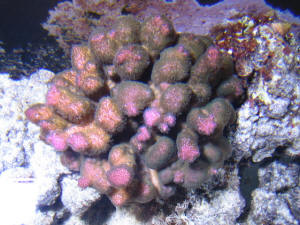
posted on WWM> 3- BTW could you help ID this coral. I got it
several months ago and was never sure about the species. The LFS
(one I don't trust too much) sold it as a "cats paw"
Pocillopora. Now while I am quite sure it's a Pocilloporidae, I
hesitate between the genus Stylophora and Pocillopora. The species
I can't tell for sure (damicornis?). Can you tell with that
picture? <No pic> In any case I think it requires very strong
water flow and lighting. Well at least that's what he gets now
and seems fine with it, showing growth and improving color (turning
from brownish greenish orange to pink). I can send a few more
pictures of the Pocilloporidae and of the agonizing glabrescens,
just didn't want to overload you... Many Thanks! Dominique
<Please do try re-sending these. Perhaps to my personal email
addr.: fennerrobert@hotmail.com Bob Fenner> |
| Pix did come through on my personal addy. The Coral in question
does appear to be a Stylophora species, and for the health of the
Euphyllia, please read over the section on WWM re the family
Caryophyllidae. RMF |
|
|
| Frogspawn Frustration - 05/07/2006 Hi, Sorry but I
forgot to mention one thing in the previous email. About
a day and a half after the water change (original text included
below) when I noticed that the coral was not doing well I checked
the SG and it was then at 1.018 according to my
hydrometer. I quickly called the LFS I had bought the
water from and they thought that my measurement probably wasn't
correct but said if I believed it to be that low to add one cup of
salt dissolved in some RO/DI water. I did that and the
next day was when the other LFS measured it at the current
1.023. So it occurs to me that maybe there was something
wrong with the salt water I got from the first store causing the
salinity to drop and would that have affected the coral this
way? Also, one other thing. When I changed the
water I removed the salt water first, replaced the salt water I had
removed with the new and then topped off with
RO/DI. Does the order I did this in
matter? Could that have caused the problem? Thanks
again, Debi Original message was......... (Hello Bob or whichever
expert happens to answer this, hope all is well with you.) My
frogspawn isn't well and I cannot figure out what can be the
problem. I have attached two pics so you can see the
decline for yourself. My tank specs are as
follows: 46 gallon bow front, 60 lbs. live rock and one
inch of substrate sand, Aragonite I think, Remora Skimmer w/Aqua
Jet 1200, one Aqua Jet 600 PH, one Seio 600 PH. occasional use of
an Aqua Clear Power Filter for running carbon and
PolyFilter. Ran carbon for about two weeks and took it
out yesterday, replaced it with PolyFilter. At the
moment the Aqua Filter is not on and has been off since
yesterday. Lighting is 36" 2x96 Coralife Aqualight
w/Lunar Lights, 1x Actinic and 1x 10,000K. Lighting is
run Lunar constantly, with Actinic 12 hours and White 10, Actinic
comes on one hour before the white and stays on one hour after if
goes off. The tank does have a canopy with a glass top
which I leave open for oxygen exchange. Bioload is light
with two false percula, one red striped shrimp, one sand sifting
sleeper goby, one frogspawn and various snails and hermit crabs,
along with some green hair algae and some red slime. The
water tests are Ammonia-0, PH 8.2 to 8.4, Nitrite-0, Nitrate-0,
Phosphorus-0, Calcium 550, Alk 2.5, SG 1.023 and temp 79-80
Fahrenheit controlled by a temp controller. These
results confirmed by my local LFS and myself. I feed
with Mysis and Cyclops-eeze in a squirt bottle, usually once a day,
add a little garlic drops and some occasional Selcon to the food.
and DT's weekly. Additives are only Iodine weekly and now
I have used Bi-Ionic 2 part for the past couple of days at 30 ml.
each both days on the advice of my LFS because he says my
alkalinity is low. Normal water change schedule is 15
percent every 10 days. It started three days ago, just one
day after a I changed 6 gallons of water and added 2
gallons top off RO/DI. Both purchased from the LFS and
the same as I have been using for the three months this tank has
been up and cycled. I noticed that there were some
bubbles around the top edges of the water when I started the
change. I thought that was strange. The
frogspawn was looking pretty good as you can see in the before
picture then the morning after the water change he began to look
like one side was not coming out very much at all and has been
going further and further in for the last two days resulting in the
after picture. The after picture is taken with only the
actinic around 10 pm, but he looked this way all day. As I
mentioned all water parameters seemed to be good except for the low
Alk which I am working on. The only thing besides
changing the water that I can think of that is different is that
during the change I siphoned up quite a bit of red slime that was
on the sand and did get the sand stirred up quite a
bit. I also seem to have a small problem with green hair
algae in the lower part of the tank. My LFS has
suggested a lawn mower blenny for the algae. Could I
have stirred up something from the sand that could be affecting the
coral. I know that the Cyano is a bacteria and I know I
didn't get it all out. Would that be the
problem? I haven't changed the lighting or the
corals position since he came home, I have had him about a
month. I haven't had the best luck so far with this tank
as I have lost a Royal Gramma about two months ago, a Yellow Tang
about 3 weeks ago and a 6 lined wrasse about 2 weeks
ago. I have no clue what happened to any of them as
there were no obvious signs of Ich or anything
else. They just slowly died over a matter of days after
my getting them. The Tang only lasted about 10
hours. I have decided to try buying my live stock
someplace else. I realize this is a new tank by normal
standards and will go through settling in pains, but it has been
cycled for three months now and the store says I am doing
everything right. The clowns and shrimp and goby look well
and are eating and the shrimp has molted twice in two months, last
time just yesterday. The goby has recently started
taking his sand up high to sift (like mid tank, is this
significant) and so the sand is on the rocks a lot, occasionally I
blow it off with a turkey baster. That's all I can
think of that might be relevant. Sorry for the length I
just wanted to make sure you had all the
information. Please any suggestions or help would be so
appreciated as this is getting frustrating to me as a new hobbyist
that is trying to do everything good to take care of my
fishies...............) Thanks in advance, -Debi
<Debi - Frogspawn are usually very hardy. They like
medium light and medium to low flow. Unfortunately, I
could not see your images. When you do water changes,
you should try to keep your SG stable. Thus, if you need
to top off with fresh water, you should do it first before you do a
water change. Since Hydrometers can be unreliable, you
should invest in a refractometer. You can get them on
eBay for around $40. The accuracy and piece of mind they
give is worthwhile. I am concerned with your fish
dying. You should have a quarantine tank for all new
purchases. When you get the refractometer, check the
SG. You may find that it is much different than you
thought. Regarding iodine, most people don't add
it. The general rule is don't add something you
can't monitor and test for. Best of
luck, Roy> |
| Frogspawn Frustration - II - 05/07/2006 Sorry, this is a
resend of a sort because when it was sent the first time I
accidentally left out what might be pertinent information and also
the kind person (Roy) that tried to answer it couldn't see the
pics and consequently only commented on a portion of the
message. Does it sound like I should be looking for
other problems? What would they be. The fish
dying are also an issue and the LFS always says the water tests are
good and has no idea what could be the cause. <Debi - Frogspawn
are usually very hardy. They like medium light and
medium to low flow. The pictures were
helpful. Sometimes it takes them several days to adjust
to a new location or to being moved. In the before
picture, your frogspawn is sweeping in one direction. In
the after picture, the frogspawn has retracted on the side where
the flow seems to be coming from (retraction is normal if something
is not right). If you can adjust the flow, I would first
try reducing the amount of flow that hits the frogspawn (or find
something to put on the left side to block some of the
current). If that works, I think the branches will come
back out. Another possibility is if the lighting is not
the same over both sides of the frogspawn (i.e., if one side is in
the shade compared to the other side). I have seen
frogspawn branches retract if there is not enough
light. Since frogspawn are hardy, I don't think what
you feed, or how often, has anything to do with your current
problem (mine grow like crazy and I have never target fed
them). The amount of algae you currently have in the
tank may be a result of overfeeding. You might want to
feed a bit less rather than buy a Lawn Mower Blenny which usually
won't eat Cyano or Hair Algae. I don't think the
Cyano or Hair Algae will have much effect on the frogspawn as long
as they are not growing on it. When you do water
changes, you should try to keep your SG stable. Thus, if
you need to top off with fresh water, you should do it first before
you do a water change. If you don't, you could have
a high SG spike if you dump in the new salt water and then use
RO/DI to get the SG back down to 1.023. Since
Hydrometers can be unreliable, you should invest in a
refractometer. You can get them on eBay for around
$40. The accuracy and piece of mind they give is
worthwhile. I am concerned with your fish
dying. You should have a quarantine tank for all new
purchases. When you get the refractometer, check the
SG. You may find that it is much different than you
thought. Regarding iodine, most people don't add
it. The general rule is don't add something you
can't monitor and test for. Best of
luck, Roy> |
|
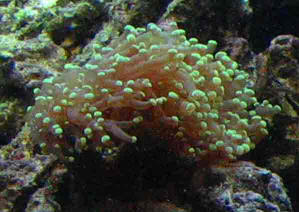 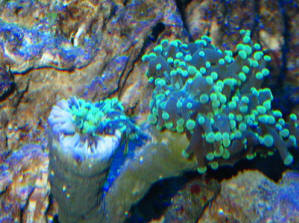 Before, after Before, after
|
|
|

