 |
|
| Home | Marine Aquariums |
Freshwater Aquariums |
Planted Aquariums |
Brackish Systems |
Ponds,
lakes & fountains |
Turtles & Amphibians |
Aquatic Business |
Aquatic Science |
Ask the WWM Crew a Question |
| Please visit our Sponsors | ||||
|
As much as humans are wont to be adverse to change, taxonomists keep things a-changing in their worlds of classification... As new evidence surfaces, is made up, discussed/discoursed animals get moved around in their "higher taxonomic schemes". Here is the bulk of what aquarists used to know of as the family Caryophylliidae, moved to a new familial aggregation by Veron (2000) to their own grouping, the Euphylllias. Looking for Eusmilia? Go to the family Meandrinidae.
Aquarium Use: This new family contains some of the most beloved (and one of the most vilified) species of reef aquarium-friendly Scleractinians. Most of the Euphyllids are hardy, adaptable animals given basic care... and all are good looking. They are also excellent water quality bioassays. Should their water be less than acceptable this family will fail to open its polyps. Selection: Due to their sharp, often thin-walled skeletons most of the Euphyllids are easily damaged in collection, shipping, handling. Take care to carefully examine prospective buys. Prophylactic dips involving half doses of malachite green and diluted seawater have proven efficacious in treating many cases of tissue degeneration on arrival at wholesale facilities, but many specimens are lost to avoidable trauma. Colonies should only be touched on their non-living undersides, gingerly wrapped in sheets of plastic bagging underwater and double, triple bagged with a liner for transport. Placement: Is very important with these animals. They possess very expansive bodies and stinging tentacles which can/will extend to other sessile invertebrates placed near them. Further, there is a good chance of negative chemical interaction with Soft Corals (Order Alcyonacea) should these be crowded, challenged. I would leave at least six inches of "no man's land" space between colonies of these species and any/all other sessile invertebrate livestock. Take care to acclimate new specimens (via water transfers) and introduce all as small specimens if possible. Other countervailing strategies like the use of activated carbon, frequent partial water changes, effective mechanical filtration are suggested. Environment: Medium lighting and weaker current are appreciated by Euphyllids. Many are collected in shallow, turbid waters in the cover of mud/silt and seagrasses. Excessive water movement can be a cause of sweeper tentacle extension and subsequent stinging of tankmates. Likewise, the family is quite susceptible to photo-shock. New specimens should never be exposed to powerful lighting. Instead, place them in deeper, indirectly illuminated areas initially. Foods/Feeding/Nutrition: These corals are ready "macro-meaty-food-item" eaters. Surprisingly large pieces of cut fish, invertebrates (e.g. cut clam, shrimp, squid...) as food can/should be offered directly to their feeding tentacles. I suggest this be done at a rate of twice a week... to balance between sustenance and pollution from overfeeding. I also endorse a once weekly soaking of these foods in a vitamin preparation before offering. Disease: As mentioned, damage leads to easy losses either quickly or more slowly via tissue recession or Brown Jelly Disease (protozoan, bacterial involvement). Filamentous algae growth on denuded sites can be real trouble. Some folks have outbreaks of various flatworms (Platyhelminths) on these corals, but these are best ignored, rather than treated for.
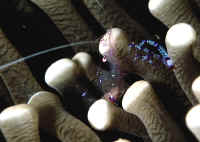
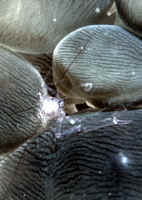
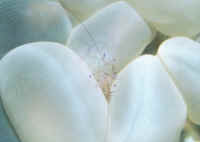
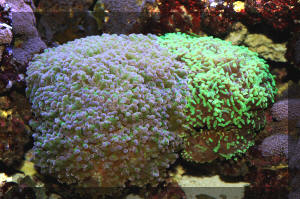
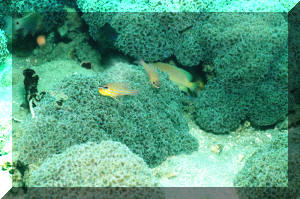
Interaction with Other Invertebrates: This family is host to a large number of non-vertebrate marines. Look closely in the wild and at specimens in captivity. Here are some Periclimenes holthuisi in Euphyllia ancora and Plerogyra sinuosa in the wild. Be on the lookout for less-than desirable life forms as well... like larger Bristleworms.
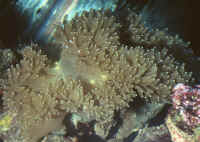
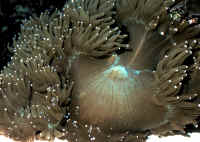
Euphylliid Genera, Notes: Genus Catalaphyllia Wells 1971: One
species, the Elegance Coral. Flabello-meandroid skeletons. Even, smooth
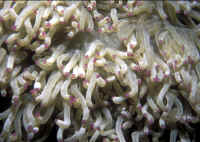
septa (both seen when animal is dead). Tentacles tubular w/ pink tips; colony
surface with striped appearance.
Genus Cladocora:
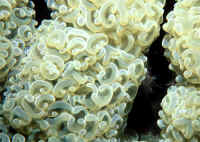
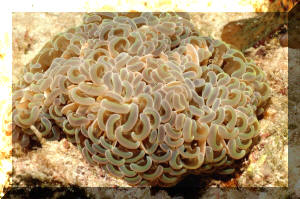
Genus Euphyllia Dana 1846: These corals are unified and
identified by salient characteristics of their skeletons, the walls of
which are thin, solid, smooth edged, reach from the middle to edge of
colonies. These skeletons overall form is flabello-meandroid or phaceloid.
Their corallites show small gaps between their exsert septa. Tentacles
are long, variously terminated shape-wise, and out both day and night.
|
|

|
Features: |
|
| Featured Sponsors: |
.JPG)
.JPG)
%20MD.jpg)
%20MD.jpg)
%20MD.JPG)
%20MD.JPG)
%20MD.JPG)
%20MD.JPG)
MD.JPG)