|
| |
|
Related FAQs: Euphylliids/Caryophylliids,
Caryophylliid Corals 2, Caryophyllids
3, Caryophyllids 4,
Caryophyllid ID,
Caryophyllid Compatibility, Caryophyllid Systems,
Caryophyllid Selection,
Caryophyllid Behavior, Caryophyllid Feeding,
Caryophyllid Disease, Caryophyllid Disease 2,Caryophyllid
Disease 3, Caryophyllid Disease 4,
Caryophyllid Propagation/Reproduction, Elegance
Coral, Elegance Corals 2, Elegance
Coral Identification, Elegance Coral Selection,
Elegance Coral Compatibility,
Elegance Coral Selection,
Elegance Coral Systems,
Elegance Coral Feeding,
Elegance Coral Disease/Pests,
Elegance Coral Reproduction,
Stony
Coral Behavior,
Related Articles: Dyed Corals, Stony/True Coral,
Coral System Set-Up, Coral
System Lighting, Stony Coral
Identification, Stony Coral Selection, Coral
Placement, Foods/Feeding/Nutrition,
Disease/Health, Propagation,
Growing Reef Corals,
/The Best Livestock For Your Reef Aquarium:
Frogspawn, Grape, Anchor, Bubble... and Elegance
Corals, Family Euphylllias (formerly of the Caryophylliidae), Pt. 2
To: Part 1
|

|
|
By Bob Fenner |
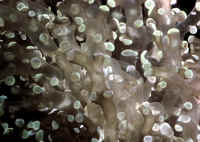
Catalaphyllia in the wild
|
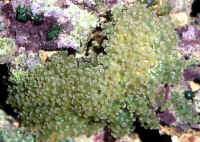
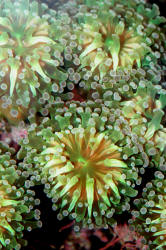
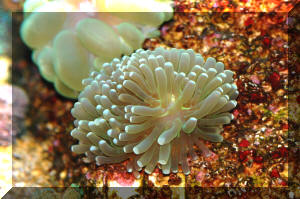
| Euphyllia cristata Chevalier 1971, Grape Coral.
Colonies of 1-2 inch diameter. Large, circular polyp tentacles with round
to flattened knobbed ends. Below: two pix in aquariums and one in N.
Sulawesi. |
Bigger PIX: The images in this table are linked to large (desktop
size) copies. Click on "framed" images to go to the larger size. |
 |
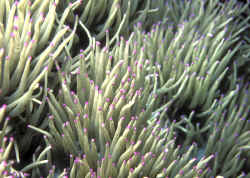
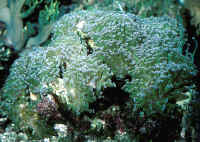
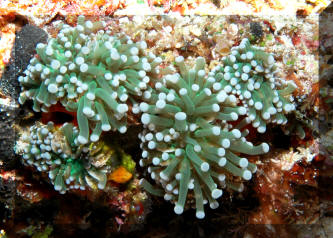
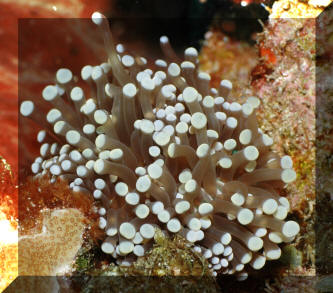
| Euphyllia divisa Veron & Pichon 1980, Frogspawn
Coral. Characterized by tubular tentacles with branchings and knob-like
ends. At right, green colony, a one meter one in Malaysia and three
aquarium close-ups below. |
 
|
| Euphyllia glabrescens (Chamisso & Eysenhardt
1821), Torch Coral. Branches 1-1 1/2 inches wide with about one inch gap
between. Skeletons thin and delicate. Tubular tentacles with rounded tips.
Aquarium specimens at right and below, the last with partially exposed
skeleton showing phaceloid colony |

|
| Euphyllia paraancora Veron 1990, Branching Hammer
Coral. Polyps very similar to E. ancora, but arranged in circular
patterns. Aquarium photo. |

|
Genus Nemanzophyllia Hodgson & Ross 1981, Fox, Ridge, Jasmine
Coral. One species.
| Nemanzophyllia turbida Hodgson & Ross 1981, very
thin-walled skeletons of flabello-meandroid construct. Distinctive lined
polyps that are joined and truncated by living and dead portions of
colonies. Best kept in medium current in low light conditions. A wholesale
specimen at right, and two below in aquariums. A great aquarium
species. |

|
Genus Physogyra Quelch 1884, Pearl Coral. One species
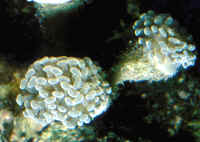
| Physogyra lichtensteini Milne Edwards &
Haime 1851. Massive or large plate colonies that are made up of solid
plates. Tentacles open at night. During day, grape-like vesicles evident,
able to be retracted quickly, unlike Plerogyra. At right, aquarium
specimen and partly open vesicles in the wild. Below, completely open
vesicles, closed colony and massive one showing skeleton Bunaken/Indo.
images. |
 
|
Bigger PIX: The images in this table are linked to large (desktop
size) copies. Click on "framed" images to go to the larger size. |
 |
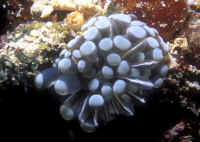
Genus Plerogyra Mile Edwards and Haime 1848, Bubble, Bladder, Grape Coral.
Characterized by their colonies being covered by oblong bubble-like vesicles by
day, tentacles by night
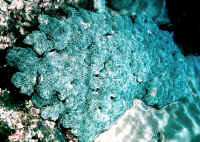
| Plerogyra sinuosa (Dana 1846).
Flabello-meandroid skeleton as shown, with grape-like variable vesicles
that are slow to retract (but still can/do sting). Typically found in
turbid water. Aquarium and two wild images (Indonesia) below showing
vesicles open, a large colony and close up of skeleton at night. Below,
second row: Skeleton close-up a small and large colony in the Red
Sea. |
| Plerogyra simplex Rehberg 1892. Similar vesicles as P.
sinuosa but colonies with branched skeletons of phaceloid colonies.
Specimens off of Bunaken, Sulawesi, Indonesia. |
 
|
Bigger PIX: The images in this table are linked to large (desktop
size) copies. Click on "framed" images to go to the larger size. |
.JPG) |
Conclusion:
Amongst the most popular aquarium corals, Euphyllids have
much to recommend their captive use. They're certainly beautiful, interesting
behaviorally, and conditionally hardy. Most need space around them, clean water,
low lighting and water movement, and occasional feeding... outside of picking
out initially healthy specimens. They're larger losses are mainly a matter
of a lack of care in collection and handling beyond. Don't let this short
introduction decide for you however whether members of this newly-made family
are for you. Investigate further before buying.
Bibliography/Further Reading:
Coral Search
Borneman, Eric H. 2001. Aquarium Corals; Selection, Husbandry and Natural
History. Microcosm-TFH NJ, USA. 464 pp.
Fatherree, James W. 1999. Elegance Coral. TFH 8/99.
Fatherree, James. 1999. Common corals of the genus Euphyllia. TFH 9/99.
Fatherree, James. 1999. Bubble corals in the reef aquarium. TFH 11/99.
Fenner, Robert. 2000. Catalaphyllia. What's wrong with your Elegance Coral,
family Catalaphylliidae. FAMA 3/00.
Fossa, Svein A. & Alf Jacob Nilsen. 1998 (1st ed.). The Modern Coral Reef
Aquarium, v.2 (Cnidarians). Bergit Schmettkamp Verlag, Borhheim, Germany. 479pp.
Giovanetti, Thomas A. 1989. Keeping Plerogyra
sinuosa, the Bubble Coral. FAMA 7/89.
Hoover, John. 1998. Hawai'i's Sea Creatures. A Guide to Hawai'i's Marine
Invertebrates. Mutual Publishing, Honolulu HI. 366pp.
Humann, Paul. 1993. Reef Coral Identification; Florida, Caribbean, Bahamas.
New World Publications, Inc. Jacksonville, FL. 239pp.
Michael, Scott. 1996. Bubble Coral; the opinions
about keeping them seem to be inconsistent. AFM 3/96.
Verloop Ria and Ron Ates. Elegance Coral Catalaphyllia
jardinei. FAMA 12/99.
Veron, J.E.N. 1986. Corals of Australia and the Indo-Pacific. U. of HI press,
Honolulu. 644 pp.
Veron, J.E.N. 2000. Corals of the World. Australian Institute of Marine
Science. Queensland, Australia. three volumes.
To: Pt. 1
| |
|