|
|
| Home | Marine Aquariums |
Freshwater Aquariums |
Planted Aquariums |
Brackish Systems |
Ponds,
lakes & fountains |
Turtles & Amphibians |
Aquatic Business |
Aquatic Science |
Ask the WWM Crew a Question |
| Please visit our Sponsors | ||||
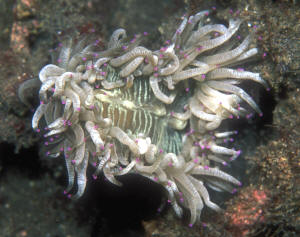
Elegance question 01/31/09 Hi guys and gals at WWM. I use your site often, thank you for being so dedicated to the hobby and hobbyists. I'm in the process of researching Elegance corals and want to add one to my system, but the more I read about them the more conflicting information I get. Some say that they should be placed in the substrate and not receive direct light contact from MH's, others say they are accustomed to high light and should be positioned higher in the tank under MH's, and yet other say something entirely different. I realize that some elegance corals come from lagoons were they receive high nutrient loads and live in the substrate and others are located were they receive low nutrient loads and are attached to rocks. I've read the articles on WWM and have read several coral books (Aquarium corals Eric Borneman, Coral: a quick reference guide Julian Sprung, and others) that discuss Elegance corals, but I'm still confused about their proper placement, light requirements and general hardiness within a reef system. <Ah, join the club. As you've noted (and bless you for your diligent research), elegance corals can come from different habitats. And that's a part of what makes knowing their care requirements difficult. On top of that, there's something called "Elegance Coral Disease" that has been wiping out these corals left and right. Unfortunately, very little (if anything), is known about the condition/disease. There are a lot of theories (as I'm sure you've come across), but no one really knows.> Is all the conflicting information surrounding Elegance coral care due to their varied habitat? <Most likely, yes.> Also I've read that Australian harvested Elegance are substantially more hardy than other Elegance coral and LiveAquaria.com rates the Australian Elegance coral care as moderate and boasts that they are very hardy were most other e-tailers rate Elegance coral as difficult. In your experience are Australian Elegance coral any more or less hardy than Elegance corals harvested from other locations? <Truth is, I do believe that even the so-called "Australian" Elegance corals are from the same general areas as the other Elegance corals [BobF: please correct me if I'm wrong here.]. <<Catalaphyllia specimens are also/still collected in Indonesia... have not proven sturdy in recent years. The ones from Australia are far superior. RMF>> I run a 220G display tank that is attached to a 300G sump/refugium. My lighting is 3x250W MH's that I run for 12 hours a day for my display, and my sump has 4x65W T5 HO fluorescents that I run for 12 hours on the opposite photoperiod. I have about 200 Lbs of live rock and a 4" DSB in the display and another 200Lbs of live rock and another 4" DSB in the sump. I utilize Chaeto and Caulerpa for nutrient export in the sump as I don't routinely run a skimmer. I also use bonded filter pads for mechanical filtration. My water parameters are Alk 9.0, Cal 425ppm, pH 8.2, Amm 0, Nitrates 0, Nitrites 0, <All sounds good.> and I do 15% water changes monthly. <I might up these to 20%, but now I'm just being nit-picky.> For live stock I have mostly LPS with a couple of softies (xenia and toadstool) for fish I have: yellow tang, hippo tang, bi-color anthias, 2 Firefish, 2 mandarins, lawnmower blenny, sand sifting goby, and 3 Banggai cardinals. I'd like your opinion on whether or not I could successfully maintain an Elegance coral in this system, and if the origin of the specimen really has an impact on the hardiness of the coral once it is in your tank? Also does color of tentacle tips and shell shape play an important role in determining success of the coral in the aquarium? <The color, no... but if the body of the coral is swollen and the tentacles short/stubby, then it is very likely disease. If I were you, and I would just try to find an elegance coral that's been doing well in a LFS (or in some system, any system) and just put it under the same conditions it's been doing well under. So, say a LFS has an elegance coral that's been doing well on a sand bed, under moderate light, for a few months... then get that coral and put it on a sand bed and under moderate light. If you find one that's been thriving under MH and on rocks... put it under MH, on rocks. Unfortunately, that's about the only good advice I can give you.> Thank you Joe <De nada, Sara M.> Catalaphyllia jardinei hardiness - Adult vs. Juvenile stages? 07/20/2008 Dear WWM Crew, <Trent> I've read somewhere (not sure where, I've tried and failed to find the reference) that it's thought that this species of coral has at least two nearly indistinguishable life stages: a cone-shaped juvenile stage where it lives detached from the reef in deeper waters (20m) and an adult stage where it's brought by currents to grow attached to the reef in shallower waters. <Mmm, actually, the morphology is a function of two principal different collection types... a more shallow, mucky population being distinctly more wedge-shaped, the deeper water ones (same species) less so... among other differences... importantly here/to hobbyists; relative survivability of specimens... the shallow water being much more hardy> This source pretty much agrees with the husbandry of the coral suggested in Bob Fenner's article 'Catalaphyllia; What's Wrong With Your Elegance Coral, Family Caryophylliidae' (low-moderate diffuse light, higher nutrient levels, low-moderate water flow, horizontal placement, etc). However, the source claims that the 'adult' form is hardier than the 'juvenile' form and the two forms can be easily distinguished because the adult's calcareous skeleton will have obvious damage incurred during its breaking from the rest of the reef by the harvester. <Mmm... better to seek out specimens that are entire/whole... not sections that have been broken from a larger/parent> Evidence suggesting that this may contain some truth can be found at www.liveaquaria.com. On this site they offer this coral from 'eastern Asia' and 'Australia.' The skeleton of the form off Asia is undamaged because it lived detached from the reef, but the form found off Australia has damage to its skeleton because it had to be broken from the reef. <Really... want to emphasize to hobbyists that the "free" phaceloid specimens of this species are MUCH more suitable for their use, purchase than pieces of attached colonies that have been broken off... Is this clear?> They claim that the 'Aussie' coral is hardier than the other (which is reflected in its price) and that the damage to the skeleton will not be detrimental to the living animals. <Mmmm> What's your take on this juvenile v. adult theory? <Is bunk... not an age difference at all, but habitat, developmental. Attached colonies (similar to Goniopora... stokesi if you will) may be "older" but not necessarily... they are less appropriate (survival wise) likely due to damage in collection mostly> It seems to me that this would agree with the history of success of these animals being kept in aquariums. About a decade ago this coral was generally considered very hardy, but as time went on (and the depth at which these animals were harvested grew deeper due to limited supply) hobbyists tended to think the coral was becoming more difficult to maintain. It would seem that the hardier 'adults' were all harvested at the shallower depths and the harvesters were now going for the more delicate 'juveniles' at greater depths. <The historical data is such...> Last questions: I'm planning a species-specific aquarium for this coral and I was wondering, would a 70W MH be too strong/concentrated for these animals if the tank's depth is only 17in? Would a couple of PCLs be better? <Mmm, either could be made to work... adaptation of the specimen to either is encouraged... with shading...> How much (lbs/gallon) live rock would you recommend? <As much as is reasonable, looks nice to you... Again, I would not be fastidious re nutrient levels per se, would use a good deal of very fine material, mud...> The tank I have is, for some reason, called a 95 wide at 48inX24inX17in, but its actual volume is closer to 85 gallons. Trent W. P.S. - I just ordered the new edition of the 'Conscientious Marine Aquarist' and I can't wait to read it. <I do hope/trust you will enjoy this second ed.. Bob Fenner> Catalaphyllia jardinei, Austr. avail. in S. Africa... 2/22/08 Hi Crew, I have been reading on a few sites that Catalaphyllia jardinei from Australia are available in the U.S. <Yes> How can we in South Africa get this beautiful coral? <I don't know... but do know who I would ask next... the South African Reefers club that way. Are you familiar with the group? Seem to be a fine group of earnest, friendly folk: www.marineaquariumsa.com I'd post there re this issue> I am sure Bob Fenner and Anthony Calfo can provide us more information. thanks Mohamed <BobF, who knows naught re the trade there.> Elegance coral ?? 12/7/2007 HI Bob! <Sara M. here.> In a forum, someone was saying how great a store's elegance corals were. I said, well I bought one there and it was supposedly from a good source and would not die. Took 6 months, but it did. Went against every fiber of my being to BUY it, but my corals never die on me. So I figured I would give it a shot. I did everything you are supposed to do and YES my tank always has 20 to 30 nitrates (no phosphates and my sps even grows!.... they are at the top of course) Anyhow, I was rebutted when I mentioned the coral was 7" long. The person said, oh well, the corals from Australia are smaller and are better. <Australian Elegance corals are "better" (less prone to Elegance Coral Disease than Indo-Pacific ones (this is so, at least in more recent years).> Correct me if I am wrong, but Australia TYPICALLY will NOT export young fish or corals, right? <Umm, this depends on what you mean by "typically." They don't export the way the does, but they do export some corals and fish.> I mean basically this person is trying to defend the store owner and I said, hey I don't blame the store owner. Bob, I just don't KNOW if I am being fed a line of c*ap about how they are smaller from Australia. <Bob and I are sitting here in Kona chatting about this right now. And, sorry to say, I'm going to have to give you the classic law school student answer to every question..."um, maybe." It's certainly possible that this coral you were sold is from Australia. It's also quite possible it's not. As for relative sizes of corals from different parts of the world... this might be the case all over (not just from Australia). However, please don't assume that this person you talked to (or the store owner) is lying to you. He/she might not be lying. Or, the lie (if there is a lie) might not have started with them. They might have been lied to by the distributor, or the distributor lied to by yet someone else up the line. In any case, Bob thinks that if your elegance coral really was from Australia, it would have been very expensive! Best, Sara M.> Elegance Coral sel. 12/21/06 Hi crew, <Hello Mohamed, Mich here.> A LFS has a few purple tip Elegance Coral for about 4 weeks. <A very beautiful coral.> How long should one wait until purchasing an elegance coral from a LFS knowing that it will do well if kept for X days at the LFS? <There is no absolute here, too many variables to consider. In most cases, longer is better, but there are always exceptions to the rule. I think if the Elegance Coral (Catalaphyllia jardinei) has been at the LFS for 4 weeks and it is expanded and looking good it should be in decent health. Just make sure you are aware of the care requirements needed by any species for which you assume responsibility. This coral prefers a soft sand bed and less water flow than most. Thanks <You're welcome. -Mich> Mohamed Elegance corals and substrate 8/31/05 Hi my trusted masters, <Hello my dearest Bernard> The substrate of my tank is about 2 inches of crushed coral (Florida Crushed Coral, 2-5mm grain size). I love to add Elegance Coral to my collection, but I am worry about damaging its underside because my substrate is not soft enough. Do you think the worry is unwarranted? Similar concern applies to Nassarius snails and other sand-bottom dwellers, assuming I have good water parameters, do you think they can live in my coarse substrate? I have a 46g tank with 50+ lb of live rock, PH 8.0-8.3, Temp 80, Ammonia 0, Nitrite 0, Nitrate < 5, Calcium 400, dKH 10. I do bi-weekly 5% water change. I Have two Ocellaris Clowns, 3 Yellow-tail Damsels, 2 Cleaner Shrimp, 4 Turbo Snails, many small Hermit Crabs, all seem very happy. Thank you very much for your help. Bernard <Substrate is not a crucial factor with these corals, however and this is a big however - be warned that the elegance corals of today unfortunately do not hold the same almost indestructible and bullet-proof status of several years back. Seemingly healthy elegance corals, suddenly begin to shrivel down in size within a few weeks to several months in captivity and ultimately meet their demise. Research is currently being conducted as to why these corals are all of a sudden dying in our aquariums. Many believe poor handling/shipping techniques and/or new collection environments/regions are to blame. Either way, I would avoid this particular species unless you are able to find a cultured one from a fellow hobbyist/friend. - Ali> Selecting elegance coral Hello Steven and all. Happy holidays! Here is my situation, I want an Elegance coral soooo bad, its pretty much that one coral I based my hobby on. I had two of them in the past and they both failed me. <Quite typical> I've read all sorts of things about them including what you guys have to say about their poor survival. I am thinking the only way to get one is from someone who has had one for several years and wants to sell it. Fat chance I know. <I would say slim chance. I just propagated mine about a month ago and sold it to another local hobbyist at a frag swap. I would look to a local aquarium society and see if anyone there has one to get a piece from.> I recently went to a place called Living Sea in Chicago and they had two of the most beautiful Elegance's I have ever seen. On top of that they were huge, at least 6" across. Anyhow, they looked very healthy and the owner is familiar with their mortality rate. He said they have been at his store in his tanks for about 2 weeks now and that if they were going to get the disease that they would have had it by know. <I do not subscribe to the theory put forth by Julian Sprung about Elegance corals succumbing to some mysterious infection. I believe the problems to come down to a difference in the variety of Elegant corals collected now and the artificial environments we subject them to. The typical purple tip, Indonesian Catalaphyllia jardinei is found in muddy substrate from deep water. Placement upon liverock under intense illumination kill an incredible number of these animals.> I'm wondering if that is a good sign for their survival or not? <I don't know his tank conditions, but two weeks is not a really long time.> He also said that he gets his corals shipped directly to him and that they are not put into a holding tank of some wholesaler, (I do believe him on that) <I believe him too about transshipping. A lot of stores do this, but again I don't believe the problem to be a disease.> but he said that is where a lot of the disease sets in on these corals, because of poor conditions, etc. What do you think of that as far as this coral surviving for me? <Do look at the holding conditions in his tanks. If the coral has been placed on rockwork or under heavy illumination, I would leave it at the store.> It is quite pricey and I've already had 2 of them, but am I crazy to think about getting it? I was even thinking about waiting maybe another 2 or 3 weeks to see then how these corals look then, and if they still look good would you take a chance on getting one of them? <If they lived a month, I would assume his conditions to be appropriate.> Thanks a lot. <Do take a look at the writings of Eric Borneman concerning this coral, its collection, and proper handling. His articles can be found on Reef Keeping (an online magazine). I would also look for any of the meandering wall variety. There are two varieties collected, one that grows attached to the reef and has a skeleton similar to a regular Hammer Coral (Euphyllia ancora). The other type is a free living form that has a skeleton similar to that of the Open Brain (Trachyphyllia geoffroyi). The attached forms seem to do much better for hobbyists. -Steven Pro> Corals I have a 29 gallon eclipse reef tank that has been set up for a year or so. I have live rock at least 1/2 way to the top, which is about 90% covered w/coralline algae. My water has always tested extremely well. I have a colt coral, green star polyps, and a mushroom which are all doing good. I want to add an elegant coral but not sure if it will do well, I've been told yes and no. I have 2 lights in the tank, a white and a blue, and I will be placing the coral at the highest place atop the live rock. It would be approx 12-14 inches from lights and have good current. What do you think? >> These are beautiful animals, but in recent years, ones with dismal survival records... the species really does not live in the type of setting you describe... Might I encourage you to consider a Euphyllia (like Anchor, Frogspawn...) Coral of the same family (Caryophylliidae) instead? If not, please take a look at my article on the Elegance, Catalaphyllia jardinei posted at www.wetwebmedia.com for more complete information. Bob Fenner |
|

|
Features: |
|
| Featured Sponsors: |