|
|
| Home | Marine Aquariums |
Freshwater Aquariums |
Planted Aquariums |
Brackish Systems |
Ponds,
lakes & fountains |
Turtles & Amphibians |
Aquatic Business |
Aquatic Science |
Ask the WWM Crew a Question |
| Please visit our Sponsors | ||||
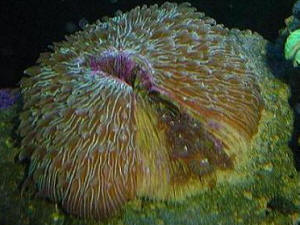
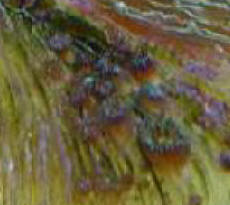
Cycloseris Acanthocauli "culture"
05/23/09 Stress Induced Sex Change in Corals
4/5/09
Broken cycloseris / plate coral - primitive fragging
technique? 10/31/07 Hi Guys and thanks for all the great
information you provide! I'm a neophyte aquarist with a 30 gallon
salt water tank. Problem is not with my tank (thank goodness) but
rather a cool purchase I made today at my LFS. I purchased a beautiful
orange plate coral (LFS owner, great guy, said it's a cycloseris)
about 3" in diameter. Brought it home in a container instead of a
plastic bag and accidentally dropped it when I walked in the door of
the house. Result, sadly, is 4 pieces of plate coral. Almost perfectly
broken into quarters. <Well, that's one way to frag a plate
coral...> I have put the pieces into my tank in hopes of
something??!! Any chance of any of them turning into mini corals, or
should I toss them before my husband comes home to witness the carnage?
<Nah, just tell your husband you now have 4 plate corals instead of
just one. If you take care of your aquarium well and give them a little
TLC, they should grow and eventually round out (each being clones of
the original).> Thanks again for all you do! - C <De nada,
Asexual Planulation in Fungia Anthony, I thanks for the reply. About that Fungia coral I was telling you about, well guess what... I found a baby Fungia in my tank just yesterday! <Outstanding!> I'm pretty excited to say the least. Yes I took plenty pics. The baby Fungia polyp was actually on top of one of my green open brain corals. <do see if you can remove it promptly. Attached or no?> I don't know if it was trying to attach there or what, but I got him isolated in one of those hang-on-in-tank deals. <Aha..> I put a little chunk of rock in there in case he wants to attach, >no need... it is a free-living coral. Some planulated specimens live attached briefly. Yours is already out of the nest so to speak. Do keep it on sand> but I don't know if they are free living as a juvenile or what. Anything you could recommend to me to keep this guy alive and not become fish food would be great. <occasional feedings would help a lot. Several times weekly with fresh hatched baby brine shrimp would be great. Frozen if you must (baby brine only... not adult). Even better would be frozen Cyclop-Eeze if you can get your hands on it> I kind of don't know what to do with it , very tiny ya know...thanks , <no worries... it will be fine. Kudos to you for the good husbandry. Please do share some pictures when you can. Hi-res digital or scans if you can.> Steelers did indeed play nobly this weekend. <Thanks kindly for saying so :) It was a fine game to watch. Very sporting. Best regards, Anthony> Fraggin' Fungia! 4/1/04 (the action, not the expletive) hello, <howdy> I have a fairly hardy Fungia sp. specimen and I would like to know if it is possible to frag these creatures? <well documented yes in the popular hobby literature (magazines, message boards threads, books like my Book of Coral Propagation, etc)> If so, what is the best way to do so and are they hardy enough to withstand fragmenting? <yes, easily so. And many techniques for it... A Dremel with a stainless steel cutoff wheel following the septa to make pie shaped wedges works best/very well> thanks for you help <best of luck! Anthony> Baby Plate corals - anthocauli in Fungiids 2/17/04 [The "baby" corals of which you speak are anthocauli (buds) on Fungiid corals. It is a common misconception that many Fungia never recover after they seem to have died (become denuded of tissue). Most in fact will begin to decalcify and issue these daughter satellites after just a few months. Leave those skeletons in the tank! When the clones grow big enough in the ocean, wave action/erosion and boring organisms dissolve the stem under the new bud and it breaks away to become free-living like its parent. The parent then continues to produce new buds. We have an article on this subject here at wetwebmedia.com at: http://www.wetwebmedia.com/trachyreproart.htm best regards, Anthony Calfo> From Travis: Hi Alison, that sounds like you got a nice surprise after what must have been disappointing to see happen to your plate. From what I've heard, the babies will grow their own skeletons and detach on their own. If they're anything like their close cousins the Euphylliids, they will recognize each other as the same species and not sting each other. However, I'm going to forward this to the most knowledgeable and helpful group of folks I know, Bob Fenner and company at wetwebmedia.com They should be able to elaborate on this with more information and more expertise than I have to offer. Best of luck with your babies, and keep me posted! They are quite the beautiful corals, I have avoided them up until now because they are so easily damaged in transport, and rarely seem to recover. Travis Joanne Moore writes: > Hi Travis, I have a question for ya about plate corals. I have a long tentacled plate coral that recently died; however, it now has about 100 baby plates on it or " daughters." I know they are it's baby's because they each look like little plates, each having their own mouths and each being about the size of my pinky fingernail now. My question was, what happens when they get bigger, will they just walk off the parent plate or release into the water and attach somewhere else or what. I can't get anyone who knows anything about this. I love plates, but they are so toxic to the other corals if too close, so I worry about what will happen if they attach anywhere. I was also wondering, if I use a toothpick maybe that would work, because I have some reef friends and family who would like a few if I could get them off. Thanks for your time. Sincerely, Alison Moore of lake Stevens, Washington. Broken Polyphyllia 8/19/04 Aaaaahhh! I've had a rockslide! I feel terrible! I was sure my rocks were stable, but apparently I was wrong! <Happens to the best of us! Black plastic cable ties, underwater epoxy and plastic rods work wonders to help prevent this.> A fairly large rock that had a Montipora capricornis attached to it fell. The Monti broke, but only in two large pieces that I reattached. I'm pretty sure it'll be fine. <Agreed. These are very hardy animals. Many of my fragments have been created in such an accident!> My big emergency is that the rock fell right on top of a tongue coral (Polyphyllia sp.). It snapped in two. It was about four inches long, but now it's in two pieces that are three and two inches. (It broke diagonally.) I can't find any information on what to do for this poor little guy. Will both pieces die? What can I do? <I would give each piece a slightly better than 50/50 chance. Do be sure that the broken edges stay open to the water and don't get buried in the sand. I am personally not a fan of dips, etc. unless there is a specific reason.> Thank you so much for your assistance! Though this is my first catastrophe, I have found your site to be indispensable in researching potential tank inhabitants. Sincerely, Conni <Glad you have benefited from WWM and the crew. Good luck! AdamC.> Fragging Fungiids 8/11/04 Hi Mr. Calfo <cheers, my friend> I read today that people can frag a Fungia coral. <this is true... quite easy too by a number of different ways/means> I have one that is 9" across and it would be cool if I could frag it. I've only frags zoanthids and xenia and also my colt coral. Can you tell me how I can do this to my Fungia please. Thanks you, JJ <you can simply saw this animal in half (or in more pieces by pie shaped wedges following the ridges of the septa) with a Dremel. With good water flow, the pieces will heal in days to weeks, and growth to complete the "circle" will occur in mere months. These are hardy and wonderful corals to keep/work with. Please do take pictures if you do this and share them with us. Kindly, Anthony> Rise From the Dead Guys, I have a Trachyphyllia geoffroyi and am pleased to hear about your discovery. It's always nice to learn more. I didn't know what Acanthocauli means, but the following paragraph (www.aquarium.net <http://www.aquarium.net/> ) describes what you found (although it's in reference to Fungia). Pretty wild. Does it mean we'll be "fragging" these too? Look forward to reading your article. I hope it will get posted on www.wetwebmedia.com first! Thanks for all your contributions. <Thanks for the additional info. That is the truly interesting part about this discovery, anthocauli production has only ever been described in the family Fungiidae. The one I have has about 30 daughter colonies on it, but fragging is not really practical here as the parent died (not intentionally) to form the daughters. And yes, it will get published on WWM too. Anthony is coming over on Friday for sushi and hopefully we will get the article completed then. -Steven Pro> As if these attributes are not sufficiently unique, Fungia also has a special mode of reproduction. While normal sexual reproduction occurs with a release of gametes into the surrounding water, Fungia reproduce asexually through the formation of anthocauli. These genetically identical daughter colonies are formed from bit of skeleton and tissue of the parent colony. Often, if there is an injury or if the parent is partially buried in substrate, the coral begins an active decalcification process whereby the injured area of skeleton dissolves and separates through the formation of certain biochemical controls and enzymes. These cellular processes seem to initiate a calcium gradient where the intracellular calcium concentration is actively pumped out, allowing a net efflux of calcium from the skeleton. The actions of the normally present burrowing algae, Cliona sp., is then able to initiate further decalcification. Following the process, the result of which is akin to the coral "cutting off its own arm, the remaining fragments of skeleton with attached tissue separate from the parent colony and move outward to begin their own solitary life David <Above is exactly what I did not want to happen. I guess it is not too big a deal. I just really want to get this published. -Steven Pro> |
|

|
Features: |
|
| Featured Sponsors: |
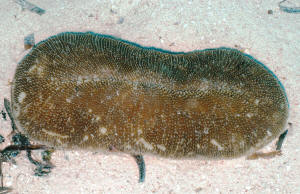
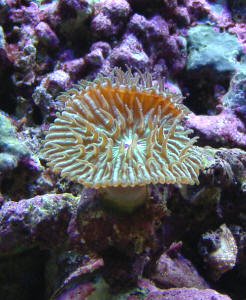 Ah, very nice. RMF.