|
Related FAQs: Marine Life
of the Tropical West Atlantic, Tropical West Atlantic 2,
Related Articles: TWA
Invertebrates, Algae, Vascular Plants, Introduction to Fishwatcher's Guide
Series Pieces/Sections, Lachnolaimus maxiumus/Hogfish, Hogfishes of the Genus
Bodianus,
The Tropical West Atlantic:
Bahamas to Brazil, Part 2
To: Part 1, Part 3, Part 4,
Part 5, Part
6, Part 7, Part 8, Part 9,
Part 10, Part
11,
|
|
| Bob Fenner |
|
Groupers & Basses- Family Serranidae. There are many
"reef" basses occupying various niches of the TWA. For the
purpose of clarity, and because they are separately identified as such,
we'll list these by their four top genera/common name
groupings.
"True" basses of the area comprise several species; most
get too big and carnivorous for home use, but two of the three most
commonly offered make outstanding aquarium fare. The Graysby,
Cephalopholis cruentata (1) is an almost dog equivalent as pet
fishes go, training to "do tricks" and coming to quickly
identify with its owners. The Coney, C. fulva (1), is a
fish of many colors, coming in golds, browns, reds and bicolor
phases'¦ always with a sprinkling of blue dots. It grows to
about half the length (10") of the larger Graysby. The
Creole-fish, Paranthias furcifer (2) is not readily recognized
as a bass at all. This fish lives more in the open waters, more like
the related, smaller Anthias species.
Genus Cephalopholis:
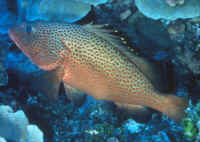
| Cephalopholis cruentata Lacepede 1802, the
Graysby. Tropical west Atlantic. To fourteen inches maximum length.
A regular offering in the aquarium trade, though not a great
beauty. Capable of rapid color, marking changes. This one in the
Bahamas. For comparison, though it is very rarely offered in the
trade, the Panamic Graysby, Cephalophlois panamensis
(Steindachner 1877), is shown. |
|
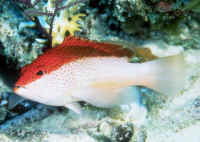
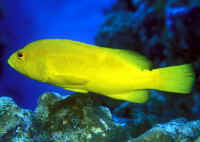
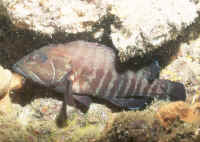
| Cephalopholis fulva (Linnaeus 1758), the
Coney. Tropical west Atlantic. To sixteen inches long in the wild,
usually less than half that in captivity. A hardy aquarium species
that comes in three distinct color variations: Overall red or red
above, white below; Brown or Brown above, white below, and Overall
Yellow (xanthic), and changes between these variations. Three of
these color morphs all pictured below: |
Genus Epinephelus:
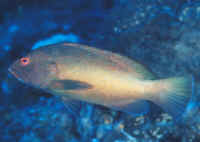
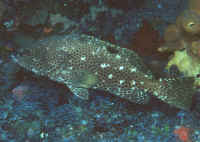
| Epinephelus adscensionis (Osbeck 1765), the
Rock Hind. West Atlantic. To about twenty four inches in length in
the wild. Shy, but occasionally collected for the aquarium
interest. This one in the Bahamas. |
|
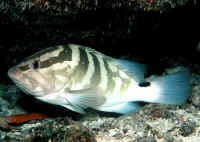
| Epinephelus striatus (Bloch 1792), the
Nassau Grouper. Tropical west Atlantic. To more than three feet in
the wild. A noble game and pet-fish for large systems. This one
foot juvenile in the Bahamas. |
|
Genus Mycteroperca:
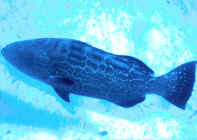
| Mycteroperca bonaci Poey 1860, the Black
Grouper. Tropical west Atlantic into the Gulf of Mexico. To more
than four feet in length. An occasional "accidental"
offering out of the TWA. Adult images from the Bahamas below. |
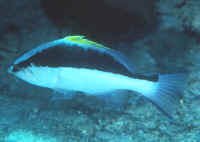
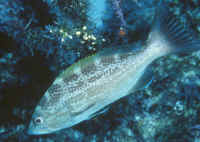
| Mycteroperca interstitialis (Poey 1860), the
Yellowmouth Grouper. Yet another misplaced bass in the trade.
Infrequently collected in the tropical west Atlantic as attractive
juveniles, they grow to more than thirty inches in length. Six and
twelve inch individuals in the Bahamas shown. |
|
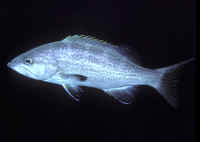
| Mycteroperca phenax Jordan &
Swain 1884, the Scamp. West Atlantic. To about a meter in length.
One foot specimen off of Cozumel. |
|
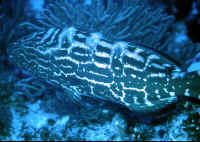
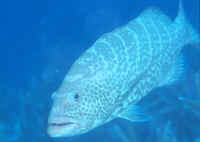
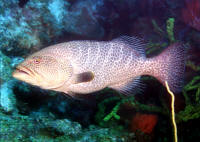
| Mycteroperca tigris (Valenciennes 1833), the
Tiger Grouper. Tropical west Atlantic and Gulf of Mexico. To more
than three feet in length. This handsome species is entirely
piscivorous. Bahamas and Bonaire pix. |
|
Genus Paranthias:
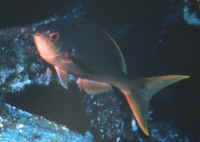
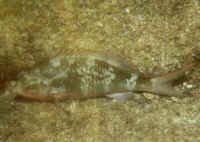
| Paranthias colonus (Valenciennes
1846), the Pacific Creolefish. Mexico's California to Peru. To
fourteen inches in length. Occasionally sold in the aquarium trade
under its own name... Here are individuals shown during the day and
resting disguised on the bottom at night. Below, individuals of the
species in the Galapagos. An intermediate individual of four inches
(young ones are all yellow), and a mottled and commonly colored
one. This is the most common bass species by far in the
Galapagos. |
|
Subfamily Grammistinae (or Family Grammistidae, Soapfishes),
Genus Rypticus:
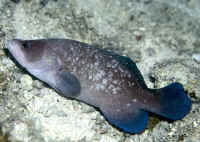
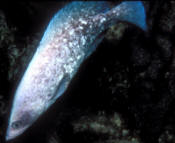
| Rypticus saponaceus Gill 1861, the Blackgill
Soapfish. Eastern Pacific; Sea of Cortez to Northern Peru,
Galapagos. To thirteen inches in length. Somber, but of an
interesting shape. Occasionally imported into pet-fish markets. In
Cozumel, Mexico and Bonaire. There are eight species in this
genus. |
|
The Dwarf Seabasses of the genus Serranus (1) are a
delight to all types of marine aquarium keepers. Most get no more than
a few inches, they're tough and don't hassle most types of
tankmates. Four of seven members of the genus regularly make it into
the industry. Most popular are the Lantern Bass, S. baldwini (1)
and Harlequin Bass, S. tigrinus (1), with its dark tiger-like
barring. About equal in running-up are the Chalk Bass, S.
tortugarum (1), and Tobaccofish, S. tabacarius (1). The
remaining three species are likewise attractive and hardy, just not
frequently available.
Ecotype: Shallows of mixed rubble, sand and reef, near the
bottom.
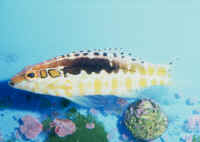
| Serranus annularis (Gunther 1880), the
Orangeback Bass. Rocky reef areas in the tropical west Atlantic. To
three and a half inches in length. Generally occurs in pairs in the
wild. Aquarium image. |
|
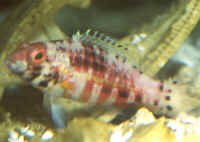
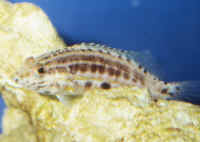
| Serranus baldwini (Evermann & Marsh
1899), the Lantern Bass. Tropical West Atlantic. To three inches in
length. Aquarium photos at right, Cancun and Cozumel below. |
|
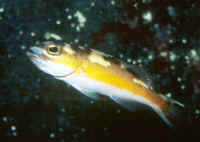
| Serranus tabacarius (Cuvier 1829), the
Tobaccofish. A common offering in the pet fish interest. Also from
the tropical west Atlantic. To some eight inches in length.
Aquarium and Cozumel pix. |
|
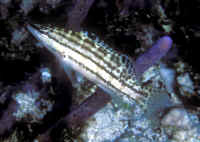
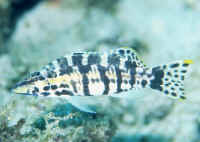
| Serranus tigrinus (Bloch 1790), the
Harlequin Bass. Common in the wild (tropical west Atlantic) and in
the aquarium trade. Grows to almost a foot in length in the wild. A
juvenile off Cozumel and adult in St. Lucia. |
|
| Serranus tortugarum Longley 1935, the Chalk
Bass. Tropical west Atlantic. To three inches in length. Aquarium,
Cozumel and Cancun images. |
Reef Basslets, genus Liopropoma, are likewise beautiful,
moderately tough aquarium choices for peaceful settings. All four
species found in the TWA are striking in appearance, though only two
occur in pet-fish markets regularly. The Peppermint (aka Swissguard)
Basslet, L. rubre (2) is most often found, with the equally
beautiful Candy Basslet, L. carnabi (2) a distant second. The
other two Liopropoma, the Cave Basslet (L. mowbrayi) (2)
and Wrasse Basslet (L. eukrines) (2) aren't collected for
aquarium use. Unfortunately they are deeper water (80-200+ feet)
species.
Ecotype: Caves and ledges of vertical reefs. These are very
secretive fishes.
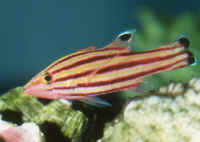
| Liopropoma rubre Poey 1861, the Peppermint
Bass. Tropical west Atlantic. To three and a half inches in length.
A small, shy beauty that adapts well to peaceful surroundings that
include dark caves to hide and sleep in. Aquarium image. |
|
Hamlets, genus
Hypoplectrus. Whether you believe that all the color
variants of this genus represent but one widely diverging species or
ten, eleven separate ones, the Hamlets make up the third group of
semi-hardy aquarium-friendly small basses of the TWA. Most often
offered is the Barred Hamlet, H. puella (2), but it is not the
greatest beauty of the group. The iridescent Blue Hamlet, H.
gemma (2), must really be seen in its full glory in the wild to be
appreciated. Other members at times available are the Indigo (H.
indigo) (2), Yellowtail (H. chlorurus) (2), and the
spectacularly gorgeous Golden Hamlet, H. gummigutta (2).
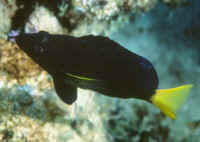
| Hypoplectrus chlorurus (Cuvier
1828), the Yellowtail Hamlet. Western central Atlantic. To five
inches overall length. Feeds primarily on crustaceans and small
fishes in the wild. Here is one photographed off St. Lucia. |
|
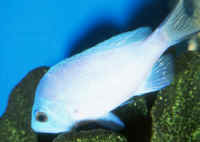
| Hypoplectrus gemma Goode & Bean 1882,
the Blue Hamlet. Florida endemic in the western central Atlantic.
To four inches in length. Pictured here is a slightly washed out
aquarium specimen. Wild ones much more vibrant blue. |
|
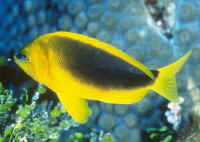
| Hypoplectrus guttavarius (Poey 1852), the
Golden Hamlet. Spottily distributed in the tropical west Atlantic.
To five inches in length. A common Hamlet offering in the pet
trade. This one photographed in the Bahamas. |
|
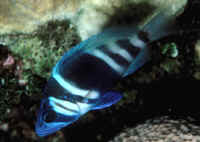
| Hypoplectrus indigo (Poey 1851), the Indigo
Hamlet. Central western Atlantic in many places. To five and a half
inches. Another of the more common aquarium Hamlets. This one in
the Bahamas |
|
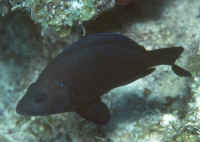
| Hypoplectrus nigricans (Poey 1852), the
Black Hamlet. Tropical western Atlantic. To six inches in length.
This photo made in the Bahamas. |
|
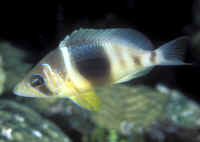
| Hypoplectrus puella (Cuvier 1828), the
Barred Hamlet. To six inches overall length... Found in... the
tropical west Atlantic. One in the Cozumel. |
|
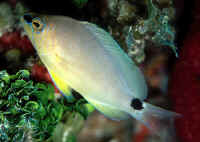
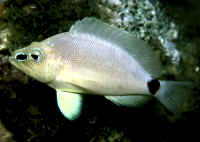
| Hypoplectrus unicolor (Walbaum 1792), the
Butter Hamlet. Western Atlantic; Florida. To five inches in length.
Identified in the field by distinctive caudal saddle and yellow
pelvic fins. Right: Bahamas and St. Thomas pix. Below: series
in St. Thomas. |
|
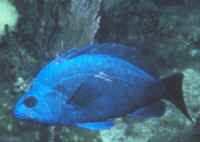
| Hypoplectrus sp., an unknown (to me) Hamlet.
This metallic blue individual was found in Belize... near Placencia
to the south there are many of this type... More fuel to the fire
that perhaps all Hamlets are one and the same species? A beauty
nonetheless. |
|
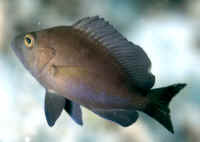
| Hypoplectrus sp., the Tan Hamlet. Golden
brown overall color except for a bluish streak on the fore part of
the pectoral fins. St. Thomas. |
|
To: Part 1, Part
3, Part 4, Part
5, Part 6, Part
7, Part 8, Part
9, Part 10, Part
11,
|
|