|
Related FAQs: Marine Life
of the Tropical West Atlantic, Tropical West Atlantic 2,
Related Articles: TWA Invertebrates, Algae, Vascular Plants,
ntroduction to Fishwatcher's
Guide Series Pieces/Sections, Lachnolaimus maxiumus/Hogfish, Hogfishes of the Genus
Bodianus,
The Tropical West Atlantic:
Bahamas to Brazil, Part 4
To: Part 1, Part 2, Part 3,
Part 5, Part
6, Part 7, Part 8, Part 9,
Part 10, Part
11,
|
|
| Bob Fenner |
|
Croakers and Drums, Family Sciaenidae. These fishes are
notable for their noise making capacity, value as food fishes,
tremendous numbers of species (seventeen genera in the TWA alone) and
numbers of individuals. As aquarium subjects the three TWA species of
principal interest are non-aggressive carnivores that spend most of
their time hiding in dark caves you provide. These are the Highhat,
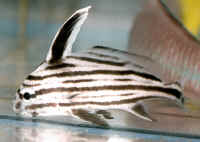
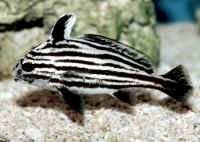
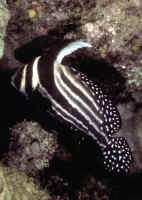
Pareques acuminatus (2) the Jackknife, Equetus
lanceolatus (2), and the Spotted Drum, E. punctatus (2).
Make sure and keep them with other peaceful fishes and assure they are
getting enough to eat (mostly nocturnal feeders), especially when you
start with small individuals.
Ecotype: In areas of reefs with sufficient cover to get under. They
hide by day.
| Equetus acuminatus (Bloch & Schneider
1801), the High Hat. To 23 cm., 9 inches in length. Western
Atlantic; North Carolina to Brazil. Found over sandy and rocky
bottoms in groups as young and adults. Below: Aquarium specimens.
An ideal size (three inch) individual in a cubicle and batch in a
wholesalers tank, and five inch individual. At right, a seven inch
adult off of St. Lucia. |
|
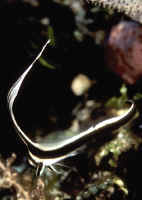
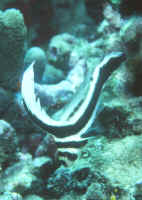
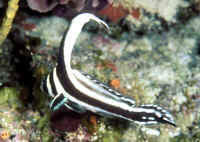
| Equetus lanceolatus (Linnaeus 1758), the
Jackknife(fish). Tropical West Atlantic and Gulf of Mexico. Found
in bays and deep coral reefs. To ten inches in length. Like other
TWA croakers, feeds mainly on small shrimps, gastropod mollusks,
crabs polychaete worms. Not as often seen as the other two species
listed. Distinguished from them by a single black band starting at
the tip of the dorsal and a lack of dots on the
tail. |
No pic (yet)
|
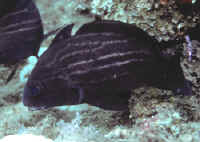
| Equetus punctatus (Bloch & Schneider
1801), the Spotted Drum. To 27 cm. Tropical West Atlantic. Below:
Three inch individual off Cozumel, four and six inch ones in St.
Lucia. At right, four and a half inch individual in St. Lucia. |
|
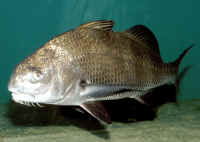
Some Not-So Aquarium Croakers: An example to show a
"typical" member of the family.
| Pogonias cromis (Linnaeus 1758), the Black
Drum. According to fishbase.org to 170 cm. and 42 kg... yes, five
feet and ninety pounds. And has lived for 43 years! Found in the
Western Atlantic; Nova Scotia to Argentina. One in the Florida
Aquarium. |
|
Snappers, Family Lutjanidae. Most of the snappers of the
Tropical West Atlantic shallows get too large and admittedly are too
ugly for any other than die-hard biotopic presentations. However a few
do deserve consideration and so I've listed and illustrated them
here. The Dog Snapper, Lutjanus jocu (2) and Schoolmaster, L.
apodus (2) are characters and good looking when young. My personal
preferences aside, about the only snapper I've seen offered from
here is the Yellowtail, Ocyurus chrysurus (2). It even gets way
too big (more than two feet)
Ecotype: The first two in shallow to mid depth reefs near the
bottom, the latter in small associations mid-water above reefs.
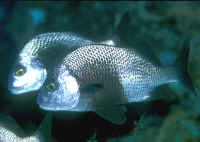
| Anisotremus surinamensis (Bloch 1791), the
Black Margot. Tropical West Atlantic. To two feet in length. Feeds
at night on crustaceans, fishes, urchins... Cozumel
image. |
|
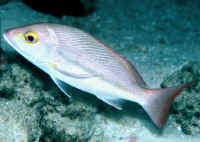
| Lutjanus adetii (Castelnau 1873), the
Yellow-Banded Snapper or Hussar. Western Pacific; east coast of
Australia and New Caledonia. To twenty inches maximum length.
This one of many in a school off Heron Island in
Australian waters, |
|
|
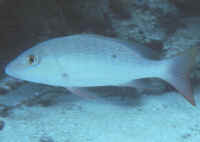
Lutjanus analis (Cuvier 1828), (Cuvier
1828), the Mutton Snapper. Western Atlantic; Massachusetts to
Brazil, Gulf of Mexico. To 26 inches maximum length. This one off
of Belize.
|
|
|
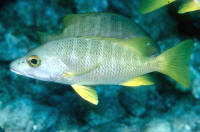
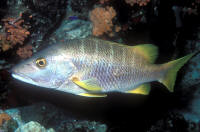
Lutjanus apodus (Walbaum 1792), the
Schoolmaster Snapper. Western Atlantic; Massachusetts to Brazil
and the Eastern Atlantic; Core d'Ivoire to Guinea. To nearly
twenty seven inches total length. Here in the Bonaire, seven and
twelve inch individuals.
|
|
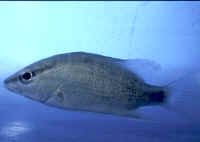
| Lutjanus griseus (Linnaeus 1758), the Gray
Snapper. Tropical West Atlantic. Freshwater, brackish, marine. 89
cm., 20 kg. maximum. Occasionally imported as juveniles for the
aquarium interest. Nocturnal feeder on fishes, crustaceans,
worms. |
|
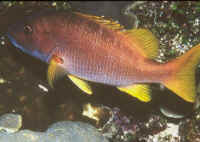
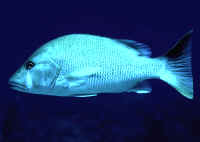
| Lutjanus jocu (Bloch &
Schneider 1801), the Dog Snapper. Western Atlantic; Massachusetts
to Brazil, including the Gulf of Mexico, and the Easter Atlantic;
St. Paul's Rocks and Ascension Island. To Thirty two inches
maximum length. A one foot specimen off of Belize, another off of
Cancun. |
|
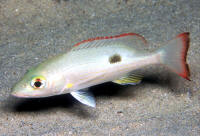
| Lutjanus mahogani (Cuvier
1822), the Mahogany Snapper. Tropical West Atlantic; N. Carolina to
Venezuela. To 19 inches in length (most much smaller). This eight
inch individual off Bonaire. |
|
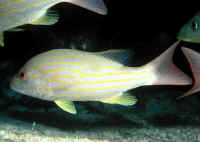
| Lutjanus synagris (Linnaeus 1758), the Lane
Snapper. Western Atlantic; North Carolina to Brazil, Gulf of
Mexico. To two feet in length, most under a foot. This pink tail
spot-less phase one in the Bahamas. |
|
|
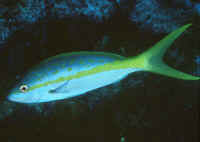
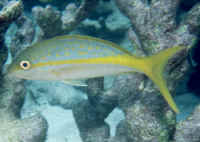
Ocyurus chrysurus (Bloch 1791), the
Yellowtail Snapper. Western Atlantic; Massachusetts to Brazil and
Gulf of Mexico. Maximum length to thirty four inches, most around
a foot in length. One in the Bahamas and one in Belize.
|
|
To: Part 1, Part
2, Part 3, Part
5, Part 6, Part
7, Part 8, Part
9, Part 10, Part
11,
|
|