|
|
| Home | Marine Aquariums |
Freshwater Aquariums |
Planted Aquariums |
Brackish Systems |
Ponds,
lakes & fountains |
Turtles & Amphibians |
Aquatic Business |
Aquatic Science |
Ask the WWM Crew a Question |
| Please visit our Sponsors | ||||
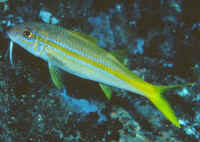
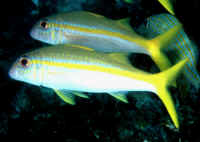
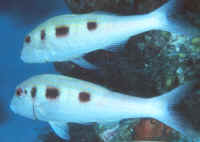
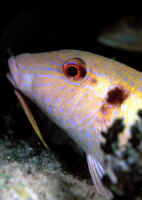
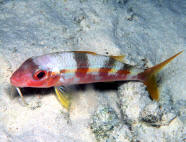
Goatfishes, Family Mullidae. Two of the four species of Goatfishes found in the TWA are regularly offered in the trade. The Yellow (Mulloicichthys martinicus) (2) and Spotted (Parupeneus maculatus) (2) Goatfishes make great aquarium specimens given sufficient substrate and food. Constantly active, these fishes require frequent refueling, a few times of day with meaty foods. Ecotype: Goatfishes utilize their jaw barbels to root around in the bottom sand/gravel for food in rubble and shallow reef areas.
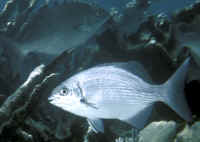
Sea Chubs, Family Kyphosidae. Though they're certain to lose in beauty contests, the Chubs or Rudderfishes, more than make up for a lack of good looks in spunk. Occasionally wholesalers will carry (because collectors catch and ship them) the Bermuda (Kyphosus sectatrix) (2) and the Yellow (K. incisor) (2) Chubs in small numbers. These are very active, open water herbivores that require frequent feedings. Ecotype: Swim in mid- and upper water above reefs to open ocean.
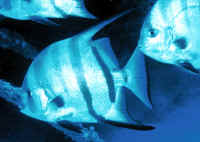
The Spadefishes, Family Ephippidae. Yes, the same family as the popular marine aquarium batfishes. The Atlantic Spadefish, Chaetodipterus faber (2) makes a hardy, fast-growing captive for very large systems. This fish feeds on anything, ferociously. A real looker, both as young and adults. Ecotype: Swim in mid- and upper water above reefs to open ocean.
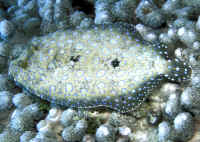
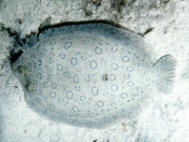
Left-Eye Flounders, Family Bothidae. Of the many flatfishes found here only the Peacock Flounder, Bothus lunatus (2) is used in any numbers. This camouflage artist is easily kept in captivity given adequate space and meaty feedings. Ecotype: Shallow broken reef/rubble zones to sand and grass beds, on the bottom.
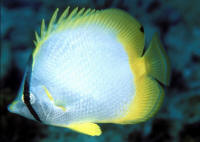
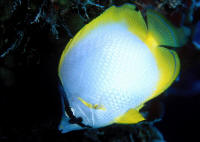
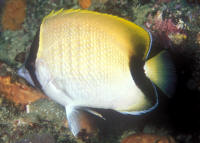
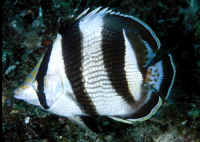
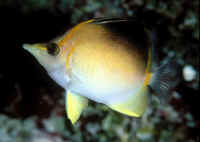
Butterflyfishes, family Chaetodontidae. Of the seven species of butterflyfishes found in the TWA, only the four shallow water species (Foureye, Chaetodon capistratus (3), Spotfin, C. ocellatus (3), Banded, C. striatus (3), and Reef, C. sedentarius (1)) and occasionally a deeper water form, the Longsnout (Prognathodes aculeatus) (1) are imported; and not many of these compared to the Pacific. Atlantic butterflies have two strikes against them. They're not as attractive as many chaetodonts found elsewhere, and the first three listed rate only minimally in hardiness. The Reef and Longsnout, and if you're fortunate to run across either the deepwater Doubleband (Prognathodes aya) (1) or Threeband (P. guyanensis) (2), are actually quite mid-hardy and undemanding. Ecotype: A mix of shallow to deepwater reefs and drop-offs, associated with corals and gorgonian forests.
To: Part 1, Part 2, Part 3, Part 4, Part 6, Part 7, Part 8, Part 9, Part 10, Part 11, |
|

|
Features: |
|
| Featured Sponsors: |