|
FAQs on the Hydrozoan Identification
2
Related Articles: Hydrozoans, Cnidarians, Fire Corals, Stylasterines, Hydrozoan Jellies,
Related FAQs: Hydrozoan ID 1, Hydrozoan ID 3, Hydrozoan ID 4, Hydrozoan ID 5, Hydrozoan ID 6, Hydrozoan ID 7, Hydrozoan ID 8, & Hydrozoans 1, Hydrozoans 2, Hydrozoan Behavior, Hydrozoan Compatibility, Hydrozoan Selection, Hydrozoan Systems, Hydrozoan Feeding, Hydrozoan Disease, Hydrozoan Reproduction,
Medusoids/Jellies (Ctenophores, some Hydrozoans,
Scyphozoans): Jelly Identification, Jelly Behavior, Jelly Compatibility, Jelly Selection, Jelly Systems, Jelly Feeding, Jelly Disease, Jelly Reproduction, Fire Corals,
Lace
Corals, Stinging-celled
Animals
|
|
| Re: Xeniid Help....HYDROIDS HAPPY
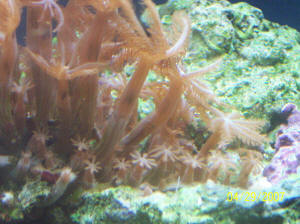
UPDATE -- 4/28/07 Hello to all and thank you again for
being there!! I have placed a copy of our previous
correspondence below for reference. <Thank you for
this> I wanted to let you know that because of your (Mr.
Fenner's) ability to teach me something new my Xenia are back
on track with new babies everywhere!! I am certain they
would have died without your 100% accurate assessment, diagnosis,
and treatment recommendations (which I followed to the letter) as I
was treating for everything BUT hydroids and they kept going
downhill. I have enclosed pictures of their incredible recovery!!
(It has only been two weeks since their near death
experience). Thank you again SO much for being there,
you saved another life! If there is anything I can do to
help you out in return, it would be my pleasure!! Kimberly
<Thank you for sharing the news of your success. Bob
Fenner> |
|
|
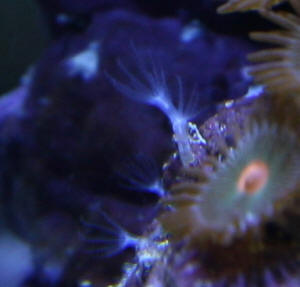
| Are these hydroids? 10/6/06
Hi Crew, <Jason> I have noticed some creatures in my tank
that are new to me. Please let me know if you can identify them,
and give me advice on removal, if necessary. Pictures to follow.
<I see them> They are whitish/translucent with a stem and
some fingers arranged around what's possibly a mouth. In the
following pictures, they are on the rock with the Zoanthid polyps,
directly to the left of the bottom group of polyps. I have listed
flickr.com links to the photos: <a href=" http://www.flickr.com/photos/bromion/259389615/"
title="Photo Sharing"><img src=" http://static.flickr.com/92/259389615_1f2b120b6f_b.jpg"
width="783" height="1024" alt="id1"
/></a> Thanks! Jason <Might well be a hydroid
species... a Polypoid Cnidarian for sure. Bob Fenner> |
|
|
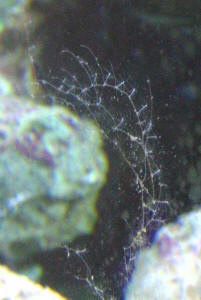
| What is this? Bad news... hydroids
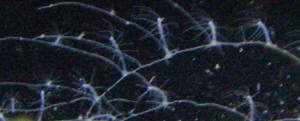
8/1/06 My tank has become over-ran with this ( I think ) pest.
<Is... serious> The local aquarium dealer has no idea what it
is either (see attached images). I have had an Aiptasia problem but
I thought I had it under control. I would like your opinion if this
really is a pest, or is it something I should not worry about.
<You should... I would take "drastic action" here>
It seems to have covered the live rock in my tank as well as the
fake plants I have put in. The fish in my tank are all fine except
for the black cap Basslet which now has white scarring along his
head (he is the only fish that hides in tight spaces, which is why
I think he may have more contact than any of the other fish). Any
help would be great. Please email me back at: Thanks, Shamus <I
would consider "nuking" this system... biocidally
bleaching it... Please read here: http://wetwebmedia.com/hyzoancompfaq.htm
and the linked files above. Bob Fenner> |
|
|
Variation in hydroids? 4/15/06 Good day WWM
crew! You folks the bomb! <Boom, boom da boom...> Sew,
I noticed on reefcentral, on their current (4-14-06) homepage, for
their slideshow presentation, they have some images of hydroids mixed
in there. <Are common in shallow reef environments...> I've
had what I thought to be a rather small colony though spreading all
over rockwork, of polyps. They look like a mini version of
snake polyps or a variation of a small yellow polyp. I can
provide images if needed. <Please do> My question,
mainly.....these guys in my tank, that look almost identical to the
slideshow on reefcentral, retract when touched or if anything moves or
swims by them.....so, are there any species of hydroids that retract?
<Likely so> If so, I would have never known such....and am
craving a definitive answer. Thanks very much for your time,
look forward to hearing from you. Hydroidy polyp. <Please read here:
http://wetwebmedia.com/hydrozoans.htm and the linked FAQs file
above. Bob Fenner>
Hydroid identification... no graphic - 2/15/2006 Hey
pros got a quick question for you. I was browsing through
your array of posts and articles when I stumbled upon the
"Hydrozoan" section. I looked through the photos
and found one that is similar to something I have in my
tank. The picture I'm referring to is under a post
entitled "Bad boyz hydroids- 12-30-03. The picture
shows small tube-like structures protruding from the live rock with
tiny little white heads. <Covers many species...> I have
something similar in my aquarium. There are several small
(1/16 to 1/8 on an inch) solid tubes, purple in color (covered in
coralline algae) that appear to be growing out form the coralline algae
(or maybe the coralline is just growing onto it). On the end is a tiny
filamentous structure (looks like a clear bubble but it's very
small so hard to tell) but in either case it looks as if it could pull
inside the tude. <? Not retractable> These little tubes have been
there for at least a few months if not year, I never paid attention to
them, and I have never noticed them bother anything. There
are no corals growing near them, but I assuming if I see them in that
spot then they are probably growing other places too. All corals
(Shrooms, xenias, colt, zoos, and gorgonians) seem to be doing
fine. Can I do a test by placing a small xenia, perhaps,
near this "hydroid" to see what happens? Are these
little tubes always "bad" or can they be beneficial/neutral
creatures as well? <As long as "stay small", to
themselves> I have seen other similar creatures that
live in tubes (some straight some coiled) that have feather duster like
heads. I'm certain these aren't harmful, but how do
you visually separate these from hydroids? <If trouble,
best to remove, denude from the rock> One post stated that they can
look like corals, algae, or jellyfish. That describes many
small creatures I see in my aquarium, how do I separate the good from
the bad? Thank you Jon <... a photo or drawing please. Bob
Fenner>
Little white pests...but not Aiptasia...and other problems
Hi, hope you can help! <Will do my best> Background: We have a
125 gal saltwater tank with 2 filters, protein skimmer, but no reef
lighting (yet). <... but some lighting?> Inhabitants
are a yellow tang, Firefish, coral beauty, 2 cleaner shrimp, a pink
knobby Cuke, a dozen or so hermit crabs, and damsels. (Neon
damsel, blue damsel, humbug damsel, 3 green Chromis.) We
have several large live rocks, and a few pieces of fake decorator coral
junk while we wait to get the right lighting to add the real
stuff. Substrate is a mix of live sand and crushed
coral. Chemistry and temp perfect. Tank is about
6 mo.s established. All is well in there. We have a 20 gal
hospital tank for inductees and sick guys, currently only inhabited by
2 cleaner shrimp and a few hermits, about 4 months old. A
few pieces of decorator plastic caves, and a few pieces of live
rock. Same substrate. Same chemistry and temp as
125 gal tank, but our new fish don't survive it'¦ not sure
if something is wrong in there or if we are getting bad stock or
what's going on. <Good list of speculations... you
are using your big tank's water there? I would> We don't
want to introduce new fish into the big tank, because we've already
experienced 'chasing down the sick guy' in the big tank, and
it's not good for any of the other inhabitants. <Well-stated>
We had two lunare wrasses in the main tank for about a
month that were trying to eat everyone else, so we moved them to the
hospital tank for a few weeks before returning them to the pet store,
and they were fine in there. <Interesting... gives weight to the
"initial bunk livestock" theory> We feed with frozen
multi-pack foods in the eve, and leave dried seaweed pieces pinned up
during the day, both of which are eaten voraciously, but nobody looks
to be starving, or even close, and the shrimp are molting and hermits
moving to new homes, but no visible food decaying or spike in nitrates,
so think we are good with feeding. Problem #1: Every time we
get new fish, they die in the hospital tank, usually within 3-5 days of
arrival. We do 10% water changes (in both tanks) every
week. We have tried a 100% water change in the hospital
(several times). We have tried restoring it with water from
both the main tank and clean water source to help match. <Ah, I
see> (Water source is completely purified, we bought a
water purification system solely for the tank water, and add Oceanic
Salt.) <I would read over re synthetic salt mix brands... on WWM,
the Net... and switch to something else (myself)>
Occasionally we see signs of ich on the new
guys'¦when we do, we remove the carbon in the filter and treat
with Kick Ich'¦. <This product is worse than worthless.
Please read here: http://www.wetwebmedia.com/homeopathfaqs.htm At best it's
a misleading placebo, worse, it may be poisoning your system to a
degree> but sometimes no signs of ich, they just keel
over. We used to induct our fish over a several hour period
to the hospital tank, lights off, adding ¼ cup to their bags
at a time until introducing, but have gone even farther now to a
'drip method' where we place the fish and water in a (covered,
dark) container, and slowly drip the hospital tank water into the
container until it overflows into a bucket (4-6 hours or so), before
introducing the fish into the tank. Still they
die. Any advice or thoughts??? <Lots... for here, try a
Polyfilter in your water flow path... see if you "get any
color"... You likely have a poison source here... perhaps a bit of
metal from... a clamp? Ornament? Check with other hobbyists in your
LFS/source store... do they have similar lack of "luck?">
Problem #2: Several months ago we were thrilled to see a
bunch of 'little white things' birthed in our 125 tank and
floating around. (Hey, stuff is
living!!) =) They were free-swimming, with a tiny
ring of tentacle looking things around the top, sort of hydra-looking,
and may have been Aiptasia, <Nah... not this life's M.O.> but
if so did not last long. (Probably got
eaten.) About a month ago, there was a birthing of same in
the hospital tank. We had added some live rock, and also
infused some water from main tank, so don't know
source. At the time there were (doomed) fish in there, so
only one of the birthed critters survived. He lodged himself
on a shell and grew to be about an inch or two long! He was
white, with a large rotund belly, and a small hole at one
end. <Sounds like my ex-brother in-law> No visible
tentacles, really, but a small circle of very short hair like things
around its hole. Interior appears almost
hollow. No narrow base, far removed from Aiptasia
descriptions, obviously alive due to growth, but not movement,
(stationary in all regards), and very ugly. Sort of like an
onion? After another batch (3) of new fish died, we removed
him as well, as we did not know what he was and he was therefore
suspect. (About 3 weeks ago.) <Likely not related to your fish
mortalities, and don't know what this is exactly... see below>
Last week, there was another birthing of these things in the hospital
tank! They appear first as free-floating creatures with little umbrella
heads (very tiny), almost like hydras, but then affix themselves
everywhere--the glass, heater, shells in the substrate, and commence to
filling out with the wide belly onion look. They are
growing, and are now already probably 1/8-1/4 inch long. I
have searched and searched and can't determine what these things
are. They fit the description of Aiptasia in how they arrive
and behave, but not at all in appearance after that. <Actually, not
an Actinarian (anemone) but likely a hydroid of some sort... a guess
based on your description of appearance and life history. Not
desirable, but no reason to panic either... they are originating from a
bit of live rock (strobilizing is the fancy word). They will "run
out of eggs" someday soon.> Any help? <Oh yeah, getting to
something in the way of a real solution... Here's the big wind-up
and the pitch.... a refugium! I'd attach another (live) sump
container to your existing system, put it on at least a reverse timed
lighting schedule (do get some light for your main tank if you
don't have this as well), and grow some live macro-algae, have a
DSB there... Voila! Whatever the problems are/were, solved. Please read
here: http://www.wetwebmedia.com/refugium.htm and the linked files
above till you understand rubber band. Bob Fenner> Thanks,
Tracy
|
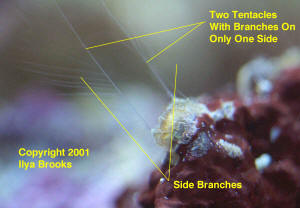
Stranded Hydroid! Yikes! 4/7/05 Hello WWM
Crew, <howdy> I have a quick question for you regarding a
finger leather and a strange set of tentacles coming from it.
<yikes! they are not from the leather, but instead are from a
stinging hydroid. They can be quite aggressive to other reef
creatures and even burn your skin painfully> I have attached a
picture of identical tentacles as what are coming from
my leather but am unsure of how to deal with this issue.
<manual removal> I have only had the leather for 3 weeks
now and it has never extended a single polyp. <Perhaps
it's irritated from the hydroid. More importantly... I fear
you have added this coral to your tank without a proper
quarantine period. Yikes, if so... it's a surefire way to
introduce pests and predators to your tank like this hydroid>
Every evening these threads come out and they are very intricate
which is what led me to believe they were not just mucous. I
cannot see anything on the leather itself by following
the threads but there are 6 or 7 coming out. Any help you can
give me would be greatly appreciated. Regards, Scott B. <There
are many types of hydroids in the world. Some look like corals...
some look like algae... others more like jellyfish. Caution with
all :) Anthony>
|
|
|
|
|


