|
Related FAQs: Indonesian Angelfishes, Marine Angelfishes In
General, Selection, Behavior,
Compatibility, Health, Feeding, Disease,
Other Regional Accounts of Marine Angels:
Red Sea, Baja,
Caribbean
Related Articles: The Marine Angelfish family,
Pomacanthidae, Best Marine
Angels,
/The Conscientious Marine
Aquarist
Marine Angelfishes of
Indonesia
|
|
| Bob Fenner |
|
Angelfishes for Marine Aquariums
Diversity, Selection & Care
New eBook on Amazon: Available
here
New Print Book on Create Space: Available
here
by
Robert (Bob) Fenner |
 |
Genus Apolemichthys:
|
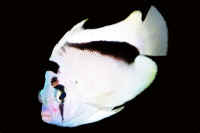
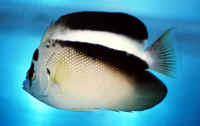
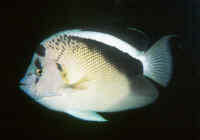
Apolemichthys griffisi
(Carlson & Taylor 1981), Griffis' Angelfish (2).
Occasionally imported from Indonesia and the Solomon Islands.
Found in various parts of the Central Pacific. To ten inches
overall length. Below, seven and nine cm. individuals (Photos by
Hiroyuki Tanaka) and six inch one in captivity by RMF.
|
|
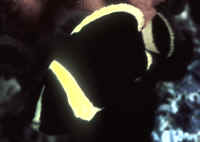
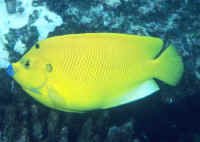
Apolemichthys trimaculatus
(Cuvier 1831), the Three-Spot Angelfish (2). Can make a hardy
addition to a good size (100 gallons plus) established reef
system. To about six inches long. East African coast to western
Pacific. To ten inches in the wild. A 1 1/2" juvenile in
captivity and full-size adult in the Seychelles.
|
|
Genus Centropyge:
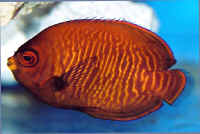
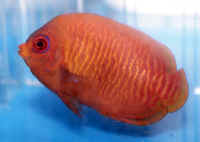
| Centropyge aurantius
Randall & Wass 1974, the Golden Pygmy Angel (1) is a real
striker. It's a shame that this species hides so well,
necessitating extensive breaking of coral and drug or poison use in
its collection, and hiding for so much of the time in captivity.
Western Pacific Ocean, Indonesia to Caroline Islands. Aquarium
photos of a 6 cm. specimen from Bali by Hiroyuki Tanaka and a 9 cm.
one in captivity by RMF. |
|
|
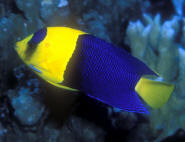
Centropyge bicolor (Bloch 1787), the
Blue-and-Gold, Pacific Rock Beauty, Bicolor or Oriole Dwarf Angel
(3), is highly variable in it's survivability in captivity.
Some shipments are 100% live on arrival, others can be just the
opposite within days. Better specimens come from other than the
Philippines or Indonesia. To 6" if they live. One in N.
Sulawesi.
|
|
|
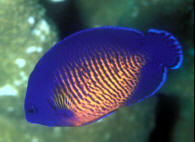
Centropyge bispinosa (Gunther 1860),
Two-Spined, Dusky or Coral Beauty Angel (2). Usually hardy from
everywhere but the Philippines. Found widespread throughout the
Indo-Pacific to central Pacific. One in N. Sulawesi.
|
|
|
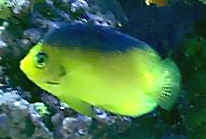
Centropyge colini Smith-Vainz & Randall
1974, Colin's Dwarf Angel (3), is a deepwater form (usually
collected below 100 feet) that does poorly as far as the genus
goes. Rare and expensive in the hobby. Indo-west Pacific to
western Pacific area. Thanks to Evan McLaughlin for this pic!
|
|
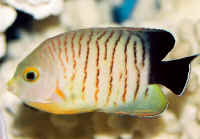
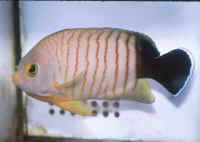
| Centropyge eibli Klausewitz
1963, Eibl's Dwarf Angel (1), is an excellent aquarium species,
especially coming from Sri Lanka, its principal source, though
found all over the eastern Indian Ocean over to the Maldives.
Closely related to Centropyge vroliki of the Pacific, with
which it hybridizes. Aquarium pix by Hiroyuki Tanaka and
RMF. |
|
|
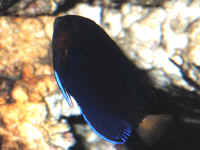
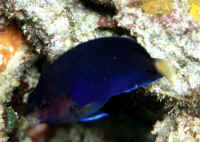
Centropyge flavicauda
Fraser-Brunner 1933, the Damsel or White-Tail Dwarf Angel (2), is
rarely seen in the trade; one of the dwarf-dwarf angels, growing
to only a couple of inches in length. Indo-west and central
Pacific. Pix by Hiroyuki Tanaka and
RMF collected off of Nichinan Coast and Gili Air, Lombok,
Indonesia.
|
|
|
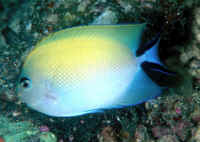
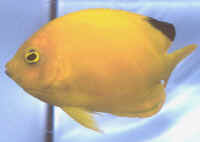
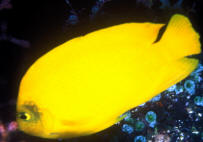
Centropyge heraldi Woods & Schultz 1953,
Herald's or the False Lemonpeel Angel (2), are overall yellow
with a variable amount of black on their dorsal fins and behind
the eyes (males), but never with the blue outline around the eyes
of the "true" Lemonpeel, Centropyge flavissimus.
Central and western Pacific Ocean. Aquarium and N. Sulawesi
pix.
|
|
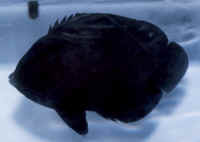
| Centropyge nox (Bleeker
1853), the Midnight or Black Pygmy Angel (3) is as its name implies
overall black. Only a few of this shy species adapts well to
captivity. Western Pacific. |
|
|
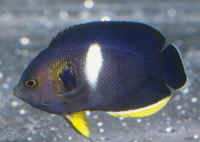
Centropyge tibicen (Cuvier 1831), the
Keyhole Pygmy Angel (2). Some folks have had better success with
this species than I and my associates. Start with a mid-sized
specimen, 3-4". Indo-west Pacific.
|
|
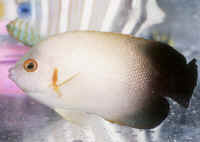
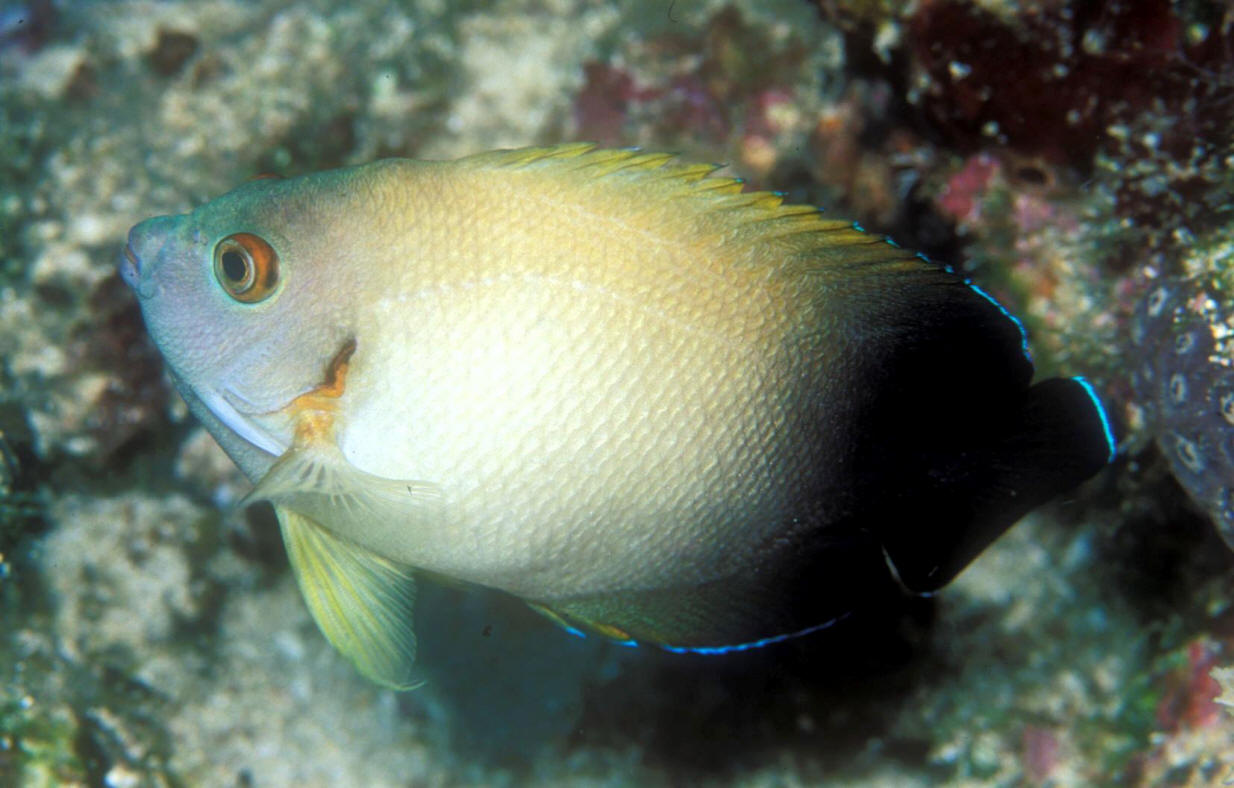
| Centropyge vroliki (Bleeker
1853), the Pearl-Scaled or Half-Black Dwarf Angel (1), is one of my
standard, "marine aquarium service account species". Very
hardy. Indo-west Pacific Ocean in distribution. Closely related to,
and hybridizes with Centropyge flavissimus and Centropyge
eibli. Aquarium and N. Sulawesi pix. |
|
Genus Chaetodontoplus:
|
Chaetodontoplus
chrysocephalus (Bleeker 1854), Orange-Faced Angelfish (2).
Possibly a variant or male of C. septentrionalis, or a
cross between it and C. melanosoma. Western Pacific Ocean,
Japan to Indonesia.
|
I got to get out more often
|
|
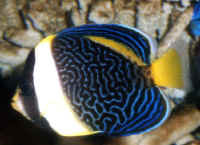
Chaetodontoplus duboulayi
(Gunther 1867), the Scribbled Angelfish (1). A more common import
from the genus. Best started at 4-5 inches to wean over wild
foods (sea squirts, sponges). To twelve inches overall in the
wild. North coast of Australia to New Guinea. One inch and adult
aquarium and Airlie Beach, QLD pix by RMF. 3 cm. by Hiroyuki
Tanaka at right.
|
|
|
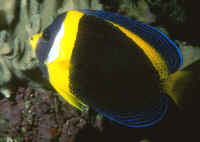
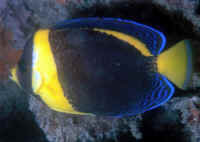
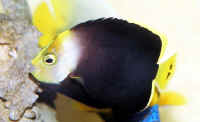
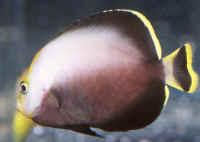
Chaetodontoplus melanosoma
(Bleeker 1853), Black Velvet Angelfish (2). Variable in initial
health from wild. Best to leave at the dealer's a good week
or two. Indonesia on up to southern Japan. To eight inches long.
8 cm. individual by Hiroyuki Tanaka and 15 cm. by RMF.
|
|
|
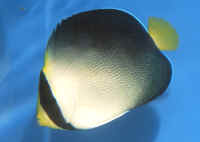
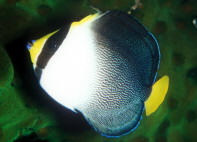
Chaetodontoplus mesoleucus
(Bloch 1787), the Vermiculated Angelfish, better known in the
west as the Singapore Angel (2), the most commonly imported
member of the genus, and at six inches maximum, one of the better
choices. Western Pacific. Yes, it looks more like a Butterflyfish
than an Angel. Aquarium, N. Sulawesi and Gili Air, Lombok,
Indonesia images.
|
Genus Genicanthus:
|
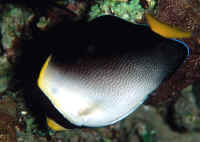
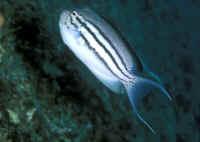
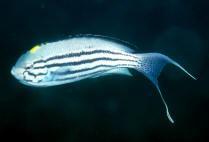
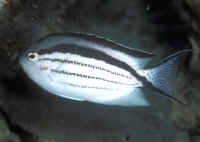
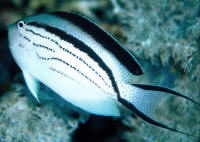
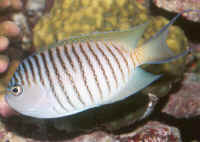
Genicanthus lamarck
(Lacepede 1802), Lamarck's Angelfish (2). Indo-Australia
Archipelago. To seven inches in length. Probably the most common
member of the genus used in the trade. Males and female in N.
Sulawesi and female shown off of Gili Air, Lombok,
Indonesia.
|
|
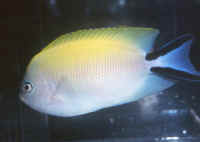
Genicanthus melanospilos
(Bleeker 1857), the Black-Spot Angelfish (2). Similar to G.
caudovittatus to the west, this species is found throughout
the tropical western Pacific. Also to about six inches long. Male
and Female shown in captivity. Below, male and female in
Fiji.
|
|
Genus Paracentropyge:
|
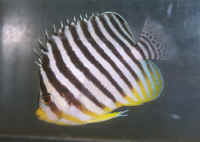
Centropyge multifasciata (Smith &
Radcliffe 1911), the Multi-Barred Angel (2). More deep-bodied
than other Centropyge and with 13 versus the usual 14, 15
dorsal rays of other dwarfs. Not imported regularly in any
numbers. Currently placed in the genus
Paracentropyge.
|
|
Genus Pomacanthus:
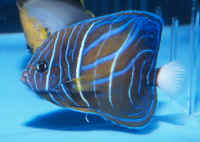
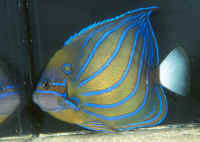
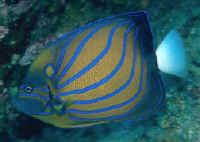
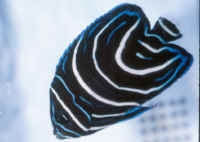
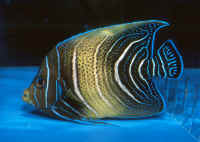
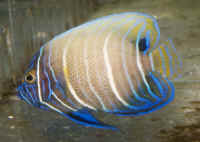
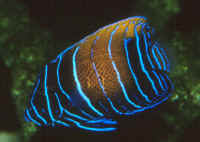
| Pomacanthus annularis
(Bloch 1787), the Blue-Ringed Angelfish (1). An oft-neglected
beauty, that is surprisingly (to some) hardy. Indo-west Pacific and
east African coast. To about eight inches overall. Changing
juvenile, sub-adult in captivity, adult in Pulau Redang,
Malaysia. |
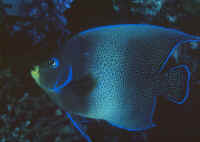
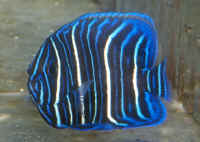
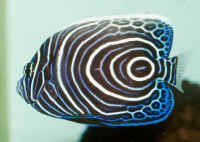
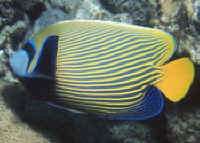
| Pomacanthus
imperator (Bloch 1787), the Emperor Angel (1). Widespread
in the central and western Pacific into the Indian Oceans coasts
and Red Sea. To fifteen inches total length. Shown are a juvenile
of about four inches in captivity and an adult in the
Maldives. |
|
|
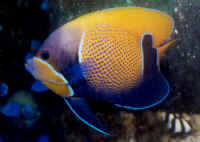
Pomacanthus (Euxiphipops) navarchus (Cuvier
1831), the Navarchus, Majestic or Blue-Girdled Angelfish (3).
Found throughout the Indo-Australian Archipelago. To ten inches
in length. Juvenile (2") and adult (6") in
aquarium shown.
|
|
|
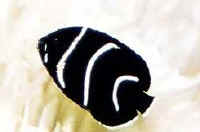
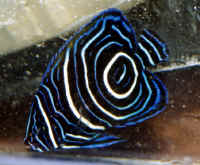
Pomacanthus
semicirculatus (Cuvier 1831), the Koran or Semicircle
Angelfish (1). A beauty from throughout its wide range, Indo-west
Pacific eastward to Africa, but not the Red Sea. To about
thirteen inches in length. At right, 1 and 7 cm. individuals by
Hiroyuki Tanaka. Shown below: two, five and twelve inch
individuals, the first two in captivity, the adult in Fiji.
|
|
|
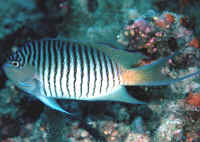
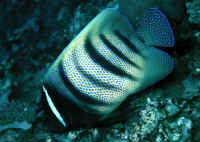
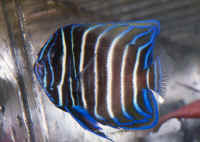
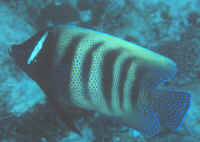
Pomacanthus (Euxiphipops) sexstriatus
(Cuvier 1831), the Six-Striped/Banded Angelfish (3). One of the
largest angelfishes at some eighteen inches maximum length. Also
found throughout the Indo-Australian Archipelago. Juvenile
in aquarium (3") and adult (10") in Australia
shown.
|
|
|
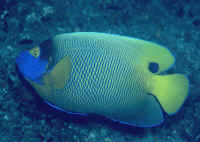
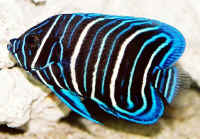
Pomacanthus (Euxiphipops) xanthometopon
(Bleeker 1853), Yellow-Mask or Blue-Face Angelfish (3). Indo-west
Pacific to the Maldives. To thirteen inches in length. At right,
a 7 cm. individual in captivity, photo by Hiroyuki Tanaka. Below:
Juvenile (3"), changeling (4") in captivity and foot
long adult in the Maldives shown.
|
|
Genus Pygoplites:
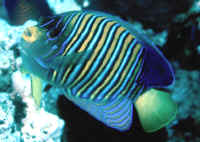
| Pygoplites diacanthus (Boddaert 1772), the
Regal Angelfish. Indo-Pacific; Red Sea, East Africa to the
Tuamotus, north to southern Japan. To ten inches in length. Note
the gray chest area of this Fijian specimen. The more desirable,
hardier Indian Ocean and Red Sea ones have an orange chest
area. Below, tiny 2 and 3 cm. specimens photographed in
captivity by Hiroyuki Tanaka. |
|
Angelfishes for Marine Aquariums
Diversity, Selection & Care
New eBook on Amazon: Available
here
New Print Book on Create Space: Available
here
by
Robert (Bob) Fenner |
|
|
|