|
FAQs on Lymphocystis, Tumors,
Viral Cysts... 2
Related Articles: Lymphocystis, Environmental
Disease, Clownfish Disease,
Related FAQs: Viral Diseases
1, Aquatic
Virology, & FAQs on Aquatic Virus
Disease: Identification, Causes/Etiology, Cures/Medications, Case Histories: Non-Lymphocystis, Lymphocystis,
|

|
|
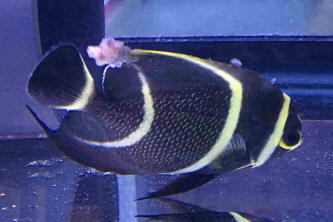
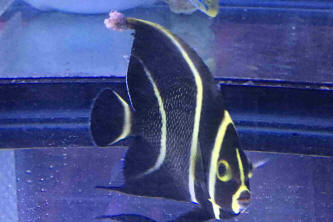
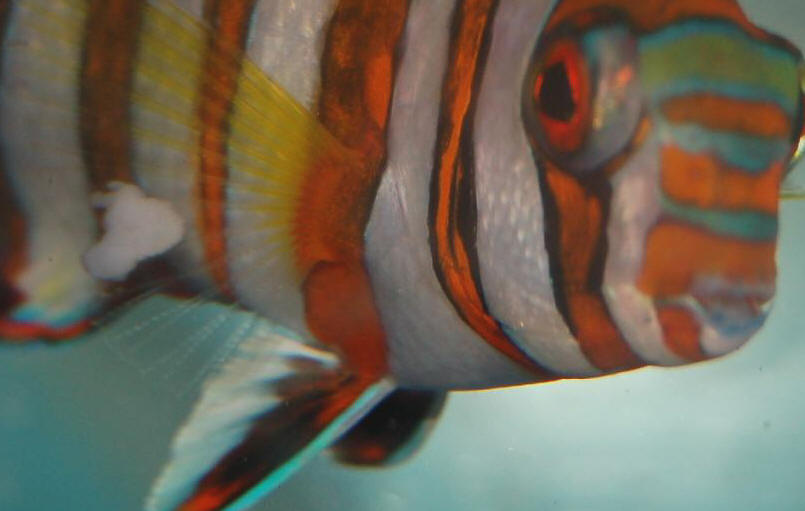
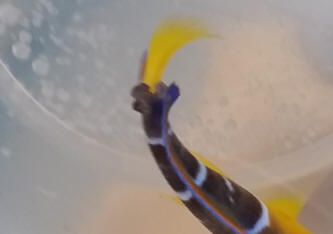
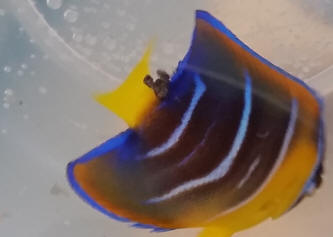
French Angel with Fin Rot or nodule disease(?)
2/19/18
Hi,.
I was hoping you could offer some advice. I am treating a French angel with a
nasty case of what I first thought was fin rot.
<Mmm; nah>
It has eaten away most of its streamer and there are a few other nodules on his
pectoral fins (see pics). When it first appeared I tried treating the fish with
a combined Kanaplex and Metroplex mix. After the 5 days I saw no improvement. I
did a 20% water change and switched to Maracyn Plus. I have just completed the
3rd treatment (day 1,3 and 5). I am seeing a small improvement - not sure if
it's the Maracyn or the fact that I pulled the fish out and dabbed some iodine
on the infection two days ago. Should I retreat with Maracyn Plus (after another
water change)? If it's a virus (Lymphocystis?)
<Appears to be so; yes>
then I don't know that an antibiotic would do any good. Should I try something
else.
I hate to keep throwing drugs at it.
<No antibiotic will help here. Please read the linked files at top here:
http://www.wetwebmedia.com/viraldislymph.htm
There is a Pearlscale butterfly in the same QT tank that shows no infection
(they are together because they were purchased at the same time). The Pearlscale
eats well. The French eats sparingly from time to time. The goby in the
background is in another QT tank.
Thanks,
Mike Spizzirri
<I'd physically trim off the bit here... sharp scissors. Daub with a bit of
Mercurochrome, Merthiolate... with a Q-tip. Bob Fenner>
|
 |
|
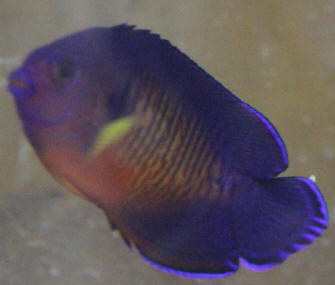
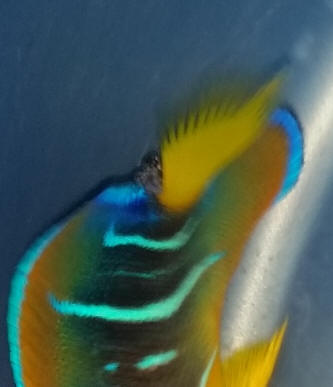
Lymph on Coral Beauty angelfish? 12/27/17
Crew! This fellow came in with a few other fish and he had some cotton on a
dorsal ray and some minor damage on a pectoral fin. I did a FW/MB dip on
everyone and put them all in QT. The other fish didn't develop any issues
and I moved everyone else to a holding tank. He's been eating and behaving just
fine. The cotton went away after the dip and he's been healing. Now, 2 weeks
later, the dorsal ray and pectoral fin look fine but this granule on
his caudal fin showed up. I'm thinking this is Lymphocystis and I'm wondering if
there's any benefit to keeping him in QT after the 1 month mark (I have a
Butterflyfish in my DT with Lymph). Also, do you recommend any immunosupportive
treatments while in QT? Thank you!
<I do concur w/ your observation. To me, this looks almost certainly to be
Lymphocystis. T'were it me/mine, I'd pinch off (with your finger and thumb, this
bit, while enroute moving this fish to the main-display. And do what
you can to optimize nutrition and environment to help the fish fight off viral
return. Bob Fenner>
|
 |
Chelmon Lymphocystis
4/8/15
Hey Bob, I've had a CBB in a 55 qt for about 6 days now. After nipping at live
rock for 2 days he finally started eating vitamin soaked PE mysis.
He's been eating about 6-8 shrimp a day and is active. It did have a
little "lymph" when I got it, but has gotten worse since.
<Quite common; and I would expedite this (and all Butterflyfishes) through
quarantine... likely do a preventative dip/bath and place straight away. NOT to
worry re the Lymph... easily defeated, not often spread...>
The water quality is great; 1.022 SG,
<Mmm; would keep more NSW, 1.025-6>
ammonia and nitrites at 0, nitrates at about 20 and it is the only fish in the
tank. There is plenty of LR plus I'm running a Fluval 406 with ceramic media
seeded from my main sump. I've been reading about possibly transferring
him to the DT, but am nervous.
<Don't be>
It's only been 6 days, so it could still have ich theoretically, also the lymph
will eventually explode and possibly spread.?
<No... see, READ on WWM re>
My 150g DT inhabitants are as follows... Black dogface puffer (7"), teardrop
butterfly (4"), comet (6"), Flagtail Blanquillo (7"), orange tail filefish (4"),
and a long nosed hawk (3").
The DT is extremely healthy and active and has been for about 2 years.
Do you think I should be patient here, or risk transferring him.
<I would definitely do the latter>
Another worry of mine is that he'll have a lot of competition for food and may
perish unless I keep him where he is to "fatten him up a bit".
Especially the file fish who is the fastest most voracious eater I've ever seen
:) Any thoughts? Thanks!
-Jay
<Welcome. Bob Fenner>
|
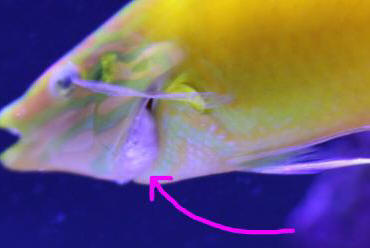
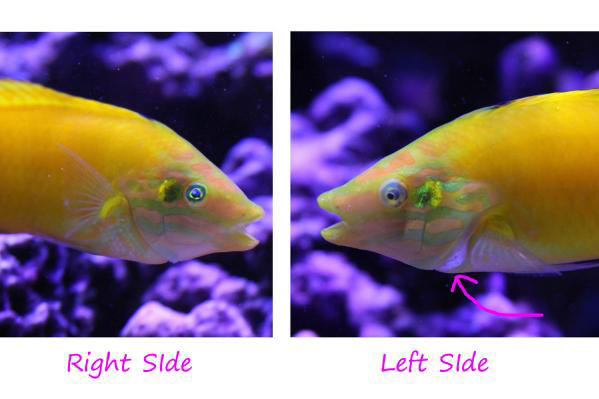
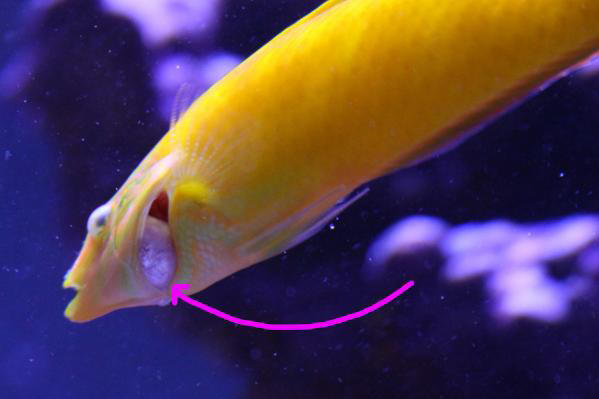
Yellow <sic> Coris <Halichoeres> Wrasse with Swollen Gill -
Please Help! 11/12/13
Dear Mr. Fenner,
<Antonio>
My name is Antonio and I have yellow Coris wrasse that has a gill issue.
I posted it in the Fish Disease forum over at ReefCental.com
<http://reefcentral.com/forums/showthread.php?t=2348310 > and
3Reef.com
<http://www.3reef.com/forums/diseases/corisswrasse-severely-swollen-gill-150695.html
> . One of the members (Newsmyrna80) on reefcental.com suggested I bring
this to your attention.
My yellow Coris Wrasse has developed a swollen gill. He started showing
signs of trouble with the gill a few weeks ago, but I left him in place
since at the time, it was very minor and he had no other outward signs
of discomfort. His eating and sleeping habits have remained normal
(always a good eater), and his energy level has remained normal until a
few days
ago.
<Mmm; not swollen per se; but some sort of tumorous growth
coming out from the cavity>
Starting on Friday - he seemed a bit more lethargic than normal, but was
still eating like he should. His gill had inflamed a considerable amount
and is now pushing out of the side of his head.
I have already setup a hospital tank and moved him into it earlier
today.
What I need help with is identifying the issue so I can make the best
decisions on treating him. Below are some close up photos of his left
gill, and a video of him swimming around.
<I would not treat... but maybe try one or more purposeful cleaner
organisms at this juncture... Perhaps a Lysmata sp. shrimp for a first
go>
I've shown this to a few other both online and at my LFS, and have
received varying opinions from parasitic infection, tumor, fungus - but
no solid consensus yet.
<... only can be discerned by necropsying the fish, area... with it dead
or killed... Embedding, sectioning... histological exam.>
History of water parameters can be viewed on my AquaticLog profile here:
http://www.aquaticlog.com/showcase/m...quariumId=2396
<http://www.aquaticlog.com/showcase/measure?aquariumId=2396>
<http://www.aquaticlog.com/aquariums/onlytono/2>
Video
<http://www.youtube.com/watch?v=bbdK5WawKbk>
http://www.youtube.com/watch?v=bbdK5WawKbk
I'm sure I've left something out here, so if you have any questions,
please
ask - thanks in advance.
Antonio Gutierrez
<Welcome. Bob Fenner>
|
 |
|
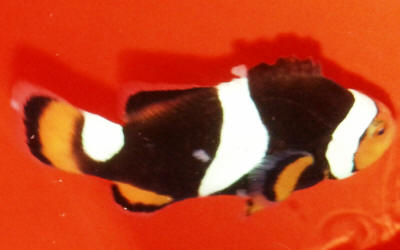
Cotton Candy like growths on Clownfish
1/11/13
I have a clownfish that came in with what best I can describe as cotton
candy like growths on it's dorsal fin (at the end), caudal fin, on the
underside (in the pic they would be by pectoral fin), and then on it's side
right after the second white stripe.
<I see this>
I'm not quite sure what these are, and I know the picture is not the best.
At first I thought it was the onset of Brooklynella,
<Mmm, no>
so I began doing daily 60 minute Formalin baths (I have done 3 so far) and
then moving the fish to a new QT aquarium each time, as to avoid
reinfection. Since I have not see any improvement, and the fish continues to
eat, I am thinking I may have something else going on with her, maybe
Lymphocystis?
<This would be/is my guess>
Any help you can provide would be appreciated.
<Read here:
http://www.wetwebmedia.com/virdisidf.htm
and the linked files above; and here:
http://www.wetwebmedia.com/clndisenv.htm
the root "cause" of these viral incidences are said to be environmental
("water quality") and/or nutritional in nature...
Bob Fenner>
onyx-clownfish.jpg <https://docs.google.com/file/d/0BwVcllKbJWA1d2Z3RFZLSzdsUzQ/edit>
|
 |
Re: Ich treatment, need advice... Now Lymphocystis
1/7/13
Hi Bob,
<Adam>
I guess I've moved away from the original Ich topic that I originally
wrote you about, but I believe I've identified the source of the
growths on the Copper Band that I wrote about last. The picture
in this thread on Reef Central shows identical, though far more severe
growths to what's on my fish:
http://www.reefcentral.com/forums/showthread.php?t=1829872
<Okay>
I guess it's Lymphocystis, and since I wrote you last it's gotten
significantly worse. I've read through the Lymphocystis page on WWM, and
just about anything else I could find online, and it looks to me like
the only treatment for this is a low stress, low handled, high quality
environment, basically the opposite of a QT system set up for the tank
transfer method.
<Including the use of purposeful cleaners (organisms)>
Also, my canister filter that was cycling in a bucket in the garage died
at some point right before the final transfer, so I have been continuing
to transfer my fish every three days while dosing PraziPro. I understand
now that while I've pretty much eliminated all the parasites, I'm only
making the Lymphocystis worse. I hate to knowingly introduce an
incurable virus
<Mmm, they're everywhere... not to worry>
to my display tank, but to me it looks like the only way I can provide
the environment necessary to beat back the disease is to transfer them
all to the display tank, which has plenty of supplementary live foods,
perfect water quality, and ample space & hiding places. I'm hoping that
the excellent health of the other fish will prevent them from becoming
infected, and that the CBB will recover once it's in a stable
environment.
I'm also going to pick up a pair of cleaner shrimps tomorrow, and
thoroughly bleach all my QT equipment so it doesn't infect the next
batch of fish.
<See above>
So unless you see some giant red flag in my plan, I just wanted to say
thank you for all your time and assistance, and I hope you had a very
happy new years!
Adam
<I'd move all to the main/display. B>
Banggai Cardinalfish Iridovirus
2/13/12
Dear WWM Crew,
<Jeff>
I am a research student with an interest in iridoviruses, and recently
came
across a couple of postings from one of your members as follows (from
"FAQs about Banggai Cardinalfish health/disease"
http://www.wetwebmedia.com/banggaidis.htm ):
"Infected Banggai Cardinals 8/23/11
Crew,
After a numerous attempts to introduce Banggais to my display they all
have died the same way. After a vigorous first week eating well ...
they
suddenly stop eating, become lethargic. Final phase is with stringy
feces and die one day after that. Tried every medication possible but
nothing has worked. Looking in the www I found the article that seems
to explain everything and it is getting very serious. They are infected
with a non reversible disease... a time bomb: Iridovirus.
It seems that the problem is a Iridovirus witch has no cure that has
infected the collection and distribution channels of this little
fish.
Please read the article posted bellow and help us all Fish lovers to
better understand this issue and try to reduce the wild caught doomed
Cardinals.
Eric
Systemic Iridovirus infection in the Banggai Cardinalfish ...
http://vdi.sagepub.com/content/21/3/306.full
<Thank you for sending this along. Hopefully folks will add this
knowledge to the weight of purchasing locally/regionally cultured
specimens of this species... and these will not in turn become like
tank-bred Colisa lalia.
Bob Fenner>
Cardinal Banggai 8/24/11
Gentlemen,
It is me again. troubling with the Banggai virus.
This time my question is related to the correct temperature for these
little ones.
Almost everyone mentions in the web mention a 75 F 82 F temp range BUT
reading from the Banggai islands and technical reports they mention
temps of 82 F to 89F ( 28 - 32 C )!
This is a huge difference... and let me tell you that the ones I had in
quarantine tried to be near the thermostat for a reason... could it
be?
<Not likely temperature, but habitat... Juveniles "hang"
out amongst urchin spines, large anemones... Not in the open>
Is it possible that we all are very wrong about the temp they need to
be in??
<Don't think so... I've been diving in their islands... the
water is rarely more than 82 F.>
Thanks for your reply
Eric
<Welcome. Bob Fenner>"
Eric mentions "numerous attempts" but I was hoping to contact
him for some further details (how many attempts, over what sort of time
period, when (e.g.. month) fish were purchased, conditions under which
the fish were kept etc). Is there any way in which you would be able to
put me directly in contact with Eric?
<Unfortunately no. We don't retain or post others email
addresses w/o their express desire>
Many thanks in advance for any assistance that you may be able to
provide.
Regards,
Jeff
<If you'd like, do write back w/ contact info. on how Eric,
others might contact you and we'll post. Bob Fenner>
Re: Banggai Cardinalfish Iridovirus
â'¬â€œ 2/14/12
Dear WWM crew,
I am a research student with an interest in iridoviruses. I have
recently come across a number of posts on the internet by hobbyists
such as Eric's posting here at WWM "Infected Banggai Cardinals
8/23/11"
(http://www.wetwebmedia.com/banggaidis.htm ) describing their
experiences with mortalities in Banggai Cardinalfish consistent with
Iridovirus infection (with signs including inappetance, lethargy and
particularly white stringy faeces).
I would be very interested in hearing from hobbyists such as Eric who
have experienced such mortalities, as I am interested in some further
details from these events (such as how many occasions this has occurred
on, over what sort of time period, when the fish were purchased,
conditions under which the fish were kept
etc). I can be contacted through iridovirus@hotmail.com
and would be most appreciative if you could post this on my behalf.
Many thanks for your assistance.
Regards,
Jeff
<And you Jeff. BobF>
|
Moorish Idol - parasite or fungus... Mmm, neither
12/18/11
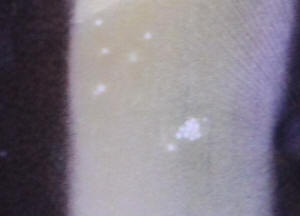
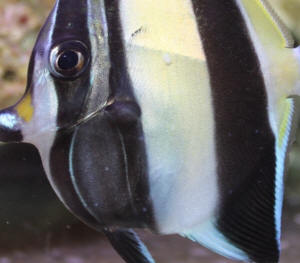
Hi all, hoping to get some assistance with identifying the
disease on my Moorish Idol.
<All righty>
I received the fish on 11/21/2011. (26 days ago). I immediately
placed the fish in hypo-salinity at 1.008
Salinity. The fish had no sign of sickness, I just do it as a
precaution. Anyway as with most Idol's it took about 5 days
to start eating. It is eating with increasing enthusiasm every
day. It's gut is starting to fill out nicely. There is
however what looked initially like Ich and has developed into
something more. It started off with some spots that looked to be
under the skin and has increased in size to what is now outside
of the skin. The first ones have gotten larger and looks like
cauliflower.
<An apt description; this appears to be the
environmental/viral condition called Lymphocystis. Please read
here re: http://www.wetwebmedia.com/virdisidf.htm
and the linked files above>
>
The fish has never once rubbed/scratched or shown any sign of
stress. I took some pictures tonight (attached) and the larger
ones that looked like cauliflower almost looks like a grouping of
small eggs. Let me know if you have an idea of what this is so I
can appropriately treat.
Picture 3 parasite on the fin seems to be different then all the
rest. It looks like cotton.
<This is likely "just environmental"... and the
treatment for all is coming... placement in an optimized, stable
world... of near seawater strength (concentration) and good
nutrition. Bob Fenner>
|
|
|
Re: Moorish Idol - parasite or fungus
12/18/11
Thank you very much. :)
<Certainly welcome and congratulations on your Zanclus... DO
please read over what we have archived on this species on WWM, and
consider using Spectrum pellets as your staple here...
BobF> |
|
Yellow "growths" on Foxface fins? -
6/11/10
Hello WWM crew,
<Hi Shannon>
I'm hoping you guys can help me out with my very first
saltwater fish, a Foxface,/ Siganus vulpinus/.
<Okey Dokey>
He's about 4 inches long and is now in my 20-gallon
quarantine tank. I've noticed recently that there appears
to
be a yellow growth or wart on the edges of one of his pectoral
fins, and another on the tip of one of his dorsal spines. His
color is good, he's alert, his breathing is steady and even,
and he's eating well. I'm not sure what these growths
could be--is it possibly Lymphocystis?
<Could be, yes>
Since I consider you fine folks the experts, I thought I'd
ask you first before I consider any kind of treatment, plus I
don't want to start putting chemicals in the quarantine tank
and stress out the Foxface. Any help would, as always, be greatly
appreciated.
<Ok, what has he been in contact with regarding other animal
life recently?
This could be a sting/ injury. Or it could be Lympho like you
say. Photo's are always helpful here, as from the information
given it is impossible to give a definitive answer. I agree
though, that you should not treat this animal with anything just
yet>
Thanks in advance,
<No Problem>
Shannon O'Rourke
Old Bridge, NJ
<Simon, Cheddar, Somerset>
Re: Yellow "growths" on Foxface fins?
6/13/10
Hi Simon,
<Hello Shannon>
Thanks so much for your quick reply.
<S'fine!>
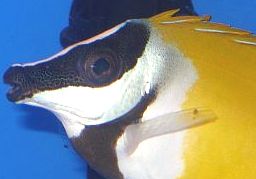
Ok, here's the best photo I could get of my Foxface, as
he's so active!
<This is a good photo>
You can see the yellow growth on his pectoral fin and dorsal
spine in the attached photo.
<Yes, this does look like Lymphocystis to me>
He's the only one in the quarantine tank right now, as he
went right in there when I brought him home from the LFS.
<Well done>
At the store he was in a tank with some type of small wrasse, but
I don't know which species it was. Hopefully the photo will
help.
<Yes, this fish looks healthy to me, no treatment required
here other than your good care and it should disappear on
it's own in time>
Thanks again,
<Thank you>
Shannon
<Simon>
|
 |
|
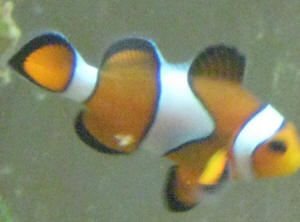
Wart-like Growth on Ocellaris Clown... yes
2/27/09 Hi, <Simon> I've had a good look
through all the information you've got on WWM but I can't
come up with a positive diagnosis for my Clown. <I see>
There's a little story about this that needs to be told to
give you all the information. 5 weeks ago we bought a Blue Linkia
Star, <Not usually hardy> a small Torch Coral and another
mid sized coral and a small (tiny) Ocellaris Clown to attempt to
pair with our larger Ocellaris. We don't have a QT tank yet
(we really should bite the bullet and set one up, this experience
has taught us a lesson), <A too-common one> so they all
went into our main tank (after acclimatisation, etc). That night
we noticed a small wart like growth coming out of the top of the
center of the star. Over a period of a week the growth got larger
and larger and eventually started to come out of the center of
the base of the star as well. Our LFS has a 14 day guarantee on
fish health, and were happy to take him back and replace with
another (healthier) specimen. <... we'll see. Please read
on WWM re Linckia...> The pairing of the Clowns went
remarkably well, there was no fighting, biting or anything like
that, they just immediately started hanging out, sleeping
together and playing together. The original Ocellaris has now
grown phenomenally; she had stopped growing for a few months
before now. <Also typical> About a week after the star went
back we noticed a similar wart-like growth starting to appear on
the small Ocellaris just behind his central white stripe.
I've attached a photo, its not a brilliant shot, but he's
just so fast! The growth has slowly gotten bigger (now about 2mm
in diameter), but so has the Clown. Today we noticed what may be
another similar spot starting to grow near his tail. <I see
this> He does not seem to be affected at all by the growth,
he's playful, eating ravenously, generally friendly with the
other fish and his colour is vibrant. There is no extra slime,
stringy waste, or any other signs that he is unwell, so I
can't reliably identify it as any of the common viruses,
bacteria or fungi that affect Clowns. Any help you can give would
be appreciated, they've become such a good pair it would be
horrible to lose one (or two if its contagious). The tank is 188
litres <Too small for the star> with about 25kg of live
rock. Its been established for 14 months and we've only lost
one chromis (while on a month away from home) so far. The tank is
stocked with two chromis, a coral goby, a two spot goby, the two
Ocellaris Clowns, an urchin, the blue linkia, the torch coral,
the other coral (can you identify it from the photo?) <Mmm,
no. All I see is the Euphyllia> and various hitchhikers
(brittle stars, bristle worms, a snail, two Chitons, etc.). We
change 5-10% of the water every week and our tested levels are
always stable and low. <Good> I hope you can help, Simon
<This does appear to be a wart-like growth as you state... the
bulk of which go by the term "Lymphocystis" in the
hobby... there are no specific "treatments", but most
all these "come and go", similar to "planter's
warts" in humans... Better water quality, nutrition tend to
ward off, heal faster. I would not "treat" the water,
but might look into a purposeful cleaner organism... See WWM re.
Bob Fenner>
|
 |
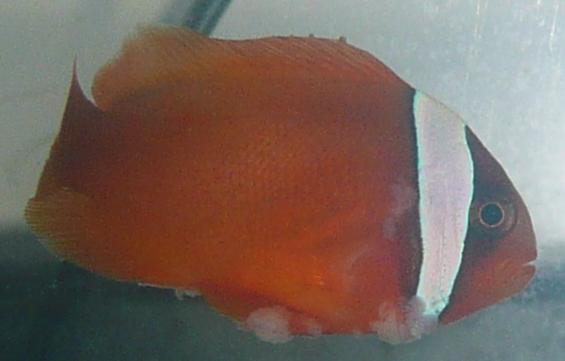
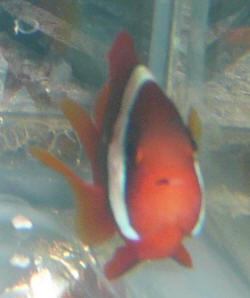
| Helppp! Lymph on
wild-collected Clowns 05/19/08 I bought two tomato clown
fish about three weeks ago (actually one is a cinnamon clown fish),
their names are Cinnamon and Julius. I'm new at this salt water
thing and I'm already learning a lot which I should have
researched before I bought the tank. All our levels have been fine
for pH, nitrite, nitrate, ammonia, and our SG and temperature.
Anyways, when I bought my clowns, they looked okay in the store and
then when we got them home we noticed a small white clump on
Julius's bottom fin. <This is a non-specific viral
complaint... Lymphocystis... environmentally-mediated...> It
started to grow larger within a couple days so we started
researching online. We added Melafix to our tank <...
worthless... worse than worthless> and contacted the Wet Web
Media Crew. We sent a picture but they couldn't diagnose it and
they told us that Melafix doesn't work. Julius continued to get
worse so we set up a quarantine tank (which I know we should have
done first). We put the clown in the small quarantine tank and used
Cuprix which is a chelated copper medicine. <Copper is not
efficacious here either...> We also read that we could try to
pull off some of the white clumps which we tried but he still got
worse. Now he has the white clumps all over his fins and his gills
and our other clown is beginning to get white clumps in his mouth
to the point where he can't eat. He has also developed one tiny
white spot on his skin. I have them both in quarantine now and I
don't know what else to do. We bought a Picasso Trigger before
we realized they were sick also and right now he is in our 75
gallon tank away from the clowns. They were all together for a
little while so I hope he doesn't get sick too. I'm going
to send a picture of the clown with the clumps on him and one of
the clown with the clump in his mouth. Any help would really be
appreciated. Thank you, Heather. <Please read here:
http://wetwebmedia.com/viraldislymph.htm the linked files at top.
Bob Fenner> |
  |
|
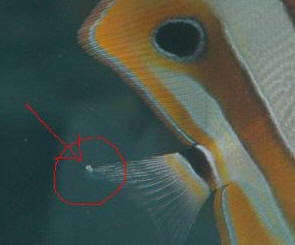
Lymphocystis - Chelmon rostratus 1/6/2008 Dear
Crew, <Andy> Good morning. I'm sending you two separate
messages, because they deal with separate issues and I know they
might get sorted among different Crew members. <Ok>
Here's the first! I purchased a Chelmon rostratus, not only
because it has always been one of my favorite fishes but also
because I have about 10 or 15 Aiptasia growing in my display that
I'm hoping it will eat. The butterfly has been in my 30g QT
for 7 days now. <I would move it to the main display> When
I purchased it, I made sure it was eating at the LFS. For the
first 2 days after I brought it home, it ate well--frozen Mysis
and blood worms. After day 2, however, it stopped eating. I had
done my research on the fish beforehand, so I knew these fish can
be finicky eaters. So, I got on WWM to research what others have
done in similar circumstances, and I discovered that what I am
experiencing is not uncommon and that the advice has been to get
some live rock in the QT to get the fish to graze the worms, etc.
on the rock. It just so happened that I have a few pieces of LR
that were not supporting other pieces of LR and that host some
Aiptasia, so I decided to throw 2 pieces in the QT. I placed the
first piece in (which had about 8 Aiptasia) and went back for the
second. By the time I got back to the QT, all the Aiptasia were
gone. I thought, "this could not be." Sure enough,
though, this morning they are still gone (along with a very
pretty orange feather duster that hiked in on the rock--oh well).
The Chelmon has pretty much denuded my LR of any worms, etc. So .
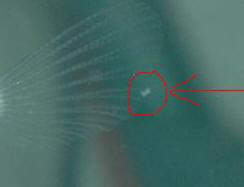
. . Thanks for the advice! <Welcome> ANYWAY, my question
really relates to 2 masses on the tail and pectoral fin of my
Chelmon, shown in the attached photos. Based on my research, I
believe that the fish simply has Lymphocystis, but would like
your concurrence. <I do agree> If so, I won't hesitate
to put him in the display after the 3-4 week QT if all else goes
well. If it's something else, then I'll proceed
accordingly. <I would place this fish now... this is much more
an "environmental" or stress condition than a type of
pathogenic disease... Won't be "catching"...>
Thanks as always for your time/help. Andy (Although I realize
(think) that 15 Aiptasia is not an infestation by any stretch, I
am trying to figure out why they are appearing. <Some cellular
material must have been introduced at some point... likely
on/with LR, but could be algae...> I have cut down feeding to
once per day--usually frozen Mysis or blood works, or Formula 1
flake. I employ a 30g fuge with Chaeto, DSB and LR. I run
Phosguard in the sump. I have tested my display water, my RO/DI
water, and my storage water for phosphates and silicates--I have
two test kits--a Seachem (color never matches test strip) and a
Salifert (really hard to read!). No silicates are present. The
Seachem kit shows 0.1 phosphates (or 0.01, can't remember the
scale) in all three sources; the Salifert shows 0, so I'm
befuddled). <No need or use... Bob Fenner>
Re: Lymphocystis - Chelmon rostratus 1/6/2008
Thanks, Bob. I presumed that everything needs a long QT period,
but it seems that with the Copperband 8 days is enough as long as
it isn't showing other signs of disease/reason to keep in QT?
<... please re-read... "I would..."> I don't
understand your last response, "no need or use" re my
phosphate kits/readings. Would you mind explaining? Thanks again.
<These readings for soluble PO4 are in agreement within the
limitations of the test gear. B>
|
|
|
Lympho on Copperband butterfly 12/2/07 Hello,
Thanks for all of the help in the past and the great site. I will try
and keep this short. I have read through the Lympho FAQ's and
couldn't find what I need. I received a copperband from
LiveAquaria.com about 2 weeks ago, I put him in my 20 long quarantine
and after a couple of days I noticed the white clumps developing on his
fins. They have spread to his tail and even some on his body. He eats
extremely well, only mysis though (I have noticed in the past that I
only have luck getting Copperbands to eat "white" food,
anything to this?) <Don't know... but interesting
speculation> which I soak in Selcon. I have read that there is no
direct cure for this and that good water quality and food are the best
medicine, there is also a cleaner goby with him but I don't see him
clean him though. My question is, would you keep him in quarantine
until it goes away or would you put him in the display? <I would do
the latter... This viral complaint is "not that infectious"
and yet, won't begin to self-cure unless the Chelmon is "in a
better place"> The only fish in the display are a tomato clown,
lawnmower blenny, and very expensive juvenile chevron tang. <Oh!
Just wrote a piece for this Ctenochaetus sp.... one of a few while am
out in HI... "in spare time"...> Thanks for all of the
help. Merry Christmas, Jeremy <I do hope the frenatus clown
doesn't go after your Butterfly. Only experience will tell... do
remove/float the clown in a plastic colander for a few days if
apparently so. Cheers, BobF>
Re: Lympho on Copperband butterfly 12/18/07 Just
wanted to let you know that the Copperband is looking great now. He is
still eating and seems to be happy. I removed the tomato clown just in
case, as I had seen it chasing the chevron and noticed the fins on the
chevron looked "nipped". He is still eating great so I assume
they will grow back. Any reason to think it was caused by anything
else? <Mmm...> Only a few small crabs, lawnmower blenny, and
butterfly with him in the tank. Looking forward to reading your article
on the Chevy tang on the website. Have a great Christmas. Jeremy
<Will download after it runs in print... have attached here for your
perusal. Cheers, BobF>
Mixing medications... Lymph related to env. stress,
Cu exp. 10/27/07 Hi <Hello there> I was hoping that you can
help me figure out necessary treatment for my Juv. Queen Angel. I have
125 gallon that I have had up for the 18 months. I recently removed all
my fish to a hospital tank and started treatment with CopperSafe for
ick. I am 10 days into treatment and all fish seem to be responding
well except the Queen Angel. She has kicked the ick but in the last
couple of days she has showed signs of what appear to be cauliflower
like white growth on the tips of her fins and mouth. <Ahh... likely
the virally related condition Lymphocystis> I was wondering if this
is environmental because of the CopperSafe. <Yes... very likely a
contributor here> I have performed regular water changes making sure
to replace the CopperSafe and am now wondering if I need to add an
antibiotic or wait and then add carbon to remove the CopperSafe. <I
would wait> I did perform a fresh water dip when I first noticed but
feel that I don't want to add additional stress. She is eating
well. Any advice is greatly appreciated. Thank you. Queen Angel Dad
<Likely the Lymph will recede, disappear with the improved
environment, return of the Holacanthus to its main display. Bolstering
immune systems with supplements (e.g. BioVit)... HUFAs, AAs,
Vitamins... is encouraged. Bob Fenner>
Lympho on coral beauty... reading 9//15/07 Hi crew! I've
diagnosed my newly acquired coral beauty with lymphocystis. He's
been in a QT for 3 weeks and the 2 spots came up 2 days after I brought
him home. <As with warts, other viral growths, involvements,
including with our own species... there is a stress factor...>
I've been following the advice with doing water changes using my
main tank water (every 3 days). I'm feeding him mysis shrimp with
Kent's garlic also put live rock in the QT for munching. These
spots still are not going away. <Mmm, won't with this treatment
regimen...> I gotta laugh at trying to scratch these spots off
<Spots? Please read here: http://wetwebmedia.com/lymphfaqs.htm and
the next Related FAQs file linked above> ....there's no
way....he's a feisty fish!!! Just trying to net him to put him in
the QT made a mess! Question is: should I keep waiting for these to
fall off or is he ok to put in the main tank? How long can he stay in
the QT for the Lympho before it becomes detrimental to his overall
health? Thank you for your time and knowledge!!! Jennifer <Read on
my friend, read on. BobF>
Lympho ~ Tusk fish 8/15/07 Afternoon,
<David> Just a quick question on Lympho as I did not see the
answers in your FAQ's. My Harlequin Tuskfish originally had a small
cauliflower like white growth on his left side fin and Bob and I agreed
it was definitely Lympho. This was left alone and after about 3 weeks
it fell off or was scraped off by the fish. Within about a week or so,
the growth reoccurred in several small masses on the same fin and then
again in two large clumps on the tailfin and small signs of growth
along the side of the fish. Just got back from vacation for past 10
days to find pretty much all the major growths have fallen off or have
been scraped off, but I can now see what appears to be even more
smaller growths all over the back of the fish... Would you expect this?
I'm worried it will keep coming back more and more until perhaps
finally the gills are involved.... Thoughts? Suggestions? David
Brynlund <These viral complaints can be persistent... as in
humans... all other life... Many models of cancer, aging... relate
their involvement... I would do your best to boost the "immune
systems" of the host fish/es... HUFA, vitamin soaked foods, the
occasional application of same to the water, along with iodide... See
WWM re. Bob Fenner>
Re: Lympho ~ Tusk fish 8/15/07 Thanks for the
quick response Bob... <Welcome> Better to treat the whole 200g
tank or catch this fish again for quarantine? <No... leave in
place... "it's the system Dave"> What's your
experience been with that SeaChem Garlic additive along with the Focus
or Mez... (I forget what it is...)?? <Not a fan... though I cook
with quite often> From reading your info, it seems as though this
virus is more common in clown fish?? <Somewhat, yes> In
rearranging my tanks, would adding my two False Percula's to the
same 200g tank as my Lymph'd Tuskfish be a bad decision??? <Mmm,
no... though might get eaten> I've read two sources... One says
it is contagious, the other indicated it wasn't? <Not very
cross-species-wise> David Brynlund <RMF>
|
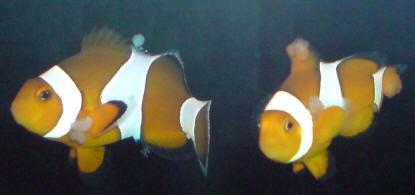
Lymphocystis? NNS? - 7/23/07 Hi Crew, <Young> This
is my first time writing to you guys, but I've already
benefited from your replies to other ppls questions many times,
so thank you very much for your time! I have had these clownfish
for more than a month and they started having small lumps growing
on them, first in one... and then in the other. I should've
quarantined the fish but since it they were the only fish in the
tank (10g +10g sump), I skipped that process (I know huge
mistake). Anyhow would like to confirm if this is lymphocystis or
something else and what can I do about it. also is there anything
I can do if its lymphocystis? <Does appear to be... and is
large enough to likely be advantageous to pull off with your
fingers (triggering immune response)... and adding a cleaner
organism or two (my choice? A Lysmata species)> I mean I know
there is no known treatment but just wondering if there is
anything ppl out there have tried. Also should I separate the
fishes, I mean will it be contagious from one fish to another say
one gets well but then gets it again from the other or vice
versa? Thanks once again, Kind regards, Young <Please read
here: http://wetwebmedia.com/lymphfaqs.htm and the file linked
above in the FAQs series. Bob Fenner>
Re: Lymphocystis? Non-native speaker? --
07/24/07 Hi, Thanks for the quick response. what's
<... are you a NNS? Please learn to/use spell/grammar
checkers...> the procedure of pulling of with fingers, I mean
I'm new to this and I cant imagine anyway in which I could do
this without harming them. <This is posted where you were
referred to. Read there> Also I do have 2 cleaner shrimps
(Lysmata amboinensis) but they do not clean the fishes, actually
the fishes don't let the shrimps clean them any idea what I
can do? <Yes; read> the first tumor did go away but they
keep getting more as you saw in the picture. Read the FAQ you
send me to and Im doing what most ppl suggest, trying to keep
good water quality and feeding them to maintain them healthy,
should I do a fresh water dip? <... no...> Thanks once
again, Regards,
Young
<Keep reading... Bob Fenner>
|
|
|
|
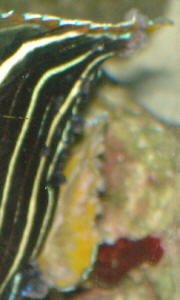
Chrysurus angel sick... Mis-mix, Lymph - 7/23/07 Hello
again Bob I wrote you about 2 weeks ago, had a horrible ich
problem and you helped me out a ton... as it stands I only lost
my queen angel.... sad she was my favorite... I transferred all
but the leopard sharks and my lion fish <Mis-placed...> to
a large 40x45x10 inch tub in my garage... I treated them with
Cupramine and all my fish made dramatic improvements ASAP.... As
for my sharks and lion I treated them in my display( I know you
hate to hear this....) but I had no choice, I treated them with
quinine sulfate from fishfarmacy.com and my lions infection
cleared up in a week. The sharks never showed any signs but I
wasn't taking any chances... I have since done several water
changes 25% each and added charcoal to the sump to filter out the
quinine sulfate. I returned all fish (imperator, passer, pair
yellow banded maroon clowns, <... am becoming very tired of
fixing your English... spaces between your sentences...> and
the chrysurus angel, less live rock (in separate tank with no
meds) back into display. Now my chrysurus angel is developing a
bunch of what looks like fungus on its fins, I cannot tell if it
is fungus or bacterial. I tried scraping it of but it wasn't
coming off very easily and it started to bleed a little bit, so I
returned it to tank and left him alone. His color was a bit off
from the stress but he seems to be fine, eats very well and seems
to be getting along with king dog imperator boss). any thoughts
<... This is a clear case of Lymphocystis... etiology unknown
but most are related to poor water quality, avitaminoses and
overly-stressful conditions period. See WWM re. RMF> Kelly
Craven
Re: chrysurus angel sick -- 07/24/07 Hello
Bob thank you for your much appreciated help. I apologize for my
poor typing, I was typing from my phone. <"This is the
modern age"> I read the FAQ'S on lymphocystis, but
could not find any info on whether it travels up the body of
fish. <... through> The fins yes but its now on the fish
body. I was wondering if it could be bacterial? Thank you again.
<... keep reading... Viral. RMF>
|
|
 .JPG)
|
|
Lymphocystis 6/30/07 Hi, <Dave> A
quick one here. I read through your FAQ's on Lymphocystis and
the consensus seems to keep water parameters optimum (which I do
my best to do anyways) and let the virus run it's course.
<This, along with bolstering nutrition, possibly using a
purposeful cleaner organism, and maybe pulling off the bulk of
the material (thinking this may "trigger" the
animal's' immune system/s) is about "it"> I
have a Harlequin Tuskfish that has been in quarantine with 2
Bannerfish for treating Crypt. I always thought the white spot on
my Tuskfish was sand debris, etc. but while extensively reading
through your website on parasites, etc and from reading Bob's
book. it sounds identical to Lymph. <Appears to be this to me
as well> Small white cauliflower like growth on the tip of one
fin only. I've attached a link to an article I read on the
subject. Certainly not challenging your general consensus, but
the article seems to imply that this virus is somewhat
infectious. <Mmm... is/are... just "to a degree"...
depending on prevailing circumstances...> I already have the
three fish in quarantine. Would you be of the opinion then that
this should not spread to my Heni's? <Mmm, not likely>
Once it disappears, what has been your experience of
reoccurrence? <Can, does... once again... a lesson in the
variability of our awareness more than a relative yes/no didactic
understanding of the universe...>
http://www.aquarticles.com/articles/management/Lawler_Lymphocystis.html
As always, thank you for your comments and all your help
previously.. Dave <Dang the torpedees, full-speed ahead...
Focus on what you're trying to achieve Dave... Let this drive
guide your consciousness, activity (here and everywhere);
you'll do, are doing fine. BobF>
Re: Lymphocystis 6/30/07 Thanks for the
response, hope you got my pictures in the subsequent email.
<Yes, thanks. All posted in today's Daily FAQs> I did
read something about pulling off the growth and the chance that
it would leave somewhat of an open sore which would increase the
chance of a reinfection of sort? Or the opportunity for something
different to take effect? <Mmm, not likely... seems to stir
recovery if anything> I was thinking potentially of leaving it
until my quarantine period is up in 2 more weeks... introducing
just the Heni's back to my main display... and then removing
the growth while the Tusk is in isolation... <Or in transit
better...> and then keep him quarantined for another 2 weeks?
Would pulling the mass off and then introducing him to the main
display be advised or shall I just do it now while he has 2 more
weeks of quarantine? <Ah, yes... I would remove the material
in moving this animal thus. RMF>
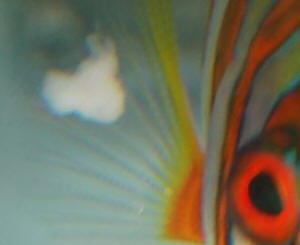
Lymph. again... 7/31/07 Man, I wish I was
you.... Out diving. I'm writing you from my office 9 stories
up in Calgary, Canada... Although it's a balmy 31oc here the
past few weeks. <Nice!> Are you in Hawaii? Last summer, I
had the opportunity to follow the first Snowflake Moray I'd
ever seen in the wild. He was hunting in the shallows of Hanauma
Bay, Oahu. Very intriguing to watch. <Am out on the Big Island
with friends... Chris and Jor of WWM e.g.. And do see Echidna
nebulosa quite often... along with many other "puhi" in
the rocks> If you recall, I had also sent pictures and
comments on my Harlequin Tusk fish and his cauliflower-like
cottony growth on his fin (Lymphocystis??). You had suggested
removing the growth with a fingernail when I was transporting him
back from the quarantine tank he was in at the time... Back into
my main display. He actually shed the fungus <Mmm, actually
viral> a couple of days before I moved him and appeared to be
100% ok. Within a week of moving him into the main display, he
now has smaller sized cottony clumps along the edge of one side
fin. He has two large clump masses on his tail, and one small
cluster forming along the upper edge of his body. He still swims
around and feeds aggressively, however I can tell that unless he
expects to be fed, he'd perhaps rather not swim as I have
found him a few times sitting in the rockwork during daylight
hours resting. There is no growths anywhere near his gills and he
is breathing normally. I'm also leaving on vacation tomorrow
for 10 days. Under the circumstances, would you recommend leaving
him alone to see if he once again sheds the growths on his own?
<I would not move this labrid> I'm not sure if I'd
have the time to catch him in that tank to remove by hand... And
even if I did, I think I'd want to be around to monitor him
in case of problems occurring with potentially open sores???
<I would try bolstering its immune system... soaking foods in
a HUFA/Vitamin mix... and adding Spectrum food/s here> Of
note, the Bannerfish seem interested in nipping at the growths
which is a good thing, but the Tusker darts away. Also of note,
the Tusk fish is flashing the odd time... I guess I don't
blame him... Anything to get rid of those little veggies growing
off him. David Brynlund
<Please read re Lymphocystis... RMF>
|
|
|
Sick Clowns 07/28/03 Hello Crew, <Hi Amanda> I have had
two TR true Percs in QT for almost three weeks. Yesterday I noticed the
beginning of small bumps. It appears like ich but it is clear and very
difficult to see. The spots are on the body below the front most
dorsal, I cant see any spots on the fins. I started lowering sg today
from 1.025 down to 1.022. Temp is at 80. I figure I will continue to
lower the sg-but how low? Could this be bacterial or fungal? I have yet
to read anything stating that ich can be clear, so I am leery of
treatment based on that presumption. The fish are swimming and eating.
Can you please advise appropriate treatment? Thank you for your help!
Amanda <Ananda spotted this one in my box and has the following
advice: "That sounds exactly like lymphocystis. QuickCure is
supposed to help...according to the bottle. I started that treatment
too late to save one of my fish, but if she gets to it early...."
So, I would follow her advice and begin treatment now. Here's more
to read: http://www.wetwebmedia.com/infectio.htm,
and look for lymphocystis on the sites search engine, that'll bring
up a lot more FAQs for you to read as well. Good luck, and our hopes
are with you.>
Banggai Cardinal lip growth 5/7/07 Hello folks, I have 130gal
FO tank a variety of compatible fish and most all seem to be happy and
healthy. I have wet/dry filtration and skimmer and water quality is
good. <Not useful... need real data> One of my Banggai Cardinals
has a couple of strange looking growths on its lower lip. <Likely
"lymphocystis"... a semi-strange
environmental/nutritional/viral condition...> They look like warts
and are similar in color to the fish. They do not look like anything I
have been able to find on any site about fish diseases. The fish seems
to be fine, it eats well, hangs out with Banggai #2 and chances the
Banggai #3 off into hiding. None of the other 20 or so fish have any
sign of any such growth. Any ideas? Thanks, David Austin <Please
read here: http://www.wetwebmedia.com/lymphfaqs.htm and the linked FAQs
files above. Bob Fenner>
Re: Banggai Cardinal lip growth -- 05/07/07 Bob and Crew,
Thanks very much for the response and the great job you are doing. It
is hard to imagine how you have the time and patience to deal with all
of us. I think your suggestion of Lymphocystis is correct based on the
articles and photos you referred me to. I tried removing the growths
from the fish with no luck. So if he is not too traumatized by that
effort perhaps the disease will run it's course and he will be
okay. Meanwhile, it is back to working on water quality and good
nutrition. Thanks again, David Austin <Thank you for your kind
words. If there is room (and likely no predator problems) I do
encourage you to add a purposeful cleaner organism as well... Perhaps a
Lysmata species... will help clean off... and greatly reduce the
element of stress... very important here. Bob Fenner>
Re: I looked everywhere! (But did you look here?)
pt.3 2/22/07 Hi Graham, <Hello, I'm sorry for the delay,
but... well, you know.> So here's the update on the
situation I got the qt out and got the baby clowns in there.
<Excellent!> I've been treating them with Instant
Ocean's Lifeguard. << http://72.14.253.104/search?q=cache:lYSnEsx2m14J:www.tetra-fish.com/ENEWSROOM/printer_
friendly_press_release.asp%3FdocumentID%3D211+Instant+Ocean+Lifeguard&hl=en&ct=clnk&cd=2&gl=us
High-tech...>> <I don't have any experience with this
product yet, but the write-up looks good; non-antibacterial means
good for the nitrifying bacteria..> I guess it's new it is
supposed to help treat bacterial, fungal, viral, and parasitic
diseases. My qt is a 30 g but I have it filled only half way.
<?> The QT parameters are as follows pH 8.2, Ammonia: 0.25
ppm <!!! Water change now!>, Nitrite 0 ppm, Nitrate 0 ppm,
and salinity: 1.023 ppt. <Would remind you that with a QT,
especially a half-full one with little/no filtration to speak of,
you will need to be performing large daily water changes to take
the place of filtration.> The display tank's parameters are
pH: 8.2, Ammonia 0 ppm, Nitrite 0 ppm, Nitrate 5.0 ppm, and
salinity 1.022 ppt. I know the qt is bad, I'm planning on doing
a partial water change tomorrow. <See above.> I think part of
the problem is that I'm just using a sponge filter that I had
let sit in my tank for 5 days and the fact that there's no live
rock or sand in the qt and I guess I've been overfeeding them a
bit as well. <All true...> I have noticed one of the other
clowns has a similar white growth on the tip of its tail and a
third one has a white cyst-looking think on its right pectoral fin
that seems to be growing THROUGH his fin, it's protruding
slightly on both sides of it, it does look similar to the other
clowns' growths. <Would try FW-dips (Read WWM re) in
addition to the QT, daily.> <<And I'd amend the
pH-adjusted FW dips/baths with formalin and aeration>> I am
beginning to think you were correct and that it is that
lymphocystis since they are on day four of the medication (it's
only supposed to be used for 5 days) and it seems that they are all
getting it. I went back to that LFS and their siblings who are
still at the store all seem to have this as well I'm thinking
it's just genetic. <Not genetic, no. Just associated.>
<<And like common models of such viral involvements,
environmentally/nutritionally mediated>> I did purchase a
skunk cleaner shrimp and acclimated him to the display tank so that
once I do return them to it maybe he can pick the growth off them,
if they'll let him. I did figure out a way to get pictures of
them as they are all very very feisty and eating heartily still.
<Very common with cystic infections...> I forgot my camcorder
has the option to take still frames of video, so I grabbed some
video of them and got the shots from that, it's not super clear
but at least you can take a look at it now. Oh and for diet I read
on the saltwaterfish forum about diseases and diet, hence the
reason I thought a cleaner shrimp would help since someone on there
had a percula with a similar problem. <Can be helpful. (Natural
solution, no meds...)> So I have made them homemade fish food
from a recipe on the site. It's a mixture of cuttlefish, clam,
octopus, cooked mussel, scallop, and shrimp, ground up with kelp,
chard, fresh garlic, and soaked in Kent's Zoecon. <Very
good, will help them fight.> They've been on that and the
flake food and frozen Hikari Mysis shrimp since Sunday. OH and to
make matters worse I just saw today that my coral beauty seems to
have an eye injury, I wasn't able to get her out of the display
tank and into the qt with the clowns, I'm waiting on an order
for one of those fish catcher things. <Have had repeated success
treating eyes with FW-dips, and possible physical removal of
parasite. You may find that the cloudiness will slough off in the
lower salinity.> Anyhow it looks like she has two scratches
across her cornea and she is acting quite neurotic, she keeps
swimming up and down in the same corner of the tank, I'm not
sure if it's bc of the injury or bc I finally got my light in
today. The new light has 260 watts whereas the old one did as well
however, the bulbs were about a year overdue for a change and it
was also only 30" whereas the new one is 48" and actually
fits the entire length of my tank. I have a picture of her cornea
too, my bf thinks it could be fungal too. So if it is how and why
am I having such a fungus problem??? :'( Thank you for all your
help and input Graham, sorry this is so long winded I have attached
the pics I hope they help. <Fungal... hmm. I wish I was a fish
doctor. I need to see what I'm dealing with, and even then I
don't have one method of treatment for each problem. I would
recommend you treat for Lymph and consider Epsom salt for the angel
after the FW-dip. http://www.wetwebmedia.com/epsomfaqs.htm. I am assuming
you have read all the FAQs here about clowns and their associated
problems, along with how to setup a QT. I think you're on the
right track here, but the QT should be maintained with water
changes more often than you suppose is enough. Remember: measurable
ammonia is too much! I'm looking back, and noticing that
I'm not that helpful here! I will CC this to Bob for review. I
am very fatigued, but felt a sense of obligation to answer your
Q's. I hope you find something useful here! -GrahamT>
Shawn
<<I am in agreement with your stmt.s Graham.
BobF>> |
|
|
Questions regarding quarantine and lymphocystis 1/30/07 Hello
again, I really appreciate all of the advice and dependable
information. Actually my fish do too as they are alive and well.
<Ah, good> I have two questions I need your advice on. First, I
am going to close down my 75 gallon FOWLR and transfer a Niger
Triggerfish, Assasi Triggerfish and a Tuskfish to a 125 gallon FOWLR
tank. The 75 gallon had an ich outbreak about a year ago that I managed
well and have not had a problem since. In treating the ich outbreak the
tank remained in a fallow state for 30 days. Question 1 is do I need to
quarantine and or dip the fish before transfer to the 125 gallon to
manage the risk that there may be a low level of parasite activity that
has not affected the fish? <I would do the dip/bath... FW,
pH-adjusted... enroute to the new digs> These three fish will be
joining a Kole Tang and a Flame Angel in the 125 gallon so I want to
minimize any potential problems. <I understand> Question 2 the
Assasi Triggerfish and Tuskfish will occasionally have white patches on
their fins that I diagnose as lymphocystis. I make this diagnoses based
on the appearance that the white patches seem to be inside the
transparent fins of the fish and not discrete grain like spots that
protrude from the fins. The white spots are more patch like and larger
in size then the ich that I have encountered in the past. I realize the
description is terse, but that is how I would describe it. I don't
treat and have no concerns as they come and go intermittently. Can you
provide any help with the diagnoses? Thanks again. <Mmm, might be
virally-mediated... but could also be protozoan (there are some
microsporidean, sporozoan infestations that appear as this... are
wide-enough in their expression to show on diverse Orders of fishes...)
and even a few worm possibilities. In all cases I would NOT go so far
as to venture into test-treating this... I'd ignore and focus on
elements of bolstering resistance through nutrition, and providing an
optimized, stable environment. Bob Fenner>
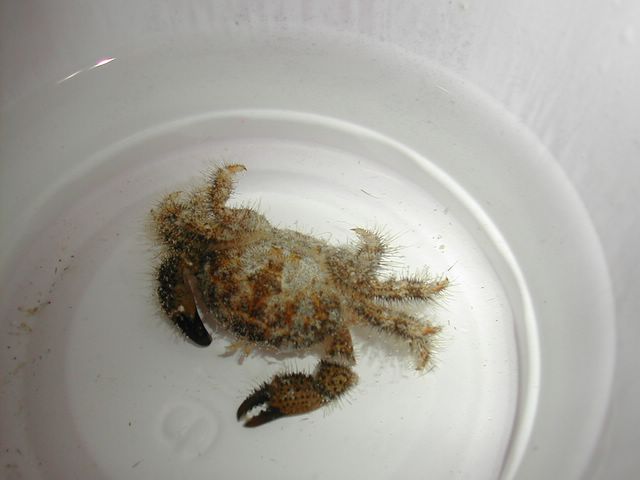
| Lymph transfer, Crab removal 4/18/06 Hi Everyone! After
several months of non-eventful fishkeeping, I have two questions
for you. First, we have a yellow tang that has been in QT for the
last month-plus after purchase. He's a great little guy --
growing fast, very healthy eater, loves playing in the current, but
had what we determined was Lymphocystis on his tail starting in
week 1 of QT. Despite our concern, we followed fish store and FAQ
instructions ( http://www.wetwebmedia.com/lymphfaqs.htm) and just left
him alone with care to water quality, and the spot disappeared at
the end of week 3. (yay!) <Good> Five days later, there's
a new tiny spot on one of his fins. My question is whether we
should continue to quarantine him until he has a month free of
this, or if it's okay to put him in the display tank with our
two Ocellaris clowns and our Royal Gramma. <I would move, place
this fish> The water quality is higher in the main tank, but I
don't want the other fish to catch it. <Not likely>
Second, we have a hijacker crab that appeared in our tank last
fall. When we first saw him, he was about ¾" across
and only partially visible at night. Since then, we've pulled
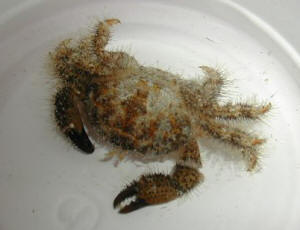
out a few dead crabs of the same type. (For a good picture, see
here: http://photos1.blogger.com/hello/252/1727/640/DeadCrab.jpg
Note bristly hair and black-tipped pincers.) One of my Blog readers
ID'd it as a Pilumnus fissifrons, which seems right on, except
that there is almost no information about it. We've spied bits
of legs in the rock over the last few months, but haven't seen
the full crab until last night. We were horrified to realize that
his body alone is now two inches across and with his legs he's
over three. He's bigger than our fish. We watched him for long
enough to conclude that he seems to be eating just coralline algae
and is scared of the fish, but is big enough that he's actually
shifting the rocks as he feeds. We want him out of the tank, but
are at a loss as to how. He seems more or less to move between four
5-10 lb rocks, some of which have zoos and mushrooms, so we
don't want to lose them. He's a very quick mover when
he's scared and only comes partway out of the rocks, so
catching him with a net seems daunting. And he seems, for the
moment, not to eat meat, so we're not really sure how to seed a
trap. Do you have any advice how we might go about removing this
quickly growing, creepy crab from our tank? <Can be trapped or
baited/removed. Please read here: http://www.wetwebmedia.com/swcrabcomp.htm and the
linked files... I would remove this animal, pronto.> Thanks for
your help on both points! The WWM site is such a godsend. Susan and
Kevin. <I'd say this is more of a Bobsend m'self. Bob
Fenner> |
|
|
|
|


.JPG)
.JPG)