|
FAQs on Aquatic Viral
Diseases: Identification
Related Articles: Lymphocystis, Environmental Disease,
Clownfish
Disease,
Related FAQs: Viral Diseases 1, Viral Diseases 2, Aquatic Virology,
& FAQs on Aquatic Virus Disease: Causes/Etiology, Cures/Medications, Case Histories: Non-Lymphocystis, Lymphocystis,
|
|
|
MHLLE question 2/27/13
Hey everybody,
I am so glad I found WWM. What an invaluable resource! You
are now the only place I go for anything saltwater related. There
is so much misinformation on the web, its mind boggling. Now to my
question. After searching your forums, it seems that my large Naso
may be suffering from MHLLE. I have read every thread you have on
this and have followed all recommendations, but I feel like it might be
progressing, thereby making me wonder if I have it identified correctly.
<This looks more like something viral... growing out of neuromasts about
the head>
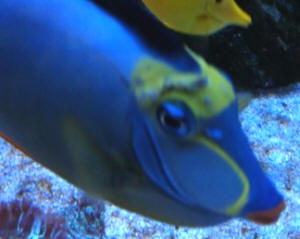
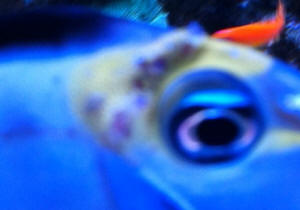
Attached is a picture of his head. It started out as a couple
small “pimples,” but progressed rather rapidly. It seems like
within a matter of a few days, it went from a few pimples to warts.
Now it looks like masses and getting some holes. I am concerned
that it seems to be progressing on one side and not the other.
I have read that MHLLE is bilateral. This started out as
bilateral (with a preference for one side), but one side seems to have
cleared up while the other is getting worse.
When I initially noticed the bumps (within a day or two of them
appearing), I inquired at the LFS and was told that it was probably
MHLLE and was instructed to treat with Metro in his food.
<Mmm, won't help here>
I did this for a few days in his pellets until he quit eating pellets, I
assume because of the taste.
After I found someone who knew what they were talking about and they
identified it as a nutritional deficiency and not a parasite or
protozoa, I changed his diet and quit the Metro (he had been on Metro
for 5 days). I got some NLS pellets and Ocean Nutrition seaweed
with garlic. He wasn’t interested in the pellets, but would devour
the seaweed and come back for more.
Then I found your site and read every thread you have on MHLLE. I
felt good that I had obtained the NLS pellets, and also went and got
some Nori and Selcon. He still wouldn’t eat the NLS but loved the
Nori and Selcon.
A little history: I ordered this tang sight unseen about 3 months ago
from the LFS. I had a 10g QT set up and ready to go and when he
came in. He was supposed to be about 3”, but he was almost 7”
long. Much too large for my QT system so I had to make the call to
acclimate and add to the display since it was late and there wasn’t a
local store open to get a bigger QT. I wasn’t too worried as the
tank was new (2 months without any fish) and he was the only fish in
there. My new system is 400g and will ultimately be a reef setup,
although it is now mostly LR (500lbs) and a few mushrooms. The
tank had been running fishless for 2 months prior to adding the Naso.
It had already cycled. The ammonia was 0, the nitrites 0, nitrates
5-10 using API test kit (the colors look the same to me on the 5 and
10), phosphates about .05 using Elos test kit. Ph 8.0-8.1, water
temp 77F, salt mix Red Sea Coral Pro (1.025), RO/DI water testing zero
TDS,
Marineland Black Diamond carbon, Super Reef Octopus 5000 skimmer, 800
micron filter socks, and LED lighting.
The fish was fine for the first 2 months. When I saw no signs of
disease, I started to add new fish that I had acquired and had waiting
in QT. They were all added over several weeks to give the system a
chance to catch up. New additions were: a yellow tang and a purple
tang (3”), a Hippo tang (5”), a school of Banggai Cardinals (8), a
school of Lyretail Anthias (8). The whole tank was very
harmonious.
For the first couple of months, the Naso only really showed an interest
in PE Mysis shrimp. After finding out that it might be a
nutritional deficiency, I cut out the PE and tried to get him onto
pellets and seaweed. About that time, I also acquired a Blue Jaw
Trigger from a friend (6”). This fish was very high energy.
He was never aggressive towards other fish, but at feeding time, he
would charge right through the crowd to get his portion and everybody
else’s. This would sometimes make the Naso shy away. I don’t
know if this could be causing stress to the Naso and be a contributing
factor.
<Not likely much>
The Naso has not had any PE Mysis shrimp in 2 weeks and has been eating
Selcon soaked Nori every day for the last 3 days. He is starting
to warm up to the NLS pellets and eats 4-5 1mm pellets at feeding time
(2-3 times a day). He spits out the 2mm pellets. He has been
eating the pellets for 3 days. I think he would eat the Nori
continuously if I gave it to him. That is all he begs for.
My question is: does this look like MHLLE, even though it isn’t
bilateral?
<It does not>
Is it common for it to progress for a bit once nutrition is corrected,
before it starts to reverse? I feel like my water quality is good.
My RedOx is consistently between 350-400. I do 10% water changes
every other week. I had been running carbon but just removed it
today after I felt sure any Metro that was in the water was gone.
I have read on your site that carbon could contribute. I will now
run without carbon for a bit. I also added Phoslock to remove any
remaining phosphates.
<Mmm, I'd allow some HPO4 here; not use chemical filtrant/s>
I just want to feel confident that I have identified the problem
correctly and that I am treating appropriately to give him the best
chance. Thanks for all that you do. James
<T'were it me/mine, I'd continue as you have, and add some purposeful
cleaners here. Likely Lysmata species. Hopefully their presence will tip
the balance and stir your Naso to self-improvement. Bob Fenner>
|
 |
|
Yellow Clown Goby Lymphocystis?
5/24/12
Good morning :)
I have been in the SW Hobby for 10 years. My main display tank is
8 years old and happy, waiting to possibly be upgraded for a larger
tank. I have a second tank (30 gal, live rock, pH 8.3, T 78,
Amm/Nit/N-ate 0, S 1.026) that had live rock, crabs and snails for 2
years. Initially, he was going to temporarily house my DT
inhabitants while I transferred tanks.
Everything was put on hold for various reasons, so I decided to actually
put fish into my smaller tank. I started with Yellow Clown Gobies,
as I love them but they never would survive in my DT (always ended up in
the sump). I noted on WWM that these fish do not quarantine well,
so I added them directly to the 30 gal tank 2 1/2 weeks ago.
Meanwhile, I quarantined my Gold Bar Maroon Clowns (ORA and from a good
fish store that quarantines, so I'm not sure I needed to quarantine
them, but I did just to be sure).
As an aside..... I paired up a medium and small clown and they are
happily getting along together so far.
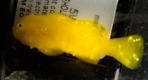
Within a day of putting the yellow gobies into the tank, I noted one of
them had weird "protrusions" of scales. These really did look like
flat scales sticking straight out of it's body. Many of them - 20 or so
at least. I think the other goby had a couple, but not nearly as
many. I could not find this anywhere online (I failed to take a
picture.... sorry).
I did find one person on WWM describing something similar. And I
found one other site that has a thread about an "unusual parasite" that
is described somewhat similarly. That thread indicates this
parasite is known to have an "affection" for small gobies or similar
fish.
I stared at this fish a lot, and really didn't think they were
parasites.
After about 48 hours, he went back to normal. All the while, this
goby ate well and often. (Mysis/Spectrum Pellets). Yesterday I
added my extremely healthy Maroon Clowns to the tank. Right after,
I observed that this Yellow Goby was COVERED in white spots. It is
possible that I just hadn't looked at him earlier that day. But I
wondered if they showed up because I stressed him out by adding the
Maroon Clown. I panicked and took the Clown Gobies out into
Quarantine. I should have looked at them thoroughly before adding
the Maroon Clowns! Now both of my yellow gobies are covered in
these spots.
I read extensively - and I wonder if this is Lymphocystis?
<Mmm, don't think so... based on appearance and such rapid onset>
It isn't Ich or velvet, and I don't think it is flukes/parasites.
It seems extreme/sudden, but I think the stress could do it. I
also read an old article about the Lymphocystis life cycle. It
seems that at Day 8 after infection, cells change but there is not virus
visible, day 15 the virus becomes active and visible in the cells, and
day 28 it is in its most active state. This would fit close to the
timing of my fish - if the "scales poking out" were the result of
cellular changes at approximately day 15 - this would be the right
timing for the most active phase.
Probably worsened by the added stress. I understand Lymphocystis
is a Herpes Virus - which in humans is certainly activated by stress
also.
<Yes>
If this is Lymphocystis, should I put these clowns back into the tank?
Or try to keep them in quarantine?
<I'd try treating for Protozoans and worms in quarantine for a couple
weeks>
I believe the tank will be more calming....
<Agreed>
the Gold Bar Maroon Clowns initially showed no interest in them.
Also they seem relatively mellow and cooperative. I don't want to
infect the Clowns, but I don't want to kill the Gobies either by keeping
them in quarantine too long.
If not Lymphocystis..... ?
<Can't tell w/o sampling, microscopic examination. Bob Fenner>
|
 full size pic full size pic |
|
Is this Lymphocystis? 4/25/12
Once again thank you all for sharing all of your knowledge and expertise
through this wonderful site. I have read some of the articles here and I
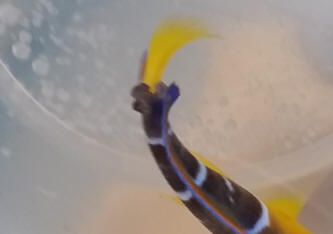
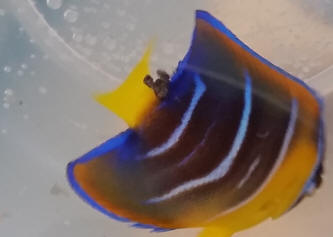
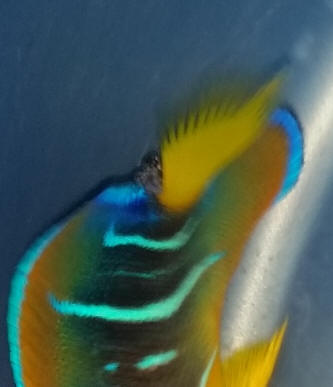
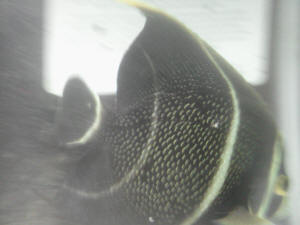
believe my French angelfish may have Lymphocystis. She has developed white
cotton like spots on her body over the last two days and these spots appear
to be larger than Ich. She has been in qt for two weeks now and her behavior
is normal with a very high level of curiosity. She readily eats anything
that is offered. Can you please look at these pictures and advise if I am on
the right track?
<Mmm, usually what is generally labeled as Lymphocystis manifests itself on
the (mainly unpaired) fins... I suspect there are a few virally-mediated
such growths of/on fishes... These spots look more discrete... perhaps just
reaction sites to physical injuries. I would "treat" by doing what you can
to maintain good water quality and nutrition; not through chemical
applications>
Thank you,
Scott
<Welcome. Bob Fenner>
|
 |
|
Ailing Angel: Looks like Lymphocystis 3/2/2010 Lymph
ID
Hello Crew,
<Hi Kirby.>
I know you've heard this a lot, but I have to compliment you
all on a fantastic site.
I use the information on a very frequent basis, but as is human
nature, sometimes I still learn things the hard way, however your
advice has saved me from myself more than once. .
<Thank you for the kind words.>
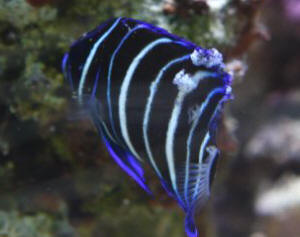
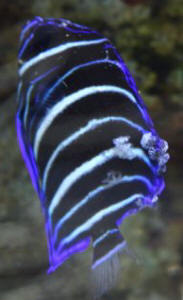
Onto the fishy business: I have an angel that the LFS claimed was
a juvenile 6 line angel.
The angel was in a 10 gallon bare quarantine tank for 2 weeks,
and all appeared well before I moved it to the main tank. While
acclimating it to the water in the main tank I gave it a
Methylene blue treatment for about 20 minutes, just as a
precaution.
The angel was ok for he first couple of days then I notices some
patches on the rear section of it's body. I thought it might
have been irritation from rubbing against the numerous Vermetid
worms in the tank, the spots on the body seemed to clear up, but
now it has several spots that I can only describe as looking like
cysts. these look like little egg pouches or something. I have
looked at a lot (not all) of the information from the WWM pages,
and have not encountered anything that fits this description. I
do believe it is some type of parasite, but so far (I don't
think it's going to stay this way) none of the other fish are
showing any signs of infection.
<The pictures are a little hard to make out, but it looks like
Lymphocystis A viral infection similar to warts and seems to be
more common on angelfish than others. Have a look here and see if
anything looks familiar:
http://www.wetwebmedia.com/lymphfaqs.htm >
I've attached some photo's to help identify the ailment,
and maybe confirm the fish's identity as well. the fish too.
Let me know if any of the pictures need to be clearer, sometimes
the picture compression process does things to the image
quality.
I know that I probably should get this little one into a hospital
tank, but I haven't had time to try to get him out. My
experience is that I need to practically tear the tank apart to
get a fish out, if there's one piece of live rock left in the
tank, all the fish will find a way to hide under it.
By the time a fish is easy to catch it's usually too far gone
to be able to be helped. So I'm looking at about a full day
to tear down and put back together the tank to get the fish out.
The wrasse is the hardest since he hides in the aragonite. Could
you help identify what the angel is afflicted with, and how I can
treat it?
<If it is truly Lymph it will clear on its own in
time.>
I'd really hate to lose this new critter, it looks so nice
(when it was healthy) and I also need to know what it is, since
it's probably going to happen to all the other fish too.
<Lymph is non contagious.>
The tank parameters are as follows
180 gallon main tank, 75 gallon sump,
SG 1.023
calcium 400
ph 8.3 to 8.4
nitrates, nitrites, ammonia, phosphates all practically not
measureable.
Sorry for the long message, but I find its good to provide as
much relevant information as I can.
<Detailed information is always appreciated.>
I appreciate your assistance, so will the critters I'm
sure.
<My pleasure.>
Thank You,
KP
<MikeV>
|
  |
Lamarck Angel Disease, viral
7/14/2009
Hello,
Thanks for all the information you all provide. I have been using your
site for about 8 years.
<Ahh! And WWM is coming up on its 15th year anniversary... Got a
solicitation for red and gold stickers for the event>
I have a Lamarck Angel with fluffy white patches on her fins and mouth
area. She has been in my tank for about 1 week. Before going into the
main tank, (one week in q. tank) I noticed she did have a spot on her
dorsal fin. It looked like it was rubbed. Of coarse, once I added her
to main tank, it bloomed. There's a "glob" below her
mouth and a few more globs on her dorsal fin. I see smaller spots
appearing on her pectoral fins as well. My tank is a 155 bow, with
quite a few butterflies and a few other angels.
I have some cleaning inverts and about 180lbs of live rock. The tank
has been set-up for 5 years in the current location. I use a skimmer,
and some bagged media in the sump. Should I try to yank her out and dip
her?
<Mmm, no... I wouldn't... This is likely the viral/stress
syndrome labeled Lymphocystis... You can read re:
http://wetwebmedia.com/lymphfaqs.htm
and the linked files above>
As long as the other fish are not stressed, this should not infect
them, right?
<Likely so>
She is eating everything I give her. Mysis, Formula 1&2, and
blackworms, flakes and some algae. My SG is kind of low at 1.020-1.021
ish,
<I'd raise this... to Near Seawater strength>
pH 8.3-8.4, trace nitrate <20ppm.
-Becky
<And supplement foods with a HUFA, vitamin prep... see WWM re... Bob
Fenner>
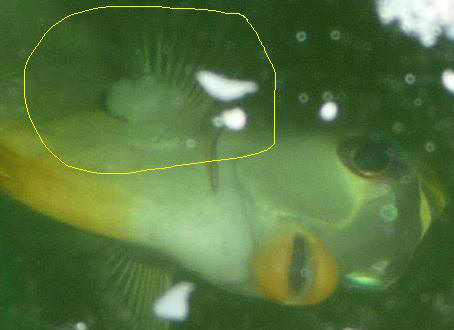
Blond Naso Growth: Lymphocystis
7/15/2009
First, thanks for all of your help. You guys are a great
resource.
<Thank You.>
I just picked up a Blond Naso and it has a white cauliflower like
growth on its fin (see pic). It is in the quarantine tank right
now. Please advise what you think the growth is and how I should
treat it. Thanks again!
<It looks to by Lymphocystis. You can read about it here:
http://www.wetwebmedia.com/viraldislymph.htm This should clear
itself in time..
Mike
<MikeV> |
 |
Lymphocystis on six line wrasse
5/17/09
Hello,
<Greetings, Christine here>
I have a Six Line Wrasse with a cauliflower looking growth between his
right eye and snout. It has been there for months, doing more research
shows it may be a Lymphocystis. I thought it was a tumor and just kept
an eye on it. My water parameters are Ammonia 0, Nitrates 10ppm,
Salinity 1.025. Nothing wrong with its tank mates (2 Kent clowns, Niger
Trigger, Zebra Moray, Orchid dotty back, Yellow Tank) From what I have
read it would typically go away after several weeks but it's been
there for months.
I now feel I should quarantine it, what is your take?
Thanks
Tom
<"Cauliflower-like" does sound like Lymphocystis, and
considering the very slow progression of the growth that or another
virus is likely. Cancerous tumors and viral growths are physiologically
quite similar in some ways, so
without extensive testing you may never know, but that is ok. In either
case, there is no medication you could give to change things, so the
treatment path is the same: supportive care in the way of solid
nutrition, varied foods, vitamin supplements like Selcon and VitaChem,
and good water quality. Beta-glucan as a supplement in the food may be
helpful as well. I wouldn't bother taking the fish out into
quarantine as it offers no benefit: there's nothing you can do in a
hospital tank that you can't do in the display (as long as the
other fish are leaving him alone), and
stressing him by moving will be detrimental. Plus, if there is anything
contagious about the growth, all of your other fish have already been
exposed. Keep an eye on it and continue as usual.
--Christine>
|
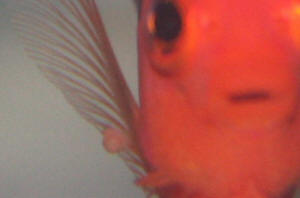
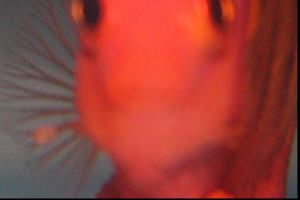
Lymphocystis? 3/9/09 Just need a quick
clarification. Is this Lymphocystis or some sort of tumor?
<Almost assuredly Lymph> If it's a tumor, what
treatment would you suggest? <Mmm, none... just good care,
feeding, time going by... see WWM re> This is on the fin of a
Flame Angel. Also thought the pic may help others diagnose their
own fish:) Thanks much!!! <Thank you Scott. Bob Fenner>
|
  |
|
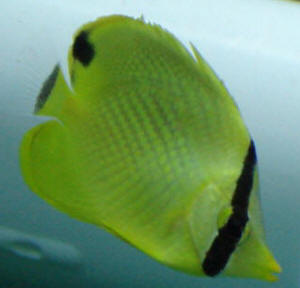
Another Ich question... perhaps 04/14/2008
Hi Crew, I know you don't get tired of these... an Ich
question. On Friday I picked up a latticed butterfly and put it
in a QT. All appeared to be fine. Saturday it had 3 spots on its
tail fin... and I know it's Ich. <... maybe> Since
researching WWM I know they are sensitive to chelated copper. I
did do a fw dip with meth. blue for 4 min... fish was extremely
stressed. I had Cupramine on hand but didn't have a SeaChem
test kit. I found one in town, went and got it. Came back and
dosed as directed. Tested the tank and got no results. According
to the FAQs on WWM this is not too uncommon. Here's the
problem. I have no way of testing this copper within the 48 hours
as recommended... any suggestions on another way to test? Also
fish seems a little stressed, would it be prudent to filter the
copper out and try another method, formalin dips or 50% water
changes every other day for 2 weeks, to combat this? Thank you
Jennifer <I would hold off on treatment period... this may
well not be Ich/Cryptocaryon... are the spots located directly
over the fin rays? Possibly these are just reaction sites from
rough netting... A well-resolved picture would help... Bob
Fenner>
Re: Another Ich question... - 04/14/08 Hi
Bob, Update: Sunday I did a 50% water change (using main tank
water) and am currently using a PolyFilter to get the copper out.
I would have sent pics but they are too small to see in the pic,
not to mention the little bugger wouldn't sit still. 1 of the
3 spots is gone. The spots are not on the fin rays they are on
the very edge of the fin. <Both telling... this is not
Cryptocaryon> At what point do you think I'll know for
sure it's Ich and what would be your recommendation for
treatment given that latticed Butterflyfish are copper sensitive?
<... posted... In general, best to use quinine.> Is
Cupramine ok for this fish? <IF it had something for which
Copper is useful to treat...> I have researched this disease
to death so I am quite familiar with its' lifecycle and the
treatments. I just don't think this fish was doing well with
the Cupramine, stationary in the corner, heavy breathing. Since
the water change moving around more and normal respiration.
<Thank goodness> And FYI on the SeaChem test results..
according to SeaChem if there is a lot # on the powder reagent
then that is the problem. <?!> They have revamped their
test kits. Thank you Bob Jennifer <And you Jen. BobF>
Re: Another Ich question... - 04/15/08 Dear
Bob and I say dear because if you don't think this is Ich
I'll sing your praises even more than I already do!! In all
of the research that I have done I have yet to see that the spots
needed to be on the fin rays but it does make sense. The 2
remaining spots are gone. She hasn't scratched that I've
seen but I try to stay out of the room to keep her stress level
down. <Good point, practice> I shall continue with water
changes to keep up water quality. She hasn't eaten since I
brought her home but seems interested in picking at tank wall and
floor. <What they do> I've put Mysis shrimp in the clam
shell as suggested on WWM but nothing. I'll try other tricks.
<Fresh/er live rock...> Thank you again Bob for all of your
great advice!! Jen <Welcome! BobF>
Re: Another Ich question... -- 4/15/08 I
wrestled with the live rock idea because if it was Ich meds would
kill...well you know the rest. However, she did eat some shrimp.
By the way I did see those 2 spots after all on her tail (had to
press my face against the glass), which now makes 48 hours.
Thanks again, Bob! Jennifer <Jen, can you send a
well-resolved, close-up pic? BobF>
| Re: Another Ich question... 4/16/08
Bob, I don't know "well resolved" these photos
are but it's the best I could get. It was stressing her
out. The spots have gotten a little bigger. You can see them
at the very edge of her tail. I did another 50% water change
siphoning the bottom. Just out of curiosity if quinine is so
effective and is safe for sharks why isn't it the cure
most recommended overall? Thanks Bob. Jennifer <Mmm...
this is almost certainly NOT Cryptocaryon... on the basis of
placement, size, and the lack elsewhere on the body. What it
is... likely... is Lymphocystis... a
viral-environmental-stress complaint. NOT treatable by
"medicines" per se, but ameliorated via
environmental improvement, enhanced nutrition,
alleviating/lowering stress overall. Do know that this
species of Butterfly is NOT easily kept in captivity... Bob
Fenner> |
|

|
|
Re: Another Ich question... 4/16/08 Bob, That is
great news!!! I've dealt with Lympho before.. you
actually helped me through it with my coral beauty.
He's thriving in the display tank. I'm sending
another pic for better clarity. I took my book (your book)
into the LFS for reference and I was positive this was a
Latticed Butterflyfish. If not then what is it? Thank you.
Jennifer <... is a Raffle's... see here:
http://wetwebmedia.com/Goodchaetodon.htm This one is
dangerously thin. I would move it post haste to permanent
quarters... with plenty of live rock, other feeding. B>
Re: Another Ich question... 4/17/08 She started
eating Mysis shrimp yesterday.. couple times a day. I put a
well algae covered piece of live rock in with her today
that she's picked at some. Thanks for all of your help
and reassurance!! Jennifer <Ahh! Good news... and yes to
there being a few common names for this Chaetodon species.
Cheers! BobF>
|
|
|
|
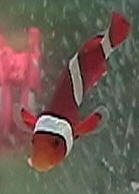
Re: I looked everywhere! (But did you look
here?) pt.3 2/22/07 Hi Graham, <Hello, I'm sorry for the
delay, but... well, you know.> So here's the update on the
situation I got the qt out and got the baby clowns in there.
<Excellent!> I've been treating them with Instant
Ocean's Lifeguard. << http://72.14.253.104/search?q=cache:lYSnEsx2m14J:www.tetra-fish.com/ENEWSROOM/printer_
friendly_press_release.asp%3FdocumentID%3D211+Instant+Ocean+Lifeguard&hl=en&ct=clnk&cd=2&gl=us
High-tech...>> <I don't have any experience with this
product yet, but the write-up looks good; non-antibacterial means
good for the nitrifying bacteria..> I guess it's new it is
supposed to help treat bacterial, fungal, viral, and parasitic
diseases. My qt is a 30 g but I have it filled only half way.
<?> The QT parameters are as follows pH 8.2, Ammonia: 0.25
ppm <!!! Water change now!>, Nitrite 0 ppm, Nitrate 0 ppm,
and salinity: 1.023 ppt. <Would remind you that with a QT,
especially a half-full one with little/no filtration to speak of,
you will need to be performing large daily water changes to take
the place of filtration.> The display tank's parameters are
pH: 8.2, Ammonia 0 ppm, Nitrite 0 ppm, Nitrate 5.0 ppm, and
salinity 1.022 ppt. I know the qt is bad, I'm planning on doing
a partial water change tomorrow. <See above.> I think part of
the problem is that I'm just using a sponge filter that I had
let sit in my tank for 5 days and the fact that there's no live
rock or sand in the qt and I guess I've been overfeeding them a
bit as well. <All true...> I have noticed one of the other
clowns has a similar white growth on the tip of its tail and a
third one has a white cyst-looking think on its right pectoral fin
that seems to be growing THROUGH his fin, it's protruding
slightly on both sides of it, it does look similar to the other
clowns' growths. <Would try FW-dips (Read WWM re) in
addition to the QT, daily.> <<And I'd amend the
pH-adjusted FW dips/baths with formalin and aeration>> I am
beginning to think you were correct and that it is that
Lymphocystis since they are on day four of the medication (it's
only supposed to be used for 5 days) and it seems that they are all
getting it. I went back to that LFS and their siblings who are
still at the store all seem to have this as well I'm thinking
it's just genetic. <Not genetic, no. Just associated.>
<<And like common models of such viral involvements,
environmentally/nutritionally mediated>> I did purchase a
skunk cleaner shrimp and acclimated him to the display tank so that
once I do return them to it maybe he can pick the growth off them,
if they'll let him. I did figure out a way to get pictures of
them as they are all very very feisty and eating heartily still.
<Very common with cystic infections...> I forgot my camcorder
has the option to take still frames of video, so I grabbed some
video of them and got the shots from that, it's not super clear
but at least you can take a look at it now. Oh and for diet I read
on the saltwaterfish forum about diseases and diet, hence the
reason I thought a cleaner shrimp would help since someone on there
had a percula with a similar problem. <Can be helpful. (Natural
solution, no meds...)> So I have made them homemade fish food
from a recipe on the site. It's a mixture of cuttlefish, clam,
octopus, cooked mussel, scallop, and shrimp, ground up with kelp,
chard, fresh garlic, and soaked in Kent's Zoecon. <Very
good, will help them fight.> They've been on that and the
flake food and frozen Hikari Mysis shrimp since Sunday. OH and to
make matters worse I just saw today that my coral beauty seems to
have an eye injury, I wasn't able to get her out of the display
tank and into the qt with the clowns, I'm waiting on an order
for one of those fish catcher things. <Have had repeated success
treating eyes with FW-dips, and possible physical removal of
parasite. You may find that the cloudiness will slough off in the
lower salinity.> Anyhow it looks like she has two scratches
across her cornea and she is acting quite neurotic, she keeps
swimming up and down in the same corner of the tank, I'm not
sure if it's bc of the injury or bc I finally got my light in
today. The new light has 260 watts whereas the old one did as well
however, the bulbs were about a year overdue for a change and it
was also only 30" whereas the new one is 48" and actually
fits the entire length of my tank. I have a picture of her cornea
too, my bf thinks it could be fungal too. So if it is how and why
am I having such a fungus problem??? :'( Thank you for all your
help and input Graham, sorry this is so long winded I have attached
the pics I hope they help. <Fungal... hmm. I wish I was a fish
doctor. I need to see what I'm dealing with, and even then I
don't have one method of treatment for each problem. I would
recommend you treat for Lymph and consider Epsom salt for the angel
after the FW-dip. http://www.wetwebmedia.com/epsomfaqs.htm. I am assuming
you have read all the FAQs here about clowns and their associated
problems, along with how to setup a QT. I think you're on the
right track here, but the QT should be maintained with water
changes more often than you suppose is enough. Remember: measurable
ammonia is too much! I'm looking back, and noticing that
I'm not that helpful here! I will CC this to Bob for review. I
am very fatigued, but felt a sense of obligation to answer your
Q's. I hope you find something useful here! -GrahamT>
Shawn
<<I am in agreement with your stmt.s Graham.
BobF>> |
|
  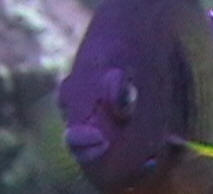
|
Non-white Lymphocystis? Hi, all, My LFS has a nice looking
Potter's angel that is eating and behaving well. I'm
considering it for my 45G reef tank which has my Sebae plus some
Zoanthids and corallimorphs. I realize it might pick on the Zoanthids
but I'm probably going to pull those anyway. However, this angel
has some swellings or growths on its dorsal fin that, to my eye, look
similar to Lymphocystis except that it is not white; just the normal
potter's angel coloration (and perhaps not has rough surfaced as
Lymphocystis; hard to tell). My LFS owner, who I've known for years
and consider as reliable as anyone is who is trying to sell me
something says he has seen this before and thinks it is swelling
possibly related to capture and will go down on its own. <Likely
so... if it lives... This is one of the least hardy species of
Centropyge for aquarium use...> Any idea what this is? I'm only
familiar with white Lymphocystis. Can it occurred colored? <Rare...
usually gray to white> Or are there similar viral infections that
leave the flesh colored? <Tumors of different sorts, etiologies,
yes> The fish would be quarantined but should I leave at the LFS
until this disappears on its own? <Not a good choice... for a 45
gallon system...> I hate to pass up an otherwise well adjusted
potter's angel, they seem pretty touchy. And I think the tank would
make a good home for it; plenty to graze on and lots of LR. <Will
likely do better in your care than the LFS's... Bob Fenner> From
your FAQ if it is Lymphocystis, it doesn't seem high risk but it
doesn't look like Lymphocystis to me. Thanks, Marc
The Emperor's New...Disease? Hello my name is Ryan.
<Hey, Ryan! Scott F. with you!> This is my second time writing
with a question and I would like to thank you for the quick response
and great information on the first. My question this time deals with a
sick fish. The fish is an Emperor angel and he has developed some white
clumpy regions around his face and also going on down his back. I read
about Lymphocystis on your website and that was my best diagnosis. The
spots are larger than Ick and they almost have a pattern to them as
they are only on the face and a straight line down the back. I prepared
to let it run its course but some of the spots have gotten to the point
where blood is showing around them. He has also stopped eating and is
hanging out around the return flow from the filter. This makes me think
that he may be having some respiratory problems. <Lymphocystis
generally clears up on it's own. On the other hand, the fact that
your fish appears to be listless, hanging in front of the filter return
seems to be indicative of something more serious, IMO. In fact, the
difficulty in breathing suggests the possibility of Amyloodinium. The
spots may be the damage caused to the fish's tissue by the
parasite. The tissue is essentially being liquefied. I would take the
risk and operate under the assumption that this is the illness which
you are dealing with. You must take quick action to save the fish's
life.> Should I quarantine and treat? If so, what should I use? I
hate to stress him out any more. I really need some help. <The first
thing that I would do is read up on Amyloodinium to verify if this is
what you're dealing with. Once you're satisfied that this is
the case, I'd opt to remove the affected fish to a separate
aquarium, and commence treatment with a commercial copper sulphate
preparation, following the instructions of the product exactly. You may
want to incorporate a freshwater drip prior to commencing the copper
treatment. If this is Amyloodinium, it may be necessary to remove all
fishes from the aquarium, and let the tank run fallow for about a
month. This disease is highly contagious, and often fatal if left
untreated. Monitor copper levels and observe the fish continuously
during this period of time, maintain high water quality, and good
aeration. Hopefully, with quick, decisive action, you'll beat this
disease!> Thank you so much for your help. Keep up the great
website! I have learned some much from your wonderful work. Thanks
again! ~ Ryan <We're always glad to help, Ryan. I hope that, if
we're right about this diagnosis, your fish makes a full recovery.
Good luck! Regards, Scott F.>
The Emperor's New...Disease (Pt2) Ryan again. Thanks
again for the quick response. I did what you suggested and did a little
research on Amyloodinium. I sure hope that is not what I am dealing
with! <Me, too!> As of now I am a little unsure. Everything that
I read said that Amyloodinium looks like a rusty like powder covering
the fish's body and infected regions. <That's usually
correct...I'm a bit curious, though, about the apparent skin damage
to the fish. I'm convinced that we may be dealing with some type of
parasite here. maybe monogenetic Trematodes, or, perhaps, even
Microsporidean (a protozoan infection). > This is not the case with
my Emperor. He doesn't display any rusty discolorations, only the
white raised regions that are about twice the size of Ick spots. They
do appear to be deep into the skin and he does have some cloudiness in
his eyes. I am not sure where to go from here. Can Amyloodinium present
itself in this way? <Amyloodinium does cause cloudy eyes and labored
breathing.> Also it doesn't seem to be spreading to any of the
other fish and from what I have read Amyloodinium is highly contagious.
<Correct!> I did a water change and it seemed to help but my
water quality has never been a problem (pH: 8, NH3: 0, NO2: 0, NO3:
10). I attached a couple of pictures. <Sorry, Ryan, I couldn't
get them to open...> I don't know if they are detailed enough or
not but I need all the help I can get. Thanks a lot for the expert
advice. It is very much appreciated ~ Ryan <Well, Ryan, since we
still don't have 100% ID on the illness here, we may have to
attempt some "broad and simple" treatments, at least to get
the fish on the road to recovery, without further stressing it. I'd
start with freshwater dips, removal to a separate tank, and use of
Methylene Blue, which is a very gentle (albeit not super effective)
treatment. Perhaps these methods will turn the tide for this fish. If,
however, more symptoms appear, or the symptoms are getting worse,
I'd make my best guess as to the cause (assuming that it's a
parasitic infection), and utilize copper sulphate, as per
manufacturer's instructions. With labored breathing, and other
symptoms present, this fish needs some help soon. Keep in touch- Good
luck! Regards, Scott F>
Re: Ocellaris Clown (disease) Hello Sirs. Thank you again for
all of the info. I'm writing to get your opinion on
diagnosis/treatment of my false percula. After searching the site, I
found a post that seemed pretty similar to my situation (as far as the
symptoms). It goes: Brooklynella, Microsporidean, or Lymphocystis?
Hello, I recently made the mistake of purchasing a large (3")
Amphiprion ocellaris (common clownfish) from my local fish store. They
had just received the animal when I purchased it, mistake number two. I
added the clownfish to my newly cycled reef tank (mistake number three,
biggest one). Within 24 hours I noticed a white wart/cauliflower growth
on the animal's right side, in the white band area, just behind the
gills. The clownfish will not eat and appears to be stagnant although
it is moving about somewhat. The animal does not exhibit any other
signs of infection, no small white spots, glazed or popping eyes,
scratching, fin rot, and the like. What has infected my fish? I've
narrowed it down to either Brooklynella, Microsporidean, or
Lymphocystis or ? ? ? What can I do to cure the fish and save my reef
tank. Should I remove the infected fish to prevent the disease from
spreading to the other tank mates (choc chip star, scooter blenny, 2
turbo snails, 6 reef crabs)? Please advise, I want to save my tank and
the clown if possible. thanks, Dan Rose Thank you for writing so well,
including with such clarity and humility... Glad to know that I'm
not the only one who makes egregious errors in the hobby... I would
almost bet that what you are seeing is indeed the Clown-attacking
protozoan Brooklynella... And would in any case follow these steps. Do
take the fish out and treat it in a separate "hospital"
system... for it's sake, the use of the treatment
"medicine", and the safety from the same of the rest of your
system. The likelihood that the Brooklynella will affect your other
livestock is minimal (there are no other Clownfishes...)... Copper is
of little use if indeed this is Brooklynella, but formalin dips/baths
are efficacious. Buy a stock solution (my fave retail brand is Kordon,
but any will do)... generally a few drops per quart of pH adjusted
(just with sodium bicarbonate, baking soda is fine) freshwater... and
move the fish from the main tank into this solution for about ten
minutes... either add an airstone, occasionally splash the water around
for aeration), move the Clown to the bare-bottom (but still filtered,
aerated.... with a hang on, sponge, box filter...) hospital/quarantine
system... Dump the treatment water... repeat every day for three
days... and stop there if there is no further visible sign of the
disease... If it re-shows or persists, wait two days and resume the
dip/baths... This will work.... Bob Fenner Well I thought that the
"wart/white cauliflower" part definitely defined what has
appeared on the very tip of the dorsal fin of my fish. I've had
this fish about a month. 2 weeks in QT and 2 in main display. About 3
days after introduction into the main tank, I noticed a white spot
about the size/shape of a grain of table sea salt (yum). Wasn't
sure so I've been watching and reading in the meantime. In the last
10 days the spot has maybe grown by 25-50%, but has not spread to any
other areas. It also has not spread to Pac Blue Tang. He (or she
I'd suppose) was eating normally until yesterday when he/she
started "sampling" then spitting out food (similar CMA
recipe). Seems similar enough to enclosed post to warrant an email.
Would this be a Brooklynella infection that would require the above
recommended treatment? <Mmm, the wart-like growth on the Clown could
be lymph, the spot on both fishes is likely crypt, tangs don't
"get" Brooklynella> Other info: 125 gal, 90# LR (more
coming when the $$ does), 200# LS, 240W NO fluor. lighting @13 hrs/day
(MH with more $$ again), 2x Rio 1100 plus return for circulation, TF
1000 skimmer, sump w/ 55W PC lit 'fuge, airstone and active carbon.
Today's parameters were pH-8.2, Ammonia-0, Nitrate- <5 ppm, Alk-
4.8 mEq/L, Ca-350 ppm, Temp 77, SG-1.025 Other livestock: 1- Pacific
Blue Tang, 1-sand sifting star, 12 bumblebee snails(?), 6-turbos,
12-astrea, 1- hitchhiker clam as of yet un-ID'd, misc hitchhiker
polyps/sponges etc, and very soon 1- cleaner shrimp to be determined
<I would hasten the acquisition of the Cleaner Shrimp/s... maybe get
more than one> Hope this is enough/ not too much info. Thank you for
your help and dedication to helping the rest of us become as informed
as we can possibly be. <Perhaps add a Gobiosoma Goby to the Cleaner
list as well... otherwise nothing "stands out" as real
trouble/cause here. Bob Fenner>
Re: Ocellaris Clown (disease, Lymphocystis?) Just to clarify,
the tang is clean. Only the wart like growth on the clown's dorsal
fin. Off now to find out about lymph and get those cleaners. Thanks
<Please see here: http://www.wetwebmedia.com/lymphfaqs.htm
Bob Fenner>
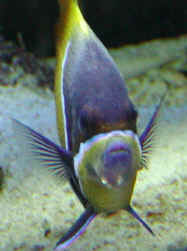
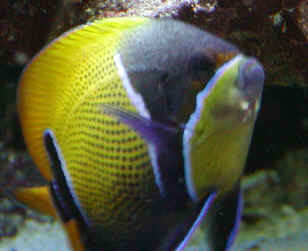
| What Are These Bumps on My Navarchus?
>Hi, >>Greetings, Marina here. >I bought a 3"
Navarchus Angel from TMC around 6 months ago. Around a month ago, I
noticed a small white bump under his mouth. At first, I thought it
was an infection from him possibly getting an abrasion from darting
in/out of the rockwork. He was still eating fine and otherwise
behaving normally, so I thought that by keeping the tank conditions
optimal the injury would heal itself. >>I would do the same.
>Well, it's been over a month later and now the original
white "bump" is bigger and now there are even two more
"bumps"! Now I'm worrying that it may be some kind of
disease that may require more hands-on treatment. I've attached
two photos of the fish for you to look at. >>Excellent that
you've presented the pics. If I am not way off base here,
I'd wager that it might be Lymphocystis, though I'd like to
get another opinion on that. >I really struggled with the
decision to put the fish in the main tank early, but because he was
not eating in the quarantine tank, and on the recommendation of
TMC, and since he was the only fish in the tank, I moved him to the
main tank after only one week of qt. >>For the LIFE of me I
cannot fathom why anyone would recommend shortening/eliminating
quarantine. Well, it is what it is at this point. Unfortunately,
I've discovered that Bob's "article" on
Lymphocystis is non-existent, so I'm linking you to the
Lympho-faq page. Should it be Lymphocystis, I can tell you it is a
viral infection that, in my own experience, has never been fatal. I
liken it to warts, it's ugly, we don't want it, but it
won't kill us. http://www.wetwebmedia.com/lymphfaqs.htm
This is the link to the FAQ, and try a Google on the subject for
more information. Typical presentation is on the fins, though the
body is not unheard of by any means. To the best of my knowledge
this is not something that readily spreads or is highly infectious,
and because there is no treatment we find that it, just as
mysteriously as it began, corrects itself with time. >The only
fish in the tank are the angel and a Royal Gramma. The tank is
mostly LPS and a few mushrooms. It's a 90 gal tank, with 30 gal
sump, Aqua-C EV120 skimmer, 3" sand bed, ~125lbs live rock.
Water parameters are within the normal accepted ranges. Any advice
will be appreciated. Thanks in advance. >>I've attached
your pics so the powers that be may have a look as well, but it
really looks to be Lympho to me. I do hope this helps in that
it's something, but not a terribly bad something, which is a
good thing since it's something you really can't do
something about. Best of luck! (And don't skip q/t anymore! 30
days, mate.) Marina |
|
What's That White Lump? (3/13/04) Hello, new to the hobby
and your site has been my lifeline, thank you. <Welcome to the club.
This site helps me daily too. Steve Allen today.> I recently
purchased a yellow tang. I believe it may have marine Ich. Ich is
described as looking like salt grains however, the white matter that is
on this fish does not look at all similar to a grain of salt. The fish
of concern has a small, white, fleshy looking material that is on the
edge of his tail and dangles off. Hope that you may know what this is.
<Sounds more like Lymphocystis to me, which is basically viral fish
warts. Search this term on WWM for pix and info.> If it is Ich, and
I copper medicate the tank, what will be the short and long term
effects on the live rock, and my BTA? <Death> Thank you again for
helping so many of us hobbyists, your site should be disseminated along
with every marine item ever sold. Keith Tallbe <Keith. Never put any
medication in a display tank. Copper is the worst--quickly lethal to
all inverts. Always treat in a hospital tank. You did not mention
quarantine. You should quarantine all new fish in a separate tank for 4
weeks before putting them in the display. I can almost guarantee
eventual disease, misery, and sorrow to all who skip this vital step.
Read more on WWM.>
Banggai Cardinal tumor or parasite Greetings! <Howdy>
I'm new to your web site and recently purchased "Reef
Inverts...". I've been impressed with both and want to get
your 'take' on a problem that has recently developed with a
single, large, relatively old (at least 3 years) female Banggai that
I've had for at least two years. This female is in a 125 gal
community tank with 3 other Banggai's and a variety of other reef
fishes that I've kept successfully, and disease-free for more than
four years. Over the past month, the female Banggai developed more
labored breathing and, subsequently developed a small, white, fleshy,
hornlike protuberance on its upper edge of the left operculum. <Good
observations, description> I, then, noticed more fleshy
'growths' of this material under both opercula that caused them
to 'flare out' slightly and they were visible further down the
fishes gullet. No other fish (neither the other 3 Banggai's nor the
other roughly 12 different species of fish in my tank have shown any
similar signs of trouble. <Okay> I am familiar with the tendency
of Banggai's to develop fleshy sores on their lower mandibles due
to battles with other individuals. These always heal and the fish
remains in good health. The problem Banggai, although its behavior
seems to be, otherwise, unaffected appears to have developed some
milkiness in its eyes, which I think may be due to the internal growths
in its head region. The growths are strictly confined to its head. Do
you think that this might be a tumor due to age of the fish, or do you
think I may have a parasite or fungal problem? Your advise would be
greatly appreciated! Smooth Sailin'! Bryan <I would side with
your conjecture re tumor, age here. Naught to do... not
"catching". Bob Fenner>
-Lymph?- Kevin, Thanks for writing back. <No prob> Just
in case it is a case issue....try this: http://www.zoyzoy.com/aquarium/images/clownwithskinsores.jpg
<Yikes, those are some serious gashes> I have put ZERO copper in
my tank as I intend to have a reef at some point. <Well there's
no way that this fish has lymph, which usually appears on the fins as
white blobs. The picture is great, good detail. It looks like they are
physical wounds or some sort of sub-scale fungal infection. I'd hit
it with a general antibiotic so they don't get infected, other than
that I don't believe there's much you can do. -Kevin>
Thanks, Jeff
Cotton like growth / Is this fungus? Howzit Guys:
<Fine> I really enjoy your site and I refer to it as my living
marine encyclopedia. Thank you for sharing your knowledge and all your
support. <Welcome> I have a 5" Heniochus that has developed
a white fuzzy cotton like translucent growth about 1/32" round on
one of her fins. All the rest of my fish are doing well (flame angel,
yellow tang & 2 clowns) in a 100 gallon tank with live rock, 40
gallon sump w/ refugium & Chaeto, 4" sand base and protein
skimmer which has been running almost 1 year. I would like to say it is
a fungus because that's what it looks like, but understand that
fungus on live fish is not that common or am I mistaken? <Mmm, may
be a fungus... but sounds like a case of Lymphocystis...> She eats
primarily thawed brine shrimp and will not take other food stuffs,
<Not good nutrition... but a good clue> is very active and has
nice colorations. I am worried about not providing all the nutrients to
sustain her good health that may also contribute to this condition
because brine shrimp has little nutritional value. <Bingo> I
tested my water parameters and the ammonia, nitrate & nitrite are
all in check. The salinity is about 1.020, water temp @ 74 degrees and
the PH 8.3. She is the newest addition to my tank prior to a 2 week
quarantine and a 10 minute freshwater dip with Methylene blue. Please
help me identify the problem so I'm sure I know what I dealing
with, suggest a cure and provide me with some alternative foods that my
Heni may take a liking to. I have tried a mash of thawed scallops,
vitamin flakes, Nori, garlic, vitamins mixed with the thawed brine to
no success. Mahalo and Aloha, Les <Please see the pix and read here:
http://www.wetwebmedia.com/viraldislymph.htm on to the
Related FAQs linked above... Bob Fenner>
Re: Cotton like growth / Is this fungus? Lymph on a Heni
Aloha Robert: <Howdy> Thanks for your prompt response. I checked
your link and can not say with certainty that it is Lymphocystis or
not, because the pics on the site are not clear enough. In fact, I did
check this link and read about Lymphocystis prior to emailing you. It
does however resemble it. Well let's assume that it is, what steps
should I take to treat my Heni. Also, please provide your thoughts on
possible food stuffs that she may like that would improve her diet.
Mahalo, Lester <Posted on WWM... use the search tool or indices to
find, read. Bob Fenner>
| Lymphocystis on A. ocellaris 4/15/05 Hi WWM
Crew, First of all thank you all for sharing your knowledge and
experience on this site and helping other Hobbyists around the
globe. I have learned a lot from the WWM site since I first
discovered it 2 months ago (shortly after I set up my first marine
tank). <Thanks for the kind words! Knowing that you and your
pets have benefited makes this a very satisfying job!> So far I
have always be able to find answers to my questions by reading the
articles and FAQs. However this time I think I need some additional
help. I bought a Amphiprion Ocellaris 5 days ago and acclimate it
to the quarantine tank with a quick fresh water dip. It looked well
and started eating the same day. However 3 days later I discovered
a small round patch on its tail, which has now grown 3 times bigger
to about 3-4 MM and spread to the underside of its body. It has not
lost his appetite and feeds eagerly, but is not as active as the
first two days. It stays around the same spot except when feeding.
<This all sounds good. Do keep in mind that FW dips less than
about 5 minutes are probably ineffective. A target of 10-15 minutes
(or even longer), especially for very tolerant fishes is ideal.>
After some research and reading through your site, I think it has
Lymphocystis but the lesions pictured in the following two links do
not look the same, and are different to those in the pictures I
took. I am hoping that you can confirm my thoughts, or otherwise
point me to the right direction. http://www.wetwebmedia.com/viraldislymph.htm
http://www.enaca.org/Health/DiseaseLibrary/LymphocystisDis.pdf
<The white "wart like" appearance of Lymphocystis is
very distinctive as is the fact that it occurs almost exclusively
on the EDGES of the fins or mouth. It is not likely to be confused
with another kind of disease or lesion. Lymphocystis is also common
to a small number of species and very uncommon in most others. It
is unusual in clowns. If you are confident that it is Lymphocystis,
I would not worry... it is rarely life threatening and goes away on
it's own. My guess is that your fish suffered an abrasion or
similar injury. Well fed specimens in good quality water usually
heal well and quickly.> Here are the tank parameters as of
today: pH 8.2, Temperature 79F, Ammonia 0.005 mg/l (I was surprised
to see this as the tank has been running for over a month and I
quarantined two yellow gobies for 2 weeks right before the
clownfish, both yellow gobies are now doing well in my main tank),
Nitrite not detectable, Nitrate 20 mg/l. <Any measurable Ammonia
is cause for concern but before you start to worry, please verify
your result with another kit, preferably of another brand. (a
friend or good LFS should save you the expense of buying another).
Although it probably has little to do with your problem, I suggest
that all marine aquarists regularly test and maintain alkalinity,
even in fish only tanks.> I have cut back feeding and done 30%
daily water change for the past three days. This has brought down
Ammonia level from 0.01 mg/l to the current level. Should I just
keep doing this to improve the water quality? Or should I take
further actions? Your help is very much appreciated. Best Regards,
Damien Kwok, Hong Kong <If you verify the results of your
ammonia test kit (the change in level suggest that it may be
correct), then you need to address the biological filtration
problem. In the mean time, please make sure you fish is getting
enough food. It will need the energy to heal. Water changes are a
good idea, but make sure that the new water has been aerated over
night. Also, ammonia becomes more toxic at higher pH, so I would
suggest that you check the pH of both the tank and new water
immediately before the change. If the pH of the new water is higher
than the pH in the tank, it should be carefully adjust it down
(check your local fish store for "pH Down" or similar
products) so that it is the same as the tank. Best Regards.
AdamC.> |
|
|
| Lymphocystis on A. Ocellaris FOLLOW-UP
4/15/05 <Damien, I am following up because I missed your
pictures the first time I replied. I still don't think that
your fish has Lymphocystis, but that certainly isn't a simple
abrasion either. I am asking the other crew members to take a look,
but in the mean time, I am not going to alter my advice, except to
suggest that if it continues to get worse, I would move the fish to
a hospital tank for antibiotic treatment. AdamC.> Hi WWM Crew,
First of all thank you all for sharing your knowledge and
experience on this site and helping other Hobbyists around the
globe. I have learned a lot from the WWM site since I first
discovered it 2 months ago (shortly after I set up my first marine
tank). <Thanks for the kind words! Knowing that you and your
pets have benefited makes this a very satisfying job!> So far I
have always be able to find answers to my questions by reading the
articles and FAQs. However this time I think I need some additional
help. I bought a Amphiprion Ocellaris 5 days ago and acclimate it
to the quarantine tank with a quick fresh water dip. It looked well
and started eating the same day. However 3 days later I discovered
a small round patch on its tail, which has now grown 3 times bigger
to about 3-4 MM and spread to the underside of its body. It has not
lost his appetite and feeds eagerly, but is not as active as the
first two days. It stays around the same spot except when feeding.
<This all sounds good. Do keep in mind that FW dips less than
about 5 minutes are probably ineffective. A target of 10-15 minutes
(or even longer), especially for very tolerant fishes is ideal.>
After some research and reading through your site, I think it has
Lymphocystis but the lesions pictured in the following two links do
not look the same, and are different to those in the pictures I
took. I am hoping that you can confirm my thoughts, or otherwise
point me to the right direction. http://www.wetwebmedia.com/viraldislymph.htm
http://www.enaca.org/Health/DiseaseLibrary/LymphocystisDis.pdf
<The white "wart like" appearance of Lymphocystis is
very distinctive as is the fact that it occurs almost exclusively
on the EDGES of the fins or mouth. It is not likely to be confused
with another kind of disease or lesion. Lymphocystis is also common
to a small number of species and very uncommon in most others. It
is unusual in clowns. If you are confident that it is Lymphocystis,
I would not worry... it is rarely life threatening and goes away on
it's own. My guess is that your fish suffered an abrasion or
similar injury. Well fed specimens in good quality water usually
heal well and quickly.> Here are the tank parameters as of
today: Ph 8.2, Temperature 79F, Ammonia 0.005 mg/l (I was surprised
to see this as the tank has been running for over a month and I
quarantined two yellow gobies for 2 weeks right before the
clownfish, both yellow gobies are now doing well in my main tank),
Nitrite not detectable, Nitrate 20 mg/l <Any measurable Ammonia
is cause for concern but before you start to worry, please verify
your result with another kit, preferably of another brand. (a
friend or good LFS should save you the expense of buying another).
Although it probably has little to do with your problem, I suggest
that all marine aquarists regularly test and maintain alkalinity,
even in fish only tanks.> I have cut back feeding and done 30%
daily water change for the past three days. This has brought down
Ammonia level from 0.01 mg/l to the current level. Should I just
keep doing this to improve the water quality? Or should I take
further actions? Your help is very much appreciated. Best Regards,
Damien Kwok, Hong Kong <If you verify the results of your
ammonia test kit (the change in level suggest that it may be
correct), then you need to address the biological filtration
problem. In the mean time, please make sure you fish is getting
enough food. It will need the energy to heal. Water changes are a
good idea, but make sure that the new water has been aerated over
night. Also, ammonia becomes more toxic at higher pH, so I would
suggest that you check the pH of both the tank and new water
immediately before the change. If the pH of the new water is higher
than the pH in the tank, it should be carefully adjust it down
(check your local fish store for "ph Down" or similar
products) so that it is the same as the tank. Best Regards.
AdamC.> |
Another Follow-up, Remarks to the Lymphocystic Clown
<snip> The reason I am writing everyone is because I also
completely missed the attached photos when I replied and they are
scary! The person described an Ocellaris with a white patch on it's
tail that spread a bit. They thought it was Lymphocystis. They sounded
pretty newbie with a young tank and reported a trace amount of ammonia.
The fish was acting and eating normally. I replied that I doubted
Lymphocystis because of the species and the location of the lesion and
made suggestions for proper water changes. It sounded more like the
fish got banged up a bit, so I also suggested that abrasions usually
heal fine on their own with good food and improved water quality.
However, when I did go back and look at the pics.... yikes! Whatever it
is sure doesn't look like Lymphocystis, although it is
understandable how they came to that conclusion. Whatever it is is
pretty ugly looking, but doesn't look like anything I have ever
seen before except for some pics that one of the crew (Jeni I think)
shared with us of a puffer condition where spreading patches of the
skin turns grayish until the fish perishes. If anyone is inclined to
take a look, the original message is in the "emails with
images" folder. I will be curious if anyone has any insight.
Thanks! AdamC <Have looked at image, text... does look like some
sort of tumorous growth... diag/prognosis, about the same as lymph...
BobF> <<Adam, I've answered some queries quite similar to
this, and in my research I did find that, while very uncommon,
Lymphocystis can indeed occur on the body like what is pictured. In my
own opinion many, if not MOST, instances of disease are more due to
water quality, nutrition, and basic husbandry issues than anything
else. Lympho is no different in this respect. Marina>>
Lymphocystis on A. ocellaris Part 3 4/17/05 Hi Adam, Thank
you for the response. Unfortunately my clownfish's condition
deteriorated rapidly, stopped eating and moving around, and finally
passed away yesterday. <Sorry to hear.> Looking back if I did not
diagnose the illness as Lymphocystis and treated with antibiotics right
away, it might have made the difference. Anyway I guess this is part of
the experience and how we learn. <I polled the Crew for input about
your clownfish, and got a few replies. One indicated that there are
occasions when Lymphocystis does occur as a body lesion. Another agreed
it probably was not Lymphocystis, but has seen similar lesions which
eventually went away without intervention.> I hope someone can
identify the true cause of the lesions in the picture and recommend the
appropriate actions. Not only I can learn the lesson and know how to
deal with it next time, the information can be useful for other
hobbyists as well. Best Regards, Damien Kwok <For all of the reasons
you listed, I wish I had a more definitive answer. In the mean time, I
would suggest that you don't add any new fish for a couple of
weeks, just in case this was caused by a communicable disease. Best
|
|