|
|
| Home | Marine Aquariums |
Freshwater Aquariums |
Planted Aquariums |
Brackish Systems |
Ponds,
lakes & fountains |
Turtles & Amphibians |
Aquatic Business |
Aquatic Science |
Ask the WWM Crew a Question |
| Please visit our Sponsors | ||||
Lymphocystis on six line wrasse
5/17/09 Lymphocystis, Marine 2/11/08 Hello all, <Hi> I currently have three Bartlett's Anthias in my QT. One has Lymphocystis<http://www.reefcentral.com/forums/showthread.php?s=&threadid=1278266>, while the other two are unaffected. I have been using Maracyn to treat it and it seems to be going away. <Lymphocystis is a viral disease, the Maracyn anti-biotic will not effect it.> All of them have been eating well too. Is this something that can spread to other fish, or is it okay to release them to the display. Thanks. Tyler <As long as you are sure it is lymphocystis then they can be release to the main tank, it is not generally contagious or harmful to the fish. See here for more http://www.wetwebmedia.com/lymphfaqs.htm .> <Chris> Imperator Angel (Lymphocystis, John Donne's lament) I recently picked up a small Imperator Angel approximately 4" in length. I purchased him with having Lymphocystis at the time, the shop owner was going to flush him, and he was doing well up till 2 days ago. I was feeding him Brine Shrimp soaked in Zoe and occasionally Formula Two. He has quit eating. He is in a 10 Gallon Med tank, with a simple over the back. I can add a sponge filter that has been floating in my sump for a while for just such an occasion. I read at FFExpress that perhaps a water change and live rock would help so I have done that. I am also shopping around to find someone who sells Ocean Nutrition Angel Food, I read it is mostly a sponge base food source. I knowingly picked up the animal ill, but I saved him from a flushing, what can I do to keep him alive? <Place this animal in your main display tank... there is very little chance it will "pass" the lymph on to other fishes... and very good chance it will perish soon otherwise> I have already spent quite a few hours simply staring at him in the tank and trying to talk him into eating, but I have has no such luck. I have a sincere problem about caring to much for Marine Fish. <Is there such a thing? I refer you to the writings of John Donne... "If a clod be washed from England's shore..."> I am always picking up sick fish and curing them. I am getting better all the time and I know that I am doing some good by saving just a few animals doomed otherwise. <Perhaps they are in turn saving you> This is my first angel and I must say they are somewhat more difficult than I had expected. I thought a case of Lymphocystis would be a piece of cake to heal from all the information I had read, and I am still sure I can cure him if he would help by eating. All the water parameters are fine. 0's on Nitrate, Nitrite, and Ammonium. Ph is 8.3 and water is 79-80 degrees. Lighting is timed with 2 24" fluorescents. Help me Mr. Fenner. I have a great deal of respect for you and hope to meet you one day to express all you have done for me and my hobby. Your book is my favorite and quite beaten and dog-eared on the pages that the binding still holds. <Do place this animal in larger, more settled quarters... soak foods with a liquid vitamin preparation and iodide... the viral infection it has is an environmental "disorder", imbalance... strengthen it psycho-emotionally by improving its environment, nutrition, and in turn it will cure itself internally. Bob Fenner> Sincerely, Joseph M Howell Blue Tang Bob, Another question - I have a small (2.5 inch) Blue (Regal) Tang. <Wow, this is small> I have had it for about 2 weeks. It has some white fluffy like spots on it's body and fins. Mostly noticeable when the light hits him at an angle. Not too many, and it is eating fine, swimming fine. On a rare occasion will brush against the live rock. Best described as like the dandelion seed fluff that blows in the air. I am feeding the usual flake food, and Graze. I have read your articles in "The Conscientious Marine Aquarist" regarding Ick, but also have read your advice on the website about Lymphocystis. <This is likely the latter.> I am really not sure what this is or whether to treat it or not. <I wouldn't "treat it" as such... simply maintain good water quality, boost immune systems with vitamins, iodide addition to foods, water... perhaps add a cleaner (oh, see you have down below)> All my levels are at zero, PH is good, salinity good. I also have a Yellow Tang, two Clownfish, Royal Gramma, Flame Angel and just got a Cleaner Wrasse (bought it before I read your boycott article in your book - it will be my last one) and two cleaner shrimp. I think it and the Yellow Tang had some of these spots once before but they went away. Any suggestions? <Just the above> I bought your book a week ago and read it in two days <!> (amazon.com is a great thing). Awesome material, I wish I had it before I even bought the tank. Should be a must read for anyone BEFORE getting into this hobby. Your knowledge seems endless. <Simply many years of accumulation, tests, trying to "make known" what one feels should be...> After reading the book, it gave a whole new perspective on being "conscientious", and changed my whole feeling of responsibility about keeping these animals. Thank-you. <Thank you my friend. Our minds, consciousnesses have met, are confluent. Bob Fenner> John Kummer Lympho-Maniac? Hi, I have an angel fish with what I think to be is Lymphocystis on his lips and is unable to eat anything. What should I do? Thanks, Kerrie <Well, Kerrie, Lymphocystis is not entirely understood. Some people believe that it is an environmental malady, brought on by water conditions, diet, or even stray voltage. It is rarely fatal, and usually goes into spontaneous remission without any intervention on the part of the aquarist. I'd just continue with excellent environmental conditions, good food, and patience. Hopefully, it will clear up with minimal intervention on your part....Hang in there! Don't go too crazy...just maintain common sense husbandry practices and keep the fish as happy as possible. You can read up more on this malady on the WWM site. Regards, Scott F>
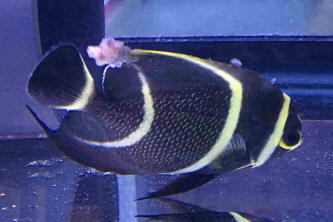
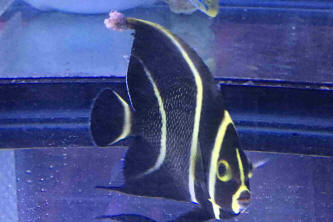
Scrape Off Fish Warts?? (4/19/04) My large French angel appears to have warts <lymphocystis> under his mouth and some on his fins, the pet store recommended I scrape them off with a razor blade or it will get worse. Is this proper treatment, I thought if I left it alone, kept quality water, and fed him well that it would go away on its own. What do you think? <I agree with you. The risk of injury during the process and the risk of causing a bacterial infection in the wound created by scraping are too great in this large, beautiful fish. Like human warts, lymphocystis does not appear to be harmful and usually clears on its own eventually. Excellent water quality and optimum nutrition will hasten this. Steve Allen.> Mainly Clownfish Lymph Dear Robert, I have come for your help
again. After some reading and stuff, I must agree that rather than
having ick, my clowns are most likely sick with Lymphocystis. All are
alive so far and eat like pigs, but I read in several books that
Lympowhatever is a viral disease and has no cure. <Mmm, no
"direct cure"... like virally-mediated conditions in humans
(like warts) there are steps one can take to effect apparent remission.
Please read here on our site:
http://www.wetwebmedia.com/lymphfaqs.htm> I also read, and I quote
"The disease is not usually fatal, but it is of course infectious
and there is no cure. Depending on circumstances, it is usually best to
destroy the infected fish....". What circumstances are they
talking about? Isn't it a bit drastic? <Mmm, this is too
drastic, too negative... Lymph/ocystis is generally not
"that" infectious... Have seen it "cured" on many
species of fishes... As you will find by reading the FAQs where
I've sent you, by improved water quality, nutrition, prising clumps
from fishes...> I've never killed anything intentionally (well,
that's not entirely true) do I have to? What are the consequences
of having all fish get this thing? I mean if I let them live and add
others. None seem to be bothered by it so far. (perhaps the "so
far" is the answer to this one) <No need, reason to kill
specimens...> Of three clowns that I have all were infected. After I
put them together with LTA (Macrodactyla doreensis), one no longer has
the growth (he had the smaller clumps), another has gotten worse (got
new clumps and some of the old have grown, some have become smaller)
and the third one seems to have remained unchanged (actually he just
got there, 2 days ago, moved from copper-safe tank with two old and one
new growth). Is there a chance that the first dude is cured? <Yes...
with improved immunity no less> I did read somewhere that apparently
Macrodactyla D. is "the cure" for Lympho.. even if the fish
is just placed with the MD without making a clown-anemone bond.
<Anything that improves the life of the host will delimit the viral
component... an important lesson here... Please read:
http://www.wetwebmedia.com/mardisease.htm> None have actually bonded
with MD. The sicker one sometimes comes by and rubs himself against the
stem (foot) of the anemone. Do you know anything about the magical
powers of Macrodactyla Doreensis or it is just me, reading too much
into it? <Mostly the latter... as I state, the "balance
equation" is tilted more toward "health" with a more
"complete" positive environment... the Anemone is part of the
equation> A follow-up: In the 10g (everyone is there temporarily),
the anemone seems to be doing OK. It finally got up and is now standing
attached with her disk (not foot) to a rock next to it. It also started
to feed by itself ( I used to have to stick food directly into her
mouth as she dropped it otherwise). We are still waiting for 55 to
cycle with rock. Is it normal to have zeros in ammonia and nitrite
after only 3 weeks? Could we have finished cycling? <Likely
finished> Tests show 8.0-8.2PH, Nitrite=0,amo=0, nitrate<20.
(should I test for something else?) <Perhaps alkalinity, and
the biomineral calcium> I did do a massive water change once toxins
reached zeros, so that should explain nitrate, which I did not test
before the water change. Oh, and is there any reason why my water
smells like vinegar, or something very similar to that.
<Results of dying, competition of live rock constituents> I did
however go wild (following the dosage) on additives, such as iodine
(Kent), calcium (Seachem), strontium & molybdenum (Kent), trace
elements (CombiSan and Kent) and Carbonate Alkalinity (Seachem) for the
rock. I forgot to add iron.. oops. Are those elements in any way
harmful to fish, considering the dosage is correct? <Better to
under-dose, be careful about mixing, matching manufacturers products.
There are some semi-toxic mixing possibilities> Well, I think I
should leave you alone for now... Thanks a bunch Oksana <Study where
I've sent you, and the links beyond. Bob Fenner> |
|

|
Features: |
|
| Featured Sponsors: |