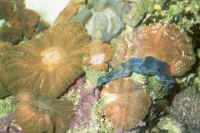
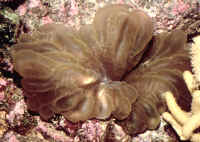
|
Related FAQs: Mussids, Mussids
2, Mussid Identification,
Mussid Behavior, Mussid Compatibility, Mussid Selection, Mussid Disease, Mussid Systems, Mussid Feeding, Mussid Reproduction, Stony/True Coral, Coral System Set-Up, Coral System Lighting, Stony Coral Identification, Stony Coral Selection, Coral Placement, Foods/Feeding/Nutrition, Disease/Health, Propagation, Growing Reef Corals, Stony Coral Behavior,
Related Articles: Large Polyp Stony
Corals, Stony or True Corals,
Order Scleractinia, Dyed Corals,
/The Best Livestock For Your Reef Aquarium:
Brain, Meat, Pineapple
Corals, Family Mussidae, Pt. 2
To:
Part 1,
Part
3, Part 4,
Part 5, Part 6,
Part 7, Part 8,
|
|
|
By Bob Fenner
|
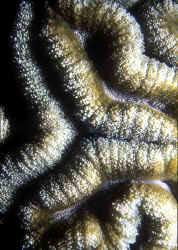
Lobophyllia hemprichii
|
Genus Cynarina Bruggemann 1877. Solitary, fleshy circular polyps,
with prominent/large lobed septal teeth evident (as opposed to the similar
Scolymia of this family). Typically tissue is inflated with water
during day (tentacles out only at night). Monotypic genus (one
species). This genus now placed in the family Lobophyllidae by some.
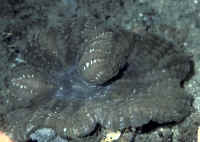
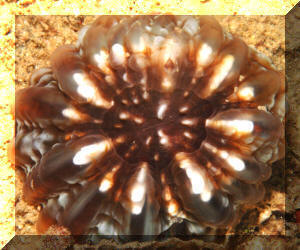
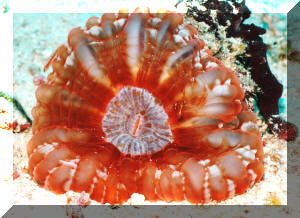
| Cynarina lacrymalis (Milne Edwards and Haime
1848). Button, Meat, Record, my fave: Donut... Coral. A popular
aquarium species that prefers medium to lower light intensity. Many
color varieties. Able to expand more than twice its skeletal size.
N. Sulawesi specimen at right, aquarium ones below. |
|
Bigger PIX:
The images in this table are linked to large (desktop size) copies.
Click on "framed" images to go to the larger size. |
 .JPG)
%20MD.JPG)
%20MD.JPG)
%20MD.JPG)
%20MD.JPG)
  |
|
Yo Bob
10/27/13
Mussid ID corr.s, Indo-Pacific Scolymia are now Acanthophyllia
Hi Bob,
<Hey Jules... now am humming the Beatles tune... A to middle C>
It was nice seeing you last weekend, as always.
<Ahh, a very nice time indeed>
I was just browsing Google looking at some coral photos to help
illustrate the answer to a taxonomic question someone sent me, and I
happened to notice that you have a very special photo on your site-- I
know, you probably are thinking that all of your photos are special.
They are, but this one is particularly so. I have attached it here.
<Will look for... oh, I see you explain below>
You use to illustrate Scolymia, hence the name you gave the photo, but
it is not Scolymia. It is Acanthophyllia deshayesiana. It is a common,
high-value import from Indonesia, usually imported as Scolymia,
sometimes as Cynarina, but now legally only as Acanthophyllia. Long
story. The are many many photographs of this coral in aquariums since it
is a very popular aquarium coral. There are to the best of my knowledge
no published photographs of it taken in the wild. Hence my interest in
your photo.
<Ahh, thank you>
You listed Raja Ampat as the locality. Do you remember the depth and any
other details?
<Aye yi yi... I barely remember what I made for bfast this AM. Many
years... decades back, I showed some discipline in labeling just
finished rolls of film with such notes... >
Even the "Cynarina lacrymalis" featured just above the
Acanthophyllia, also photographed at Raja Ampat, is likely a special
photo. I believe it shows Indophyllia macassarensis, which is
sometimes not easy to distinguish from Cynarina lacrymalis, and
sometimes not easy to distinguish from Acanthophyllia deshayesiana. If
you look at my book Corals A Quick Reference Guide you will see that I
grouped these three species into the genus Cynarina, which is what I
suspect will ultimately happen on the taxonomic front, though it may
take many years.
<Am very inclined to beg you to look through my (many, Way too many)
totally unidentified Cnid. pix, let alone my likely mis-id'ds>
With your permission I would like to forward a copy of this photo to
Charlie Veron. He has recently recognized the validity of this coral
(after many years of me beating him over the head about it because he
refused to separate it from Cynarina lacrymalis). He has lots of good
AQUARIUM photos of it to illustrate his online version of Corals of the
World, but he has no underwater photos from the natural setting. I am
sure he would love to feature your photo.
Best Regards, Julian
<Ah, certainly... I will take a quick look on my HD and attach the
original here for all's use; actually three others labeled in the same
series. Cheers, BobF>
|
Re: Yo Bob
10/27/13
Thank you Bob, these photos are GREAT !
<Ah my friend; it's the gear and opportunity>
I need to go to Raja Ampat.
<Oh! I'll gladly go w/ you... Really! Have the time, funds; just fresh out
of dive-adventure partners... Is a fab area... Arenui, Cheng Ho...>
I have sent them on to Charlie Veron and I am sure he will contact you about
them at some point.
<Ahh!>
Best Regards,
<Cheers, and again, am not joshing re getting out for diving tog. BobF>
Julian
10/28/13
Julian... on being a bit more awake, re-reading your msg., have noted your
ref. to "Cynarina" I likely have (mis)labeled from RA. Have included the
three images from my HD here for your and JEN's perusal. Cheers, BobF |
.JPG) .JPG)
 |
Re: Yo Bob
10/28/13
Thank you Bob, FYI,
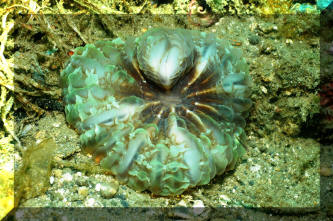
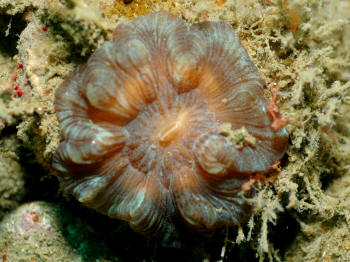
Cynarina lacrymalis RA (1).JPG is Cynarina lacrymalis
Cynarina lacrymalis RA (2).JPG is Indophyllia macassarensis (C. lacrymalis
per Joe Fish... D'oh!)
Cynarina lacrymalis RA.JPG is Trachyphyllia geoffroyi
<Am more and more convinced to have you ID all Scleractinian pix! Thank you
again. Bob>
Best Regards,
Julian Acanthophyllia photos
10/28/13
Hi Bob,
<Hey Dr. V., I met you years back when John Jackson (RIP) had you over to
the States for the MACNA hobby conference>
Julian forwarded your photos of Acanthophyllia to me. And yes, I would
indeed like to use them on Corals of the World website. Acknowledged of
course. Is this OK with you?
<Ah yes; you (and all educational, non-commercial) uses of my work are fine
to use>
Very nice photos.
<Ahh; thank you. Am grateful to JulianS for straightening me out on these
(and so many more likely) inaccurate ID.s>
Best wishes, Charlie
<Cheers, BobF>
Re Acanthophyllia photos 10/28/13
Many thanks Bob.
<Glad to share. BobF>
Charlie
|
Genus Indophyllia:
|
Yo Bob
10/27/13
Mussid ID corr.s, Indo-Pacific Scolymia are now Acanthophyllia
Hi Bob,
<Hey Jules... now am humming the Beatles tune... A to middle C>
It was nice seeing you last weekend, as always.
<Ahh, a very nice time indeed>
I was just browsing Google looking at some coral photos to help
illustrate the answer to a taxonomic question someone sent me, and I
happened to notice that you have a very special photo on your site-- I
know, you probably are thinking that all of your photos are special.
They are, but this one is particularly so. I have attached it here.
<Will look for... oh, I see you explain below>
You use to illustrate Scolymia, hence the name you gave the photo, but
it is not Scolymia. It is Acanthophyllia deshayesiana. It is a common,
high-value import from Indonesia, usually imported as Scolymia,
sometimes as Cynarina, but now legally only as Acanthophyllia. Long
story. The are many many photographs of this coral in aquariums since it
is a very popular aquarium coral. There are to the best of my knowledge
no published photographs of it taken in the wild. Hence my interest in
your photo.
<Ahh, thank you>
You listed Raja Ampat as the locality. Do you remember the depth and any
other details?
<Aye yi yi... I barely remember what I made for bfast this AM. Many
years... decades back, I showed some discipline in labeling just
finished rolls of film with such notes... >
Even the "Cynarina lacrymalis" featured just above the
Acanthophyllia, also photographed at Raja Ampat, is likely a special
photo. I believe it shows Indophyllia macassarensis, which is
sometimes not easy to distinguish from Cynarina lacrymalis, and
sometimes not easy to distinguish from Acanthophyllia deshayesiana. If
you look at my book Corals A Quick Reference Guide you will see that I
grouped these three species into the genus Cynarina, which is what I
suspect will ultimately happen on the taxonomic front, though it may
take many years.
<Am very inclined to beg you to look through my (many, Way too many)
totally unidentified Cnid. pix, let alone my likely mis-id'ds>
With your permission I would like to forward a copy of this photo to
Charlie Veron. He has recently recognized the validity of this coral
(after many years of me beating him over the head about it because he
refused to separate it from Cynarina lacrymalis). He has lots of good
AQUARIUM photos of it to illustrate his online version of Corals of the
World, but he has no underwater photos from the natural setting. I am
sure he would love to feature your photo.
Best Regards, Julian
<Ah, certainly... I will take a quick look on my HD and attach the
original here for all's use; actually three others labeled in the same
series. Cheers, BobF>
|
|
|
Genus Isophyllastrea
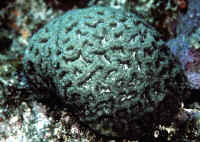
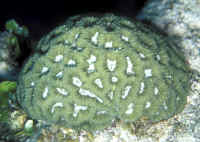
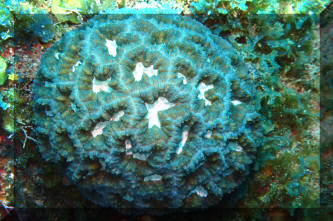
| Isophyllastrea rigida, Rough Star Coral,
Polygonal Coral. Tropical West Atlantic. Dome-shaped. Ridge along
midline of septa. One each in Cancun and Cozumel,
Mexico. |
|
| Verticals (Full/Cover
Page Sizes Available) and Larger (linked) PIX |
%20MD.JPG)
 |
Genus Isophyllia Milne Edwards and Haime 1851. Small colonies
(typically under eight inches in diameter), flat to slightly
dome-shaped. Thin septae and columellae (on dead skeleton appearance).
Found only in the tropical West Atlantic.
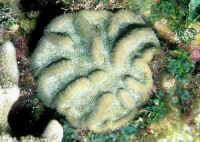
| Isophyllia sinuosa (Ellis and Solander
1786). Distinctive for its range. Meandering valleys. Not common.
Bahamas image. |
|
To:
Part 1,
Part
3, Part 4,
Part 5, Part 6,
Part 7, Part 8,
|
|