|
FAQs about Soft Corals of the Family
Nephtheidae Reproduction/Propagation
Related Articles: Soft Corals of the Family Nephtheidae,
The Soft Corals of the genus
Dendronephthya, Soft Corals, Order Alcyonacea
Related FAQs: Nephtheids 1, Nephtheids 2, Neptheid Identification, Nephtheid Behavior, Nephtheid Compatibility, Nephtheid Selection, Nephtheid Systems, Nephtheid Feeding, Nephtheid Disease, Soft Coral Propagation, Alcyoniids, Dendronephthya, Paralcyoniids, Nidaliids, Xeniids, Soft Corals/Order
Alcyonacea
|
|
Kenya Tree Coral Reproduction.
11/24/10
Hey WWW,
<Hay?>
What's new?
<Not much CP>
For quite awhile now I've had a tank containing various
colorations, shapes and sizes of Capnella. Sp. I used to frag these to
help fill in places of the aquarium in order to make it look a bit
fuller.
I have two different varieties, One is Brownish tan coloured.
The Other Capnella is largely whitish in coloration, has significantly
thicker stalk, shorter branches
,considerably smaller polyps and has a very excellent Greenish hue not
present in the former.
What seems to be happening in my tank is that Random Kenya trees are
appearing in low flow areas" I now have at least 15 new frags
besides the original 19 larger ones" I came to inspect the tank
today and discovered the culprit is the Largest colony.
This coral appears to be Pinching off some of its own branches
somehow.
<Happens... a mechanism for dispersal in time and space... quite
handy in adverse circumstances eh?>
These branches seem to establish themselves within a few days and
attach to whatever
they are able to make base contact with.
<Oh yes>
I've never seen my corals actually do this on their own before so
the process of how the branches are coming off looks unusual to me.
<Happens... all the time...>
It appears that where the separation occurs, a section of tissue
Shrinks in a ring formation until their is almost nothing holding the
branch in place and the branch, still fully expanded and healthy
looking then floats away. what remains appears to be a stump but it
doesn't resemble the damage left over from fragging with scissors
or a razor.
The Stump is not very ridged, but rather has a more fleshy
appearance.
During this separation the colony itself remains fully expanded.
What could this be?
<A type/form of asexual repro.. If anything, a good idea to
monitor... keep an eye out for whatever might be triggering this
"in extremis" activity, thin the herd by selling such frags,
trading out w/ others>
They weren't really doing this a week ago, so I
am concerned that this might be some kind of stress related
activity.
<Ahh! I as well>
I'm not entirely sure how though, as these animals are the dominant
species in my tank with very little competition.
<Best to keep "restricted"; not allow the one genus,
colony to take over... chemically as well as
physically/territorially>
the only other corals are a few small mushrooms which hitchhiked, a
very small Sarcophyton and a Briareum that likes to grow on the
glass.
Worrying aside, its provided my Male Clownfish a fun Forest to swim
around in.
the female seems like the Briareum and dislikes the Kenyas. The result
seems to be whenever she attempts to bully him, he retreats to the
trees and disappears.
<Sounds fab. BobF>
Re: Kenya Tree Coral Reproduction. 11/24/10
Hey!
<Neigh!>
Thanks for replying so quickly,
you guys are great.
So what do you mean specifically by In extremis?
<Look it up... in Linqua Latina, "at the furthest
reach"...>
I've tried to locate definition for this terminology and it seems
to denote the end of life.
Do you mean that the colony which is Budding off these branches is
dying?
<They may be acting as if>
Also, just out of curiosity
what are the average life spans of This type of coral in nature and in
captivity?
<Got me. Years at least>
Thanks for the advice by the way.
I've been putting all of the new trees
on Rubble pieces and I am waiting for attachment.
3 more have appeared since I sent you the first message yesterday.
After these are secured I will be seeking trades, store credit or
something else.
their is a small LFS near by which is doing some Marine aquaria so this
might end up being beneficial to me in some way.
The owner has told me he is interested in obtaining frags.
Perhaps I should also consider setting up a frag tank?
<A good idea. BobF>
Ask the WWM crew, Coral repro., Kenya Tree
1/1/09 Hi WWM crew, <Hello William, Minh at your
service.> I've been in the hobby for about 10 years and am
currently 17. I am currently running three tanks and about two years
ago finally made the jump to salt water with two of them (a 30g main
and a 10g hospital). I felt confident in myself and went for the reef
setup in the 30g early on and have moderately succeeded so far. I
wanted to ask if there was any reason why coral reproduction would be
laggard or if there were specific issues that could help the
acceleration of reproduction. <Coral growth is a function of several
key factors: water quality, food availability and light availability.
More on these points later.> I have read many of the FAQ's and
articles but most talk about slowing the growth, which I want to
accelerate. I am currently keeping a small green starburst polyp
colony, a small glove polyp colony, small Kenya tree (which I just
attempted my first coral cutting on[successful]), and a medium button
polyp colony and all are separated by several inches at least and some
over a foot, are well lit, and have good water flow.
<Congratulations on successfully fragmenting your first coral. The
Geothermal Aquaculture Research Foundation (GARF) has an excellent site
with excellent techniques for your future fragging endeavors:
http://www.garf.org/.> I have a Corallife light with two T5 bulbs
(one 10,000k and one actinic), a Rena XP2 Canister filter, a Maxi-Jet
600, a SeaClone 100 Protein Skimmer and three heaters (two 150W and one
50W). The bottom is coated in about 4 inch thick layer of live sand and
the tank has about 50lbs of live rock. I am soon going to be taking
this setup completely apart to be used as the sump for my new
predrilled 55g so I will probably not add any new equipment unless
absolutely necessary. The water parameters are: salinity=1.022,
ammonia=0ppm, nitrite=0ppm, nitrate=10-100ppm(I know that's bad but
my town water has 15ppm by itself and I need to travel to get better
water), pH=8.2, hardness=10 degrees, and Calcium=495. <Let's
talk about water quality. Obviously, the elevated nitrate level is of
concern. To address this, there are several options. First, by
switching to a purer source water produced by your RO unit, you should
address a major contributor to high nitrate readings. Furthermore,
there are other methods that you could apply to your new tank that will
help: -Reduce the inputs of nitrogen to the aquaria. -Increase nitrogen
export by growing and harvesting macroalgae or turf algae (or any other
organism of your choice). -Use a deep sand bed. -Remove existing
filters designed to facilitate the nitrogen cycle (such as your Rena
XP2). These methods are described in details in this excellent article,
"Nitrate in the Reef Aquarium":
http://www.advancedaquarist.com/issues/august2003/chem.htm. Aside from
nutrient control, having excellent water quality to maximize coral
growth includes careful management over pH and some major elements such
as alkalinity, calcium and magnesium. Your calcium reading of 495
(ppm?) is a cause for concern. The recommended range for calcium in a
reef aquarium is 380-450ppm calcium ion. Sustained elevated calcium
levels may lead to some problems, such as precipitation of calcium
carbonate and ultimately driving down alkalinity. Furthermore, elevated
calcium readings may also indicate high phosphate concentration. For
more information on this subject, please review the following articles:
- "A Simplified Guide to the Relationship Between Calcium,
Alkalinity, Magnesium and pH":
http://www.reefkeeping.com/issues/2006-06/rhf/index.php#18. -
"Solving Calcium and Alkalinity Problems":
http://www.advancedaquarist.com/issues/nov2002/chem.htm.> My
inhabitants are down to only a female tomato clown and a cylindrical
Sandperch after a few mishaps with a Leopard Wrasse (femme
fatale[inexperience in copepods]), a Coral Beauty Angel, a Sixline
Wrasse (viral infection), the male Tomato clown(killed by female) and a
Yellow Tang. I have always been fighting the nitrate levels in all
three tanks and I believe I am finally going to get a RO unit to end my
troubles. My main goal is to encourage the spreading of the polyps and
propagated Kenya trees over my rocks but so far they haven't made
an attempt to do anything of the sort. Any recommendations would be
well appreciated. <Aside from the topic of water quality addressed
above. Light and food availability are important factors to consider in
maximizing coral growth. The soft corals you currently house are
normally classified as low light corals and your current lighting
method should suffice. Regular bulb replacement to ensure the highest
photosynthetic usable radiation (PUR) reaching your corals will
optimize growth. As you acquire more corals and upgrade to larger and
potentially taller tanks, adding more lighting units or more intense
units should be considered. Lastly, another key component for your
consideration in coral husbandry is food availability. To supplement
the energy corals gain via photosynthesis, one can feed a variety of
food. Further reading on this subject is available in this excellent
series of articles: "Reef Food":
http://www.reefkeeping.com/issues/2002-07/eb/index.php.> Thanks
again, William Joyce <You're welcome. Cheers, Minh Huynh>
Kenya Tree Reproduction -- 10/02/08 Good evening
WWM crew. <Howdy. Jessy here.> I recently set-up a new reef
aquarium and am experiencing a new phenomena. The Kenya Tree that I
have had for over a year now seems to shedding. Small segment near the
top of this coral are breaking off to what seems to be anew colony. Is
this a natural asexual reproduction or am I experiencing something
different? The small pieces I have put into a small 10 G quarantine
tank and they seem to be doing fine. All my parameters are in check.
What is the scoop? <This is how Kenya Trees reproduce. Sending off
little babies. If you aren't careful you'll soon find yourself
with a forest of Kenya Trees all over your reef. Read more on the
subject. Regards, Jessy>
| Capnella? Is spawning 2/15/07
<Sure seems to be!> Hi Bob. the odyssey continues.
<Always> Previously I sent a
picture asking if the hitchhiking coral was Capnella. At
the time I didn't know they can shrink up into little balls.
<Yes, can> and after a couple days I thought they were just
growing really fast. So just to be sure I've
attached more recent photos of the tree corals and one showing a
polyp expelling an egg. <Neat> Tuesday and
Wednesday both of them have been releasing small orange
'eggs' all day long. The green star polyps I
have (Briareum) appeared to be doing well and has affixed itself to
the rock. But Wednesday morning for the first time they
did not come out and have been closed up all day. They
have been closing at night and opening in the
morning. Because of the spawning I decided to do some
maintenance, blow debris off the rocks, clean the glass and use
bonded filters to catch debris and changed them twice. I
did water tests and found my nitrite is at .25. <Mmm, could be
artifactual... might be just subse/conse-quent from the
cleaning> Now I had purchased the Purigen bag as the
LFS suggested but they also said that using charcoal would be
redundant. Unfortunately, I did not take water tests at
the time of the exchange. Could that have caused the
nitrites to go up or did the spawning do that? <Mmm,
both, either> Could the nitrites be why my green star polyps
closed up? <Likely the soft coral effecting it... but, yes>
The remainder of the tests are as follows: 1.024 - Salinity 0 -
Ammonia 0 - Nitrate 0 - Phosphate 8.2 - pH 10 - dKH 480 - Calcium
.03 - Iodine After seeing the results of the test I did a one
gallon water change and inserted a filter bag with charcoal into
the modified AquaClear 70. A retest two hours later
showed 0 Nitrite. <Ah, yes... readily cycled out>
When I brought home the green star
polyps inside the mat was a hitchhiking feather duster or tubeworm
that did not like his new location and picked up and moved to the
underside of the same rock I placed the mat. That was
interesting to watch. Anyway, for the feather duster,
star polyps and tree coral I apply Live Farms BioPlankton once a
week and DTs Reef Blend once a week (one midweek and one over the
weekend calculating the amount for a 10 gallon tank). Is
that sufficient food for them? <Mmm, along with
whatever is produced endogenously... likely and apparently so>
Is this too much for the tank? Could this possibly have
caused the nitrite level to rise? <Mmm, possibly, but not
likely> I would like to add one or two more corals
but really am not sure what to add. Drs. Foster and
Smith have charts next to their products showing
'temperament' of the different animals, as well as other
helpful information. Are these fairly correct?
<Yes... fairly> Should I look for corals that are marked as
"peaceful" only since I have a small tank? <Yes... a
good guide... and small/ish colonies to start...> I rearranged
the tank a bit so I have one rock that's set off about an inch
or two away from the others, and was thinking about putting some
zoanthid there. Would they still spread to other areas
of the tank? <Mmm, yes... and these can be quite noxious...>
I have seen zoanthid growing right up to green star polyps in the
LFS display tank and they 'appear' okay. <Their
"conditions" are likely more facile... larger (diluting)
volume... temporary housing...> Would the zoos over time take
over as they are listed as semi-aggressive? <Likely
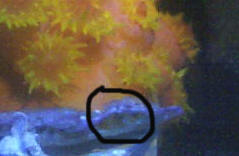
so, with time> The sun coral is
doing well and Tuesday I noticed a baby a little larger than a
pinhead, but it is in a gap in the shell that the colony is on.
<Also neat> I've attached a photo with a circle to show
where it is. As it grows will its shell get cracked?
<Mmm, yes> Or, as it grows will it conform to the
space. <A bit of dominance likely...> Its
tentacles are fully extended at night and are just outside that
small gap. The others have not yet extended their
tentacles. The photo was taken 2/1/07 as a record and as
you can see there is no baby in the picture, so this is something
that occurred in the last 2 weeks. <You're on top of it!>
Going back regularly to the LFS for
water refills, I'm sorry to say the other two sun corals that
were there are dying. They replaced mine by purchasing
another so they had 3 on display for sale. Over a 3 week
period one ended up having hair algae covering it, which when I
went back again was gone. The other two are
starving. Their color is fading, some areas are turning
black. It really bothers me every time I go there to see
them in that state. <Mmm... you know this
Dendrophylliid must have each polyp individually fed... usually
in/towards "lights out"... about Iodine/ide
treatments?> Back to the subject
of fish in a 10-gallon tank. Please don't
cringe. The reason I keep asking is because when I
search through forums I read things like "I have 2 Cinnamon
clowns in my 10 gallon for a year" <... not
suggested> or when asking the LFS I get answers that just
don't seem right. I was looking at a pygmy angel in
a tank at the LFS (just looking honest). The salesperson
said a Flameback Angel would be a better choice for my 10-gallon
tank. <Please don't> I questioned that I had
read the minimum recommended tank size should be 20-30
gallons. <I agree> The reply was that they need
that space to hide from other fish but would be fine in a 10-gallon
tank alone. <Mmm, no> How tempting. but personally I think
they need more swimming room. <Yes... and also for
psycho-emotional reasons> Anyway, I was thinking more in the
line of one or two tank raised neon gobies or one tank raised
Percula or Ocellaris clown. <Better> It wouldn't be
anything I would add now, but a few months down the road if I
decide to add fish that is. I am considering adding a
second cleaner shrimp (L. amboinensis). <I would not>
Would my current resident shrimp despise or approve his
new tank mate? <Too likely to be trouble... esp. during
molts> If I did decide to add a fish in the future would having
two shrimp in the tank with it be too much (for my tank
size)? It's funny (well not really) but the LFS had
me buy this book on nano-reefs when I first started setting
up. The template they have for a 10 gallon tank is 1
blackcap Gramma, 1 Rainford's Goby and 1 Brazilian Flameback
Angelfish, 2 peppermint shrimp, 1 assorted scallop (Lima sp), 1
Condylactis sp anemone. <Ridiculous> I won't list the
rest. Isn't that a bit much? Or am I the
one who really isn't understanding this? <Your understanding
is approaching perfection. Keep that curious, dubious to the point
of cynicism view/filter, and you'll do fine. BobF> |
|
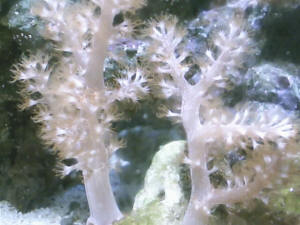 Are these
Capnella? Close
up of polyp expelling egg (center) <Yes, appear so to me.
RMF> Are these
Capnella? Close
up of polyp expelling egg (center) <Yes, appear so to me.
RMF>
|
|
|
Scleronephthya Hi Bob, <Omar> Very good site, has
helped me on numerous occasions in this contradictory hobby! My
question, I have a Scleronephthya in my aquarium that I have had for 4
months, it is upside down in a cave/overhang, near a powerhead
providing rotating flow. I feed it live phyto daily (mix of 3 species
of phyto) and Cyclop-eeze once a week, which it seems to
'enjoy', I have seen it consume the whole copepod on occasion.
I bought it as 1 coral, I now have 3 new baby ones so the cave is being
filled with the coral, the original has put out new branches and is
getting bigger, can I take frags of this coral?? <Yes... but I would
wait a few more months> Also after having such a positive experience
with this coral I should like to try my hand at a dendro, how much more
difficult are they, what must I do differently for dendro?
<About the same> Thank you for your continuing help and advice
Regards Omar <Please do monitor what you're doing, share with
others... in an article or two... with photographs. Bob Fenner>
|
|