 |
|
| Home | Marine Aquariums |
Freshwater Aquariums |
Planted Aquariums |
Brackish Systems |
Ponds,
lakes & fountains |
Turtles & Amphibians |
Aquatic Business |
Aquatic Science |
Ask the WWM Crew a Question |
| Please visit our Sponsors | ||||
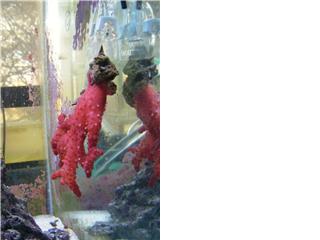
Chili coral (Nephthyigorgia) -- 07/26/07 Hi Guru's of the underwater world! <Hi Debbie, Mich here... but far from a guru.> I love your site and refer to it often. <Glad to hear!> Today I have a question about a chili coral that I acquired. <Typically does rather poorly in captivity.> The LFS guy said that it did NOT need to be hung upside down, but it did need moderate water flow and low light. I read one letter on WetWebMedia that said it SHOULD be upside down and another that suggested leaving it in the substrate. I would just like to clarify which is correct? <In the wild it is usually found hanging, but I have seen this coral commonly kept lying on the substrate in captivity... When in doubt, I try to mimic nature.> I currently have it in a shaded area, <Good.> but when it opens at night it completely fills the area and some of the branches touch the rock that surrounds the area that it is setting (not upside-down). Is that going to be a problem in the long run? <Perhaps... depends whether or not the rock is causing injury.> I didn't realize how big it is when it opens because it was during the day that I purchased it. <Perhaps if you researched ahead of time you would have been aware. I'm not saying this to be judgmental, I too have made this mistake. I am saying it is a good habit to be in and I would highly encourage you to do this. It is the only way to be a responsible reef keeper. This is not an easy coral to keep. I presume you are aware that it is aposymbiotic, meaning that it has no zooxanthellae, and therefore non-photosynthetic. This coral must be target fed, at night when the polyps are extended, but their nutritional needs are not well defined.> Thank you for all of your help <Welcome!> kudos to all of you that provide such a wonderful service! <Thank you for your kind words. Mich> Debbie Terry Lighting for soft corals, Nepthea, Kenya Tree 12/19/06 Hi, <Hi Dave, Mich with you tonight.> I just got a small Kenya Tree coral and a Green Nepthea. <OK> I have done some research on lighting requirements for these corals and read some conflicting information. <Yes, I am not surprised.> Some places say "intense light" some say "low light". My big problem is the "relative" aspect of high vs. low light. I have a 30g (36"x12"x16") tank with 3 x 39W T5 HO lights (1 act, 2 d10kK). From what I understand this should be more than adequate for the corals referenced. <I would tend to agree.> The question is at what level should these corals be. I can use two Xenias as reference if that will help. I have two different pulsing Xenia corals at different ends of the tank. They are both about half way up and seem to be very happy. Would the Nepthea and Kenya Tree need more light (higher in the tank) or less (lower in the tank) than the Xenia? <My guess as to the reason you're finding conflicting info is most likely related to the Nephthea. Some specie of Nephthea have zooxanthellae while others reportedly do not. Those lacking zooxanthellae require feedings to survive in captivity. Neon green tree coral, the most common Nephthea in the trade, typically has zooxanthellae and will often turn brown under intense reef lighting. To maintain the green, a lower may be better, but if it does turn brown, it is not indicative of poor health. Kenya Tree (Capnella), tend to grow in more turbid areas, getting a lot of nutritional support via dissolved material in the water. I think a lower placement would be better. Good water circulation is more important and supplementation with phytoplankton may help. While I'm at it, what about orange Rics or zoos? <Orange Ricordea are typically found in shallower waters, so they would most likely benefit from a higher placement in your tank. Zoanthids are highly dependant on zooxanthellae and will benefit from a higher placement also. Good luck!> Thanks, <You are welcome. -Mich> Dave Chili coral wont open... keep upside down with good flow! 1/11/05 I have a Chili coral in my 60G LR/LS reef tank that won't open up. <this most always occurs from lack of water flow: not enough or not enough of the right kind. Also... the animal must be kept upside down to survive naturally long term> I have had it since May of '04. Tank Parameters are: Ph: 8.2 Salinity 1.0225/1.023 Temp 77-78 Calcium 350-400ppm all others (nitrate, nitrite, ammonia) minimal/barely readable. Feed PhytoPlex and zooplankton 2x per week. <hoping for a fishless refugium too... this would be a great benefit for many reasons> The coral used to open up every night, until it ejected the spicules from one branch. As per advice from I don't remember where, I cut off that piece. This was in August. it didn't open after that for a few days only, but after that it was business as usual. Then I moved. I put all the livestock in buckets one day, then set up the tanks next day or the day after. When I took "chili guy" (as I call it) out of the bucket, it was open, and remained open for several days after being put in the tank again, I figure it was hungry, yes? Anyway, then it closed up and hasn't opened up again since. I moved Thanksgiving weekend. I have it in a cave, with a powerhead directed at it and attached to a rock with rubber bands so it hangs upside down in the cave. <do be careful about laminar flow like this... its unnatural for most corals and can be fatal in time. Turbulent flow would be better> (The rubber bands only touch the rock it came with so as not to split it) Is there anything I can do to save it? <manipulate the powerheads to create a better flow pattern around the coral. Do a keyword search here on our website for an article called "goodbye powerheads" for a better long term solution> even though it is just a red lump, it has yet to eject any more spicules, so I think I stopped that from spreading. My Fiancé's cousin gave us a book and said that there is something in the book that we could try-something about dipping chili guy in freshwater for 30 seconds, then in a strong iodine solution. <little or no purpose for doing this... no pathogen is indicated, and frankly... the brief dip would do little to help it if there were> I think this is supposed to shock it into "resetting" itself (like it's a computer?!) <ahhh... no.> If anyone knows that exact formula, that would be great, as I cannot find it in the book, "Reef Secrets." Thanks for all your help! <trust me, mate... its all about finding the right kind of flow. Do try feeding thawed frozen (or dry in slurry) Cyclop-eeze as a better zooplankton offering. Anthony> |
|

|
Features: |
|
| Featured Sponsors: |
 Free Chili, no thanks