|
FAQs about Pocilloporid Corals Health
Related Articles: Pocilloporids, SPS Corals,
Related FAQs: Pocilloporids 1, Pocilloporids 2, & FAQs on: Pocilloporid Identification, Pocilloporid Behavior, Pocilloporid Compatibility, Pocilloporid Selection, Pocilloporid Systems, Pocilloporid Feeding, Pocilloporid Reproduction/Propagation,
& Stony/True Coral,
Coral System Set-Up, Coral System Lighting, Stony Coral Identification, Stony Coral Selection, Coral Placement, Foods/Feeding/Nutrition, Disease/Health, Propagation, Growing Reef Corals, Stony Coral Behavior, SPS Identification, SPS Behavior, SPS
Compatibility, SPS Selection,
SPS Systems, SPS Feeding, SPS
Disease, SPS
Reproduction,
|
|
|
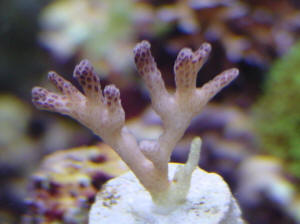
Bird's nest coral 5/23/14
Hello experts ! good afternoon...
<Howsit Kaustav?>
This is a mail asking for some advice which I am sure is very surprising for
you ! I have got a birds nest coral frag ca 3 weeks ago as shown in the
attached pic. It is sitting on the top half close to the surface of my 33
gallon tank. I have 2 x T5 (marine and actinic blue from Juwel) and a 24inch
magenta/blue LED Stunner from Ecoxotic. The water parameters are not fully
ideal but my LPSs and a lettuce SPS seem to do ok...
I can see the polyps of the bird's nest extend except on the top of the
branches that faces the light. Not sure if I see some bleaching (the frag is
cream coloured)
<Appears to be bleaching... stressed...>
but it appears very bright in the pic attached. The polyps seem to be coming
out uniformly on all other sides. This location also has good water movement
which is probably not direct on the coral.
Now is this somewhat normal behaviour and should I expect the frag to grow
from the under and sides ?
<Mmm; not normal/healthy behavior; no>
Or should I put it at a lower level for overall polyp extension (given the
choice I would rather not as I do not have a ledge that can take the plug)
? Thanks a ton for your help....br Kaustuv
<Well... could be simple allelopathy at play here; or ongoing effect of
being handled/moved... A lack of Fe, Mg out of balance with Ca,
alkalinity... Have you searched, read on WWM re Scleractinian, Pocilloporid
health, systems, feeding....? Bob Fenner>
|
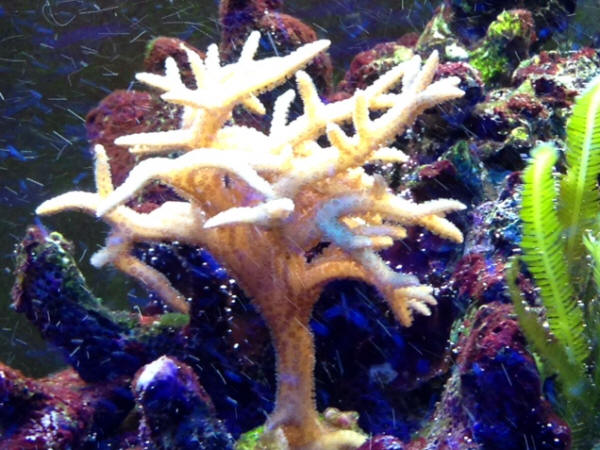 |
Birds Nest Coral,
env./hlth. 4/5/12
Hello,
<Joan>
I've searched your wonderful web site, but have been unable to find
the answer to this question. I have a 55 gal salt water aquarium that
has been running approximately a year. It's stocked only with a
variety of corals (soft, LPS, and a couple of SPS) and invertebrates. I
run a refugium with a protein skimmer 24/7 and T5 lighting. The tank
parameters have been nearly perfect. Temp 78, Sp gravity 1.026,
calcium 400,
<Mg?>
kH 9-10, and phosphates, ammonia, nitrates all zero. My tank and
live rock are covered with coralline algae and all species are thriving
except a small birds nest coral.
The birds nest coral sits in the top third of the tank.
<I'd move it down lower>
I believe I may have had it in too high of water flow when I
purchased it 3 months ago. It soon started to develop coralline algae
on a few of the tips and the base of the coral. I've moved the
coral into an area of less water flow. The top half of the coral looks
very healthy with many small new spikes beginning to grow and I can see
the small polyps covering the surface.
<Good>
However, the bottom half is thick coralline. Will this coralline algae
continue to grow and smother the top half of the coral?
<Can't say>
Should I leave it alone or should I frag the top half off and start
anew? The current base provides nice stability, so I don't want to
break it apart unless its necessary. I appreciate your help on this
question.
Thank you,
Joan Maten
<I'd just move the specimen lower... vertically... Bob
Fenner>
Pink Birds Nest with some sort of algae
growing on the tips 9/23/11
Hey Crew,
<John>
I have a pink birds nest coral that has been in my tank for 3 months
and showing stunning color and extremely fast growth during that time.
Three days ago I upgraded the powerhead that was operating in its
vicinity to a magnum 6, almost tripling flow in that area. The
powerhead is controlled by a wave maker, but the flow was pretty much
directed at the birds nest.
<Mmm... I would re-direct this... this genus, these species of stony
corals don't live in situations of such high water movement>
Yesterday, I noticed that the beautiful whitish/pinkish growth tips are
turning brown and there seems to be some brownish flesh blowing in the
current (only noticeable on close inspection). From the looks of it, it
was diatoms or some similar algae. At first I thought it was dead
polyps, but this doesn't appear to be the case. It only inflicted
the tips, and mostly on the side of the coral that's facing the
powerhead. I always thought more flow was better for sps corals,
<Mmm, no; not so w/ all families, species, colonies>
but could the increased intensity of flow somehow leave the coral
vulnerable to algae?
<Yes indeed>
This seems counter-intuitive....
Levels are NO4 <3>=0 , PO4=0,
<... need some/detectable nitrate and soluble phosphate>
ALK=9 dKH, Calcium=440, magnesium=1400
No other corals are touching or even near the birdsnest (only a
Stylophora frag and an Acro frag (ample spacing provided). No other
area of the tank appears to be inflicted with similar-looking algae.
It's kind of like a brown dusting on the tips, and it comes off
with a soft bristle tooth brush, which I've used for two days now.
I first noticed the algae the morning after adding the new powerhead.
Seems like quite a coincidence considering it was stable up to that
point.
Thanks in advance for your help, and sorry that I cannot provide a
picture.
I will try to upload one later this afternoon if it's
necessary.
Underneath the "algae" the coral appears to still be healthy.
Good color, polyps look like they're extended, but it's hard to
see the smaller ones near the tips.
John
<I wish you were out here w/ me in Fiji... Easy to show ecoclinal
variation by water movement, light availability, siltation extent and
more... Bob Fenner>
|
hermits eating Birdsnest 4/21/10
Hey there Crew!!!!!
<Sandra>
What would all of a sudden make hermit crabs infest and devour a
6 inch by 5 inch Pink Birdsnest?
<Hunger, awareness, perhaps a "weakened" state
sensed re the Seriatopora>
This Birdsnest has been in the same place for 2 years and was
doing awesome until 3 days ago. All of a sudden dozens of hermit
crabs started eating it. I took out all the hermits that were
eating it, any other hermits I could see at the time and did an
iodine dip on the coral and put it back in the tank. The next
morning it was infested with 15 hermit crabs again. I know
hermits are omnivorous and will sometimes eat corals.
<Oh yes>
This tank is 180 gallons, established for over 2 years. I test
for 14 different parameters and they are all within acceptable
range. The tank has probably 50 or more SPS corals in it and the
crabs aren't bothering anything but this Birdsnest. What
might the Birdsnest have acquired to all of a sudden make it a
magnet for hermits?
<Mmm, can't tell for sure, but "something"
changed re making it attractive as a food item>
No other corals or fish have been added to this tank in over 3
months.
I've done a microscopic analysis on the dip water to see if
anything came off of the coral and didn't find anything that
would point to the cause. There was very little detritus, no
algae spores, no worms, parasites or eggs that I
could detect. I've done analysis on problem corals before and
found detritus and algae to be a primary cause of what is
generally referred to as RTN with a secondary cause the bugs that
tend to populate in the detritus causing the loss of coral
tissue. I've never seen RTN without finding one or more of
the problems previously mentioned. I even did an RODI dip on a
branch and didn't find a single thing in the RODI water under
the microscope. I'm just perplexed. I've never seen herds
of hermits all of a sudden attack and kill a particular coral
like this. Any ideas on
what would cause them to do this? I'm attaching a picture of
my poor Birdsnest. I moved it to another tank without any SPS in
it until I can frag what I can of it and pray I can salvage a
branch or two.
<Good>
Any information you could give me would be appreciated so maybe I
can prevent this from happening to any of my other corals. I will
continue to remove all the hermits I find. You guys are
awesome!!!!
Thank you,
Sandra P.
<Other than my usual warning/admonition re the use of
"Hermits", I don't know what changed here. I salute
your promptness, actions in effort to save this colony. Bob
Fenner><<Mmm, might have been weakened by the GSP below
it...>>
|
  |
|
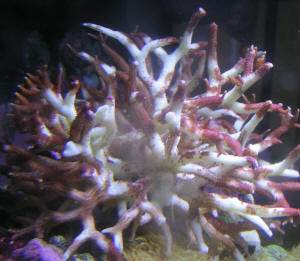
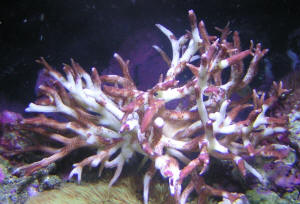
Pocillopora Question, not enough info -
10/8/2009
Hi Scott V/WWM Crew,
Hope you're well!!!
I have a question that's been bothering me for a while.
I've recently (2weeks ago) purchased what i believe to be a
Pocillopora verrucosa coral. I would have attached a picture, but
my photography skills are rubbish :-). Anyways, it was brownish
before and now its pinkish with white tips. Are the white tips a
sign of growth or trouble? There also seems to be some brown
matter on the tips, producing bubbles? Is this an algal problem?
I do have some brownish hair algae growing in areas of the tank.
I do like this specimen (and the little coral crab living in it!)
and would love to see it thrive.
All levels, PO4, NO3, Alk etc are normal/zero.
Your thoughts on this would be greatly appreciated!!!
Thanks,
Adriel
<Hey Adriel! Unfortunately, judging simply by description
might be questionable at best, or detrimental at worst. Please do
provide us a picture or two to look over, as well as the actual
numbers from your tank
testing. The brown matter on the tips producing bubbles does
sound like an algal problem to me, but again this is quite hard
to judge without an image to base upon. -JustinN>
Re: Pocillopora Question 10/9/09
Hi Justin N/ WWM Crew,
<Hello again!>
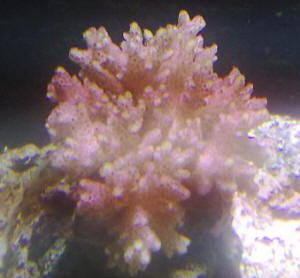
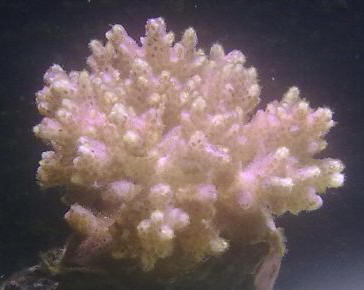
I've tried to get better pics as enclosed, but my camera
isn't with me and these were taken on my mobile phone.
<Understandable, thank you for the pics.>
Apologize for the trouble. I'm not sure if they're clear
enough for you to help.
Thanks,
Adriel
<At a glance, it does appear that there may be some algal
growth occurring on the specimen... Most SPS appreciate lively
flow, perhaps there's just not quite enough circulation in
the tank at this time? The pink coloration with white tips to me
would more likely indicate a sign of growth than a problem of
health -- mostly because the coloration has improved. I would
attempt to remove as much of the algae as possible from this
specimen, and look into increasing overall turnover rate within
your tank. Good luck!
-JustinN>
|
  |
Re: Pocillopora Health --
10/09/2009
Hi JustinN,
Just wanted to say Thanks!
<Glad to help!>
The coral is in the path of an EcoTech MP10, 10 inches away,
thought that it would be enough, but I think I'd better get it
a bit closer. This is my first time keeping SPS, thus a bit
concerned.
Thanks a ton!!!
Adriel
<The concerns are understood -- SPS keeping is a very different
world from LPS and Corallimorph keeping.. The EcoTech MP10 is a
quality product, but how big of a volume of water is it
circulating? Might be beneficial to add some ancillary movement
into the tank -- SPS very much appreciate the brisk
movement (though typically don't prefer the direct blasting
constantly.)
See here: http://wetwebmedia.com/spscorals.htm
http://wetwebmedia.com/pocilloporidae.htm and
http://wetwebmedia.com/pocilloporidae2.htm and the related links
above.
-JustinN> |
|
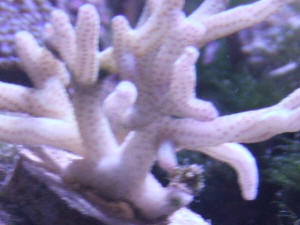
Coral question 01/12/09 Hi, I hope you can
tell me what is going on with this birdsnest frag I just got.
<It looks to be bleaching and dying.> I know it is hard to
see but there are 2 places where the coral appears to have a
brown maybe dark green area. <Looks like algae.> One is on
the bottom right tip that looks broken, the other is on the
nearest middle left branch. On the second one it starts on the
tip of a broken area but appears to go through the inside of the
coral & through it to a small branch on the opposite side. I
am not sure what it is but it seems to be traveling from some
injury, parasite, or algae to the inside of the coral. I am
wondering if I should throw it away? <Not yet... it's not
completely dead yet.> Remove the area? Treat it? <I would
just leave it alone for now. Check your water parameters, make
sure all are what/where they should be.> I got several other
frags at the same time but none of them show signs of this.
<Frags of what? Acroporids are very sensitive corals...
"Bird's Nest" especially.><<... this is a
Pocilloporid. RMF>> Don't want them in the display tank
until I get a handle on this. <Do check your parameters.>
Thanks Tina <Best,
Sara M.>
|
 |
|
Re: coral question... Frags... Seriatopora...
01/13/09 Sara M, thanks for the quick reply. I also got
2 very small Monti frags, 1 green thin branch birdsnest, <Yes,
and let me say, I'm sorry how in my last email I called this
an Acroporid... I was a little tired, I meant to say
"Pocilloporid" (which are what Birdsnest corals
are).> and 1 small blue Gomez. These all have good color, the
green thin branch has had polyps out non stop even in the bag
& the Gomez has opened at night. I got them last Tuesday. I
acclimated them over a 5 hour period & placed them low in the
tank as not to shock them. The one I wrote you about is supposed
to be a "rainbow" birdsnest. It has been this same
color since I first opened the box. My tank stats are: Ammo 0,
nitrites 0, nitrates 2.5, <Hmm... do try to get your nitrates
down to 0.> alk 2.8, ph 8.2, salinity 1.025, temp 78, calcium
420, phos 0. Tank is 90g with 250 W 14K metal halide light. 175
lbs live rock, 4" sand bed, Magnum 350 (for carbon), 4
Koralia pumps, & Aqua C remora protein skimmer. I was going
to wait a full week (today) to move them 1" higher, but now
wonder if maybe I should move the rainbow lower? <Possibly, or
higher... this depends on what kind of lighting it was under when
you bought it. Do you remember?> Also, except for the thin
green birdsnest (it has green polyps on 1/2 of the ceramic plug,
I am pretty sure all these were fragged very recently. I think I
have just discovered why ORA frags are worth the price !!! Is
there anything I can do to help this birdsnest recover? <For
now, if all your other corals/frags are doing well, I would just
be patient and wait for the coral to adapt. Sometimes frags just
don't make it for whatever reason. Other times they suffer a
lot after being fragged and moved, but recover eventually.
You'll probably just have to wait and see what happens with
this one.> Thanks again Tina <De nada, Sara M.>
Re: coral question, now NO3 01/13/09 Hi Sara
M <Hola Tina> Sorry, one last question. Last summer I was
having problems with nitrates. After a water change they would be
at 10 & then creep up to 20 after about a week & then I
would do a water change & they would go back to 10. I asked
WetWebMedia for help with this & it turned out my canister
filter was the cause, but in the reply I mentioned wanting sps
corals & that I knew I couldn't get them until my
nitrates were at 0, in the reply I was told that I was not
supposed to try for 0 more like 5. <There very few concrete
"rules" about these things. Truth is, you might be able
to keep some SPS corals with nitrates at or below 5, but there
might be others who just won't tolerate it. In either case,
even if some of your SPS frags might tolerate the nitrates, they
likely won't be as healthy as they would be with nitrates at
0.> In the display tank I have 2-4" clams & unless I
have been reading your site wrong I thought they needed some
nitrates for food, so I assumed when I was told to keep the
nitrates closer to 5 that the sps would use some nitrates for
food also. <The thing is that what you're measuring with
your test kit is "excess" nitrates. The nitrates that
the animals might be metabolizing won't stay in the water
column and so won't show up in tests. So you want your
measurable nitrates to be as close to 0 as possible since what
you're measuring is not any and all nitrates, but excess
nitrates. Does that make sense?> I have been using the display
tank water for the hospital tank thinking the sps would use the
nitrates. So if they don't like nitrates & the clams do
need some nitrates, then am I wrong in thinking the sps will
never mix with the clams, or is it just the birdsnest corals that
won't tolerate the nitrates? <Please see above. Your tank
will *always* have nitrates. What you don't want is excess
nitrates.> Confused again! lol <I hope this helps.>
thanks a bunch Tina <De nada, Sara M.>
|
Stylophora bleaching 1/2/08
Thank for all you guys do. Think how many aquatic lives you have saved!
<Thank you> I am an experienced reef-keeper with numerous
systems, at home and at the school where I teach. I am hoping you can
shed light on the common occurrence of single SPS coral bleaching in a
tank that has many other healthy inhabitants. In particular I am most
puzzled by the bleaching of a six year-old Stylophora in a well
established 140 gallon setup (including sump) that was recently moved
vertically in the tank (T5 lighting). This coral survived a temperature
perturbation (three years ago) that killed most other corals. The
Stylophora was recently moved to an area in the tank at the same
vertical height but with reduced flow. Is bleaching possibly influenced
so dramatically by flow rate? <Could be an influence> The
tank's water chemistry is "near perfect" and is one of
the healthiest systems I manage. Should I move the coral? <If badly
bleaching, yes, I would... If REALLY badly bleaching, I would frag,
discard the dead parts> He really is a beauty and I would love to
try and save the tissue that still has Zooxanthellae (about 10%).
<Agreed> The only other change to the system is that I recently
started feeding a frozen food called Emerald Entrée for my
poor tangs and other herbivores that are hungry in a tank that has no
visible algae at all. The frozen food is over six months old. <Mmm,
if kept frozen, this food should be fine...> Thanks you for your
time, Trevor <Do move this Stylophora... it may be that some other
biological cause is at play here... that won't be replicated in the
new setting. Oh, and do send along images in cases like this for
evaluation of conditions, possible useful input (e.g. re allelopathy).
Bob Fenner>
RTN Theorizing 12/24/08 Hi
Crew, <Hello Jason. Minh at your service.> It's been a long
time since I've had to write you with a problem. That's good!
Unfortunately, one of my beautiful and large Birdsnest just underwent
rapid tissue necrosis (RTN). It happened frighteningly fast; in less
than a day the grapefruit-sized coral went from healthy to half dead!
<I'm sorry to hear about your loss.> While my particular
cause is unknown (I suspect encroaching mushroom corals, but unsure), I
noticed something interesting. The death progressed along the branches
of the coral, not simultaneously. In fact, it spread from base to tips
(oldest to newest growth). I understand this is a common pattern. In an
attempt to save as much as possible, I broke off branches that were
still alive and discarded parts that were totally bleached. <Rapid
Tissue Necrosis (also known as apoptosis) is a cellular reaction in
corals initiated by various stresses such as bacterial infection,
temperature, UV radiation, allelopathy, etc. In this particular case,
the encroaching mushroom is a very capable culprit.> More
interesting: the frags that had some dead tissue still on them
proceeded to degrade in the same manner. Those that were comprised only
of living tissue appear OK. <If the tissue on a fragment is
undergoing apoptosis, it will continue to degrade until the fragment is
dead. I would suggest for you to quarantine any remaining healthy
fragments in a separate tank to isolate the cellular reaction. This
would allow for the highest survival rate of your Seriatopora guttatus
while reducing any risk of exposing other healthy SPS corals to this
condition.> This is very puzzling. If this condition was caused by a
biological or chemical agent attacking the coral flesh, one would
expect that it would either be localized (killing a small area) or all
over (killing patches at different places on the coral simultaneously).
The fact that the progression moves very predictably along the branches
implies, at least to me, that it is innate behavior of the organism,
not the result of attack. Perhaps it is an evolved survival mechanism;
a last-ditch effort to abandon the skeleton and grow anew somewhere
else on the reef more amenable to the coral's health. In our tanks,
of course, that would not happen thanks to lots of factors, but
possibly on the reef? This may explain why the frags without dead
patches survive: the signal to eject never reaches them, so they
persist. Do you know of any research in this regard? Thoughts?
<Although I have seen broadcast reproduction occur in a similar
manner, and some rare instances in captivity, the behavior of tissue
necrosis appearing in a predictable band pattern indicates a classic
case of apoptosis. This cellular reaction could be triggered by
allelopathic attack from a neighboring soft coral. Further reading on
this subject is available in an excellent article by Eric Borneman,
"The Coral Health and Disease Consortium: New Information on Coral
Disease." Link:
http://www.reefkeeping.com/issues/2002-03/eb/index.php.> Thanks!
Happy Holidays! Jason <Likewise to you and yours. Cheers,
Minh.>
Bleached Birdsnest 7/18/08 Hey crew, hope
you are all doing well on this fine Thursday. I have recently received
a small frag of Birdsnest Coral. This is my first attempt at keeping
sps and all the research I have done so far about keeping this type of
coral, leads me to test in my tank. The frag I received was pretty
bleached. I don't really know what bad looks like compared to
really bad, but green polyps come out of the frag. <Green? Likely
not so healthy... with opportunistic algae growing on these parts>
It still seems like its alive, is it? <Can't tell from
here...> The frag is about 1 and 1/2" tall and has a few little
branches off of it. The whole exoskeleton is white, until you look
close and see the green. The tank it came out of was a custom
24"x24"x24" with heavy duty MH lighting. I am currently
running T5 HO in a 60 (30"x18"x24"). Does this little
guy have a chance in my tank to live or get color back and grow? All my
perimeters are to spec. Thanks for your help. Spencer Hall <Read
here: http://wetwebmedia.com/poritidhlthfaqs.htm and the linked files
above... Bob Fenner>
Reef question hi I have a birds
nest hard coral and it is white at the roots << Is it white where
it is attached to the rocks, or the entire underside of the coral?
>> I'm wondering if it multiplying or dying and how can I
help it.<< I wouldn't think that it would go white and expose
the skeleton when it is multiplying, so I'll say it isn't
happy. >> and also I have a toad stool it is doing great but I
have a problem with it is slumped over how can help it is happy though
please send back thank you for your help << How much, and what
type of lighting do you have. Birds nest in general are very high light
corals and should be treated like other stony corals. >> <<
Adam Blundell >>
Pocillopora Problem? Hello, <Hi there!
Scott F. with you today!> I bought a frag identified as Pocillopora
damicornis from ETropicals about 2 months ago. It was advertised as a
green Pocillopora, but when I received it, it was a pale brown color.
<Not uncommon when newly received...> I placed the coral
approximately 5-6 inches from the water surface, and the tank receives
light from 2x 96 watt compact fluorescents (1x 10000K and 1x
ultra-actinic). The coral has its polyps extended for the majority of
the photoperiod (about 12 hours a day), and sometimes keeps its polyps
extended well after the lights go off. <Good!> I was initially
worried about this coral, since I would see my Peppermint shrimps
seemingly grazing on this particular coral. It almost looked like it
was trying to pick at the polyps. I have 4 (approx. 1 inch) Peppermint
shrimps in my tank. I read on your site that they may pick at corals,
but usually not to harm them (they're rather doing their job and
cleaning stuff off of the corals). <I'd get nervous seeing them
around my Pocillopora, too. They usually are harmless, but anything is
possible, you know?> I make sure that I put in some supplementary
food that they are able to eat, and they have been doing it much less.
<Excellent. I wish I could have said the same for my Sailfin Blenny,
which constantly snacked on my Pocillopora, until I relocated him!>
Since being placed in the tank (with moderate indirect, turbulent
current, and full exposure to the current light setup), the coral has
slowly changed color from the light brown to a fluorescent green.
<Awesome!> I figure this was a good sign, since it appears more
now of what it was initially described. However, I just noticed today
that there is a small patch (about 1 mm x 1mm)on of the branches of the
coral that seem to have lost tissue. It is not completely white, and
still has some brownish hue to it. The polyps in that small area is
either retracted or no longer there. I'm worried that this could be
the start of something bad. Water parameters are: S.G. of 1.023-1.024,
Ammonia and nitrite is 0 and nitrate is 5-10 ppm. Calcium is 360-400,
and pH varies from 8.3-8.6. The aquarium has a 3 inch live sand bed,
and the aquarium is a 55 gallon bowfront with 30 lbs of live rock. The
system is about a year and a half old. I have been having problems with
my lighting recently, with the PC bulbs visibly (honestly) losing
intensity in about 2 months time. Could the coral tissue be receding
because of inadequate lighting intensity? <I suppose it's
possible, but I doubt it, in this case. sounds to me more like a
localized response to some sort of trauma (maybe munching?). Keep a
close eye on this colony. Not to overly freak you out, but these corals
can decline quickly if they suffer significant tissue damage. It may
not be a bad idea to "frag" some of the coral if it begins to
decline, in the hope of salvaging some of the colony..> I also
recognize that this could be a bacterial infection (since I did not dip
this coral prior to placing it in the tank...I know...bad form).
<Well, you've learned!> I will be upgrading the lighting to 4
x 96 watt PCs in about a week coincidentally, since I plan on keeping
SPS's in the future. Sorry that this is exhaustingly long-winded.
Your advice is greatly appreciated. Thanks!!! Fil <Well, Fil, at
this point, I'd just keep observing the colony carefully, and if
the entire colony starts to decline, do consider salvaging what you
can. On a happier note- I can say that I have witnessed this phenomenon
in my own specimen, and it has always rebounded just fine! Good luck!
Regards, Scott F>
| Sick Stylophora 1/7/04 Hello, I've had my 29 gallon
running for about 5 months now. It was an upgrade from a 20 gal.
and I've added a lot of different corals lately. <hmmm...
easy on the "a lot"... this is a tiny tank for corals,
unless you plan to frag several times monthly. Even a few corals
will outgrow this tank in 1-3 years> I don't know much about
what goes good together or where they go, but I've been able to
use your site and Bornemann's book as reference for all my
inquiries. I recently bought a Stylophora which I got a deal on
since it wasn't looking very healthy. <please read and
understand why it is critical to quarantine all new livestock...
particularly ones that look sick. Else you will infect your tank
most likely in time with something unsavory> Almost a day or two
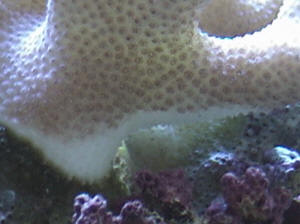
after it was placed in the tank I noticed around the base of the
living tissue that something had eaten away the material which was
previously there. <for starters, this coral needs very strong
turbulent (not linear as from a power head stream) water flow.
20-30X tank turnover minimum> I remember there being more of
this algal stuff where there is now a white band. I didn't
think much of it. A day or two later, I noticed it had increased
very slightly. I read up in the Borneman book about what is known
as White Band Disease. I'm afraid that maybe that is what I
have. <not likely... this coral just looks starved to death over
time> For a remedy, it suggested to try using Lugol's dip or
propagate a healthy chunk off of it. <the coral is too pale...
looks starved. I'd leave it be and focus on water flow, light
and feeding.> Are you familiar with this disease? <yes,
somewhat> Do you think this is what I have? <cant say from
pic quality... but again, its unlikely> What recommendations or
questions do you have? <do read the articles here at
wetwebmedia.com on QT and check out Steve Pros recent article on
the same at reefkeeping.com> Sincerely, Brant |
|
|
P. damicornis problems 4/24/08 Hi guys,
Your website has helped me with my own tank a countless number of times
but today I come to you with a question from on the job. We currently
have been having problems with a Pocillopora damicornis culture. The
tank has had lots of what looks like hair algae but a little washed out
for quite some time now. All nutrient (ammonia, nitrite, nitrate and
phosphorus) levels are negligent <Negligible I think you mean>
(probably since the algae are sucking up anything extra). <Yes...
often a/the case> This has made maintenance a pain but really
hasn't caused any major problems. About 10 days ago, however, we
had a few colonies (maybe about 5) quickly decline in the southeast
corner of the tank and just a few days ago in the northwest corner (so
complete opposite ends). The only reason I can think that it may be
localized in these two corners is because of more stagnant water
conditions. <And perhaps less useful light... do you have a PAR
meter?> I believe it may be brown jelly, would this infect P.
damicornis? <Mmm, could.> It starts at the base and can take over
half of a colony in a matter of hours. The tissue kind of goes up and
then sloughs off leaving just a skeleton behind. <I would remove to
elsewhere, any colonies showing such. Immediately> I wish I would
have taken pictures of this to show you and I will if it continues. If
this is indeed what it is, I know you have said to add Lugol's
solution or another source of iodine to the tank, but what I cant find
is how much. <Is a given concentration, not how much per se... You
need an iodine/ide test kit> Also, my boss would like to know ways
in which it can be introduced ( I have several theories but she would
like an unbiased opinion before I tell you more details of our culture
methods, my thoughts on the situation, ect'¦). <No such
word... is etc... a contraction/shortening of et cetera res... Latin
for "and other things"> A few other details: after the
first occurrence, I added activated carbon to the inline filter
(something I believe should be there all the time) but it is a very
small amount for the tank size (a couple cups for a main tank and sump
total volume of about 250 gallons). It was about 5 days or so (its all
logged so I can be exact down to the hour if need be) between
outbreaks. Also, when taking out the first few, tissue got blown around
the tank and touched other coral colonies which up to this point have
been unaffected. As always, thanks for any ideas/advise, Carl <Have
you seen the small, near the same color Nudibranch that causes trouble
with Montiporas? I encourage you, your boss to contact Morgan Lidster
of Inland Aquatics here. In Terre Haute, Indiana. Bob
Fenner>
Re: P. damicornis problems 5/1/08 Hi Bob
and crew, Thank you for your timely response, and I apologize for this
one being so delayed. Soon after I sent the past e-mail, I realized
that this was just a case of RTN. Any colony showing signs was removed
immediately. The most probable cause was extra stress. I cringe to say
that it was most likely due to the addition of several new
invertebrates (sponges, gorgonians, anemones, crabs, and snails) that
were not quarantined. <Erk!> I personally did not feel that any
of these should have gone into a culture tank, perhaps with the
exception of the snails and crabs, and certainly not before they were
quarantined. <We agree> I thought this was very poor practice for
a research facility. I spoke up about adding sponges that could
potentially release toxins and anemones that could substantially
increase the nutrient load, but my voice was not heard (I am
unfortunately very low on the totem pole). <The curse of a
government or other large bureaucratic job...> They were added for
filtration (personally I think they are putting more in than they are
taking out), and will not be used for any experimentation. RTN started
9 days after all the invertebrates were introduced. I have to ask, do
gorgonians tend to release any more allelochemicals than SPS corals
would? <Oh yes... some species can to a huge degree> The good
news is that there have been no more fatalities although I would not
say we are in the clear yet. Thanks for all the advice! Carl <Thank
you for this follow-up. BobF>
| Pocillipora struggle 12/19/07 Hi crew, I have
a 75g reef tank. My most recent addition is a Pocillopora frag.
When I got it from the store, it looked great. The polyps all had
really good extension, and it was nice and fuzzy. In about a week
it had turned to this. The polyps come out more when the lights go
off for the night, but not nearly as much as they did at the LFS.
http://s160.photobucket.com/albums/t171/NirvanaFan01234/12-18-07/?action=view¤t=DSC00032.jpg
<Okay> It was under metal halide lighting at the LFS. I have
440 watts of VHO lighting. I was told this would be enough
lighting. The frag is currently about 6" from the surface of
the water. All of my other corals are doing very well. The
Pocillopora is the only one that is showing signs of any distress.
Do you have any idea on what could be wrong? Is there any hope to
save it. <How long have you had this frag?> My current stats
are: Specific gravity - 1.025 ammonia, nitrite, nitrate - 0
magnesium - 1200ppm calcium - 400ppm alkalinity 8dkh <These are
all fine> My test kits are getting old, so I think I am going to
have the LFS test them to double check them. I have tried moving
the frag up, down, into low flow, into medium flow, and even into
high flow. Nothing seems to be working. Thank You in advance, Joe
<May just be adjusting... There is much, likely TOO much to
refer you to indirectly on WWM re Scleractinian health... but
perhaps perusing the FAQs files on the families will awaken
something to your consciousness... Otherwise... read here:
http://wetwebmedia.com/acclimcoralslight.htm and the linked files
above. Bob Fenner> |
|
|
Dying Green Birds Nest Coral...
poisoned 11/4/07 Hello, I'm getting a little desperate on my
new aquarium. I have a 50 gallon tank that's been setup for about 3
months now I rushed the process by buying about 10 pounds of live sand
from a well established refugium at a fish store near my house and
filled the tank about half way up with coralline algae covered live
rock (figured I'd take a few short cuts so I could stock it sooner)
I had a recent outbreak of Ick that I couldn't get under control
with fresh water dipping <This is not a sure cure...> and the
fish store down the street from me sold me a small blue bottle of ich
cure made by Aquatrol, Inc. I was told this was completely reef safe
<... no> which was very important to me since I have started
collecting coral frags I currently have a very small Zoanthid colony a
single Ricordea some star polyps and a green birds nest coral (this one
is my favorite it's about the size of a quarter) my tank currently
has 2 circulation pumps and a hang off the back protein skimmer I add
PurpleUp daily <Not a fan...> with top offs of Kalkwasser
I've started adding Seachem Reef Iodide to try to save my birds
nest but to no avail. After adding the ich cure to my tank every 24
hours for 3 days I had one Astrea snail die and my birds nest turned
completely white I thought it was completely gone but a few days later
the polyps re-opened as green as ever unfortunately about half of them
are now gone and only the top branches are still showing signs of
feeding. Water Parameters: PH 8.3 Ammonia 0 nitrite 0 nitrate 10 KH 9
Calcium 450 salinity 1.023. Is there anyway I can save my favorite
coral? my only fish include a fat green mandarin and a 3" copper
band butterfly My lighting is the T5 HO Nova Extreme 36" with the
2 10k's and the 2 460nm actinic's with 3 moon white lunar
lights (should I keep these on 24/7 <No...> I was told to but it
seems odd) any help would be greatly appreciated. Thank You, James
<Sorry to state James, but you've poisoned the system... and are
continuing to do so with the "Purple Up"... I would
"punt" and add a pad of PolyFilter... to remove most excess,
cut the use of the coralline booster... and hope. Bob
Fenner>
| Pink Bird's nest coral hlth. 4/11/07 Hi,
<Hello there> I have a question about my pink bird's nest
coral. I purchased it around mid-January and was told to keep it in
the bottom 1/3 of my 50gal reef (250W 10,000K HQI metal halide +
two 96W actinic PCs). <Is/was this similar to what this colony
had been exposed to?> I noticed some tissue recession on the
bottom of the coral where it was shaded and moved it up to a spot
about 2/3 up the aquarium, with fairly intense light. My thinking
was that it wasn't getting enough light near the base. It shows
new growth at the tips of the coral, <What they do> however
I've recently noticed that the tissue still appears to be
receding near the base of the coral. The decay stopped in some
spots that were more visible. I'm wondering if this is a slowly
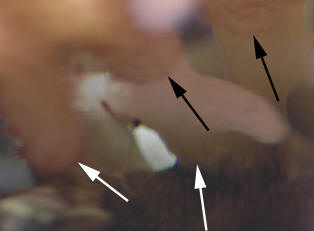
progressing necrosis. I've attached a picture that shows the
original boundaries of decay with white arrows and the new edges
with black arrows. I've heard of fragging some stony corals
above the sites of tissue necrosis in order to save them.
That's not really something I want to do to this piece though.
Is there something I should do to treat the coral? Thank you,
Edmund <Mmm... not much is my response... Does appear to be
mostly healthy... Do you feed this? Please read here: http://wetwebmedia.com/corlfdgfaqs.htm and the linked
files above... There may be other factors not mentioned here at
play (e.g. allelopathy, avitaminosis... an imbalance of
biomineral/s...). Bob Fenner> |
|
|
|
|

