|
FAQs about Pocilloporid Corals
Identification
Related Articles: Pocilloporids, SPS Corals,
Related FAQs: Pocilloporids 1, Pocilloporids 2, & FAQs on: Pocilloporid Behavior, Pocilloporid Compatibility, Pocilloporid Selection, Pocilloporid Systems, Pocilloporid Feeding, Pocilloporid Health, Pocilloporid Reproduction/Propagation,
& Stony/True Coral,
Coral System Set-Up, Coral System Lighting, Stony Coral Identification, Stony Coral Selection, Coral Placement, Foods/Feeding/Nutrition, Disease/Health, Propagation, Growing Reef Corals, Stony Coral Behavior, SPS Identification, SPS Behavior, SPS
Compatibility, SPS Selection,
SPS Systems, SPS Feeding, SPS
Disease, SPS Reproduction,
|
|
|
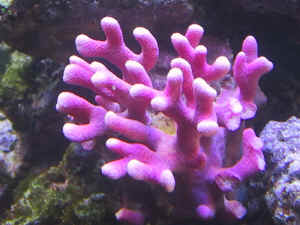
Re: Unusual Coral Frag Growth 6/23/10
Hi Bob,
<James>
Didn't really need an ID, just thought this frag was unusual
in it's formation. Generally the base and fingers grow
proportionately, at least it's been my experience. Thought I
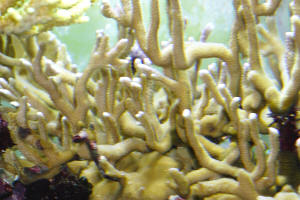
send a pic of the parent coral even though it isn't a very
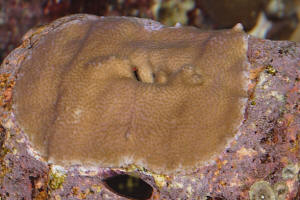
good pic. I've also attached the pic of the frag.
Got to get that 60mm macro.
James
<The first is a Seriatopora/Poritid... the second/frag... who
knows? B>
|
  |
|
Re: Unusual Coral Frag Growth 6/23/10
That is what's unusual, the second frag (flat appearing
coral) is a frag from the Seriatopora/Poritid.
James
<We'll see... I took this to be your meaning in both
emails. B>
|
|
Pocillopora or Stylophora 3/23/09
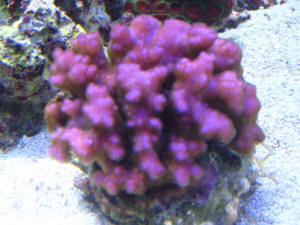
Please help me identify the sps in the attached picture. It was
sold to me as an aquacultured Stylophora, but the more I look at
it I think it is a Pocillopora.
<I agree>
Under my 10,000k halides w/actinic VHO it looks like pink tips
with greenish tinted polyps. What do you think? Thanks for your
help.
Ryan
<See here: http://wetwebmedia.com/pocilloporidae.htm
and part 2... Bob Fenner>
|
 |
Re: Pocillopora or Stylophora
3/23/09
Mr. Fenner, Thank you for the reply. It does look like the
Pocillopora in the link you sent me.
<Yes... Stylophoras are more branched, look more
"furry" in gross appearance>
Have you heard about or experienced problems with Pocillopora
reproducing and taking over a tank?
<No I have not... this genus, family is typically very slow
growing>
I read this somewhere and am now scared about having my new
purchase (pink Pocillopora) in my tank. Thank you.
<Welcome Ryan. BobF> |
| Coral ID Hi <cheers> I bought a sps
yesterday and the seller wasn't sure of the ID, so I thought I
will like the pros to verify what I thought. I have attached the
photo of the coral. I think it is a Stylophora pistillata.
Presently, the coral is sited 15cm of air, 10cm of water away from
PC lights. A direct PH current on a rotating output will sweep it
direct for a very short time every 1 second cycle. Other times when
the PH is not directed at it, the random current are bounced off a
glass located about 30cm from the coral. Thanks in advance Edwin
Lam <Edwin... although the image does not give a clear visage of
the polyp structure, this specimen does indeed look like the
Pocilloporid, Stylophora pistillata. It will need strong random
turbulent water flow and stable water quality as one would provide
for most any Scleractinians. They are believed to mature sexually
at a young age (just several years old) and may produce planulae
asexually if fed well. A fishless upstream refugium is highly
recommended here. Best regards, Anthony> |
|
|
Trying to ID something... Robert, First I wanted to extend my
thanks to your friend who stood in your place while you were on a
diving trip a few months ago, and I love his straight forward advice,
and he gave good advice on my zebra lion. <hmmm... that would have
been Steve, Jason or myself, Anthony. You are quite welcome at any
rate> I bought some live rock from Petswarehouse.com, Fiji rock in
specific which I ended up recurring, and last week I noticed something
that I think is a coral, but am not sure. The pics I have of it are too
blurry. What I have looks like either Pocillopora verrucosa or
Pocillopora damicornis cropping up, <P damicornis is very
common...what a pleasure for you if it is!> but I am not sure.
Whatever it is, it is encrusting, it has irregular shaped lobes or
polyps, a clear membrane over it, and quite aggressive in spreading. It
spreads over live rock where there is little on it as opposed to where
coralline has grown over old skeleton. <hmmm... the Pocilloporids
would not encrust very far without raising branches. Perhaps another
reef invertebrate it is> I have noticed various colonies of this
stuff in cream, one in a pinkish brown, and one I am not sure if it is
pink coralline or the same thing in pink. The largest of the colonies
is about half the size of my palm, and about 1/4 inch thick or better.
It has some pores like verrucosa but it also resembles damicornis with
the membrane that is over it, so I am not 100% certain. As of
thanksgiving or so, this large colony was not there, then all of the
sudden, BAM! I thought it was some man eating fungus from area 51 or
something; I had never seen anything like it. It does not move, it has
no shell, it is not a sponge for sure. It is not porous like a sponge,
and the smaller colonies have some sort of structure to it where you
can see through the membrane clear enough. The polyp structures or lobe
looking things are in no specific pattern, all variant in size, and
ranging from a few millimeters to 10-15 mm. How do I know for sure that
it is a coral, and if it is, how do I know what the likelihood is of it
being a Pocilloporid or not? I also have some other things that look
like another variety of a Pocilloporid. <do forward a picture when
you can... I suspect I will be able to ID it to your satisfaction.
Kindly, Anthony Calfo> Joe Szweda
|
|

