|
|
| Home | Marine Aquariums |
Freshwater Aquariums |
Planted Aquariums |
Brackish Systems |
Ponds,
lakes & fountains |
Turtles & Amphibians |
Aquatic Business |
Aquatic Science |
Ask the WWM Crew a Question |
| Please visit our Sponsors | ||||
Pocillopora Question, not enough info -
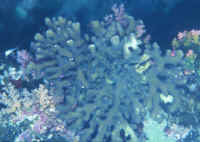
10/8/2009 P. damicornis problems 4/24/08 Hi guys, Your website has helped me with my own tank a countless number of times but today I come to you with a question from on the job. We currently have been having problems with a Pocillopora damicornis culture. The tank has had lots of what looks like hair algae but a little washed out for quite some time now. All nutrient (ammonia, nitrite, nitrate and phosphorus) levels are negligent <Negligible I think you mean> (probably since the algae are sucking up anything extra). <Yes... often a/the case> This has made maintenance a pain but really hasn't caused any major problems. About 10 days ago, however, we had a few colonies (maybe about 5) quickly decline in the southeast corner of the tank and just a few days ago in the northwest corner (so complete opposite ends). The only reason I can think that it may be localized in these two corners is because of more stagnant water conditions. <And perhaps less useful light... do you have a PAR meter?> I believe it may be brown jelly, would this infect P. damicornis? <Mmm, could.> It starts at the base and can take over half of a colony in a matter of hours. The tissue kind of goes up and then sloughs off leaving just a skeleton behind. <I would remove to elsewhere, any colonies showing such. Immediately> I wish I would have taken pictures of this to show you and I will if it continues. If this is indeed what it is, I know you have said to add Lugol's solution or another source of iodine to the tank, but what I cant find is how much. <Is a given concentration, not how much per se... You need an iodine/ide test kit> Also, my boss would like to know ways in which it can be introduced ( I have several theories but she would like an unbiased opinion before I tell you more details of our culture methods, my thoughts on the situation, ect…). <No such word... is etc... a contraction/shortening of et cetera res... Latin for "and other things"> A few other details: after the first occurrence, I added activated carbon to the inline filter (something I believe should be there all the time) but it is a very small amount for the tank size (a couple cups for a main tank and sump total volume of about 250 gallons). It was about 5 days or so (its all logged so I can be exact down to the hour if need be) between outbreaks. Also, when taking out the first few, tissue got blown around the tank and touched other coral colonies which up to this point have been unaffected. As always, thanks for any ideas/advise, Carl <Have you seen the small, near the same color Nudibranch that causes trouble with Montiporas? I encourage you, your boss to contact Morgan Lidster of Inland Aquatics here. In Terre Haute, Indiana. Bob Fenner> Re: P. damicornis problems 5/1/08 Hi Bob and crew, Thank you for your timely response, and I apologize for this one being so delayed. Soon after I sent the past e-mail, I realized that this was just a case of RTN. Any colony showing signs was removed immediately. The most probable cause was extra stress. I cringe to say that it was most likely due to the addition of several new invertebrates (sponges, gorgonians, anemones, crabs, and snails) that were not quarantined. <Erk!> I personally did not feel that any of these should have gone into a culture tank, perhaps with the exception of the snails and crabs, and certainly not before they were quarantined. <We agree> I thought this was very poor practice for a research facility. I spoke up about adding sponges that could potentially release toxins and anemones that could substantially increase the nutrient load, but my voice was not heard (I am unfortunately very low on the totem pole). <The curse of a government or other large bureaucratic job...> They were added for filtration (personally I think they are putting more in than they are taking out), and will not be used for any experimentation. RTN started 9 days after all the invertebrates were introduced. I have to ask, do gorgonians tend to release any more allelochemicals than SPS corals would? <Oh yes... some species can to a huge degree> The good news is that there have been no more fatalities although I would not say we are in the clear yet. Thanks for all the advice! Carl <Thank you for this follow-up. BobF>
Dying Green Birds Nest Coral... poisoned 11/4/07 Hello, I'm getting a little desperate on my new aquarium. I have a 50 gallon tank that's been setup for about 3 months now I rushed the process by buying about 10 pounds of live sand from a well established refugium at a fish store near my house and filled the tank about half way up with coralline algae covered live rock (figured I'd take a few short cuts so I could stock it sooner) I had a recent outbreak of Ick that I couldn't get under control with fresh water dipping <This is not a sure cure...> and the fish store down the street from me sold me a small blue bottle of ich cure made by Aquatrol, Inc. I was told this was completely reef safe <... no> which was very important to me since I have started collecting coral frags I currently have a very small Zoanthid colony a single Ricordea some star polyps and a green birds nest coral (this one is my favorite it's about the size of a quarter) my tank currently has 2 circulation pumps and a hang off the back protein skimmer I add PurpleUp daily <Not a fan...> with top offs of Kalkwasser I've started adding Seachem Reef Iodide to try to save my birds nest but to no avail. After adding the ich cure to my tank every 24 hours for 3 days I had one Astrea snail die and my birds nest turned completely white I thought it was completely gone but a few days later the polyps re-opened as green as ever unfortunately about half of them are now gone and only the top branches are still showing signs of feeding. Water Parameters: PH 8.3 Ammonia 0 nitrite 0 nitrate 10 KH 9 Calcium 450 salinity 1.023. Is there anyway I can save my favorite coral? my only fish include a fat green mandarin and a 3" copper band butterfly My lighting is the T5 HO Nova Extreme 36" with the 2 10k's and the 2 460nm actinic's with 3 moon white lunar lights (should I keep these on 24/7 <No...> I was told to but it seems odd) any help would be greatly appreciated. Thank You, James <Sorry to state James, but you've poisoned the system... and are continuing to do so with the "Purple Up"... I would "punt" and add a pad of PolyFilter... to remove most excess, cut the use of the coralline booster... and hope. Bob Fenner>
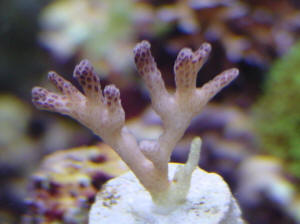
Bird's Nest Coral, Caliendrum becomes
white 6/17/06 Hello, first of all I want You to Know I
am Italian so my English is quite (not to say very) poor. excuse me for
next errors. Thanks. <I wish all "native" English speakers
were as literate and gracious. Thank you> As write in the title in
my tank there is a little fragment of Seriatopora caliendrum (dimension
like an apricot to give an idea) that is becoming with from the center
to the tips, even if it continues its tips growth. Tips are brown (the
very top are white because of the growth) becoming brighter and
brighter to the centre of the branches until the white of the skeleton
is visible. Tissue seems to be in place (even if you can see through)
and so the polyps do but all zooxanthellae had gone. <Yes... this
appearance is typical of wild, healthy specimens...> Tank set up: 85
litres full of rock coming from my old big tank, 1/2 inc aragonite
sugar from old tank, 150W HQI 10000K, 4000 litres per hour
global movement and Tunze 3110 skimmer. Temp regulate by heater and fan
with digital controller 27-28 Celsius. Refill with CaOH. water change
weekly 10%. I have an upstream refugium of about 40 litre. DSB,
Chaetomorpha growing quite fast and Xenia inside. Light if it's
interesting 2x24W 3100K + 1X24W Blue. No fish in tank, only 2 Lysmata
amboinensis 2 hermit crab, many snails. Only a Synchiropus ocellatus in
refugium (I take it to save it from another horror tank) long a little
more than 1 inc. What do You think about this disease ? Have You ever
eared about something like that ? Thank You for your answer. Marco
Nanni Italy <I don't think you have a problem here Marco. Take a
look on the Net re this species appearance in the wild. What you
describe is a healthy colony. Mine here: http://www.wetwebmedia.com/pocilloporidae.htm If
anything, I might increase your weekly dosage of Iodine/Lugol's
with your water changes. Bob Fenner>
Seriatopora caliendrum Hi Bob, <James, today> Do you have any ideas where I may be able to find a Seriatopora caliendrum colony or frag? Any help would be greatly appreciated. Thanks. Brian <Brian, I found a couple places for frags. Keep in mind these are difficult corals to keep. http://www.frags.org/keywordsearch.php?keyword=seriatopora+caliendrum&searchmethod=all James (Salty Dog)>
Coral Aggression: Galaxea 1/7/04 Brant here again, <cheers> I really appreciate having such an informative site. I wanted to mention in reference to my last e-mail about white band that I also got a Galaxea at the same time. I placed it on the top of a rock in the center of the aquarium with some distance between corals. <grumble, grumble... would rather have heard it was placed properly in a QT tank first for 4+ weeks. We might not be having this exchange if so <G>> The Stylophora is only 3-4 inches away and is somewhat 'downstream' from the Galaxea. <Yikes! The Stylo is soon to be Galaxy coral food> I've read a lot about sweeper tentacles <eventually 10" long from Galaxea... they are one of the worst> and was wondering if this had anything to do with my Stylophora problem. <very easily so> My salt level is low also, at about 1.019. <do get this up to 1.023-1.025 for corals> Besides the Stylophora problem, I was wondering if I could/should place my Galaxea directly on the floor of the tank at the farthest distance from everything else? <perhaps... they are one of the most aggressive corals in the trade> Your help is greatly appreciated. Sincerely, Chris Brant <best of luck, Anthony> Reef question hi I have a birds nest hard coral and it is white at the roots << Is it white where it is attached to the rocks, or the entire underside of the coral? >> I'm wondering if it multiplying or dying and how can I help it.<< I wouldn't think that it would go white and expose the skeleton when it is multiplying, so I'll say it isn't happy. >> and also I have a toad stool it is doing great but I have a problem with it is slumped over how can help it is happy though please send back thank you for your help << How much, and what type of lighting do you have. Birds nest in general are very high light corals and should be treated like other stony corals. >> << Adam Blundell >> Pocillopora Problem? Hello, <Hi there! Scott F. with you today!> I bought a frag identified as Pocillopora damicornis from ETropicals about 2 months ago. It was advertised as a green Pocillopora, but when I received it, it was a pale brown color. <Not uncommon when newly received...> I placed the coral approximately 5-6 inches from the water surface, and the tank receives light from 2x 96 watt compact fluorescents (1x 10000K and 1x ultra-actinic). The coral has its polyps extended for the majority of the photoperiod (about 12 hours a day), and sometimes keeps its polyps extended well after the lights go off. <Good!> I was initially worried about this coral, since I would see my Peppermint shrimps seemingly grazing on this particular coral. It almost looked like it was trying to pick at the polyps. I have 4 (approx. 1 inch) Peppermint shrimps in my tank. I read on your site that they may pick at corals, but usually not to harm them (they're rather doing their job and cleaning stuff off of the corals). <I'd get nervous seeing them around my Pocillopora, too. They usually are harmless, but anything is possible, you know?> I make sure that I put in some supplementary food that they are able to eat, and they have been doing it much less. <Excellent. I wish I could have said the same for my Sailfin Blenny, which constantly snacked on my Pocillopora, until I relocated him!> Since being placed in the tank (with moderate indirect, turbulent current, and full exposure to the current light setup), the coral has slowly changed color from the light brown to a fluorescent green. <Awesome!> I figure this was a good sign, since it appears more now of what it was initially described. However, I just noticed today that there is a small patch (about 1 mm x 1mm)on of the branches of the coral that seem to have lost tissue. It is not completely white, and still has some brownish hue to it. The polyps in that small area is either retracted or no longer there. I'm worried that this could be the start of something bad. Water parameters are: S.G. of 1.023-1.024, Ammonia and nitrite is 0 and nitrate is 5-10 ppm. Calcium is 360-400, and pH varies from 8.3-8.6. The aquarium has a 3 inch live sand bed, and the aquarium is a 55 gallon bowfront with 30 lbs of live rock. The system is about a year and a half old. I have been having problems with my lighting recently, with the PC bulbs visibly (honestly) losing intensity in about 2 months time. Could the coral tissue be receding because of inadequate lighting intensity? <I suppose it's possible, but I doubt it, in this case. sounds to me more like a localized response to some sort of trauma (maybe munching?). Keep a close eye on this colony. Not to overly freak you out, but these corals can decline quickly if they suffer significant tissue damage. It may not be a bad idea to "frag" some of the coral if it begins to decline, in the hope of salvaging some of the colony..> I also recognize that this could be a bacterial infection (since I did not dip this coral prior to placing it in the tank...I know...bad form). <Well, you've learned!> I will be upgrading the lighting to 4 x 96 watt PCs in about a week coincidentally, since I plan on keeping SPS's in the future. Sorry that this is exhaustingly long-winded. Your advice is greatly appreciated. Thanks!!! Fil <Well, Fil, at this point, I'd just keep observing the colony carefully, and if the entire colony starts to decline, do consider salvaging what you can. On a happier note- I can say that I have witnessed this phenomenon in my own specimen, and it has always rebounded just fine! Good luck! Regards, Scott F>
Trying to ID something... Robert, First I wanted to extend my thanks to your friend who stood in your place while you were on a diving trip a few months ago, and I love his straight forward advice, and he gave good advice on my zebra lion. <hmmm... that would have been Steve, Jason or myself, Anthony. You are quite welcome at any rate> I bought some live rock from Petswarehouse.com, Fiji rock in specific which I ended up recurring, and last week I noticed something that I think is a coral, but am not sure. The pics I have of it are too blurry. What I have looks like either Pocillopora verrucosa or Pocillopora damicornis cropping up, <P damicornis is very common...what a pleasure for you if it is!> but I am not sure. Whatever it is, it is encrusting, it has irregular shaped lobes or polyps, a clear membrane over it, and quite aggressive in spreading. It spreads over live rock where there is little on it as opposed to where coralline has grown over old skeleton. <hmmm... the Pocilloporids would not encrust very far without raising branches. Perhaps another reef invertebrate it is> I have noticed various colonies of this stuff in cream, one in a pinkish brown, and one I am not sure if it is pink coralline or the same thing in pink. The largest of the colonies is about half the size of my palm, and about 1/4 inch thick or better. It has some pores like verrucosa but it also resembles damicornis with the membrane that is over it, so I am not 100% certain. As of thanksgiving or so, this large colony was not there, then all of the sudden, BAM! I thought it was some man eating fungus from area 51 or something; I had never seen anything like it. It does not move, it has no shell, it is not a sponge for sure. It is not porous like a sponge, and the smaller colonies have some sort of structure to it where you can see through the membrane clear enough. The polyp structures or lobe looking things are in no specific pattern, all variant in size, and ranging from a few millimeters to 10-15 mm. How do I know for sure that it is a coral, and if it is, how do I know what the likelihood is of it being a Pocilloporid or not? I also have some other things that look like another variety of a Pocilloporid. <do forward a picture when you can... I suspect I will be able to ID it to your satisfaction. Kindly, Anthony Calfo> |
|

|
Features: |
|
| Featured Sponsors: |