|
|
| Home | Marine Aquariums |
Freshwater Aquariums |
Planted Aquariums |
Brackish Systems |
Ponds,
lakes & fountains |
Turtles & Amphibians |
Aquatic Business |
Aquatic Science |
Ask the WWM Crew a Question |
| Please visit our Sponsors | ||||
Dogface Puffer, teeth, fdg. cockles
2/22/11
Help!!! My puffers teeth fell off...
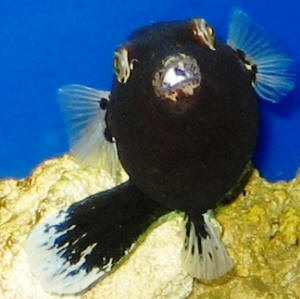
11/9/09 The Tooth Fairy visited my Black Dogface Puffer 10/24/08 My happy and very healthy, Black Dogface decided to shed one of his four fused teeth yesterday; upper row, left side. <Mmm> Actually, it is a "break" and not a "shedding". I can see where the break occurred within his mouth if I get a good viewing angle. There is a jagged edge to see if I can look far into his mouth. It is difficult to see. He has lost a lot of tooth! The remaining three teeth (or bones), appear to be in good condition and length. Fortunately, I don't believe he can pierce his own skin by biting it...I hope! My puffer, "Blackjack", has been with me for almost five years now. He has never had physical problems except for a rare case of ich last year. His appetite is what you would expect for a Dogface with a diet consisting of Frozen Formula I and II, krill, plankton, silversides, shell fish. I never had to consider filing his (or her!) teeth down because of excessive length, he has always done a fabulous job maintaining them by nibbling on the food, substrate and the rocks throughout the years. So, in a nutshell, what do you think? Do I need to do anything? Do I need to remove him from the show tank or add a broad-spectrum antibiotic? <Mmm, no need to "do" anything... very likely the tooth will regenerate in time... months, perhaps a year or more> His behavior appears to be normal and so are his eating habits. I do not see any signs of infection. The remaining tank mates are unremarkable and have been coexisting for over a year; no problems at all. Water parameters are normal. Ironically, he looks perfect for the Halloween season only having 75% of his teeth! <Heeee!> Any insight would be greatly appreciated. Thanks! PD 135GAL FOWLR - Black Dogface (12"), Harlequin Tusk (10"), Lion (6"), Sweetlips (6"), Rainbow Wrasse (10"), Tassel Filefish (6"); 40GAL WET/DRY. RODI-H2O. <Mmm, just time going by, your good care here. Bob Fenner>
Trimming Puffer Teeth 6/7/07 Hi, <Hi Kim, Pufferpunk here> You guys have provided me with an enormous amount of help in the past and I thought I would pass along some information about a fairly obscure topic that is very difficult to find an answer to on the web. <OK, thanks!> A while back, I had a problem with my puffer teeth growing too long. I found information on your site for trimming large puffers teeth by using a Dremel. <Kelly Jedlicki's article.> This was not going to work for my small puffers as I was afraid I would take their whole head off with such a large tool! <Hmmm... I gather you didn't find the one I wrote? http://www.wetwebmedia.com/FWSubWebIndex/smpufferdentistry.htm> I finally found a safe way (by combining info from your site and a few other sites) to trim their teeth and just wanted to pass the info along as I have run into quite a few people who did not know what to do with their growing puffer teeth and even some who had their puffer die because they were no longer able to open their mouth to eat. I have done this 5 or 6 times with complete success. I have done it on both my figure 8 and my green spotted puffer. I purchased Finquel from Doctors Foster and Smith's website and I use a 1/4 teaspoon of the Finquel and 1/4 teaspoon of baking soda (to stabilize the ph, this is a crucial step) in a gallon of their own aquarium water. I mix it well with a plastic spoon and then add an air stone. I then add the puffer and in about 10 minutes or so (actually about 13 minutes for my figure 8 and 8 minutes for my GSP--it's funny how their tolerance varies just like people). They are just about out cold and then I wrap them in a hand towel soaked in aquarium water and trim their teeth with a pair of cuticle scissor (the fancy kind that retracts when you release the handle.) Be very careful not to cut their skin (I never have but always fear that I will.) I then place them in a gallon of regular tank water that I have set aside previously. After letting them return to normal, (don't freak out, they will act dead and then jumpy when coming to,) I release them back into the tank with a set of shorter teeth! Hope this helps some puffer lovers. <Thanks for the suggestion of using Finquel. This is the same is the same tranquilizer that Kelly has been using for 10 years on larger puffers, mentioned in the article you read. What I didn't know was that this is offered by Drs. Foster & Smith. As far as I know, she was getting it from her vet. I will post the availability of Finquel on my pufferforum & this letter will be posted in our FAQs, so I hope more folks will be aware of it's availability. ~PP> Blind puffer -- 04/13/07 My black puffer seems to be blind although he seems to be perfectly healthy. It started after a stressful event when I had to trim his teeth. He stressed out and got kinda sick looking so I put him in my hospital tank. <Did you anaesthetize him properly? Read the two WWM articles on trimming puffer teeth, if you have not yet. Did you accidentally touch his eyes or have you used to much force while trimming the teeth?> He looks great now, but isn't eating on his own. If I hand feed him and put it in his mouth he eats very enthusiastically. <Carry on feeding him that way. Provide a varied diet enriched with vitamins and hope the best.> I think he just can't see the food. His eyes look perfect and he moves them around. You'd never guess there was anything wrong with this fish. Ever heard of this kind of thing? <All blind puffers I have seen had cloudy or wounded eyes.> Do you think it might cure itself? <No, if he is really blind. I hope I am wrong.> Thanks for your help. <You are welcome. Good luck. Marco.> Greg. Puffer Dentistry 1/8/07 Hello Crew, <Hi Lisa, Pufferpunk here> This is my first time writing into my FAVORITE (I am yelling the word favorite!) site on the web! Your information is so complete that it is daunting. You guys are amazing! <Thanks bunches!> I just read the instructions on Puffer Dentistry. I am simultaneously fascinated and frightened since I just got my first puffer (Stars and Stripes) a week ago. He is about 4 inches (including tail). He is eating okay although he does do a bit of spitting out of some frozen food. <Be sure to defrost 1st. Yes, puffers are certainly messy eaters! Mine squirts food out of his gills! This is why it's so important to give extra room for dilution of the pollution they cause (a nice big tank, minimum 180g for a 19" adult) & extra filtration/water changes.> He seems to enjoy some commercial (human) shrimp (washed off as advised). He also had no problem devouring an aggressive banded-coral shrimp and ailing arrowhead crab the day he arrived. That being said I have some additional questions with regard to the dental procedure and will list them individually to save time and space (hope that is okay). 1) Since my new puffer, "Blinky", is in his first home, am I correct in assuming that his little teeth have never been trimmed? <Probably not. He's been eating crunchy foods in the wild.> 2) If the answer to this question is "yes", considering his size of 4-ish inches can I further assume that it is time for or even overdue for a trim? <Not unless his teeth are overgrown now. Puffers actually should never need their teeth trimmed, if fed a proper crunchy diet.> 3) Is there any way to tell (by looking) how long is too long for Puffer teeth? <They will hang over or stick out. Sometimes, the puffer can't close or open it's mouth.> 4) If I need to do a trim, how long should I wait (since he has only been with me a week and still may be suffering from some stress due the acclimating process). <If it's eating without any problems I wouldn't trim at all. If there are problems with severely overgrown teeth & the puffer is starving, they should be trimmed immediately.> 5) Last but not least, is that 3 cups of tank water in each one quart container for the procedure? I assume the answer is "yes", but did not want to do anything without confirmation since we all know the implications of the word "assume"! <I didn't write the large puffer dentistry article, I wrote the small puffer dentistry article but that sounds about right. Again, I doubt your puffer's teeth need or ever should need trimming, if fed properly. See: http://www.thepufferforum.com/forum/library.php?p=53 > One last (off the subject of dentistry) question. My Puffer has not yet eaten either of my cleaner (skunk) shrimp, although he spends an awful lot of time "hanging out" with them. He will swim over to them, point his nose and eye-ball them. That's when I start to think, "Oh no, this is it!" and then the puffer will turn his back on them, continuing to hover over the shrimp while they gently caress his belly with their antenna. The other afternoon one of the shrimp bravely strolled across the tank and I later found the two of them sharing an afternoon nap (the shrimp openly clinging to a rock and the puffer laying on the gravel three inches away with his back to the shrimp and his tail tucked around the side of his body). They looked so cute together; am I foolish to hope that this is a developing relationship? Or will these shrimp eventually become Blinky's afternoon snack? <Whilst diving, I'm always amazed as I watch these shrimp dare dive into the mouths of some of the most ferocious beasts of the sea. The fish must know the shrimp are there to help & they don't get eaten.> Thanks so much for your help with my questions and your great website. <Go visit www.thepufferforum.com, for more puffertalk! ~PP> Your biggest fan, Lisa Crugnola Arothron hispidus Teeth 8/7/05 Hi Just a quick question I would appreciate your help with. My tank had a large amount of brown diatom growth in it, I had quite a lot of silicates coming through my RO filter which I have removed with Rowaphos, now within 1 month it has virtually all gone ... except for what looks like diatom growth on my puffers well worn teeth!! I have tried to remove it with a toothbrush but to no avail!! <Heeee! I'll bet the oral dentifrice companies would like to sponsor a session...> Is this likely to be a problem for him or is it harmless? Thank you Dave Squire (England) <No problem Dave... Maybe try some shellfish (cockles, mussels, shrimp) to help with the grinding/whitening process. Cheers, Bob Fenner> Mappa puffer Hey Bob, Rob from PA here, Do you have some advice on how to file a Mappa Puffers choppers down? Can be held gingerly in a very wet towel, mainly underwater, moving a flat file in and out flat over the beak-like teeth> Also my buddy with the puffer asks do you know how to de-worm the puffer? <A few ways... the best is just to sneak some garlic pieces into its favorite foods> I didn't know fish could get worms. Last question for me this time, do you have any knowledge about the use of solar energy to help with the sky high electric bills my tank is making, especially because I just ordered a new 200 gallon, to expand my reef into ... hahahahahaha what a hobby !!!!!! Thanks again Rob Huss <All forms of energy are inter-transmissible... that is, they (heat, light, motion...) can be converted to other formats... like electron flow (electricity)... Look on the net and contact your utility company about present technology, subsidies for solar. Bob Fenner> Puffer teeth Hello Mr. Fenner. Well....seems my green puffer's teeth have grown too long. He can still eat, and I'm feeding him snails regularly, but they don't seem to stop the growth. I've looked through your website and can't find an actual description for grinding down your puffers teeth (I apologize if I somehow missed it). How can I file down my puffers teeth. <I assume that you browsed the FAQ's on this page: http://www.wetwebmedia.com/diodontidfaqs.htm... beyond that it is about as simple as it sounds. A rotary tool (Dremel tm, or the like), a gently handled fish wrapped in a towel wet with aquarium water, a helper or IV drip raining saltwater in the gills for the short time that it takes (be sure not to stress the puffer when caught for the procedure). I'll make sure Bob gets this message with a request for a possible referral to published info(?) from the puffer queen (Kelly J). Kindly, Anthony Calfo> Thank you, Mark Keusenkothen Porcupine Puffer Hello. I found your wonderful website while searching for an answer to my porcupine puffer dilemma and thought I might e-mail you to ask your advice... <Okay> We have had our porcupine puffer for about 2 ½ -3 years. In this time, he's been happy and (presumably) healthy, eating vigorously (but we try not to overfeed him). <Ah, good> He's in the tank with a yellow tang, coral beauty and algae blenny - our tank also has live rock and a good amount of well-established corals. Water quality is consistently fine. So. Here's the problem. Four days ago, I was going to feed puff (freeze-dried krill, soaked to rehydrate) & he seemed to have his usual interest in the food, struck at the krill, but couldn't seem to eat it. So then I tried a krill soaked with a little brine shrimp & he wouldn't eat... then I tried a little piece of frozen mussel with no luck. Today we tried breaking the krill into small pieces, but still no luck. He sees the food, strikes at it, but it doesn't go into his mouth. I have read your advice regarding hunger strikes, but this doesn't seem like a hunger strike to me because he's going after the food & he's his usual bright-eyed & perky self. He just can't physically seem to eat the food. It's almost as though he can't open his jaw wide enough to get the food in... <Not good... maybe it's teeth are too large, need some trimming... or worse, a deficiency disorder may be manifesting itself as this inability to open the jaws> I have your book & have looked at puff's teeth & they don't seem to me to be overgrown (but what do I know?). To be honest, puff has been receiving a diet primarily composed of krill (with an occasional smattering of something else). Therefore, it's very possible that the teeth (or something else?) haven't been worn down the way they should... When we previously provided food with shells (e.g., crabs) he wasn't too interested - hence, the krill diet. <Yes> Here are the questions: Could his teeth, etc. be so overgrown that he physically cannot eat? <Yes, this does happen> If so, would this have manifested itself overnight? <No, would have been more gradual...> ...or could his inability to eat be the result of a nutritional deficiency from years of eating a diet primarily based on krill? <Oh! Yes> ...or is there something else that you can suggest? Based on your information regarding hunger strikes, it appears that puffers can go for quite a while without food - so I'm not concerned that he'll starve this week, I'd just like to rectify this problem if possible. <I understand, and agree.> Wow. Sorry to be so long winded. Any information you can provide to me would be greatly appreciated! Thanks in advance for your help! -Stefanie <At this juncture I would wait, see if this animals jaws, eating do resume within a couple of weeks. If not, do have another "Puffer proficient" aquarist take a look at this specimen, consider grinding its teeth down. In the meanwhile do try applying liquid vitamin preparation to the fish's water. It will be getting this into itself via drinking. Bob Fenner> Porcupine Puffer Problem. Kelly, any input? Hi! I have a problem that I noticed some of your other readers have had with their Porcupine Puffer. That is, he has suddenly stopped eating and hasn't in about a month. Like the other stories, he used to eagerly eat , but now, he tries to get the food in his mouth and can't. I guess this is common and I tried your advice which was to force-feed him. but I have a couple questions regarding this. When I hold him, he starts to inflate and ends up expelling the food back out when he begins to deflate. So am I supposed to hold him tight enough that he cannot inflate? <No... actually more gently, underwater... so it doesn't want to inflate> If so, how will I know if I am squeezing too tight. If this does not work, is there a chance that he may just start eating normal again? <Yes, for sure> How long can a puffer go without eating? <Some for weeks, others, a few months> Thanks for the help. Take Care, Eric <Good luck, life my friend. Bob Fenner> Puffer Lockjaw - rough prognosis 1/30/05 I don't want to repeat what you have answered many times on the website already, but I'd was hoping you had an update on your research. Magnus has replied to a few people with Puffers with Lockjaw and said he, along with others, were doing some serious research in to the issue. <Anthony Calfo in your service> Mine is swimming and acting as normal. Goes to eat the food (gets excited as always) but seems to either not get quite close enough (like he's mis-judged it) or swims in to it, but doesn't open his mouth to eat, then spits the food away. I've also seem him "shake" as he tried to work open his mouth. I'm trying iodine and I've upped the vitamins I'm adding to the tank (I always add some vitamins to his food). <believe it or not... try thawed frozen peas too... many Tetraodontiformes love them> Water quality is generally very good and has been for 18 months upwards, with 0 Ammonia, 0 nitrite and nitrates varying from 20 to 40. Skimming all the time, varied diet of krill, Mysis, cockles, muscles, silver side and prawns. Tried other foods, but he's quite fussy ;-) I'm worried I'm going to have to force feed him, <this may be necessary> But I would like to know if you guys have come across any other treatment or husbandry that might help him (or if you think it may in fact be something else)? His teeth seem OK so I don't think it's this as a problem and he ate normally a few days ago. I'm going to do some water changes and cross all my fingers! Thanks in advance for any additional advice you may be able to offer. Best Regards, Andy <you did not mention much here my friend (puffer age/captivity, species, etc.) so I am going to have to make some inferences. After consulting with puffer "expert" and WWM friend Kelly Jedlicki, she stated what we have feared and hear of so commonly. Lockjaw has a very poor prognosis and is caused by an extended period of neglect in the diet (dietary deficiency... extremely common with Porcupine puffers allowed to eat krill as a majority of the staple - is this your species/situation too?). It takes many months of a limited diet to cause this (sometimes years), and is not something that can be corrected quickly. In fact, once puffers get to this point, few survive without drastic measures (force feeding). Do keep in mind too, that your puffer is not necessarily a picky feeder by preference... stress of inappropriate tankmates, worms/sickness on (new) imports, etc. can lead the fish to train you/us as aquarists into feeding only limited fave foods. But this is not acceptable... like children, my friend... they will play you <G>. To prevent this in the future, the easiest thing may be to make a prepared frozen food mix/slurry. Bob (Fenner) has recipes in his book/our archives and others abound on the web. Mix in a wide variety of meats, greens and vitamins... add B12 and fresh garlic juice (you squeeze) for an appetite stimulant, and include whatever favorite prey your fishy likes (often krill). Make it chunky enough for healthy feeders to eat without much mess... and blend some (puree) for force-feeding these next few weeks on the sick individual. Consult a local vet for force feeding advice and equipment (plunging syringe, soft tubing, etc). There may also be some other good puffer advice on www.lmas.org under articles. Please do update us with your results too. I wish you the very best of luck!> Puffer lockjaw II 2/3/05 Hi again. Many thanks for your kind reply. <always welcome> I will attempt to give you more information and an update. It's a Diodon holacanthus - Long-Spined Porcupine Puffer. <this is the most common species (nearly always) with lock-jaw like symptom in captivity> He is about 4inches long, living alone in a 75US Gallon tank (until a larger one can be afforded). I've had him about 12 months. His main diet is frozen, cockles, muscles, prawns and Silverside, sprinkled with vitamins. He's always been a fussy eater. <its not a bad idea to de-worm (use Praziquantel like "Prazi-pro) from Drs Foster and Smith) and then hit them hard with B12 and garlic laced foods to jump start better feeding rather that get "trained" by them into feeding a limited diet> It took me several weeks before he would accept prawns and I've had a nightmare trying to get him to eat any shelled foods. He won't touch them unless I break them almost open for him first. I also get live Ghost Shrimp for him, when it's available in the LFS. In fact, I have 15 Hermit crabs in the tank which he has ignored for months and won't eat ;-) At the weekend I attempted a force-feeding. Quite stressful (more for me than him) I can tell you. We gently pulled his upper and lower lips back to see the teeth and they looked OK, (I'm no expert of course.) <have you read the article in this months CA e-zine on Fish Dentistry? http://www.wetwebmedia.com/ca/volume_2/cav2i1/puffer_dentistry/puffer2.htm> They appear to bite in the middle nicely and at least to my eyes, didn't appear to be overgrown. <understood... it is less common in Diodon by far... rather so in Arothron species> We tried to get the mouth open to put some food in and at on point, he snapped and clamped down on the small pliers (which had been sterilized), which looked promising. We then tried again, but with varying foods on the pliers but he would not open his mouth and we could not get his mouth open ourselves, so it was decided to leave him alone. (All this was done underwater, BTW). <wow... impressive!> Today, I tried him again on some food. He was excited that I was at the tank, as usual, but as soon as I offered him food, he swam away and would not come back to me. I dropped the food on a rock and stepped away from the tank. He wandered back to it, but acted as he has been, by attempting to bite it, but seemed to bite about 3/4 of an inch too early. It's as if his depth perception is faulty, yet if I put the food on his mouth, he won't bite. <instead of lockjaw, I'm wondering if this isn't a different sort of deficiency from his picky diet... vitamin A/vision failure. Also common with restricted diets> As suggested by my LFS, I "teased" him with some food, always following him round with the food, until he got annoyed enough to bite out of anger at it, but he still failed to bite at it. On the rare occasion that he did, he still failed to take proper bites. So, at the end of the day. I'm still mystified as to the problem. <do some keyword searches on the Net for vitamin A deficiency in fishes, symptoms, etc> I will try the de-frosted peas and I'm attempting to locate some more live food to get his interest back. The fact he did bite the pliers means it can't be lockjaw after all, but due to the fact he bites too soon, or maybe not enough, I don't know if his teeth are in fact slightly too long and it hurts him to open his mouth or if he is just being awkward. He has now not eaten for 14 days and is looking slightly thinner than normal, but still has lots of energy. <yes... they can go months without feeding actually> Many Thanks, Andy <best of luck! Anthony> Puffer lockjaw III I've read up on lots of Kelly (PufferQueen) articles and they have been a real eye-opener. After more investigation, I've ruled out the eyesight problem. I've checked him 'tracking' food around and he locks-on overtime. He got some interest back in food today and went to try to eat and failed. He just didn't open his mouth. After a few seconds, he swam away and shook violently and convulsed as if something was stuck in his mouth, then swam on normally again. I've caught him doing this quite a bit in the last few days, which leads me back to the lockjaw or teeth. <It is common and most likely with this species and the diet it was given> I'm not sure it is the teeth as he eat normally, then 3 days later, didn't feed again. If it was the teeth being too large, I'm sure you would see a more gradual decline in eat ability. And of course, when we tried to force-feed him a few days ago, he bit the pincers and managed to open his mouth/teeth enough to pump in water extremely quickly to puff up very fast. So the final conclusions are lock jaw (but is the symptoms of this that they can't open their mouth at all, or they can but only with very limited movement?) <Degrees of affliction indeed> OR, the teeth have grown a little more since then and he's decided it hurts to open his mouth wide-enough to take food on board (hence the shaking), bearing in mind he doesn't like shelled foods to help with the teeth. <Not likely the cause in such short time (weeks). Especially with poor eating... slow growth> It's looking less like a moody Puffer and more likely that there is something wrong. The thing now is, do I risk making the (somewhat weakened) little guy unconscious to take a real good look and possible action on the teeth, or simply let him continue in to his fourth week without food and the dosing of iodine and vitamins? <Repetitive force-feeding is in the future here> I really feel between a rock and a hard place. (sigh) Thanks again to Anthony, Leslie and Kelly for your advice. Andy <Sorry mate, best of luck. Anthony> - More Puffer Problems - Hiya, <Hi.> We have a 75 gal tank w/ one Dogface Puffer & one trigger (they get along just fine) and have had them for about one year. About 6 days ago we noticed that the Puffer (Puff Daddy) stopped eating and starting swimming around with his tail bent around to his side, kind of tucked. He was kinda listless and so I started looking on line for answers and came across your great website! We read about his teeth growing and were surprised that no one at the pet stores ever has the crucial information on how to properly take care of these babies. <Unfortunately, it's hard to know it all... is why we collect the knowledge, questions, answers here for you to find.> We never knew to feed hard shelled food (we do now and have a stock of clams, crayfish, gut loaded ghost shrimp and such for his delight). So we braved the clove oil and Dremel and filed down his teeth, we had to do something because we couldn't let him starve to death. He was great for it and seemed to recover just fine. It took overnight for him to start swimming around and looking more like his old self. However, he still hasn't eaten and he is still keeping his back fin wrapped around instead of stretched out. Upon looking closer we noticed what looks like a blood line in his tail fin. He doesn't have anything else visibly wrong with him. I've looked all over the internet for something on this w/no luck. We have put him in a QT for now in hopes of helping him along. Have you ever seen or heard of anything like this and can you please help?!? <Sounds to me like it might be a reaction to water quality although puffers are known to sulk and then return to their normal selves for no apparent reason.> By the way our tank water reads as follows; salt, nitrites and temp are all right on; however, ph is 7.9 and nitrates is 110. <pH is very low... should be in the 8.2 to 8.4 range, you should really address this. Likely this is what's bothering your puffer.> We've been doing regular water changes. We have a very thin layer of crushed coral on the bottom, and we have two Fluval filters and we run the diatom filter during water changes and cleaning. <Do you have places for the puffer to hide?> Any advice is greatly appreciated. <Get to work on that pH.> Jenn & Bob ;) <Cheers, J -- > |
|

|
Features: |
|
| Featured Sponsors: |
.jpg)