|
FAQs about Puffer Disease/Health
5
FAQs on Marine Puffer Disease: Marine
Puffer Disease 1, Marine Puffer
Disease 2, Marine Puffer Disease
3, Marine Puffer Disease
4, Marine
Puffer
Disease 5, Marine Puffer Disease
6, Marine
Puffer
Disease 7,
FAQs on Marine Puffer Disease by Category:
Diagnosis,
Environment,
Nutrition, Social,
Trauma, Pathogenic,
Treatments
<Plus see below re Disease by Category per Puffer Family>
FAQs on Marine Puffer Disease by Group:
Marine
Puffers & Kin, Velvet &
Crypt, Boxfish Disease,
Tetraodont Disease, FW Puffer Disease, BR Puffer Disease,
Toby Disease, Burrfish Disease,
Related Articles: Puffers in General, A Saltwater Puffer Primer:
Big Pufferfish! by Mike Maddox, Puffer Care and
Information, (Big) Pufferfish Dentistry By Kelly Jedlicki and Anthony Calfo,
Small Puffer Dentistry
By Jeni Tyrell (aka Pufferpunk), True (Tetraodont) Puffers, Freshwater Puffers,
Burrfishes/Porcupinefishes,
Tobies/Sharpnose Puffers,
Boxfishes, Puffer Care and Information by John
(Magnus) Champlin, Things That My Puffers
Have Told Me by Justin Petrey,
Related FAQs: Puffers in
General 1, Puffer
Identification, Puffer
Selection, Puffer Behavior,
Puffer Systems, Puffer Feeding, Puffer
Reproduction, True (Tetraodont)
Puffers, Freshwater Puffers,
Burrfishes/Porcupinefishes,
Tobies/Sharpnose Puffers, Boxfishes,
|
|
| Need Some Help with New Puffer...Please Hi
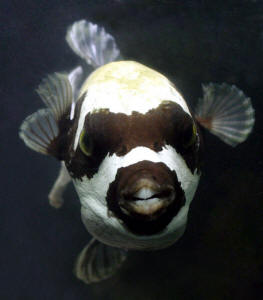
Guys, <Leslie> I have had this Red Sea Masked Puffer for just
about a week. <Rare, and expensive generally> He was slow to
start eating but is eating well now.....krill, squid, calamari,
crab legs, Mysis, algae sheets, assorted shrimp, and scallops,
enriched with vitamins. <Sounds good> He is in a Q tank with
live rock. The salinity is 1.010. He started flashing 2 days ago
just occasionally. Today is flashing frequently and I just noticed
tiny black dots.....Black Spot Disease??? He also has 2 very
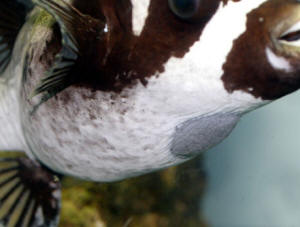
concerning good sized gray lumps.....the one on his ventral side
posterior to what would be a chin if he had one, which is about an
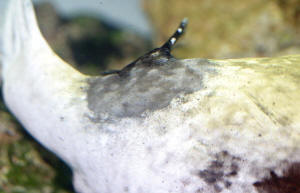
inch long by 1/2 inch wide and the other just under his dorsal fin
is about an inch in diameter. <Perhaps another type of
"black spot"> As far as I know he did not have these
yesterday ........unless I have gone blind as well as nuts. I know
....I know yeah sure.....I love the posts that say my fish just all
of a sudden got this huge thing on him .....they make me nuts. You
and I know it has been there brewing. Well these were not there
yesterday. The heater is in the filter and there are no pumps for
him to get injured by. Anyone ever see this? Any ideas what it
might be? <Perhaps just accumulation of melanin (color)... from
what cause? Stress in general?> I included some photos ......Any
ideas and help would be appreciated. I have never dealt with either
of these problems. Lump under dorsal fin Lump on ventral surface
<These are trouble... once again, am at a loss as to direct,
non-direct "causes"... perhaps this fish has/had some
real internal troubles that are just becoming evident. The source
you got this fish from, any news from them re other specimens?>
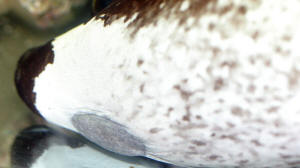
Black specks Thanks so much, Leslie P.S. Things with Kali, my sick
pooch do not seem to be giving me the break I had hoped for. We go
to the Veterinary Cardiologist in LA tomorrow and hopefully he will
have some helpful news......like she can go back to Doggie Day Care
when I am working. I work the weekend, hopefully it will be mellow
and I can work on some queries during my breaks. I will try to be
back for real next week. Sorry for the extended absence. <I hope
your dog will be fine as well as your puffer. I have no specific
remedy to recommend, but/and will post on WWM in the hope that
someone will chime in with help. Bob Fenner> |
The black dots look very irregular in size, which
likely rules out a parasite to me. The gray patches are concerning
to me on this soft tissued fish (vs. large scaled). If it looks
like anything more than discolored skin/pigments (as with changes
of color in angry, sleepy, sick fishes) but rather appears to be a
patch with some substance (mucous, turbid, film-like? anything?)
then I'd feel safe/better treating the beast with the old
stand-by first course of a Nitrofurazone and Furazolidone cocktail
(like Jungle Brand "Fungus Eliminator"... goofy name,
fine product... use double dose for saltwater here). I'm not a
huge fan of hyposalinity for scaleless fishes (rather a far cry
from the Red Sea especially here)... but I'll concede he's
tough and it would not hurt/may help temp for you to continue.
beyond that... add no other meds and do not knee-jerk or react
without cause (clear symptoms of a clear problem).
bets of luck
Anthony |
|
Leslie, I just wanted to add to Anthony's
response.... Be conscious of how you are measuring
Salinity. You are at the lower limit of what I would expose
nearly any marine fish to. If your measuring device is
faulty, you could be a couple of points lower. I personally
consider refractometers mandatory for managing hyposalinity. I
also agree that the black spots are not likely "Black
spot". In addition to the irregular sizes, typically
the organism that causes this is superficial and is very
susceptible to FW dips and/or hyposalinity. Given the fact that
parasitic infestation is unlikely, I would err on the safe side
and raise the SG a few points in addition to Anthony's
excellent suggestions.
Adam
|
 |
|
 |
 |
| Re: Need Some Help with New Puffer...Please Hi Bob, Yes
rare and expensive in deed. I have been waiting for one for a long
time. <Saw the most of this species in the Red Sea on the last
trip that I've ever> What ever this is I don't think it
is good. It appeared out of no where and this am it doubled in size
and this afternoon when we got home from the vet it was even
bigger. Nothing that spreads this fast could be good. I am bummed
to say the least. <Me too> I emailed Kelly Jedlicki and
apparently she has seen this before. .... Here is her response: Hi
Leslie, First question: what pet store/wholesaler did you get the
masked puffer? This is very important to me as I saw many puffers
with this same ailment about 3 years ago. I sent cultures on a
couple of the lesions & found a rare organism. You said these
lesions came up quickly, are they growing or spreading rapidly
still? Are you treating the puffer with any antibiotics? My masked
puffer has similar black spots ( have had him 5 years). The
flashing is due to the irritant of the lesions (lumps) on him. In
almost 15 years I have not seen black spot disease on a puffer. I
would concentrate on getting antibiotics to him ASAP -
Enrofloxacin, Furazone, Kanamycin or sulfa would be my first
choices. I would do a concentrated bath as well as try to get
him/her to eat antibiotic laced food. Do you have any substrate on
the bottom of the tank? Did the LFS have substrate on the bottom of
the tank? If so what type & depth? Does your puffer prefer to
rest on the bottom? Please let me know how your new friend is
doing. Kelly" Thanks for the response and well wishes. My Kali
girl is doing much better than we expected. I am very relieved. She
does not have the dreaded Dilated Cardiomyopathy as was originally
suspected and either does my 8 year old male Willie who had a pre
surgical work up today. The Cardiologist today diagnosed a leaky
heart valve ......Mitral Valve Insufficiency which caused her
Arrhythmia and Congestive Heart Failure. The good news is the
although she is an old lady at 11.5 and older than some dobies even
live to, with 10 to 12 being the average life expectancy, the
prognosis is not near as grave as was they originally thought. So
she will be keeping me company for another year or so. Yippee!!!
Another year of cleaning up pee LOL......doggie diapers and plastic
lined pads are helping there and her new med is beginning to take
effect. The ER Doc did a great job and has her on the perfect med
regime. Her lungs are clear and her heart rhythm is very good as
well. Things seem to be under control except her incontinence
problem which seems to be getting a bit better. I am thrilled and
relieved. The Puffer however is another story. Thanks again, Leslie
<Do agree that the black spots are likely inconsequential... the
grey markings another story... Bob F> |
Re: Need Some Help with New Puffer...Please
UPDATE Hi Bob, Adam C and Anthony!! <Hello Leslie> I have
a follow up to the Masked Puffer with the mysterious gray
lumps/lesions......I wish it was better news but I lost the fish
less just under 48 hours form the first time the original lesions
were noticed. This fish had no signs of these lesions 24 hours
before the first time they were noticed. He looked normal and was
eating. These gray smooth lumps spread amazingly quickly. 18 hours
after I noticed the original lesions they had doubled in size,
despite rapid and aggressive treatment. They continued to spread at
an alarming rate covering more than 50% of the fish's body by
the time he died less than 48 hours from the time I noticed the
original lesions. <Does sound more and more like a cancerous
tumor of some sort... and I have never seen a specimen recover from
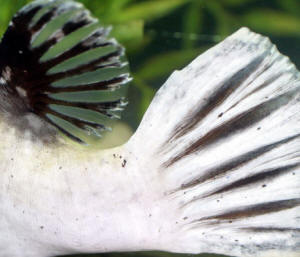
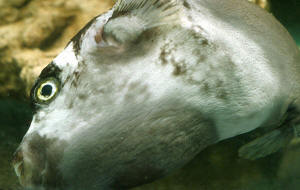
such> Here is a photo of the fish 18 hours later...... Here he
is shortly after he died.....about 24 hours after the above 2
photos..... Sorry for the disturbing photos but it is sort of hard
to believe without actually seeing it. <Yes> I was unable to
save this poor fish, but did get some good information from a local
vet and after doing quite a bit of research believe I now have a
few contacts should I need diagnostic cultures and sensitivities or
pathology studies done on a fish in the future. Should anyone have
a tissue sample or remains of a fish they would like to prepare for
cultures or pathology studies ......the fish or tissue sample needs
to be placed into sterile marine water which has been pre chilled
to 40*F and then placed into the refrigerator. The water &
container can be sterilized by microwaving or boiling. Tissue form
fish breaks down quickly so this needs to be done as soon as
possible with the sample delivered to whom ever is going to do the
testing ASAP as well. If the process of autolysis has begun the
cultures will not be able to be done. If the fish is to be
preserved for longer periods of time for a necropsy without
cultures and studies that require cells to grow it can be placed in
formalin but once this is done cultures are no longer possible. The
ratio of formalin to body mass of the fish needs to be 10:1 and the
body cavity of the fish needs to be opened in order to allow the
formalin to contact the internal organs. I personally would have
trouble with this one and would prefer the cold water method
allowing the pathologist, biologist or Vet to obtain the actual
samples or do the actual cutting. <Thank you for this> Also
unless one was to find a kind interested soul with the appropriate
experience and equipment it could be considered cost prohibitive
for some. The most information would be obtained form a fish
prepared and delivered ASAP using the sterile chilled salt water
method The prices I was quoted today were ..... $65.00 for each
culture & sensitivity and depending on what was found more than
one might be indicated. $76.00 for the gross necropsy done by the
Vet then 200 to 250 for the lab to do a complete necropsy looking
at each organ including pathology and histology. <A bargain...
considering the time, gear, education involved> Pathology
studies alone can be done can be performed on a fish placed in
formalin as described above for about $180.00 plus shipping and
handling but my understanding is that the information from this may
be limited depending on the degree of autolysis the tissue has
undergone and there would be no guarantees as to how useful that
info would be in determining the etiology of the malady. I had
planned on a necropsy and cultures but by the time I found the
appropriate individual the fish had been dead 4 days and the
general consensus seemed to be that at this point it most likely
would not give us the most useful information in terms of
preventing or treating this disease in the future so in light of
the cost and probable inadequate information I decided to pass this
time. However, the fish is preserved in formalin at the Vets if you
think a necropsy at this point might prove useful, I would cringe
while writing the check for $180.00, not including shipping and
handling but certainly reconsider. Hopefully none of us will need
such services in the future but should we, we will at least be a
bit more prepared. Thanks as always for your help with this,
Leslie
<Bob F> |
 |
 |
|
Re: Need Some Help with New Puffer...Please
UPDATE Hi Bob, Adam C and Anthony!! <Hello Leslie> I have a
follow up to the Masked Puffer with the mysterious gray
lumps/lesions......I wish it was better news but I lost the fish less
just under 48 hours form the first time the original lesions were
noticed. This fish had no signs of these lesions 24 hours before the
first time they were noticed. He looked normal and was eating. These
gray smooth lumps spread amazingly quickly. 18 hours after I noticed
the original lesions they had doubled in size, despite rapid and
aggressive treatment. They continued to spread at an alarming rate
covering more than 50% of the fish's body by the time he died less
than 48 hours from the time I noticed the original lesions. <Does
sound more and more like a cancerous tumor of some sort... and I have
never seen a specimen recover from such> Here is a photo of the fish
18 hours later...... Here he is shortly after he died.....about 24
hours after the above 2 photos..... Sorry for the disturbing photos but
it is sort of hard to believe without actually seeing it. <Yes> I
was unable to save this poor fish, but did get some good information
from a local vet and after doing quite a bit of research believe I now
have a few contacts should I need diagnostic cultures and sensitivities
or pathology studies done on a fish in the future. Should anyone have a
tissue sample or remains of a fish they would like to prepare for
cultures or pathology studies ......the fish or tissue sample needs to
be placed into sterile marine water which has been pre chilled to 40*F
and then placed into the refrigerator. The water & container can be
sterilized by microwaving or boiling. Tissue form fish breaks down
quickly so this needs to be done as soon as possible with the sample
delivered to whom ever is going to do the testing ASAP as well. If the
process of autolysis has begun the cultures will not be able to be
done. If the fish is to be preserved for longer periods of time for a
necropsy without cultures and studies that require cells to grow it can
be placed in formalin but once this is done cultures are no longer
possible. The ratio of formalin to body mass of the fish needs to be
10:1 and the body cavity of the fish needs to be opened in order to
allow the formalin to contact the internal organs. I personally would
have trouble with this one and would prefer the cold water method
allowing the pathologist, biologist or Vet to obtain the actual samples
or do the actual cutting. <Thank you for this> Also unless one
was to find a kind interested soul with the appropriate experience and
equipment it could be considered cost prohibitive for some. The most
information would be obtained form a fish prepared and delivered ASAP
using the sterile chilled salt water method The prices I was quoted
today were ..... $65.00 for each culture & sensitivity and
depending on what was found more than one might be indicated. $76.00
for the gross necropsy done by the Vet then 200 to 250 for the lab to
do a complete necropsy looking at each organ including pathology and
histology. <A bargain... considering the time, gear, education
involved> Pathology studies alone can be done can be performed on a
fish placed in formalin as described above for about $180.00 plus
shipping and handling but my understanding is that the information from
this may be limited depending on the degree of autolysis the tissue has
undergone and there would be no guarantees as to how useful that info
would be in determining the etiology of the malady. I had planned on a
necropsy and cultures but by the time I found the appropriate
individual the fish had been dead 4 days and the general consensus
seemed to be that at this point it most likely would not give us the
most useful information in terms of preventing or treating this disease
in the future so in light of the cost and probable inadequate
information I decided to pass this time. However, the fish is preserved
in formalin at the Vets if you think a necropsy at this point might
prove useful, I would cringe while writing the check for $180.00, not
including shipping and handling but certainly reconsider. Hopefully
none of us will need such services in the future but should we, we will
at least be a bit more prepared. Thanks as always for your help with
this, Leslie <Bob F>
Re: Need Some Help with New Puffer...Please
UPDATE Hi, Leslie I am sincerely impressed by your diligence and
resolve on the matter. Outstanding and above and beyond what I would
have done, I'm sorry to say/admit :) Thank you for sharing this
info/history... I'm saving it myself for future reference.
If/assuming it was pathogenic in origin... it really underscores just
how fast some topical and systemic infections can really progress
(fishes and cnidarians alike... I'm reminded of wounds on anemones
that spread like wildfire and take the animals life in what seems like
hours - certainly less than a day or two with so little tissue/actual
mass). Seems to me that scaleless and small scaled fishes suffer such
afflictions more severely than most large scaled fishes. Very sorry to
hear of the death, regardless... but very good to see something's
good/useful come of it. thanks kindly for sharing :) Anthony
Re: Need Some Help with New Puffer...Please
UPDATE Hi Anthony, Thanks for the compliment about my diligence and
reserve. It is sort of a mixed blessing, most of the time friend
occasionally faux......sometimes I just don't know when or refuse
to throw in the proverbial towel, wave the white flag or scream
Uncle. I think it has part to do with my medical background and
wanting answers. There was also a gorgeous Coral beauty in the Q tank
with the Puffer. It has no signs of any problems so far. My
fingers are crossed. Re sharing.....You are most welcome. I thoroughly
enjoy learning and sharing. It is part of my passion related to this
hobby. Much of what I do in this hobby revolves around sharing the
pleasure as well as the disappointments. I have learned some of
the most amazing things by sharing an experience good or bad or some
information I researched, resulting in a thread that snowballed into a
discussion and ultimately brought to light some new idea or answer to
some question. I was at the LFS today and they had a tiny Stars and
Stripes Puffer, which I gave a really thorough once over.
The little guy was just an inch long and had a gray patch which
suspiciously looked like it might be the beginnings of this gray lump
disease, which Kelly J. the Puffer Queen calls Puffer Lump
disease. Something interesting I noticed is that this little puffer had
a bigger beak than most of the Puffers I have seen that have only been
in captivity a very short time, usually do. The Masked Puffer I
just lost also had a bigger beak than I would have expected being in
captivity for such a short time. The LFS only had him a few days before
I brought him home. I cannot help but wonder if it is not somehow
related. Kelly mentioned in an email to me that she saw quite a bit of
this disease on several Puffers about 3 years ago. This little
Stars and Stripes came form the same wholesaler as I believe the Red
Sea Masked Puffer came from. I am still waiting for a definitive answer
on that one. I was very tempted and had a fleeting irrational thought
that perhaps bringing this little guy home would provide some
additional information .....sort of as an experiment...... being able
to observe the progress of this one more time as well as performing the
cultures on live tissue should it actually have the same thing or
something similar. I opted for heart sparing sanity over science. I
just have to stay out of the LFS for a few weeks now :). I am more and
more tempted to have the pathology study done. I just wish I knew
if some useful info would come out of it. When it rains it pours.....my
Harlequin Tuskfish is unusually secretive, laying on his side and
breathing rapidly, since last evening. He did come out to eat but
only nibbled and normally is quite a good eater. It turns out the
electric was off for 2 to 3 hours while I was at work yesterday.
Up until yesterday he has been fine and all the other fish are fine. I
hate to rush in and treat him for who knows what but at the same time
it is hard not to have a bad feeling and sit and wait for some more
definitive symptom. With warm regards, Leslie
|
Tuskfish, Puffer, Photos, and contributing to the site. Hey
Anthony, Bob, Adam and Jason, I hope all is well with you gentlemen
today. I should be back in the swing of answering queries by the end of
the week. I work the next few days and then have a few off. Again sorry
for the absence. Things are settling down here bar another disaster to
throw me off track. <No worries, and welcome back>
Re the
Photos..... Anthony.....I just put a package of 3 CDs with photos
in the mail to you. USPS priority. You should have them in a couple of
days. I am just finishing an inventory list which I will get off to you
tonight. I can forward it to anyone else interested if you would like.
I included in the seahorse photos are nursery tanks, fry at different
ages, courting shots, disease photos and different species and seahorse
tankmates. I also included and some of my other fish ..... Puffers and
companions. I hope they work for you and if not no worries hopefully
you will enjoy them.
Re Contributing to the site... I was
looking thru the site for something, yesterday and stumbled upon a few
places I thought I might be able to contribute. Many of my photos prior
to this new digital camera are not suitable for printing but would do
well on the web if you guys would like to use them anywhere you need
photos. I could certainly contribute information on the species of
seahorses being bred currently, by whom and also supply photos of the
species. Besides the horses I have a CB Fridmani Pseudochromis, black
and white Percula clowns, an assessor and a redheaded goby. I could
also get together keeping parameters for the individual seahorse
species if that would be useful. I have a series of pregnancy and birth
shots as well as documentation of a couple of species at various ages.
I have barbouri fry daily from birth thru a few days and then once a
week up until about 9 weeks or so. <You are welcome to actually post
content (credited to you) if you have the time, interest, and a program
to reach WWM> I have a good friend in San Diego who is probably the
most successful hobbyist breeder in the country, at least that I am
aware of. She has taken the best features form several nurseries and
come up with quite a nice set up, which is also very versatile. It is
fairly easy to set, use and clean. It can be used on a small or large
scale basis for either pelagic or benthic fry. She is working with her
5th generation of CB erectus from CB OR stock. Her horses are not only
healthy and hearty they are gorgeous and beautifully marked. 20 some
odd years experience breeding Corgis must have impacted her seahorse
breeding techniques. <I live in SD... am surprised your friend and I
have not crossed paths> I also have some close up shots of the one
of the major reasons most hobbyists lose their fry....HYDROIDS...nasty
nasty little buggers they are and wiped out more than one of my broods
as well as over 170 Dwarfs. I never knew until I looked back at some
macro shots and saw them in photos taken close up with a 100mm macro
lens. They were not visible to my naked eye at all, as a matter of fact
the 5x magnifying glass with coupled with my reading glasses didn't
even prove helpful. The fry are tiny and the hydroids well a tad more
than microscopic. <Yes> I try to document pretty much everything
I see in the tanks.....I have many more disease photos but that are of
the lo res web only variety. I have either been blessed with very bad
luck or as I prefer to think about it the opportunity to learn about
and photograph this stuff. <These would be especially helpful. We
get a lot of disease queries> I also have collected some info on how
and where to have pathology studies done on fish and how to prepare the
specimens. Adam C suggested I write it up for the web site. So I am
working on that. <Great>
Re the sick fish.....My Puffer and
Tusk I spoke with a Vet today who breeds Koi and happens to do some
aquatic medicine. He does mostly Koi but has a few contacts and a
gentleman who used to work with him as a vet tech, he trained and who
has quite a bit of experience treating sick fish. I mainly wanted
someone who was able to do and send cultures out, which I have now
found. He thought the Puffer most likely had some sort of Virus from my
description. The Tuskfish is just barely hanging on He is still swollen
laying in his side with rapid gilling. I am amazed how quickly some
fish succumb and how long others hang on. He looks at me every time I
go near the tank. I can barely stand it. I am not holding much hope out
for him. The vet said it sounded like kidney failure form any number of
things......cyanide, bacterial infection, or possibly even the meds. He
said many of the meds we use are nephrotoxic and damage the kidneys.
Especially Gentamycin and Kanamycin along with many of the others we
use. It is his feeling that different species may require different
dosages and have different tolerances to meds. Hence the difference
between Noga's dosages which are so much higher than most of those
recommended by the manufacturer, which are generalized for all fish. I
doubt this was the case because the fish had generalized edema prior to
the meds. The fish was supposed to be from Australia I believe that
rules out cyanide. He mentioned that it can actually take 3 to 4 months
before the fish succumb to the effects off the cyanide. I thought it
was much quicker. Like the blenny I got 2 days ago and was dead the
next morning. :(. I am staying out of the LFS for a while. The rest of
my fish are still fine knock on wood, spit 3 times and toss some salt
over my shoulder. He mentioned that cultures offer the most useful
information. A culture is most effective when taken from a live
specimen. If the live fish has no open wounds or lesions to culture and
parasites are not suspected then it would have to be sacrificed with a
sterile culture obtained from the liver. Necropsies according to this
gentleman do not afford the most useful information. He did mention
that in terms of parasites most can be IDed by a microscopic
examination which he can do at his office. Anything more involved is
sent out. Ok I have babbled on long enough .......Let me know how if
there is anything else I can do to help and thanks so much for your
assistance. Fondly, Les <Be chatting, Bob F>
Puffers Not Responding To Medication <Hi, MikeD here> I
have a porcupine puffer and a green spotted puffer in a 125. They
started out with Ich and it has progressed to velvet and now they are
sitting at the bottom gasping. Water quality is
good. I have tried Maracyn, Maracyn 2, and marine aquaria
no-Ich which is copper free and usually works but nothing is working
this time.<Usually when people think they are seeing ick turn into
velvet it's actually secondary bacterial infections, but you even
have those bases covered.> You say don't use copper and try dips
but never mention any thing else to try.<In worse case scenarios
like this, I've had fair luck with a product called "Quick
Cure", which is formalin and Methylene blue used half
strength. Sometimes when all else fails there's nothing
to do but drop back and punt.> I don't think these
guys are going to make it but I sure don't want to run into this
again.<It certainly doesn't sound promising, but I've had
fair success with this with Burrfish, the tangs of the puffer clan, so
all fingers are crossed.> Thanks<Good luck> Lisa
Swollen Jaw on Puffer 6/30/04 Hi, Pufferpunk
here> We have a healthy 200 gallon tank. We have had our
gold puffer for approximately a year and we love this big
guy. Two days ago, his jaw looked swollen. Then yesterday he
would not eat and his tongue (which is usually black) was white and
covered in some sort of film. His eyes are clear and his
overall body is perfect in appearance. He does not want to swim or eat
at this point. Have you heard of such? What to
do? <Although I have not ever heard of this particular ailment, it
sounds like a bacterial problem. Quarantine your puffer
& try treating with Myacin, or any other anti-bacterial that looks
good for this kind of infection.> Thanks so much!! <Good luck, I
hope he gets better! ~PP>
Dog faced Puffer OD on copper My office has a saltwater tank
professionally cleaned and cared for once a week. We have grown very
attached to our fish and have recently enjoyed the addition of an
adorable dog faced puffer. <Congrats, Dogface puffers are one of my
favorite fish!> We noticed some white spots on his fins and was
treated with copper at least 3 times now. <Big
no-no! Puffers are extremely sensitive to copper, and it
should never be used on puffers (or other sensitive animals like
inverts/corals etc...). It will be best to stop treatments
like that ASAP.> I have noticed each time it is treated our dog
faced puffer will become very immobile and has some discoloration,
changing to a darker color. <That is a typical reaction to
copper.> After checking your website I am afraid this
"professional" company has no idea what they are doing to our
adorable dog faced puffer. <This sounds that way. I
learned back that many of the "professionals" aren't that
professional. They don't know everything, and it's
best if you do your research to be sure that accidents like this
don't happen.> Please offer any advice on how to save our puffer
and possibly a new truly professional company in Salt Lake City, Utah.
<Sadly I'm not sure of any professional companies in Salt Lake,
I had done a search on Aquarium Maintenance online to see if I could
help, but it gave me a list. I wasn't sure who would be
good or not, so perhaps if it's best if you ask around. As for you
puffer care, the simple act of giving you puffer a freshwater dip for
5-10 minutes and placing him in a tank that is copper free will be the
best way to help your little dog-face. Here are some great
places to start learning about puffers. http://www.reefnut.com/Puffer%20Article.htm
This is a handy article dealing with puffer care and info. http://puffer.proboards2.com/index.cgi?board=faq
A puffer board. Totally devoted to puffer care. A
very good place to start getting info.> Thank you for your time.
-Sarah <Good luck with your dog-face puffer! I do hope
that it gets better, these are some of the best fish I have ever had
the pleasure to keep. I'll keep my fingers crossed for
you. -Magnus>
Trapped Air in Puffer? 6/20/04 Hello, <Hi,
Pufferpunk here> I have a striped puffer that looks like she has
trapped air/water around her eyes and forehead. I've
tried holding her at the bottom of the tank (head up) and gently
massaging trying to free the trapped air/water (not sure if it's
water or air at this point). I don't think it's an
organism of any kind, because she's been like this for a couple of
weeks (under close observation). There are no signs of
bruising or redness, I even changed foods for her to see if it's an
allergic reaction, but still no luck. Any ideas on what it
could be or what I could do for her? <Puffers swallow air/water into
their stomach. There would be no connection for the air to
get into their head from there. I think this may be an
internal bacterial problem. I would quarantine the fish
& treat for that. Make sure the med you use is safe for
scaleless fish.> Thanks again, Chris <If you need further
assistance, put a title that doesn't include puffers, or I'll
get it back in my box. I'm not great with prescribing
meds. ~PP>
Sad Puffer....possible electrical problem (6/15/04) Hi Phil,
Leslie here this morning. I am very sorry to hear about your
troubles. Puffers are one of my favorites!!. Your scenario reminds me
of something very similar that happened to a tank of mine once. My
first thought is stray electrical current in the tank. It
took one nasty electric shock for me to figure out, after a
sub standard lighting upgrade done for me by a LFS. I was
quite surprised that the fish were not in worse shape. I had an out
break of Ich in what was a healthy and stable tank with no new critters
added as well as fish acting erratically and jumping near the surface.
If you do not have a ground probe on your tank
you should consider placing one immediately, but that is just a
Band-Aid and finding the source of the problem would be warranted as
well. I called an electrician to come and test my tanks as well as
install GFIs in all my water related electrical outlets. This could be
done without an electrician if one was handy but since I am challenged
in that area I got some help from a pro. These articles on electricity
and FAQs should be helpful.... http://www.wetwebmedia.com/elecmar.htm http://www.wetwebmedia.com/elecmarfaqs.htm
http://www.wetwebmedia.com/elecmarfaqs2.htm
http://www.wetwebmedia.com/gfcimarfaqs.htm
http://www.wetwebmedia.com/pumptrouble.htm Hope
this helps and best of luck with your Puffer! Leslie
Valentini Puffer Died Hi, my name is Dawn < Hi Dawn you
have Leslie here today> We just bought a Valentini puffer from a pet
store and after only 2 days he got white spots. We put him immediately
in our hospital tank and few hours later he died. Was this Ich or could
it have been something else. < Ich is certainly a possibility, hard
to say without seeing or hearing more about it.> He did nip at a
anemone but was fine all day and night. <They are not reef safe fish
and I doubt that was the problem.> We have another Valentini in
another tank and he does just fine with anemones and other fish. <
Believe it or not fish have different "personalities" . The
Sharpnose Puffers are not considered reef safe and all have the
potential to nip fins. Some of the Sharpnose Puffer species are more
aggressive than others but all have the potential to nip at inverts and
other fish. You may occasionally find one that does not bother either.
I had a friend who kept one in her reef for years, without ever a
problem but an occasional missing snail.> What do you think could
have happened? <Hard to say exactly but most likely the fish was
carrying or picked up an organism capable of causing disease under the
right circumstances, either at the wholesalers or the LFS. Anyone of
several stressful events could have weakened the fish enough to cause
the organism to become pathogenic. In most cases quarantining all new
arrivals for a period of 4 to 6 weeks is recommended. Please read the
following articles and associated FAQS for a better understanding of
how this all occurs and how you can help to prevent it in the future.
Marine Disease: The Three Sets of Factors that Determine
Health/Disease: http://www.wetwebmedia.com/mardisease.htm
FAQS on Marine Diseases http://www.wetwebmedia.com/disFAQsMar.htm
Quarantining Marine Livestock: http://www.wetwebmedia.com/quaranti.htm
and Quarantine of Marine Fish: http://www.wetwebmedia.com/QuarMarFishes.htm
Please help thanks. Sorry about your fish. Hope this helps,
Leslie
Valentini Puffer fish with 1 white spot (6/5/04) Hi my name
is Kevin. <Hi Kevin, Leslie here this morning> Well my Valentini
puffer fish acts normal but there's 1 white spot on his dorsal fin.
I thought it was Ich so I treated it for 2 weeks now, but it would not
go away!!! My puffer act normally but it's just that 1 spot I have
a hard time getting rid of it. So please if you no what it is, how to
get rid of it, just e-mail me back. <It sounds like Lymphocystis,
which is considered environmental and viral in origin. There is no
known treatment and it usually resolves on it's own. You can help
the process along by maintaining excellent water quality, feeding
nutritious foods and minimizing stress. Please see the following FAQs
for additional information.... Lymphocystis: http://www.wetwebmedia.com/lymphfaqs.htm
Nutrition; Foods and Feeding for Marine Aquarists: http://www.wetwebmedia.com/feeding.htm
Puffer Feeding: http://www.wetwebmedia.com/pufferfdgfaqs.htm
and http://www.wetwebmedia.com/pufferfdgfaq2.htm
FAQs about Tobies, Sharpnose Puffers: http://www.wetwebmedia.com/tobyfaqs.htm
Thank you, Kevin <Your most welcome, Leslie>
Porcupine Puffer I have done the freshwater dips.
<These are extremely beneficial to puffers. I have seen many puffers
cured with only this procedure, no medicines used.> I believe once
per day for five days is good. Yes? <You can do it more days
if you feel it is helpful without any adverse reactions to the
puffer.> Also my puffer does just fine with 15 minutes in a
freshwater dip. I am proud of my puffer for tolerating that
wonderfully. <puffers are very tolerant of freshwater dips. In
fact many biologist have seen puffers swim into freshwater to rid
themselves of pests such as this.> How do I know if this is working?
Do the white spots just fall off? <some people have told me they
have seen them fall... I just seem to notice a lessening of the number
of spots.> I know that eventually my puffer needs a larger tank. I
will worry about that when he is within three months of needing the
larger tank. <It's best to start planning now and looking
around, it will save you loads of headaches when it comes closer to the
time.> How many inches can he grow to in an 80 gallon tank and still
be all right? <It's not necessarily how big he is in the
tank that you have to worry about. When puffers are cramped they will
become ill quite frequently. In smaller spaces they quickly foul the
water which in turn effects their health. The larger the system the
easier it is on you and the puffer.> He is about 5 inches long right
now. How many months does it take for him to grow to 12 inches?
<It depends on the feeding. But it takes a couple of years to get
the full foot long puffer. They seem to shoot up to 6 inches quickly
they the rate at which they grow to the 10-12 inch mark depends on the
quality of water in the tank and the nutrition of the food.> I feed
him two shrimp and two small pieces of squid (about 2 cm long) once per
day. <That seems like quite a good feeding schedule, your puffer
should be doing quite well I imagine.> I want to feed him snails but
I don't know where to buy these. Are they the turbo snails? <You
can talk to your local store and tell them you wish to purchase snails
in bulk, most will be happy to offer you a good discount for your
business. Turbos are pretty hard shelled. You might want to look at
snails that are smaller and easily crunched.> Can the puffer bite
into a clam shell? <Larger ones can, but usually you have to
crack them with a nutcracker first so the puffer can get a purchase on
them and work the shell over with it's teeth.> Won't my
puffer eat the shrimp? <The person who had sent you that email
must not have realized that it was a porcupine puffer. 99.5% of porcs
in a tank will eat a cleaner shrimp within minutes of it in a tank.
They are just that actively aggressive eaters. I'd skip the shrimp.
They are to expensive to be a snack for your puffer.> And will the
puffer harm the gobies? <hard to say with Puffers. with dogface
puffers they usually accept them. I've seen some porcs have quite a
variety of fish in there tank with little to no problem, while I have
seen others that are alone because they have eaten all other tank
mates. I would skip them unless you offer a large tank and plenty of
rock work for the little fish to hide in from the puffer.> Thanks,
Irene <good luck-Magnus>
Stars & stripes puffer & Orbic batfish rotting
away I am an assistant in a Marine Biology program. We have a 10in
stars & stripes puffer and a 10in Orbiculate batfish in a 200 gal
tank. The stars & stripes just moved into that tank on May 14,
after a stars & stripes we had had for 20 years died from old age.
I did a 30% water change, matching the salinity of the 200 gal to the
salinity of the tank the puffer was housed in previously. While moving
him I noticed that portions of his caudal fin were missing, but since
he had been housed with another fish I didn't think anything of it.
Friday, May 21 we began to notice that all of the puffer's fins
were rotting away. We treated it to a five minute freshwater dip on
Friday and a ten minute dip on Saturday. On Sunday we noticed the
batfish's eyes had clouded over and her pectoral fins had started
to deteriorate. Since then we have treated the tank with Melafix and
dipped both animals for 5 minutes every day but the puffer is getting
worse do you have any suggestions? <I do. The water change you
effected was a good step... but do check you alkalinity and pH... and
possibly elevate both. I suspect your root problem here is water
quality. Check the mechanical filter media for clogging, excess
material and clean or renew it. At the semi-last resort, if you have
another system, I would move at least the most mal-affected puffer to
this. I do not encourage anything other than nutritional
supplementation here in the way of chemical treatment. Bob
Fenner>
Puffer Problem? Hi there, <Hello! Scott F. here today!>
I am new to this saltwater fish tank hobby. I just recently purchased 2
yellow box fish. The are real tiny, about the size of a dice. I have a
10 gallon set up ( I also have a 55), but the guy at the fish store
said they would be fine in a 10 gallon. <Well, for a short time,
anyway. Hope that the move to larger quarters is coming sooner rather
than later!> My water is good--no problems there, I think. One of my
fish has recently started to shake and to twitch and he will swim on
his side just for a second. Should I be concerned. Any information you
might have will be greatly appreciated. Thank you so much for your
help. Vanessa. <Well, Vanessa, it's hard to say what is causing
the twitching that you're seeing. If it is a continuous behavior,
it could be signs of some sort of trauma to the fish. On the other
hand, if it just happens once in a while, it could be that the fish is
responding to some sort of discomfort. Perhaps some parasitic problem?
Are there any other outward signs of disease? Do observe the fish
carefully. If the fish appears to be eating, and is otherwise
apparently healthy, then it may be something relatively minor. I'd
run a full spectrum of basic water quality tests, and then I'd keep
a very close eye on the fish for signs of other problems. Sometimes,
doing nothing but providing excellent environmental conditions and good
food is all it takes to make everything right. If the fish begins to
decline, or show other signs of illness, do write back and we'll do
our best to help you. Regards, Scott F.>
Puffer Fading (5/25/04) Thanks Steve! <My pleasure.>
Last night I went to the LFS and got some DI water so I will be using
that from now on. <Smart. Do consider buying your own system. You
will recoup your investment within a year or so.> My puffer seems to
be doing worse however. <:(> The Ich is multiplying, his eyes are
cloudy and full of Ich, he refuses to eat and hangs out at the top of
the tank mostly. I've asked around and someone recommended a
freshwater dip (2 others said not to, that it would add to the stress).
What are your thoughts on this? <Well, this sounds like a desperate
situation. I fear that the stress of a dip could kill your puffer, but
he may be too far gone for anything to help and does not seem likely to
survive if you don't do something more, and soon. It is probably
worth the risk at this point. Do be sure to match pH and temp to the
tank. Adding Methylene blue (Available at many LFS) may help him
tolerate the dip better by increasing the oxygen and darkening the
water. I should also mention that copper can be hard on puffers. Some
people oppose using it with them. Search on "copper, puffers"
for info. Your puffer may also perk up if you cut the copper
concentration way back and treat with hyposalinity instead. See the
articles I referenced previously. I'd also add and antibiotic too,
because the cloudy eyes may be due to a secondary bacterial infection.
Unfortunately, this may increase your ammonia problem by killing even
more biofilter than even the copper is already doing. And formalin will
do the same. Frequent water changes will be needed. Desperate times
call for desperate measures.> thanks again -a <Hope this helps.
If you lose him, don't be too hard on yourself, you're doing
everything in your power for him.>
Puffer Hanging In There (5/26/04) Again, Steve thanks so much
for your continued support and speedy reply. <You're
welcome.> To update, the puffer looked worse last night so I gave
him the freshwater dip with Methylene blue. We caught him with a
container (we didn't want to use a net for fear he would swallow
air). <Excellent> Pouring off as much of the container water as
we could then poured him into the dip; he didn't looked too
stressed out, he was in for 2 minutes or so. Unfortunately, none of the
Ich came off (maybe too short a dip, also diluted with saltwater).
<Straight freshwater for 5-7 minutes is more effective. This
treatment is sometimes repeated daily for a few days.> He seemed
more lively, and we also then did a 50% water change. I added a poly
filter to further reduce the copper. This morning most of the copper is
gone, and I'm not sure whether to continue with this treatment. I
bought some antibacterial medication too. Do you recommend continuing
at low dosage of copper/Cupramine (0.25) or switching to something
else? <Did you read the articles at www.reefkeeping.com? Here's the
first one: http://reefkeeping.com/issues/2003-08/sp/index.htm
> Someone at the LFS swears by this concoction he gave me called
'smurf juice'- a mixture of Methylene blue <hence,
Smurf>, formalin and malachite green (add 1 ml/10 gallons for 3 days
straight). <I cannot comment on the dosing because I have no idea of
the concentrations, but formalin & malachite green are known to be
effective against Ich. Like all therapies, they have a downside. You
can read more about them at the link provided.> He said not to
administer any other anti-bacterial medications if I use this mixture.
<My thought on Antibacterials is if the eye clouding seems to be due
to bacterial infection.> I fear I'm doing more harm than good
because I keep changing medications, but I'm worried about using
the copper because it seems to be making things worse (I had read
conflicting WetWebMedia points of view using copper with puffers, but
decided to go ahead with the treatment because I was told that it's
more effective than formalin). <Yes, it is best to go with a plan
and follow it through to completion. Copper is indeed controversial,
but your experience of worsening suggests that it was probably doing
more harm than good in your case.> I need to pick a medication and
stick with it, else he's going to starve to death:{ <Agreed. Use
the info in Steven Pro's articles to make a decision. BTW, consider
joining the forum at http://wetwebfotos.com/talk/ Lots of
great folks there who would be happy to share experiences & offer
suggestions. I hope this all helps. Steve Allen>
Puffer Getting Better (6/7/04) Hi there fabulous
WWM crew/Steve, <Hello. Good to hear from you again.> Just a
quick question and follow-up. The valentini puffer is doing
very well and has been Ich-free for almost 2 weeks! <Excellent!>
The hyposalinity seems to be working. I will keep him in QT for another
2 weeks, almost he looks like he's getting bored-pacing the tank,
etc. The 10 g. must be too small. <Yes, but just think how happy
he'll be when he can go back into the main tank disease-free.>
My question is, can I use a pre-seeded filter that have
been in my main tank for over a month now in the QT to combat ammonia
levels? <Since the tank has been fallow for a month, this should be
OK.> The main tank's salinity is 1.023 and the QT's salinity
is 1.012 (for now), so I'm afraid the nitrifying bacteria will be
instantly killed by the difference in salinity. <Being
single-celled, bacteria seem to adjust fairly well, and are able to
live at a variety of salinity levels. However, acclimating over a
couple of hours might help. Another option instead o the filter is a
bag of Bio-Spira Marine if it is available in your area. You can add
the remainder to your main as a "booster." thanks as always.
<A pleasure. Glad to hear things are going well. Stay patient and
all will be well in the end. Steve Allen> -a ps. WetWebFotos.
com's message board is great! thanks for tuning me in. <Thanks
for taking part.>
Treating Ich (5/29/04) Hi Steve, <Hello
again> Good/Bad news about the puffer. Last night I came
home and he looked a lot better, and fed him a live clam (after soaking
in freshwater for 10 min or so) and he ate part of it! <Good!>
The Ich had also receded somewhat. <Also good> I did a 50% water
change and added the smurf juice dosage (thanks for the links, I had
read through them yesterday or day before I believe) This
morning, he looks ok with the exception of the his skin-it looks like
it's flaking off near his belly. I know I should pick a treatment
and follow through with it, but again I'm having second thoughts
again. Sorry to be such a pest with the questions-I'm definitely
learning with this fish! Thanks so much, I really appreciate it -Angela
<Glad to help. I hope this works out. The peeling may be from skin
damage from the Ich. Keep your water free of ammonia and nitrites.
Consider adding Melafix to try to prevent infection. Add a
broad-spectrum antibiotic if it looks infected. Be aware that this will
also kill your QT's biofilter.>
Cramping a puffer's style Hi, <Hi! Ananda here this
morning...> I have a very sick porcupine puffer by the name of Amy.
She is in a 55 gallon aquarium that is divided in half.
<Bingo. I bet that's the problem: the fish has nowhere near
enough room. My view is that these fish should be in tanks that are at
least 6' long. Are you aware that they get to football size?>
The other side of the tank belongs to an orange seahorse. This tank has
been setup for years and although the water quality is not perfect it
does remain constant. I test it on a daily basis. SPG-1.023, pH.-7.8
(which I know is low), <Too low. Use a buffer.> AMMONIA-0,
NITRITE-0, NITRATE-160 (which I also know is high). <Way too
high. Do you have a protein skimmer???> I do have live rock in this
tank. The seahorse shows no sign of stress and they have both been
exposed to this water quality for at least a year possibly two.
<Not all symptoms of stress are visible.> Amy's diet has only
been frozen krill that is what I was told to feed her, but I noticed
that she won't eat them any longer. <Puffs do get tired of
their food unless you feed them a variety of foods. Do read the Puffer
Feeding FAQs: http://www.wetwebmedia.com/pufferfdgfaqs.htm
and http://www.wetwebmedia.com/pufferfdgfaq2.htm
...> Right now she looks terrible. Still has sparkles in her eyes
but she lingers near the top of the aquarium and swims all humped
up. <That is a definite sign that the tank is too small for
the fish.> She's still active when she sees me, comes up to
greet me, but she just looks bony with labored breathing and I'm
not positive but it looks like there is missing skin on the top of her
back in two places (small areas), also I noticed uneven edges of her
right pectoral fin (if she is facing you). I can quarantine her and
treat her if need be but I'm not sure with what. <This
fish needs a much bigger tank in the short term, and a major water
change as soon as possible -- 70% is not out of line for nitrate levels
that are this high. Do let the water mix for at least 4 hours before
you use it.> I have resorted to force feeding her since that is the
only way I can get her to eat. <Try other foods.> I feed her
twice daily 3cc liquefied krill (this is the only thing that I have to
feed her right now). Amy is a beloved family pet and I would hate to
lose her especially if there is something I can do about it. Any
suggestions? <Yep, sprinkled through the text above. --Ananda>
Thanks, Janel
White worm in puffers' eyes 5/20/04 I'm battling an
outbreak of skinny, white worms affecting at least two of my puffer
fish (a Valentini puffer and a striped Burrfish). The worms seem to
gravitate to the fishes' eyes but also have appeared on fins and
poking out of flesh. I haven't find any info online, so any advice
much appreciated...Thanks, Jenn P. <for success with fishkeeping
long t term, you will want to have a good diagnostic fish disease book
on hand. For a cheap, reliable book look for Untergasser's old but
accurate "Handbook of Fish Diseases) (TFH press). The best modern
work to date is that of Noga's. To address your problem now though
is fairly easy. Any parasitic worms that large to see can easily be
dropped off with a proper freshwater dip and/or use of Formalin. Please
do a keyword search of our site for these terms and protocols if
unfamiliar. Best regards, Anthony>
Porcupine puffer with spots Hey again! <Hi! Ananda here
today...> Thanks for the advice on the boxfish, it seems that his
dark markings are quite normal! phew! That little guy is really a
sweety! Now I have another problem that requires your expertise: I have
had a porcupine puffer for about 5 months now and he seem to have white
spots in his fins. The fins are a little whitish (not totally clear)
and I see these 1/16th inch spots. <They are raised spots, I take
it...> I've quarantined him for 2 weeks with a weak solution of
CopperSafe and it disappeared. But now after 2 weeks in the main tank
it seems to have come back. <Yep, Ich does that. Marine Ich has a
month-long life cycle: it is on the fish for a bit, then drops off into
the substrate, then heads back for the fish (to simplify matters
greatly!). That's why you need to keep the fish and system Ich-free
for at least a month before adding fish back to a previously-infected
system.> In the main tank no one else has it. <Not surprising.
Porcs can be Ich magnets. Also, the other fish may have it, but not to
the point of it being visible.> This is the second time I quarantine
him to try to fix this problem and I have been treating the main tank
on and off with RX-P for over 2 months to make sure it didn't have
any left. <I'm not familiar with that particular product, but
evidently it didn't work as advertised.> Other than this, he
eats fine, swims is curious and he even likes to "anchors"
himself under rocks and just stays there looking around. He sure
doesn't act sick. He doesn't have the salty type dots on his
skin nor on his fins. <Wait... your second paragraph said he has
white spots on his fins...? I am now confused.> Numbers are good,
tested just this morning and did a 25% WC every 2 weeks for the last 2
months. Specific Gravity - 1.019 Ammonia - 0 ppm Nitrite - 0 ppm
Nitrate - < 05 ppm (inverted it last time!) pH - 8.2 temperature -
78-80F and the setup is: 1 hang on filter 125gph 1 Prizm skimmer 20 lb
of live rock <Likely dead rock, now, thanks to the anti-Ich
medication.> crushed coral sub What could those spots be? and how do
I go about curing him? <I would move both fish into quarantine for a
full month, and go with a full-out hyposalinity treatment. Much more
info is available on the WetWebMedia site.> Thanks so much for your
advice, it is much appreciated! Jos?br><You're quiet welcome.
--Ananda>
Sick porcupine puffer: won't eat <Hi! Ananda here
tonight...> I have a porcupine puffer that has gotten sick. He has
developed an arch in his back and refuses to eat. He has trouble
swimming, acting erratic an unable to keep himself straight. <Could
be a couple of things... swim bladder problems or water quality issues
come to mind first, though there are other possible causes. How big a
tank is he in?> He sits on the bottom of the tank most of the time.
He seems to want to eat, but gives up because he can't swim right.
We tried skewering food krill and put it in his mouth, but he spits it
out. I've given him a Melaleuca extract to defend against possible
bacterial infections. There don't seem to be any external
parasites. This has been ongoing for about a week. The water conditions
are as follows - Ph 8.2, no ammonia or nitrites, very slight nitrates
and phosphates and temp around 78 F. <Could you bring a tank
water sample to the LFS to confirm the ammonia and nitrite
readings?> The salinity stays stable around 1.019. I've had him
for about 6 months. He eats vitamin fortified Freeze dried krill and
frozen clam, but doesn't like anything else. I don't like to
resort to live food, but if that's what requires, I have access to
ghost shrimp, brine shrimp, live clams, snails, brine and feeder fish
of all sizes. <Of those, my preferences are ghost shrimp and snails.
Ghost shrimp are cheap, and you can gut-load them, so I'd try that
first. You might try feeding them some highly-nutritious food and then
giving them to the puffer. If the shrimp move too fast for him to get
them, then I'd suggest snails. If neither work, you might try some
brine shrimp as an appetizer first, then something else.> Would a
broad spectrum antibiotic help? He also had a red mark in front of his
right pectoral fin, directly in back of his gill. That seems to be
clearing up with the Melaleuca. <It just might, especially if
you've got signs of something that's clearing up with the
Melaleuca.> He also inflates for no apparent reason and deflates
quickly. He also seems to be breathing quicker than normal.
<Both are definite stress signs.> There is a red general starfish
and a coral catfish as tankmates, both seem fine. Anything you can
suggest would be extremely helpful since he's like part of the
family. Thank you in advance. <If you decide to medicate, that's
best done in a hospital tank. I would also consider dosing the tank
with a reef iodine supplement; that has helped other puffers that have
had difficulty eating due to jaw or thyroid problems. Hope this helps!
--Ananda>
Puffer pimple? Hi, <Hi! Ananda here this afternoon...>
Got a mini reef at home which is a home for my 1 inch Valentini puffer
(His name is Tamblot). <Oooh, I bet he's cute at that size.>
Just last weekend, I introduced a pair of clowns to the
tank. They all are doing good until just a few days ago, I
noticed that the left check of my puffer is bulging. Similar
to a mosquito bite or pimple and it is pink in color. I
could sometimes see him scratching it on the surface of the
rock. It's itchy maybe. <Sounds like
it.> Right now, he is having problem closing his mouth and he looks
like he is having a candy ball on his mouth. He still
hasn't lose its appetite though. Is this an itch? <It
actually sounds like it might be Lymphocystis. That's caused by a
virus, and can be triggered by high nitrate levels in your tank. I
would double-check your water quality; if your nitrates get to about 10
or so, do a water change. My guess is that the introduction of the two
clowns at once introduced more bio-load than the tank was prepared to
deal with. The nitrates may have spiked, causing the puffer's
problem.> I would greatly appreciate your suggestion to remedy this
problem. <I would isolate the puffer in a separate tank and do
frequent water changes to keep the ammonia and nitrites at zero and the
nitrates at 5 or less. If you have some bio-filtration you can use on
the hospital tank, that will probably help. Also, do more frequent
water testing and water changes on the main tank. If what the puffer
has is indeed Lymphocystis, it will eventually go away by itself -- IF
you keep the puffer's water quality pristine. If you have problems
keeping the nitrates down in the main tank, do consider getting a
better skimmer -- that will pull gunk out of the water before the
nitrifying bacteria have to deal with it, thus preventing nitrates from
being formed.> Regards, Joebel <Do also check out the WetWebMedia
site for Lymphocystis. --Ananda>
Porcupine Puffer in Distress 5/9/04 Hi and good evening:
<Hi Deborah, Pufferpunk here> We have a porcupine puffer fish
that has suddenly become lethargic and is laying on the bottom of the
tank, breathing hard. His belly has a sunken-in appearance
as if he is emaciated, which he is not. <If his belly is sunken in,
then why would you think he wasn't emaciated? A puffer
can eat & eat & if it has internal parasites, will show signs
of emaciation.> Until today he has eaten
heartily. However, he did have an episode during a recent
feeding in which he appeared to 'choke' on a piece of shrimp
and began to inflate. When he was semi-inflated he began to cough for
lack of a better descriptor (not his usual deflation
action). He appeared to return to normal. I would
appreciate any thoughts or advice. We have had him for
several years and are concerned to see him in such distress. <You
might want to look thru the FAQs, I remember a similar Q to this within
the past month or 2. Have you added any other fish
recently? One thing I can think of, would be internal
parasites brought in by another fish, that could have been passed on to
your puffer. A friend of mine's puffer choked on a piece
of gravel it had swallowed, while going after some food. She
did an autopsy & found the gravel lodged in it's
throat. Make sure you check the water
parameters. Breathing hard can be a sign of ammonia or
nitrites.> Thank you, Debbie Gilliss <I hope your puffer will get
through this. ~PP>
|
|

