|
|
Related Articles:
Puffers in General,
Puffer Care and Information, True Puffers, Freshwater Puffers,
Burrfishes/Porcupinefishes,
Tobies/Sharpnose
Puffers, Pufferfish Dentistry By Kelly Jedlicki and Anthony Calfo, Puffer Care and Information
by John (Magnus) Champlin, Things That My Puffers
Have Told Me by Justin Petrey,
Related FAQs: Boxfishes, Boxfishes 2, Boxfish Identification, Boxfish Behavior, Boxfish Compatibility, Boxfish Selection, Boxfish Systems, Boxfish Feeding, Boxfish Disease, Boxfish Reproduction, Puffers in General, Puffer Identification, Puffer Behavior, Puffer Compatibility, Puffer Selection, Puffer Systems, Puffer Feeding, Puffer Disease, Puffer Dentistry, Puffer
Reproduction, True Puffers,
Freshwater to
Brackish Puffers, Burrfishes/Porcupinefishes, Tobies/Sharpnose Puffers, Marine Environmental Disease
1,
/The Conscientious Marine
Aquarist
The Puffers Called Box-, Cowfishes,
family Ostraciidae
|

|
|
by Bob Fenner
|
Ostracion
cubicus, Australia
|
Ostraciidae,
from the Greek ostracum, meaning "shell", the box, trunk or
cowfishes are found all over the tropical Atlantic, Indian and Pacific
oceans. Fourteen genera with about thirty three species. These may be
the most characteristic of fishes with their bodies encased in a bony
carapace.
The family is also notable for some
members possession of "ostracitoxin" a toxic discharge
substance of some trunkfishes. If/when sufficiently disturbed whole
tanks, and recirculating systems of livestock have been wiped out.
Though this is rare, the cautions listed elsewhere in this piece on
netting, acclimation, and tankmates should be heeded if you intend to
try a trunk/boxfish.
The genus Lactoria, especially Lactoria
cornuta should be dealt with carefully; I have witnessed three
poisoning "episodes" with this species, one from a dead
specimen in a filter, another from a harassed individual, the third
from the careless introduction of shipping water into a display
system.
Lactoria and members of the genus
Lactophrys are commonly called Cowfishes for their
"horns", a conspicuous pair on the head and another doing
rear-guard near the anal fin. The Smooth Trunkfish, Lactophrys
triqueter is the most frequently offered member of the genus, with
the Scrawled (Lactophrys quadricornis) and Honeycomb
(Lactophrys polygonius) cowfishes occasionally available. All
three hale from the western tropical Atlantic and grow to at least
eleven inches in length.
|
Genus
Acanthostracion
|
See below, species moved to genus Lactophrys
|
|
Acanthostracion quineensis (Bleeker 1865),
the Guinea Boxfish. Eastern Atlantic coast, along Africa's
coast. To seven inches in length.
|
No pic
|
|
Acanthostracion notacanthus (Bleeker 1863),
the Island Cowfish. Eastern Atlantic and mid-islands. To twenty
inches overall length.
|
No pic
|
|
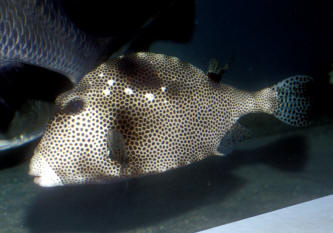
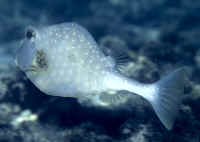
Lactophrys bicaudalis (Linnaeus 1758), the
Spotted Trunkfish. Tropical west Atlantic. To nineteen inches.
This one's about fourteen inches, in the Florida Aquarium,
Tampa. More "spotty" appearing as juveniles. As the
juvenile below.
|

|
Bigger PIX:
The images in this table are linked to large (desktop size) copies.
Click on "framed" images to go to the larger size. |
|
%20MD.jpg)
|
|
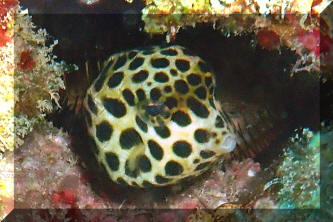
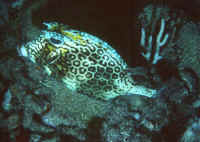
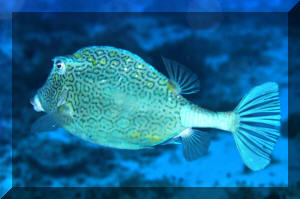
Lactophrys (now Acanthostracion)
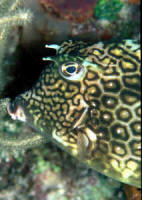
polygonius (Poey 1876), the Honeycomb Cowfish. Tropical
west Atlantic. To about nineteen inches in length. Bahamas
pix.
|
 
|
| Bigger PIX: The images in this table are
linked to large (desktop size) copies. Click on "framed"
images to go to the larger size. |
 |
| Lactophrys (now
Acanthostracion) quadricornis (Linnaeus 1758),
the Scrawled Cowfish. A small one (four
inches) and adult one in the Bahamas. |
 
|
|
Lactophrys trigonus (Linnaeus 1758), the
Buffalo Cowfish. Tropical west Atlantic. To about eighteen inches
in length. St. Thomas pic.
|

|
Bigger PIX:
The images in this table are linked to large (desktop size) copies.
Click on "framed" images to go to the larger size. |
|
%20MD.jpg)
|
|
Lactophrys trigueter (Linnaeus 1758), the
Smooth Cowfish. Tropical west Atlantic. To about eighteen inches
in length. A juvenile and adult (3" and 12"
respectively), in Tobago. And a ten inch individual in the
Bahamas.
|
| Bigger PIX: The images in this table are
linked to large (desktop size) copies. Click on "framed"
images to go to the larger size. |
%20MD.jpg)
%20MD.jpg) |
|
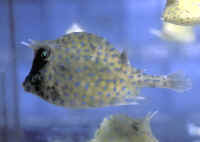
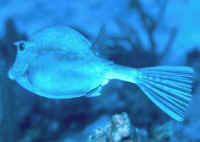
Lactoria cornuta (Linnaeus 1758), the
Longhorn Cowfish. Indo-Pacific, Red Sea, east African coast. To
some eighteen inches in length in the wild. At right, a profile
in N. Sulawesi. Below; aquarium photos of two juveniles and an
adult size specimen in Mabul, Malaysia.
|

|
| Bigger PIX: The images in this table are linked
to large (desktop size) copies. Click on "framed" images
to go to the larger size. |
%20MD.JPG) |
|
Lactoria diaphana (Bloch & Schneider
1801), the Roundbelly Cowfish. Southeast Atlantic, Indo-Pacific
and east Pacific. To thirteen inches overall length.
|
No pic
|
|
Lactoria fornasini (Bianconi 1846), the
Thornback Cowfish. Indo-west Pacific, south-east Atlantic (South
Africa). To nine inches. This four inch one in Hawai'i. The
best member of the genus for aquarium use in my opinion
(obviously).
|

|
| Verticals (Full/Cover
Page Sizes Available) |
%20vert.JPG) |
|
Lactoria paschae (Rendahl 1921). Southeast
Pacific: Easter Island.
|
No pic
|
The Genus Ostracion: The Spotted Cube,
Ostracion cubicus is a perennial favorite, especially as a
bright yellow with black spots juvenile. It is a large fish in the
wild, attaining some eighteen inches. On a smaller scale, the Black
(female) and Blue (male) Spotted Boxfish, Ostracion meleagris is
often seen as well.
About "Boston Beans": these are
juveniles of various species of cowfishes and boxes, not a specific
designation; they grow up to look like the adults of whatever species
they are.
|
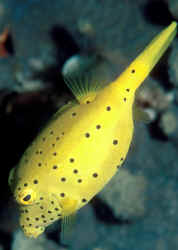
Ostracion cubicus Linnaeus 1758, the Yellow
Boxfish. Indo-Pacific, Red Sea, east African coast around South
Africa into the Atlantic. To eighteen inches long in the wild. At
right: a juvenile in Fiji, Below: a sub-adult in captivity, an
adult in the Cooks, and a aged individual in the Red Sea of about
a foot in length. At the bottom an adult of color in Mabul,
Malaysia.
|

|
Bigger PIX:
The images in this table are linked to large (desktop size) copies.
Click on "framed" images to go to the larger size. |
%20MD.JPG) |
| Ostracion cyanurus (Ruppell
1828), the Bluetail Trunkfish. Western Indian Ocean, Red Sea, Gulf
of Aden, Africa's eastern coast. Here's a beautiful
male in Egypt's Sharm in the Red Sea. |

|
Bigger PIX:
The images in this table are linked to large (desktop size) copies.
Click on "framed" images to go to the larger size. |
 |
|
Ostracion immaculatus, Temminck &
Schlegel 1850. Northwestern Pacific: Japan. Closely related to
Ostracion cubicus of the Indo-Pacific.
|
No pic
|
|
Ostracion meleagris Shaw 1796, the Blue
(male), Black (female) or Whitespotted Boxfish. Vying with the
common Cowfish, Lactoria cornuta, for most commonly
offered species in the family. Like other (demersal) Boxfish
species, this one needs to be well fed... on the tank bottom, not
the surface or mid-water. Take care with aggressive feeding
tankmates. At right, a male in the Galapagos. Below: A female and
male in captivity, Hawai'i, and a set in N. Sulawesi.
|

|
|
Ostracion nasus (Bloch 1785), the Shortnose
Boxfish. Western Pacific. To twelve inches.
|
No pic
|
|
Ostracion rhinorhynchos Bleeker 1852, the
Horn-nosed Boxfish. Indo-west Pacific. To fourteen inches in
length.
|
No pic
|
|
Ostracion solorensis Bleeker 1852, the
Reticulate Boxfish. Indo-Australian. To four inches in length. A
great beauty and good choice for home aquarists. More and more
available. A photo of a female Gili Air, Lombok, Indonesia, and
male in S. Sulawesi.
|
 %20male.JPG)
|
| And a male in Mabul, Malaysia: |

|
| Bigger PIX: The images in this table are linked to large
(desktop size) copies. Click on "framed" images to go to
the larger size. |
 |
|
Ostracion trachys Randall 1975, the
Roughskin Trunkfish. Western Indian Ocean: Mauritius. To four
inches in length.
|
No pic
|
|
Ostracion whitleyi Fowler 1931,
Whitley's Boxfish. Central to western Pacific. Males found
more westward only. To six inches total length. At right is a
female (and male!) in Hawaiian waters, where males are
exceedingly rare. Below, a female and male in Nuka Hiva,
Polynesia where both sexes are much more common. Note the
differences in color, markings between the females of Hawai'i
and the Marquesas.
|
 
|
|
Paracanthostracion lindsayi (Phillips
1932). Southwestern Pacific: New Zealand.
|
No pic
|
|
Polyplacapros tyleri Fuji & Uyeno 1979.
Southwest Pacific, New Zealand and east Australia.
|
No pic
|
| Bigger PIX: The images in this table are linked to
large (desktop size) copies. Click on "framed" images to
go to the larger size. |
| |
|
Tetrosomus concatenatus (Bloch 1785), the
Triangular Boxfish. Indo-west Pacific. To twelve inches.
|
No pic
|
|
Tetrosomus gibbosus (Linnaeus 1758), the
Humpback Turretfish. Indo-Pacific, Red Sea, east African coast.
To twelve inches in length. Here's one off of Na'ama Bay
in Sharm, Egypt's Red Sea.
|

|
Bigger PIX:
The images in this table are linked to large (desktop size) copies.
Click on "framed" images to go to the larger size. |
|
.JPG)
|
|
Tetrosomus reipublicae (Ogilby 1913), the
Smallspine Turretfish. Indo-west Pacific, along east African
coast. To twelve inches in length.
|
No pic
|
Deep/Coldwater Boxfishes: The Family Aracanidae or
Subfamily Aracaninae: Some folks split off these genera, species on
the basis of their carapace being open behind their dorsal and anal
fins, and some other discernible external traits. The seven genera, 13
species rarely make it into the trade, but a few (below) are imported
from where they are most commonly found (Australia).
|
Anoplocapros amygdaloides (Bleeker 1863),
the Western Smooth Boxfish. Southeastern Indian Ocean:
Australia's west and south coasts. To one foot in length.
|
No pic
|
|
Anoplocapros inermis Fraser-Brunner 1941,
the Eastern Smooth Boxfish. Southwestern Pacific:
Australia's eastern coast. To fourteen inches length in the
wild.
|
No pic
|
|
Anoplocapros lenticularis (Richardson
1841), the White-Barred Boxfish. Southeastern Indian Ocean:
Australia's west coast. To thirteen inches in length. This
one in captivity is about four inches. Typical for aquarium use
import.
|

|
|
Anoplocapros robustus (Fraser-Brunner
1941), the Chubby Basketfish. West Pacific. To nine inches.
|
No pic
|
|
Aracana aurita (Shaw 1798), the Striped
Cowfish. Indo-west Pacific. To eight inches. Aquarium images of
juvenile and adult at right and an intermediate individual
below.
|
 
|
Bigger PIX:
The images in this table are linked to large (desktop size) copies.
Click on "framed" images to go to the larger size. |
 |
|
Aracana ornata (Gray 1838), the Ornate
Cowfish. Southeastern Indian Ocean. To six inches in length.
|
No pic
|
|
Caprichthys gymnura McCulloch & Waite
1915, the Rigid Boxfish. Southeastern Indian Ocean. To four
inches.
|
No pic
|
|
Capropygia unistriata (Kaup 1855), the
Black-Banded Pygmy Boxfish. Southeastern Indian Ocean. To five
inches.
|
No pic
|
|
Kentrocapros aculeatus (Houttuyn 1782).
Western north Pacific: South China Sea. To five inches in
length.
|
No pic
|
|
Kentrocapros eco (Phillips 1932).
Southwestern Pacific: New Zealand. To four inches.
|
No pic
|
| Kentocapros flavofasciatus
(Kamohara 1938). Western North Pacific and New Caledonia
(antitropical in distribution). To five inches in
length. |
No pic
|
|
Kentrocapros rosapinto (Smith 1949), the
Basketfish. Western Indian Ocean. To about five inches in
length.
|
No pic
|
And further regarding the keeping of ostraciids; they
have not had a good record of success with marine aquarists, mainly
related to diet or the lack of it. These fishes need food, green AND
meaty on a regular basis; most are lost to outright starvation.
Especially on first arrival, or when you acquire them, it is critical
that the specimen begin feeding. Please see the notes under
foods/feeding below.
Bibliography/Further Reading:
Debelius, Helmut. Undated. Pufferfish in the marine
aquarium. Aquarium Digest International #27.
Debelius, Helmut. Undated. Boxfish- those fascinating
marine oddities. Aquarium Digest International #36.
Edmonds, Les. 1989. Boxfishes-armor in the aquarium. TFH
7/89.
Fong, Jack. 1994. The ten most amusing Boxfishes. TFH
8/94.
Lobel, Philip S. 1985. Spawning behavior of the spotted
trunkfish, Ostracion meleagris. FAMA 8/85.
Michael, Scott W. 1997. The puffers; unique in many
ways. AFM 8/97.
Michael, Scott W. 1998. Swimming boxes. Boxfish are
interesting to keep, but choose their tankmates carefully to avoid
disaster. AFM 3/98.
Nelson, Joseph S. 1994. Fishes of the World, 3d ed. John
Wiley & Sons, NY.
Pyle, Richard L. 1989. Whitley's boxfish,
Ostracion whitleyi Fowler. FAMA 7/89.
Quinn, John R. 1986. Puffers & friends; a look at
the pros and cons of keeping the popular puffers. TFH 5/86.
|
|