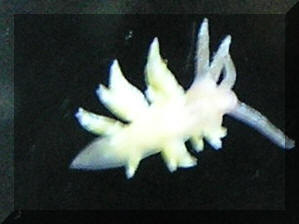
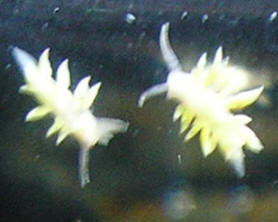
Featured
Sponsor


FAQs about Sea Slugs, the Opisthobranchs, Identification

Related Articles: Sea Slugs, Nudibranchs,

Related FAQs: Seaslugs 1, Seaslugs 2, & FAQs on: Seaslug Behavior, Seaslug Compatibility, Seaslug Selection, Seaslug Systems, Seaslug Feeding, Seaslug Disease, Seaslug Reproduction, & Marine Snails 1Marine Snails 2Marine Snails 3Nudibranchs, Nudibranchs 2, Nudibranch Identification, Nudibranch Behavior, Nudibranch Compatibility, Nudibranch Selection, Nudibranch Systems, Nudibranch Feeding, Nudibranch Disease, Nudibranch Reproduction, Berghia Nudibranchs, Snail ID 1, Snail ID 2, Snail ID 3

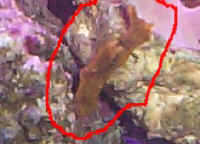
Nudi? Possible Sea Slug – 5/3/08
Hi guys
<Hi Ian, Lynn here this morning.>
I think I saw a Nudibranch but not sure. It was highlighted on the front glass panel otherwise would never have noticed. It was a tiny yellowish worm looking slug which was about 10mm in length and 2mm wide. It was moving like a Nudi and had two little feelers on its head.
<It does sound like a sea slug of some sort.>
Please help me to ID this and if a Nudibranch could it be a pest?
<Sorry, Ian, but without a good photo I can’t even begin to narrow down the search. As far as it being a possible pest, it’s undoubtedly a pest to something, but what I have no clue. A lot of these guys are obligate feeders, feeding on one specific food item and that’s it. Once that food source disappears, so do they. Have you noticed any damage to your resident corals/cnidarians (if you have any)? If not, chances are good that this little slug isn’t too much cause for concern. You may see it out an about for a bit and then no more.>
I have not recently introduced anything into the tank but at this size it could have been around for a long time without being noticed.
<Many are nocturnal but can be seen in systems during the day when they’re running out of food. Also, some are cryptically colored/adorned so that they blend in unbelievably well with their surroundings - which in quite a few cases is what they eat!>
Your help is appreciated.
<You’re very welcome, Ian. For more information and help in narrowing down the possibilities, please see the following links (as well as the highlighted links at the tops of the WWM pages):
Sea Slugs: http://www.wetwebmedia.com/seaslugsopisthobranchs.htm
Nudibranchs: http://www.wetwebmedia.com/nudibran.htm
Sea Slug Forum: http://www.seaslugforum.net/ >
Cheers
Ian
<Good luck! Take care, -Lynn>

Re: Nudi? Possible Sea Slug – 5/3/08
Hi Lynn
<Hi Ian>
Thanks for your prompt response. Will check out the web pages you sent.
<Sounds good. What you want to do is look for shared traits in the species of sea slugs/Nudibranchs shown at the WWM links I provided. That should help you narrow the search to family level. After that, go to the Sea Slug Forum and compare each individual species listed under that family. It can be tedious and time consuming, but ultimately rewarding! Here’s a quick link to the SSF species list: http://www.seaslugforum.net/specieslist.cfm >
Cheers for now
Ian
<Take care and let me know if you’re able to ID that little fellow! –Lynn)>

Please ID: Sea Slug - 4/19/08
<Hi Cynthia>
I am new to nano-reefs. I actually went into the LFS to buy a small freshwater tank and ended up walking out with a 14g Bio-Cube.
<Nice!>
Please ID this weird white slug/worm that was hitchhiking on a turban snail. It's now on my live rock. I've exhausted myself searching the web and looking at photos of worms, snails, slugs. It does have 2 hornlike tentacles on its head.
<Unfortunately, I can’t see enough of the little guy to tell exactly what it is other than a sea slug of some sort. You might want to look through the various families/genera at WWM for shared/common traits including general shape, ornamentation on the back, shape of rhinophores (hornlike tentacles on the head), etc. Then go through the individual species listed under that family or genus at the Sea Slug Forum (link listed below). Also, keep in mind that these creatures do vary in color and can even fade and turn white if they’re starving. Identifying sea slugs can be a big challenge, but you should be able to narrow it down to family given the links below. Also, be sure to go over part 3 of Bob’s Nudibranch article for more general information regarding keeping, etc.
http://www.wetwebmedia.com/nudibran.htm
http://www.wetwebmedia.com/seaslugsopisthobranchs.htm
http://www.seaslugforum.net/
Species list at SSF: http://www.seaslugforum.net/specieslist.cfm >
Thanks
Cynthia Rice
<You're most welcome and good luck on your search! -Lynn>

Infected Tank??? Aplysiid sel.   4/1/08
Hi Bob,
<Cynne>
Hope this finds you well. Once again I have encountered a question regarding stock. The tank is the same as I described before. I now have 90 % of the Scorpions on frozen food, as well; I have followed your advice and purchased the Aqua C Remora Protein Skimmer with Mag 3 pump. I also have increased to a 4-6 inch sandbed with some aragonite. The Scorpions are so much fun :) I cannot believe that I enjoy them even more than the seahorses.
<Both have/exhibit interesting behavior for sure>
I no longer have the starfish; I sacrificed him about 2 months ago for a CopperSafe ich treatment (entire tank). I had to choose between the $17.00 starfish or the $1000.00 fish. I have since changed all filter media, changed 100% of the water in 25% intervals over a couple of weeks and rebuilt the biological with rock rubble from the LFS. I also continue to run poly filters and charcoal in the Aqua Clear. My question is I recently purchased a sea hare.
I have always wanted one, but was afraid of inking.
<Mmm, not an issue with many... tropical species. Unfortunately there is a current rush of selling large, non-tropicals...>
I have searched your site but am still unsure as to what I have. According to one of Anthony's replies, I found that any Sea Hare with tassels is Carnivorous?
<Mmm, no... not a sure characteristic>
The pet store said this one was a Herbivore and they weren’t sure regarding toxins.
I also found one currently running on EBay and according to the seller; this guy isn’t toxic
http://cgi.ebay.com/NANO-Hairy-Sea-Hare-Reef-Aquarium-Live-HAIR-ALGAE_ W0QQitemZ290207618335QQihZ019QQcategoryZ66788QQrdZ1QQssPageNameZWD1VQQ_ trksidZp1638.m118.l1247QQcmdZViewItem.
They also advertise this as a nano size, Yet he looks a lot like the one on your FAQS page 2nd photo.
<Mmmm... is this Bursatella leachii? Am thinking so... get's a bit large for nanos, but is tropical...>
I bought him in NC, I am desperately hoping he is not a cold water species. He is fat bodied brown to green in color with black splotches. He also has baby blue specks all over the body and head, as if someone splashed paint on him, and he is tasseled. Please help I can get whatever food he needs. I just need to know what to expect. The fish do not mess with him at all and all intakes on filters and power heads are covered.
Thanks again for all your advice!! You guys are great!!
Cynne
<Do see the Net (Google images et al.) for pix, ID... BobF out in Borneo>

Re: Infected Tank??? Seahare ID   4/4/08
Hi Bob,
Thanks to all of you once again for quick response and intelligence beyond compare. You pegged it!! Bursatella Leachii he is. I could not find him on your site, and the internet was still a little contradicting. So what to feed? Life expectancy? Toxicity? Thanks Again Enjoy Borneo!!
Cynne
<I know naught other than what can be found on the Net also... did collect/culture Aplysia californica years back... but this is about all of the group. BobF, done diving and headed back tomorrow>

Surprise critter: Sea Slug? ID sources - 1/5/08
Hi all,
<Hi Richard!>
First, thanks for sharing so much info on WWM - it's a big help!
<Thank you, it’s our pleasure!>
I've just set up my first marine tank (after 20 years of FW tropical).
<Such a wonderful, rewarding hobby – welcome to reefkeeping!>
It's been cycling for nearly 2 weeks. I kicked the cycling off with about 4kgs of LR, which I'm told came off the Victoria coast (Oz - I'm in Melbourne).
<Lucky you! I am determined to get to Australia one of these days. The Great Barrier Reef has always been at the top of my list of places to see/explore.>
Ammonia and nitrates are currently at 0ppm, although nitrites are at 2.5.
<Will subside/cycle out.>
I've got a healthy supply of copepods & amphipods flourishing already, also some snails.
<Yay!>
Tonight I happened to pass the tank with the lights off and spotted something strange on the back glass. I turned on the lights and saw what appears to be a small sea-slug. Unfortunately due to the amount of algae starting to grow already, my camera wouldn't focus, so no photo I'm afraid.
<Darn.>
It's a teardrop shape, about 15mm long, 5 mm wide and a brownish red in colour. It has two white feathery antennae at the thin end of the teardrop and three small white spots on it's back - almost a small smiley.
<Oh I know, I know! It’s the rare and elusive Smiley Nudibranch, family Smileyidae – just kidding <g>. Sorry, I couldn’t resist!>
It's quite flat, although the centre of the back is raised about 3 mm. Any suggestions as to what it could be?
<Unfortunately, there are just too many possibilities and without a photo...?>
I'm planning on keeping seahorses in the tank in another month or so <Go slowly here.> and I'm trying to avoid nasty surprises. Algae eaters would be fine though...
<Understandable. If it were me, next time I saw that little guy, I’d get him out of there.>
Also, is there any kind of marine creature search engine on the web into which you can enter distinguishing features?
<Not per se - that covers all marine creatures. At least, not that I know of.>
Seems like something that would come in very handy for many people :-)
<Yes, indeed! In lieu of one specific search engine, there are many sites on the web that can help (including WWM!). I’ll give you some of my favorites. The first will be of particular use for you as it covers crustaceans of southern Australia. You may find some of the amphipods/copepods/etc. populating your tank here:
http://museumvictoria.com.au/crust/page1.html
Here’s another site that’s run by a friend in the Philippines:
http://home2.pacific.net.ph/%7Esweetyummy42/hitchhikers.html
This site is Dr. Shimek’s dichotomous key – very handy indeed!
http://www.ronshimek.com/Invertebrate%20Key%20to%20Major%20Taxa.htm
Great sites regarding Sea Slugs:
http://pick4.pick.uga.edu/mp/20q?guide=Rhabditophora&flags=not_no
http://www.wetwebmedia.com/seaslugsopisthobranchs.htm
http://www.seaslugforum.net/
I hope these help. I’ve got a gazillion more on file, but these should get you started!>
Many thanks,
Richard
<You’re very welcome! Take care -Lynn>

Update: New marine tank with surprise critter - Nudibranch? Sea Hare - 3/8/08
Hi Lynn,
<Hey Richard! How’s my favorite Aussie doing?>
Thanks very much for the info you sent me.
<You’re very welcome.>
The 'smiley slug' disappeared for a little while, but a couple of weeks ago surfaced again.
<Neat>
It's grown somewhat (35mm+) since I last saw it, and I just wanted to let you know that
I'm now sure it's Dolabrifera dolabrifera, the algae eating sea hare.
<Yay, congratulations and good on you for figuring out what it is! Thanks, also, for letting me know. Neat little creatures like this tend to lurk in the back of my mind until they're identified.>
In fact, I seem to have about five of them, and although the smiley looked quite different when it was young (appeared to have a smooth back and white markings), the similarities between the mature hares really make it obvious.
<Awesome>
Now that I've watched them in action for a few weeks, the following are pretty clear:
- They don't eat anything other than algae.
- The colours come from the particular algae that they're eating (slowly changes over a period of 5 - 6 days). Seems likely that the red pigment doesn't penetrate all parts of the body - he's now pinkish brown with green ears :-)
<Heeeee! It’s the Easter Sea Hare!>
- They're indifferent to what colour slug they mate with.
- They're not the smartest critter in the world and often can't tell the difference between a rock and a seahorse (much to the surprise of both parties when they go for a ride)
<Wheeeeee! Yep, it doesn't exactly sound like they're sharpest tacks in the drawer!>
Cheers,
Richard
<Thanks again, Richard, for following up with this and for sharing your observations! Take care and have a great weekend, -Lynn>

Sea Slug ID: Elysia crispata? Need more information – 2/3/08
<Hi there, Victor!>
About one month ago, I acquired some live rocks from the southern part of Puerto Rico, after curing them I placed them in my marine aquarium. Last week I noticed an odd creature, which I assume to be some type of sea slug. It is completely white in color with two antennas and its back is completely covered with white corkscrew strands. Two days ago I discovered two more of these creatures, one measures 1 1/4" and the other two 1". To my surprise, the larger one merged with one of the smaller species and today I noticed pasted to the glass what looks like a corkscrew rope in a circle, I assume these are eggs.
<You assume correctly!>
At first I thought that these were Lettuce Sea Slugs (Nudibranch) but this species is not completely white nor do they have those corkscrew strands on their backs. My question is: What species are these creatures and do they represent a threat to my marine community? Almost forgot, I have never seem them on the bottom, they are always on the glass and move slowly just like a snail.
<Hmmmm, here's one possibility, Elysia crispata. If that’s it, I’m going to go buy a lottery ticket! Please see these links: http://www.seaslugforum.net/factsheet.cfm?base=elyscris and http://www.seaslugforum.net/display.cfm?id=10414
If that's not it (or if it's close), then an ID is going to take some research. What I would recommend is to go through the following links and try to determine which family your sea slug shares the most characteristics with.
Start here: http://www.wetwebmedia.com/seaslugsopisthobranchs.htm .
Then see the three pages starting here: http://www.wetwebmedia.com/nudibran.htm , especially the section on page 3 titled “The Big Three Aquarium Problems with Nudibranchs”. Once you determine a likely family, you can then go to the Sea Slug Forum and look through the species listed in that family: http://www.seaslugforum.net/. It’s a lengthy process, but you might just find your little slugs!>
Best Regards and Thanking you in advance, Victor.
<You're very welcome and good luck! Take care. -Lynn>

Surprise critter: Sea Slug? ID sources - 1/5/08
Hi all,
<Hi Richard!>
First, thanks for sharing so much info on WWM - it's a big help!
<Thank you, it’s our pleasure!>
I've just set up my first marine tank (after 20 years of FW tropical).
<Such a wonderful, rewarding hobby – welcome to reefkeeping!>
It's been cycling for nearly 2 weeks. I kicked the cycling off with about 4kgs of LR, which I'm told came off the Victoria coast (Oz - I'm in Melbourne).
<Lucky you! I am determined to get to Australia one of these days. The Great Barrier Reef has always been at the top of my list of places to see/explore.>
Ammonia and nitrates are currently at 0ppm, although nitrites are at 2.5.
<Will subside/cycle out.>
I've got a healthy supply of copepods & amphipods flourishing already, also some snails.
<Yay!>
Tonight I happened to pass the tank with the lights off and spotted something strange on the back glass. I turned on the lights and saw what appears to be a small sea-slug. Unfortunately due to the amount of algae starting to grow already, my camera wouldn't focus, so no photo I'm afraid.
<Darn.>
It's a teardrop shape, about 15mm long, 5 mm wide and a brownish red in colour. It has two white feathery antennae at the thin end of the teardrop and three small white spots on it's back - almost a small smiley.
<Oh I know, I know! It’s the rare and elusive Smiley Nudibranch, family Smileyidae – just kidding <g>. Sorry, I couldn’t resist!>
It's quite flat, although the centre of the back is raised about 3 mm. Any suggestions as to what it could be?
<Unfortunately, there are just too many possibilities and without a photo...?>
I'm planning on keeping seahorses in the tank in another month or so <Go slowly here.> and I'm trying to avoid nasty surprises. Algae eaters would be fine though...
<Understandable. If it were me, next time I saw that little guy, I’d get him out of there.>
Also, is there any kind of marine creature search engine on the web into which you can enter distinguishing features?
<Not per se - that covers all marine creatures. At least, not that I know of.>
Seems like something that would come in very handy for many people :-)
<Yes, indeed! In lieu of one specific search engine, there are many sites on the web that can help (including WWM!). I’ll give you some of my favorites. The first will be of particular use for you as it covers crustaceans of southern Australia. You may find some of the amphipods/copepods/etc. populating your tank here:
http://museumvictoria.com.au/crust/page1.html
Here’s another site that’s run by a friend in the Philippines:
http://home2.pacific.net.ph/%7Esweetyummy42/hitchhikers.html
This site is Dr. Shimek’s dichotomous key – very handy indeed!
http://www.ronshimek.com/Invertebrate%20Key%20to%20Major%20Taxa.htm
Great sites regarding Sea Slugs:
http://pick4.pick.uga.edu/mp/20q?guide=Rhabditophora&flags=not_no
http://www.wetwebmedia.com/seaslugsopisthobranchs.htm
http://www.seaslugforum.net/
I hope these help. I’ve got a gazillion more on file, but these should get you started!>
Many thanks,
Richard
<You’re very welcome! Take care -Lynn>

Update: New marine tank with surprise critter - Nudibranch? Sea Hare - 3/8/08
Hi Lynn,
<Hey Richard! How’s my favorite Aussie doing?>
Thanks very much for the info you sent me.
<You’re very welcome.>
The 'smiley slug' disappeared for a little while, but a couple of weeks ago surfaced again.
<Neat>
It's grown somewhat (35mm+) since I last saw it, and I just wanted to let you know that
I'm now sure it's Dolabrifera dolabrifera, the algae eating sea hare.
<Yay, congratulations and good on you for figuring out what it is! Thanks, also, for letting me know. Neat little creatures like this tend to lurk in the back of my mind until they're identified.>
In fact, I seem to have about five of them, and although the smiley looked quite different when it was young (appeared to have a smooth back and white markings), the similarities between the mature hares really make it obvious.
<Awesome>
Now that I've watched them in action for a few weeks, the following are pretty clear:
- They don't eat anything other than algae.
- The colours come from the particular algae that they're eating (slowly changes over a period of 5 - 6 days). Seems likely that the red pigment doesn't penetrate all parts of the body - he's now pinkish brown with green ears :-)
<Heeeee! It’s the Easter Sea Hare!>
- They're indifferent to what colour slug they mate with.
- They're not the smartest critter in the world and often can't tell the difference between a rock and a seahorse (much to the surprise of both parties when they go for a ride)
<Wheeeeee! Yep, it doesn't exactly sound like they're sharpest tacks in the drawer!>
Cheers,
Richard
<Thanks again, Richard, for following up with this and for sharing your observations! Take care and have a great weekend, -Lynn>

Sea Slug Id – need more info – 10/11/07
Hi,
<Hi there!>
I have a reef aquarium and recently found a sea slug in it and I am having trouble identifying it. <Understandable, can be a challenge.> The closest thing I can find that it resembles is the Janolus cristatus but I live in Florida in the United States so I am not so sure that it could possibly be that. <So it was collected locally, then?) The next closest thing it resembles is the color of Berghia but not Berghia. It has a wider body with much longer cerata. I assume it is nocturnal because I have only seen it out at night. <Okay> It also moves much faster than Berghia. I have Berghia in a separate aquarium. If you have any ideas about what it could be or could point me in the right direction I certainly would appreciate it much.
<Well, a photo would be great here, but I can refer you to an excellent site for research: http://www.seaslugforum.net/. While there, do go through the species list (http://www.seaslugforum.net/specieslist.cfm) and check the links for genus Phyllodesmium, under the Family Glaucidae - as well as these species for comparison:
http://www.seaslugforum.net/factsheet.cfm?base=dondocci
http://www.seaslugforum.net/factsheet.cfm?base=phidlync
http://www.seaslugforum.net/factsheet.cfm?base=learpoic
http://www.seaslugforum.net/factsheet.cfm?base=learevel >
Thanks in advance,
Tariea Haywood
<You’re welcome, and good luck! –Lynn>

Sea Hare ID  – 09/25/07
Hi Bob,
<George>
We took a shot of this animal and although it seemed like an Aplysia dactylomela at first we have second thoughts now. First because it was shot three days ago in the Mediterranean (and not the Caribbean) and second because it doesn't show the typical "wings" on its back.
<Mmm, yes, but...>
Do you know what this species is ? Needless to say, you can use the photo for your site (a higher definition photo can be sent to you if you need it for publication).
<Looks like Aplysia dactylomela to me...>
Best regards and many thanks,
George Reclos

Re: Weird White Pod or Sack on Tank - Looks Like Something That Was Attached to Alien Or Syconoid Sponges Identity Crisis - Dying Gracilaria  – 5/19/07
<Hello Earthling, now called Dan, Mich with you again.>
Hmmm, I think the problem is one in the same Mich.  More in depth look in the fuge.  This pod seems to turn into a two antennae white slug.
<Mmm, nope!  You have two different creatures here.  Sea Slugs and Syconoid sponges>
I’ve seen two crawling in the fuge...very small & they appeared white.
<These Sea Slugs look to be of the order Sacoglossa or Sap-Sucking slugs which feed mainly on algae.  Likely they are part of the genus Elysia.  More here: http://www.wetwebmedia.com/seaslugsopisthobranchs.htm >
This one in the pic was in the tank... not so white.
<Perhaps greenish?>
Also is a pic of what I would call a bunch of Pupa entwined in the Gracilaria.
<Nope, still Syconoid sponges.>
Thanks with the help.
<Welcome!>
Man I am scratch'n for an answer...  
<I won’t ask where...>
with out the Gracilaria, my nitrates are beginning to rise.
<Gracilaria can be a challenge to grow.  If it’s growing sponges, it’s not tumbling enough.>
I could put Chaeto in there but would that be fuel for these things as well?
<No, but Chaeto or Caulerpa may be a better food source for the slugs which can be difficult to keep in captivity.  Mich>
DanH
Picture Too Large!  5/18/07
<Please return with a smaller picture attached.  This one is overloading out bandwidth.  Thanks, WWM Crew>
Sorry
<No worries.>

Help ID this slug   5/10/07
Some people on Reef Central think it's a slug but not sure what type or if it is reef safe. Could it be a Sea Hare? I found it at night underneath my Molokai LR. Does it eat algae? Thanks.
<Is a Common Sea Hare (or Kualakai in Hawaiian), Dolabrifera dolabrifera (Rang, 1828), Family Aplysiidae... Do feed on algae, live under rocks intertidally! Nice pix! Bob Fenner>

Fuge hitchhiker ID, Green Slug…..   1/28/07
Greetings Bob & Crew!!
<Hello.>
The other evening, I wandered through my fish (laundry) room and stopped to look at the pods crawling around my 40-gal sump from my 125 reef in the next room.  I swear I saw a leaf from one of the algae move....and I realized that it was alive!!!  It looks like a land slug, but all green.  Only about an inch long.  No idea how long it has been in there or when it came in. It seems happy to crawl around the ample macro algae in the tank and just graze.
I've done a few searches and can't seem to find anything like it.
Any ideas what it is???  Pic attached.
<Well, from the photo it does appear to be a Nudibranchia. I will say first off that by photo alone…even with the actual specimen in front of you, it is quite difficult to i.d. by exact species.  They are mostly very, very difficult to care for and have notoriously short life-spans in captive environments. However, occasionally, some survive….as appears to be the case with yours.  It likely has a food source, and judging from the color of the animal, (as you eluded to) it appears to negotiate a large sum of vegetable matter, algae, into it’s diet.  I would just observe and enjoy.> <<Mmm... likely another Opisthobranch group... RMF>>
Thanks
<Anytime.>
-Ray
<AdamJ.>
PS  GO BEARS!!!!!
<We don’t have a football team in SoCal….lol.>

Marine... slug
Here are 2 pictures of something I saw moving around in my tank and I have no idea what it could be? Maybe you have seen one before or no what it is. It is about a quarter of an inch long and moves around the tank like a slug. The color is a brownish green and looks like it has antennas on the front of the head.  
                                 Thanks Shawn
<I see it... good pix. Some sort of Nudibranch I think... please see here: The Sea Slug Forum (great online scientific resource)
http://www.wetwebmedia.com/nudispt3.htm
or this link at the end of this area. Bob Fenner>

Greek Goddess
I went to my local fish store and seen a Greek goddess it was deep blue and purple. I have never seen colors so bright before. Is this creature a slug, snail or what?
<yes on all counts... AKA shell-less snail, sea slug>
also is it reef safe? thank you frank.
<tough to say...no one can keep them alive. If your LFS ordered this animal (as opposed to having received it on substitution/without ordering it) the I have little respect or regard for their irresponsible business practice. Please admire this animal from photos for now. Anthony>

- Mystery Slug -
Hi,
<Good morning, JasonC here...>
I have a 30 gallon tank that has been cycling for 5 weeks now. I have a lot of algae so my first live stock purchase has been 4 turbo snails. While at the aquarium store the sales person told me that the black slug they have will also help clean my tank. So I purchased it. Once in my tank I noticed it seems to be more of a nocturnal creature and it is very active moving all over the tank. However I don't notice it cleaning anything. I am wondering what it really is and what I should feed it? I will try to describe it.......
It is a very interesting creature. it is a black velvet color with what looks like veins running through it's body. The veins are iridescent, greens, blues and purples pending on the light or its mood I guess. It has two antennas with white tips and what I can best describe as a short elephant like trunk on top of its head? On the mid/top portion of it's body are the same elephant like trunks with two in back, two in front and one in the center of the back. The trunk on the top of its head has a small opening that opens and closes.  It seems to be more nocturnal in nature.
<Sounds to me like some type of Nudibranch which is a slug... being any more specific than that is a challenge as this family is incredibly diverse. For an eyeful of possibilities, look here:
http://www.seaslugforum.net/species.htm
And then for some further reading on Nudibranchs, look here:
http://www.wetwebmedia.com/nudibran.htm >
My question is, is this creature/slug really good for helping to keep my tank clean and is there some food supplement I should be feeding it and what kind of slug is it, will it bother my anemones, corals and other inverts when I start to stock these sort of things? <Well... again, it's hard to say specifically. Most of the Nudibranchs are very specialized feeders and will starve to death if they don't find the right food-stuffs. In this case, it does sound like the animal you have is ill-suited for the purpose it was sold to you for, which is unfortunate but not uncommon. As to determining the proper food... well, you'll need to do some more research in order to determine which slug this actually is, and then you'll know more about what it eats. Bad news is that in the interim, it could indeed be a danger to your corals and or anemones because there are some that specialize in eating these things. Again, I don't know for certain which Nudibranch you have and would suggest spending some time on http://www.seaslugforum.net - that is really one of the best online resources out there for Nudibranchs.>
Thanks,
Carmen
<Cheers, J -- >

Sea Slug ID - coral eater 8/1/03
Hello,
<cheers>
I found this creature in my tank; I think it has been eating my leather coral. Can you identify it? I have attached two pictures. Thank you!!! Would
<any sea slug with "tassels" [cerata] on its back is a give-away carnivore. The cerata are structures which hold the noxious or stinging elements of its prey. Yours is a familiar coral eater... commonly ascribed to the genus Tritoniopsis (true or not). Bottom line... it is to be removed unless your reef is large enough to grow enough soft coral to sustain it. A beautiful creature indeed. Anthony>

Sea slug/Opisthobranch resources 8/2/03
Can you provide a little more info about it? Where can I find additional information about it? Thank you.
<the shell-less snails that we call "sea slugs" are well studied for their magnificent beauty and fascinating physiology. The sheer number of resources on the Internet alone is simply staggering. In our new book of Reef Invertebrates (Fenner/Calfo)[insert shameless plug here: https://secure.wetwebfotos.com/order_form.jsp & http://wetwebfotos.com/store/nma-ri.html ]we give extensive coverage to the group and list tens of resources in the bibliog.. One of the very best to begin with is:
http://www.seaslugforum.net/
there are also resources/studies listing the exact diets of many Opisthobranchs if you pursue other species. Best regards! Anthony>

Snail?  Nudibranch?
>Hi, WWM Guys and Girl, I think that it is a Nudibranch.  Someone at the LFS suggested possibly a limpet, but I don't think so. Don't those all have shells?
>>Girl Marina again.  ;)  To the best of my knowledge this is correct.  
>I'm going to try to send the pics again in a zip file, perhaps they'll come through that way.  
>>Do check the extension of the file type, this may have been the initial problem, though I'm hardly an expert.  
>I'm inclined to think that it is not predatory by the lack of cerata on it's back, is this a "fairly" safe assumption??  
>>This I cannot confirm or deny.  
>I appreciate all the hard work you guys do saving our critters from our lack of experience.
>>Heh, we try.  Do hope we've been of help to you and everyone else who reads this stuff.  Marina

Sea Slug - Good or Bad? 9/20/03
Hello everyone!
<howdy, Thanassis!>
I saw today a sea slug o my LR and I tried to locate it in your book "Reef Invertebrates" but I could not find something similar. It is white and a little grey on the top. Its two antennas are white and on the top they are yellow. I am attaching a photo.
It is really interesting to watch, I just do not know if it is safe for my reef. Thanks, Thanassis
<alas, my friend... the picture is not clear enough and the subject does not fill the frame (it is so tiny in the picture). Please try to capture the animal and photograph is up close and clearly in a cup. Also look to see if it is truly  shell-less snail or if there is some kind of internal or external shell. Best regards, Anthony>
Scutus antipodes
For the past 6 months I have been searching for the identity of a sea slug that piggy-backed on some live Fiji rock. I think I now know what he is: Scutus antipodes. Since I spotted the first one I now have 3 and they are an amazing critter to watch! Check out the attached pictures that I borrowed from another site.
<Very nice>
They seem reef safe, are they algae eaters?
<Yes... and can grow to 15 cm... six inches!>
Thanks,
Jeff
<Bob Fenner>

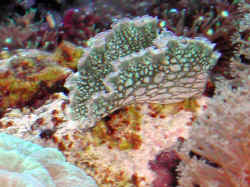
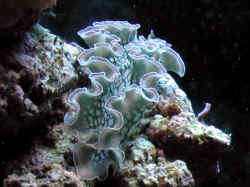
Lettuce Sea Slug
Hey Gang, Happy Holidays! Anthony, (or whoever's in charge of desktop pic on daily questions page), I took these pictures earlier today. I thought they might look good on the WWM site for the daily pic! Thanks from Denver! Stormbringer.
<What a coincidence... I was just scanning an Elysia (Tridachia) crispata yesterday... Your digital pix are better than my analog. Thanks for sending them along. Bob Fenner>

Sea Slug ID (12/23/2003)
Howdy wet ones! <Greetings. Steve Allen here.>
Question for you.  I found this sucker crawling around the tank last night.  I assumed he is a sea slug and not a flat worm.  He was a few millimeters thick, about 1.5" long and had what looked like eyestalks on one end, like a snail.  Don't know if there were eyes on it or not though.  I can't imagine it can be a snail could it, without a shell?  He looks like a stomatellid snail without the shell.  I have many of those in my tank.  Wait a minute, I am reading in my "Reef Invertebrates" book right now that they can have a shell completely hidden within the mantle, hmm... But can they get this long?  He moved kinda quickly which is characteristic of the bunch.  Anyways, the picture is not real good, hard to get the camera to work with the flash in the dark.  Any ideas if it is sea slug vs. flat worm vs. hidden shell Stomatellid? <Looks more like a sea slug to me. You might want to check out this site and send the picture to them: http://www.seaslugforum.net/welcome.htm
Thank you as always and Happy Holidays! <Same to you!>
Paul

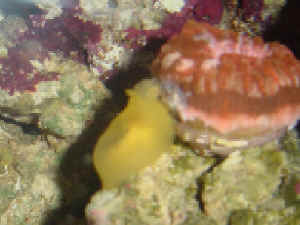
Carnivorous Slug 1/30/04
Hello,  I hope your doing great.
<Hi Steve!  Adam here.  I'm great!  Hope you are too.>
Last night I happened to take a look at my reef tank through a video camera with a night scope.  I noticed that something large, as big as my thumb, was on my button coral. I turned on the lights, and it was a yellow Nudibranch.  I think.  Can you tell me by the picture if this is a coral eating slug and what kind it is?  It looks as though it did damage to the button.  I just lost a bubble coral recently, and I never lose my corals.
<You had it right in your subject.  The critter is more likely a slug than Nudibranch.  Nudibranchs almost always have cetae ("Frills").  Although most Nudibranchs are destructive predators, the same is rarely the case for slugs.  I would want to be certain that this beautiful critters is predatory before removing it, but I am fairly bold that way.  If you are fairly certain that it is causing damage, you should be able to catch it in the act at night and remove it.>
Thanks for your help!  Steven O. Garcia <Good luck!  Adam>

Carol at Ocean Rider, Hawaiian Sea Hares, pix of same
Hey Bob,
<Carol!>
So last time you called I got your message the  day after the party. What is with that? Did we misbehave at the last gig????
<Heeee! Not enough!>
Call my on me cell next time at 937 XXXX.
<Will do>
Hey I am working on a new web site with an invert section.  Do we have Aplysia juliana or californicus here in Hawaii?
<Juliana is, and a few others... See Hoover's "Sea Creatures" pp. 149-153...>
I thought it was  Juliana but then someone said they don't ink which ours definitely do! I need a nice photo of one too if you have one.
<I just looked... don't have a decent pic of any of the Hawaiian species!>
Aloha and Cya soon??
<Yes! Coming over next month for a few weeks. Will definitely call... maybe we can all go out diving... to find, take pix of Anaspideans! Hello to your husband and the boys. Bob Fenner>
Carol

Nudibranch photos  - 03/05/06
I wonder if this Nudibranch is similar to the one Arthur found on his pipe organ coral (email answered by Anthony on nudifaqs.htm page).  Found this swimming around in our quarantine system when we were finished unloading a shipment from Indo.  Enjoy.
<Don't know, but it's a beauty! Bob Fenner>


Featured Sponsors:
Google
 
Web www.WetWebMedia.com

Amazon Honor System Click Here to Pay Learn More