|
|
| Home | Marine Aquariums |
Freshwater Aquariums |
Planted Aquariums |
Brackish Systems |
Ponds,
lakes & fountains |
Turtles & Amphibians |
Aquatic Business |
Aquatic Science |
Ask the WWM Crew a Question |
| Please visit our Sponsors | ||||
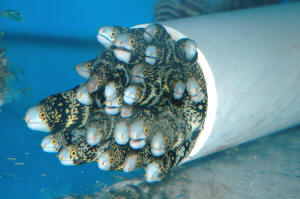
snowflake eel mating? 7/20/11 Snowflake eel concerns -- 11/24/09 FAQs about Snowflake Moray Eel Disease/Health -- 10/22/08 Hi WetWeb Crew <Hello Katie.> I have had a snowflake eel for 2.5 years (from about 20cm to 40cm long). For the first year he was very active and got very excited at the first smell of food entering the tank. He ate anything and everything. He loved mussels, prawns, squid and Krill (fortified with vitamins). For the last six months he has been very reclusive and fussy with food. He spends most of his time hiding behind rocks in his conduit home - he used to be a lot more social. He used to come and eat out of my hands at the top of the tank. Now I have to take the food and put it in front of his face. He won't take the mussel or prawn anymore, but will eat squid and krill. About six months ago the area on the top of his head became white. This white area is getting larger over time and I am getting quite concerned about him. <Understandable, can be serious, fatal.> He doesn't come out much anymore and doesn't seem to have much energy. Do you have any idea what is wrong with him? <You did not mention the size of its tank, water quality or co-inhabitants. Check the water quality first. Long term declining health is often related to bad water quality. Nitrates should be below 20 ppm at least. If they are not, do a series of water changes until they are and re-think your filtration system. Also check pH, which should be above 8.0 and the salinity. If the nitrates are below 20 ppm all the time and the other parameters are okay, too, I would consider a lack of nutrition. All the foods should be soaked in vitamins at this stage, and personally I'd stop feeding krill until its health improves. In addition, it does not have to be fed every day, feeding every few (2-3) days is fine for a 40 cm moray.> (I don't actually know that it is a male - looking through the thread though it's interesting that everyone thinks their eel is male!) <The small Echidna nebulosa are mostly females, larger ones often males. Size is not a 100% gender indicator. With a little experience you can see if you've got a male or a female by looking at the front teeth. Males have longer front teeth with fine serrations. That seems much more reliable than size.> Many thanks for your help. Regards, Katie <Good luck. Marco.> Breeding snowflake eels Since I am going to take your advice and go with the snowflakes, how many would be able to fit in a 55g? <that would be relative to size and time held there. Many juveniles when small but alas this will not help you. They do not pair up or life-mate conspicuously as some other fishes do. And as such, two adults at 18-24 will be perhaps too much bio-load for a 55 gallon aquarium if fed well enough to be kept in breeding condition> I would like to get about 5 of them cause my chances of having males/females would be greater. <agreed on the statistics, but I have no idea on how to help you sex or find a pair> Also what is there temperament like? <overall very well behaved> Could I stick my hands in the tank? <usually yes, but all eels must be respected and watched carefully> I am going to try and use the wooden squire to feed them off of cause I would know they were eating and it would also be neat. I Will get to work on this. Thanks a lot! <agreed... feeding tongs and skewers are always recommended with eels> John P.S. Any extra advice? <alas, no my friend beyond good fish husbandry (varied diet, superb water quality, large aquaria, etc)... you have the exciting challenge of being a pioneer to teach us all! Anthony> Snowflake Info Anthony, I may have some help for you. Considering all of the advice the WWM crew gives me, I figured I could return the favor. <much appreciation!> I know little about corals, plumbing, etc., but I know snowflake morays very well. I have had my present specimen for seven years and a previous one for two. John wrote you yesterday asking about sexing them. They are suspected to be protogynous hermaphrodites. <ahhh, yes... many eels are hermaphrodites. I did not know this about snowflakes> Basically, there is a school of thought that some Snowflakes apparently "change" into males at about 17", their teeth become sharper and more serrated in the upper jaw than females. Have him read Scott Michael's Reef Fishes Vol. #1 for a good outline on this species. Michael refers to this tooth phenomenon. <excellent reference!> I had read a slightly different account of this elsewhere also. My snowflake is approx. 28", and I have noticed that the teeth in his jaws and roof of his mouth have indeed become more sharp, in the shape of arrowheads. BTW, this change occurred sometime after he reached 20" -- <very interesting!> I didn't notice specifically when. I cannot state that "he" is actually a male, as I have not attempted breeding him. <try placing a TV remote control on one side of the tank and see what side he migrates to :p > Also, reassure him that Snowflakes are indeed quite mellow 95% of the time, never bothering other tankmates. I can handle mine in non-feeding situations. However, at feeding time they often get very boisterous, snapping at everything in their search for food. I've been accidentally bitten a few times and instantaneously released after mine realized his error, but nonetheless he drew blood. An adult's jaws (not just the teeth inside) are sharp and unbelievably strong. <not to mention remarkably unsanitary... needs good medical attention often> Feeding tongs are certainly advised if he intends to feed several at once. FYI, they love supermarket squid, scallops and shrimp (fresh, not canned). Buy a 1/4 lb. at a time and then toss in the freezer to kill potential parasites, etc. before thawing out portions to feed. <excellent point about freezing... and yes, Squid (tentacles!) are especially stimulating to eels> A great animal! Hardy and long-lived too -- mine was 17" seven years ago, so he's probably 10+ years old and showing no signs of advanced age. Wish John the best of luck. <your kindness will be repaid in kind I'm sure... thank you> Anthony, one quickie for you: I know you dislike siphon overflows and powerheads, <true for most tanks yes> but I will need more circulation in my tank upon its redesign...Long story short, I cannot drill a 2nd overflow. So, which is the lesser of two evils for circulation only, two Tunze powerheads or a siphon overflow hooked up to an external pump? <the Tunzes are AWESOME! And I would NEVER sleep well in a house with a siphon overflow system... too many overflows and fires/hazards> I'm leaning toward the Tunzes due to fear of potential siphon or return line leakage/spillage someday. <failure is inevitable in the 3 year picture for most overflows... really the 1 year for most> If you prefer a siphon, which brand for a 180g? <I literally wouldn't take a siphon overflow for free... rather pump up to a refugium and use the display for a sump to get max flow in a two tier system> Thanks. Steve w/Predators. P.S. The Ginas from Providence told me they are immune and unafraid of your "garlic force field" :) <outstanding... now if we can only find some that are attracted to men of Mediterranean extraction that look like they are wearing Mohair pajamas with their shirts off. (Ha! Chia pet chest) :P Kindly, your furry friend... Anthony> Snowflake Romance Hi <Hi, Mike D here> I was wondering if you know anything about Snowflake eel reproduction?<Not as much as I wish I did. I've been told that Snowflakes are protogynous hermaphrodites that change sex as they go through various stages of their life, much like groupers and wrasses.> I have a Snowy who has become rather active, before I was lucky to see him, but now he swims in and out of the rocks apparently looking for some thing.<This behavior seems to be related to growth and security more than sex, with larger animals having more self confidence in their ability to take care of themselves, particularly in familiar surroundings.> He is eating and looks fine and I have had him for over 2 years now.<The age would seem to indicate that it's at or approaching sexual maturity.> Is there any chance he is looking for a mate? It is spring here in Australia.<That's always a possibility as spawning urges are often triggered by the length of the daylight hours. It's quite likely that the presence of another, older Snowflake would be the final factor involved, but if they are like many other eels the probability of captive rearing is extremely remote due to their complicated and extended juvenile stages.> Cheers Jess |
|

|
Features: |
|
| Featured Sponsors: |