|
FAQs about Snowflake Moray Eel
Disease/Health
Related FAQs: Snowflake Morays 1, Snowflake Morays 2, Snowflake Eel
Identification, Snowflake Eel
Behavior, Snowflake Eel
Compatibility, Snowflake Eel
Selection, Snowflake Eel
Systems, Snowflake Eel
Feeding, Snowflake Eel
Reproduction, Moray Eels, Zebra Moray
Eels, Moray Identification,
Moray Compatibility,
Ribbon Moray
Eels, Freshwater Moray
Eel FAQs. Moray Eels in
General, Moray Behavior,
Moray Compatibility,
Moray Selection, Moray Systems, Moray Feeding, Moray Disease, Moray Reproduction,
Related Articles: Snowflake Morays, Zebra Morays, Ribbon Morays,
|
|
|
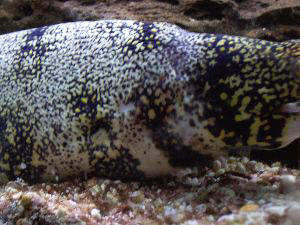
Snowflake Eel Swollen Snout 2/19/18
So,
<Hi.>
my smaller snowflake eel has a swollen snout as you can see from the picture.
<Actually I can't.>
I'm guessing it's like a swollen sinus for something. But I'm not sure. He is
still eating great and water quality is pretty much perfect due to it being a
macroalgae tank.
<Sounds good.>
Do you have any idea what this is?
<Swelling can be the start of an infection, but as noted above I can't see it.>
Is there a way to treat it? So far I am dosing Seachem Stressguard and vitamins
in case it is some sort of infection.
<Yes, dosing vitamins to the food and providing a perfect water quality is what
I would do here.>
Thank you. Jinoo Kim
<Good luck. Marco.>
|
 |
|
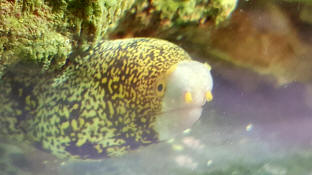
Re Snowflake Eel Emergency 2/22/18
Hello, this is Jinoo Kim. I have talked to one of you guys about this
situation before, but it wasn't a big deal.
<I remember.>
Now it is. To recap, my eel has a swollen snout which appears to be
mainly around the nostrils. My eel has been a lot more sluggish, losing
a lot of yellow coloration, and can't even sense the food in front of
him. He even looks smaller in general. I have been dosing a lot of
vitamins (thiamin and Vitamin B especially), but I don't know if it is
doing anything.
<Vitamin B1=thiamin, which is important, but other vitamins are
important, too. Have you been feeding a varied diet with crustaceans,
fish and bivalves, maybe cephalopods?>
Hopefully the picture uploads as it hasn't in the previous message, but
I do need an answer.
<It did upload, but I could not see the swelling.>
Thank you.
<If the eel is still eating try adding a more complete vitamin mix e.g.
Vita-Chem to the food. If the situation gets worse you might be dealing
with an infection, which could require a treatment with an antibiotic
(Maracyn or comparable) preferably in a hospital tank. Also see
http://www.wetwebmedia.com/snoflkeeldisfaqs.htm for similar cases.>
Jinoo Kim
<Good luck. Marco.>
|
Snowflake Eel question... feeding f'
7/11/16
Hello!
<Hey Shawn>
I have had a snowflake eel for some time now and I'm having
problems getting it to eat at the moment.
<Oh... what have you been feeding? Some food strikes are common w/
Muraenids, but... many times they're resultant from nutritional
deficiency syndromes>
The snowflake is about 30 inches long
(I've had it since it was about 6 inches or so)
<Neat!>
and resides in a 125 gallon tank with lot of live rock and 4 tank mates.
He has had very long stretches of not eating in the past (6 to 8 weeks)
and then binges of eating 2-3 shrimp every day.
<Yes; not atypical>
This is the longest stretch without eating, possibly 12 weeks. I'm
trying different proteins and he seems to react the best to fresh raw
shrimp.
<Needs more than this. AT LEAST the soaking of food in prep.s... Like
SeaChem's "Vitality">
Here's the thing: He often goes for the shrimp but every time he takes
it he ends up letting go and not actually eating it. Any tips to get him
eating again or suggestions of what may be happening here?
<See WWM re Vitamin and HUFA et al. supplementing... I'd also double
dose the system w/ iodide-ate>
Tank parameters are all in acceptable ranges but the temperature swings
up in the summer heat (maxes around 85 degrees). No tank mates are
messing with him.
Shawn Wasson
<Please keep us "in the loop" here. Bob Fenner>
Snowflake Eel question... Marco's go
7/12/16
Hello!
<Hi.>
I have had a snowflake eel for some time now and I'm having problems
getting it to eat at the moment. The snowflake is about 30 inches long
(I've had it since it was about 6 inches or so) and resides in a 125
gallon tank with lot of live rock and 4 tank mates. He has had very long
stretches of not eating in the past (6 to 8 weeks) and then binges of
eating 2-3 shrimp every day. This is the longest stretch without eating,
possibly 12 weeks.
I'm trying different proteins and he seems to react the best to fresh
raw shrimp.
<Needs more than just shrimps. Please read
http://www.wetwebmedia.com/ca/volume_6/volume_6_1/thiaminase.htm.>
Here's the thing: He often goes for the shrimp but every time he takes
it he ends up letting go and not actually eating it. Any tips to get him
eating again or suggestions of what may be happening here? Tank
parameters are all in acceptable ranges
<which are? Check for pH (8.0-8.2) and low to medium nitrates (<<30 ppm)
and correct if necessary.>
but the temperature swings up in the summer heat (maxes around 85
degrees).
No tank mates are messing with him.
<Check said water parameters and try to carry the diet. Mine always went
crazy for cockle (Cardium spp.) and other bivalves. Also read
http://www.wetwebmedia.com/snoflkeeldisfaqs.htm for similar
cases. Good luck. Marco.>
|
Snowflake Moray -- Disease 1 1
16
Hi Team,
<It's taken seven plus min.s to download one of your pix here in Roatan. WHY
don't you, others follow our directions?>
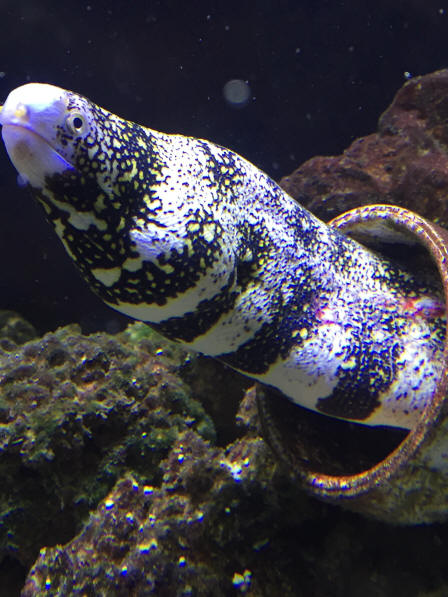
Happy Friday! I am writing to you in regards to a snowflake moray I have kept
for nearly 4 and half years. She has recently come down with what appears to be
Head and Lateral Line Erosion. I was able to get a good look at the length of
her body this morning and there appear to be red lesions along the majority of
her lateral line. Recently, I had to adjust my pH (which was scarily low at 7.9)
and raised it back to 8.3 safely using a buffer. Could these lesions maybe be an
acid burn? Or a parasite?
Melafix has been added to the tank.
<Worse than worthless. SEARCH this on WWM, actually READ>
She has not been eating well for about 2 months now. Pictures of the lesions are
attached. She is still breathing under 60 breaths a minute although her breaths
do look labored. She has been fed a mix of ghost shrimp, krill, and
silversides over the years soaked in VitaChem.
<And re Thiaminase poisoning>
Water Parameters:
Nitrite: 0
Nitrate: 25ppm (Yes, I know this is a bit high. Doing a water change!)
Ammonia:
Gh: 180ppm
Kh: 220ppm
Ph: 8.3
I also stumbled upon this paper associating activated carbon with HLLE.
I do use carbon in the system so I'm wondering....
http://coralmagazine-us.com/content/activated-carbon-hlle-smoking-gun-found
<Mmm; nah. Keep reading re. The etymology of this symptom has been discussed
heatedly (at times) for decades.... many contributing factors.... water quality,
nutrition, "stress", some Protozoans possibly involved..... And do READ re
Echidna health period on WWM; inclusive of goiter. This fish's throat is
overly expanded. I'd be treating the water (and possibly foods) with iodide-ate.
Bob Fenner>
Any advice/thoughts you have are greatly appreciated!
Last thing I noticed is that there appears to be clear mucus-like strings of
about 3-4" coming off of her body. Is this her slime coat (and an immune system
response?) or is this perhaps a sign of a parasitic/bacterial infection.
Best,
Nathalie Rovall
|
 |
|
Re: Snowflake Moray -- Disease
1/4/15
Hi Bob,
<Hey Nate>
Thanks for getting back to me! My apologies for the slow picture download.
The snowflake eel is being treated with Maracyn after detecting a possible
fungal infection with the lesions.
<Mmm>
I am going to try to address each of the theoretical causes of HLLE and see how
the eel responds.
<A logical approach>
So far, her breathing has become more normalized and a few of the lesions appear
to have stopped expanding.
Question: I know that fish with HLLE often die from lack of eating. It's been
several weeks that she hasn't eaten. Any recommendations?
<... the Thiaminase and Goiter reading. Stat>
Garlic doesn't seem to entice her. Should I be considering force feeding?
If so, how to go about...
<Read. BobF>
|
Snowflake Eel / Red Around Mouth... no data
9/28/14
I've had a snowflake eel for about three years that has always acted
very normal.
<...ly>
Over the past two weeks has been hiding in the bottom and not feeding
much. When he did come out today to eat… I noticed a red color on his
cheeks, on both sides of his head. Would this red coloring have anything
to do with his recent hermit like behavior.
<... Who can/could state; given the information (lack of) proffered?
Have you read what is archived re Echidna nebulosa on WWM? Do so. Bob
Fenner>
snowflake eel and fish in shock
11/27/12
We came home from a week long vacation to find that our heater quit
working and our tank was extremely cold. Our snowflake eel and
fish are in shock.
Our eel is stretched, leaning backwards, and looks as though he is
breathing only from the right side. Our tomato clown and trigger
are really lethargic, and laying sideways. We did a 50% water change out
and got the temp back up to where it should be.
<Very good.>
Our PH, nitrate, and ammonia levels are where they should be. Is
there anything else we should do? Please help.
<Do measure ammonia and pH once or twice per day for the next few days.
Cold temperatures can kill off bacteria as well as (in)vertebrate life,
which can lead to high levels of organic pollution and a new cycle of
the system. If you have any corals or other larger invertebrates in
there, which seem clearly dead remove them. Also have enough salt at
hand in case this happens. If you measure any ammonia do another water
change and provide sufficient oxygen supply, because of apparent decay
processes.
Severe die-off and a new cycle is one extreme of what can happen. If you
are lucky you may notice nothing or only a small diatom bloom and might
find you fishes back to their old-self within a day or two.>
Thank you,
Cassandra Gaskins
<Good luck. Marco.>
|
Snowflake Eel has white nostrils. 8/5/12
Hello, I've recently noticed that my eels nostrils have turned white. Pretty
sure they were bright yellow when I got him.
<Yes, they should be yellow. At least they are on the pictures I have,
including quite old specimens.>
He seems perfectly fine though. Behavior has been the same since day one.
I'm just curious as to why they would be white. I've attached a photo. Sorry
for all the microbubbles. Breaking in a new skimmer. Any insight on this
will be greatly appreciated.
<Can only speculate. Sometimes bacterial infections are accompanied by a
loss of color, white patches. I'd recommend to check the water parameters
and diet (see FAQ on Snowflake eels).>
Thank you. –Adam
<Keep us updated if more white appears or if the yellow is restored at some
point. Cheers, Marco.>
|
 |
Snowflake Eel help (echidna nebulosa)
6/17/12
Hello Bob or others,
<Would be waiting on Marco (resident Muraenid expert); but see your two
following emails...>
For the last few days i have noticed my Snowflake Eel has been acting a
little lethargic and what i would describe as a bit 'off'. I was
on vacation for a week and had my stepfather feed my fish while i was
gone, but due to the slightly complicated nature of feeding the eel, i
had him only feed the fish because i only feed him ever 5-6 days or so,
so i wasn't too worried.
When i got back, i attempted to feed him- but failed. he would not eat.
so i just dismissed this as him possibly going into one of his hunger
strikes like i read about on the net. This morning when i got up
and turned the lights on, he was coiled up at the front of the tank,
head upright and breathing, but more labored than usual. i also
have noticed he has been 'twitching' once a minuet or so since i have
been watching him. it looks like he may have a
'bump' or larger portion of his body, could be inflamed..?
<Something... did it get poked (as by a Lionfish, or?>
Water params are normal, nitrate around 5-10, 0 nite/ammo, ph 8.3, temp
79.
He shares a 90g tank with a Blue Mandarin and a serpent sea star. ( my
other tankmates are QT at the moment )
His usual diet consists of mainly Omega One freeze dried shrimp, and
small silver sides chopped up ( the eel is about 14'' long, so he cant
take
a full silver side) Could this be thiamine deficiency?
<Perhaps a factor>
What should i do for treatment/ curing the poor thing?
<I'd be moving it elsewhere if you have such. Bob Fenner>
Snowflake Eel help (echidna nebulosa) 'Continued'
6/17/12
The situation has worsened I'm afraid. i have now observed a few
heavy thrashings while laying on the bottom of the tank, he looks to
have 0 energy and is laying on the ground in full sight, not even
attempting to retreat to his burrow. i noticed him laying with his
'face' sideways, on the ground. If i had to guess i would say his
behavior points that he is in some sort of pain..?
<From what cause?>
and the lump in his 'stomach' has me wondering: is it possible he
swallowed a snail or perhaps worse- a hermit?
<Maybe...>
Is there anything i can do to 'alleviate' his pain or otherwise?
<Perhaps the addition of a few teaspoons of Epsom Salt...>
Im currently mixing 30 gallons of water for a water change to
absolutely rule out water
quality.
<Good. BobF>
Re: Snowflake Eel help (echidna nebulosa) 'Continued'
6/17/12
After watching longer, and closer now, it seems he is coiling and moving
to alleviate pain? (he was laying upside down for a few minuets, moving
his body around and then would lay still for a few minuets and then
twitch, and then try to find a new position to lay still again)
Its my belief that he has ingested either a hermit or a snail, shell
whole. What is the end of the eels digestive system? are the able
to pass 'larger' items or will he have to 'vomit' up this obstruction if
that is what this is?
<Not much one can do in these situations... the water changing, MgSO4...
B>
Re: Snowflake Eel help (echidna nebulosa) 'Continued'
6/19/12
Any chance for an update or a picture if this eel is still alive? You
note an inflammation on the bump in your first email? If you can confirm
this, you may have to treat the eel in a hospital tank with an
antibiotic such as Maracyn 2. Your water change and the possible use of
Epsom salt have already been noted. Swallowing a snail or hermit would
be no problem for a snowflake eel. The twitching and the bump, potential
inflammation however... I'm suspecting an infection not totally uncommon
with Echidna eels (see WWM for similar cases), which can easily be fatal
if not treated at an early stage. Good luck. Marco.
Snowflake Eel help (echidna nebulosa) Follow-up
6/21/12
Hey bob, bad news.
<Marco here.>
The Snowflake died, confirmed at 4:21 Central standard time.
<Sorry to hear.>
The details surrounding his death are still unknown. Is there anything I
should / can do with the specimen?
<At this point probably not. You could have it be examined by a
qualified vet, maybe he would find the cause of its demise, maybe not.
My guess as noted in an earlier mail is an internal bacterial infection,
see WWM (Snowflake eel disease) re similar bumps on E. nebulosa.>
A very sad, dark day this is, I'm deeply upset at his untimely death...
<Understandable. Take care. Marco.>
Snowflake eel-thiamine deficiency?
11/2/11
Hello WWM,
<Sharr>
Our snowflake eel stopped eating about three or four weeks ago, but
after doing some research online we found out not eating was
common.
<Yes>
As we have been watching our eel and trying to feed him we noticed he
gets these flashes of breathing really hard and thrashing his body
around almost like he has paralysis. We found your website and came
with a possible conclusion
that he could have a thiamine deficiency since we have only
been feeding him frozen silversides.
<Mmm; yes>
Our tank has been up for over a year. We don't have any numbers for
our water conditions but all our other fish and anemones
<Generally a poor idea to house Muraenids and Anemones together; the
former being so blind, oblivious that they touch the latter>
are doing great and our eel was doing good <well> for about five
months before this started. We were able to catch him and put him in a
separate tank by himself with fresh, clean water hoping that this will
help him want to eat again. We are going to buy the Vitamin B you
mentioned to start soaking his food in.
<Good>
Is there any advice you can give us about bringing him back to the
snowflake eel we had a few months ago or anything else we should/need
to do?
<Do look into offering ghost/glass shrimp, live... that you can
gut-load>
Is there anything we need to add to his tank that will help him?
<I'd also add a bit of iodide/ate to the foods, water on a
weekly basis>
Thank you,
Sharr and Kyle
<Welcome. Bob Fenner>
Re: Snowflake eel-thiamine deficiency? 11/2/11
Thank you for the information! Where can we get the iodide/ate
from?
<Sold as commercial prep.s in the trade; e.g.:
http://www.seachem.com/Products/product_pages/ReefIodide.html
BobF>
|
Snowflake moray jaw dislocated
9/10/11
Hi and thank you for exceptional source of info for marine
aquarium
<Hello and welcome Erja>
I have a snowflake eel that is about 14" long, bought him
around 5 months ago as a tiny baby. About a week ago I noticed
that his jaw is a little crooked, not aligning with the upper
jaw. See attached photo. I have been feeding him with cocktail
shrimp, mussels and squid. Until now I haven't been using any
vitamin supplements but since I have been reading wwm I decided
to order Formula 1 and 2 and will be giving him those about once
or twice a week.
<Good>
My question is if the crooked jaw is a cause of inefficient
nutrition or its dislocated is it possible that it will correct
itself in time?
<If this is the cause, this fish is feeding and if corrected
nutritionally, it may well do so>
If not, is there anything I can do other than keeping him
fed?
<Not really. I would not try straightening of the jaw
forcefully>
Thank you so much of your time and regards from Finland
-Susanna-
<Welcome. Bob Fenner in Fiji>
|
 |
marine tank, Eel ill from Bristleworm spawning
event? 6-10-11
Dear WWM crew, I have 2 questions for you. I have had an Snowflake eel
for 6 1/2 years. He was the size of number pencil when I got him. He is
now 3 feet long and 1 1/2 inches thick.
<Nice>
He has been very lethargic lately and I was wondering how long do they
live?
<Mmm, at least ten-twelve years>
My 6 line wrasse has been missing for a week and I believe he ate
it.
<Possibly>
Would that make him sick?
<Could>
Second question. Two years ago I added Bristle Stars to the tank and
last week a very strange thing happened. Literally hundreds of Bristle
Stars all exited their hiding places at the same time. They climbed to
highest points in the tank. They each postured with the center of their
bodies elevated away from the rocks and released white mucus in large
amounts.
<Gametes>
They then went back into hiding. What was that? Thanks for your
help.
<Spawning... whatever triggered this, or these sex cells themselves
might also be the root cause of your Echidna's malaise. I'd be
changing out a good deal of the water, spiffing up (cleaning) your
skimmer contact chamber and collection cup, utilizing a bit of
activated carbon in your filter flow path. Bob Fenner>
Snowflake Eel unhealthy?
4/3/11
Hi,
<Hello.>
I recently purchased a baby Snowflake Eel (8or9in) to live alone or
with a small hopefully eel proof tank mate in my 29 gallon Biocube with
plenty of space and a large rock full of great caves. He ate at the
store when I purchased him and was taking one breath every 2 or 3
seconds. I have had him for about 20 hours in my tank which is ready
with good quality according to my lfs water tester people.
<In the long run, you may want to learn to test the water
yourself.>
The tank is a bit murky as he has been digging the sand out of his cave
so he has more space and seems not very clear although I haven't
let it go for more than ten hours without moving
something, feeding something (my crustaceans), moving rock, evening
sand and such...
<I hope this tank was cycled with live rock for a few weeks. See
here: http://www.wetwebmedia.com/estbiofiltmar.htm>
He is now taking breaths every one second when I watch him why can this
be and what can I do to fix it?
<Probably low oxygen in combination with the new environment. The
standard Biocube tanks often don't come with a skimmer, which is a
very useful gadget when keeping moray eels by removing nutrients from
the tank other filters won't get as well as by adding oxygen.
It's not uncommon that hobbyists add skimmers to Biocube tanks. The
Oceanic BioCube Protein Skimmer is already adapted to this tank type.
Also, a little more surface current will be good for gaseous exchange,
also adding oxygen to the tank. This can be achieved by a circulation
pump/powerhead as they are made by Tunze (Nanostream 6025) or Hydor
(Koralia Evolution 550) to name just two examples. Such a pump can be
oriented parallel to the water surface in a depth where it does not
suck in air. As a short term solution for murky water and low oxygen,
you can do partial water changes.>
I am obviously upgrading my tank in a few months for him but for now,
he is my top priority of health and safety. I fed him once a chunk of
silverside and he only ate like half of it and not
the whole thing.
<Probably still stressed.>
Also, at the fish store I asked them to feed him before I bought him
and he ate an entire silverside. He regurgitated it on the way home in
his bag like a snake does I guess because he was stressed from the
move.
<Totally normal.>
I have heard about adding things to their food would this help? Please
any info or tips would be greatly appreciated thanks.
<First of all Silversides (and Krill as a matter of fact) should not
make up most of the diet of a Snowflake moray, you can use them from
time to time, but not at every feeding. A moray eel diet should be
varied to avoid deficiency diseases. Please see this FAQ for feeding
questions and diet composition:
http://www.wetwebmedia.com/snoflkeelfdgfaqs.htm . You should add
vitamins at least once a week (a eel of this size can be fed every two
days, if you want to feed every day use smaller meals). Cheers,
Marco.>
Re: re: Snowflake Eel unhealthy?
4/3/11
Thank you now he seems to be stuck in my Liverock but I can't
tell...
<A moray should not get stuck. Imagine if all the eels getting stuck
in coral reefs around the world... would be a very short lived fish
family...>
His head is poking out through a little cave but his head is coming
like straight up through sand I am afraid he is crushed beneath the
large rock and don't know if I should lift the rock to make sure he
can move and risk harming him or should I leave him alone until morning
it is like 1am here and have to sleep what would you recommend?
<It probably is not stuck. If you feel totally unsure, touch its
head (with a tool!) and see if it reacts, moves, retreats or rather
fails to get away and panics (which would indicate it is
stuck).>
Waiting 8hours then trying to coax him out with food and risk leaving
him stuck or attempt to lift the 17lb rock and risk crushing him please
respond quick thanks a lot.
<To avoid tumbling rock, you can fix them e.g. with cable wraps to
build a stable reef structure. You can also incorporate some PVC pipes,
which often become the preferred residence of the eel. Feel free to
send an update in the morning.>
Re: re: Snowflake Eel unhealthy? Env., 4/3/11
He is ok! He has found so many holes and caves in my rock I never even
knew of. Thank you a lot.
<Welcome. Take care. Marco.>
Re: re: Snowflake Eel unhealthy? 4/3/11
He came out! good thing I waited... He is still breathing quite heavily
and at some times will tilt his head straight up and open his mouth
almost like a snake regurgitating its prey when it has to run but he
doesn't regurgitate anything and eats well...
<Lack of oxygen. Feeding won't help here.>
My tank is a 29 gallon the nitrate levels are a bit higher than
recommended for a long period of time and said that may be it.
<You should correct this.>
I also noticed when I feed him some live freshwater ghost shrimp, he
regurgitated it partially then swallowed it back. His head kind of
twitches when he does this and I don't know why.
<Still, lack of oxygen. I would not feed the eel for a few days (not
a problem for it) until you get this problem solved.>
What can I do to help him?
<See past emails. Water changes, skimmer, surface
agitation...>
I moved the filter pump so it shoots a little air around and water
breaks the surface a bit but that hasn't helped. I got some Nutra
Cycle Organic Waste Remover designed to help break down his large
"fecal-matter" and help with the tanks cleanliness.
<Won't help much here.>
I also added three hermits and am getting a serpent star on
Thursday.
Anything else I can do? salinity is around 1.023 and temp is 80. Thanks
a lot! I have also added a Blue Damsel so I can see how he acts around
small fish (it is bigger than he can swallow but still...).
<Can be missing all of a sudden at one point. Won't help much
with the prognosis if other fishes are eaten.>
The Clownfish I talked about earlier is apparently a Platinum Clown it
is 300 dollars and genetically made pretty crazy looking fish I might
send a pic when I start looking more into putting Clownfish in my tank
and have questions. Oh yes, do you all think that a fifty five long
would be okay for an eel, anemone, clownfish, serpent star, and
possibly a dogface puffer?
<Well, I certainly don't. A dogface puffer is a big (almost one
foot) and massive fish that even for itself should not be kept in
anything below a 125 gallon tank (and with tank mates you'll need
much more space). The moray will also need more than 55 gallons in the
long run, have you ever seen an adult of this species? In addition, I
noted that they can eat Clowns especially after their gender change in
an earlier mail already...
>
Thanks a lot. Sorry for grammar. I know the rules but I have been
really really busy these past weeks...
<If you want us to answer you, we want you to take the time to use
proper grammar and spelling. Simple as that. I'm no native speaker,
but I still I saw "alot" to correct. Marco.>
Re: re: Snowflake Eel unhealthy? 4/7/2011
The fish are all doing fine. The eel is down to one breath for two
seconds now is this healthy?
<Appears so.>
The hermits are hard at work as well. I am still not sure how I can
remove fish waste in the tank the chemical I got hasn't been very
helpful so far.
Are there any sea creatures who eat fish and eel faeces?
<Hermits, Serpent stars (as noted in an earlier mail) are the most
easy options here. However, they'll only turn fish faeces into
their own faeces, nothing is removed from a tank.>
I would love to have one of them. Also, My water is a little bit
murky.
<You are already experiencing problems of relatively high bioload in
this small tank and think about adding more bioload...>
Is there any common thing you would recommend to help fix this? I
looked around my LFS but found only treatment for saltwater.
<See earlier emails... skimmer, etc.>
Do you think the inhabitants of my tank would be alright together in a
55 gallon tank in December? That is when I plan to upgrade and want to
have all of the animals so far (read last message).
<Well, for some time surely, but not as a long term (>3 years)
solution).>
I have seen Snowflakes living fully grown five years old in Bio
Cubes
<Which I doubt... or at least the word "living" has to be
replaced by "being cramped". As adults these eels are almost
twice as long as this tank is wide as the tank...>
so I don't understand the problem if they are given good caves and
few tank mates... Please explain why they can't because I have
actually seen them on the internet
<Oh well, I've seen a lot of thing on the internet I would not
recommend to do at home...>
and a man at my LFS said he had one for four years in his Biocube then
it fell out on the floor and died because he left the top off to cool
it down a bit. I don't mean to contradict you all but I have
heard/seen of it working and believe me I know you all know way more
than I, I just want to know why.
<The natural life of moray eels is known from research in the coral
reefs as well as long term experiences in zoos and private aquaria. The
spaces, crevices they live in are small compared to what space other
fishes use, but not smaller than their own size. Generally, they have
not one, but a small number of caves, something given the adult size of
these eels never can be done in a 29 gallons the conscientious way.
Also and probably equally important, you will get severe problems with
water quality when properly feeding an adult eel in such a small volume
of water, which will lead to health problems and ultimately a short
lifespan. However, it's your decision. I'm sure you'd find
some internet forum where you'll be endorsed for having a E.
nebulosa in a 29 gallon tank, but not here. Do as you please, feel free
to go elsewhere, if you don't like the advice here, but in case of
problems also stay there. I hate to say: I said so.>
Also, would it be a good idea to add a Black Sea Serpent Star on
Thursday and a few Blue Hermits?
<Yes, they can be useful as a clean up crew, but don't overstock
them, because if you have to feed them additionally you create another
source of nutrients. Cheers, Marco.>
Re: re: Snowflake Eel unhealthy? 4/7/2011
My tank water is all good
<Need proper numbers here... "all good" is very
unspecific. In the last email you described the water as murky.>
and I feed my Snowflake Eel cocktail shrimp, Ghost Shrimp, and silver
sides. He is twitching his head fast to the left in a jerky style every
10-40 seconds when I turned my lights on I couldn't see him when I
turned
them off so idk. Why is this happening?
<Can be related to slime coat problems, which can be related to
water quality problems. Can go away if the quality is improved. Also
see the WWM Snowflake disease FAQ for similar questions and other
reasons...>
His breathing seems normal and he looks fine I fed him every day until
today I decided to wait a day I have had him almost a week he lives
with a purple lobster coral banded shrimp
<<Incompatible mix. RMF>>
and blue damsel in a 29 gallon tank and is 9-11 in long. What can I do
is it permanent?
<It shouldn't.>
Help! I thought I was feeding him good variations...
<Yes, you also should add vitamins to the food about once a
week.>
Is this reversible.
<My guess as noted above: Water quality... so yes.>
Help me please.
<Take care. Marco.>
More: re: Snowflake Eel unhealthy? 4/7/2011
lives with a purple lobster coral banded shrimp
<<Incompatible mix. RMF>>
<Yes. I told him very clearly in an earlier email, the lobster is
already missing a claw... Won't work long term. Apparently not
reading type of customer. Marco.>
>Ah... yes. A pity. Cheers, BobF<
Snowflake moray; dislocated jaw --
09/13/10
We have a snowflake moray eel that appears to have a "dislocated
jaw".
<Picture?>
Is this possible?
<Yes. Can happen in fights for example. Is not even uncommon in zoos
-- I see it quite often where several eels are kept together and are
not fed with enough caution. Solve the problem, which led into this
condition. Can also be a secondary result of an inadequate
diet.>
He is having difficulty eating since his jaw does not close
properly--that is, he looks like Popeye with his "crossed over
" jaw. I feed him dried krill using a stick and break it off into
small pieces.
<Not a good food. Try mussels or clams without shell. They are a
rather soft food. Krill is not useful as a main staple at all and can
lead to deficiency diseases such as neural problems -- and talking
about jaws: possibly lock jaw.>
Sometimes he manages to swallow some, most often he is unable to
manipulate the krill and loses it. Is there anything possible to
"relocate" his lower jaw bone?
<Yes (complicated, needs a sedative, only recommended to vets) , but
might 'pop out' again if not rested properly.>
This morning it appears to be back in place but once he opens his jaw
to receive food it pops back out.
<That's what I'm thinking.>
Is he in pain?
<I don't know, but it certainly this is not a very pleasant
experience.>
Thank you for any suggestions.
<Do try feeding a larger amount of a vitamin enriched adequate and
soft food. Next, don't feed the eel for at least 1 week (if small)
or 3 weeks (if large). This damage does not have a bad prognosis, even
if it persists. I know from captivity and nature eels with dislocated
jaws, broken jaws, even missing large parts of their jaws, which are
still thriving. But it will need a good diet and clean water. Cheers,
Marco.>
Red Chin on Snowflake Eel 6/25/10
Hello,
<Hi Jean.>
Please excuse my oversight if this is already posted but I did search
WWM for a while and did not find previous post to match my question.
Our 24" snowflake eel has been in terrific health for the past 3
years (we got him as a "baby" at approx 6" long). In the
last two weeks he has developed a pink chin but has no other areas of
discoloration. He's also been quieter overall and less active
during the evening/night when he usually swims all
around. Our system is a 125 gallon Uniquarium and tank mates are 1
cowfish, 1 tomato clown, and 2 blue devil damsels. The diet consists of
frozen squid, clams, and Mysis shrimp.
<How can a 24" eel eat Mysis? Perhaps you mean some larger type
of shrimp such as Krill or Prawns.>
The only suspect I can see from reading all of your posts is a possible
vitamin deficiency, perhaps?
<Yes, this or insufficient water quality (check for a good pH
(8.0-8.2) and low to medium nitrates (<30 ppm) and correct if
necessary. Be sure to add vitamins to each meal until the situation has
improved.>
Lastly, my husband recently battled some form of red hair algae that
grew on the sand and then rocks with hair-like tendrils. Could this
also be a suspect to make our eel appear to be wearing a bit of
lipstick?
<Depends on how they were battled... If they were exterminated with
chemicals it's very well possible depending on what was used and
the concentration.>
Your feedback is most appreciated. Thank you.
Sincerely, Jean
<Good luck. Marco.>
Snowflake Moray with intestinal blockage/rather
infection -- 06/13/10
Hello,
<Hi Jess.>
My snowflake eel has swelled through the midsection quite extensively
and also seems to be breathing a little more laboured than before. I
suspect thiaminase as the problem since I fed her a high shrimp diet
until recently.
<is a possibility.>
I have changed her diet but is there any other treatment I can
attempt?
<Such swellings are likely connected to internal bacterial
infections, although there are also nematodes that produce similar
growths. If you can get the eel into a hospital tank you still can try
treating it with an antibiotic such as Maracyn II. If it still eats
feed vitamin enriched food and also keep the water pristine.>
Thanks for your time, Jess K
<Also see http://www.wetwebmedia.com/snoflkeeldisfaqs.htm
for similar cases. Good luck. Marco.>
Snowflake eel, carpet surfing
5/23/10
I just moved my fish and live rock into my 75 gallon tank. It was about
a 20 minute ride for them all. Everything went well except my snowflake
escaped out of his Styrofoam box and fell a few feet during his
drip.
<Typical of these escape artists!>
I quickly gathered him up and got him back in his box, boy is he
slimy.
<You are lucky you did not get bit!>
They have been in their new tank for about 3.5 hours and I have noticed
that my snowflake his puked up his shrimp he ate yesterday morning.
Should I be worried?
<Though not the best thing for them, I would not be particularly
worried.
I have seen these things pronounced dead, looking like jerky come back
after being placed back in the tank. His reaction is not unheard of. At
the least he was very stressed here. Nothing to do except give it time
and a good home.>
Thanks Dave.
<Welcome, Scott V.>
Snowflake Eel issue -- 05/10/10
Hi Marco:
<Hello P.>
Thanks for weighing in on Nessie, my sick snowflake. Since I wrote two
weeks back, I've now seen her several times. I've also read
absolutely everything relative on your site...and on the web. I'm
still not exactly sure how she got here..but regretfully, she's not
getting better. We're now about 8 weeks into not eating (that I
know of). She had been "hand fed"...a bit of a misnomer..the
tank is too big to hand feed but I use long tongs to reach down to her
and she has usually come up to meet the tongs. Now when she sees them
she quickly pulls back, almost afraid of them. Her diet has always been
varied. Fresh mostly (shrimp, octopus, squid, mussels, clams, fish) but
some frozen as well.
<Sounds good.>
I've not added vitamins given the fresh and varied diet.
Her slime coat is definitely deteriorating. I now see that her backbone
is totally white. There are sections (1 inch in length) of her sides
that are also without pigment. Today, with a magnifying glass up to the
tank, I could see two small areas that I would term petechiae (although
I don't know if this is an appropriate term for eels). Most of her
body remains covered in a white-ish haze which has diminished her
snowflakes..minus her head, which looks perfectly normal. Her behavior
is a little bazaar, as well. She must be in great pain given her
"skin" condition. She thrashes her head in jerky motions,
finds spots in the tank that she's never hung out in...under
corals, or high up in the rocks instead of low in the reef.
<Yes, am sure the slime coat is very disturbing.>
I doubt she's "fixable" at this point...but is there
anything I can do to make her more comfortable...anything I can add to
the tank that won't hurt other inhabitants? If, and it's a big
if..I could remove her from this large system, would you recommend
anything else? I do have a hospital tank up and running at all
times.
<Yes. At this point I'd try an antibiotic such as Maracyn II
assuming it might be an bacterial infection not necessarily connected
to a week immune system. If you have access to a fish vet a sample of
the slime coat should be examined under the microscope to exclude any
parasites. Even in this case the use of an antibiotic should be helpful
to help cleaning any tiny wounds they left from harmful
bacteria.>
Thanks so much. P. Strong
<Welcome and good luck. Marco.>
Snowflake eel issue, fdg., hlth.
04/27/10
Hello There:
<Hi.>
I have a fairly large reef system..about 700 gallons. I've had my
Snowflake Eel, Nessie, for 7 years. She's surprisingly gregarious..
usually.. with a voracious appetite. Generally she'll eat two whole
shrimp, or chunks of scallops, or squid, every other day. I understand
eels can go for several weeks without eating...but we are now nearly 7
weeks without hand feeding
<Watch your fingers. I know a guy with a bad scar from an Echidna
nebulosa he hand fed for years'¦ He was lucky no important
nerve fibres were cut.>
and this is not normal behavior for her. Admittedly, in a tank this
size, there's plenty to snack on but she's always had a
welcoming relationship with the several cleaner shrimp, and none are
m.i.a.
She's fairly listless and seems to have some slim hanging off
her.
<Not so good.>
She's about 3 ft long, but the tank has about 300 lbs of rock so
it's a bit difficult to see her body unless she chooses to swim,
which she's not done lately.
Tank parameters:
NO2 0
NO3 0
pH 8.3
Phosphates 0 - .25
Calcium 420
KH 17
NH3 0
Salinity 34ppm
Copper 0
Temp 81
Magnesium 1240ppm
<Sounds all good.>
Any ideas on what's up?
<If the eel is having problems with its slime coat this can mean
severe trouble. Did you use vitamins on its food on a regular basis? If
you fed mostly frozen food, a lot of the natural vitamin content was
lost during freezing and thawing. This needs to be replaced. In
addition some marine foods may contain vitamin destroying enzymes, see
http://www.wetwebmedia.com/ca/volume_6/volume_6_1/thiaminase.htm
There's not much you can do in this case except keeping on to try
feeding and to watch out if further symptoms occur. Also see here for
similar cases: http://www.wetwebmedia.com/snoflkeeldisfaqs.htm >
How long do these eels live?
<The older ones I found were about 14. I'd say one Snowflake eel
year roughly correlates with about 6-7 human years.>
Thanks very much for any info and very much appreciate your
site...which is the best on the web. Sincerely, P.Strong
<Thanks for your kind words. Good luck. Marco.>
Snowflake Eel not eating w/cloudy eye -
03/28/10
Hello,
<Hi Heather.>
My 7 year old Snowflake Eel developed a glazy eye about a month ago. My
local pet store suggested I give it a little while to see if it goes
away on its own as it may have been a scratch.
<Usually no big deal if just one eye is affected.>
About a week passed and it hadn't gone away or improved. I started
medicating my tank (75g) with Seachem Sulfathiazole which is supposed
to cure bacterial, fungal, and protozoan infestations. I have treated
four times now and the eye hasn't improved but is also hasn't
gotten worse. It's only on one eye. All other tank inhabitants are
healthy (butterfly fish, serpent star, coral banded shrimp, reef
hermits, tuxedo urchin). Over the course of two weeks his appetite went
from being ferocious to declining bit by bit until he stopped eating
all together.
<Was this possibly connected to the use of the antibiotic or did it
start earlier? If it is possibly connected to the antibiotic, I'd
stop dosing, do a large water change and add carbon.>
He hasn't eaten in two weeks. I've tried feeding him
everything; krill, prawn, scallops, and shrimp. He shows no interest
and will even turn and move the other way if I leave it in front of his
face too long. My phosphates are a little high and I'm working to
get that down. My Nitrates are a little high as well (10)
<10 ppm is not too high for the eel.>
which may be due to having removed the activated carbon from my
canister filter while I medicate the tank. I also need to decrease how
often I feed my butterfly fish, that may have contributed to the spike
in Nitrates as well. Otherwise PH is good
<8.0-8.4?>
, no ammonia or Nitrites and temp is at a steady 77 degrees F. Do you
have any idea what could be wrong with my eel? Any other suggestions as
to what I can do?
<A question would be if you fed this eel with vitamin enriched food.
Frozen and dried foods lack important vitamins, which in the long run
can lead to deficiency syndromes and a generally weak immune system. If
you can get the eel to eat again, add vitamins to the food at every
meal until the eye has healed.>
Is this just a sign of old age?
<Could contribute to it.>
I love my eel dearly and have watched him grow from a baby of only 6 or
so inches to a giant 2 foot, thick, handsome beast. Thanks for your
help!
Kindly, Heather
<I'd check the hypothesis if not eating could be connected to
the antibiotic, and also if the slow healing could be a result of a
lack of vitamins, and act accordingly. If these ideas are wrong, I fear
there is not much you can do except doing larger water changes to avoid
unknown environmental problems and trying a different antibiotic
(possibly not in the display). Good luck. Marco.>
Re: Snowflake Eel not eating w/cloudy eye, and Vitamin
C use f' - 03/29/10
Hello WWM,
<Hi Heather.>
I have another question regarding my eels health;
I did a 15% water change on Friday, put the carbon back in my canister,
and let it run until this morning. This morning I removed the carbon
and dosed again with the antibiotic since the eels yellow color was
coming back really well prior to the water change and carbon
reactivation. I feel the antibiotic was helping to some degree as his
color was returning (very pale prior).
<Okay, if the antibiotic is improving the situation use it. As a
side note: The Snowflake eels I watched had a paler, less yellow color
at night and a coloration with more yellow during day. Many other
morays have day/night coloration (independent of your light source),
too. Ensure the improvement you note is due to the antibiotic and not
the daytime.>
Today I bought Brightwell Aquatics Vitamarin-C and have added one dose
to the tank. If his illness is due to (which is highly probable) a
vitamin deficiency, is it too late for him to recover?
<Cannot tell for sure. I hope it's not too late.>
Do you think he will be able to ingest the needed Vitamin C to come
around?
<Very little.>
While I understand this is probably a hypothetical question, my main
concern is whether or not a vitamin deficiency can lead to a
"point of no return" or if it's reversible.
<If the animal still was eating, the chances would be better and
most symptoms of the deficiency would probably cease when one would
feed food vitamin enriched foods. I'd keep on offering small pieces
of food.>
Also, since he's incredibly ill, can the dose be doubled without
overdosing and causing more harm? (It's not quite clear on that in
the instructions).
<Vitamin C can be a carbon source for some bacteria in the tank.
It's also an antioxidant and will make the ORP (RedOx Potential)
drop (no need to measure this here). You'll notice an overdose by
cloudy water about half an hour to an hour after dosing.>
Thanks again for your help.
<One note: Vitamin C isn't the necessarily the lacking
substance, however adding without overdosing will not hurt. I'd
assume Vitamin B1
http://www.wetwebmedia.com/ca/volume_6/volume_6_1/thiaminase.htm
.>
Kindly, Heather
<Cheers, Marco.>
Re: Snowflake Eel not eating w/cloudy eye -
03/30/10
Hello again,
<Hi Heather.>
This morning I ordered Vita-Chem for overnight delivery. It is a highly
concentrated formula of all the necessary vitamins and nutrients for
marine fish.
<Okay.>
I put the activated carbon back in my canister this morning and will be
discontinuing the antibiotics; since I'm almost certain his illness
is due to vitamin deficiency, dosing with antibiotics will probably add
more stress.
<Can.>
My two newest questions are; how long can eels typically go without
food before death? It's been two weeks....he's approximately 2
feet long and an 1 1/2+ in diameter.
<More than two months, two weeks is not very long.>
Secondly since he's not eating and I can only dose the tank with
the vitamin formula, what about target feeding? Like how corals are
fed? If I put some of the vitamin solution in a sterile empty injection
stick like those used to kill Aiptasia, or the feeding device used for
corals, and put it directly in front of my eels face and gently
released the formula, might he be more apt to ingest some?
<You can try (don't get bitten), but I assume not much of the
solution will get into the stomach/digestive tract of the eel. It will
leave through the gills, which are used rather for gaseous exchange
than nutrient uptake. Also try feeding small pieces of food with
vitamins, hopefully it starts eating again within the next
weeks.>
Thanks again for your help. This is a heartbreaking and stressful
time.
Kindly, Heather
<Yes, but as far as I know you are doing all that can be done.
Let's hope for an improvement. Cheers, Marco.>
Re: Snowflake Eel not eating w/cloudy eye -
04/01/10
The Vita-Chem says it is tissue soluble. Does this mean fish, inverts,
can absorb the vitamins through their flesh?
<If soaked in it (frozen food). Very little to nothing is going to
be taken up through the intact skin of a living animal in an aquarium,
little to very little is going to be taken up by drinking (marine fish
do drink).>
If so, this may be a good thing since my eel is still not eating. I did
a 20g (my tank is a 75g) water change last night and dosed with the
vitamin solution.
<Okay, carry on.>
What are the suggestions/recommendations for if/how/when to euthanize a
fish?
<Personally I would not as long as there is hope, and a moray eel
not eating for just two or three weeks is not a hopeless case. But
here's a link to the WWM article by Neale in case you might need
it: http://www.wetwebmedia.com/euthanasia.htm.>
I am very reluctant to go that route but am unsure how to tell if my
eel is suffering and if so, what the ethical thing to do is. Some days
he seems to be getting better, other days he has his head crammed under
the underside of a rock and is on his side. I just ran home and
he's breathing regularly and is sticking halfway out his PVC pipe,
just hanging out.
<If he's regularly breathing and has no spasms I assume it is
not suffering.>
I turned off all aquarium lights thinking the dark might help minimize
stress as well.
<After several years the eel should be used to aquarium illumination
and not be stressed by it. However, I don't think leaving the
lights off will do any harm either.>
I do have some mushroom corals, but my eels health is more important to
me right now. I haven't dosed with antibiotics since last Sunday
and only once. Monday I put the activated carbon back in the canister
filter and did a large water change yesterday. I haven't noticed
any worsening of the eye since stopping medication. Not sure if I
should try medicating again or just stay with the vitamin solution,
lights out, and trying to get him to eat.
<Sounds all OK.>
What about live food?
<You can try feeder shrimps or a crab, but I'm not sure
you'll have more success here, since the eel was trained to frozen
food for many years. Stay away from feeder fishes such as minnows or
gold fish. Also continue trying to (gently) offer frozen food.>
Thanks again for all the help! Kindly, Heather
<Good luck. Marco.>
Re: Snowflake Eel not eating w/cloudy eye -
04/09/10
Hello WWM,
<Hi Heather.>
Some good news and a question; my eel started eating.
<That's truly some great news.>
I offered it a very small piece of a silverside on Tuesday evening and
after much enticing, he ate it. Then last night he ate two small pieces
of silverside (those I had soaked in vitamins).
<Two meals accepted on two consequent days? I think your eel is
recovering.>
His behavior has improved, mostly.
But this morning I saw him do something that resembled a seizure;
shaking his head and then what seemed like gasping for breath for only
a couple seconds, but I fear the moments of satisfaction from him
finally eating are being replaced by yet another worry. Can eels suffer
from such things like seizures?
<Probably.>
And if so, can they still survive?
<Certainly depends on the reason of the 'seizure'. Neural
damage vs. 'setting the first or second jaws'. The latter
occurs sometimes (maybe here, because the jaws were not used for quite
some time) and as a single incident would not be a matter of concern
for me.>
In the past he's always had a slight head shake that he did maybe
once a day or a couple times a week. Just a few twitches then he was
fine. Maybe this recent illness has somehow made that behavior worse.
This morning after his head spasm he seemed kind of out-of-it. Normally
he notices my presence by the tank and sticks his head out or at least
follows me with his eyes. This wasn't the case this morning after
his episode. I hope he continues to eat and continues to get
better.
<Me too.>
Hopefully he's just still healing and this odd seizure-like
behavior will subside.
Any insight?
<Observe if this behavior occurs repeatedly. If not, I wouldn't
be concerned.>
Thanks again! Heather
<Welcome, Marco.>
Re: Snowflake Eel not eating w/cloudy eye
- 4/14/10
Hello Again,
<Hi Heather.>
April 6th, 7th, and 8th my eel ate. He hasn't since then.
<Not so good news.>
He's checked out the food but hasn't eaten any.
<Are you trying crustaceans/bivalves or only silversides?>
Since he went over a month without eating is it possible that his
stomach shrunk (much like a humans would) so much during that time that
he's full?
<It should be able to eat again and not be full.>
His eye is completely healed, his color is bright, and he's showing
less signs of abnormal behavior.
<Great the eye healed!>
However occasionally he'll open his jaw really wide, like he's
taking a big gulp of water. Do you know what that is?
<Maybe adjusting its jaws (or "yawning"). I see many of my
eels doing that for a number of years, so I would not interpret it as a
bad sign. A similar gesture is used to keep away threatening
visitors.>
I stopped medicating the tank when he started eating again. I'm
wondering if whatever illness he had isn't wasn't completely
gone when ended medication but am reluctant to start medicating again
if he is in fact healed and is just not eating because he's still
digesting the three days worth of (small) meals.
<I would not treat the eel at this point. Not eating is a very
unspecific symptom.>
He has been through some stress in the past couple days; a 20% water
change with 2 hours of minor disturbance (scrubbing glass, removing
parts in tank to clean, etc.) and on Sunday I had to remove my
Klein's butterfly fish from the tank as he was nipping at my eel
very vigorously (hadn't happened before) and my eel was trying
desperately to catch him
<Actually such hunting activity is a good sign, but I wonder why it
did not get the butterfly. Maybe the eel is still weak and the
butterfly was exploiting the situation and trying to get the predator
out of its territory.>
and I could tell he was under great stress.
<This could be a very good reason for an eel to stop eating.>
Every time my eel tried to turn around in time to catch the fish it was
nipping him somewhere else. When taking the fish from the tank the
entire tank was disturbed as I had to move all my live rock to get him,
it was a mess and quite a strain on everything in the tank. My eel has
since calmed down but I wonder if all that set him back (volume of
stress).
Sometimes he kind of leans to the side when he's just hanging out.
I don't recall him resting like that before. He doesn't look
stressed or anything, but at times it looks a little odd how he's
cocked to the side. I'm sure all fish behavior is different, just
curious if some behavior signals something or not.
<If it is lying around totally in the open instead of its caves,
that's indeed potentially a bad sign.>
Any further advice/insight would be appreciated. Thanks again for all
your help!
Kindly, Heather
<I'd carry on offering food (preferably crustaceans or
bivalves), providing clear water (low nitrates < 25 ppm, high pH
8.0-8.4) and avoiding stress. Good luck to you and your eel.
Marco.>
Sick snowflake eel - 02/14/10
My Boyfriend called me frantic last night and told me that his
Snowflake eel that he has had for years is acting very strange, looks
sick and is probably going to die. He told me that its body turned
completely white and it keeps shaking its head back and forth like it
is having a seizure.
<Not good.>
He recently just put a new pump on which was the same as the one we
were using before but the old one was going out and hasn't been
working very good for a while.... The water is fine all our levels are
good
<Please compare them to the WWM Snowflake disease FAQ, especially
nitrates and pH.>
and we feed him krill mostly and quite often we will go get some live
bait (just some gold fish) and when they don't have the krill
available we get silverfish.... He shares the tank with a lionfish and
that's it....
<Completely wrong diet I fear. The krill and the goldfish are both
likely inducing a vitamin B1 deficiency. A typical symptom of eels is
the so called trunk winding syndrome, severe neural damage.
Please also see
http://www.wetwebmedia.com/ca/volume_6/volume_6_1/thiaminase.htm>
Thank you!
Oh and I read this post online someone was having the same problem but
it sounds like there biggest problem was feeding their eel squid but
regardless could this info help me?
<I tend to disagree. A good diet does include a number of various
food items. Feeding mostly krill or mostly tropical squid is both worse
than feeding a variety of crustaceans, mollusks and potentially fish.
And, if you are feeding frozen foods, you should always add vitamins on
a regular basis to avoid deficiency syndromes as the one you are likely
experiencing. Live bait is probably among the worst choices to feed
your eel with.>
****I recommend feeding your snowflake krill on a normal basis and once
a week giving him Formula 2. Formula 2 gives him vitamins that keep him
healthy, and I have not met an eel that doesn't like it. I have a
total of 4 eels, and have numerous friends with them too. I am the eel
expert for them. If you encounter this problem again...as most LFS feed
their snowflakes squid. You can let him sitting quarantine in a
Furazone Green bath for about a month. It clears up the infection in
the liver, and if you stop the squid diet...and replace it with krill
and Formula 2, you shouldn't have a problem with that
again.****
<As noted above I disagree with the citations you added. As so see
in the linked article some species of fish are perfectly fine, while
some tropical ones are not. Krill, however is highly suspect of
containing thiaminase and should not make up more than 10-20% of a fish
diet. If the eel still eats feed it with food soaked in vitamins and
start changing its diet. Also see
http://www.wetwebmedia.com/snoflkeeldisfaqs.htm . Good luck,
Marco.>
Snowflake Eel Jumper
Another Snowflake eel carpet surfing -- 01/26/10
Hi,
<Hello Matt.>
I recently purchased a snowflake eel. I covered the holes in the lid of
the aquarium as I was aware that they are notorious jumpers. I
acclimated him to the water and put him in the tank, he seemed to take
the acclimation well. I then left for the evening and I returned 6
hours later to find him on the floor, motionless. I put him back in the
water in the bucket I had acclimated him in, although it appeared a
lost cause. Despite having lint all over him and appearing to be dead
he began breathing and moving. I put an airstone in the bucket and went
to sleep for the night. In the morning he didn't seem well again so
I acclimated him once again to the tank's water and put him in. He
seemed alright, although he was breathing very hard, taking big gulps
with his mouth. Today he is looking very weak, and has a clear mucus
looking substance under his chin and partway down his belly, and is
still breathing very hard. There is a lionfish and longspine urchin in
this tank as well, and it is a 70 gallon tank with good water
parameters. Is there anything I can do to save this eel?
<Good water parameters like pH between 8.0 and 8.4 and nitrates
<25 ppm and being well oxygenated (skimmer, surface circulation)?
Also offer enough caves (e.g. tubes), so the eel can hide from the
lionfish. They are not always perfect tank mates. I hope there's
not too much internal damage, especially dried gills. The dried mucous
being replaced is a normal occurrence. There's not much else you
can do, but generally eels recover from such adventure trips.>
Any swift answer would be appreciated as I have no idea how much longer
it may survive.
Thanks, Matt
<Welcome. Marco.>
Snowflake eel problem
Snowflake eel carpet surfing -- 01/24/10
Hello, had a quick question for you about snowflake eels. I read your
post you already made on unusual behavior but none were quite my
problem. My eel jumped out of the tank one night.....the one night
after having him for 3 months that I leave the lid open....anyways I
found him the next morning on the ground...(carpet) still alive,
barely, so I immediately threw him back in the tank. He thrashed around
a bit...but soon acted fine and when to a normal spot in the rocks. But
since then he has not left that spot or eaten in a week. I was curious
if being out of the tank for so long or the fall, could have given him
brain damage or something to cause him not to eat. Or if maybe he's
just in a recovery period or something.
<Shock and stress are likely the reasons your eel is not eating.
That's normal. Can take days, weeks, sometimes months. Generally no
problem. I hope it has no additional damage. Offer enough caves, space,
high water quality and not too aggressive tank mates to help.>
Any help would be Awesome!!!! Thanks.
<Welcome. Marco.>
Eel quarantine period -- 12/15/09
Dear WetWebMedia crew,
<Hello Jason.>
Just a quick question regarding a snowflake moray in quarantine. I
recently purchased the eel from a local fish store. It had been at this
store for quite awhile, and is currently in a 10 gal quarantine tank.
The eel appears to be healthy and is eating well.
<Very good.>
Would a week long quarantine period be too short?
<Depends on the reason you put your eel into quarantine for. If you
did that to ensure it is eating captivity the aim has obviously been
reached and the quarantine can be ended. If you put it into quarantine
to see any possible outbreaks of white spot diseases, one week is too
short. However, while moray eels can get those diseases and can
transmit them to other inhabitants of your tank, they are very rare
within the family. For most other possible diseases one week seems
rather small, too. I'd decide also from the situation at the store
it came from: Were there other obviously sick fishes in their tanks?
How long was the eel at the store and was it quarantined there? If the
store is well run and the eel has been there for a few weeks chances
for the introduction of a disease are much smaller than if the store
carried a number of fishes with white spot diseases or bacterial
infections.>
I hope to purchase a Hawkish from a different store that won't
"hold" the fish for me for and extended time, and I don't
want the eel and Hawkish in the qt tank at the same time.
<I would not want this either.>
Thank you. Sincerely, Jason.
<Hope the notes above help you with your decision. Also see
http://www.wetwebmedia.com/snowflakemoray.htm and the linked FAQs for
more Echidna nebulosa information. Marco.>
Eel quarantine period II -- 12/16/09
Dear Marco,
<Hello Jason.>
Thank you for the reply.
<You are welcome.>
My main concern with the eel is the transmission of disease. It had
been at the LFS for about 2 months. The store has 2 saltwater tanks
that share a filtration system. I have not noticed any of the fishes in
either tank infected with ich.
<Sounds good.>
There was one recently arrived butterfly that looked like it had
Lymphocystis.
<Quite harmless as you probably know.>
I checked the other store that carried the Hawkfish on Monday. They
have 2 in stock, so I plan on waiting a bit longer before moving the
eel to the main tank. Hoping that the store doesn't sell both
Hawkfish in the near future.
<I do wish you good luck.>
Sincerely, Jason
<Cheers, Marco.>
Snowflake Eel Life Quality -- 10/25/09
Thanks for an amazing site; I think this really is the best informative
site on the web for salt water. Many hours and many more to come on
research your site.
<Thank you for your kind words.>
Stats first on this question, I have a 29 gallon with 35lbs live sand
and 20lbs live rock. Eheim canister at 145 Gallons per hour, skimmer
and 20 gallon refugium. One 12-14' snow flake eel and nothing
else(I know much too much fish for the tank given what I've read on
WWM but what about over-filtration and great diet?).
<The latter two are good things.>
She gets a usual diet of clam flesh, prawns, squid, and I add vitamins
from time to time.
<Sounds good.>
With a excellent filtration system and diet why can't she live in a
smaller tank? Humans thrive is very small circumstances, just look at
Japan:) I can't really afford the square footage for the bigger
tank and I'm wondering why with super filtration and water changes
I can't pull off the smaller space?
<What you are doing can work well for 2-3 years in my opinion and
experience, but this eel will grow to twice its current length and more
than 4 times its diameter if you keep on feeding a good diet and
provide a good water quality. It will become quite thick and you might
have problems to have a proper cave system for an eel that size in a 29
gallon tank. Consequently, this will mean psychological stress. If I
read your email correct you quite care about your pet. I believe when
the time comes you'll notice that the tank is becoming small by
yourself and look for different quarters for the moray.>
Thank you very much for your advice.
<Welcome. Marco.>
My snowflake CornEelius, hlth. -
09/29/09
Hi guys.
<Hello Brianna.>
I have searched the web pretty decently, and maybe I am just not good
at searching the web, but I still feel like the information I have
found thus far is insufficient.
I have a 50 gal saltwater tank. I started cycling it last January and
got my first 2 fish in late late march: A snowflake eel and a striped
damsel. Originally I bought the damsel (who we refer to lovingly as
"merle" thinking he would be eaten by my eel eventually, but
it is now September and he has not touched Merle.
<Give it some more years'¦>
Anyway. I have my eel, a yellow tang, a damsel and a clarkii.
<Pretty much fish for a 50 gallon tank I believe, especially with
the tang.>
I noticed about 2 weeks ago he was twitching violently (saw this on
your page already, read it may be a malnourishment or psychological
stress issue)...but beyond that, he has developed red sores on his nose
and chin, and when I got a closer look at his mouth, I noticed that the
top left almost seemed like it was bowing, i.e. almost looks like it
has collapsed inward a bit.
My water levels have been fine.
<What? Would need numbers to be helpful'¦ See if the
nitrates are below 25 ppm and if the pH is between 7.8-8.4. If this not
the case re-evaluate your water change schedule and filtration.>
I had an ammonia issue a while back but it wasn't through the roof
and I rectified the situation in a very timely manner. My eel had been
thriving up until 2 weeks ago. He hasn't eaten or really made an
effort until today. Usually my clarkii attacks the shrimp as I lower it
down and the eel will scare him off and take it...At first he showed he
was very hungry but stopped bothering when the clarkii came over. He
would bite at it over and over but it seemed like he couldn't see
it or it hurt him when he bit it.
What does all of this mean?
<After months of rice crackers only, how would a human
react?>
I am extremely worried for my bud as he has been quite the character up
until recently. Is there anything I can do? I have tried to feed him
other things like silverfish and he absolutely shows no interest in
anything but freeze dried krill.
<which is far away from a sufficient diet. Training a eel to a new
type of food can require a lot of patience and consistency. At some
point it will accept the new food, but it can take weeks in which it
does not eat. Good food items are a variety of crustaceans, mussel and
squid enriched with vitamins for fish. Keeping the diet varied is
really important.>
Is it too late to save him?
<Cannot tell, but I do not hope so.>
Please help!!!
<First, check the water quality as written above. Second try to get
the eel to eat other types of food and be sure to include vitamins. If
the sores increase or the situation becomes worth (like permanent fast
breathing or spasms) a treatment with an antibiotic such as Maracyn II
in a hospital tank might be the last possibility to help its immune
system. See http://www.wetwebmedia.com/snoflkeeldisfaqs.htm and the
other linked FAQs above for similar cases.>
Thanks, Brianna
<Good luck. Marco.>
Snowflake eel acting weird; bouillabaisse --
09/14/09
Hello,
<Hi Jessica.>
I tried to Google my problem and came across your web site. My
snowflake eel has been acting normal for 8 months and now he/she is
acting strange. The eel will open its mouth and thrash its head around
violently for quite a while. The tank is 50 gal and everything is as it
should be
<Water parameters? Need numbers!>
so I do not understand the problem. In that tank there is also a
lionfish, a Niger trigger, an undulated trigger, a Sailfin, and a rusty
angel.
<In a 50 gallon tank? Even if all the fish were tiny this would be
overstocked.>
The rusty and undulated are the newest to the tank but I got them two
months ago, and the
eel problem has only been going on for a week. Any advice is
appreciated! Thanks, Jessica
<Your tank is overstocked and the problem of your eel is likely
environmentally induced. Caused by psychological stress and probably
declining water quality. I'd reconsider the stocking list and read
on WWM and good books re the different fish and their requirements in
terms of space, water quality and compatibility. Some tough decisions
have to be made. Also read about Snowflake eels and their diet here:
http://www.wetwebmedia.com/snoflkeelfaqs.htm and in the other linked
Snowflake eel FAQs above. Neurological malfunctions can be related to a
wrong diet. Cheers, Marco.>
Snowflake eel sick; little detail --
09/14/09
Hello
<Hi Corina.>
We have a snowflake eel that won't eat and is acting very strange.
He keeps turning on his side and looks like his breathing is very
labored.
<What are you trying to feed? What did you feed in the past?>
Water quality is within normal limits all other fish fine.
<Need more detail: nitrates, ammonia, pH, salinity. How large is the
tank? What are the tank mates? Have there been any changes
recently?>
Also he keeps going to the top of the tank and puts his body vertical
and floats like that for a little. Can you help us figure out what is
wrong.
<Not with the few things you told me.>
We have had him for 4 years and never had any problems before.
Thank you for your time. Corina.
<Sounds as if the eel cannot get enough oxygen. Check if there is
enough surface current in the tank and if the skimmer works properly.
Next, check your water quality, especially nitrates as an indicator for
organic pollution. They should be below 25 ppm. If they are not, do
corresponding water changes. Another possibility is that this eel (if
it was feed only one type of frozen food in the past and no or little
vitamins) might suffer from a deficiency disease. Also see
http://www.wetwebmedia.com/snoflkeelfaqs.htm and the other linked
Snowflake eel FAQs above. Good luck. Marco.>
|
Snowflake Eel with bloating behind the head --
04/07/09
Hi Crew,
<Hello Rich>
I hope you can help me diagnose my eel issue.
<Will try.>
I have had a snowflake eel for about three years in a 125 gallon
tank. He has been in hiding for a few days. This is not unusual
after a tank cleaning. However today he 'resurfaced' with
bloating behind his head. See attached. Any ideas?
<Likely bacterial in nature, possibly due to a trauma (falling
rock etc.). Any chance the eel ran into a lionfish or similar? My
first actions would be to provide perfect water quality with a pH
of 8.0-8.4 and nitrates (indicator for organic pollution) < 25
ppm. In addition I'd feed a variety of quality foods
(shrimps, crabs, mussel, squid) with fish vitamins to help the
immune system. If the swelling grows or remains unchanged for
longer (>2 weeks) or other symptoms occur (e.g. fast
breathing, discoloration), I'd consider a treatment with meds
in a hospital tank.>
Thank you in advance. Rich
<Welcome and good luck with your eel. Marco.>
|
 |
|
Re: Snowflake Eel with bloating behind the head
4/7/09
Thanks Marco.
<Welcome.>
I will test the water and try feeding him today (although I
suspect he will not eat which is normal for him after a tank
cleaning).
<Yes, but maybe tomorrow or another day this week. If the
water parameters for organic pollution (nitrates, ammonia) are
high you'll need to do water changes to bring them down in
time.>
I do not have a lion fish (or any other fish with stinging
ability).
Today the swelling is the same, however his breathing is labored
and his skin very pale.
<If this gets any worse or remains like this for today,
I'd use an antibiotic such as Maracyn II in a separate
tank.>
Rich
<Good luck. Marco.>
Re: Snowflake Eel with bloating behind the
head 4/11/09
Thank you Marco.
<Welcome.>
Unfortunately the eel died on Tuesday night. I suspect it was a
bacterial infection that I did not catch as he hid in a conk
shell for
a few days.
<I agree.>
The other fish seem unaffected. Rich
<Marco.>
|
Tank upgrade, snowflake injury from escape -
11/18/2008 Hello WWM crew, <Hi Michelle.> I wrote you a
few times over the past couple months about upgrading my tank. Well,
yesterday I finally did the upgrade from a 75gal FOWLR to a 125gal
FOWLR. Tank inhabitants are as follows: Snowflake eel, LTA, and BTA (I
know you don't suggest this mix) and the normal crabs and snails.
Early this morning my snowflake decided to swim up the intake tube and
into my wet/dry trickle filter. <Was stressed and trying to flee
from the new, not-so-perfectly cycled environment. Put an aquarium safe
grid of adequate size (smaller holes than eel head diameter) at the
intake.> I found him on top of the pre-filer above the bioballs. He
was still wet and moving around. We placed him back into the tank and
he seems injured. It appears that he hurt one of his nostrils and maybe
his neck (area right below his gills). He is swimming around and seems
to have a kink in that area of his body. He seems to be very stressed,
which is understandable. He is laying on the bottom of the tank and
appears to be breathing heavy. <Maybe internal damage from the
escape, not much you can do here.> He does occasionally swim around
to find a new place but stays towards the bottom of the tank. Do you
think he will recover? <Cannot tell.> Is there anything I can do
to help him recover any better? <Sufficient surface current to
provide enough oxygen/gaseous exchange and a calm environment.>
Also, I do believe I am getting a small cycle in the new tank, which I
am assuming is normal since it was such a large upgrade. The tank
parameters are as follows: PH: 8.0 Nitrate: 15 Nitrites: 0 Ammonia:
0.25 <Watch this parameter and dilute it with water changes if
necessary. Don't let it raise any further.> Phosphorus: 0.5
Specific Gravity/Salinity: 1.26 Temp: 79F Alkalinity: 11.2 dKH Any
suggestions would be greatly appreciated. Thank you. Michelle.
<Monitor the tank parameters, but don't further stress the eel
(e.g. by trying to stuff food inside of it). Make all remaining eel
traps like this intake eel-proof. Good luck. Marco.>
Re: Tank upgrade, snowflake injury from escape Tank
upgrade, snowflake injury from escape, now Calcium, alkalinity -
11/18/2008 11/24/08 Thanks for your quick response!
<Welcome!> Just an update, the eel is doing fantastic! He seems
much happier, swimming around with ease and exploring to find a new
cave to make his home. <Okay, sounds good. I hope the tank is
eel-roof now.> I would like to start adding corals in the next few
months, however I would like to get my calcium and alkalinity levels
stable first, and am having trouble doing that. Here are my current
levels: PH: 8.0 specific gravity: 1.26 Nitrates: 10 (am trying to
reduce, already dropped from 15) Nitrites: 0 Ammonia: 0 (have reduced
from 0.25) Phosphorus: 1.0 (am making a trip today to get phosphate
balls to help this) Alkalinity: 12 dKH Calcium: 350 I have read that an
ideal calcium level is around 400, is that correct? <Yes.> Also,
what is the best way to decrease the alkalinity? <Simply do not add
anything, which might increase it. Alkalinity will be used up by
microscopic (and macroscopic) life in your still very young system. 12
dKH is not that bad, just do not let it raise much higher. If you want
to increase Ca, use organic Calcium (Calcium gluconate), often sold as
a liquid. See http://www.wetwebmedia.com/calcalkmar.htm. Alternatively,
simple water changes can help if the mixed water has the desirable
parameters (if it does not, use a different salt) and will also help to
drop Phosphate and Nitrate concentrations. Kalkwasser would be a third
option, but due to your high alkalinity it may result in precipitation,
cloudy water or/and CaCO3 crusts on the heater.> I have Kalkwasser
but am having problems with it. It says on the label to mix it and let
it sit for a few hours until it forms layers, and to use the second
layer from the top. Well, I have mixed 1 teaspoon with a half gallon
RO/DI water, but no layers are forming even after 12 hours. What am I
doing wrong? Was there not enough Kalkwasser mixed in? <You could
have used your mixture, it likely just had a smaller concentration of
Calcium hydroxide. Kalkwasser is the mixed product. Calcium hydroxide
(Ca(OH)2) powder + RO/DI water. If you do not see any sediment, you can
add a little more of the powder. The clear liquid on top of the
sediment is your Kalkwasser, which can be added to a tank. Also, watch
your pH if using Kalkwasser.> Thanks in advance for you advise!
~Michelle <Welcome. Marco.>
FAQs about Snowflake Moray Eel Disease/Health --
10/22/08 Hi WetWeb Crew <Hello Katie.> I have had a
snowflake eel for 2.5 years (from about 20cm to 40cm long). For the
first year he was very active and got very excited at the first smell
of food entering the tank. He ate anything and everything. He loved
mussels, prawns, squid and Krill (fortified with vitamins). For the
last six months he has been very reclusive and fussy with food. He
spends most of his time hiding behind rocks in his conduit home - he
used to be a lot more social. He used to come and eat out of my hands
at the top of the tank. Now I have to take the food and put it in front
of his face. He won't take the mussel or prawn anymore, but will
eat squid and krill. About six months ago the area on the top of his
head became white. This white area is getting larger over time and I am
getting quite concerned about him. <Understandable, can be serious,
fatal.> He doesn't come out much anymore and doesn't seem to
have much energy. Do you have any idea what is wrong with him? <You
did not mention the size of its tank, water quality or co-inhabitants.
Check the water quality first. Long term declining health is often
related to bad water quality. Nitrates should be below 20 ppm at least.
If they are not, do a series of water changes until they are and
re-think your filtration system. Also check pH, which should be above
8.0 and the salinity. If the nitrates are below 20 ppm all the time and
the other parameters are okay, too, I would consider a lack of
nutrition. All the foods should be soaked in vitamins at this stage,
and personally I'd stop feeding krill until its health improves. In
addition, it does not have to be fed every day, feeding every few (2-3)
days is fine for a 40 cm moray.> (I don't actually know that it
is a male - looking through the thread though it's interesting that
everyone thinks their eel is male!) <The small Echidna nebulosa are
mostly females, larger ones often males. Size is not a 100% gender
indicator. With a little experience you can see if you've got a
male or a female by looking at the front teeth. Males have longer front
teeth with fine serrations. That seems much more reliable than
size.> Many thanks for your help. Regards, Katie <Good luck.
Marco.>
Snowflake eel in trouble -- 10/06/08 Hello
Crew, <Hi Carlos.> I woke up Friday morning to find that my
heater had run away and the temp in my 75 gal tank had risen to 93F.
<Ouch.> I lost a Sailfin Tang and (unbelievably) a Blue Damsel
that had made it through the initial cycling of the tank 18 months ago.
I also lost a bubble tip anemone. Surviving the incident were my Naso
Tang, Maroon Clown and Snowflake Eel. The clown was fine. The Naso did
not eat for a day, but is now back to it's piggish self.
Unfortunately, my Snowflake has not eaten since Friday. I have tried
all its favorites - cut up shrimp, Mysis, even carnivore pellets
(which, for some reason, he really likes) to no avail. He does move,
spending his time either in the rocks with its head sticking out
(normal) or sticking about half it's body straight up vertically as
if it's waiting for food. I have waived the cut up shrimp directly
in front of his mouth, but he will not take it. I know it has to be
slowly starving, as this eel would eat anytime you placed any of the
foods I mentioned above in the tank. Is there anything I can do?
<Provide a good water quality with a series of small water changes
if you have not done that, yet. After all the dying on the macroscopic
and microscopic scales nitrates are possibly through the roof (should
be kept below 20-25 ppm). Also check the pH, which should be above 8.
Use fresh carbon or resin to remove unwanted molecules that might have
been set free from the anemone and other former life. While it is
possible your Echidna suffered some internal damage (in which case you
can do nothing except providing a good water quality as indicated
above), it is more probable it simply just was stressed out by the
incident and needs some days to weeks to recover psychologically. They
can remain without food for weeks, if it was sufficiently fed in the
past even for months. Starving is not a problem. When it starts eating
again add vitamins to its frozen food about once a week, Carnivore
pellets are also a fine addition if it eats them.> Thank You,
Carlos. <I hope your eel gets well soon. Marco.>
Snowflake moray eel question -- Head shaking --
07/14/08 I have had this eel for about a month. His appetite and
appearance has been very good until a week or so ago. <Food? Water
parameters? Tank size?> Though he still looks excellent, he has
developed a rapid side shake of his head. <For how long?> Not
constant but every 2-4 seconds or so. <Without more background
information some guesses: Possibly problems with something stuck in its
throat (Food, parasite, fireworm, anemone arm). Problems with its slime
coat (do you see white stringy stuff coming off?). Neural damage, often
due to a lack of vitamin B (feeding too much frozen/dried food without
vitamin additions. Try to clarify if any of the three possibilities can
be confirmed. Also check your water quality (nitrates < 30 ppm and
pH around 8.0) and correct them with a series of partial water changes
if necessary.> Seems this has coincided with his loss of appetite. I
have searched the web constantly and read all the health questions on
your site but none address this issue. Thanks and regards. Bill. <I
hope the suggestion above help. Cheers, Marco.>
Re: snowflake moray eel question -07/18/08 Died.
<Sorry to hear that. Marco.>
|
Swollen Snowflake Eel -- 12/04/2007 Hi WWMedia Crew!
<Hello Andrew and Laura> We're huge fans! You've
help us a great deal, as we've learned enough to set up our
very first tank. Aside from some predictably difficult moments,
we feel it's been a success. <Glad to hear.> We've
read every FAQ on the site--(using the Google tool as
necessary)--not even those just regarding our problem, but
several others, which have helped us a great deal. (Also huge
fans of the CM and Bob and Anthony's Reef Inverts.)
Unfortunately, we haven't been able to find a topic that
corresponds to our situation. (Though it's probably there
somewhere.) Recently, we acquired a young snowflake eel. He
seemed healthy and inquisitive. He had a lot of personality. We
named him Gumboot. Anyway, we quarantined him for 4 weeks
<Very good> , and he seemed fine--quite happy even, eating
frozen foods, like krill, shrimp and scallops. We introduced him
into our main tank, along with a sole tankmate--a young lionfish
who also seemed happy and healthy. (The lionfish remains so to
this day.) A few days ago, the eel disappeared into the rock. Old
story, I know, but in this case he reappeared, acting curiously.
Although he had been ravenous, he now retreated from food.
<Not eating can be a sign of stress, disease, injury, not
being hungry.> Soon after, we noticed a peculiar swelling or
growth just above his midsection. Since then, he will not eat. He
continues to hang out in his favourite spots, his breathing seems
OK, but the swollen area has not moved or changed, and he
hasn't eaten since Thanksgiving. <Swollen areas or bumps
on eels can have many reasons: - Parasites below the skin (marble
like appearance), - Internal bacterial infection (many shapes;
usually growing; has to be treated in a hospital tank with
antibiotics), - Various types of tumors (some will go away by
themselves, some can only be treated by a vet), - Constipation
(swelling at the belly, use Epsom salt; don't feed much
krill, but more mussel and crab meat), - Carrying eggs (eel may
increase its diameter more than three times, but yours is
probably too young). - In your case I would not exclude the eel
was stung by the Lionfish, swelling is one of the symptoms.
However, the swelling should become smaller with time unless a
piece of the fin ray of the Lionfish got stuck in there and
caused an inflammation. In that case you should see a tiny
entrance wound.> He is only about 8" long, if that
matters. (Sorry we can't provide pix, but he won't show
enough of himself to be relevant.) <I hope the list above
helps you to get an idea of the possible reason and treatment of
the swelling.> Water parameters: SG-1.023, pH-8.2, temp-77F,
Am 0, Nitrites 0, Nitrates <10. The tank is 90G FOWLR, w/ a 20
g sump, 100 lb. live rock, and a TurboFlotor protein skimmer.
<Sounds all okay.> Should we remove the eel to quarantine
and medicate--and if so, medicate with what? <Only if you know
what he has, you will know how to treat.> Or should we just
hang out and hope for the best? <Try to get a better diagnosis
with the list above.> (Is he, say, just constipated?) <Well
possible. Is the swelling mostly at the belly?> Sorry for the
somewhat obvious question, but although he hasn't been with
us for too long, we're very fond of him. <I'm sure you
are and I do hope Gumboot will get well again. Further
recommended readings are
http://www.wetwebmedia.com/moraydisfaqs.htm ;
http://www.wetwebmedia.com/moraydisfaq2.htm ;
http://www.wetwebmedia.com/snoflkeeldisfaqs.htm;
http://www.wetwebmedia.com/zebramdisfaqs.htm;
http://www.wetwebmedia.com/FWSubWebIndex/fwmoraydisfaqs.htm>
Thanks immensely... Andrew & Laura in Chicago <Hope that
helps, Marco.>
Re: Swollen Snowflake Eel -- 12/05/2007 Hi Marco!
<Hello Andrew and Laura.> We can't thank you enough for
taking the time to answer our question. We hope you won't
mind if we attach a brief rider: <No problem at all.> As if
things weren't bad enough, we experienced a 5 hour power
outage here in Chicago, during winter. Fortunately the display
tank only lost about 2.5 degrees in that time. <No problem
here for your FOWLR.> Afterwards. Gumboot came out. His
swelling was even more pronounced, and he seems quite apathetic.
He lay dead center, in the front of the tank. His respiration was
normal, <Gills are not affected.> but he was limp and not
inclined to hide. <This looks really bad.> We've
removed him to a 10 gallon QT, so we might better see what is
happening with him. <Understandable choice seeing the
pictures. Offer him some cave to feel more comfortable and keep
the water quality pristine.> He remains sluggish. We've
attached some pictures here <I see one, had no idea the
swelling was that large.> , in hopes that you might be able to
help us more. Do you have any sense of what might be going on
here? We're ready to dose with antibiotics or iodide
supplements, but we're not sure which way (if either) to go.
<Look for a wound from a lionfish sting and check if the
lionfish has intact stinger ends. What we see here is probably an
accumulation of fluids. If there is no wound I'd suspect an
internal bacterial infection hard to diagnose exactly/treat
accordingly without a veterinarian. You can try an antibiotic for
gram negative bacteria like Maracyn Two, but, although some eels
swollen like your moray survive, many die. It is impossible to
know without tests which antibiotics actually work, due to the
apparent use of loads of antibiotics at many collectors and
wholesalers.> Thanks again. We know you're busy, and we
appreciate your help more than we can say. Andrew & Laura in
Chicago. <Sorry I have no better news. Keep us updated, I
still hope Gumball survives. Marco in Heidelberg.>
Re: Swollen Snowflake Eel; dead now --
12/06/2007 Hello again Marco, <Hi Andrew and Laura.>
Once again, thank you so much for helping us to figure this out.
Well, the sad if not unexpected news is that our eel died
sometime overnight last night. He had "deflated" a bit
and was just lying at the bottom of the QT. <I am very sorry
to hear that.> He does look awful in the photo (he was only
posing because he couldn't move well I think). We had tried
to get him out of the main tank before the swelling had gotten as
bad as in the picture, but he was still feeling good enough at
that point to dive into every cave in the rocks, and since he
wasn't eating couldn't be lured out with food. So
unfortunately by the time he was sick enough to be captured, it
was too late... <A common problem with sick eels (and other
hiding sick fish in reef tanks as well), it's hard to get
them out of the rockwork when they cannot be lured out with
something to eat.> We're leaning towards the internal
bacterial infection diagnosis at this point. The swelling was
smooth and clearly growing. We didn't see any punctures on
his body, nor broken spines on the lionfish. Also, the two of
them really showed no interest in each other and mostly stayed on
opposite ends of the tank. They both were always hand fed (with a
feeding stick) so no quarrelling over the same piece of food
either. We just had a couple of follow up questions to run past
you now - hope that's ok! <Sure.> If this was an
internal bacterial infection, should we be worried about the lion
too? He seems 100% fine - eating, swimming, alert, no weird
bulges, etc., but they were together in the tank for over a
month, and definitely a couple of weeks after Gumboot stopped
eating (which was our first sign of trouble). If we do need to be
worried about the lion, is there anything beyond careful
observation that we should do at this point? <Careful
observation is obligatory, although the Lionfish would likely
also stop eating if he was infected. I'd also possibly change
the diet and reduce the times you feed krill, there might be a
correlation of feeding krill as a main staple and bacterial
infections, however, this is hard to prove (krill is among the
most common food items), would need lots of data and detailed
analysis of the sold krill. Also add vitamins on a regular basis
to strengthen the immune system and keep up with the high water
quality. If you have an UV sterilizer available use it to reduce
the number of possible pathogens in the water column.> Also,
we have been quarantining a marine Betta that we had been
planning to introduce into the tank this coming weekend. We have
been using water from the main tank for his water changes to keep
the water parameters the same and acclimate him. He's been
doing fine and eating great. Is there any reason to put off
moving him into the tank as planned? <If you already used the
water from the main tank for its quarantine tank, and the fish
did not show any signs of disease for weeks, you can also
transfer the fish to the display. This most interesting fish also
needs a varied diet.> I guess that's all. We really do
appreciate your advice and time. We're pretty new to this,
and there's clearly a lot to learn! <I can assure you the
learning never stops. I'm sorry you lost Gumboot, but it
appears to me you did, what could be done. Your picture of the
eel and emails hopefully will help others to diagnose and
treat.> Thanks a million, Andrew & Laura in Chicago. <I
wish you more luck in the future. Marco.>
|
|
|
2 very quick questions and then I have to join
reality... JC Aquarium courses, degrees, Pangasiid ID, sick
Echidna... 7/28/07 <Heeee! Definitions please> Thanks
for your help! <Welcome> I have one more situation: I am very new
to the marine world. I am taking a course in Aquarium Science at Oregon
Coast Community College in Newport, Oregon (new program). <Neat!
Have just perused this site... very exciting to realize such one and
two year programs exist...> Question 1) Where do you get all your
info? Do you all have years of experience, biology master degrees?
<Mmm, many years of collecting aquarium literature, reading
critically, writing (few processes make one learn better...), have an
extensive pet-fish, fisheries, ichthyological library... Worked in the
ornamental aquatics trade earnestly for decades... Do have many years
of formal academic education, degrees in the life sciences... My brief
bio. here:
http://www.wetwebmedia.com/WWMAdminSubWebIndex/bobfbio.htm> A few
select books you rely heavily on? <Yikes... there are many... Ed
Noga, Fish Disease, Diagnosis and Treatment seems pertinent here... the
Modern Coral Reef Aquarium tomes by Fossa and Nilsen... Debelius Atlas
series...> Question 2) My snowflake eel is bloated. Yesterday it
happened. I watch this dude every day. I have read all the info and I
am saddened to think that it is going to die. Yes it was eating
guppies, our lionfish died two days ago (in a different tank). I am
afraid we got some 'bad' fish, however the Pangasiid is doing
very well. <Mmm, I see... this group/family is tough...> Could
this be a possibility-the 'bad' guppies? Or is there something
else going on? <Might well be related to something in/on the
"feeders"...> The ell is still alive this morning. Thanks
ever so much! Really! <You have read here:
http://www.wetwebmedia.com/snoflkeeldisfaqs.htm and the linked files
above? Bob Fenner>
Snowflake eel; dislocated jaw; 12 gallons;
malnutrition -- 07/30/07 Wet Web Crew, <Chris> I have a small
snowflake moray eel that hasn't eaten in over a month. <Can
happen. Hopefully it will survive another one.> His breathing
appears labored, and he doesn't look well now. A few weeks ago, I
noticed that his lower jaw was deviated to the side, almost as if
someone had kicked him and dislocated it. <Likely an accident with a
tumbling rock or a pump.> This roughly corresponds to his reduced
eating, though I can't confirm the timing precisely. His jaw
definitely wasn't crooked for the first 15 months I had him. He
lives alone, so the possibility for accidents seems small, though he
does like to slither into the back of my 12 gallon nanocube and curl up
near the pump. <You had him for 15 months and he is still in a 12
gallon nanocube? That is no adequate tank in my opinion. Even if he was
tiny when purchased and carefully fed, it should have outgrown this
tank in a few months. Hope your water quality is sufficient and
upgrading is being considered.> I don't know if there is a
screen on the pump intake (it's buried down deep). I'd hope
there is one, but the designers might have omitted it if they were
relying on the big sponge filter. This sounds like a reach, but I
can't explain why his jaw is visibly out of whack and he can't
eat. I've been watching and waiting, periodically offering him food
and hoping his jaw would heal. <Yes, they are hardy, I have seen
healthy living wild specimens even with missing parts of the jaws and
the gills. However, if your specimen doesn't eat sooner or later,
it is doomed. Try to offer some small pieces of prawn or tempting
mussel flesh, even Mysis might be swallowed due to its small size. If
no food item works, force feeding with a tube or a veterinarian (x-ray,
relocating the jaw if possible) are the solutions left.> I worry
whether I was underfeeding him, and this somehow led to a disease of
his jaw. <Unlikely, they do not need much food. Underfeeding a small
eel would be feeding less than a piece of food (size of the mouth) per
week. Large specimens can be fed every two weeks without getting
thin.> I had been feeding him krill. <Very bad as the only food.
Needs much more variation and vitamin addition and if indeed the only
food offered for 15 months likely is another or even the reason for the
bad condition of this eel leading to deficiency diseases caused by
malnutrition. A growing young eel without a proper diet likely has weak
bones, tendons and muscles, which are more easily damaged.> Any
thoughts on how this might have come about, and on what I might do to
save him? <Hope that helps and good luck with your moray eel.
Marco.> Thanks, Chris.
Snowflake eel; dislocated jaw; 12 gallons;
malnutrition -- 07/30/07 Wet Web Crew, <Chris> I have a small
snowflake moray eel that hasn't eaten in over a month. <Can
happen. Hopefully it will survive another one.> His breathing
appears labored, and he doesn't look well now. A few weeks ago, I
noticed that his lower jaw was deviated to the side, almost as if
someone had kicked him and dislocated it. <Likely an accident with a
tumbling rock or a pump.> This roughly corresponds to his reduced
eating, though I can't confirm the timing precisely. His jaw
definitely wasn't crooked for the first 15 months I had him. He
lives alone, so the possibility for accidents seems small, though he
does like to slither into the back of my 12 gallon nanocube and curl up
near the pump. <You had him for 15 months and he is still in a 12
gallon nanocube? That is no adequate tank in my opinion. Even if he was
tiny when purchased and carefully fed, it should have outgrown this
tank in a few months. Hope your water quality is sufficient and
upgrading is being considered.> I don't know if there is a
screen on the pump intake (it's buried down deep). I'd hope
there is one, but the designers might have omitted it if they were
relying on the big sponge filter. This sounds like a reach, but I
can't explain why his jaw is visibly out of whack and he can't
eat. I've been watching and waiting, periodically offering him food
and hoping his jaw would heal. <Yes, they are hardy, I have seen
healthy living wild specimens even with missing parts of the jaws and
the gills. However, if your specimen doesn't eat sooner or later,
it is doomed. Try to offer some small pieces of prawn or tempting
mussel flesh, even Mysis might be swallowed due to its small size. If
no food item works, force feeding with a tube or a veterinarian (x-ray,
relocating the jaw if possible) are the solutions left.> I worry
whether I was underfeeding him, and this somehow led to a disease of
his jaw. <Unlikely, they do not need much food. Underfeeding a small
eel would be feeding less than a piece of food (size of the mouth) per
week. Large specimens can be fed every two weeks without getting
thin.> I had been feeding him krill. <Very bad as the only food.
Needs much more variation and vitamin addition and if indeed the only
food offered for 15 months likely is another or even the reason for the
bad condition of this eel leading to deficiency diseases caused by
malnutrition. A growing young eel without a proper diet likely has weak
bones, tendons and muscles, which are more easily damaged.> Any
thoughts on how this might have come about, and on what I might do to
save him? <Hope that helps and good luck with your moray eel.
Marco.> Thanks, Chris.
Eel with dislocated or broken jaw (follow up) --
08/15/07 was: Snowflake eel; dislocated jaw; 12 gallons; malnutrition -
07/30/07 WetWeb Crew, <Chris> Thank you for your reply to my
question. <You are welcome.> The eel was originally in a
26-gallon tank, until he became aggressive toward one of the fish, so
the 12-gallon nanocube was a temporary solution until he moved into a
friend's 300 gallon tank. I think it's probable that the pump
caused the injured jaw, as I only have light plastic coral decorations.
I have to assume that this nanocube tank is unsafe for eels, and will
not keep another one in it. <Okay.> I removed him from the tank,
wrapped him in a wet t-shirt, and examined his jaw with the intent of
reducing the dislocation if possible, but the lower jaw is completely
floppy -- no chance of it regaining it's function -- likely a
fracture rather than a dislocation. <Fractures can heal, too.> I
tried to push a wet krill into his mouth, but stopped when it
didn't go in with a gentle push. The next step is to see if
he'll eat some mushy food out of the end of a long bulb pipette. If
that fails, I can't see how I can feed him. <Might be better to
try a rubber tube and a syringe instead of a rigid pipette, which might
hurt the eel. Tranquil or clove oil can be used to sedate the fish if
necessary. See http://www.wetwebmedia.com/anesthefaqs.htm (no articles
I fear).> If it comes to that, should I let him starve, or euthanize
him? <I'd prefer to wait and see if the jaw might heal and try
force feeding with a tube once a week, or if you can get a good amount
of food in him even every two or three weeks. If it does not work and
you feel like ending his pains see
http://www.wetwebmedia.com/euthanasiafaqs.htm. See here to gain some
hope:
http://www.starfish.ch/photos/fishes-Fische/moray-Muraenen/Gymnothorax-fimbriatus-2.jpg.
This wound is healed.> Thanks, Chris. <Good luck. I hope for an
unexpected happy end. Marco.>
Dead snowflake eel; improper diet and tank mate
-- 07/24/07 I had a small snowflake eel (maybe 8 inches long) in my
30 gallon tank for about 2 months and he seemed very healthy and happy
since the first day I got him, regularly hand fed him one good sized
piece of freeze dried krill every 3 days. <Hee! Until they grow and
get you. However, freeze dried krill is not useful as the main food at
all. If you carry on feeding that to a young moray eel, he never will
live long enough to mutilate your hand. Varied, frozen and untreated
sea food makes an adequate diet and even this should be improved
occasionally by adding vitamins.> Yesterday morning I woke up and he
was sprawled out in the gravel and his stomach was so bloated that it
looked like it was going to pop, and he died a few hours later and he
went flat as a pancake so I'm guessing he didn't happen to eat
something he shouldn't have. Any ideas on what could have happened?
<Improper diet followed by a weak general condition and a deadly
problem with digestion.> The only conclusion I could come to was
maybe some kind of parasite or possibly he was stung by the lionfish I
added the day before? <The latter is an alternative possibility.
Typical symptoms are spasms and erratic swimming. You should be able to
see a tiny wound in that case. Those two do not always mix well,
especially in a 30 gallon tank. It also could have ended the opposite
way. I'm sorry for your loss, but please do some more research on
the needs of your pets before you buy them the next time.
Marco.>
At a loss... Snowflake moray death...
overcrowded sys., some biofiltr. shortfall... 6/22/07 re-sent...
sigh... same answers (Apologize if this comes through several
times. Keep getting fatal errors from the server) <No worries>
Hey guys, Richard from Hawaii again, <BobF headed out that way next
mo...> Big trauma this AM as we watched our 12" snowflake die
shortly after we woke up. Have had him for 3-4 months and he was
thriving, swimming eating etc. Zero sign of distress until late last
night. I conducted my weekly water change yesterday (30% with coral and
gravel cleaning). I usually do a water only change every week and a hot
water soak of all the coral every 2nd or 3rd week to minimize the
algae. A refresher on my set-up: 75 gal fish only ESHOPPS-100 wet/dry
with Rio-2500 return pump (still going strong) TurboTwist UV (on the
return line) SeaClone 100 in sump (no, haven't replaced yet, but am
working on the replumbing you suggested) Stock: Dog Face Puffer, Tomato
Clown, Queen Angel, Dwarf Golden Moray (14"), <This system is
WAY overcrowded...> several small Damsels (kids won't let me get
rid of the starter fish). (Threadfin butterfly and small humu have
passed since I last e-mailed. Believe the puffer got the threadfin.
Unsure on the humu.) Just completed a full water test (Instant Ocean
Quick Test Kit), with the following results: Ammonia: <.1ppm
(smallest scale) Nitrite: <.2ppm (smallest scale) <These NEED to
be zero, zip, nada...> Nitrate: <10ppm pH: 7.9 (I know this is
low, but consistent with previous reading. I add SeaChem pH buffer to
the makeup to drive it up to 8.0, but usually returns to 7.9. Also add
NovAqua as a dechlorinator) <I'd pre-mix, store your new water
for a week... and not use> Alk: 11.2 DKH I feed with a homemade
combination of Ocean Nutrition Formula 1 and 2, Mysis shrimp, brine
shrimp and squid. Strips of squid for the puffer and eels. Everyone
else appears to be doing fine. I did change the coral arrangement, and
everyone was working on finding new homes. Could I have overstressed
him by changing his environment? Could he have swallowed a piece of
gravel digging a new home? Certainly not the first water change he has
been through. I'm using the same husbanding and feeding strategy I
have used for years and have never had the losses I'm having now.
This one hits hard. Even the Golden misses his friend. Open to any
suggestions. Thanks as always, Richard <Nothing jumps out here
Richard as a direct cause... But you really need a MUCH larger system
for the species you list... The Atlantic Angel alone requires a couple
of hundred gallons... And the trace nitrogenous wastes? Trouble. Bob
Fenner>
Dead snowflake, unknown cause -- 06/10/07
Hey guys, Richard from Hawaii again, <Hi Richard.> Big trauma
this AM as we watched our 12" snowflake die shortly after we woke
up. <Sorry for your loss. How did he die? Did he have spasms or was
he rather lethargic? Any changes with regard to breathing? Did he loose
his mucous coat? See WWM marine diseases and moray FAQs re the symptoms
you observed.> Have had him for 3-4 months and he was thriving,
swimming eating etc. Zero sign of distress until late last night. I
conducted my weekly water change yesterday (30% with coral and gravel
cleaning). I usually do a water only change every week <Do you use
RO water? Has your house copper pipes?> and a hot water soak of all
the coral <substrate I assume, because say your tank is a fish
only.> every 2nd or 3rd week to minimize the algae. <I'd
rather improve natural nitrate reduction to get rid of the algae.
Posted on WWM.> A refresher on my set-up: 75 gal fish only
ESHOPPS-100 wet/dry with Rio-2500 return pump (still going strong),
TurboTwist UV (on the return line), SeaClone 100 in sump (no,
haven't replaced yet, but am working on the re-lumbing you
suggested) Stock: Dog Face Puffer, Tomato Clown, Queen Angel, Dwarf
Golden Moray (14") <want one, too.> Damsels (kids won't
let me get rid of the starter fish). (Threadfin butterfly and small
humu have passed since I last e-mailed. Believe the puffer got the
threadfin. Unsure on the humu.) <To me it seems like a lot of fish
for 75 gallon, especially with the three you lost.> Just completed a
full water test (Instant Ocean Quick Test Kit), with the following
results: Ammonia: <.1ppm (smallest scale), Nitrite: <.2ppm
(smallest scale) <Those two should be 0 and show no coloration in
the test.> Nitrate: <10ppm pH: 7.9 (I know this is low, but
consistent with previous reading. <Probably due to the bio-load.>
I add SeaChem pH buffer to the makeup to drive it up to 8.0, but
usually returns to 7.9. Also add NovAqua as a dechlorinator), Alk: 11.2
DKH I feed with a homemade combination of Ocean Nutrition Formula 1 and
2, Mysis shrimp, brine shrimp and squid. Strips of squid for the puffer
and eels. <A little more variation for the latter two, e.g. mussel
and prawn with vitamin additions would be fine.> Everyone else
appears to be doing fine. I did change the coral arrangement, and
everyone was working on finding new homes. Could I have overstressed
him by changing his environment? <Unlikely, if he ate.> Could he
have swallowed a piece of gravel digging a new home? <Also rather
unlikely.> Certainly not the first water change he has been through.
I'm using the same husbanding and feeding strategy I have used for
years and have never had the losses I'm having now. This one hits
hard. Even the Golden misses his friend. Open to any suggestions.
<Losing three fishes in a row should ring all alarm bells, even if
you suspect the puffer killed one. Something is probably wrong in the
system. Check for copper in your hot tap water. Some eels very
sensitive to it. Also check your dead eel for external
wounds/infections. Another possibility may be he was squeezed under a
rock in the changed setup. I would not add further fishes now.>
Thanks as always, Richard. <Cheers, Marco.>
Snowflake not eating, discoloration = inadequate
food, high nitrates -- 06/05/07 Hi WWM Crew! <Hi Jesse.> I
have a 55 gallon FO aquarium, which I've had set up for several
months now. I bought a 7.5" Snowflake Eel about 2 weeks ago, and
when I first got him, he seemed to be doing fine. He was fed feeder
fish (rosy reds) at the pet store. <Bad practice, this species is
totally inadequate as a feeder fish. An enzyme (thiaminase) contained
in these fish destroys vitamins in your moray eel.> But I fed him
freeze-dried krill after I bought him, and he was eating really well.
<Not much better. Go to the supermarket and get some (uncooked) sea
food such as mussel flesh, squid etc. While you are shopping visit the
LFS, get some vitamin supplements for fish and (if your are running low
on salt) a new bucket of salt, because you'll need to do lots of
partial water changes. You may want to tell them feeding rosy reds,
minnows, goldfish and such to other fishes will harm them.> Then a
few days later, he stopped eating. I thought maybe it was because I was
overfeeding him earlier, because I read online that if you overfeed
them, sometimes they go a couple weeks without eating. But then today,
when I woke up and turned the tank light on. I looked at him, and he
was a lot lighter-colored than he was yesterday. There was an area near
his head, a couple inches long, where he was all pale and white, and
the big black spots were gray instead. But all the rest of his body was
still the normal color - light yellow with big black spots. And the
white part of his body looks fatter than I think it used to be. He
still looks the same, it's horrible! He also seems to be breathing
a bit heavier now, too, but it could just be my imagination. <In the
white area he probably is producing too much mucous. Your Snowflake
moray is really in a bad condition, probably due to a vitamin
deficiency and high nitrates. Possibly the thick mucous coat makes your
eel look heavier. I hope it's no swelling from a bacterial
infection.> I also recently (after I bought him) read that feeding
them freshwater feeder fish will cause liver disease for the eel - do
you think that's what it could be, since that's what he was fed
at the pet store? <Not all freshwater feeder fish are bad, rosy reds
are.> Does anybody know what it is, or has anybody here ever
experienced this before? Please help me!!! Here are my water
parameters: pH: 8.3 Temperature: 77° Salinity: 1.023
Ammonia: 0 Nitrite: 0 Nitrate: 60-70 Thanks --Jesse. <Those nitrates
are way too high. Certainly they are adding to the bad condition of
your moray eel or even predominately cause it. You need to decrease
them by daily partial water changes to below 20. Try feeding him small
pieces of squid or mussel (they love both) soaked in vitamins, but
don't stress him too much by hunting him with the food
stick/tweezers. If he does not eat, hope improving the water quality
will improve his condition. Also hope there are no bacterial infections
in the areas the mucous production is disturbed. When your moray eel
survives, think about improving filtration of your tank. Those nitrates
are way too high. Think about a larger tank, more live rock, a
refugium/sump with DSB and algae, and a larger skimmer. 55 gallons will
hardly be enough for a snowflake eel in the long run, even if there are
no other fishes. They are hardy, I hope he pulls through. Good luck.
Marco.>
Quarantining a snowflake eel -- 04/25/07 Dear Bob,
<Marco here with you today.> I am about to acquire a Snowflake
eel. I always quarantine my new fish for 6 weeks <good.>, of that
4 weeks are typically under a hyposalinity treatment (1.010). The
process has worked very well not having seen common diseases introduced
to my tank for over two years. <That's the way it should be in
all displays.> Can a Snowflake eel handle such hyposalinity
treatment? <Yes. Be sure to use a lid, though. See http://www.wetwebmedia.com/snowflakemoray.htm for selection,
etc.> Regards, Ash.
Another snowflake jail break - 03/28/07 Hi, <Hi
Aaron, Marco here.> my moray got out last night and I'm just
wondering if he going to be alright. He was still alive, when I picked
him up, but when I put him back in the tank he threw up his food. Is
this normal? <sign of stress.> He is only 30 long and I'm
worried he is going to die. <Chances for survival are rather
good.> I would also like to know how often should I feed him if he
is alright. <If the 30 is in cm every day to every other day, if it
is in inch twice a week.> Thank you in advance. Aaron. Just me
again. His skin is peeling. I know that's normal when they get out.
<Yes. Can take several months until it is completely healed.> Is
there anything special that I can do? Thanks, Aaron. <Provide
pristine water quality and soak his food in vitamins to prevent
secondary bacterial infections.>
Elvis the Snowflake Eel-God Rest His Soul! - 10/24/06
Hi Bob, <<Eric here...Bob is still "out and
about">> I live in Key Largo and had Elvis for 9 years, he
died today! <<Sorry for your loss>> I think he was about
13. I am crushed, what is the life expectancy for these
critters? <<Hmm, don't know the specifics of Echidna nebulosa
but similar species have been known to live as long as two-decades in
captivity, though I suspect average life expectancy is somewhat
less>> I introduced a sponge crab into the tank about a week ago.
<<Mmm...must question the wisdom of this considering a snowflake
eel will certainly eat any/all crustacean tankmates>> The water
became out of balance, Elvis has lived through this before though.
<<Did Elvis eat the crab? You do realize the sponge of
the sponge-crab serves as both camouflage and as a toxic
deterrent?>> Please let me know what you think. <<Is likely
Elvis simply died of old age...13 years is probably about
"average" for captive care>> Thanks! Angie
<<Regards, Eric Russell>>
Snowflake Troubles, Iodine? Tank Size? -
09/30/2006 Hello All, <Hi! Sorry for the delay in
this reply - your email was in a format that our Webmail system has
some trouble with, so unfortunately, mine is one of the only systems
able to respond to it.... and I've been kind of out for
a bit. I do apologize.> My snowflake of almost three
years is known as little pig. He's housed in a 75gal tank. <Very
disturbingly small for this species....> The snowflake has
completely stopped eating. (2 weeks) <Not unusual for an eel, really
- but I am concerned, especially with the tank size in question.>
Tank mates include one yellow tang 3 years old. One cleaner wrasse 5
months old (I know you don't like seeing these fish in the home,
but I love these little guys.) <.... love them right to death,
then.... Not only do they have terribly poor survivability
in home aquaria (obligate parasitivores that they are), but removing
them from their natural environment can - and does, in some cases -
have grievous impact on the environment from which they are
removed. If you continue to purchase these animals, do so
knowing that not only are you dooming an animal to death by starvation,
but knowing also that you've deprived the animals in its
environment from their primary source of parasite removal, and perhaps
doomed animals in nature to death, as well.> and one lionfish 2
years who passed from a growth in his mouth. <.... what sort of
growth? Was this an iodine deficiency? .... Incidentally,
this is more bioload than I can conscientiously recommend in a 75
gallon aquarium. Big, messy eaters (eel, lion) contribute to
making it even more unsettling.> And some corals. <.... what
sort?> Diet: Frozen shrimp, Salmon, and live ghost shrimps as
treats. <Good foods for the eel. Might even try some
other frozen meaty foods, especially Ocean Nutrition's Formula
One.> Water tested and then to give you all the readings they fall
in the norm. Did check phosphate levels too. <"Norm" means
nothing to me/us. We need actual readings/results to be able
to fully know what's going on in the tank.> The snowflake has
never gone on a hunger strike before...not like the
lionfish. <Disconcerting that your lionfish would ever
refuse food....> Reason for name (pig) and for the concern. He was
out swimming and laid in front and was able to measure him. 27 in.
Could he need a bigger home??? <Oh heck yeah. That's
a really big fellow. He'd really do better to be in a
bigger space.> I cried over the lion.. Lord knows this will hurt
more. <It is, indeed, very painful to lose such an
animal. They become family.... and I am deeply
sad for your loss of the lion.> Thanks for the info. Love
the site. It's the first place I go, when I need some
answers. <Glad to be of service. Wish I could help more -
please do reply with your water parameters; that should hopefully shed
some light on things. Also inspect the eel closely for any
"lumps" or "growths" inside the mouth or under the
jaw. I suspect your lion may have been deficient in iodine,
and perhaps that's the same problem with the eel at this
point. Water parameters will help to gain an understanding
here. And please.... Stop supporting (with your
dollars) the practice of removing (killing) cleaner wrasses from the
places they need to be.> Brenda <Wishing you
well, -Sabrina>
Snowflake eel damage/Tang species id
9/22/06 Saludos from Puerto Rico again! My snowflake eel died last
night (after a couple of years with me), as I previously mentioned he
wasn't able to feed (actually swallow the food) offered and in the
last weeks was not even interested in what was offered (frozen krill
and squid). In the last weeks I noticed that even his mouth was not
closing normally, like the lower jaw was not aligned with the upper
jaw, and someone from a LFS mentioned me that this was a condition that
snowflakes sometimes suffer, is it true or maybe this could just be
caused by an injury from the emerald crab confrontation or even by not
feeding well (nutrition)? <My guess would be on a physical injury...
from swimming about, and into something> Another question, yesterday
I bought a tang that was sold to me as blue eye tang, I never heard of
this species and is actually a beautiful fish, it looks like a Kole or
yellow eye tang but instead of a yellow ring around his eye it is blue
and the tail is more elongated than the Kole. Do you have some
information about this name? <Mmm, perhaps here: http://www.wetwebmedia.com/ctenocha.htm
Ctenochaetus binotatus. Bob Fenner>
Snowflake Eel... iodide deficiency
7/26/06 Hello, I have a 75 gallon marine tank, to which
I have a seahorse, a damsel fish, and a snowflake eel. (On a side note
I do realize that a seahorse would be hard to take care of with its
current tank mates, but I assure you, I make sure it gets enough food,
and is not harassed by the other fish) <Mmm... yes, hard to provide
food with the damsel competing, in such a large volume...> They all
seemed to be doing fine, but when I went to feed everyone, I noticed
that my eel's belly and a little passed the throat area seemed to
be lumpy in some areas, and inverted in others. <Ahh, good
observation... Likely a thyroidal tumor...> I just recently noticed
this, he is eating fine (krill) and seems to be swimming fine as well.
I worries me, and I would like to know if you have any ideas on what
this may be or how I should go about treating it. Also, my eel is only
about 8 to 9 inches long if that has any relevancy.
Thank you very much, Krista <Yep... please
read here: http://wetwebmedia.com/snoflkeeldisfaqs.htm
and the linked files above. Bob Fenner>
Re: Snowflake Eel... iodide
deficiency 7/28/06 Also, I checked my water and
everything seems to be just fine. I was also wondering, if what you
stated could be the problem with my eel, is it possible that this could
happen over the span of a couple of days. One day he was looking
normal, and two days later, is when I saw what was wrong. Thanks again,
Krista <Not likely to "just happen" so quickly, but not
unusual for such to go unnoticed until "large enough" to
become macroscopially appreciable. Bob Fenner>
Re: Problem with Snowflake Moray
7/31/06 Hi crew, <Jonathan> I've just got some much
better photos, which I've attached. <Mmm, not attached...
embedded, and won't open> The red patch sticks out from the
fish, I'm wondering of it's suspicious? <Likely> I
realize copper and dye based meds are out, but would a
freshwater dip be wise? <Not IMO... have you read on WWM re
Morays in general and Echidna nebulosa Disease, Nutrition, Systems...?
Bob Fenner>
| Problem with Snowflake Moray ... tumorous,
physical trauma, endocrinological? 7/18/06 Hi,
<Hello there> Sorry to bother you with this but I'd
really appreciate some assistance. <Will do my best> My
Snowflake Moray has some very nasty looking growths on his body
- one first appeared on his flank, now there is another
under his mouth. <Not good> I initially thought it was
lymphocystis, <Rare on/with true eels/anquilliforms> and
thought it would clear up on it's own, but that
doesn't seem to be happening. The growths have been there
for about 3 months, and seem to be getting worse. He
stopped eating a couple of weeks ago, and I'm very concerned
about him. <I as well> Any ideas on what these growths are,
and how I should treat him? Water quality seems fine, 8.2PH, 5PPM
nitrates, no phosphate. <Likely some form/type of "tumorous
growth"... more descriptive than enlightening as to actual
probable cause or cure/s... "Something" amiss...
genetically, developmentally... environmentally, nutritionally...
that this is the "expression". The prognosis is not
good... almost all cases that I'm aware of result in loss with
this situation. Bob Fenner> |
| Re: Problem with Snowflake Moray
7/18/06 Ah, that's very sad news but thanks for your help.
I've attached a couple of photos - they aren't great, but
do they confirm your diagnosis? <Actually... no...
These marks do not appear tumorous at all... but physical injuries.
Good news!> Is there anything we could try? I'd be happy to
pay for surgery or similar if it's an option.
<It appears to me that this Echidna nebulosa "got its head
stuck" and suffered physical trauma in extricating itself.
This moray, and all other muraenids have remarkable (I guess
that's why I'm remarking re it) "powers of
regeneration"... Your Moray may well self-heal/cure in time. I
would be supplementing (soaking) its crustacean foods in a
vitamin/iodide mix. Bob Fenner> |
|
|
| Re: Problem with Snowflake Moray
7/18/06 Thanks, that's a huge relief. However the white
patch on his flank has been there for a few months now, and
doesn't seem to be healing. And he has picked up more of
the same under his 'chin' It doesn't come
across well on the photo, but there certainly seems to be some
sort of white growth, slightly proud of the
moray's 'skin'. Could it be due to parasites or
similar? <Not likely> The real concern now is that he's
stopped eating, so we can't even medicate him that way.
<Also a good clue...> Thanks ever so much for your help,
he's a real family pet, so I'd like to make sure I do
everything I can for him. What would you suggest as next
steps? I can get you a more recent photo if that would be of
use <There is a very good chance that Iodine is a big if not the
"stumbling block" in this animals curing. If it were
me/mine, I would administer Lugol's Solution, at a drop per
five gallons of stock strength, every third day for two weeks here.
Do keep offering preferred crustacean food items
"wiggled" in front of this fish's face toward evening
via a "feeding stick". Bob Fenner> |
|
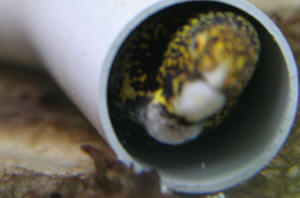
|
Re: Problem with Snowflake Moray
7/18/06 Bob, Thank you so much for your advice, I really
appreciate it. I'll proceed as you suggest. <Good>
I've attached a couple of more recent photos. <Ahh... does
appear to be a bit of a goiter under this fish's throat/buccal
region...> Thanks again for helping, it's been a pleasure to
'talk' to someone who's done so much for the hobby
in general, and my enjoyment of it specifically.
<Excelsior! Bob Fenner>
|
Re: Problem with Snowflake Moray,
attaching files 8/4/06 Hi crew, <Jonathan> Did
you receive the mail below, and were the photos helpful
with diagnosis? <Did receive this email, still trouble with
embedded files... need to be tiffs, jpgs, bmps... ATTACHED...> We
checked on the eel today, and the swelling under his mouth
appears to be receding, but he keeps twitching his head from side
to side as if something is bothering him. Any ideas on what
this looks like, and how we can help the eel? <Same query, same
response as previous. Please see WWM for its archival. Bob
Fenner>
Re: Snowflake Moray problems, no
cumulative useful info. 8/19/06 Hi crew,
<Jonathan> Please help. The situation with our snowflake has
worsened. Where he had swollen areas, pretty much overnight he has open
wounds, as if something has eaten away at his body. Any advice on
how we can help him would be appreciated. I've attached the
most recent photos. <These embedded pix are not opening> I've
got a hospital tank up and ready, but just want some advice
on what to do next <Read: on WWM re Echidna nebulosa disease,
all Moray Disease FAQs, systems, nutrition... What have you done thus
far? In reviewing what you had written before... did you treat with an
iodide/ine/ate material? Bob Fenner> Re: Snowflake Moray
problems 8/20/06 Sincere apologies for the problems
with the photos. I've now uploaded them under my user ID
(JonR400) on WetWebFotos. I hope you can find them there. <Mmm,
nope: http://wetwebfotos.com/Home?actionRequest=users
Not listed or searchable.> I've been dosing with Iodine twice
weekly, and have kept the water quality to the usual high
standard, but have taken no other steps. I think the photos are quite
dramatic (unfortunately) so I think they may well help with a
diagnosis. If there's another method other than putting
them on WetWebFotos, I'd be happy to try it. <Mmm... well...
there are other possibilities. I would try another form of iodine...
Betadine... Bob Fenner>
Re: Snowflake Moray problems
8/21/06 Please try the following link, this may help: http://wetwebfotos.com/Home?actionRequest=userview&userID=10586
<Ahh, thanks for this... "WWM User..." Does look very
bad... viral involvement possibly... but I still wouldn't
"give up"... there is still a good chance this fish will
recover, repair. Bob Fenner> |
|
 
|
|
Re: Snowflake Moray problems
8/22/06 Hi, <Hello> Thanks for the encouragement. Is there
any other treatment you could recommend to assist if it is a viral
issue? At the moment, things just seem to be going from bad
to worse. Thanks again for all your time. <Unfortunately, no.
There are anti-virals in use for human therapies, but these are
untested for fishes as far as I'm aware. Bob Fenner>
|
|
Snowflake moray eel health
question 6/26/06 Hello, First off great site. I
had something odd happen. I have a 200 gallon tank with some
tangs, a hawkfish, dogface puffer and a dragon wrasse. The
tank has 180lbs of live rock. I have had a snowflake eel but the other
day I saw it roaming around exposed (it's usually hiding). The
top of its head looked as though it had some internal
bleeding or something? The next day it was dead. All tests
are ok, weekly water changes and all of the other fish seem fine.
I thought the eel was a very hardy fish? I had it in the
tank for over a year and a half. Do you have any idea's?
<Perhaps a secondary infection resultant from a mechanical injury...
The Echidna zooming about, whacking its head against a sharp rock... my
best guess here. Bob Fenner>
Re: Emerald crab chances against
eels... Zip ... Echidna injury - 05/20/2006 Hello! I come to
you again with a little concern on the situation I described to you
about my snowflake eel trying to consume an emerald crab. Since that
day I moved the crab to the refugium but up in the main tank the eel
have change since that day. I noticed that after the eel attacked and
tried to swallow the emerald crab he/she can't eat very well. When
offered with food the eel will take it with the normal interest but I
have noticed that he/she can't swallow the food as
previously and keep chewing it for some time and sometimes
the eel just release the food item and keep looking for more. Some
times you can see the mouth of the eel full of dried shrimps but that
is not normal since before he/she always swallow those quickly and look
for more Would this be that the eel was injured in that episode? It has
been some time since that situation and the eel have not got better.
<... might have damaged its mouth... perhaps related to the
Mithraculus incident. Not much to do here but wait, hope, keep trying
small-enough foods every few days. Bob Fenner>
| Snowflake eel has peeling skin - 05/20/2006 Dear
WWM: <Irene> I have had my Snowflake Eel for 18
months. He has grown from about 6 inches in length to
about 12 inches in length and has grown triple in
diameter. He remains relatively active and seems to
behave okay. Water parameters are good and he lives in
an 80 gallon tank with three Bannerfish and one rainbow wrasse.
This morning I discovered that my eel has what appears to be a
large gash on the left side of his neck where his gill
is. I did not notice any appearance of injury or illness
on my eel about three days ago. I did not have a chance
to see him the past two days because he was hiding under a
rock...perhaps due to his illness or injury. <Likely is from
dashing about... during the evening...> Here is a
photo. Is this a mechanical injury from moving under and
around rocks or is this an illness? <The former>
The skin has peeled off. I am so sad. I
don't know if he will survive. So far, he is moving
around okay and does not seem to be dying. <Echidnas are tough
animals... I give you, it good odds of recovery> The eel last
ate about 10 days ago and it was squid. I usually feed
it shrimp or squid or silversides. I tried to feed it
about three days ago but he was not interested. Thanks for any
ideas that you may have on this. Irene <Steady on... keep your
water quality stable, optimized... and keep offering foods and all
should be fine. Bob Fenner> |
|
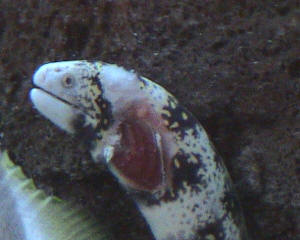
|
Snowflake moray eel... swelling 3/21/06 I
recently purchased a snowflake eel about a month ago and although it
doesn't have the whitish bands on his body, it still possesses the
yellow/white spots. The eel is about 12 inches in length and is about
¾" in diameter. The eel last week went through a
process of doubling its girth from behind the gills to the rectum
area......I thought it was mal-nutritioned and tried to feed it, but to
no avail with both ghost shrimp, raw shrimp and squid tentacles.
Anyways after about a week of sitting in recluse in a sunken ship in
the tank, I finally found little 1/8" size translucent eggs
floating around the aquarium water and they each possessed a 1/32"
white dot in them. <These are not from this fish> They eventually
settled to the bottom of the tank and after another day of hiding in
the ship only poking his head out. The eel then came out last night and
swam like it normally did and is back to the original size before the
incident. Not sure if the eel laid eggs to be fertilized. Want to know
if anyone has information on this. Should I get rid of the
"eggs" or just let them be....... <I would likely siphon
them out. Too likely to rot/decompose, mal-affect your water
quality> the ghost shrimp seems to be eating a few of them. I also
found a hard white ¼" like rock with some green mucous
on it.....looks maybe like the plug that held the eggs inside the eel.
Will try and feed it tonight to see if the appetite is back. <Have
seen small Morays "swell" as you state... sometimes recover
as yours did, other times perish. Bob Fenner>
Saltwater
questions: Epaulette and Snowflake Eel 2/23/06 Hi Bob,
<Joseph> I have a few questions to clarify some issues which I
have not been able to find an answer to on your website. Firstly, the
article on Zebra Moray Eels suggests a simple freshwater dip for new
arrivals, instead of the usual 2-3 weeks quarantine. Can this general
rule-of-thumb be applied to Snowflake Eels given their close relation
with each-other? <Mmm, I wouldn't actually dip either one of
these. Muraenids in general don't have difficulties that freshwater
dips/baths help with... are generally "too slimy" to have
external complaints coming from the wild... I would quarantine unless
the specimen/s appeared in perfect health> Secondly, I am
considering buying a juvenile Epaulette Shark for my 850 Litre, 8'
tank. I was hoping you might shed some light on what quarantine
procedure I should use. <Mmm, most sharks I'd skip actual
quarantine on in hobbyist settings (different from much larger
commercial, public settings)... as the likely damage from such is
probably much more than it's worth> I have a 40 litre (10g)
quarantine tank however I feel that the stress caused from placing the
shark in such a confined tank may outweigh the benefits gained from
quarantining. <Agreed> From what I have learned, keeping stress
to a minimum may (arguably) be the single most important factor in a
successful introduction of livestock. <Most cases, yes>
Am I on the right track??? Perhaps a simple freshwater dip
is enough? <I would skip dipping most sharks, most scenarios as
well> And how should I handle the shark when placing it into the
tank? Should I use a large net, or gently lift with gloved hands?
<Yes... this and/or a wet-towel> Thirdly, in regards to my
quarantine tank, is it reasonable to expect to be doing small (10%)
water changes (with main system water) every few days to manage the
water quality (i.e. ammonia/nitrites/nitrates)? <Often, yes...
daily...> I understand that small tanks are almost guaranteed to be
highly susceptible to a large variation in water chemistry in a short
period of time? <Unfortunately, yes.... To be guarded against>
Finally (thanks for putting up with so many questions), when carrying
out freshwater dips I use a product called Bactonex from Aquasonic and
each mL of this solution contains 1.66mg Aminacrine Hydrochloride and
0.025mg of Methylene Blue.. In your opinion, is this a suitable dip?
<Is more helpful than none> Thank you immensely for taking the
time to answer.. Joe (Sydney, Australia) <And you for writing, and
so well. Cheers, Bob Fenner>
Re: Snowflake eel ... disease? -
01/09/2006 Pretty unbelievable, huh? I think I might have a
parasite, how would I know? I haven't noticed scratching, but the
fish one at a time seem to get sick. Today my lion fish died, and my
tang looks like it's hallucinating, or psychotic episodes or
something. How do I know, and what do I do? <Monica, the first thing
you need to do is educate yourself on parasitic diseases/symptoms. Am
posting a link here for you to read. http://www.wetwebmedia.com/ichartmar.htm Monica,
I see the original message below without my responses. You
need to reply with all original content as I cannot remember who's
who and what's what. We do not keep files with queries,
they are deleted after they are posted on the WWM FAQ's. I have
made comments again on the query below.> http://mail.yahoo.com Re: Snowflake eel Hi
James, Thanks for replying so quickly. I don't smell
it, and I have looked everywhere. How far could he get? The tank size
is 175 gallons. <Don't know what to tell you
Monica. A fish this size generally doesn't go
unnoticed. James (Salty Dog) FAQ Crew
<crew@mail.wetwebmedia.com> wrote: Snowflake eel
HI, I have a few questions. First, I got a snowflake eel 4 days ago,
and he has vanished. He is not in any of the rocks, filters, gravel,
tubing, or on the floor around it. Literally, it vanished. I've
read that they jump, but how far could it go? I have checked the entire
room. Do they bury themselves? Doing a water change, I took out all the
rocks and siphoned the gravel, but I can't find him. Any
suggestions? Unfortunately, I think it will be too late, but I would
like to know. Also, I have my water tested often, regularly, my ph is
between 7.8 and 8.2, my salinity is 2.2-2.4. I have gotten very good at
maintaining these numbers, but for some reason, my fish keep dying. One
at a time, they start to appear sick, then die. They first are
sluggish, then stop eating, then they disappear, and a day or two
later, I find them dead. What could be happening? Is this normal?
<Water quality, diet, overcrowding> I have lost a copperband
butterfly fish,<You sound relatively new at this and the Copperband
is definitely not a fish for a newcomer. DO research
fish/inverts before you buy so you know what you are getting
into. Are you aware that the puffers attain lengths of up to
1'6" and they are semi aggressive, enjoy nipping fins of
tankmates. The panther grouper is another fish attaining
lengths of up to 1'8", and both of these fish require a 90-100
gallon tank minimum.> 3 porcupine puffers, a bi-color angel, a
panther grouper,<The grouper is capable of eating fish much larger
than you would think. A poor choice.> a blue
tang <Another difficult fish to keep for a newcomer.> tomato
clownfish and a black and white snapper <Another poor
choice. The Macolor niger (black snapper grows fast and can
attain a length of up to 2' and requires at least a 180 gallon
tank. I'm finding it hard to believe your dealer is actually
selling you these fish. It has gotten ridiculously expensive to just
replace the dead fish. Any suggestions? <Yes, you need to buy fish
that are hardy and do not have special food
requirements. There are plenty of colorful hardy fish that
can make an attractive display.> The only thing living well are
damsels, a yellow tang, a coral beauty, and a bi-color Pseudochromis. I
have a dwarf lion fish and another porcupine puffer in there also that
appear to be doing well, but are only a few weeks old. I am so
frustrated,<Monica, you are your worst enemy, you are frustrating
yourself by not knowing what you are buying.> I am about to give up,
maybe you can help. Any suggestions? <Since you didn't reply
with the original query I don't recall what size tank you have but
I'm guessing your tank has exceeded it's carrying capacity by
far. Do read the articles on the WWM, you will learn much
here, and do purchase a reference book such as Conscientious Marine
Aquarist.> Thanks for your time, <You're welcome and do reply
with your tank size. James (Salty Dog)> Monica Atkinson
Snowflake out of water Hello Mr. Fenner, <Elizabeth>
Situation #1 You've always been so wonderful with information in
the past and I'm hoping that you can sate my curiosity once
again. We have a snowflake eel in a small predator tank (75
gallon). We've had him since he was the size of a pencil
and now he is 14" and has quite a "sturdy" built.
<Like me!> He's always been a voracious eater and be it
shrimp, squid or octopus he always gets the lion's share at every
feeding (his tankmates are a two and a half inch Niger and a 3"
stars and stripes puffer). When I fed them this morning, the
eel was nowhere to be seen. When I later (2 hours) mentioned
this to my hubby he went to investigate and Mr. Magoo the eel was
curled up on the carpet behind the tank, crispy and dried
out! First instinct had us put him back in the tank and he
immediately began to move and hid after about a minute of reorienting
himself. We've really searched and there are no holes
that could accommodate escape so he must have managed to push up the
small sliding glass where I feed them. <Can do so> We have since
braced it with electrical tape to ensure that it doesn't happen
again. Whew, now to my questions, firstly, how long can
they survive out of water? <Depending on temperature, humidity,
initial health... hours...> To be as "crispy" as he was it
must have been a minimum two hours from the time I fed and noticed him
not there until we found him behind the tank. Should I
remove him and put him in our QT? <Mmm, not at this point> Should
we have done something else like rinsing him etc. before putting him
back in the tank? <Yes... best to dip out some system water, soak,
get off "dust-bunnies", then place in main or other
system> We just went on instinct to return him as quickly as
possible and frankly we were shocked that he wasn't dead and
actually swam immediately on hitting the water. Hopefully it
will never happen again but I'd like to know the proper protocol as
a just in case. Thanks for any advice you can offer!
Situation #2 Our 250 gallon tank features an Emperor Angel that
we've had since he was a one inch juvie. He is now
almost six inches and in full adult coloration. (he's
more like a puppy than a fish and I know I probably shouldn't get
attached but with his personality I can't help
myself.) We recently had a 1000' gallon display tank
built in to our family room to accommodate our batfish <Neat!>
and the tank is now almost five months cycled and the bat and his mates
are doing well with all parameters good and basically the same as the
250 gallon tank. I want to move the angel in but don't
know if I should do a full quarantine on him as if he was a new fish
before putting him in the big tank or if I should just QT for two weeks
or so making sure that all looks good before moving him in.
<I would simply net the angel, place in a bucket and drip-acclimate
it to the new system's water and place> Also, Randy the E. Angel
and our biggest cleaner shrimp (a sucker that is almost 4"s and
has been in the tank for as long as the angel) spend much time together
with the shrimp "riding" on the angel doing it's work,
should we move this shrimp with the angel or just let the smaller
cleaners in the big tank take over? <I would move them together...
carefully matching specific gravity in both systems...> I want to
make this transition as easy on the angel as
possible. Thanks again for any advice that you can offer.
Best regards at this holiday season to you and all at WWM! Elizabeth
Turner <And to you and yours. Bob Fenner>
| Sick Eel, No - Injured & Hunger Strike =
Typical Behavior Hi Crew, <Steve> I have a rather large
(I would guess about 3 feet long) Snowflake Eel whom I have had for
several years. <Neat animals> A little over a month ago he
stopped eating and pretty much went into hiding. <Happens> At
first I wasn't too concerned because he has done this before
and always pulled out of it. But this is the longest it has gone on
and today he finally came out of hiding and I saw something
disturbing on him. His right gill isn't opening, so he's
only breathing on one side. (I don't think I would have much of
an appetite if I had a collapsed lung either.) <No lungs, and
likely not a problem> Furthermore, that whole side of his body
seems to be deteriorated, I attached a picture. <Nice pic. Looks
like a "simple" mechanical injury to me... a gouge if you
will...> After reading the FAQs I'm afraid it may be from me
not feeding him a properly balanced diet. I regularly fed him raw
shrimp (human edible grade shrimp) and occasionally krill.. but I
didn't do that too often because it's very messy and the
shrimp is nice and clean. I don't think he's ready to
kick the bucket yet because he still keeps his head up (i.e. he
doesn't just lay on the rocks waiting to die) and he has
started moving around more, but I don't know what to do about
him not eating. Once a week or so, I've been waving some shrimp
in his face (with tongs of course) with no success. Is there
anything that can be done for him? <Mmm, really... just
patience at this point... an Echidna nebulosa of this size can go
w/o feeding for months (really), and yours looks to be in good
shape otherwise...> I've been considering getting some live
ghost shrimp to see if that will entice him to eat, but I'm
afraid my clown fish will just pick at the shrimp and make me watch
them suffer. <I'd try the shrimp... and adding vitamins to
the water, food> If I can get him eating again, can you suggest
some other foods that are relatively clean (like shrimp) that would
give him some variety in his diet? Thank you. Steve Weatherly
<Most any live to fresh, frozen/defrosted crustaceans are worth
trying. Bob Fenner> |
|
|
Eel health concern Hi bob!
As you may remember I've got a snowflake eel. I've got a couple
of health questions about him. A couple days ago I noticed he had a
rather large lump on his side. Today I noticed he has two now in close
proximity to each other. There's no discoloration or anything. I
know snakes get a lump where their food is...does the same hold true
for eels? I've been feeding him whole frozen silversides. Also his
breathing pattern seems to get kind of fast frequently I was wondering
if you could give me an idea about how many inhales per minute to look
for. (he's a little over a foot I would guess). One final
question...I bought him some frozen mussel, its looks like it might be
a compilation of some different kinds mushed together and he REALLY
doesn't like them...Is it safe to feed him canned clams that are
for human consumption? (just seems like he might like whole clams
better) Anyway, I appreciate the info. Thank you once again. Steve
>> Thank you for writing (back). The lumps are a little
troublesome. No, eels don't really show "bulges" after
big meals (except in the tummy area sometimes). These are hopefully
transient. At any length there is not much (nothing I would) to do re
the appearance... On the clam issue, yes, I'd leave off with any
food your fishes are not accepting, and, yes, human intended foods can
be offered. But, let me be clear here. This genus (Echidna) and one of
other fave morays (Gymnomuraena) are not piscivorous (fish eaters) as
you know, and have pebbly type teeth that are not capable of tearing
their food.... So, we, must offer foods in swallow-size chunks.
Therefore, please cut bits of the clam, shrimp, etc. up that can be
taken in one gulp! I give your eel good chances of self-healing from
the bumps... Bob Fenner
Snowflake Morays Bob, My questions are about Echidna
nebulosa. What is the lifespan for these amazing creatures in the wild
and captivity? <Several years possibly in both... the record
in captivity is about fifteen years> Also , is crushed coral a
suitable substrate for them? Great website! <Yes... and have you
seen the piece on this species I've recently added? Here:
http://wetwebmedia.com/snowflakemoray.htm Bob Fenner> Thanks,
Joe
Moray Eel Hi Bob, I have written earlier about a
problem I had with massive fish loss. Well, I lost all of them with the
exception of my Snowflake Moray. I am now starting over and moved my
eel to a quarantine tank. About 7am this morning I checked on the eel
and it escaped. I looked all over before leaving for work and was
unable to find it. So I left it for dead and will tear apart my
basement later. Well, I returned around 11:30am to begin my search and
found the eel beneath my freezer ALIVE. Have you ever heard of an eel
surviving out of water for 4+ hours? <Yes... depending on
temperature, humidity... for a day or more.> This seems pretty
amazing. Ed <Keep any holes in the top covered! Bob
Fenner>
Re: Moray Eel Hi Bob, Since I placed him back in the
tank after being out for 4+ Hours the Eel hasn't been eating. Is it
to late? <No my friend. Not too late... offer food two days
from now> How long can the eel last without eating? <Many days to
weeks> Is there a technique that you know of to get it to eat? Any
ideas would be helpful - I'd hate to loose him. Thanks, Ed
<Don't lose yourself... Bob Fenner>
Snowflake eel <<Hello, JasonC here helping out
during the holidays.>> My husband got me a beautiful 11 inch eel
for Christmas and I thought I had a proper lid for him but now I
realize that I probably don't. The lid is all glass and pretty
heavy and covers all except where the filter goes but somehow last
night he jumped out. <<this is a common eel talent.>> He
was in front of the tank on the floor so do you think he was strong
enough to lift the cover? <<likely, yes.>> I read your link
on eels when I got him the day before yesterday and remembered that you
said if this happens not to give up immediately and to rinse him and
put him back in there but I don't know how long I should leave him.
I don't want to dispose of him if there is any chance of him
reviving but looking at him I have my doubts. <<is he swimming
about, taking food?>> When I found him he was kind stiff and not
moving and filmy looking. <<oh my...>> I don't know how
long he was out on the tile but he was kind of stuck to the floor with
some slime although he wasn't totally dry. <<hmm... the slime
was likely the eel's mucus coating, beginning to dry out.>>
How long should I leave him in there and if by some miracle he does
revive do you know if the pet shops sell some kind of filter cover?
<<I'd leave him in until all hope is lost - these are pretty
tough customers and with some luck the eel will rally. Most likely
quite shaken/stressed from being aired-out. As for the tank cover,
perhaps [unless you have one in the house] you might reciprocate the
eel gift with a Dremel gift for your husband. This way you can modify
the plastic strips that can be attached to the back of a glass cover so
that it has a tight fit. Then... put some rocks on the cover or
something of similar weight.>> I am so sad for him. <<me
too, but there is good reason to be hopeful. You need to think like an
eel and then try to secure the top as much as possible - which
sometimes is still not enough it seems. Eels are the Houdinis of the
fish world, with the exception of the octopus, and as such you need to
take action if you want to keep it for any period of time. Good luck,
cheers. J -- >>
Re: Snowflake eel No, he isn't swimming or even
moving for that matter and he is starting to peel now. I guess he was
just out too long. <Don't give up on this fish... I have seen
almost "dried up" jumped-out specimens make remarkable
recoveries/resurrections. Do keep your aeration high and testing
ammonia, nitrite... Bob Fenner>
Re: Snowflake eel He didn't make it. The LPS has
one the size and thickness of a pencil, seems healthy and is eating, Do
you think he is too small? <Please read here:
http://www.wetwebmedia.com/snowflakemoray.htm Bob Fenner>
Snowflake eel Bob, <Anthony in your service> I
have an eel that is approximately 18" long. I don't know how
old he is. <that makes two of us <smile>> His neck has
slowly been getting larger and he has slowed way back on food intake.
The swelling began on his right side but now seems to be on both sides.
He is visibly larger about 1 1/2" below his head. He looks like he
really wants to eat but seems reluctant to do so. I have been able to
get him to eat very small pieces of food but after swallowing one
piece, he won't eat again. Is there anything that I can do? Thanks,
Art Riggens <Art, I have had this question a great many times and
would be surprised to be mistaken here. My guess is that you have
allowed yourself to get into a routine of feeding this eel a single
food or limited group of foods (like silversides or freshwater feeder
fish). If so, you eel, like many before him, is dying of a secondary
condition mitigated by a dietary deficiency from the limited diet. If
that is the case, I'm afraid that the eel is in dire straights.
Unfortunately, if you tell me that it has been eating 8 different
foods, I would be puzzled and still unable to help. A drastic change or
improvement in the diet with Selcon soaked food might help
incidentally, but it still sounds like a more serious problem. I will
file this message in Bob's mailbox to see if he can share any
insight or another perceptive. He is away traveling at present but will
be checking his mail. Best regards, my friend. Anthony
Calfo>
Re: Concerned eel owner, eel worsens! Please HELP
I'm beginning to become embarrassed by this never ending thread of
questions...I will try to make this the last one. <no
worries!> A brief refresher, I've got a foot long snowflake
which I felt was breathing hard. At your advice, I checked salinity as
well as aeration and both turned up within healthy parameters. I'd
dismissed my earlier concern as simple anxiety over a new acquisition
when my eel to a turn for the worse. His breathing has increased, he
hasn't shown the slightest interest in food since I've had him
(over a week), he lies head down in bare view, and generally seems on
the verge of death. Consequently, I am in a state of panic mixed with
despair. <could there be any metals present in the water?
Recent medication or copper? Have you done a large water change to see
if that relieves him (if not it tends to rule out water quality and
leans towards pathogen or health condition)?> I can't figure out
what is wrong. Could it be disease? <possible> He does seem
to have a white stringy substance around the mouth but it may just be
something from off of the live rock. Is there anything I can do? Is
there a special food that might be particularly enticing? <the
tentacles of squid (Calamari whole)> I've tried shrimp, krill,
squid and even live feeders. <unless small ghost shrimp or
live crayfish... resist freshwater feederfish... deficient> Should I
try to give him a freshwater bath or would that only hasten his
demise? <unlikely helpful here> My quarantine tank is still
cycling. <the QT does not need to cycle necessarily, my
friend. Use aged water and aged filter media (live rock, filter floss,
etc) from the display tank and do daily water changes until the
chemistry levels (if it even wants to spike at all). Later keep a
sponge filter running in the main display at all times to be prepared
(and spare the need for a full time QT bio resident like a damsel>
Again sorry to continue question you so much concerning my eel. I'm
new to the hobby and so have a very strong emotional investment in the
creature. Your help and expediency are greatly appreciated.
<alas... we have no specific symptoms to act upon. If you are
willing to do small daily water changes for 7-14 days if necessary, the
QT may be better off for him. Else... continue to do large water
changes in the main display and look for a solid symptom. I regret that
I cannot be more helpful but without sight or symptoms... I'm at a
loss. Kindly, Anthony>
Snowflake eel not eating I have a snowflake eel in a 75
gal. tank, with two damsels. The ph is 8.6, 0 nitrate, 0
nitrite, 0 ammonia. I have had the eel for just shy of a
year. He has been eating regularly until recently he is not
eating as frequently. He used to eat daily to every other
day. Now he eats maybe once a week, and only one
shrimp. More recently he has started to look like a
balloon is forming on his head. <?> There is no other sign of
illness other that the head looking like he is a bottle
nose. He isn't actually less active as he was never a
big party guy in the first place. I am afraid I am going to
lose him. I am sure you are very busy, but Nessie really
needs your advice. Please email me with any
help you can. Thank you sooo much.
Brightest Blessings Julie <Your pH is a little high, but this should
not be the root cause. I encourage you to try other species of shrimp
(perhaps frozen, defrosted krill) and to add a vitamin and HUFA
supplement to this (perhaps Selcon) ahead of offering. Snowflakes do
occasionally go on feeding strikes, even lose weight, but almost always
return to feeding. Bob Fenner>
Snowflake moray Thank you very much for writing me
back. Yesterday morning Nessie passed on. I can
not for the life of me figure out what I did wrong. I had
tried different foods for him, but he would only eat dried shrimp.
<Sorry to hear of your loss> I have a lot of "rock"
anemones (don't know how to spell it). At least that is
what I am told they are. They are a brownish color and look
like the trees in a Dr. Seuss book. I have lots of them and
some of them have a base the size of a quarter. Is it
possible that the anemones stung Nessie, causing his head to swell, and
possibly causing his death? <Unfortunately yes. Please see here re
these Glass Anemones/Aiptasia:
http://www.wetwebmedia.com/marine/inverts/cnidaria/anthozoa/aiptasia/aiptasia.htm>
This was my husbands suggestion. I guess at this
point it is not important. I do not think I will subject
another eel to my ignorance. Again thank you for
getting back to me. Brightest Blessings Julie <Peace to you. Bob
Fenner>
A Snowed Out Snowflake?? 3/19/03 Hi
Guys,<Hey David! Phil with ya today!> I read the
FAQ's and other info on the snowflake on your
site, I've had my eel for a couple years, bought it at
about 8 inches and now it is 20+ inches. It was a dark brown
with the normal yellow highlights and white "snowflakes" but
now it has turned mostly white (with-in a couple days). I feed it
randomly shrimp/silversides/squid twice a week soaked in Zoecon, the
tank is a 180 reef with a huge skimmer all water parameters are
normal. Is this color change normal, or is it sick? (it also
didn't eat this week, but it is well fed so I'm not worried too
much).<After talking w/ Ananda we came up with some questions for
you... lol. Can you tell us your exact water
parameters? How is the eel turning white... is it getting
pale or is it turning white like it has dandruff?> Thanks for any
info,<Get back w/ me and we can kick this
problem! Phil> David
Learning From Tragedy Today is a sad day. Neb, our
snowflake eel turned stark white, and it looked as though the other
fish were starting to bite him. <Sorry to hear that!> We've
had Neb for about 8 months, he was a juvenile that doubled in size
during the time we had him in our 90-gallon tank. Our other fish (1
clown, 1 niger trigger, 1 dog-faced puffer) seem fine. We noticed that
the niger trigger was starting to go into Neb's plastic tube
that's buried in the sand. Could the trigger have stressed Neb out?
<Quite possible. Despite the predatory reputation of Snowflake Eels,
they are generally somewhat shy and reclusive in their habits, and will
simply not compete with more aggressive fishes like triggers and
puffers> We are also wondering if the diet was okay, we were feeding
Neb shrimp soaked in vitamins on a skewer. <Well, that's not a
bad component of his diet. However, all animals should receive a varied
diet, consisting of other foods, like krill, chopped squid, clams,
etc...Variety is important. Good though on the vitamin supplementation,
though> Really sad to lose that beautiful creature. Any insight you
might have would be appreciated. Thank you, Connie <Hang in there,
Connie. I'm sorry to hear about your loss, but I know that
you've learned something, so that's why this tragedy will not
have been in vain. Don't let it dissuade you from growing and
learning in the hobby. Good luck! Regards, Scott F>
I Don't Get It!!! How's it going?? great I hope
>Pretty well, thank you. ok to the point seasoned tank keeper, and
this is the first time I've ever asked for help on line I either
find the answers or figure it out. >Ok, I'll do my
best. this is really getting to me, my snowflake 2nd I've owned in
5 years did what I read on your site the heavy breathing, just prior to
that his size seemed to increase quite a bit he looked as if he bulked
up, which I felt good about, stopped eating though, thought he had
gorged himself last feeding was a great eater (but had to hand feed)
which wasn't a problem diet was consisting of blanched squid,
octopus, shrimp, etc.. >Curious as to why you blanche
it. Unfortunately, I'm having a bit of trouble picking
through the information you've provided here. I've
never, ever fed my marine fish cooked foods. then just to spice it up
like we are supposed to I gave him and puffer and trigger heck every
one would jump in on the feast small frozen then defrosted no heads or
tails, gutted and de-boned Smelt (common small fish) which
was inhaled... >They take them whole in the wild, I would give them
whole in the tank, too, but would also have on hand enough water for a
30%-40% change next day (for the subsequent poop-a-thon). My water is
crisp aeration fine lights pumps filters heater are dialed in all
levels of water testing are on the money.. >This tells me nothing.
my other fish are all fine my feather dusters, polyps and whoever else
may be present are all doing fine as usual SO WHAT THE HECK
KEEPS HAPPENING THIS IS THE 2nd ONE AND THE 2nd TIME, the breathing
problem the no eating, then the changing to white and finally
convulsions ending with the big bowl. HELP ME PLEASE TELL ME
SOMETHING OR THINGS maybe other than water quality, or parasites and
attacked by anemone. >I'm sorry, but if I'm not allowed to
suggest those things then there's not much else I can do for
you. its something else and its something very specific and
I want to know what it is.. I wont be able to rest easy until its
figured out and I learn what and about it.. Thank you I hope you'll
Be able to put my mind at ease for a moment. DEANO
>Unfortunately, without more information (including the *very*
pertinent information of water quality parameters), feeding schedules,
length of residence, time in quarantine, and the actual names of the
other residents, I can't offer much of an educated
guess. From the little you have provided, I can't help
but wonder what, if any, effect feeding cooked foods to the animal
might have. If this is the second eel you've had leave
this earth this way, then I would look to husbandry practices, as
I've known these fish to be exceedingly hardy and difficult to
kill. I would assume that if you have other invertebrates
doing well in the system that they would be your "canaries in a
coalmine", which of course would tend to rule out water quality,
but I don't believe in automatically ruling everything
out. At this time it *appears* to be one of two things (this
is off the top of my head--sorting fish disease, assuming it's
disease, is quite a tricky business) infection, or
poisoning. My advice is to get him into his own quarantine
system ASAP, and I don't think that starting him on a regimen of
Spectrogram would hurt at this point. I'm sorry I
can't offer more help. Marina
- Re: I Don't Get It!!! - Ignorance... a/the high price
to individuals, society. RMF <Greetings, JasonC here...> Ok
details huh!!! <They are helpful, paints a more detailed
picture...> You know it would be cool even to throw some possible
reasons my way... <What would you like me to say? Solar Flares?>
Just so we are current in our chat the eel died yesterday morning.
<I'm sorry to hear of your loss.> Also 2 eels in a 5-6 year
time frame isn't too shabby, <It's not excellent either...
these fish live much longer in the wild, and even in captivity - as
Marina mentioned before, the devil is in the details - two eels in five
years is not great odds.> the first ended up like this recent one
because of fish Gang Warfare ha ha ha. <That is funny why?> And
by the way maybe you have "a canary program working for you"
myself well,,, Id shove a human in for my dirty work and wouldn't
think once about it.. <Pardon? You do understand the "canary in
a coalmine" comment was directed at other inhabitants of your
tank, which would under normal circumstances bail out long before your
eels - without such an indicator, one needs to look for the problem
elsewhere.> Lets put it this way, if someone asked me about you and
that you were covered in spots, pale and had a mild fever,, not being a
doctor, id say maybe chicken pox, maybe measles, maybe even German
measles, even though I haven't seen you or even knew what you
looked like. <But you could be 100% wrong making assumptions like
that - I could just be wearing makeup or have a high metabolism, or
both.> I was offering some answers to question using general
knowledge!! <And perhaps too general.> Now you seem to have to
hear and see also deal with tons of stuff in the fishy business.. so
just by the symptoms, it sounds like? <It sounds like a problem.>
or maybe its? but then it could be???? you hear me????? <I hear you,
do you hear you?> I already told you tank and water are crisp which
means there fine....... <And that means nothing to me either - the
demise of your eels tells a different story. It is too easy to quickly
say "The water is perfect." when in fact, it might not
be.> I cant see what giving you good readings will accomplish except
ruling out water quality which I already said is GOOD. <Good to you
and good to me could be two different things - it pays to compare. In
addition, there may be something about your husbandry practices which
is amiss... > So ill humor you with it anyways. 100 gl tank 83lbs
live rock Marshall and Tonga 2 -1 inch live sand front to 2/3 back of
tank thick to thin Dual overflow boxes to sump trickle more rock
trickle Lego trickle foam through a polisher then to another sump and
this lil giant pushes it back into tank by way of triple split flex
joint flow connectors 1 upish 1 downish 1 sidish a Jager Meister heater
in 2nd sump keeps us fuzzy feeling about 74 -78 Nautilus protein
skimmer in 1st sump works just fine 4 bulbs 2 really
bright white compacted 1 purple kind a blue (makes your
clothes look funny) and then 1 sun light pinkish orange
color 48 inch reg V-HO HO HO timer says you and you come on
then in 2 hrs you come on then 2 more hours and then you come on we all
stay on for 6 more hours then I go off then 2 hours later 2
more go off then 1 hour later purple done till
the morning 5 years old almost eligible for social security
benefits residents are as such 1 ylw tang 1 pwd blue 1 Porc puf 1 mar
clown 1nigger trigger 1 big jaw blenny 1 juv emper 1 purple psycho-
crom and I used to have a 2 yr old snow flake 2 dusters lrge hula
hula 1 small carpet anem green polyps purple polyp pink
polyps and lotsa lotsa coralline I feed once a day and
that's the way it works best for us and for 5 years so far 20 gal
changes 1 every 2 weeks every other day top offs pure clean cosmostized
water Kalk who once a month dripped in 1 per 1-2min ratio speeded up at
night with lights out. So now these are the results I get from all that
stuff: Grav 1.021-1.023 PH8.25 ALK
3.5 AMM 0 Nitri
0 Nitrat15/20 mg/l (ion) PHOS .05 CAL
425 IRON.12 Dissolved OX
7.0 Carbon Diox 2.3 blood
type A.O.K I bet any eel would be stoked to kick it at a pad
like this, like I said my water and tank are "CRISP" Now
please can you offer some specific illnesses <Specific? No, I
can't. As Marina suggested, you should at least start by not
cooking the food any more - these are eaten raw in the wild, and will
do your captive charges much more good if fed this way - could be
you've got a nutrient deficiency because of the blanching. Could
also be that your system is on the edge of being full - something that
cannot be tested for is the bioload, and it could very well be that as
crisp as you think the water is, with the addition of another large
messy eater, that the actual 'quality' of the water is stale,
and not as 'crisp' as a handful of tests would indicate. While
I'm on the crowding issue, you may have had social issues which
while not completely apparent might have been working against your eel
this whole time. Likewise, you may have just obtained compromised
livestock which went for as long as it was going to go. It's
difficult to be more specific than that without a post-mortem
examination under a microscope.> THANK YOU DEANO <Cheers, J --
>
Snowflake Eel Lifespan Bob, I was wondering what you
have learned to be the average lifespan of a snowflake eel in
captivity? I have had mine for over 10 years and it was
close to full grown when it was given to me. It appears that
he/she is dying and I was hoping to determine what their age is.
Thanks, Keith <Do know they do live into their "teens"...
but no definitive record for oldest. Sometimes public aquariums post
such data. You might want to look at the Waikiki Aquarium site. Bob
Fenner>
Snowflake eel is sick Help Please Ok My eel is know
swimming allover my tank and he hasn't stop for about 3 days and he
goes pale for long period of time and then he goes back to normal color
I don't know what I need to do can you please help me I don't
what to lose him. <Sorry for the delayed
reply. I would first check your water as I am guessing
something is amiss in this area. Cody> Thank you
Jodie
Our snowflake eel and copper treatment 09/10/03 <Hi
Cheryl> "Flakey" (how original) our snowflake moray jumped
out of the tank the other day and flopped around for awhile (2-3
minutes) until he went limp. I plucked up the courage to
throw him back into the tank. I'm afraid the experience
may have injured him as he hasn't eaten since (3 days
ago). Or could it be that I began a copper treatment for our
lion fish (who has a parasite) the same day that Flakey jumped out and
he's affected by that instead? He's not his usual
perky, swim around the tank self. Just wants to stay in one
spot and refuses his favorite food....shrimp. Any advice gladly taken,
Cheryl Cooper <From the page on snowflakes, "I have had
go-arounds with other pet-fish writers, culturists, public aquarium
staff re "remedies" involving muraenids. They are sensitive
than most fish species to these treatments. Copper and malachite IF
utilized MUST not be overdosed NOR treatment periods extended for these
species. I know this from hard-won first hand experience, re-collecting
Morays killed by "No COPPER" treated tanks in San Diego, and
readings of other to-be-trusted writers experiences. " Go here to
read the rest. Unfortunately, copper is pernicious in aquariums,
permeating and contaminating the rock work and sand. Here's more on
copper: www.wetwebmedia.com/copperus.htm , I suggest you go and read up
on these two subjects. At the least, he should be in a QT till you
finish the treatment, you may also want to look at using PolyFilter
when you're done the copper treatment, it will help remove it from
your system. Good luck, PF>
- Sick Snowflake - Can someone please help me? <I
can try.> I have a snowflake eel that is dieing. He is
about 5 weeks old and was doing fine 2 days ago, but last night I found
him just lying on the bottom of the tank. It looked like he
might have gotten his head stuck under a rock but I don't think so
because when I pulled him out there wasn't any
resistance. He tried to swim but all he did was slide across
the bottom of the tank upside down. It looked like the front
half of him was rigid (unable to move) while the back half of him was
able to move. Now this morning all he does is lay there
gasping for air. Someone please help. I have since
changed 20% water and noticed my pH a little low so I added some buffer
to help raise it and added an air stone to my filter to try adding more
oxygen. He has also only been feed frozen shrimp since I have had him.
PLEASE any help would be greatly appreciated. <My friend, it sounds
to me like you've done everything that can be done at this point.
Sometimes it just happens that we [meaning it's happened to me too]
get compromised livestock that appears relatively healthy but quickly
deteriorates in our care. I'm not sure I can do much beyond offer
my sincere hope that this eel pulls through - time will tell.>
Thanks, Mark Tank-30gal long Ammonia-.25 Nitrite-0 Nitrate-15
Salinty-1.025 Ph-8.2 Dkh-11 Calcium-400 <Cheers, J --
>
Snowflake Moray age, nostrils Hi. I have a
30" echidna nebulosa (Snowflake Moray) that I've owned for 9
years. He was 18" when I got him. How old do you guess he
is? <Perhaps a dozen years> He had come in a group of
three good-sized Snowflakes from a wholesaler when I purchased him, so
I assume he had been in the wild just previously. He still has great
coloration so I don't think he is elderly, as fading colors are
often a good indicator of that. My second question is a tough one. This
species has short yellow nostrils that protrude approx. 1/8". I
have been out on business trips a lot this past year and hadn't
realized until recently that my Snowflake's nostrils have changed.
The left one protrudes a lot less than before, it is practically a nub.
The right one has lost virtually all yellow coloration and is sealed
up. Directly behind it now is a horizontal razor-thin groove about
1/4" long that looks open. Do you know if this is a natural
transformation as these animals get older? <Sounds like a
"bump in the night" sort of injury. Likely not
problematical> The moray's behavior remains normal. I
think it is either a natural occurrence or the result of scraps with
his tankmates during feeding time. He has two long-time roommates, a
7" clown trigger and a 10" golden puffer, but I've never
noticed him wounded. And outside of the fish chasing after the same
food items, I've never seen any aggressive biting. Any
thoughts? <Maybe a nip... maybe a scrape. Altogether not a big
worry. Bob Fenner>
Snowflake Moray age, nostrils? 4/1/04 Hi. I have
a 30" echidna nebulosa (Snowflake Moray) that I've owned for 9
years. He was 18" when I got him. How old do you guess he
is? <tough to say... could be as young as 12-14 yrs old (some
grow fast in the wild and in aquaria). But it could easily be much
older as 18" is approaching full size for many> He had
come in a group of three good-sized Snowflakes from a wholesaler when I
purchased him, so I assume he had been in the wild just previously. He
still has great coloration so I don't think he is elderly, as
fading colors are often a good indicator of that. My second question is
a tough one. This species has short yellow nostrils that protrude
approx. 1/8". I have been out on business trips a lot this past
year and hadn't realized until recently that my Snowflake's
nostrils have changed. The left one protrudes a lot less than before,
it is practically a nub. <happens with some eels from rubbing
(literally) in the confines of aquaria. Is this a small or crowded
tank?> The right one has lost virtually all yellow coloration
and is sealed up. Directly behind it now is a horizontal razor-thin
groove about 1/4" long that looks open. Do you know if this is a
natural transformation as these animals get older? <not
natural in so much that all will go this way> The moray's
behavior remains normal. I think it is either a natural occurrence or
the result of scraps with his tankmates during feeding time.
<definitely the latter is contributory> He has two
long-time roommates, a 7" clown trigger and a 10" golden
puffer, but I've never noticed him wounded. <yikes... with
the size of those roommates... I do hope this is a very large display
(8 feet long... 400 gallons +). Else the tank is undersized
IMO> And outside of the fish chasing after the same food
items, I've never seen any aggressive biting. Any thoughts?
<indeed, if this is (sadly) a small commercial aquarium (200 gallons
or less), then the symptoms are an artifact of the crowding (physical
space and/or tankmates). Do consider what appropriate living space
really might be if this is the case. Anthony>
Spotted Snowflake
Eel Hello, first time poster here, I have just recently noticed
that my snowflake eel has developed a white spot on the lens of each on
of its eyes. My other fish do not display any
signs. My eel has been for the last couple of months,
inactive. It does not appear to be eating and has areas of
redness on its skin which appear capillary or vein-like. His
nostrils or breathing tubes are now pointed downward instead of up and
out. << Very good description. Thank
you.>> He also appears to be thinning. << Is he
eating? Two parts to that question, are you trying to feed
him, and is he accepting the food?>> What is going
on? Is this ich? And, as I have read, in your
other postings, is a garlic treatment warranted? Thank-you.
<< It doesn't sound like ich, but it does sound like a water
quality issue. Is this a fish only tank, or a reef tank, and how are
you filtering the water? I don't think Garlic would hurt, but
I'm not sure how much it will help. With eels I
don't recommend medications or freshwater dips or things like
that. I do think that feeding him is the important first
step, so if you have to use a pair of tongs to hold the food right in
front of his face, then do that.>> Jonathon Jones <<
Adam>>
Re: White spot only on each eye of my snowflake eel
Tried feeding him, but he just wouldn't take it. Used a
feeding stick too. Next I plan to go buy small live shrimp
to see if he'll take that. << Live food is a great idea for
fish that are not otherwise eating. It really induces a
feeding mechanism in them.>> It is only a 85 gallon 2 stage
tank. I have taken steps to improve the water quality, and
it appears better. What about fungus? << Without a
picture I wouldn't want to guess on that. Either way,
good water quality is the key. >> The red vein-like areas are
worrying me. They appear mainly along his ridges and tip of
his tail. << I've seen this before and it was usually a sing
of poor circulation. Actually it was over circulation like
the fish has too much adrenalin in them.>> He is definitely
thinning.<< Do try the live shrimp first. Also, if it
is possible to easily remove the fish, then moving him to a hospital
tank is always an option.>> << Adam Blundell
>>
Snowflake Eel Questions (2/4/05) I have a small
snowflake eel, approx 9 inches. It lives with two other
tankmates in a 60gal tank with 50 lbs of not-live rock. My ammonia,
nitrites and nitrates are almost non-existent (per a test kit). The pH
is 8.2. Both of the other fish are fine but the eel appears to have
heavy respiration most of the time. It does eat, a lot, and is active
at night but during the day it hides under the sand and pokes its head
out every couple of hours. The salinity is low 1.019 and I'm in the
process of raising it. <Slowly target 1.024 range.> Should I be
concerned with the breathing? <Probably not.> I read in a
previous post that approx 60 "breaths" a minute is
acceptable, this eel is slightly heavier. <Do you mean
"heavy" as in deep and forceful or
"rapid" as in fast? Eels tend to have almost gulping
respirations that one may thing is "heavy," but a rate of
more than 60 per minute is odd.> Also is it burying itself because
it is stresses or just likes the dark. <Eels are also reclusive.
They hide most of the time. If it comes out and swims about in the
light, it is probably hungry. This is a rather small Snowflake, still
young. (Mine has grown from about a foot to two feet in 18 months.) It
may just be scared like a young child would be. You did not mention
what the tankmates are. Perhaps they are big or aggressive?> Any
information would be greatly appreciated. <Your parameters are good.
I would not worry too much about heavy (rather than rapid) breathing.
If it eats well and comes out sometimes, it is probably fine. I have
found that whole krill are great eel food, as are other strips/chunks
of meaty seafood. I use the seafood gumbo mix from my local
Albertson's. Now that he is as big as he is now, mine will take 3
or 4 3" Silversides with 3 or 4 1.5" krill for dessert every
3-4 days.> Thanks in advance, John <Hope this helps. Steve
Allen.>
- Snowflake Eel Problems - Hello, I have had my
snowflake eel for about 8 months. About a week ago I noticed that
its colour was faded and what seems to be its butt has a bubble coming
out of it. <Huh...> Water quality is high, tested
weekly. All other fish (clowns, tang, banded cat shark) are doing
really well. Its diet is frozen or fresh squid, octopus, and
shrimp. The local fish store says that it might be laying eggs but not
really sure. <I doubt this scenario. What is more likely that
this is either a prolapsed rectum or a tumor - neither of which you can
really do anything about I'm sorry to say. Your best bet at this
point is to make sure it is still eating and voiding its food, and that
its water quality stays tip-top.> Thanks in advance, Mike
<Cheers, J -- >
Malnourished Moray 8/23/05 My snowflake eel is about
3-4 years old. He's about 18 inches long and 2 inches
diameter. He usually eats 1-2 medium frozen shrimp every
other day. <Needs a wider range of nutrification...>
Day before yesterday he only had 3 bites (about 1/2
shrimp). This would not concern me except that tonight he
did the same and he has local swelling around and behind his left
eye. About 1/2 inch diameter and 1/4 to 1/2 inch
raised. I'm not sure if I should try to treat
this. As rapid as it has come on, I'm not sure he'll
survive if it grows much faster/bigger. R. Rodriguez <Please read re
Moray Foods...: http://www.wetwebmedia.com/morayfdgfaqs.htm I would try
soaking whatever foods this animal will still take in diluted
"aquarium" iodine/ate, Selcon or equivalent... this may be a
simple goiter... or other result of avitaminosis. Bob
Fenner>
Re: snowflake eel 9/13/05 He died a few days
later. Water quality was good. Any suggestions as
to what could have come on so quick? <The swelling... may have been
evidence of an internal tumor, perhaps a