|
|
| Home | Marine Aquariums |
Freshwater Aquariums |
Planted Aquariums |
Brackish Systems |
Ponds,
lakes & fountains |
Turtles & Amphibians |
Aquatic Business |
Aquatic Science |
Ask the WWM Crew a Question |
| Please visit our Sponsors | ||||
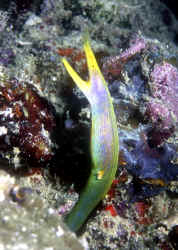
Black Ribbon Eel 1/31/19 Eel lost his tail, looking for advice
9/27/18 Blue Ribbon Question, fdg, rdg., other
gerunds/participles... 3/5/13 Blue Ribbon tankmates 3/8/13 Blue Ribbon Eel Feeding
8/22/11 Ribbon eel diet 5/9/11 Blue Ribbon Eel, sel./stkg. -- 06/09/10 Black Ribbon Eel, fdg., comp. --
04/08/10 Ribbon eels in community tank? --
01/26/10 Re: Ribbon eels in community tank II? --
01/27/10 Eel and lionfish combo -- 11/03/09 Blue ribbon eel and a bamboo shark, comp...
7/19/09 Black Ribbon Eel, dis. -- 04/20/09 Mysterious disappearing of my fish! Rhinomuraena
epiphany 4/19/09 Lionfish/Boxfish Compatibility ? 03/07/09 Hello Crew, <Kevin> First off, love the site is a huge help. <Ah, good> Currently in the process of establishing a new tank. It is a 4x2x2 and will contain two ribbon eels and two dwarf fuzzy lionfish. <Mmm... Kev... Ribbon eels are very hard to keep... and Lions are too likely to spine/sting them...> I have spent a lot of time preparing myself and my tank for these two especially the eels. I have noticed that on the compatibility chart on LiveAquaria.com *linked from a previous FAQ* (www.liveaquaria.com/general/compatibility_chart.cfm) that the boxfish is compatible with eels and lions. <Mmm, somewhat... but not really... Like all "puffers", too likely to sample/bite both groups of fishes> I suppose my question is simply, how can this tiny little fish <Which species? Some Ostraciids get feet long> be compatible when everything I have read tells me the lion will eat whatever will fit in its mouth, which would be easily be the boxfish? Thanks in advance Kevin <I'd re-think this entire stocking plan... It won't work. Bob Fenner> Re: Another Ribbon Eel Question/comment, comp. 8/20/08 Hi Bob, <Brian> Very disappointed to report this but I need your advise <advice> to figure out what happened this weekend. My ribbon eel passed away and I'm trying to decide what to do. <Bury it> My eel was very active of late and would swim about the tank about every hour or so (it never ate when swimming, seemed more curious about the surroundings than anything). It ate whenever a part of it was inside of the pvc maze but never when completely free in the tank. Nothing surprising to me here so far. This Saturday, I came into my living room and saw that my eel was swimming backwards in the tank. <Rhinomuraena... and morays in general, can/do swim in this manner... useful for "backing up" into holes...> I looked closer and saw that it had a huge cut (or tear) on the neck below its gills. It was writhing and tying itself in a knot to pull away from whatever caused the problem. This was painful to watch as I have no idea what happened. It clearly suffered a fatal injury and was trying to spare its life. I moved it to the sump to observe but it died twenty minutes later. I have a few ideas about what happened and could use your advise to narrow the possibilities. Here goes: 1. It somehow swam into my Vortech powerhead. There is a filter blocking the intake, but the output is still open and maybe its head found a way to enter and get the fatal cut. I could put a screen over the output to prevent this from happening in the future. <Mmm, doubtful... the discharge pressure should prevent this, but... maybe a good idea to screen as you say> 2. It got curious about my Coral banded shrimp and got pinched across the neck. The claws of this animal are really strong and if it pulled away while being pinched could have ripped itself open. It was a very clean cut so it still seems probable. <Mmm, maybe...> 3. It aggravated my golden dwarf moray eel. <Oh, a definite possibility here> While there was no food to be fought over, there might be a possibility that my dwarf moray just bit it in defense. the cut was so clean that I doubt that this was the cause. The moray has been very reclusive since I got the ribbon but still ate and never tried to share space with the ribbon eel. Seems unlikely but I'm open to suggestions. <Not a good idea to mix Ribbon Eels with other Muraenids> 4. It tangled with my Purple tang and caught the defense spike on its tail. The tang seemed to ignore it but their tail bones are very sharp. Could this have caused the untimely end. <A smaller possibility> 5. It cut itself on a rock or pipe exploring. Not likely in my mind but still not sure. <Smaller...> 6. Bristle worms or hermit crabs? That's everything else I have. <Nah> I'm so disappointed. I never sent a video of my success and feeding because I thought I'd have more time. I'm prepared to get rid of anything that would impact my future success. Gosh I'm frustrated! <I'd be separating/removing the other Moray. Bob Fenner> Re: Another Ribbon Eel Question/comment 8/21/08Hi Bob, <Brian> I'll remove the suspects from my tank when I get back. I'm leaving for a trip in two weeks and don't want to confuse my friend about what to do. Will report back in a month. Brian <Real good. Bon voyage! BobF> Ribbon eel feeding - 07/21/08 Hello Bob. I am very much interested in the ribbon eels and would like to get one. Well it would have its own 90 gallon tank with a pvc pipe for cover. I can get a very nice specimen from the Maldives and my dealer is very reputable. My question is this that you said feeding it guppies is not nutritious so can they survive on damsels. I can feed it about 6 damselfish a week. Will this do. Thank you! <Mmm, maybe... better to read, train onto other... : http://wetwebmedia.com/rhinomuraenafaqs.htm BobF> Another Ribbon Eel Question/comment, sys., fdg. 7/11/08 Hi All, <Brian> I've read all of your comments about the care of black or blue ribbon eels and agree with your opinions for the most part. They are tough to maintain if you're expecting them to act like a snowflake moray. I just have to wonder why my experiences have been so different? <How much have you had is my immediate question> Please don't post this as I really don't want to encourage others to try this animal in their tanks. <Mmm, I do consider your input here too valuable not to share> I'd just like to explain my experience and help you help others who have made a mistake by buying something they don't know how to care for. Purchased my first black ribbon eel in high school about 16 years ago. It was eating at the store and I kept it for almost 2 years in a fish-only, sterile tank. It unfortunately became the prey of a hungry puffer fish and died of an infection. It was already eating when I got it so I guess I made a wise purchase in 1992. Purchased my first blue ribbon eel in 1994 from a different store and placed it the same fish only tank. I teased it with frozen krill and prawns every day for two months before it ate! After that, It accepted food whenever I was feeding my fish. It even hand fed from me whenever I waved a krill in my tank. I had that eel for about 18 months before it found a way to crawl out and dry out in my carpet. A very sad day for me. Gave up all aquariums in 1996 to finish college. After school and a big break from aquariums, I purchased another black ribbon eel online in 2005 and received a stressed animal. It was near death there was no guarantee from the vendor due to the delicate nature of the species. I tried to revive it but lost the battle. Very disappointing. I just finished a new reef tank and designed it to be eel friendly and escape proof. I have hidden PVC under the substrate with the goal of housing a ribbon eel. So I purchased another black ribbon eel online and made sure that I would pick it up the moment it arrived. I placed it in my tank a month ago and it ate THE FIRST DAY. I can feed this this animal by hand now and needed no live foods to encourage it. I soak the food in Selcon before feeding and have tried both frozen krill and squid with success. I'd be happy to show you the actual feeding if it will help others save these awesome animals in their tanks. <Thank you for this... will gladly post a link to "You Tube", what have you, post your detailed account for others edification> Maybe I'm an exception but I believe that Ribbon Eels are a reasonable aquarium animal for those that have done their research and understand the requirements in captivity. They are a HIGH MAINTENANCE animal but worth every minute. I just wanted to share a success story. I'd be happy to keep you posted on my progress here. I believe the PVC maze beneath the substrate is a huge contributor to my recent success. My current goal is to take an eel or two to maturation (black to blue). I'd be happy to send pics or updates if it will help others understand the demands this species deserves or advance the hobby. Respectfully, Brian <Again, thank you for your well-written account of personal success, trials with Rhinomuraena. Bob Fenner> Re: Another Ribbon Eel Question/comment 8/5/08 Hi Bob, <Brian> Sorry that it's been a while. I'm back in grad school and have a hard time keeping up with my e-mails outside of work and school. Just an update. My ribbon eel is still eating like a champ and even swims around the reef tank when hungry. <Good... other folks (who evidently don't go diving where Rhinomuraena occurs) think this fish is sedentary... It does "swim about"> It's been two months now so I want to know what you would like to post to help others. I do have a "You Tube" account but have never posted anything. My digital camera takes movies so let me know what you want to see and I'll post it. Please pardon me if it takes a bit to figure out. Thanks again, Brian <Mmm, I too have never posted to YouTube... likely your feeding procedure, the general set-up, some images of typical behavior. Bob Fenner> Ribbon Eel Update 9/29/08 Bob, <Brian> It's been a while. I returned from vacation and decided that it was time to try once more to add a ribbon eel to my tank. I had removed the golden dwarf moray and banded coral shrimp from my setup as suggested so I was ready for shipment last Wednesday. I received a beautiful specimen and promptly saw my purple tang cut it with it's tail! <!> I guess we know the source of my last problem. The eel is doing well now, but I had to remove the tang that day in order to preserve its life. Now here's the good part: Even after being injured, the eel ate silversides on Friday and today (Sunday). It's getting more aggressive so I think the injury is healing. It's still timid now (it was pretty active prior to the incident with the tang.). I'll keep you posted on the progress. I wanted to let you know that I haven't given up on this animal and am willing to accommodate its needs. Right now I'm convinced that a ribbon eel needs a protective PVC maze (and a great supplier) for it to be secure. In the past (almost 15 years ago), I needed weeks to get one of these animals to eat. Now I have a better setup and no problems feeding the ribbon eels in a day or two. I will send a video or two your way very soon. <Mmm, maybe post... on YouTube or such> Hope this is an encouraging story. I'll keep you posted. Brian <Thanks, BobF> Nutrition (RMF, edit if required) <I agree with you Neale. RMF> 7/6/08 I asked u a question on blue ribbon eel feeding. What is the best and most nutrition food for a bre. I have the opportunity to purchase a healthy one for his own 75 gallon tank. <Greetings. Put your money back in your wallet. Anyone offering Rhinomuraena quaesita for sale is essentially making this deal: he'll take lots of your money, and in return will give you a fish with a 99% chance of being dead within weeks. Simple as that. This is the fishkeeping equivalent of someone offering to sell you the Brooklyn Bridge. Don't fall for it. What they eat in the wild is small fish, but unless you have a limitless supply of healthy, gut-loaded marine (not freshwater) fishes, this isn't something you can do. Bob Fenner may have his own opinions on this, but I'd have to rate Rhinomuraena quaesita as the worst routinely traded aquarium fish in the hobby. Cheers, Neale.> Nutrition, Rhinomuraena reading 7/4/08 Hey crew. My LFS has a great ribbon eel and it also eats. Well I would like to buy it but I wanted to ask u <...> if feeding it guppies is safe since I read that feeding sw fish fw food is bad for the fish's health. Plz tell me if it is safe. <Not nutritionally... see WWM re. RMF> Re: Survival of Moorish Idol vs. Ribbon eel in Captivity - 05/24/2008 Hey Crew, <Hi.> I just wanted to clear my doubts on the ribbon eels. Do you commonly see the ghost ribbon eel, a different species <You are probably referring to Pseudechidna brummeri.> , as a fish that has a greater probability of eating versus the blue ribbon eel. <Yes, better, but sometimes still problematic re feeding.> While they are both difficult fish to keep, and probably should not be captured, why may the white seem to adapt better in captivity. In fact why is it that zebra morays or even eels captured along with the ribbon eels tend to survive better than these species? <These other species are simply less sensitive to changes of their environment and stress, they are more robust and may endure radical collecting methods and improper care in the industry far better. As noted in earlier posts, even Rhinomuraena quaesita may be a good aquarium fish that even may breed if collected and cared for the right way.> PS is there any campaign on banning the capturing of these eels due to there survival rates in captivity? <None I am aware of. I'd rather insist that those eels are collected and treated carefully when importing them, including that only eels are shipped that have eaten at the wholesaler, instead of simply banning them. Cheers, Marco.>Black Ribbon Eel 12/29/07 I was at my LFS today looking to pick up some crickets for my frogs and took a stroll through the saltwater area. I saw for the first time today a Black Ribbon Eel. Knowing absolutely nothing about this animal, I asked the sales lady about it. She said it was 3' long and it would double in size, said that currently it could be housed in a 55 gallon and full grown in a 75 gallon. <Uhh, no> She said that it was eating and was eating whatever it could get. <Rare to the extreme> So when I got home I checked here and read that they don't eat to well. Is all this true, and if it was already eating would it do well in a 75 gallon? <I'd keep reading... ask the folks at the shop to demonstrate this Rhinomuraena's eating habits... 90% plus die within a month of capture, mostly from starvation, secondarily from "jumping out", tertiarily from water quality issues... Bob Fenner> Ribbon Eel, pholodichthyid comp. - 12/12/2007 Hey WWM crew, <Hi Michael.> I think your site is fantastic I pretty much read it all day long in school (hehe) and I was reading up on the Ribbon Eel and I was wondering if they would eat Eel Gobies, <I hope the Ribbon Eels eat at all. With regard to the gobies it depends on the size of the gobies and the personality of the eels. Some keep them with all kinds of calm fish (in one case even with sea horses for many years) and crustaceans, others have lost their smaller tank mates to the hunger of the Ribbon Eels. They are somewhat unpredictable. Also, there are quite a few fish species referred to as eel gobies, some not even gobies at all, e.g. Pholidichthys leucotaenia. Research the adult size of the eel gobies, fish longer than 5 inch are generally not bothered by the Ribbon Eels, although I would not guarantee that for all specimens, despite their delicate nature they are still morays with nasty teeth and can behave as such.> I have a 125 gallon tank with 6 of them in there they are in between 3 inches and 5 1/2 inches <That's very small for Ribbon Eels aka Rhinomuraena quaesita or are you referring to the gobies here?.> , I know I read that Ribbon Eels are very hard to take care <The main problem here is stress, these animals are very sensitive. Most specimens are terribly stressed due to catching, export, import, trans shipper, pet shop and improper housing and feeding all the way. They refuse food for weeks and often starve. Only buy them from reputable stores supplied by reputable traders where they eat, are in perfect physical condition and are kept without bullying tank mates. Nothing else should be supported. Most of them seen in trade should have been left in the sea.> of but I wanted to try, <Good luck!.> they are beautiful and I have some other not so easy fish to keep like a Bicolor Pygmy Angel and some Great sea horses (the sea horses are in another tank). The gobies are my main concern, I would go with a Snowflake eel but I'm afraid it would eat my fish and the Ribbon Eel looks way more magnificent also thank you for the speedy response on the Sohal tang last time (I didn't get one). Michael. <As noted above mixing Eel Gobies and Ribbon Eels is an unpredictable gamble depending on goby size and eel character. Personally, I would hesitate to mix them, although it may work. You should also be aware that tank mates can make it harder to feed the Ribbon Eels. If you really want to try, first "know" your eels better, then it will be much easier to at least estimate how they will react. Oh… and don't add new tank mates at their usual feeding time. Cheers, Marco.> Ribbon eel and cleaner shrimp 2/14/2007 ... comp., fdg.
Hi crew, could someone please advise me whether I can add a red line
cleaner shrimp to my tank. I am worried about my 80 cm long white
ribbon eel, whether he would have him for a snack. <<Ribbon
morays have utterly dismal survival rates in captivity.
http://www.wetwebmedia.com/ribbonmorayeels.htm Re: Ribbon eel and cleaner shrimp 2/15/2007 Thank you Lisa, for your quick response and the links. <<My pleasure.>> I had red about the blue ribbon eels and them not surviving in captivity, but read that the white ribbon eels are easier. <<To quote Bob Fenner on one of the pages I linked you: "Obviously you're not reading where you've been referred... R. quaesita... one species... color variations are indicative of sexual development".>> <Mmm, actually, there is another species (not all the sex, color differences of R. quaesita) referred to as the "White Ribbon Eel", Pseudechidna brummeri. RMF> I bought mine about 10 months ago from a supplier who had him for at least six months before that. We hand feed him basically small live fish from the sea and frozen squid. But I will have to make a plan regarding the cleaner shrimp. Many thanks, Jana <<I wish your fish well. Lisa.>> Lionfish and an eel (crosses fingers). Rhinomuraena 12/3/06 I have a 55 gal tank that I am setting up for a lion fish, a fu Manchu to be specific, <Gorgeous, though shy animals> I have a SeaClone skimmer (I would strongly suggest nobody buy 1 of these I can't get mine to foam without it foaming like a rabid dog) <We're in agreement> I plan on putting in my red sea classic skimmer in my wet/dry (using a 75 gal rated wet/dry). I've read many places that the lionfish can go into a 30 gal tank, although its my experience that almost nothing should go in that tank for long unless its a damn damsel, <Ditto> I've also seen places that say some eels will do fine in smaller tanks if they are solitary as well. My real dream is to get a ribbon eel, I have a guy at the LFS that will get 1 and hold it for 3 weeks and show me it eats before I buy it, in fact he insists that he hold it for 3 weeks, <Good for him, them> I haven't yet told him to get a hold of a blue ribbon but that is the dream, I've seen some smaller black ribbons and I know ribbons in particular are smaller, thinner, than most eels so I was kind of hoping that you would tell me, well Josh the lionfish will do just splendid in the 55 and as he is sort of a recluse the eel will do fine for a couple of years until you get a 120 gal tank to them in. <Mmm, nope... most Rhinomuraena (by far) perish w/in a few days to weeks in captivity... this is posted on WWM: http://www.wetwebmedia.com/rhinomuraenafaqs.htm> I am expecting you on the other hand to say well Josh the lion will be fine but there is no way any eel of any kind let alone the 90% mortality rate ribbon eels can go in a 55 gal tank. <Oh! Yes> If a ribbon as I expect won't be able to go in the 55 but you know of another that will work with a fu Manchu please suggest. Please sir/ma'am don't crush my dreams, to much. Mucho appreciated Josh, the eel dreamer <Perhaps one of the smaller members of the genus Echidna. Bob Fenner> Re: lionfish and an eel (crosses fingers) More/less on Rhinomuraena 12/4/06 I checked out the genus Echidna and it seems like ribbons eels are some of the smallest, definitely the thinnest, besides your worries about their not eating, I wouldn't buy any marine animal especially an eel that I didn't see eat first, are there any other worries you have about ribbon eels? <Yes.... and posted> I have about 4 friends that have ribbons eels 2 blues a black and a white and their experience is that as long as the eel will eat there is no reason not to get one. <Am surprised to the point of being shocked that four people are known to you that are successful with Rhinomuraena... I have not known this many period in decades of service in the trade> Are any one of the ribbons easier/more hardy than the other? <Obviously you're not reading where you've been referred... R. quaesita... one species... color variations are indicative of sexual development> Like I said before the guy at my LFS won't sell me a ribbon that won't eat and it seems to me that ribbons are the smallest eels in diameter by far and in length. <Read. BobF> Ribbon Moray/Behavior 7/6/06 I have a beautiful ghost ribbon moray eel who has been doing great for about a week. I recently bought him from the local fish store. He ate 8 small ghost shrimp tonight and now he seems to have trouble breathing! What is going on? Is there anything I can do to help him? <If you are referring to his mouth agape, this is quite normal. Do read here and related links above for further info on Ribbon Morays. http://www.wetwebmedia.com/ribbonmorayeels.htm James (Salty Dog)> Edward Ghost Ribbon Moray? Pseudechidna, Rhinomuraena? 7/4/06 Hi, <Hello there> I am looking for a little information/advice I bought what I am about 90% sure is a ghost ribbon moray thanks to your wonderful site. The local fish store has had him for about a month and I thought he was really cute. He is quite reclusive and really doesn't venture out a whole lot, hopefully that will change. <Can... with a good deal of time going by, calm surroundings> He is about 1' 6" to 2' and seems really healthy. I told the guy at the fish store I was interested and he was telling me that they are very hard to keep and almost never eat in captivity. <This is so> He almost talked me out of buying him, I told the guy at the fish store that if he would eat in front of me I would buy him. The eel ate two ghost shrimp. Now what I need is any and all the information you are willing to give on this beautiful creature. <What little I know is posted on WWM... do have an article coming out in TFH on Rhinomuraena... that pretty much rehashes the same. See Fishbase: http://fishbase.sinica.edu.tw/Summary/speciesSummary.php?ID=10216&genusname=Pseudechidna&speciesname=brummeri Is this your species?> As of right now he is in only a twelve gallon nano <Much too small... take care that this fish doesn't "exit straight up"> for one more week when he will go into me 100 gallon show tank. Please any and all advice and information is welcome, I can find next to no information on these guys. Also is it possible to keep more than one in a 100 gallon long tank? Thanks again for the help. <Mmm, no... not a social species. One to a system unless it is huge. Bob Fenner> Compatibility...Ribbon Eel And Anemone 7/3/06 Hi. <Hello Josh.> I was wondering, I have a black ribbon eel who is quite awesome and eats like a champ. He is very healthy and happy. He was fed originally on saltwater feeders, but over the past few months have got him to accept frozen food off a long skewer. <Lucky you. These guys generally don't last too long under aquarium conditions.> He is currently sharing a tank with a sand sifting goby, a Lawnmower Blenny and a Lionfish. The Lionfish is on his way to a new home tomorrow and we were considering making the tank a reef tank since the ribbon eel seems very pleasant and hasn't bothered anyone even the very small goby or blenny. I was wondering if he would be compatible with an anemone. I searched and searched, but couldn't find anything that said these 2 were compatible. I have found it written that the ribbon eel was reef safe, but nothing saying that what it was compatible with. I would like to get a couple large size clown fish and an anemone and maybe a few pieces of coral. I have had this FOWLR tank and was looking at giving my best try at converting it to a reef tank. <Not a good practice to keep anemones with fish other than clowns. Just a matter of time before one or more fish will be stung/consumed.> Thanks again for all your help. <You're welcome. James (Salty Dog)> Josh Henley Black Ribbon Eel Is a Blue Ribbon Eel of a Different Color 12/8/05 Hello! I know you all have a ton of information so I was wondering if you could help me with something. I have a black ribbon eel that is close to 36+ inches. I have had her (Threadz) for two years and she eats wonderfully and seems happy in her 125. <<Wow! Good job! Marina>> However, she has never changed into any other phase. I even tried getting another but this time a blue phase (Squid) and was half her size. He was in the tank no more than 3 weeks and he began to change into the yellow phase. I thought that another eel might trigger her to change. They all seem happy but I didn't know if it was an issue that she never changed. Any help would be appreciated and I know not a lot is known about them because they don't have a very good survival rate. <Renee, you are one of the lucky few that has kept one that long. I don't know much about them, but I'm going to guess the color changes didn't take place is because of captivity. Like the large angels, color change takes much longer in captive systems than in the wild. I'm posting some info for you to browse through. http://www.wetwebmedia.com/ribbonmorayeels.htm > Again thank you! <You're welcome and wish you continued good luck. James (Salty Dog)> Yellow ribbon eel trouble (induced) 9/22/05 Hey guys, Just wanted to say that you guys are doing a great job, now to the problem at hand...... I've had this yellow ribbon eel for about 8 months, and he <Yellow? This is a female> has been eating every day or every other day and is doing very well. He lives in a green wine bottle and used to enjoy his bottle until recently when I cleaned his bottle. Having cleaned his bottle about 7 times or so, I wait till he leaves the bottle (which he usually does quite rarely) and then I clean it and put it back where it was. But this time the little guy couldn't find the bottle and therefore he hasn't eaten since I cleaned the bottle which has been about a week and a half. Realizing that he probably won't eat until he finds a home again I decided to take action. So I put a plastic funnel on the end of the bottle which worked surprisingly well b/c the first time he swam by the bottle he cruised right on in. But after my victory dance he swam back out and is once again homeless and hungry. So I am very frustrated b/c he has been doing so well, and all of a sudden he is acting very characteristic of his species in captivity. Whenever i try spoon feeding him he moves in for the kill but hesitates (like he realizes that he doesn't have a place to eat his meal) and therefore swims by the food. My first thought was that he didn't enjoy being in the bottle because it is so clean and therefore not very dark and secluded....so I covered the bottle with rocks. Hopefully I am just over-reacting but my little eel friend is the man, and he hasn't eaten for over 10 days. He also occasionally has been swimming all over the tank like a madman therefore showing signs of stress, hunger etc. so any helpful info you guys have would be great. I feed live feeder goldfish and frozen silversides. I am currently coppering the tank and everything else is as normal, healthy. Thanks for your time, and all the help Erik <Restricted diet is a poor idea/course, and the copper... making the fish anosmotic... is deadly. Remove the copper. Bob Fenner> White Ribbon Eels have BIG mouths 8/21/05 Hi guys, top quality site. I've been reading FAQ's on here for the last 6 months after my friend introduced me to your site. My most recent purchase has been a white ribbon eel as I've got the ideal rock for it to live in which is about the size of a football with three small holes and a cavern inside. I of course realized that it was almost certainly not going to go in there at first as it's going to spend time hunting round the tank to find where it wants to go. <But once it/they find a place... generally are there> I researched on line about white ribbon eels and there does not seem to be a lot of information on "white" ribbon eels specifically, but the limited info I did find suggested that they are less aggressive than other ribbon eels. <Mmmm> A lot of the information suggested they are reef safe, a lot that they aren't. The main consideration seemed to be the size of the tankmates. <Yes, and the species> Now, having experienced that despite how much you read you are dealing with an eco system in an isolated environment where the creatures you introduce are all going to interact in ways that research does not always predict accurately. I've had shrimp that have lived happily with a sand sifting starfish for months which have then suddenly turned round and eat it? No text I've read has said anything about this activity. So, I looked at the size of it's tankmates and decided to go ahead as i "thought" that it's head was certainly not big enough to fit any of them in, let alone it's mouth. Oh how wrong could I be!!!!!! The smallest fish I have are 1 mandarin (about 2 inches long) and a pair of blue spot watchman gobies (3 inches). The eel ignored the mandarin fish completely as expected. <Taste bad> However, when it found the gobies home it grabbed one before I even saw what was happening. I broke up the scrap by squirting water at them with a pipette. The goby swam out of the hole and looked mighty peeved. I've never seen how big a ribbon eels mouth is until now. It has a head the size of the sharp end of a pencil (1.5cm) and the goby is over three inches. I thought the odds were fairly certain when I bought it that it wouldn't eat them but now I'm not so sure. After the first goby got away I watched the eel move through the gobies cave to the other entrance where it met the tail of the other goby sitting head out of the hole. <Many moray eels mouths have articulating bones... much the same as many snakes... can really "open wide"> The eel came up along side the goby, touching it, and the goby did nothing at all!! If it had eyelids it wouldn't even have blinked. The eel came up and over the goby's head, opened up it mouth and put it over the goby's head just behind the eyes, meanwhile the goby did nothing. All of a sudden the eel pulled the goby into the hole and a wrestling match started. At this point I would like to stress that I had no idea an eels mouth would get so large!! I've heard they eat small fish but in comparison to the size of it's head the gobies are massive. Anyway, the eel then let go of the goby and the goby again just sat there, all fins erect, he looked rigid. After about 5-10 seconds of the eel rubbing up and down him the goby swam out to join the other goby and they just looked damn annoyed but otherwise unharmed. Whilst looking over the gobies to check they were both ok I noticed their gills could be seen as they really puff out their mouths when angry. These guys gills are blue! Is there any chance they have some sort of toxin to ward off predators cos otherwise I can't see why the eel would let go as it had the whole head in it's mouth at one point? <Possibly, yes> Would this be why the goby just sat there until the eel actually tried to eat it rather than just catch it? <Maybe... but perhaps there is some/more survival value in not "running away"... not many places to do such... and maybe these predators are like domestic dogs, and stimulated by moving prey... our dogs don't even seem to see stationary rabbits...> Also, going back to the beginning of my waffling, do you think it would be possible to entice the eel into the rock by putting food in there? <Mmm, not likely a good idea.> Anyway, thanks for your time. Any comments would be greatly appreciated. Cheers Jon Matthews <Bob Fenner> Ribbon Eel with Nose Leprosy 8/16/05 Hi Guys, I've learned a ton from this site, and/but never been driven to ask a question until now. I've had a ribbon eel in my 72 gallon tank for about 2 years, and watched it transition from black to blue. I noticed when feeding him today (he did eat) that his nasal flares were missing! They were still there when he was fed on Thursday. He seems otherwise happy and has no other fin damage. I've never heard of or seen this before today. My tank has a yellow tang, cleaner shrimp, and a couple of brittle stars that he's been coexisting happily with for a long time, plus a maroon clown that I added a couple of weeks ago (after a freshwater dip). I have never seen any of these tankmates picking on him (or vice versa). Water quality is good (84 degrees, ph 8.2, nitrate 10ppm). I had a sea hare die in the tank about a week ago and release ink, which my AquaC protein skimmer seemed to remove completely over a couple of hours. . . could this be related? <Maybe...> Any other ideas? Do you think the flares will ever grow back? Thanks for your help. Regards, Pat <My first and best guess is that the nasal extension was shorn off by a physical trauma... a quick mis-pass by a sharp rock... and yes, have heard of this before, and yes, should grow back. Bob Fenner>
Rhinomuraena quaesita Hi WWM / Bob, <Hello there> Thanks a lot for swift, helpful response about Chaetodontidae eyespot. <Welcome> A LOT of controversy about Ribbon Eels, their age, size and color! We've been checking our various books and many websites for nearly two hours! Nobody seems to agree. Maybe you know? <Perhaps> It seems established that black juveniles are males and that completely yellow specimens are adult females. <Yes> The thing that there are two totally differing opinions on, is the blue stage with yellow fin, which incidentally is the most frequently seen! <Mmmm> To your knowledge, is that - blue body, yellow fin and snout - a male or a female? <Juveniles are black, males are blue, females are more yellow to all yellow: http://www.wetwebmedia.com/ribbonmorayeels.htm > Furthermore - do you know at what age or size these color and sex changes occur? Do you know their max age and max size? <Change is not set time-wise, but developmental, depends on local circumstances... Likely change to males w/in a year, females within 3-4... size also not a function of sex change...> In the final, frantic stages of our DVD Discover the Blue - Tropical Marine Life! All help appreciated! For more info, please visit http://www.DiscoverTheBlue.com <Very nice site... looks like a great production> A free copy for you is certain! Are you interested in swapping credits Research: Bob Fenner (along with other names - of course!) with a link from your site to ours? Jacques artifishal productions Tel: +63-921-765 41 58 http://www.artifishal.com http://www.DiscoverTheBlue.com <You are welcome to mention our site, but this is not necessary. Bob Fenner> Ribbon eel questions: NOT a horror story Hi Bob and Crew, I really appreciate your site it has been a tremendous help in getting me started on the right path in this hobby. I got my first tank almost two years ago, and after multiple do-overs (crashes) and other difficult lessons, I was able to finally maintain a stable 50 gal with various leathers and polyps. The limited success I have been finally able to achieve is due largely to the advice of dedicated professionals like yourselves, so again I thank you. <Welcome> After finally seeing living things stay living in my tank, and because the opportunity arose, I decided to upgrade to a 150 gal and finally fire up the Metal Halides I had purchased. The only catch, If you would like to call it one, was that the tank came with a 40" juvenile (black) ribbon eel that the owner had been taking care of for about 6 months. <This is a long time in captivity for Rhinomuraena specimens you likely know> I didn't know anything about the Rhinomuraena quaesita, except that it looked cool. I've kept the critter for about 4 1/2 months now and didn't realize this is normally such a problem animal. <It is> I've been feeding live gold fish per the previous owner's instructions and with the exception of a few mishaps (every time I have had to move it, the eel has wound up thrashing on the floor and I've had to bare hand it to complete the move) this has been the easiest fish I have had. I seem to have lucked out by acquiring a fairly hardy specimen, but I was concerned by some of the statements in the faq's. I was particularly concerned by the statement that even if Rhinomuraena survives the first few months it usually dies of malnutrition within a couple of years. How can I prevent this from happening? <Enlarge its diet... ASAP, soak the foods (likely live at first, whole...) in supplements like Selcon, Microvert...> Additionally, my specimen is almost full length but has not attained adult coloring. What is the normal (natural) lifecycle/lifespan of these beautiful creatures. ( I checked the moray faq and several other places and haven't been able to find a timeline or even a general expectation.) <At least several years... have been kept in public aquariums this long> Finally, I've already witnessed how this predator may decide to snack on some of its tankmates. Is this the reason it is considered not reef safe or are there additional complications? <Mainly this> I would hate for my expensive lights to go to waste. Any help you could give me with these questions would be greatly appreciated. Respectfully, James <Not much known re the practical husbandry of this Moray... Bob Fenner> Ghost Ribbon Eels Hi, I was wondering how you guys feel about ghost ribbon eels. If you get Aquarium Fish magazine, there is an article about how ghost ribbon eels are easy to take care of when compared to the blue and black ribbon eels. Is this true? They have some Ghost Ribbon eels at my LFS and they are fat and healthy and seem to move around a lot. It also says that they are safe with reef tanks a lot of small fish because they get less than 1" in circumference. Is this also true? I would like to get one for my tank but thought I should ask because I have heard so many bad things about the blue and black ribbon eels. <You would be wise to stay away from all ribbon eels as most rarely live a month in captivity. James (Salty Dog)> Ribbon Moray, eating, not hello, Bob Fenner <Hello, MikeD here> I saw your web site and the FAQ section on the ribbon eels and I was wondering if you have time to answer a eel question and concern. I have a white ghost ribbon eel for 3-4 months that I rescued from work. He was not eating for months so I took him home and nursed him back to great health (it took at lease a week to get him to eat).<Congratulations on a job well done.> He was always been a active swimmer and swimming about for the longest time.<This is abnormal behavior, not normal or a good sign for an eel, particularly a ghost eel> Know last Wednesday he did a complete 360 he eat his usually meal 2- 3 half silversides every other day the next feeding I go to feed he never came out to eat. so I think he might of not been in the mood of something but now its been one week to this day that he has not eaten or came out to swim like he always has and I'm worried. He's my favored animal in my tank and I must do anything to help him. What do you think is happening?<I think he's finally fully recovered and now acting like a normal Ghost eel. By feeding every other day, I suspect he's built up sufficient body fat so that he's now acting normally, and another week to ten days more w/o food won't surprise me> I have not changed anything since last week I always clean my 75gal tank every Wednesday I maintain aquariums all over Denver and I lack the experience of this species of eel can you help.<You've dove very well. Don't panic now and create a problem, but rather try to just sit back, watch and enjoy.> thank you for your time,<You're more than welcome> Chad Smith Rhinomuraena quaesita Hi Bob, I have emailed you a few times before (once about Triggers and the # I keep, and again about the Green Leaf Coris) and this is an email about some major success. It is success with the Ribbon Eels (Rhinomuraena quaesita). My first Ribbon I decided to buy over a year ago (Black) from a local fish store that had him in a 40. I had been dying to try one for years but was afraid because of their reputation. The guy was really in need to get rid of it as it was an open top tank and he was afraid that one morning it would be lying on the floor. So I decided to try him and took him home and placed him in a 55 till he was eating then to be placed in a 209g tank. I got him started eating non-live foods immediately and he relished raw and cooked shrimp, some scallops, and some imitation crab meat (I'm currently in college so don't have a lot of money to afford the real stuff). Anyway, so that was great. Then about 8 months ago now, another local fish store had a Ghost Ribbon Eel (Pseudechidna brummeri) and had him for over a month (I had been watching him for the month) and finally decided to buy him as he was getting skinny and figured he would make a good Eel friend for the Black. The morning we went to get him I walked into the store and saw him all sprawled out across the tank not moving and not breathing. I watched him for 30sec then moved on figuring I was too late. Go back to his tank a few minutes later and watch him and saw that he took a breath so timed him and he was breathing about 1 breath a minute. He had no fat on his body, I could see all his vertebrate running the length of his body and the dorsal and anal rays were drastically out of proportion compared to his "fleshy" part. The owner said they had him for over 2 months and he had never taken a bite of anything so he let me have him for 10 figuring he wouldn't live but a few days. So take him home, adjust him to the 55 that the Black Ribbon started in and later that night feeding off the desperation to get him eating went to the local grocery store and bought a whole bunch of different things to try. Got home and he eagerly accepted a piece of fresh shrimp and it has been homeward bound since. He is now at a healthy weight, eats eagerly, and breathes normally, and resides in the 209g with the Black Ribbon and they reside under the same rock. Then 2 months ago another local fish store got in a Black Ribbon that on the under side of his gill is all mottled in Blue. I watched him for a month (as I didn't have money to get him he was 70) so watched his progress. Sadly he was kept in one of those little Kritter Keepers with nothing-no rock, sand nothing and so a month and a half later they put him on sale for 40 so decide to give him a new life (as they had decided not to order them again-I do not support the stores that buy these guys continually-only those that bought them for someone and it fell through). When I got him home I realized that he had rubbed off all the skin around his snout (upper and lower) and realized he would be a tough one to get feeding. I had him for 2 weeks before he would touch anything due to his lack of ability to smell and comprehend the smell. Just last week he took his first piece of fresh shrimp from the local grocery store, and yesterday and today he started eating like a normal Ribbon so he is on his homeward bound path. I don't know what I do special with these guys but have gotten all of them to eat frozen without the presence of live food. All 3 of the Eels are right about 3 feet long a piece. These are majestic creatures and for the person willing to devote the time and energy to these guys they can be well worth the investment. Anyway, just my take on it and wanted to share my success with them. Great site as always, btw. Kim. <Very happy to read of your success... and it is VERY unusual. Over the years have had at least a hundred episodes/experiences with Rhinomuraena... NEVER had one accept frozen/defrosted foods of any sorts. Whatever you have going for you... it is the goods. Bob Fenner> Ribbon Eel Hey Bob, how's it going <Well... I'm not Bob, but it's going well so far.> I have an idea. <ok.> A little while back my tank crashed. It sucks, every fish was dead. I went on vacation to Virginia and suddenly when I get back to California, my fish are dead and everything in the tank has been decimated. The person who was feeding my aquariums fed too much and the ammonia level shoot up. I checked the ammonia after trying to save some, the ammonia was way below the safe rate. The lowest one, probably lower. I have my local fish store take care of my fish and the sad thing is that my beautiful banded shark died. What is even worse is that the person responsible said to us that they died from not enough oxygen. That is what really mad me angry. I didn't say anything but the fact that she tried to argue with me about how they died, I just became very angry. I don't like people who think that I am incompetent with fish because I am still a teenager. I love fish. I have tons of books on fish, including a new one, MARINE FISHES by Scott W. Michael which I saved up to get. Its a really really nice book, I don't know if you have heard of it, probably have, but if you haven't its really nice. <Have heard of it, a nice book.> So now a couple of weeks after cleaning and refilling and filtering, I want to get a blue ribbon eel. I know that most people can't do it, but I feel that I could. The 100 gallon that I have has been filtering, I put bacteria in it, and its ammonia and everything is on track. I want to buy one and put it in there with just sand, no rocks yet. <I'm not sure this is so wise...> I plan to base the build of the reef around where is burrows. The sand is about an inch thick, but I'm going to build it up in the spot where I think the eel should go. <This is really not a good plan - first, no eel is going to burrow in an inch of sand - you need four or five. Second, unless you are the Doctor Doolittle of marine fish, you're going to have a hard time convincing the eel of where 'you think' the eel should go.> Then I am going to go on vacation for a week because I heard that these eels can go weeks without eating, right? <Ummm, not in my experience... and in addition, most fish imported into this country have already been without food for upwards of a week or more. Holding out additional food would seal this poor eel's fate.> I figured that it probably wont eat in my tank for a while. <I wouldn't be so sure.> But the perfect time about it being in my tank while I'm gone is that nothing will disturb it. Nobody in the house and the ammonia level won't change because honestly there is nothing in the tank giving off waste. <The eel would be producing ammonia, etc.> It will just the be the eel and sand. Then when I get back, hopefully he will be alive. <Why not just get the thing when you get back.> Then I will get him to eat something. The day after he starts eating, I'm going to build the reef around him. Slowly, I'll put maybe a rock around his hole, then another the next day, then one on top. Then I will build the rest the fourth day. I wont get anything until I get him to eat and change water after I get him. <You are doing this all backwards... complete the furnishings in the tank, then place the eel. You've picked out something against which the odds are stacked, consider that it might actually be important to have the tank rocking and completely ready to make this specimen feel at home rather than placement in a nearly-bare system.> Once that is over with, I will get all the other desired fish and hopefully he will be ok, right? <I'm not sure I agree.> Does that sound ok, cuz I heard that they do better alone for a while before I get it to eat. <Left alone by other tank inhabitants, sure - left alone by you, definitely not.> If I should do this differently, please e-mail me back. thanks and maybe you could get me info on their feeding habits? Thanks Bob you've been a great help. C ya later! <Start reading here, http://www.wetwebmedia.com/morays.htm Cheers, J -- > Myrichthys colubrinus and Blue Ribbon Eels My girlfriend purchased a Banded Snake Eel about two years ago, an amazing creature. We have found this particular Eel/Snake to be one of the easiest marine animals to keep in our tank. However, I'm reading online that its not recommended for home aquariums. Is there a particular reason why the Banded Snake Eel is considered a "Restricted Species" in many pet stores? <Mainly that most folks experiences are 180 degrees different than yours... Most Snake Eels, Ophichthyids, die from lack of feeding in captivity... the remainder generally escape their enclosure through an opening at the top.> Feeding is extremely easy, and it requires only basic water/light conditions. I would recommend this snake/eel to anyone; would you? <I don't. Please see here: http://www.wetwebmedia.com/ophichthidae.htm and the FAQs beyond> We purchased a Blue Ribbon Eel out of impulse a week ago, and they are not something I would ever recommend to any aquarium owner. <Me neither... same reasons> To our surprise the pet store in which we purchased this Eel understands its difficulty to keep and is allowing us to return it. We have tried live foods, but all it was interested in was in our "Disappeared" juvenile Damsel. Quite an expensive meal for a fish that probably wouldn't last another week in our tank. We didn't do our research and just bought on impulse; something that saltwater fish tend to do as their vibrant colors and exotic looks entrap onlookers. <Live and hopefully learn> We are taking the Blue Ribbon Eel back to the pet store tomorrow. Better to have it die in someone else's tank then our own, however we would rather it not die at all! We would just like to personally thank you and your site for helping us with our future purchases as you classify which species are best for home aquariums. <Thank you for your input and acknowledgement. Bob Fenner> Brad Vetter Lisa Borgens Blue Ribbon Eel hi guys great web site.<Hey Philip thanks!!>I learn a lot everyday. instead of reading the articles i wanted to ask some question that local fish store can't seem to answer. I have a 30 g tall tank which i currently have 30p of live rock and one blue ribbon eel.<OMG... a Ribbon eel? These need a MUCH bigger tank, it gets 3.9 feet long!!! Keeping a Blue Ribbon Eel in a 30 gallon tank will kill it very shortly.>i am using eclipse 2 as my filtration, Rio pump for circulation. here is my question. I wanted to turn it into a reef tank so i ordered Marineland SeaClone protein skimmer 100 and aqua clear aquatics wet dry sump 75 with 1800 pump and Coralife Aqualite 2x65w.will this be enough to run my tank healthy? or is it too much.?<This eel is NOT reef safe!> what about some sump out there with built in skimmer. i was told that separate components for always the best. and what do u think about AMiracle sl 5. hope i am not asking too much questions but any opinions will be appreciated. thank u. <IMO, you should return this eel. 95% of Ribbon eels don't last a few months in a home aquarium. You need a tank more like 150 gallons or more to keep this eel. I know people who have been keeping marine aquariums for 30 or more years and can't keep a Ribbon Eel. Please in the future know what you are buying. I'm sorry if I sound rude but this animal needs a bigger tank and soon. You can check the marine articles section of WWM for more info on Ribbon Eels. If you have more question please feel free to ask. Phil Re: blue/black ribbon moray eel Hi, I have a blue ribbon eel and a zebra moray, they get along fine. The ribbon eel is half blue and half black!!, can you tell me how long it will take for him to turn completely blue?. <This is a sexual maturity change. Please see here re Rhinomuraena quaesita: http://www.wetwebmedia.com/morays.htm May be months to change into a male (blue and yellow)> Also, the ribbon eel eats live and frozen brine, I've seen him, BUT the current pulls them away before he can make up his mind if his going to eat them or not, he snaps at them and misses, how can I feed him because brine shrimp are to hard to skewer because they are so small. <See the above reference re this species. Not easily fed, kept. Most die as a consequence within weeks of capture. Bob Fenner> Thank You Ribbon eel in Reef tank Hi Bob, Been digesting all the info possible on the ribbon eels in captivity and take what you say seriously. I have a 100 gallon reef tank with 120kg of live rock and corals. It also consists of a few fish such as a yellow tang, regal tang, Sailfin tang, scarlet Hawkfish, pair of clowns, Koran angelfish and a mandarin fish. The tank is fully covered and no gap at the top at all for anything to escape. I have been reading all the articles on your website and many others and asked many LFS about the ribbon eels. I have learnt that research is important in this hobby and often trial and error is best way to enforce this. The LFS has had success with these eels in the past and the ribbon eel for sale was and has been eating since it arrived. <Unusual> They even went to the effort to show me by feeding it some whitebait and it guzzled it whole. As a result they have put this eel on hold for me. My first question to you is my tank adequate for this eel?? <It is about fully stocked now with the fishes you list and their probable ultimate sizes> Secondly, now that I have seen it eat willingly from the hand of member of the LFS in a tank of 7 other mixed morays is that an indicative sign it is likely to eat in my tank?? <Likely, yes> How much pollution does a ribbon eel produce for the tank?? <FIFO here... if you feed the animal much, it will produce more waste> If I did a water change after feeding what that be sufficient?? <Too disruptive. Better to have boosted skimming, circulation, aeration> The last thing I want is this lovely creature to croak it on me so I have been doing all the research possible. Is this the sign that this eel is one of the 5% that survives captivity? <I have seen much less than one out of twenty readily accept foods... and in a system with other morays? Very exceptional> Would like to here what you have to say on this matter. Thanks Stu <Please do inform me how this animal does in your care. Bob Fenner> Re: Ribbon eel in Reef tank Bob, Thanks for the quick reply. The ribbon eel has been in the tank now for two days and has been feeding on both days. I wanted him to start eating straight away so I have been putting in front of him and wiggling some whitebait which he seems to love. When I put the tongs in he already knows the routine. How much whitebait should I feed him as he ate 2 last night and I didn't tempt him with anymore. And how often is enough to fill his belly and desire?? <I would feed this fish every two, three days... to the point where you can see a slight bulge in the area of the stomach> Do I need to supplement his diet with any additional products??? <I would soak the food items in a HUFA and vitamin preparation ahead of offering. Something like Selcon. And I would widen the food selection to include some crustacean meat. Bob Fenner> Ta Stu Ribbons and reefs >Hello Crew, >>Greetings earthling. >I have read the several warnings in your data base for black ribbon eels. For this reason, I have never considered getting one in my years in the hobby. However, my LFS has had one of these beautiful creatures for about one year now. He looks healthy but lives in a 25 gallon tank - completely inappropriate IMO. Anyway, I have a 100G healthy, well established reef environment with several corals, inverts, sebae anemone (one), fish and three small brittle starfish. I realize that there is always the possibility that inverts can get dusted by a ribbon eel, but my fish seem to be too large to be ingested by a ribbon eel (large watchman goby, jewel Anthias, med. sized black percula clownfish, small yellow tang, small yellow wrasse - 3.5"....). Is there any truth to the assumption that because ribbon eels have such small mouths and girths that my fish would be safe with one around? >>That would be my assumption as well, as it matches nicely with the rule that says: "If they can fit it they will eat it". >Are there any inherent disadvantages to putting a ribbon eel in the reef? Are they less vicious than normal, thicker moray species? >>Some links are in order here--> http://www.wetwebmedia.com/morayfdgfaqs.htm http://www.wetwebmedia.com/morays.htm >If I could have him/her in my tank, I feel that it would be a much more beneficial environment for the creature. Could I add one of these or is all of this just crazy talk?? >>LOL!! You're just talking crazy talk! Sorry, I really appreciate a good chuckle in the morning. So, your kind of crazy talk has to do with an animal that you want to see thriving. And at this point, that's the question, isn't it? Truthfully, in my own honest opinion, I think you should not purchase the animal. They are quite demanding, requiring expert care. However, if you are well-versed in aquatic husbandry and know that you can provide well for this creature (also being aware that, if it CAN eat something, it most definitely will) then consider it. Please do follow quarantine protocol, and since you seem to have some time to make your decision, I'll suggest getting to know this particular animal more intimately. Get to know what it's eating (and whether or not the regimen they have him on is healthy--goldfish are NOT healthy, for instance), if it's acclimated to non-live foods, etc., etc. Good luck! Marina Thanking you in advance for your words of wisdom. Ribbon Eel (success!) After having been to many sites, including yours, I have learned that ribbon eels seem to be very hard to keep. I have had mine for 4 months now with no problem. He lives with a Zebra Moray and is about 5 foot long. He has never presented me with any problems, being it trying to escape or eating. My question is when will he turn blue? He has a bit of blue on his throat. <Unusual all the way around (or should I state atypical?). The vast majority of Rhinomuraena refuse food in captivity, some "jump out" (most die from consequences of starvation), and have never seen one the size you state period... let alone of non-male coloration. Thanks for the input. Bob Fenner> Blue Ribbon Eel - 8/29/03 Hi, I just found your web site, I wish I had it found before I bought blue ribbon eel. And I know, You always saying "look for information first, read all about it". Well now I know. <Ughhh... a hard lesson for you too. Alas, likely to be a harder one on the eel.> The problem is that I have this eel 3days now, and I'm not so lucky as the others - I can't return it. Please, if you can help me with the instructions (how to keep it alive), I would be grateful. Now, I read all that I could find about, and it scared me. But I don't have any other choice now, right? thank you for your help. Ula <very grateful to hear of your intent/dedication. With proper housing, it is possible to keep this eel. But you can be assured that it will almost certainly need its own tank. They are too easily intimidated to feed adequately by common and unnatural community fishes that they sadly get mixed in with (tangs, damsels, clowns, wrasses, etc). Without costing you a fortune on a new tank set up, you can compromise by having a medium sized tank drilled (say a 30 gallon) and simply plumb it inline with your main display. That way... you will not need to buy a whole new filter system... just harness a current sump pump... or if you have no sump, then set the new tank next to the current one and slightly higher - then drop a power head into the main tank and pump up to the eel tank, and let the water drain right back down. I'm sure you can get away with eel housing here for under $100. Your ribbon eel needs a tank with very fine sand an a tight lid. Live food is critical... and yet even may not be enough unassisted. Many eels die of a dietary deficiency from inferior freshwater feeder fishes and shrimp. Feed a wide variety of foods like guppies, grass shrimp... and small crabs or crayfish if they will be accepted. The shrimp and guppies should be fed heavily with marine flake and frozen foods before being fed to the eel. Yo might want to consider keeping a small 10 or 20 gallon guppy feeder tank (cheap is OK.. no light, just a cover, sponge filter and a bunch of floating plastic plants... bare-bottomed too). This way you can acclimate the guppies to brackish water so they live longer in the SW tank). Scott Michaels book "Reef Fishes Vol 1" has very nice coverage on eels. I wish you the best of luck. Anthony> Blue ribbon eels I read your page and know that it is very difficult to keep ribbon moray's... have you ever had success with this species... if so could you tell me what you did to meet the special need of this eel. thank you. <continue to read and research... I personally hope you don't buy one or support their collection. The crash course (besides being left for expert care) is that they are rather shy/passive, do best in a species specific display (tight cover), need to feed on gut-loaded live prey, and that black ribbons (the unsexed juvenile) do much better in captivity than blue ribbons (males). Best regards, Anthony> Blue Ribbon Eels I have a 55gal tank that has been set up for almost a year. Around 6 months ago I bought a blue ribbon eel and less than 5 days later he was dead! The store I bought him from replaced it free with a second blue ribbon, it died within a week. Both were around 24 inches long and very beautiful. At that time I had approx. 60lbs live rock, 2 yellow tanks, 1 purple tang, 1 black lion, 1 coral beauty, 1snow flake eel that's still alive. Neither eel looked as if it had been picked on or sick that I noticed. I love these eels and am very interested in purchasing another soon. Do you have any comments or ideas on this. At this time I still have the live rock and the snow flake no other fish do to rebuilding and wanting different fish, such as imperator angle, clown trigger, Miniata grouper, imperator snapper. Any comments on this matter before my next purchase will be appreciated. I do know the next blue ribbon I want it to be smaller 12 to 15 inches. Thanks, Shane <<Very, very common... the Morays of the genus Rhinomuraena are entirely unsuitable for aquarium use... Take a look at the "other species" and the Ribbon Morays article et al. posted on the URL: www.wetwebmedia.com site... and do consider other species.... Around the world, I have only seen a few of these animals kept alive any period of time... in very large, very deep, soft bottomed systems... supplied with softer bodied crustaceans for food. 99.99 percent are dead within a month of capture... from starvation, jumping out, "mysterious" causes. Bob Fenner>> Blue Ribbon Eels Is it possible to keep blue ribbon eels in captivity? Everyone I have asked says that they have never seen one eat in captivity. I myself have kept many of these animals and never been successful. So is it possible to keep them? <<Well, yes, it is possible - I've seen a few Rhinomuraena purportedly kept for months to more than a year - but very unlikely. Most simply starve, the rest typically "jump out" of any small opening. These morays eat small shrimp in the wild and can be trained onto other foodstuffs in captivity, but are not a good gamble historically. Bob Fenner>> Ribbon eel lifespan in captivity? Hello, In doing a search on the Internet, I happened upon your "Malawi Cichlid Homepage", and specifically your "Rhinomuraena amboinensis" page about the ribbon eel. <Ah, the former is a "Net acquaintance" from Greece.> I was startled to read at the bottom your statement "99%+ do not live a month in captivity" and "most black to blue to all yellow female ribbon morays perish within a short while. You've been cautioned." I have a ribbon eel that - along with my ex-wife - can authentically be claimed to be at least 15 years old. <Wowzah! Likely a record for captivity for this species> A fish store, The Fish Cove in La Crescenta, California, has been supplying feeder guppies for this eel for at least the last 10 of those years, and can corroborate. Is this some kind of record for ribbon eels, as far as you know? <Yes... take a read through the October issue of TFH magazine. An old friend (okay, middle-aged), David Boruchowitz has a feature about this species> I am astounded by its continued hardiness, and would like to know how I can find out about its "normal" lifespan, in captivity or in the wild. I am not having much luck in my search on the Internet. <You might try querying the various chatforums, BB's... for anecdotal hobbyist input mainly.> In case it is of interest, the eel has lived alone in a 60 gallon salt water tank for a number of years. After the last other occupant died I decided I did not want to put anything else in the tank in case there was a delicate equilibrium - lack of stress, nitrates, etc. - that was keeping my eel alive. He seems incredibly hardy, against all logic and odds. Regards, - Greg Earle Sunland, California <Thank you much for this "data point"... will add to the Moray FAQs and if I ever get around to it a piece on Rhinomuraena (happen to be working on one on Echidna nebulosa of all coincidences. Bob Fenner> Tricked again - Ribbon Eels - 8/11/03 I have been doing more research on this species than I know what to do with. I am setting up a 75 gallon tank to house three of these guys (crazy, I know, but I have been told a secret as to how to get them to eat, besides, my LFS has ones that look great, and will accept frozen squid and ghost shrimp). <Ughhh... sorry to hear it. Alas, yet another newbie (to this species) tricked again. Let me assure you that there is no magical trick or secret handshake to getting this creatures to eat. It is a common misconception promoted by some LFSs or the likewise uninformed that the only or primary obstacle to this fish in captivity is getting them to eat. On the contrary, any good aquarists that receives a reasonably well handled specimens can get them to eat. The real obstacle is getting them to survive on a captive diet. Most die of a dietary deficiency from unnatural foods within months... certainly within 1-2 years. The chances of yours seeing over 2 years old is slim to say the least. Very unlikely to realize a full lifespan in your care. I am very grateful to see you setting up a species tank for them (no other fishes I presume) and commend you for it. Best of luck... it is the best way IMO> Anyways, I wanted to let you know, that on your website you have written that all yellow ribbon eels perish within a short while. <fact> There is a reason for this. In the wild, they are always born male. Once they reach about 110cm, they change from a blue ribbon eel to a ghost ribbon eel, and since this species is a hermaphrodite, it is actually changing sex. Female ribbon eels only survive for about two months in the wild, in captivity, it has been recorded that they can live up to a year, or so I've heard. Just thought I'd share. <appreciate you sharing, but this is in fact common knowledge and your eels will not live any longer for it. Kudos for your enthusiasm... but do consider the reality of it with perspective. The reputation of these eels exists for very real reasons... no matter how badly you want to have this species in your tank or not. Bob Fenner (founder of the site) has a couple life science degrees, has taught college level science, has been in the aquarium industry more years than you have likely been on the planet... and assuredly has been underwater for more hours in his life than you've been at home this year <G>. Please do take this advice as worthy and valid of serious consideration. The rest of our crew in kind has considerable experience. I myself have handled this and likely any other popular fish you can imagine as a wholesaler managing tens of thousands of gallons of livestock system over the last decade+. Please do continue to specialize with this creature, but again... be realistic and be certain to report your success or failure. Anthony> Myrichthys colubrinus and Blue Ribbon Eels My
girlfriend purchased a Banded Snake Eel about two years ago, an amazing
creature. We have found this particular Eel/Snake to be one of the
easiest marine animals to keep in our tank. However I'm reading
online that its not recommended for home aquariums. Is there a
particular reason why the Banded Snake Eel is considered a
"Restricted Species" in many pet stores? <Mainly that most
folks experiences are 180 degrees different than yours... Most Snake
Eels, Ophichthyids, die from lack of feeding in captivity... the
remainder generally escape their enclosure through an opening at the
top.> Feeding is extremely easy, and it requires only basic
water/light conditions. I would recommend this snake/eel to anyone;
would you? <I don't. Please see here:
http://www.wetwebmedia.com/ophichthidae.htm and the FAQs beyond> We
purchased a Blue Ribbon Eel out of impulse a week ago, and they are not
something I would ever recommend to any aquarium owner. <Me
neither... same reasons> To our surprise the pet store in which we
purchased this Eel understands its difficulty to keep and is allowing
us to return it. We have tried live foods, but all it was
interested in was in our "Disappeared" juvenile Damsel. Quite
an expensive meal for a fish that probably wouldn't last another
week in our tank. We didn't do our research and just bought on
impulse; something that saltwater fish tend to do as their vibrant
colors and exotic looks entrap onlookers. <Live and hopefully
learn> We are taking the Blue Ribbon Eel back to the pet store
tomorrow. Better to have it die in someone else's tank then our
own, however we would rather it not die at all! We would just like to
personally thank you and your site for helping us with our future
purchases as you classify which species are best for home aquariums.
<Thank you for your input and acknowledgement. Bob Fenner> Brad
Vetter |
|

|
Features: |
|
| Featured Sponsors: |