|
|
| Home | Marine Aquariums |
Freshwater Aquariums |
Planted Aquariums |
Brackish Systems |
Ponds,
lakes & fountains |
Turtles & Amphibians |
Aquatic Business |
Aquatic Science |
Ask the WWM Crew a Question |
| Please visit our Sponsors | ||||
Lunare Wrasse; growth rate 9/26/17 Re: mixing Thalassoma wrasses? Now sexing
4/9/15
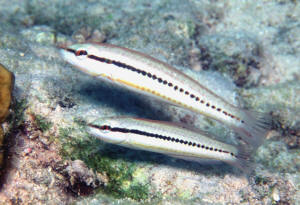
Thalassoma lutescens
7/4/14
Lifespan question, Thalassoma lunare 5/2/08 Hi, <Tim> I was wondering if you could tell me the average lifespan of a lunare wrasse in captivity. I have owned one for about 5 years now and I'm not sure how old he was when I bought him; length was about 5 inches then. Just wondering how old he might be and what his life expectancy would be. Thanks, Tim <Mmm, let's see if Fishbase.org has... Mmm, not for this Thalassoma: http://fishbase.org/Summary/speciesSummary.php?ID=5645&genusname=Thalassoma&speciesname=lunare but other members of the genus do have age/mortality data... about 10-12 years is likely an average maximum lifespan. Bob Fenner> Klunzinger Wrasse 10/15/06 Hello Crew: I couldn't find exactly my situation in the FAQs so I thought I would shoot a line over to see if you have any thoughts. As the subject line says I have a Klunzinger wrasse that has started some significant behavioral changes. I have owned him and his 4 tankmates for very close to 4 years now (haven't lost one). Those tankmates are: Goldentail moray eel (yellow variant), purple tang, niger trigger and an annularis angel. Tank is 125 gallons, with a decent amount of live rock - can't remember anymore how much but I think it was along the suggested guidelines. Euroreef skimmer. Anyway, the wrasse has always been the boss of the tank and the most active fish by far. Over the past week, he has slowed down considerably and now for the last two days has taken to staying in one spot underneath a piece of live rock and apparently hasn't moved. I can observe no external changes in terms of spots, growths or anything like that though I can only see one side of him. He was always a fairly big fish ever since I got him from The Marine Center 4 years ago. He's now a good 9 inches or so long. All 4 of his roommates appear fine and in fact have increased their activity with him kind of out of the picture and not bossing them around. No chance in my opinion the Angel spooked him as the angel is the biggest sissy in the tank. Kent Marine RO/DI unit in the house so frequent water changes - water quality appears OK and as I said everyone else is looking good. I pride myself on providing a good variety of food. Are we looking at old age??? <Perhaps, but it's always so hard to tell - few fish get a chance to get to old age in the wild so there's no baseline for what makes an old fish in captivity. Could also just be middle age - perhaps the wrasse is not the angry young wrasse he used to be. Would keep an eye on things and hope for the best. He may yet make a return with a bit of an attitude adjustment. Cheers, J -- > Klunzinger's Wrasse Acting Strange/Proper Preparation of Natural Seawater - 08/13/06 Hi Mr. Fenner, <<EricR here this morning>> Hope everything is fine there'¦ <<Yes, thank you>> Here is a problem which I don't know yet whether it's a big problem or a small problem. <<Hmm, let's see then...>> It's about the behavior of my Klunzinger's Wrasse (Thalassoma klunzingeri). <<A very neat/attractive fish>> He has been acting totally weird lately. He was the type to cruise around the tank searching for food (ate very well) and even when I clean the tank he never hides. <<Typical, yes>> But 2-days ago he never came up to the surface from his hiding place inside the sand bed. So I thought he was tired or something but the next day also he never showed up so I was obviously scared as I thought he was dead. <<Not necessarily...have observed this behavior in other/similar species>> Then I put my hands inside and tried to search for him inside the sand then suddenly he just came out moved around like lightning and vanished under the sand again. <<Yikes!...I wouldn't do this, quite stressful to the wrasse>> I repeated my actions again once but got the same results & since then he is hiding. <<Best to leave the wrasse be>> My water quality: Ammonia 0.02 & Nitrite 0.05. <<Mmm, should be "zero"...and may be what is affecting/mal-affecting the wrasse>> I use normal seawater for monthly 20% water changes which I collect from the shallow sea so I don't think I can maintain my Ammonia, Nitrite and Nitrate at '0' levels. <<This is distressing to read. Unless you are properly "processing" this water (please read here: http://www.wetwebmedia.com/seawater.htm) you are likely introducing pollutants and pathogens to your system>> Am I right??? <<Indeed my friend...this is "false economy"...and may likely mean the ultimate demise of your fish/system>> I didn't check for Nitrate as my test kit is over. Salinity: 1.020. <<Salinity should be 1.025/.026>> My tank is 80G and has only another Blue tang and a Bannerfish which are normal at this moment. <<Mmm, must mention...this tank is too small for the tang in the long-term...and marginal for the Bannerfish...in my opinion>> My green algae growth is fine <<I'll bet...>> & I have a lot of live rock. What do you think about this situation? <<I have seen these "burrowing" wrasse hide before for as long as seven days when pestered. In this case I think the problem is environmental (water chemistry issues/pathogens)>> What's up with him? <<Something in your system/water is bothering the wrasse>> Will he be normal again or should I expect the worst? <<Properly quarantine/treat/buffer the NSW, or better yet, convert to synthetic, and you will likely see an improvement>> Thanks, best regards, Rachel <<Cheers my friend. EricR>> FISH PROBLEM Hi, I have had a small lunare wrasse for the last 6 months. The last three weeks it hides in shells and under rocks and never seems interested in eating or swimming around the tank. He is breathing heavier than normal and his body color is changing from light blue to a lime green color. Is it sick or is it going through it's sex change where it becomes a "super male" ??? AMY >> You may have hit the proverbial head on the nail... I wouldn't be overly concerned re this Thalassoma lunare... as it will once again become more outgoing... I doubt if it/she/he is really sick. Bob Fenner Mexican wrasse in hiding Background: 55 gallon (fully
cycled), 2 clowns, 1 Firefish, 1 Rabbitfish, and 1 wrasse with about 18
pounds of live rock and good water conditions. I have a Mexican
(Cortez, Rock, Rainbow) Wrasse for about 6 weeks now. The
first 2 weeks he was always visibly swimming around the tank and never
hiding - then I added some (more) live rock and did a little
rearranging in the tank. The wrasse now hides for the past 4
weeks. I have peeked around the corner when the lights are
off in the room and I know he is alive and has very good color... as
soon as I put the lights on or he sees me he bolts back into his hiding
place (a fake plastic sponge (I think) coral, where one of the fingers
broke off allowing him access to swim into the base) and won't come
out. My question - he is a beautiful fish and I enjoyed
watching him swim for the first 2 weeks so what can I do to get his
behavior back to that state. <Likely not much that is easy to do...
this fish lives in quite large haremic settings... lots of space... and
lots of others (especially females) of its own kind. If you had a
larger system (a few hundred gallons) you might be able to somewhat
replicate more natural conditions, and hence behavior... If you can
place this fish in at least twice the current volume, adding a female
or two would likely induce the male to become (return to being) more
outgoing. Bob Fenner> Thank you so much for your help with. Confusing Wrasse Hi guys: I have a Lunar wrasse bought from the LFS 3 weeks ago. For about 2 weeks was eating vigorously. Over the last week, has grown very finicky. Won't eat Mysis shrimp anymore (eats and then spits it out). And may eat whole shrimp (with shell) sometimes (bangs it against a rock, very cool). <Yep- I've seen that behavior- it IS cool!> No change in behavior (still all over the tank). We have noticed that its color has become more green in the last few weeks (don't most of them go the other way) so am worried that the sex is changing. (A) is that possible? (B) any chance that is causing the lack of food take? Do I need to vary the food even more? <Female-to male sex changes are common. Color changes do happen...These fishes start out as relatively dull juveniles, and really start to color up when they reach adulthood...As for providing a variety of foods: I've never seen a fish that won't benefit from this!> Tank specs: 90g Fish Only Wet Dry with Sump ETS 300 Skimmer (was originally a reef tank) 2-3" Sand bed No nitrates, ammonia, tank very well cycled Salinity is high 1.025-1.026 but maintained constant with a NURCE top off device Lots of rock and hiding places Other inhabitants: Majestic Snapper Koran Angel Baby Clown trigger <Wow! These are some potentially very large fishes...Please, please consider the "end game" here, and plan on much larger (like several hundred gallons) housing for them in the near future, if you expect them to live anything close to a natural life span...> Thanks in advance for help! <You're welcome! Scott F> Wacky Wrasse? Howdy, I bought a Lunare Wrasse 2 days ago. When I was vacuuming the wrasse got a little frisky, and hopped out of the tank. I got him back in after about 45 seconds to one minute. It was a close one, but now he just lays there and breathes. All of his color is still there, and my chemicals are pristine. <Given time, he can make a full recovery. keep an eye on him, and make sure that he eats. Continue to maintain excellent water quality> Also, is it normal for a wrasse to lay around except for the outbursts of energy where he shoots around the tank and eats? Jeffery <Yep- wrasses are known for some of their wacky antics. If there are no disease signs, and the water parameters are as good as you say- I'd chalk it up to typical wrasse behavior. Given what your wrasse went through, I'd say that he has a good chance at a full recovery. Good luck! Regards, Scott F> - Sex Changing Wrasse - Hello to all at WWM: About three months ago a bought a FEMALE Thalassoma lucasanum, (AKA Rainbow Wrasse, Paddlefish Wrasse, Cortez margarita Wrasse). However, now almost 3 months later, it has changed to the male coloration, maybe into an actual male. I did not know these fish would or even can change from the female coloration to the male coloration. Just curious if anyone at the Crew has heard or seen of such a thing. <There are many wrasses as well as several other groups of fish that have this remarkable ability. It ensures the continuation of the species. What a planet!> Either way I like both color forms. By the way, Scott Michael's Marine Fishes pocket guide has great photos of this fish on page 319. As always, thanks for all your time and effort. Gene <Cheers, J -- > Normal lunare wrasse behavior 09/13/2005 Hi, <Hello Shelly> I was reading your FAQs regarding lunare wrasses, but I did not come across anything particularly relating to my fish situation. We have kept a lunare wrasse in a 75 gal. aquarium for about 5 or 6 months now. Tankmates include 1 snowflake moray eel, 2 domino damsels and assorted snails and hermit crabs. We had a lionfish who died suddenly about a month ago. There were no signs anything was wrong with that fish. Just one morning, I woke up to find it belly up. After that, I had the water checked and levels were perfect. So we don't know what happened with the lionfish. <Diet?> The only thing I can think of is perhaps it was injured by another fish. At any rate, my concern now is with the wrasse. It seems to be resting on the bottom of the tank for a few seconds, then gets up and swims around for a while, and goes back on the bottom. Is that normal? <Wrasses do rest quite often. Don't know what it's behavior was before the lion death.> It also likes to hide in some of the rocks (which I gather from your site is normal).<Yes> Coloration and eating habits are fine. I am just worried that it is coming down with something (maybe that the lionfish had?), and wondering what I can do. I am going to take the water to get tested again today. <Shelly, lunare wrasses like meaty foods, and vitamins should be part of their diet. A few drops of Selcon in their food does wonders. Wrasses also like to burrow in a sand substrate. Crushed coral etc is much too coarse for their skin. Ten percent water changes weekly add to the health of fish also. James (Salty Dog)> Thank you for your help. <You're welcome> Shelly Wrasse concerns 10/9/05 Hi, <Hello> I'm sort of concerned about a lunar wrasse that I have. For a few weeks now, his appetite has tapered and he is lying on the bottom a little more than usual. <How big a tank, of what make-up, chemistry?> I've also noticed, for some time now, that he breathes rapidly. Is this normal for this fish? <Yes> As far as I know, he's always breathed rapidly. But with the decline in his eating and being somewhat more lethargic, I'm wondering if something is wrong. Other than that, he looks normal and healthy. Up until just yesterday, he has been alone in the tank for several months. This after his Picasso trigger buddy jumped out of the tank to his demise. He now shares the tank with a queen angel. Thanks for any help! <... Please read re Thalassoma wrasses on WWM. Bob Fenner> Spitting lunar wrasse 2/8/06 Hey Bob, <Yo> I
observed something interesting in my tank this evening. One
of my fish is an adult lunar wrasse, approximately 6 inches
long. I feed chopped up fresh sea food that is just dropped
into the tank and frozen brine shrimp and bloodworms. I put
the brine shrimp and bloodworms in a "worm basket" to
feed. I do not know if that is the proper name, but it is
what the folks at my LFS called it. Anyway, it is a plastic
mesh cone that the food sits in to slowly dissolve in the
tank. Well, I can not just leave it suction cupped to the
glass because my wrasse will rip it off the wall. So, I hold
the cone in the water for a few seconds to let some food dissolve and
then I pull it out until most of it is eaten. Then I put it
back in, let some dissolve, and remove it again. I do this
until all the food is slowly dissolved. All of that to say
this: I noticed tonight that when I pull the feeder out of the water,
my wrasse will come to the surface and spit water at the
feeder. <Neat> I saw him spit it as far as 3-4
inches. It was really an interesting behavior. I
have seen this behavior demonstrated with freshwater Amazon fish, but
not with reef fish. I cannot imagine that is a typical
behavior, but one this fish has learned due to my feeding technique.
<And who says fishes are dumb? Bob Fenner> |
|

|
Features: |
|
| Featured Sponsors: |