|
FAQs on Thalassoma Wrasse
Stocking/Selection
Related Articles: Thalassoma Wrasses,
Related FAQs: Thalassoma Wrasses 1, Thalassoma Wrasses 2, Thalassoma Identification, Thalassoma Behavior, Thalassoma Compatibility, Thalassoma Systems, Thalassoma Feeding, Thalassoma Disease, Thalassoma Reproduction, Wrasses, Wrasse Selection, Wrasse Behavior, Wrasse Compatibility, Wrasse Feeding, Wrasse Diseases,
|
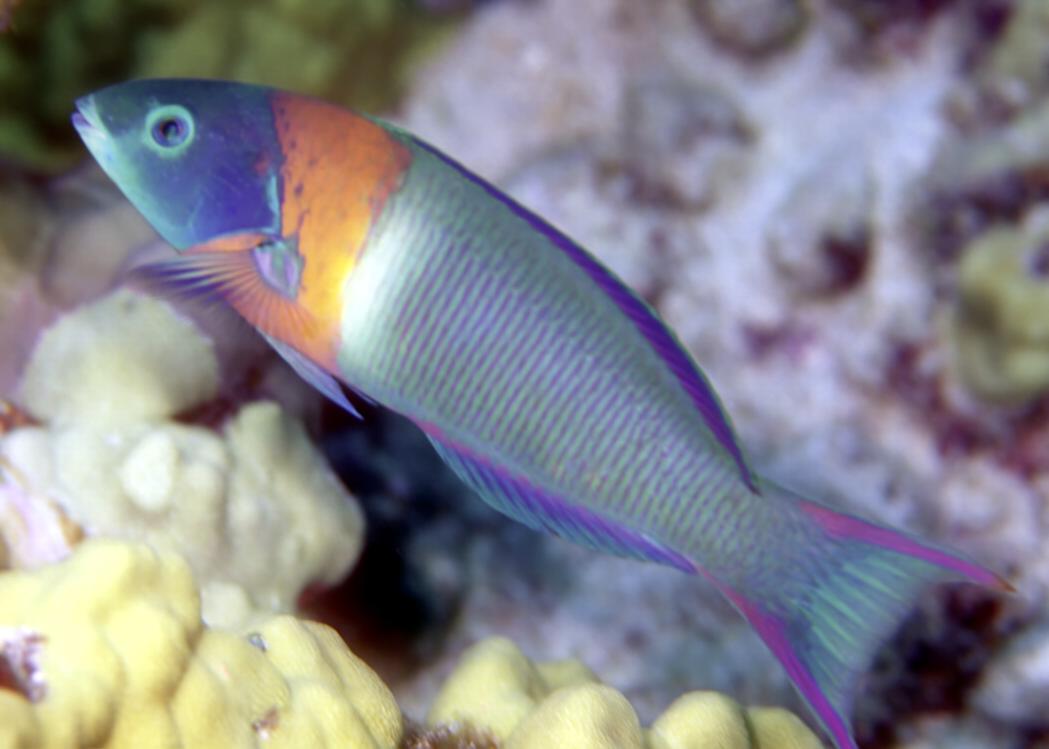
A T. duperrey in the wild, HI.
|
Bluehead Wrasse Reef Aquarium
10/9/19
WWM Crew,
<Chris>
I'm getting bored with the tank again and looking to do something different. I
have been looking through my old books (I'm old enough to have actual hobby
books) for inspiration and something you do not see
anymore today are tanks with the bigger fish. I love corals, but everything
lately is trending around the collector's sticks with little fish and I have no
interest at the moment. My current aquarium is a 110
gallon (48"x18"x30"), basically a 75g with a little more height. This current
tank has been setup as an LPS reef with Gorgonia for 4 or 5 years now and has a
harem of royal gramma, a pair of pygmy angels and a Hawkfish.
There used to be some gobies in there....but Hawkfish happened.
I would like to re-build my aquarium around a small harem of Bluehead Wrasse
(Thalassoma bifasciatum).
<Okay>
System wise, is my tank big enough?
<Mmm; barely... One male, or becoming male... perhaps 3-5 females,
juveniles....>
Could I do one male and two females? Tankmates would consist of blennies and
pygmy angels for algae control (No tangs as the tank is too small). I already
have a mated pair of cherubfish (Centropyge argi) that would stay.
Hawkfish would probably stay as my gobies' spirits can live through him.
<Ha!>
I could keep or sell the Royal Gramma harem if it is a problem with the wrasse.
<Should be okay; esp. if there's plenty of nooks, crannies>
The tank would remain Gorgonias and LPS as I like these and I find SPS to be too
finicky.
<I have a piece (art.) coming out next ish of Coral on gorg.s (along w/ one by
Felicia McCauley)>
Regarding cleanup crew, are there any snails or crabs that would be safe with
the Bluehead Wrasse. I know they generally planktivores but will also eat
shrimp, snails and stars. Are there any mobile inverts that can work in a wrasse
tank? Perhaps larger conch or Mithrax type crabs?
<I'd risk larger gastropods, not crustaceans>
Aquascaping would be live rock from Florida aquaculture with special seafloor
grade sand. What thickness would I need on the sandbed for the wrasse.
<3-4 inches of something fine/r>
Rock would be arranged to keep an open bottom as much as possible, probably
something L shaped along the bottom and tapered in height from one side to the
other.
Feeding wise, I use a liquid food blend of Mysis, Arctic Pods, Fish Eggs,
Rotifers, Oyster Eggs, etc. With the wrasse being a larger fish, I may add a
daily manual feeding of frozen mussels (or fresh oyster when in season).
<Do mix this up w/ other foods. I'd likely use a good pellet (Hikari, New
Life...) and an assortment of frozen/defrosted San Francisco Bay Brand meaty
foods>
System filtration-wise, I currently run a skimmer rated for a 150-gal tank with
UV. Since I suspect I can no longer keep a cleanup crew with the wrasse in the
tank, would an algae turf scrubber be recommended here?
<A nice addition; yes.>
Any other thoughts?
Thanks,
Chris in New Orleans
<None at this juncture. Bob Fenner>
Re: Bluehead Wrasse Reef Aquarium
10/9/19
Thanks Bob and WWM crew! Regarding the harem of Bluehead wrasse, how many cubes
of food do you think they would require daily?
<Only a part of one... maybe a quarter or so until the fish are grown>
I am a fan of the SFBB single ingredients and I usually keep mussel and the
large plankton on hand - I would supplement with the same. I do want to make
sure the turf scrubber is sized properly for the little underwater piggies. I
have kept Gorgonia for over 20 years, with it being my first coral back in 1999.
Purple sea rods will always have a place in my tank lol.
<Neat!>
I am looking forward to your article. On the inverts, I will stick with conch
then, but how would a Sally Lightfoot Crab fair (speculation is fine)?
<If/when it sheds, unless it has good hiding... might be eaten>
Finally on the substrate, I was not clear on the comment - would the Special
Grade be a good gradation (1 - 2 mm) or did I need to go finer?
<The 1-2 mm is good to use>
Thanks again, Chris
<Cheers Chris. BobF>
Wrasse on wrasse hate 5/28/18
Hi, need some expert advise that the forums can't provide. I added a yellow moon
and lunar wrasse some time ago and the two hung out with no issues.
<Genus Thalassoma wrasses are not generally a good idea to mix... territorial.
Best to have one species per system, unless it's huge... with one
determinate/male and the rest either initial phase/female or sexually
undifferentiated individuals. This is gone over on WWM>
Later I added a blue headed wrasse and he was targeted a little by the lunar but
handled it well.
<...>
The last time I saw him get bullied was when he had a krill that he refused to
give up and ended up keeping it.
An era of peace descended on the tank for anything that didn't have a shell.
Then today I saw my yellow moon being chased at top speed around the tank by the
lunar wrasse. Things subsided and they all settled back into their normal habits
with the exception of some mean glances from the lunar which made the yellow
moon turn the other direction. Then at bed time the chase
occurred again... Funny thing is these two are the same size, the blue head is
smaller and seems unaffected by the fighting. Thoughts/what should I do/what's
the crystal ball showing you?
<As above. I'd have these in separate systems... with more of their own kind>
Btw I planned on banishing the lunar to the sump but it dives for cover when I
reach for the net. So I don't know that I'll be able to do that.
<Better by far to study ahead of acquiring livestock. Bob Fenner>
Re: Wrasse on wrasse hate 5/29/18
Thanks for the reply, I guess I've been looking at the wrong portion of your
site.
<Ahh, please see here re the genus:
http://www.wetwebmedia.com/thalassoma.htm
and the linked files (at top)>
Most of the information I've read is in email form like the reply I received.
<Ah yes; what we call/label as FAQs>
Also, I did research putting wrasses together but nothing really highlighted
this issue other than to say they establish a hierarchical system and one person
saying it'll only get worse even if I isolate the lunar for a while.
<This is likely so unfortunately>
In fact my research showed several people keeping 6 types together which is why
I did this.
<Ahh; like many Cichlids, if/when crowded, aggression can be diffuse/d>
Anyway, I guess I'll keep observing and see about removing the yellow moon.
Thanks again.
<Sensible; welcome. Bob Fenner>
Re: Lunare Wrasse 9/27/17
Well, I decided I reject the offer as I am more interested in
the Banana Wrasse that my friend has. An inch or two per year
seems pretty fast, what about the Banana Wrasse? I'm guessing it's the
same. Thank you for
answering.
<It is; though this species gets considerably larger... maybe 8 inches,
a bit more, in captivity. BobF>
Re: Eel question and what gives
Now dewormers for marine fishes, Thalassoma
7/25/17
Hey Bob,
<Bob>
Thanks for the insight. Just a side note, these eye flukes, Neobedenia,
seem unfazed by Prazi pro. May look into another dewormer.
<There are a few; listed on WWM>
Lastly, I can't seem to find much info on the Mauritius red cheek
wrasse.
Have you had experience with them? Thanks , bob
<I do not; but this Thalassoma is not easily kept... too spastic, easily
damaged. Bob Fenner>
Thalassoma sel., captive fish mortality
7/26/17
Thanks bob, i will shy away from that wrasse.
I did pick up a wrasse people don't encounter often in aquaria, but I've
seen you talk about while diving in Hawaii, a Coris venusta. Subtly
beautiful, and ate everything the lfs had to throw at it.
<Hardy, like most Coris spp.>
I wanted your opinion in fish mortality. I've been told a trip to a
wholesaler during receiving can be an absolute living nightmare. Garbage
cans full of dead fish.
<Ugh>
Without any real, honest empirical data out there, what percentage do
you put on the number of fish living a week after they leave the ocean
(capture, transport, acclimation at first facility), versus one year
post capture (the hobbyist home aquarium)
<Losses likely exceed 10% for some shipments; perhaps more>
And lastly, how would you rank in order of most common first,
reasons fish perish:
<Largest source of mortality: trauma/stress in collecting, handling,
shipping>
1. Not suitable for captivity (ribbon eels, Moorish idols, mandarins)
<On a scale of 1-10, this is a 5>
2. Improper set up (seahorse in fish only set up, Achilles tang on too
small of quarters, coral eating species kept in tanks absent of coral,
Garibaldi damsels kept on tropical set ups)
<Again, about a five>
3. Disease (flukes, ich, velvet etc)
<Maybe a two>
4. Environmental ( bacterial, harsh water conditions)
<A six>
5. Incompatible tank mates (too many tangs, triggers with lion fish)
<A four or so>
And lastly 6, the mysterious fish just die whether it be stress, some
type of genetic defect (heart issue, liver etc)
<A one>
Any others I didn't think of. (I'm sure chemical interaction, stray
voltage
and others play a part too)
Thanks bob
<B>
Pinkface wrasse - bad idea? 5/4/15
Hi Bob. I’m interested in your advice regarding a Pinkface wrasse (T.
quinquevittatum). This fish was at the top of my list when I started my
260 gal FOWLR about a year and a half ago. However, I have not
been able to find one until now.
<This Thalassoma and its near congeners don't make their way into the trade very
often; mainly because the habitats that they most often are found in aren't
fished by collectors... near shore, high water movement. A close second reason
is that folks don't have the sorts of confines in turn that they require....
large, roomy, with lots of water movement>
My LFS has three of them in. Two are smaller (3-4”) with not great
color, the other is about 5” with very nice color.
<All will grow to be well-colored if maintained properly>
All are very active and eating well. In researching the fish, though, I have
heard that Thalassoma wrasses are pretty aggressive, and cam be downright mean
if not homicidal (or piscicidal, as the case may be).
<Some more than others... this one is of the more aggressive>
I know lunare wrasses are particularly mean; I have heard that Pinkface wrasses
are not as bad, but I still concerned. I have a well-stocked tank with several
tangs in the 4-5” range, several angels in the 5-6” range, a 7” niger trigger,
5” Bluejaw trigger, a few smaller fish such as a flame hawk, royal gramma and
purple pseudo, and a number of wrasses. My wrasses include a 6” harlequin tusk,
5” red velvet fairy, 3.5” exquisite wrasse, 3.5” melanarus, 4” quoyi parrot, and
a 3” transitional red Coris. What are your thoughts on adding the 5” Pinkface?
<I'd start with one of the smaller individuals... in a system of this
size; it should learn to get along>
I know it can hold its own, but is it likely to start harassing and even
injuring or killing some of my other fish? My fish are generally bold, but I
don’t want to upset the balance. I had to remove a murderous Picasso trigger a
few months ago. I am afraid catching a Pinkface wrasse would not be so easy.
Thanks for your advice!
Ben
<Welcome. Bob Fenner>
Re: Pinkface wrasse - bad idea? 5/4/15
Thanks for the quick reply Bob. You think the smaller ones will color up as they
grow?
<Already stated>
Are these a fast growing species?
<Nope>
Interesting to hear you say pinkfaces are among the more aggressive - I had
heard otherwise but not from as reliable a source as you. Sounds like you think
it’s not so bad that I should just avoid it entirely though? I have also heard
they can really harass other wrasses. I’m most concerned about my melanarus and
parrot as they are closest in color and form.
Thalassoma quinquevittatum; stkg., sel.
7/20/2014
Hi Crew,
<Chris>
I would like to know if three of these would pose a threat to a group of
6 gramma loretos already established in a 160g Fowlr system.
<Not likely a threat unless the former were very big, the latter very
small. This Thalassoma is even more energetic than the usual members of
the genus... really zooming about. You'll want a "quiet end" (stack of
high rock) for the Grammas to hide out in>
Would one or two be better instead?
<Likely so... especially if all started small... 3-4"... with just one
"turning into" a male>
My goal is to see the color changes exhibited by the male wrasse. (I
can't select a male since I live in the USVI
<Oh! Am headed out to St. Thomas next week... to do a bit of diving>
and order directly from a stateside wholesaler.) The smallest loreto is
1.5" and the wrasses will be ordered as "medium."
Also, is there any snail that would work?
<Not any that I'm aware of... too likely to get flipped, eaten>
Thanks. Your service is invaluable.
Chris Powell
<Cheers, Bob Fenner>
Re: Thalassoma quinquevittatum
7/20/2014
Thank you, Bob. I'll try two wrasses rather than three. The rockscape
has two dense areas and dozens of small holes that the loretos
use--endlessly fascinating. I'll rely on my three tangs, my two dwarf
angels, and my cleanliness to control algae.
<Real good>
Ha, I am on St. Thomas. It would be a kick to meet you.
<Oh! Will be at Megan's Resort 7/25-31... Would you like to go diving
with us? How to contact you? Via this email I take it>
I'm sure you have a full agenda, and I'm having the dreaded dental
surgery next week--plus the new fish arrival on Thursday evening.
However, toss me a line if you like. Maybe there will be a gap in
common.
Cheers, back atcha,
Chris
<BobF>
Re: 200G FOWLR Predator Stocking - wrasse selection/tradeoff
7/31/12
Bob (or other Crew if Bob isn't available),
<Bob here Dave>
I am finally ready to add fish to my tank...after years of planning,
running in circles, and 8 months of incessant emails to you (sorry)...
<No worries>
I've updated the final selections. Now that rock and sand are in my 200
Gallon (60" long x 30" tall), and I hope to err on the side of under
stocking so all specimens have a little elbow room. I hope to get your
advice one more time on FOWLR stocking.
I have 2 engineer gobies and a maroon clown in quarantine. I plan to add
a harlequin tusk, a porcupine puffer, and a hippo tang. I would like to
add 1-2 more fish, but want to ensure there is no crowding or
competition with the swimming needs of the puffer and hippo (and for
this reason, ruled out added large wrasses, large angels, triggers,
tangs, goatfish, etc).
<Smaller Tang/s, Goatfish would be fine>
Any suggestions on others to consider? Maybe a larger Hawkfish (*P.
**forsteri, P. hemistictus or C. pinnulatus)*?
<Interesting animals... I'd skip on the last>
Or a smaller Thalassoma wrasse (*T. hebraicum, T. bifasciatum*)?
<Also good (fast moving) choices>
Seems these would help ensure the puffer and hippo have their unobstructed
run of the tank?
<They'll highly likely be fine together>
Appreciate any suggestions
on these listed or others you may suggest.
<I'd consider a small, schooling species here... for color, movement...
Perhaps a shoal of Anthiines or Cirrhilabrus>
Thanks, Dave
<Welcome. BobF>
Re: 200G FOWLR Predator Stocking - wrasse selection/tradeoff
7/31/12
Bob, thank you for this feedback. I hadn't considered a shoal of fish to
add. In researching, it seems fairy wrasses may be a better fit to the
bruisers already on the stocking list (especially the Premnas and
Diodontid). Would you agree?
<Mmm, well; there are quite a few other choices/groups, but yes>
I'll complete the stocking list with a handful of larger fairy wrasse
specimens and a freckled Hawkfish. Seems this will keep the water column
traffic patterns in balance for my tall/narrow 200G.
Thank you!
<Welcome Dave. BobF>
Re: 200G FOWLR Predator Stocking - wrasse selection/tradeoff...
Thalassoma stkg./sel f' as well 7/31/12
Do you suggest that I focus on any other select choice/group?
<Mmm, please read here:
http://www.wetwebmedia.com/fowlrlvstgfaqs.htm
and the linked files/FAQs above in the series. B>
Re: 200G FOWLR Predator Stocking - wrasse selection/tradeoff
8/1/12
Bob, thank you. Having done more review on WWM at your suggestion,
I am considering introducing a small shoal of Thalassoma
lucasanum instead.
<Neat!>
I would like to add a 6" terminal male
<Wow! Hard to find, catch... you'll soon find out>
that I found today at a local reputable fish store (Elite Reef in the
Denver area), and see if I can find two smaller initial phase specimens
(with the hope that they will be female). Do you think there is any
concerns with this?
<Mmm, no>
If not, do you have any guidance on maximum sizing for the smaller
specimens?
<Three inches or so...>
As the other fish will be mid to large size, I don't want to go too
small on these. (IE, Engineer Gobies are 9", Maroon Clown and
Hippo Tang are 4", Harlequin Tusk and Puffer are 7").
<The Thalassoma are very quick and aware. As long as they're healthy
when introduced they should be able to stay out of the way>
Thank you...I'm almost there...Dave
<Enjoy the anticipation, process. Bob Fenner>
Re: 200G FOWLR Predator Stocking - wrasse selection/tradeoff
8/1/12
Bob, thanks for the feedback! I'll be sure to let you know how this
experiment goes. As they are speedy, and there will be plenty of
tankmates/obstacles that will prevent their capture, I can only hope
that carnage/death is not the final outcome of a failed harem
attempt...we shall see...
A few last questions before I give this a go...
Do I introduce the male first, females first, or all simultaneously? I
see FAQs generally encourage a simultaneous intra-species introduction,
but want to double check on the approach for a harem.
<Females first or all simultaneously>
Do you think this is likely to cause higher male aggression towards the
other tank specimens?
<No>
I may not attempt if this could cause all-out tank warfare, especially for
the other Labrid (i.e. the 7" Harlequin Tusk). The Thalassoma is my
last-choice specimen group.
<Exciting. B>
Lunare Wrasse or Not?? 4/16/12
<Hi Tina, Jordan with you today.>
Ok, so long story short :) I started with a 5 gallon saltwater and
about 2 months later upgraded to a 40 gallon saltwater (would love a
larger one but not enough room). I have a Yellow Tail Blue Damsel,
Scooter Blenny,
<Is the Scooter accepting prepared foods? It is going to be difficult to
sustain enough pods to support a Dragonet in a 40.>
Large Condy Anemone, Large Feather Duster, Multiple Tiny Feather Dusters
(hitch-hikers), 2 large snails, 1 medium snail, some small snails
(hitch-hikers), 2 Blue Leg Crabs, 4 Red Leg Crabs, and plenty of other
tiny hitch-hikers. (Only had the Damsel, Feather Duster, and 2
crabs in the 5 gallon.)
Since I set up my 40 gallon breeder (36 in. L x 18 in. W x 17 in. H)
around Christmas I have lost 2 other damsels to ick, but it has never
affected my Yellow Tail Blue Damsel or my Scooter Blenny (it has been
over a week since my last damsel died of ick).
<Are you treating in any manner? Cryptocaryon irritans will not just go
away. Read more on Marine Ich--
http://www.wetwebmedia.com/ichart2mar.htm
http://www.wetwebmedia.com/ichartmar.htm>
I have seriously been wanting to get a Lunare Wrasse (which I can get at
about 3 inches) but don't want it to get ick right away and die
(unfortunately I don't have a QT).
<Thalassoma lunare?!? They get much too large for a three foot tank and
are quite aggressive. I'd recommend setting up a QT system.>
My LFS says they are very hardy and usually don't get ick as they spend so
much time in the sand, is this correct??
<LFS is trying to make a sale.>
Should I go ahead and get one?
<No, tank is way too small!!! Do not add any fish until Crypto has been
addressed and corrected.>
I know there are worries about them eating crabs and snails but I'm
hoping if I get the 3 inch one he won't be as apt to mess with the
larger crabs and snails (not too worried them).
<It's only a matter of time until the largest of snails and crabs are on
the menu.>
My other worry is my Condy, it's kind of my baby and I would hate for
something to happen to it. Do you think if the Lunare is 3 inches
when I get it that it will leave my Condy alone??
<Condy would pose more of a risk to the Wrasse.>
I know it's taking a risk, but how big of a risk do you think? I have
done a lot of reading on-line and in all of my many Marine Aquarium
books and they all say so many different things, can you please help me
out??
<Do not put a Thalassoma lunare in the tank and kill the Crypto before
adding any new fish.>
Thank you so much in advance, you guys and gals have helped me out
before and given me great advice...keep up the awesome work!!!
Looking forward to your reply...Tina :)
<Best of luck>
<Jordan>
Just wanted to get some advice regarding a Thalassoma
duperrey. Comp. 2/1/12
<Ahh. A fave endemic from HI>
I have a
90gal FO tank with a good amount of free swimming
space. Do you think I am "pushing it" by adding this
6" wrasse to my tank?
<Mmm, possibly. What else is stocked here?>
His tailfin alone is around 2" (including long point tips). So
I'd say his body is about 5" or so. This is the first (out of
3) Thalassoma wrasse that actually swims calm and relaxed....yet alert
and always "on the move". Does this species tend to be less
"rambunctious"? What do you think? Am I providing
enough
space?
Thanks,
James
<Is about mid rambunctious for the genus... Bob Fenner>
re: Hey folks.....
I have a 3" yellow tang, 2" flame hawk and 2" purple
Dottyback, 4" Harlequin tusk, and a 2.5" Kole tang....
<Should go w/ B>
re: Hey folks..... 2/1/12
And.....WOW....he is beeeauuutiful! Pictures don't do justice in
the least! He looks like a palette of monotone pastel
colors...amazing.
<Healthy individuals are fab. BobF>
... Thalassoma Wrasse, lighting... 2/3/12
Get Bob, speaking of the wrasse I am confused with the lighting. The
orange on the wrasse and the reds (oranges) on other fish are very
muted under my coral life t5 light. Should I increase the actinic or
the daylight in order to bring these colors out? Its a 10k daylight
bulb and just the standard actinic that came with the light. I'd
like to keep the intensities on the blues but intensify the reds and
oranges as well.
Thanks
<I wouldn't change the lighting. Your eyes/mind... appreciation
will adjust in time. B>
re: Hey folks..... 2/3/12
Ok, will do. Just out of curiosity though, what would you do
hypothetically, if you wanted oranges/reds to stand out in addition to
the blues?
<Apply more light in the longer wave length, shorter frequency range
of EMR that humans can register. B>
Harem of Lunare wrasse requirements
10/5/11
Hi All,
I had a quick question. What is the minimal size tank required to have
a harem of Lunare Wrasses?
<Mmm, likely 150 gallons>
I have a 450 display with another 100 gallon sump. What's the best
number of Wrasses to have in this?
<One definitive male, a few females/undifferentiated
individuals...>
It is fairly well stocked, but I thought the harem would be neat.
<Me too... I see such groupings (where the genus Thalassoma occurs
natch) in the wild, and only in public aquariums otherwise>
Thanks,
Jim
<Welcome. Bob Fenner, out in Fiji, observing this species in such
associations most days>
re: Harem of Lunare wrasse requirements
10/5/11
Thanks for the quick response! Enjoy the Fiji's..I'll give it a
try with 3, and share the results.
<Thank you, BobF>
Thalassoma sel. 5/30/11
Hey Bob.....Hope you had a good weekend. For the first time at my lfs I
saw a Gold Bar Wrasse and he looks ok. You say its your favorite wrasse
of the genus and this one is very dull gray/green. I always buy fish
that are your favorites including the Red Coris. So, should I waiting
for one that ls more along the lines of what you say to be beautiful,
or will he change and get more colorful (he is 4")?
<Up to you... will change colour and more w/ time... Better under
good conditions. B>
Thanks
re: Hey folks..... Thal. sel. 5/31/11
Ok thanks. There is very limited information on this species. I wanted
to know, are there coloration/marking differences with male and
female?
<Mmm, yes... see the geog. survey works by John Randall, Gerald
Allen and co. B>
Saddle Wrasse Question... hlth./quarantine
3/23/11
Hello,
<Ryan>
Quick question. I picked up a beautiful 4 inch Saddle Wrasse
<A small individual! Am impressed by whomever was able to capture
one of these Thalassoma at this size>
from my lfs yesterday. After reading your site I got the impression
that this fish could be freshwater dipped and placed right into my
display tank as opposed to be put into a quarantine tank for several
weeks.
<Can be... It was our store's long-standing policy to do such
expediting w/ Labrids of this and quite a few other genera. These
fast-moving fishes (Thalassoma) suffer way too much otherwise being
confined to small spaces... often damaging themselves, jumping
out...>
My QT is a 20 high and knowing how active this fish is should I do a
quick dip and then place the Wrasse directly into my 150 gallon display
tank?
<Yes, I would>
Thank you for your help.
Ryan
<Welcome. Bob Fenner>
Thalassoma... sel. 3/16/11
And I'm not sure if the Jensen's Wrasse had additional color
morphs since your written literature on WWM but I just bought a male
and he is gorgeous (navy, lime green, mustard yellow and bright blue).
Reason why I'm saying this is because in this fish's Bio next
to the pic you state "not a great beauty but Hardy as the genus
goes....". Just thought maybe they weren't as pretty back then
compared to the newer ones. Just hope he doesn't get overly
aggressive and lives a while haha.
<Ok. B>
Klunzinger's Wrasse Question 1/12/11
Hello Crew. I ordered a Pink Faced Wrasse yesterday, but received a
Klunzinger Wrasse instead. He is now a "freebie" and they
will send me the proper fish as well. He is a good 6" in
length
<Yikes... a VERY active animal>
and looked great in the bag. After a 3 hour acclimation I placed him in
quarantine 20 hours ago.
<Take him out! I'd summarily dip/bath and place this fish in
your largest system. Something at least six feet in length>
He seems really stressed out and has been laying upright, (not on his
side), breathing heavy, with an alert look in his eyes, and in pretty
much the same area since being placed in the 40 gallon long tank.
<MUCH too small a volume>
I was wondering if this is common behavior for this fish after a coast
to coast trip from California, to my door in Michigan, or should I be
concerned here. I have the light turned off and tried once to give
him
Mysis today, without luck. The parameters in the quarantine are right
where they should be. I am also curious now that I have this fish, if
you think I will be able to keep two, Thalassoma wrasses in a 96"
x 36" x 36" system?.
<Yes>
I appreciate any advice you can give me on this issue.
Many thanks,
Howard
<Welcome! Bob Fenner>
Re: Klunzinger's Wrasse Question 1/12/11
I truly appreciate the "rapid" response Mister Fenner.
<I felt the need... "the (wait for it) need for
speed"!>
I did as you instructed and he immediately went into a dark cave in my
"show" tank (8ft long, 3 ft wide and 3 ft tall). The Wrasse
came in very "fat" but I am wondering, should I try and place
some food in his "cave" in a day or so, or do you think he
will come out on his own and eat when he is ready?.
<Oh, this Thalassoma will definitely come, be out eating w/ gusto in
time>
I have exhaustively read, and continue to enjoy your site, so I know
your take on quarantine. I was just thinking exactly what you
recommended may be an "exception", much like my new Red Coris
Wrasse was, which I why I contacted you today. The Red Coris Wrasse is
doing great, by the way, and ate right out of the bag.!
<Ah, good>
My show tank is aggressive and though I read up on the Klunzinger
Wrasse, and know he is also aggressive, I wanted to give him a little
"peace" after the long haul from the Red Sea, to California,
to Michigan, before he had to deal with the "brutes". Once
again I want to extend my heart felt thanks to you, and your marvelous
"crew" for your tireless, wonderful service you provide for
fellow aquarists.!!!. I am also a diver and take one trip a year.
<Ahh!>
I miss the ocean, but my multiple salt water aquariums take the sting
away a bit between trips. Have a great day Mister Fenner.
Many thanks.
Howard
<As many welcomes my friend. BobF>
Re: Klunzinger's Wrasse Question 1/17/11
Hello Mister Fenner or whomever I get from the "Crew" here
today. I have promising news on the Klunzinger Wrasse. As you
predicted, he is starting to emerge from a cave and grab some food.
<Ahh!>
He still appears somewhat skittish, retreating to his cave afterwards.
I do see him out and about more as each day passes. He is a magnificent
fish indeed.! Thank you again for your timely advice. I think it saved
this one for me.!
Many thanks,
Howard
<Thank you for your report Howard. BobF>
Thalassoma hebraicum pair 12/7/09
Dear WWM Crew,
<Bill>
I would like to get a pair of Thalassoma Hebraicum in my 300 gallon
tank but have not found a retailer who has a pair for sale.
<Mmm, this genus, like many Wrasses, live in haremic conditions, a
dominant male with a mix of females, developing individuals, not
"pairs" per se, though will live as "two" in a
system as large as yours just fine>
At LiveAquaria, they have a 4" female for sale and at another
retailer, they have a 5" male. Is it possible to buy them
separately and put them in a tank and they pair up?
<Mmm, in as much as the genus does, yes>
If so, should the female go in 1st? Should they be the same size or the
male bigger?
Thanks,
Bill
<In the volume/system mentioned, either could go first, the size
difference is not important here.
Cheers, Bob Fenner>
Thalassoma duperrey, sel., HI biotope -- 06/29/08
Hello WWM crew-- I am interested in setting up a Hawaii biotope. The
tank will be either 180 g or 210 g. I am still working out a few of the
setup details, including the stocking plan. I know how common the
Thalassoma duperrey, or Saddle wrasse, is in Hawaii and would really
like to have one of them in the tank. Are they available for sale
anywhere? <Mmm, yes... may have to be "special ordered" by
your LFS from their supplier/s, but are caught for the trade in
Hawaii> I live in a small town and buy most of my livestock online,
but haven't been able to find them anywhere. The display just
wouldn't seem right without the Saddle wrasse. Could you possibly
point me to a vendor that might have one? (Or let me down easy if they
are not available in the aquarium trade...) Thanks for the help. Your
site is a huge help to me. Tom <Try requesting specifically... from
Dr.s Foster & Smith, MarineDepot.com... call and talk with them
specifically re... they in turn can ask "the folks at 104th
street" in LA (mainly Quality Marine, Sea Dwelling Creatures,
Underwater World...) to ask in turn... Bob Fenner>
Re: Thalassoma duperrey 6/30/08 Thank you Bob, that is
great news. Now I have a couple follow-up questions. I read the Wrasse
System FAQs and the Thalassoma FAQs, but I am still not sure if the
Thalassoma duperrey requires a sand bed. <Mmm, not to dig, sleep in,
no> I know the moon wrasse does, but I learned in the System FAQs
that some wrasse are able to wedge into rocks as an alternative to
burrowing into sand. Would that apply to T. duperrey? <I do think
so. All members of this genus I've seen at night in the wild were
doing so> I was hoping to have a DSB as part of the refugium and
leave the display tank BB to avoid predation. Thanks again for the
help. <Welcome. BobF>
|
Bluehead Wrasse, Males sel. 6/19/08 Hi Crew, [insert
Crew member quip ; ) ] The only picture used to represent the
Bluehead Wrasse, Thalassoma bifasciatum, shows the terminal phase
male. Studies show this coloring is present in approximately 4%
of wild fish! My question is: How do the fish stores and/or their
suppliers produce so many TP males? Or, how do they get so many
IP males and females to "make the conversion"? Thx for
any insight you can provide. David <These male/terminal phase
individuals (also for many other species) are preferentially
collected in the wild. Hopefully near-conversion
"males" are readily available in such harems to convert
to functioning males. Cheers, Bob Fenner>
Re: Bluehead Wrasse 6/19/08 Hi Bob, If you'll
entertain another question ... Will IP males be a paler version
of their brightly colored TP counterparts; or is the coloring of
IP males and females usually various shades of yellow and white
bands? Thank you again for your assistance saving my Zebrasoma
some months back. It is alive and well thanks to your experience
and advise. Regards, David <Come/occur in intermediate
colors/markings... depending on mood/physiology (principally
hormonal, but neurologically mediated as well), through recent
behavior... most are yellow, with some white and black
markings... ones that are "close", waiting... turn a
bit more bluish, sometimes with black banding... like males...
BobF><<Who does wish he had the means, time on WWM to
put up his many pix to show such>>
|
R2: Adding Another Wrasse To My Tank (Not Going
to Be Easy), now Thalassoma -- 02/11/08 I've seen a Blue
Headed Wrasse (Thalassoma bifasciatum) and find them to be quite
spectacular <<Indeed'�>> ... based on the reading
I've done it seems that it could work since it is semi-aggressive
(no fear of Tomato Clowns), and differs in body size and colour from
the Sixline? <<Mmm, the size of your system is the problem
here 'though not a 'giant' (but still, almost 12' in
the wild), this wrasse gets too big and is much too active/requires
much more space than your 65g tank provides. Even though a small
juvenile 'looks' like a good fit, placing this fish in your
tank will lead to health and behavioral issues for the wrasse. Better
to stick with a Cirrhilabrus spp. as discussed 'in my opinion.
EricR>>
Lunar/Moon Wrasse sel., Rock Beauty nutr.
2/8/08 Hello; <Jamie> I currently own a 125 gallon reef
aquarium. Reef includes many varieties of torch coral, mushrooms,
polyps, and other unique animals. I have read many articles about over
population of mini reefs so I have kept my inhabitant limited including
only a true Percula clown who hosts with a toadstool.... amazing.. he
even tries to feed it; a lunar wrasse, and a rock beauty angel. When I
first started doing this I was very naive (as most people are) and
someone told me the rock beauty angel was a pygmy lemon peel with weird
markings and I thought "oh how cute" and bought him. He has
survived 2 moves and is in his final home the 125. He seems to be doing
well and has grown from about 1 inch to about 4 inches. A very good
eater as well. I have read a lot about their eating and am even
providing live sponges for him to nibble on but he doesn't touch
them... I feed him a wide variety of food including angel and butterfly
formula. Are there concerns I should have with his health in the
future? He is an amazing fish and I would like to keep him healthy.
<If you have done as well with this Holacanthus tricolor as you
state, you likely have much you can teach me... I would have suggested
the angel formula (I "talked" friend Chris Turk into its
making years back when he owned/managed Ocean Nutrition.) or Spectrum
pellets... as I've seen Pablo Tepoot's specimens feed well on
it...> My main question (now that I have strayed) was the following;
I was looking through the Marine Fishes Guide by Scott. W. Michael and
read that lunar wrasses can be kept in pairs in a tank 125 or larger.
Is this true? <Mmm, yes> I ask only because I believe I have a
female... she is quite solid green with pink variations on her face
nothing "wow" as far as color goes. I understand that they
can change sex on their own to help keep populated in the wild.
<Yes, this is so> I am not sure how fish work but I would rather
be with a partner than without. <Is fine w/o...> I would like to
give her a mate that she can relate to. If this will not cause me any
problems how do I go about choosing a male? <Best to choose an
apparent female of slightly smaller size (an inch or so) and allow the
present one to change> Any information you can offer would be great!
There is not to much information I can find in books or anything...all
I can find is that one phrase. "Males and females can be kept as a
pair in tanks 125 or larger". Thank You! Jamie <Bob
Fenner>
Advice on SixBar wrasse, Thalassoma Pass On The
Wrasse (New Fish Addition)? 12/3/07 Hi <Hey There! Scott F. in
today!> First off, thank you guys, so much, for putting all of this
great stuff out on the web for free. I've never written in before
but I've read your FAQs for many years and over this time I've
gradually been trained to never ever put anything in my tanks before
running a search on WetWebMedia for it first. <Wow-I can now die a
happy man...mission accomplished- with at least one of our readers,
anyways!> I've run into a wall on my latest 'want'
though - a SixBar wrasse. I've run through the spellings I've
seen for this on the web (Hardwick's, Hardwickii, Hardwicke,
'Sixbar') and haven't found much on WWM to do with it. I am
just wondering if there is any advice you can give me on whether this
is a good addition to my tank: <Will try> hardware -
5'x20"x20" tank, 1" crushed coral bed, 80lbs live
rock, 0 ammonia, 0 nitrite, 0 to 10 nitrate (depends on feeding),
Deltec MCE600 skimmer (by far the best and most expensive thing on the
tank), circulation totals to 17x volume turnover. inhabitants -
4.5" Odonus Niger 'Niger' Triggerfish, 5" Melichthys
vidua 'Pinktail' Triggerfish, 3 1-2" Chrysiptera parasema
'Yellowtail' Ddamselfish,1" Salarias fasciatus
*'*lawnmower' blenny, various snails and Hermit crabs (triggers
are yet to show the slightest interest in these - I am sure they will
someday). <I would tend to agree!> Nobody ever gets scrappy with
anyone else that I have ever seen. The Damsels were a little bit of a
gamble but the Triggers are far, far and away more active in the tank
than before they were added - I think these might be used as
'ditherfish' by the Triggers, they never bothered to explore
much beyond their hiding space before the Damsels went in. <Good
thought...It's hard to believe, but these types of Triggers do tend
to be rather shy, at least at first. Some do develop rather nasty
personalities down the line-it does vary among individuals.> So,
would you recommend a 5" Sixbar/Hardwick's wrasse for this
tank? I am guessing they are broadly similar to the other Thalassoma
wrasses in their behavior, but I don't know if they might play a
little hard for what seem to be some fairly peace-loving Triggerfish in
this size tank. <I appreciate your caution! I would probably be
inclined to pass on this addition. The main reason would be more of a
capacity issue than anything else. Your aquarium would be pretty much
maxed out at this point, from a bioload standpoint. Remember, the
Triggers do get quite large, and give off copious amounts of metabolic
waste. Plus, they reach pretty large adult sizes! Niger Triggers can
hit 10" plus easily! They need physical space as well. Adding
another fish (particularly a 5" one) is pushing it, IMO. Sort of
analogous to having "one more" gin and tonic, or "just
one more" slice of pepperoni/garlic pizza before that first date!
The consequences may not be immediate but they will probably be
unfortunate!> I have another 5' tank sitting empty at the moment
which I plan to move whichever Triggerfish hits the 10" mark
first, so I think I have a lid on 'these fish will get too large
for your tank' issues for the time being at least. <I'm glad
you have this option. However, I would be inclined to put one of these
guys into it's own new aquarium sooner rather than later. Why wait
for issues to arise. I'd move the Niger now.> Does the Sixbar
Wrasse need a deeper sand substrate? <In my experience, the sandbed
depth is of some consequence with this genus of Wrasses. You would
probably want to increase it by a couple of inches.> Are they
infamous 'tank psychos' once they reach a certain size? Is
there any preferred environment for these fish that you guys know of?
<They (I'm really referring to the genus as a whole- I have
personally not kept this species) can get large, ornery and a bit
"neurotic", in my experience (sort of like a number of humans
I know!), and can even be aggressive at times. This genus of Wrasses
runs the gamut from mildly aggressive and jumpy to full-on "get
out of my face" aggression! Like so many things in the hobby,
there are no guarantees. If you are not prepared for the potential
problems, I'd simply pass. Perhaps another species is more
appropriate. Hint: Look into the genus Halichoeres....> I think
these might have been overlooked by a lot of hobbyists because they
seem much more plain than some other Thalassoma wrasses - it wasn't
up until I got a close look at one (i.e.; not a terrible compressed .jpg)
that I realised they have a brilliant mother-of-pearl effect going on
along their sides, rather than being plain black and white. <Plain
fishes need love, too! But remember, there are many factors that affect
the color of a fish- mood, environment, lighting, arousal (sexual or
otherwise), geographic morphology, even the photographer's skill
with Photoshop (when it comes to pics). Your specimen's appearance
will vary! Although you are correct that the fish has a subtle beauty
that is quite attractive.> Again many thanks for your website and to
all the contributors. <Glad to be of service! Regards, Scott
F.>
Medium size wrasse, sel. 11/16/07 Hi Crew,
Just a general question if I may regarding the Mexican Lollipop Wrasse
(T. lucasanum) and the Cuban Hogfish (Bodianus pulchellus). Mexican
Lollipop Wrasse (T. lucasanum)> I have done lots of Google searches
for pics etc. If I buy a small(ish) specimen, over time will it develop
into a terminal male, with full 'lollipop' colours? <Mmm,
not so much... takes the presence of a shoal of females to generate
this> I am led to believe this fish has the same general husbandry
requirements as the Lunare Wrasse, but it is much less aggressive /
destructive? <A bit less> Cuban Hogfish (Bodianus pulchellus) My
dealer doesn't get these fish in regularly (he deals more in
'reef' fish), hence I will need to order one. Are they all red
with yellow tail and white stripe, or is that for large mature males
only? <Please see here:
http://wetwebmedia.com/marine/fishes/wrasses/bodianus/index.htm>
Lastly, of the two species, which would you say is more
'companionable'? Many thanks <The Bodianus. BobF>
Matt
Wrasses I would like to add a sand diving wrasse to my
55 FOWLR and a 4 inch sandbed. Currently I have a 5 inch marine Betta,
3 inch Fu Manchu Lionfish, a 3 inch maroon clown, and a 2 inch
Valentini puffer. Can you please recommend a species that would thrive
at adult size in this tank. I was thinking of a smaller Thalassoma
species. thanks, Everett <Hmm, some of the Thalassoma might do...
but do look at the genus Halichoeres... particularly the ever-popular
H. ornatissimus as a candidate. This latter genus' members
don't get quite as big or rambunctious... for your 55 and other
marine life, a plus. Bob Fenner, who suggests reading through the
genera and images on www.wetwebmedia.com and supplying a
"tray" (chemically inert... glass or plastic) of fine coral
sand for your new "digger".>
SOLAR OR PADDLEFIN Wrasse Hey Anthony, <Cheers,
mate> I did finally ID that wrasse I described to you. It is indeed
a Paddlefin, but it has not changed into it's striking adult colors
yet. <indeed funny how they call females and lesser males by other
common names... a quirky throwback to when they thought the two very
different color morphs were distinct species> My LFS says that the
Paddlefin is much less likely to attack my cleaner and coral banded
shrimp then others in the Thalassoma genus. He said they should be
okay. <I don't necessarily agree or disagree. Just watch
closely> He also had a beautiful Solar wrasse that came in on Tues.
I KNOW that one would not be a threat, but I'm concerned it's
too passive. <agreed...too passive. But what a magnificent fish!
Even if not directly harassed by the Paddlefin, the mere presence and
activity of the dominant fish can force the solar into competing poorly
and dwindling over time> What do you think about the hardiness/ pros
and cons of each of these fish. One thing to take into account is that
the new Paddlefin I'm looking at came in Tues with the Solar.
<the solor is a great fish with the right tankmates (generally
passive)... but it couldn't compare to the incredible hardiness of
the Paddlefin. A sturdy fish. But two very different fish. By any
measure... the Paddlefin is for a fish only tank and the solar is a
reef tank fish> This Paddlefin is much closer to his adult color,
but he's very timid about eating just yet (normal obviously).....
<not really for this species... they are remarkable fish... I have
had few imports eating offered food in a freshwater bath!!! Keep an eye
on this specimen. Are they feeding it crustacean fare (Mysid, Pacifica
plankton, shredded krill, etc?)> the Solar is eating very
aggressively. <I personally would take the solar... Paddlefins are
rather common and despite their wonderful hardiness, they get rowdy as
they get older. The solar is good with just about anything that
won't eat it <smile>> Thanks pal, Rick <quite welcome,
my friend. Anthony>
Re: SOLAR OR PADDLEFIN Morning Anthony. <Cheers, my
friend> I agree with you on the Solar Wrasse, however on Sat I
picked the Paddlefin. <indeed a great fish, all told> When I went
back the Paddlefin was eating with the gusto that you described.
<yes, hardy, colorful and meaty.. a great FO species> Based on
pure looks, future size, "commonness", the Solar was the
better choice, but I picked the Paddlefin because my tank is pretty
much fish only. Their are a few inverts but it can be a tough place.
The Solar was so gorgeous and I couldn't justify taking a chance
that it would be pinned in the corner or something. <you are very
correct... easily intimidated... good to trust your intuition about
your tank/fish> The Paddlefin was bigger and faster. It hasn't
shown any interest in my cleaner or coral banded shrimp
"yet"....is that a good indication of things to come or could
he turn on a dime? <alas. the latter> Of all my fish to give
this new wrasse trouble.......my tiny little jewel damsel! He's
relentless! <tiny? If you haven't already, look up the
scientific name for this fish yellow-tailed adult fish (Microspathodon
chrysurus).. a huge beast and quite a color change. ferocious,
indeed!> I can't believe that the Paddlefin won't turn the
table in a day or two. <it might be like the big dog afraid of the
tenacious little dog...hehe> Thanks for all your help. Rick <very
welcome, my friend. Anthony>
Lunare Wrasse, small, starving Hi Bob, I have a Lunare
Wrasse in a 55 gal. tank with a Percula Clownfish, two three striped
black and white Damsels, and a Triggerfish. They have all gotten along
quite well for almost three years. I keep a very clean tank with 10
gallon monthly water changes. I have had no problems at all with my
tank or fish. Now, in the last week, my Lunare Wrasse has stopped
eating and has gotten very thin. <Not good...> I called up my
Aquarium retail store professionals and described what was happening. I
told them that my Lunare Wrasse stopped eating, acted like he was blind
to the food, was lethargic and laying around although not buried. I
even tried to hand feed him with no luck. He gets excited when I go by
the tank and when it is feeding time and will start swimming around
acting like he wants to eat. But when I introduce the food (and believe
me, I have tried to entice him with a different variety), he will act
like he wants to eat, but then acts like he can't find the food,
kind of like a brain disorder. The retail store owner said to test the
water with an OHM reading and see if there is an electrical current
running through the water. I did, and found nothing. He is only 4
inches long, so I suspect that rules out old age, since I was told that
he should live to be 8-10 inches long. What can I do for him? He has
good coloring and no signs of anything else wrong with him, except he
has gotten really skinny and emaciated looking. I have tried everything
I know, and I want to do whatever I can to save him. Please help!
Sincerely, Dorry <Thalassoma wrasses do go on starvation bouts from
time to time... and can die from same... I suspect something in the way
of an internal parasite problem... but if the animal won't eat, it
becomes very difficult to try and treat for same. In the circumstances
you list (small specimen, prolonged starvation period) I might risk the
damage/trauma of force feeding this animal, catching it in a net and
holding it with a wet towel in the net, shoving meaty food diced up
into its mouth. First, do try a dip/bath in seawater (in a separate
container) with a tablespoon of Epsom Salts (magnesium sulfate) per
gallon, for a duration of ten minutes (to flush out the animals G.I.
tract), and the next day, place either a whole small "cocktail
shrimp" (sans shell and sauce) or an opened bivalve/clam in the
system to see if it will take it. If you have them, add liquid vitamins
to the foods and water. Bob Fenner>
Pass On The Wrasse? Hello <Hey there! Scott F. with
you today!> Hope you all survived Valentine's Day! <Squeaked
by another one!> Just a couple quick questions for you guys.
Although I have read as much as I possibly can on these wrasses, I
still have a couple questions. First one is the "surge
wrasse" I've only seen one at a LFS (Alberta) and am wondering
how they normally ship? I would like to order one (for my 7' FO
tank) but the LFS tells me they can't get them in any smaller then
a foot? Are these fish as hardy and aggressive as the other Thalassoma
species? <Well, I am not positive as to which species you are
referring to (the common name may apply to a few species in this
genus...), however, my experience with the Thalassoma wrasses is that
they ship fairly well, adapt to captive life quite readily, and do get
quite aggressive over time! I tend to favor smaller specimens, so I,
personally, would pass on a fish that's a foot in length...Try to
get a much smaller one. If you cannot locate one at the LFS, maybe you
could try contacting Marine Center (see our home page for their link),
and they may be able to secure one for you. If you can get the
scientific name of this species, I may be able to find some more
specific information for you> Also, would putting a checkerboard
wrasse (4"fish, 180 g.t.) be safe in my reef tank? I feed 4 - 6
times daily. How much do these guys like Fanworms?? Probably a
individual thing, hey? <Gosh- sorry...Once again, there are a few
species that go by this common name.. If you could supply genus and/or
species name I could provide some information...On a general basis, if
you're talking about an Anampses species, I'd say that
you're taking a huge gamble with your inverts, IMO. If it's the
Halichoeres hortulanus, once again, I'd say it' a role of the
dice...Some couldn't care less about your Fanworms, others will
simply decimate them! If you are keeping it well-fed, you certainly
have a better chance, but it's your call on this one! And believe
me- these little guys are just about impossible to remove from a reef
tank...proceed with caution!> Last question! How do I properly
quarantine fish like Mandarins and certain wrasses that basically
won't really take prepared foods but need live rock? I have a bare
bottom 40 gal with no live rock (like to keep the salinity down)?
<Good question! I usually quarantine these guys with some very small
"rubble" pieces of rock, which I will rotate out every few
days...There usually is not enough living stuff on these small rocks to
sustain the fish, so I make it a point to harvest some amphipods from
the refugium (a tedious process most of the time!) and dump a bunch in
every day...The high level of care is just another reason why you have
to be up to the challenge when keeping these guys!> Thank you so
much, you guys are truly the biggest help ever!! Lynn <Well thanks,
Lynn! And our readers are the best, too! Take care! regards, Scott
F>
Klunzinger Wrasse What's your opinion of the
Klunzinger Wrasse? Hardy? <Can be... in a largish system (more than
a hundred gallons) with very good (brisk!) water circulation... IF one
can find an initially healthy specimen... they take a beating in
collection, holding, shipping> From the Red Sea? <Yes, the
best> Easy to keep in captivity? <Most don't live a
month... due to the above points> How large do they get in an
aquarium? <Six to eight inches> Temperament? <Rough and
tumble... okay around all but the smallest fishes, will eat shrimps,
crabs... perhaps other sessile invertebrates if hungry> Thanks for
your help. Was thinking of getting one in the 4 inch range. <A good
fish for an advanced aquarist. Bob Fenner> Elizabeth K.
Birdwell
Wrasse Impasse? Hello again crew! <Hi there! Scott
F. here today!> Sorry in advance to bother you AGAIN! <Never a
bother!> I have gotten myself into a predicament, it was a dumb move
but can still be undone. <Hah! If I had a dollar for every
predicament I've gotten into....> I have a 120 gallon SW tank.
On a trip to Hawaii in October I fell in love with the Thalassoma
trilobatum, Christmas Wrasse, I have been searching in vain for months
to add one to my tank. I have made TONS of calls to Hawaii even, but I
had come up against walls at every turn and have found that this fish
is near impossible to find in the aquarium trade. <Did you try
Marine Center? They can look for one for you.> I currently have a
peaceful tank but wanted a wrasse as my dream fish. I have plans to
get a larger tank in a few months and was hoping the fish I had would
get along in the 120. <Well, this fish can reach almost a foot in
length. I'd avoid a fish of this size and activity level in a 120
gallon tank, myself. How about a smaller Halichoeres species, like a H.
melanurus? Almost as colorful- but easier to find and smaller.>
Currently I have a Naso Tang (which I hope to get in a 180 at least, if
not I have arrangements with the LFS to take her back (went to high
school with the owner), but currently the Naso is wonderful, fat and
healthy. Her tankmates include: Yellowtail blue damsel, blue damsel, 2
cleaner gobies, and a bicolor angel. Oh and last but not least I have
2 shrimp, Popcorn the fire shrimp, and Scampi the skunk shrimp.
<Love that name!> I have become very attached to them but realize
that they will probably have to go back to the LFS. Man this is
getting long winded! Sorry. My problem is this, I bought a
Klunzinger's Wrasse at the LFS, they've been getting in wrasses
by the week for me in hopes they'd find one that would be close to
my dream fish. This one is the closest, it's about 6 inches long,
and gorgeous. Before I brought it home I looked at your website and
could only find that they came from the Red Sea. I searched online and
couldn't find anything. I checked in with Scott Michaels book
& Bob's CMA and found nothing. So I bought it and it's
currently in my QT tank. I called 4 LFS's, no one had any advice
and hadn't ever had one before, the store I got them at told me it
was a peaceful fish like a Scott's fairy, which just watching him
eat I know is way off base. So my question is what do you know about
this fish, what would have to be removed for him to live in my tank, I
also had a Brazilian Gramma on my list, will any of these be able to
live together? <I must say that I have never personally kept this
fish, but have known hobbyists who have kept them. I'm not certain
of the Scientific name, which will help you find out much more
information. They do tend to be a bit "rowdy" at times, and
they do eat aggressively once they settle in. If you know the genus and
species, you'd do well to check on fishbase.org for more detailed
information on the fish than I could provide here.> Is my tank going
to be over stalked or any you advise me who might be some other fish to
add, I feel pressured to get whatever I'm going to get in the tank,
as I know this one will be the most aggressive of the group.
<Don't feel pressured by anyone to get any fish. You are in
charge! Besides, we're talking about living creatures, and no one
else should tell you what to do!> I haven't added anyone new to
tank for a while so they're a pretty tight knit group. I know the
shrimp will have to go, but will the Gobies be a lite snack too? Where
can I go to find out more about my new fishy? ><{{{{">
Thanks so much! Amy <As above- fishbase.org. That should give you
some good scientific information and a means to search for more
hobby-based information. Also, make use of WetWebMedia's chat
forum. Other hobbyists who keep this fish may have some better
information. Good luck! Regards, Scott F.>
Wrasse impasse? Oops sorry about that last e mail with
no message! <Wondered what was going on in the wide, wide world of
sports!> Thanks so much for getting back to me so quickly. And
just to answer a few questions, I have tried Marine Center, I was told
that these fish live close to the shore and no one can catch fish from
that area. I believe it was Jeff there, really great friendly people!
Also I wasn't feeling pressured by anyone to buy more for the tank,
it was my own pressure. I was trying to add in the more docile
creatures before putting the wrasse in my tank, so I felt like I had to
hurry and get everything I'd want in there and add him in last.
But I now have another question for you, how about a Paddlefin wrasse,
also colorful but considerably smaller. Are they as aggressive or
would my shrimp be safe with them? <Not as aggressive as some other
species of wrasses, even other Thalassoma spp., but not safe with
shrimps> I'm hopelessly addicted to wrasses and would have a
wrasse only tank if it were possible but I have a lot of trouble
finding info on them. I check out Fishbase.org all the time but they
don't have much in the way of info for hobbyist (is that a word?)
<Spelled hobbyist, yes> Scott Michael lives right here in town
<Lincoln, Nebraska> but his book doesn't cover a lot of
wrasse species, any idea where I might find more info so I can make an
informed decision? I have been trying to find Rudie Kuiter's
wrasse book but haven't been able to order it from Barnes &
Noble. <Try Amazon.com... and SeaChallengers.com> Thanks again
for all your help & insight! You guys have been a Godsend! Thank
you so much for giving so much time and dedication to this site!
I'm a WetWeb junky, I read it daily! Amy
<Glad to share. Bob Fenner>