|
FAQs on Thalassoma Wrasse Identification
Related Articles:
Thalassoma Wrasses,
Related FAQs: Thalassoma Wrasses 1, Thalassoma Wrasses 2, Thalassoma Behavior, Thalassoma Compatibility, Thalassoma Selection, Thalassoma Systems, Thalassoma Feeding, Thalassoma Disease, Thalassoma Reproduction, Wrasses, Wrasse Selection, Wrasse Behavior, Wrasse Compatibility, Wrasse Feeding, Wrasse Diseases,
|
|
|
Need an expert opinion for identification
4/29/18
Hi, first thanks again for your last reply. The silicone issue is resolved and
no ill effects. So I ended up getting a wrasse from a supplier and it wasn't
what I expected. I ordered a lime green (aka sunset) wrasse and got
one that at first I thought was female due to the amount of yellow. After
questioning the store they told me it was a juvenile which I accepted as an
answer until I came across a purple and yellow wrasse advertised on
liveaquaria.com. I'm attaching photos of mine and the one advertised on live
aquaria. Thoughts? The only difference may be the spots but I see those on the
dorsal as well, just not as prominent.
<... the yellow white fish appears to be an initial phase/female Thalassoma
lutescens (Lay & Bennett 1839), the Yellow Moon Wrasse>
I also had one other issue. I've owned a wrasse before but it wasn't interested
in hermits. This one is really skilled and I was wondering what type of clean up
crew can survive in a tank with pred.s?
<Will likely eat hermits, possibly snails>
I would really like to ensure the food missed in feeding is getting taken care
of in the rocks but I wasn't sure what could handle that. How skilled are
Nassarius snails at living?
<Fine as long as stay hidden>
Do larger wrasses typically eat serpent stars?
<Some do; yes>
Anyway, again I'm hoping you're willing to share some expert advice, writing not
edible on the shells isn't working.
<I'd count on your maintenance and the gear to do the clean up here>
Thanks again!
The close-up titled download is the purple and yellow wrasse on live aquaria.
<This is a Halichoeres leucoxanthus. See WWM re both genera, species. Bob
Fenner>
|
.jpg) cropped...
cropped... |
Re: mixing Thalassoma wrasses? Now sexing
4/9/15
Follow up question is how can you determine if the Goldbar wrasse is a male or
female?
Thanks again, Calvin
<Yes; well, I can... can you? Females are blah compared to males (which they can, do turn
into in time).
Some non-initial phase pix here on Fishbase:
http://www.fishbase.org/Photos/ThumbnailsSummary.php?Genus=Thalassoma&Species=hebraicum
Bob Fenner>
|
Fish ID question
6/15/14
I recently received this fish from a local reef club member. They
collected it in Port Aransas Tx about a year ago.
<A really neat place... though quite a walk out!>
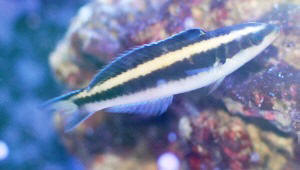
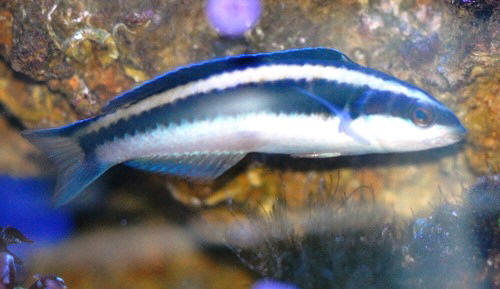
Thalassoma bifasciatum or Halichoeres maculipinna? Or....
<My guess is on the
former... a juvenile; though either species should have
changed after this time into an initial phase individual.>
Thanks in advance.
Robb M
Austin, Tx
<Ah welcome. Bob Fenner>
|
 |
|
Wrasse identification 10/2/13
Hello WWM Crew,
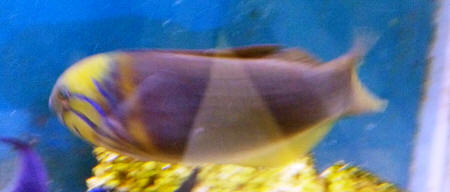
I have attached a picture of a wrasse that is at my LFS. They do
not know what type it is as a guy brought it in who was getting out of
aquarium hobby. He didn't know what type of wrasse it was either.
I was wondering if you could identify it. I have searched wwm
archives and several other sites to I.d. this fish. I do not want
to buy a fish I know nothing about.
The fish is about 5 inches long and very active. I was wondering
if it was a Thalassoma wrasse of some type.
<Yes; the yellow band behind the pec, the color bands behind the eye...
Likely T. hebraicum>
Any help you could provide would be appreciated. Thanks again for
all you do you have made me successful at this hobby.
Kellylynn
<Thanks for sending this along. Bob Fenner>
|
 |
|
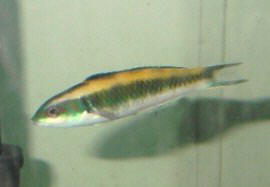
wrasse id, bunk Anglish, no pix
8/17/12
hi i ordered a lunar wrasse and was sent a substitution wrasse, i cant
find another wrasse that looks like him anywhere, although he is not
particularly good looking, he has 3 wide horizontal lines, top~yellow,
middle ~ black, bottom and belly~white, when he gets excited his face
gets a green tinge, any help would be great, i really am interested in
knowing his type
<Uhh... please run your writing through a spell/grammar checker before
sending... along w/ some well-resolved images of a few hundred Kbyte
size.
BobF>
Re: wrasse id 8/18/12
hi i ordered a lunar wrasse and was sent a substitution wrasse, i cant
find another wrasse that looks like him anywhere, although he is not
particularly good looking, he has 3 wide horizontal lines, top~yellow,
middle ~ black, bottom and belly~ white, when he gets excited his face
gets a green shade, any help would be great, i really am interested in
knowing
his type, also will he get any better looking, my guess is a clown
wrasse, but there are slight differences
<... your English ... I take it you're a non-native speaker/writer. This
fish is a Thalassoma sp.... do you know where it originated
(geographically)? Looks to me to be a juvenile T. amblycephalum, or T.
bifasciatum... See fishbase.org re the genus. BobF>
|
 |
|
Re: wrasse id 8/19/12
thank you so much, your right English is my second language,
<Ahh!>
thank you for taking the time to answer me anyway, i was under the
impression that the fish came from Florida, but they may have ordered
him from anywhere, anyway, i am so excited because either way, he is
going to be a very good looking fish, unlike he is now, he is a little
hellion!!
very very active and nosy;)0
<Ah, good. BobF>
|
|
Wrasse Identification Help
8/12/11
Hello crew,
<Chris>
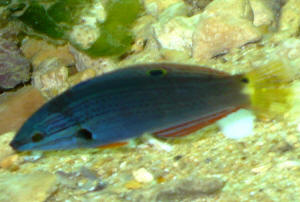
I'm having difficulty identifying a wrasse I captured out in
a reef near where I'm currently living. I am at best guess
it's in the Halichoeres family, but I can't find anything
that matches exactly. Some of the specific notes I have on this
is that it is very similar in build to the Hoeven's wrasse,
however the coloration is very different. It has a blue laterally
lined body, merged dorsal and adipose fins red in color, with a
dark spot around the adipose fin area, another spot at the base
of the tail, the tail which is yellow, red anal fin, and bright
orange pelvic fins.
The pectoral fins are clear. I have attached a photo taken of the
fish.
<I see this>
When I see these fish in the reef, they tend to stay
approximately 6 to 8 feet down, unlike most of the other similar
wrasses, which usually reside within a couple feet of the
surface. I have yet to see a specimen of this coloration more
than 3". They seem extremely territorial towards other
wrasse of the same species, and occasionally an adult blue
damsel, although in their natural setting they rarely are at the
same depth. I captured 2 of them at the same time, however the
one pictured killed the other. I normally see them picking at
rocks and coral. The area I see these wrasse at is a rocky bay in
Okinawa, along rock walls dropping down about 8 to 10 feet to a
sandy bottom.
Christopher A Cole
<Mmm, my guess is on the genus Thalassoma... do see
fishbase.org for this genus... Bob Fenner>
|
|
Re: Wrasse Identification Help --
08/13/11
Thanks, I've actually downloaded the entire Fishbase listing
for Okinawa (Ryukyus)(3697 entries) and Japan (1535 entries),
<Whoa!>
That is normally my first source for IDs when I encounter
something new.
<Is one of mine... and am out on the E. coast giving talks at
a fish health conference, so don't have access to my in-print
ref.s>
They don't have a picture that matches,
<Well... as you are likely very aware, there are MANY
variations on color and markings per some Labrid species... and
even a few as-yet, undescribed species>
but there is a large number without photos. I'm curious as to
why you said it was Thalassoma, vice Halichoeres.
<Thalassoma are more fusiform/tubular in overall profile...
which your one photo sent looks like to me... also this genus is
more prognathous than Halichoeres... whose many members are
typically more laterally compressed and truncate at the
head-end>
I found a Russian site identifying it as Halichoeres melanochir.
I Googled it to confirm, and most pictures returned looking very
similar. Again, thanks for the help.
<Thank you for sharing. BobF>
|
|
Sexing Thalassoma lutescens -- 06/26/10
Greetings Crew,
<Kirk>
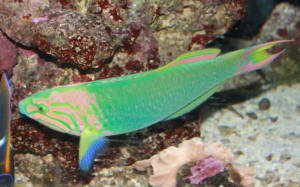
Attached pic of my 7+ inch Lime Green Wrasse (the wrasse with
many common names I call it). Based on research and other
opinions on the "boards" would it be safe to say mine
is Male, but not yet "terminal phase" as it is lacking
the blue behind the pectoral fin?
<I'd agree w/ this. Please see Jack Randall's pix
here:
http://www.fishbase.org/Photos/ThumbnailsSummary.php?ID=5646>
I've had the fish for 2.5 years in a 240, I'm planning an
upgrade to 10 foot/500ish gallons in a few years. At that time
would like to try adding perhaps 2 juvenile T. lutescens. Still a
little confused, but my understanding is juveniles can
"choose" (for lack of better word) their sex?
<Okay>
Would this be possible in a tank that size?
<Yes>
If 2 more were added would both likely be female with one
"supermale"?
<Would likely be initial phase (smaller, sexually
undifferentiated individuals are not collected, or at least
I've never seen them collected for the trade) individuals
with your becoming terminal phase (male) specimen>
I saw a pic somewhere of 2 males with 1 female as well, though I
think the pic was from the ocean, not captivity.
Thanks for your help,
Kirk
<Welcome. Bob Fenner>
|
|
Re: sexing Thalassoma lutescens
6/26/10
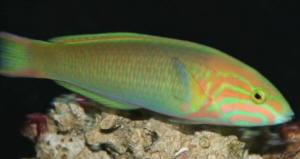
Interesting...Quick follow-up...Attached is a pic of mine
when I got him (er...it) at maybe 3.5 inch. This would be
considered "initial phase", meaning it has a
sex,
<Yes... is a female... initial phase individual>
just can't tell which, and it can still change to the
other sex? or am I off?
<All such individuals, given cues, external
circumstances can/will "turn into" terminal phase
specimens>
Thanks again Bob,
Kirk
<Welcome, BobF>
|
 |
|
|
Re: Wrasse Identification help please?
<Mmm, where is the prev. corr.?>
I forgot to tell you, although he looked a little beat up, his
scales any way, he's a very healthy eater! Loves his Mysis
and brine, but not other chunky foods. Those he just leaves. So
all I feed him now and all the rest of my huge (not reef safe
wrasses- 1 Sunset, 1 lunar, 2 yellow Coris(not), 2 bluntnoses, 1
Blue headed Wrasse, 1 zigzag Wrasse, 1 Twinspot baby Wrasse, 1
pink 3 spot Wrasse, 1 Goldbar Wrasse, a few little fairy wrasses
also. ) in my 150 gallon tank. I gave up on pellets, they just
pollute my tank something awful. But I sure go through a lot of
packages of Hikari Mysis!!
<I'll bet!>
I have a 4-5 inch Bahama Oolite sand bottom, and it's awesome
some to watch such huge fish just "disappear" when they
hit the bottom at night! They are a joy to have. They are so
beautiful! And all but the blue headed Wrasse are just fine
together. And even he is just a bit pissy at feeding time. The
rest of the time, they get along very well. I'm quite
impressed at what good pets the non-reef safe wrasses make. And
they don't eat my soft polyp corals, like my Xenias, leather
corals or my waving hands, they just taste them now and then.
Must not be very tasty, they never eat much! :)
I'm hoping to find a Thalassoma duperrey next....
<Ahh... IMO should be the State fish of
Hawai'i'.>
I love their coloring so much. I think the Thallasomas are my
favorites of all. They remind me of Golden Retrievers! They are
mellow.
Well, thank you again and again.
Hopefully he'll live a long time!
Mandy
<Thank you for your enthusiastic sharing. Bob Fenner>
Re: Wrasse Identification help please?
05/25/09
Dear Bob, I am honored to hear from you. When ever I tell people
"Bob Fenner said this is what it is......", I get no
arguments! LOL!
<Heeee! Even I wouldn't go this far!>
About the thread,...... I apologize if you didn't get the
whole thread! Here is a copy of Mich's (Michelle?) reply to
my question. (it didn't copy well, so I had to tweak it a
little to get the caps in the right places. That's why
it's not an identical copy.)
<I see... am out of the country and so not keeping up with
much of what is passing through/WWM... Thank you Mandy.
BobF>
|
 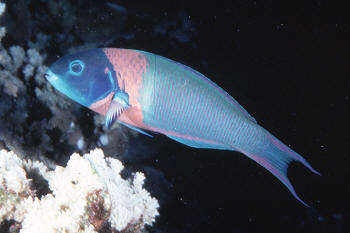 |
Thalassoma amblycephalum Sexual Dimorphism... dichromatism
3/21/07 Hi, <Hello.> What are the identifying characteristics
to look for in distinguishing a male Paddlefin wrasse from a female?
There is one at my LFS that has a blue head with a yellow band behind
its head with a red body that has a faint white stripe that runs
horizontally along its body. Is this a male or female? Someone told me
that the females have this white horizontal stripe, but someone else
told me that the males have white vertical lines across their bodies
and that they are more colorful than the females. Can you please help
me in knowing which is which. Some pics of males vs. females would be
very helpful. <Please read here: http://www.wetwebmedia.com/thalassoma.htm...will answer your
question and contains pics too. For what it's worth males are
easily distinguishable and females/juvies are not imported as much. The
one in the store from description alone is surely a male.> Thanks,
Gary
| Wrasse id I am wondering what kind of
wrasse this is, can you help me? <Of all things... we're
currently out at the Hawai'i house, and this is the most common
fish on the reefs here... and an endemic. Please see here re:
http://www.wetwebmedia.com/thalassoma.htm
Bob Fenner> Thanks, Codie |
| Wrasse ID I just sent an email earlier and
I still am not sure of the wrasse that I have? It the Thalassoma
dupery or the Thalassoma grammacticum or is it neither? I believe
the fish has not matured yet. see attachment. <It's the
former. Pls see the previous citation. Bob Fenner> Thank you for
your help, Codie |
|
|
Re: Help??? Dear Jason, Thanks so much for the helpful info.
<<absolutely my pleasure.>> Just to clarify -- are you
saying that my Rock wrasse (which I'm hoping he's really that!
-- he doesn't look like the picture on your website. . . he's
got about 4-5 horizontal rows of different colors -- pink, green,
yellow???)really isn't happy in the tank? <<well ok, looking
at wrasses that match that description... can't seem to find one,
did you search through the WWM Wrasse pages to see if you can find a
match? Likely this one has had the wrong name applied - and if this is
the case, then my previous statement about this fish not liking
tropical temperatures would be moot.
http://www.wetwebmedia.com/wrasses.htm >> Speaking of cool water,
we recently did increase our temperature to 79 degrees when our local
store told us that we were keeping the tank too cold at 74. <<74
is cool, but anywhere in the range of 72 - 80F should be good.>>
Could this increase in heat be the reason he is changing colors
sometimes? <<Yes, perhaps, good to take this adjustment slowly -
a degree or two each 24 hours.>> How do you know if he's
"happy" or not? <<Is it eating? Interacting with other
fish, decor, rocks - looking at you - or is it completely clamped up in
a corner by a heater never coming out to eat or see its surroundings.
These are generalities of course, but it should the fish should be out,
about, and eating - color changes mean all kinds of things - mood, etc.
Perhaps make your way to a public aquarium if you can so you can see
the same in a different surrounding.>> Could it really be him
growing into adulthood because he is getting larger and larger by the
day -- growing very fast. <<always a possibility >> (Please
excuse my stupidity. . I'm VERY new to this!) <<not stupid at
all, a very valid question.>> I gather that you agree to leave
the Clown alone and see what happens. Until then don't add more
fish? <<yes>> However, he's getting increasingly better
each day -- once the white spots are gone for good can I assume he is
well? <<not really a safe assumption, is why you need to leave
and watch for a couple of weeks - make certain.>> At what point
is it safe to introduce another fish? <<personally, I never
introduce more than one animal in a month unless they are tiny. I just
like to take it slow and see what happens, give everything time to
adjust.>> One more question (sorry if I'm overwhelming you)
would you recommend a fresh water dip for any new fish before you
introduce them into the family tank? <<not overwhelmed yet. as
long as you pH adjust the freshwater, yes.>> Thanks so much!
I'm so glad I found your website! It's a great source of
knowledge! :) <<Glad you enjoy the website, although it's not
actually mine, I just hang out here. Cheers, J -- >>
Re: Help??? Oh My Gosh! This is so exciting! I researched the
wrasse family on the wetwebsite and found a picture of the one that I
have! She is a Thalassoma Lucasanum (rainbow wrasse)! This is the neat
part. . . I found a picture of the female and that is definitely what I
have, BUT, I found a picture of the MALE and he looks like what my
female looks like when she changes color!!!!! I did further research
and found out that the female rainbow wrasse is able to change sexes
during her lifetime! This must be what is happening! <What a
planet!> This is so cool! Thanks so much for your help!!! :) <Be
chatting and diving. Bob Fenner>
Wrasse Identification Hi, I have been eyeing a
wrasse at the LFS for the last few weeks and decided to finally pick it
up. Because it kind of just laid around I wasn't sure of its health
especially as I hadn't seen one like this before. <Likely a
Thalassoma lutescens: http://www.wetwebmedia.com/thalassoma.htm
> Most wrasses I have had/have are energetic swimmers. <Mmm, many
species spend a considerable amount of time sitting about on or in the
substrate> But, I attributed this to its housing at the LFS, which
was a small cube. It was labeled generically as Green Halichoeres
Wrasse. But, he was unusual so picked him up after seeing him digging
and apparently healthy after a few weeks, though still not swimming
much. I got him home and acclimated him. After releasing him, he just
fluttered to the bottom (44 gal corner, with 2 small Chromis). I had
brought water to the LFS before buying for a test and everything was
nominal (8.3ph, 1.022 salinity, 0 ammonia, nitrates, nitrites).
It's a well established tank that I recently moved some fish out of
and to another tank. He "rested" upside down for hours, but
his eyes showed he was awake and aware as they were looking around
constantly. I had seen this somewhat before with wrasses being paranoid
or scared and usually digging in for a while. Later at night he hid
behind some rocks, then finally came out and swam close to the bottom
for few minutes and then used his head as a shovel and dug a hole for
the night. This took about 10 minutes, then he finally did that
squirming I'm used to for wrasses to get the rest of his body under
the sand. This following morning (got him yesterday) he was back behind
some the rock wall lying down, but again his eyes were alert and was
respiring normally. He doesn't move, at all, quite unlike other
wrasses. I am hoping with identification, maybe you can shed some light
on his name and habits so I can see where I stand with this new fish.
He is your standard wrasses shape, closer to a dragon wrasse in shape
with less ornamental fins, bright green though. In addition he has
enormous canines similar to my Harlequin Tusk. I have attached 4 pics
from when I was acclimating him (I figured this would have been the
only chance to photograph him standing still, apparently I was wrong).
Thanks as always. Scott <Use the scientific name... your search
tools... Bob Fenner>
Re: Wrasse Identification Thanks for the quick
reply. I looked at the Thalassoma lutescens, but the one I have looks
nothing like the aforementioned fish (Green Moon wrasse). The
Thalassoma lutescens looks very similar to my lunar wrasse, but this
one has a completely different mouth. It has huge canines and cannot
close its mouth with them as they are so pronounced, much like my
Harlequin Tusk. Is there any other species you might think it could be
that I may be able to research? I looked at your wrasse pages and
nothing looks similar. Thanks again, Scott <... the genus Thalassoma
wrasses do have "large canines"... did you look at the pix on
fishbase.org, Google images of this species? Take a look again
please... at the pix you sent us. Bob Fenner>
- Lunare Wrasse Problems - Hi- I recently got some saltwater
fish for my saltwater fish tank. It's a 40 gallon tank. I had 2
clownfish, and a Firefish. They were all living together for about a
week. I just got a lunare wrasse. When I bought it in the store, they
told me it was a marble wrasse, but I looked it up on the internet, and
the picture for the marble wrasse did not look like my fish, but the
lunare wrasse picture does. My fish has a long, green body, with pink
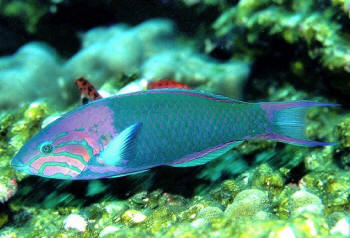
swirls on the face and yellow on the tail, which I think looked like
the lunare wrasse. If you could verify that for me, that would be
appreciated. <There are a couple of wrasses that bear this facial
coloration. Would suggest you look here: http://www.wetwebmedia.com/thalassoma.htm > My
main concern however, is that the wrasse apparently killed my Firefish.
They were fine last night when I first put the wrasse into the tank,
and this morning they were fine too. I went home on my lunch break, and
discovered that the wrasse had the Firefish in its mouth, and it was
dead. <Circumstantial evidence - quite possible the poor Firefish
was already dead before the wrasse decided to snack on it.> Now, I
was told when I bought the wrasse, that it was a peaceful fish, and
would not harm the other fish. <Mmm... well, it's true to some
extent, but they are territorial and given to fairly boisterous
behavior which other fish can find distressing. Not necessarily mean
like a queen trigger.> I really don't think that the Firefish
died on its own though, because it seemed to be doing fine. <Can
happen.> I just called the store where I bought the wrasse, and they
said that it was very unusual that the wrasse would kill another fish,
even if they are much smaller than it, and that wrasses are generally
peaceful fish. <Generally. Is like the line from the young girl,
Newt, in the movie Aliens, "The mostly come at night...
mostly."> The only thing I can think of is that the Firefish
had a long spike on top of it's head that would move up and down, I
wonder if that could have provoked the wrasse. <Doubt it.> Please
let me know what I should do. I don't really want to take the
wrasse back to the store because I like it, and hope that this was a
one time thing that happened, but I don't want it to harm my
clownfish, and any other fish that I will get. <Well... if you truly
like this fish, you need to consider your future plans as this tank is
too small for its long term needs.> Please tell me as soon as
possible what to do here. Your response will be greatly appreciated.
Thanks a lot. <Cheers, J -- >
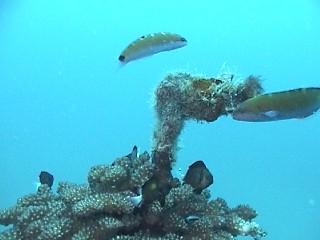
USW - Unidentified Swimming Wrasse 12/10/05
Hi Bob, <Bob is out diving just like you were, and I bet
he's taking pictures too. Today you get Adam helping you
out.> I wonder if you can help me to identify the wrasse on the
attached photo? The picture is a video capture taken in about 30
feet of water off Pacific Harbour, Fiji. As you can probably see
there were a small group living with damselfish round a small coral
head on a wreck. <Very nice picture, your wrasse looks to be a
Thalassoma lunare, most folks just refer to it as the Lunare
Wrasse.> Many thanks
Colin
<Adam J.> |
|
|
|
|

