 |
|
| Home | Marine Aquariums |
Freshwater Aquariums |
Planted Aquariums |
Brackish Systems |
Ponds,
lakes & fountains |
Turtles & Amphibians |
Aquatic Business |
Aquatic Science |
Ask the WWM Crew a Question |
| Please visit our Sponsors | ||||
Bunny Snail Problem - Valentini Puffer?
7/6/18 Valentini puffer venom? -- 07/04/09 Sharpnose Puffer, gen. 4/11/08 Hi, <Hi, Pufferpunk here> I can't for the life of me figure out how to post my question on your web site so I'm hoping someone may be kind enough to help me out via email??? <This will be posted in our FAQs.> I've been keeping marine for some time and I'm now interested in keeping some sort of a small, Sharpnose/Toby fish but so far I've only found limited and sometimes conflicting info. My 2 main questions are: 1) What is the minimum tank size for the smaller species of these fish? I currently have several 30 US gallon tanks, would I need a larger tank? <40g is best but 30g will work without tank mates.> 2) Do these fish have the same risks of toxin release as their larger cousins the box and puffer fish, when stressed or after death has occurred for example? <Puffer fish do not release toxins. You & your puffer/tank mates are safe.> I'd be very grateful if someone could offer me some advice. Kind regards, Gary. <Here are profiles of a few Toby species: http://www.thepufferforum.com/forum/ug.php/v/PufferPedia/Marine/?g2_page=2 and more info: http://www.wetwebmedia.com/tobies.htm ~PP>
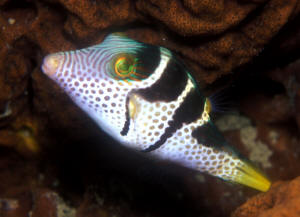
Valentini Puffer 11/17/05 Hi! I have a Valentini puffer (saddle back), I previously wrote (in about end of Sept) to get some info and you guys were great! thanks. I have a curved glass aquarium (the front corners are curved, and have no joint, so that the only joining of glass is at the back of the tank, where there are just normal right angle corners... I hope that makes sense?) <Yep> Anyway my puffer is a bit of show off and she likes to run up and down and up and down and up and down (for ages, sometimes 15 - 20 min.s, for about 3 or 4 times a day) the curved corners. I don't know if she can see a reflection of herself or something like that, <Or you... associated with food/feeding...> but I was wondering if its healthy for her to be swimming up and down the curved corners? <No worries> and if its not what can I do about it? <Zip> And even if it is healthy Its kinda annoying. So how can I stop it. <<This is not a domesticated animal whose behavior you can modify at will. MH>> Just FYI, he's very healthy otherwise (he is about 9 months old) and the tank is very stable. We have 7 other fish (in a 90 litre tank) 3 x Green Chromis, a domino damsel, a ocellaris clown, a pajama cardinal and a sand sifter, all of whom are relatively healthy and generally not aggressive. We feed them once a day, frozen green marine food (vitamin stuff) and generally the tank is in good order. <Sounds good> Also we have two (2 - 3cm's- around 1 inch) unwanted crabs. they came with the live rocks. Any ideas of how to get rid of them? <Could be baited, trapped out: http://www.wetwebmedia.com/swcrabcomp.htm> Thanks for your help. Sincerely, Sarah <Welcome. Bob Fenner> Valentini Puffer & Talbot's Damsel 9/27/05 Hi! <Hi There!> I have a Valentini Puffer. We've had him (or her) for about 2 weeks. He lives in a 90L (Sorry I'm from Australia!! I have no idea what it is in gallons... maybe near 30 - 40g??) The tank is @ 24 degrees Celsius (again no idea ... actually wait I converted it online and its 75.2F) The ammonia levels are a little high (but we're doing water changes every 3 - 4 days to correct it and it's lowering pretty well) We take the water for a weekly water check at the LFS and they told us the water is great. (Better than theirs), except the carbonate hardiness is too low, so we are using Coral Success to fix this up). <The ammonia should be zero, so a little high would not be considered great water quality. I would like to see daily water changes until the ammonia is 0.> He is kept with a Pajama Cardinal, Ocellaris Clown, Banded Damsel, Domino Damsel, Green Chromis and 2 Talbot Damsels. He's very peaceful and just seems to pick at the rocks very often, no worry to me, I don't mind him doing it. We feed him a multi-vitamin frozen food and sometimes frozen brine. He also gets fed live brine. <He needs a variety of meaty seafood as well as some greens.> I have read your Puffer dentistry article and could not see anything specific about Valentini Puffer teeth. I have printed out your General Puffer info but I haven't read it yet. (I will after writing this but its 17 pages long!!) I was wondering how am I supposed to know when his teeth get too big? <It would be preferable to prevent his teeth from over growing by feeding him some seafood in the shell so he can keep them in check himself.> I read your other responses about Puffers and couldn't see anything specific to the Canthigaster Valentini. <The information should be similar and applicable to your puffer.> Also I read that some people are concerned about the size of their puffers stomach. <Their bellies do have quite a capacity for expansion, which can be witnessed after a good meal.> My puffer has got a bit of a big tummy, but since we've had him he's only puffed up once and eats all day long. <Most of them do like to eat.> (The tank has only been set up with fish for about 4-6 weeks) How will I know if its a fat stomach or an air filled stomach? <If he has taken air into his stomach you may notice the pocket of air as a bulge and his orientation in the water will be off, in other words he most likely will be off balance and have difficulty remaining in his normal swimming position. The area containing the air will be directed towards the surface and he may possibly even be floating near the surface if there is a good amount of air trapped. This is often referred to as positive buoyancy.> Also he's very hard to catch and the tank has a lot of live rock and coral that all the fishes have hiding-holes and caves to jump in as soon as my hand goes in the tank. So I can't really grab him to touch his stomach, (like you've told others to do) how else would I know? And wouldn't it hurt him if I were to press on his stomach? <This is really not necessary unless you suspect that there is a problem. It is preferable to keep your hands out of the tank and off the fish. Every time you touch your fish you disturb their slime coat which serves a protective function for the skin.> My puffer is so beautiful and loves to make faces at the glass and run up and down to show off to me. <Yes they are very pretty and have quite endearing personalities. I find them irresistible to say the least. Puffers are one of my favorites.> Thanks for all the great info, I've learned a lot about him, just by reading some Q&A's on your site. <That's great keep up the reading. Educating yourself is one of the best things you can do for your fish!> Also I have 2 Talbot Damsels in the tank, they are pretty aggressive towards all the other fish (except the Pajama Cardinal and Valentini puffer, I think because they're bigger than the Talbot's) <Very possibly. I am not familiar with that particular Damsel species but the family as a whole is fairly aggressive. The PJ Cardinalfish should really be kept in a peaceful community tank. The Damsels and Puffer are really not appropriate tankmates. Please do keep a close eye on these fish for any signs of harassing the Cardinalfish.> If I took one of them out (if I can catch them) would this fix the problem? <No I don't think so.> My LFS said that if I keep my tank around 34C (75F) then it will stop them being so aggressive because it will keep their metabolism low, making them less hungry. Is this true? <In theory I guess it is a possibility but my best guess is that it would not work to your advantage. If it were my tank and fish I would not want to wait to find out. I would remove the aggressors as soon as possible. The fish that are being harassed are at risk for an injury and are definitely being stressed. Stress is a precursor to disease. Elevated ammonia levels are also stressful. Add the stress of being harassed to the increased ammonia levels and you have a recipe for sick fish. Please do consider removing the Talbot Damsels as well as doing more frequent water changes. > Thanks for your help. Sincerely, Sarah <You're most welcome! Best of luck with your fish. HTH, Leslie> Toby puffer identification 9/25/05 Hello Bob, <Emily> I was on your site and read your notes on the difference between the Toby and the filefish. I can't really tell from the pictures which is a puffer and which is not. I have recently bought a Toby puffer( valentini I think) and just wanted to verify that I got a puffer instead of a filefish. Can you give me more prominent signs to look for in order to tell a puffer from a file fish? <Mmm, the very best is their dorsal fins... though not often erected, will likely be when excited (like when feeding). The Filefish has a prominent anterior spine (first dorsal ray), whereas the puffer has all-about the same appearing rays> My fish doesn't seem to have the obvious blue lines running from the head to tail but there is a hidden blue/green color at the back if seen at a special angle. <Mmm, the color difference/s are not consistent, nor telling> Appreciate if you could help me identify my fish. Thanks, Emily <Look on fishbase.org, the Net... at both species... and their dorsals. Bob Fenner> Two Sharpnose puffers? I have an established 125g with lots of rock and dead coral. I have 4 small damsels and a 2inch (slightly over) Hawaiian sharp nose puffer. C. Jactator. They have all been in the tank for about 2 years now. Today I added a 3 inch (slightly under) spotted sharp nose puffer. C. solandri. <Oh...> They went at it a couple of times the first hour. Nothing major, and now *they seem give each other space. But it did surprise me since the Hawaiian is extremely passive. The fish store said they would be alright together. <Maybe... but I would not advise this> After reading more information, I realize this might be a mistake. Will the spotted get more aggressive towards the smaller Hawaiian after he becomes more established? Or is there any chance of things working out between them? Thanks and this is a great site. , Glenn <Some chance, not much. There will always be tension, stress... Canthigasterines, other than in established pairs do not occur in the wild together. Bob Fenner> Blind Puffer? Hi, once again I need to call on your help. I've had a Valentini Puffer in my 44 gal pent. for more than a year now but over the last three days I have been watching him display some discouraging behavior. First he stopped eating. I tried to coax his appetite on with some garlic extract, but it didn't do anything. Over these last two days I can describe him only as becoming disoriented. He frequently bumps into the rock and glass and seems to find just one place to mull about. Right now I'm considering several things; one is that he might be going blind, but I have no idea as to whether this would affect his feeding; <Will> two is that he ate something that did not agree with him and it is disrupting his appetite. <Maybe, but far more likely that this fish is suffering from a nutritional deficiency syndrome... next in likelihood that there is some sort of developmental/genetic disorder at play, next, water quality issue/s...> As far as vision problems his eyes move about, however if he is near the glass and I move my hand towards it quickly he does not dart away. I have three other fish in there with him; blue devil damsel, longnose hawk, false percula, and two inverts. and none of them are displaying any similar characteristics. I haven't added any chemicals to water except for my weekly tap-offs. I'm going to do a water change tonight just for good measure. Do you guys have any idea what could be affecting my puffer (and any possible solutions)? Thank you very much for all your help. Sincerely, David H. <Does this fish receive a mixed diet? Do you add vitamins et al. to the food/s, water? Bob Fenner> Re: Blind Puffer? In regards to your questions, I feed him frozen cubes of 'Mega Marine (multi-Vitamin) on average of 3 times a week. On all other feedings I feed the fish 'Formula Two Marine Pellets'. I very rarely feed the fish more than once a day. His coloration seems to be fine, as typically I thought that would be the most obvious sign of malnutrition <This is a very sufficient diet... not at likely a deficiency syndrome as cause> Currently, my water is as follows Specific Grav. 1.023 pH of 8.3 76 degrees F Ammonia is at 0 I can't do a nitrite or nitrate test because my refills are in the mail still I add Kent Marine Coral-Acell and Calcium to the water twice a week. Any ideas, or is my puffer in a bad situation? Thanks again. <Have you read through the "puffer disease" and "Sharpnose puffers" and "tetraodont puffer articles, Related FAQs files on WWM? I would. Bob Fenner> What to feed my Puffer Hi again, Today I have a question about the puffer fish that I just recently purchased for my tank. At my LFS he was labeled as a Short Nosed Puffer, but in my research online I have found that it is sort of a subcategory of puffer fish, am I correct? <Do you mean... a Sharpnose puffer... as in the subfamily Canthigastrinae of the family Tetraodontidae?> Right now I have no way of getting a picture of it for you guys to help me identify it, but I'll describe it the best I can. It has the body shape of a Dog-Faced Puffer, but it is only about 2 inches in size. The LFS told me that he would only get to be about 4 to 5 inches long fully grown. <Uhh, "bad form" to buy ahead of investigating... the species... its requirements/needs... We have most all aquarium available species listed... Read here: http://wetwebmedia.com/fishindex3.htm. Scroll down to the Puffer articles, related FAQs...> He is a light gray in color with dark gray horizontal stripes, and his tail is all black. My question is, what should I feed him. They told me at the local fish store that he should eat 3 to 5 feeder guppies a day... <Negative... see the above where you should read> ...but I have read that freshwater fish are not very nutritious. I also have a Spotted Hawkfish that is on the same diet, but only 2 to 3 a day. I think it would be easier to feed them something frozen, but I'm not sure what they would accept. Would frozen krill be a good choice, or should I try frozen silversides? Or is there another option that I should go with? I originally was feeding the Hawkfish 1 ghost shrimp a day, but they got to be a little expensive. I haven't tried feeding the puffer the shrimp, but I have read that he needs something with a somewhat hard shell from time to time to wear down his teeth. Thanks for the help, Daniel <Study my friend... the mistakes you're making are easily avoided. Bob Fenner> |
|

|
Features: |
|
| Featured Sponsors: |
.jpeg)
.jpeg)
.jpeg)
.jpeg)