|
|
| Home | Marine Aquariums |
Freshwater Aquariums |
Planted Aquariums |
Brackish Systems |
Ponds,
lakes & fountains |
Turtles & Amphibians |
Aquatic Business |
Aquatic Science |
Ask the WWM Crew a Question |
| Please visit our Sponsors | ||||
lighting for brain coral 12/9/10
Return Pump Flow--How Much Is Too Much? -- 02/18/08 Greetings WWM Crew, <<Hello Bill>> Here is my situation. I have an AGA 180-gallon RR tank with the 'MegaFlow' system--sort of. <<Mmm'¦>> The ¾-inch return is now 1-inch, and the drains are 1 ¼-inch instead of 1-inch. The 'MegaFlows' have been replaced with Durso's. <<I see'¦ I do hope this means you increased the size of the holes/bulkheads in the tank'¦not just an upsizing of the pipe>> I drilled out the 'teeth' in the overflows and siliconed black plastic gutter guard in its place. My tank has an Ocean-Motions 4 way Closed-loop plumbed according to Paul's suggestion. This all drains in to an 85-gallon 'fuge, <<Sweet>> and then to a 90-gallon sump. <<Really sweet>> My skimmer is in the sump. The return I was using was a Mag 1800, and up until last Tuesday it worked fine--then BAMM. <<Hate it when that happens'¦ I have used these and do think the Mag-Drive pumps usually serve pretty well, for the money'¦but I made the 'switch' to Ocean-Runner a while back and have been very pleased with the result'¦and when/if you can get them big enough, Eheim is even better>> A friend of mine that owns/runs an LFS said he had a 'new' (used for 5 minutes) pump he would sell me, so OK, I'm good to go right. The pump is an Eco-Plus rated at 4950gph. <<Yikes! Much too much flow for your overflows'¦or are we talking 'closed-loop' here?>> New plumbing was done--ball valve etc., etc., and I turned the pump on--(now don't get ahead of me, I know what you are thinking--but the ball valve WAS turned to 1/2 to start) <<Mmm'¦okay'¦>> Oh, I forgot--I installed a "Calfo Manifold" around the top of the tank in 1 inch PVC in place of the double returns already in use. <<Very nice>> I'm figuring my flow at about 3800 to 4000 gph--just from the return. <<Not with 'two 1 ¼-inch drain bulkheads' my friend (would only safely drain about 1000gph en toto). I must assume this is a closed-loop>> With the 1-inch return manifold--it has 12 outlets around the top--I can turn the valve to 3/4 open with no problem. With ½-inch reducers in the outlets, and with capped 45 degree pieces drilled with a small hole attached, I can open the valve all the way, without overflowing the tank. <<Okay, this 'must' be a true closed-loop then'¦no way you would be running this much water through your sump/through two 1 ¼-inch gravity drain lines>> I also have 2 Koralia #4--1200gph each in the rear corners. My 'buddy' at the LFS says it can never be enough flow. Is this too much flow ????? Thanks in advance, Bill Fletcher <<Well Bill, that depends much on your livestock's requirements/placement and how this flow is 'arranged' in the tank. A common rule-of-thumb for marine systems is to have a water-flow rate of at least ten-times the tank's stated volume. For your tank of course that would be 1800gph. I have heard of some hobbyists with flow rates of 50-times and more their tank's volume. I believe 'lots of flow' is very beneficial if applied properly'¦my own tank boasts more than 30-times the tank volume in water flow. I also believe the majority of hobbyists 'don't have enough' flow in their tanks. So to answer your question'¦if the animals in your system are not having their flesh blasted from them'¦if the animals in your system exhibit health and vigor, and the corals are not 'closed-up' all the time as a result of the flow'¦then no, this is not too much flow. Regards, Eric Russell>> Re: Return Pump Flow--How Much Is Too Much? - 02/19/08 THANKS for the reply Eric. <<Happy to assist, Bill>> To start, the pump in question IS the tank return pump. On my OM 4 way, I have a DART. <<Ah, thank you for the clarification. I must say I think either there is something I have missed, or the pump is encountering a 'bunch' of headloss as there is no way two 1¼' gravity drains handling the flow volume you mention (4,000gph+)>> Each return has 6 one inch "T"s around the top of the tank, into which a 1" to 1/2 " reducer is placed, with a 45 degree PVC piece placed into that, and then capped and drilled with a small, not real small, hole drilled in the end. <<So'¦the water is returned to the tank via these small holes in the caps? Well, that would explain how the drains can handle the flow with the valve from the pump wide-open (the 'holes' are GREATLY restricting water flow)>> This allows me to swivel the 45's left or right, and raise or lower the "T"s as needed. The drain and return tank bulkheads were re-drilled to accommodate the tubing upgrades. <<Excellent'¦too bad you just didn't go a little larger on the drains [grin]>> I did forget to add/state that ALL plumbing is in the basement which is just behind the wall that the tank sits in front of. <<Cool'¦does make plumbing/dealing with some associated hassles a bit easier>> As of now, everybody--all the animals in the tank--- appear to be doing very well--I did tweak the 'nozzles' initially so as not to blast anybody--so all is well. <<Very good>> THANKS again for ALL you do for us in the hobby--where would we be without your help and knowledge. Bill <<Rewarding and encouraging to read'¦We are pleased to be of service. EricR>>
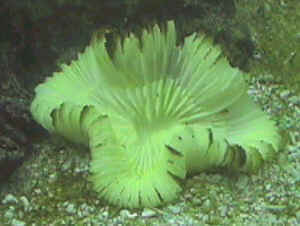
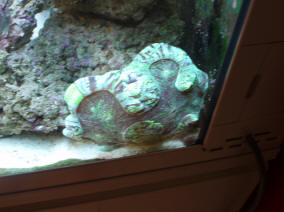
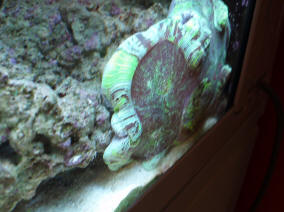
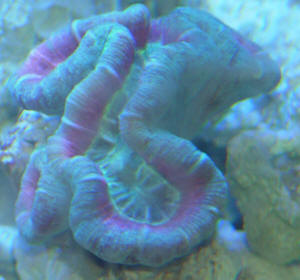
Goby Symbiosis and LPS... nano stkg., Trachyphyllia sys. 8/13/06 Hey, guys. I've got a question about shrimp-goby pairs and LPS corals. I am planning a nano-reef in a 12 gallon NanoCube. I'm thinking of keeping a Randall's Shrimp Goby and a pistol shrimp (tiger, if I can find one) and a firefish (maybe, not decided yet) in as the non-coral inhabitants. LPS corals interest me, especially Trachyphyllia and the "Closed Brains" of the Favia and Favites genus, especially the so-called "pineapple brains." I know the Trachyphyllia need to stay on the substrate, but I'm worried about the shrimp's digging covering up the Trachyphyllia. Do they have the ability to shed sediment? <To some extent, yes... but I would "mount" (set upon) the Trachyphyllia on a short (substrate depth) section of cut PVC pipe to elevate it.> Also, I still can't figure out whether the "Closed Brains" should be placed on the rocks or the substrate... <Faviids are almost always found on the latter in the wild...> If on the sand, would they be able to shed the sand from the digging shrimp? Thanks for the help. <Do be careful re nanos period... not stable... on average all crash more than once a year... Bob Fenner> Re: Goby Symbiosis and LPS 8/14/06 So, I assume the mounting has the cone shaped skeleton of the Trach placed in the pipe as a support? <Yes> That sounds like a good idea. So, I should have the PVC pipe sticking up just above the substrate, elevation of 3-5 cm above it? <Just at the substrate level will/would be fine. Bob Fenner> Trachyphyllia Lighting lots to what it should have... using WWM 5/28/06 Do you know if a Trachyphyllia will do ok going from a lot of light to what it should have? <Yes> To be more specific I have a 20 long reef with 130 watts of PC and a 75 with 390 watts of PC lighting. They are both setup with the same bulb types. The placement of the Trachyphyllia is about 4" from the top of the 20 gallon. I know to much light thanks to wrong info from LFS. Anyway it has been doing well (it gets huge) in there for 3 months now but I want to put it my 75. Will putting it in the bottom of that tank shock it into death or will it adjust and take on some of the darker colors it used to have? <... Please read here: http://www.google.com/custom?q=trachyphyllia+lighting+&sitesearch=wetwebmedia.com the cached views for the key terms: Trachyphyllia and lighting... on WWM. Bob Fenner> Brains in a nano 3/4/06 Dear Anthony, <No longer with us, unfortunately. Will cc him here> You probably remember my tank, but I'll refresh your memory anyway. I have a 20gal. nanoreef with a CPR BakPak with a prefilter, an Aquaclear 200 box filter and 130 watt PC lighting. I have 30-40lbs. <Yikes, and not much water!> of live rock with a profusion of clams and other filter feeders living on it. 1 large hairy mushroom ~5", 2 small Discosoma mushrooms ~1", 1 softball sized Lobophyllia, a large colony of daisy polyps that are spreading rapidly. (I am in the process of fragmenting some of them and then will sell the fragments on a site like frags.org) and a small colony of green star polyps ~2.5". About 8 Blueleg hermit crabs, 2 ocellaris clownfish and one yellow-tailed blue damselfish. (I am keeping an eye on the damsel.) My lobo looks on the overall like it is doing pretty well. The only thing is that it has a small (about the size of a nickel) area of recession. It doesn't appear to be getting worse, but it is not getting better. I have had the lobo for about 3 months now, the recession might have been there since I bought it. If not then it showed up shortly after I got it. I have noticed that throughout the day sometimes the lobo will be completely expanded and then in seemingly no time at all it will be closed and the mouths on it will be open. In about an hour it will be opened back up and looking fine. It doesn't do this everyday, maybe once or twice a week. Do you know why it is doing this and if it means there is something wrong with it. <Can't tell with the info. provided...> My LFS has been getting in some variety of what they call green brains. I think that they are probably Trachyphyllia. They have a flat(ish) middle section with a heavy ring of tissue around it. (it kind of looks like a flattened out lobo) I was wondering if it would be possible for me to have one. <I wouldn't here... your system is too small, crowded> I don't have any room on the bottom except for one place under my powerhead that doesn't get much light. I was wondering if it would be ok to place it on a flat rock about halfway up the 12" tank. I was also wondering how often I should feed the lobo and hairy mushroom and if I get it the Trachy. I am currently feeding them about once weekly, with small pieces of krill or shrimp. (I will probably get something else to feed them, any recommendations?) Thanks, MDM <Do take a read, Google on WWM re Lobophyllia/Mussid Disease/Health, Trachyphyllia Selection. Bob Fenner>
Where does my brain go? Trachyphylliid systems Clear Day Hello again everyone, I have searched through your site and couldn't find an answer and asked the folks at a few LFS about placement of Moon Brain corals. Some say don't let it touch the sand or it will burn. Others say it must be sand. Most of what I have read says either moderate light or bright light and moderate flow or heavy flow. Could you give me a definitive answer to lighting, flow and placement on sand or rock? I want to know what I am doing before I kill something unnecessarily. Thanks for your help and for keeping this amazing site up. Pete <Please read here: http://search.msn.com/results.aspx?q=placement%2C+systems+for+moon+brain+corals&FORM=QBRE Including the cached references to WWM. BobF> Open Brain Corals And Other LPS - 12/31/05 Hello WetWebMedia Crew! <<Hello Sheen!>> This happens to be my first time writing to you guys, thank you all for a wonderful and informative website. <<Ah! Welcome!>> Many of my hours have been spent surfing on it, researching for the reef tank that I am planning to set up. I just have a couple of questions on Trachyphyllia geoffroyi. <<Alrighty>> First, do the green kinds require more lighting than the red kinds? <<Mmm, not so much "require" as will "tolerate". The red varieties can/will tend to "brown" under intense lighting...I have even seen them decline/die under same.>> Second, I have a crushed coral substrate on my tank (from CaribSea). Would it be harmful to the open brain? <<Probably not>> I have been reading that it needs a soft substrate and wasn't sure if the crushed coral constituted a "soft substrate". <<Unless "very" course it is likely fine.>> I know that it would be best on fine reef sand. Would the crushed coral inflict cuts and injuries on the coral when it expands at night? <<Doubtful>> How much space should be given between them and Blastomussa, Caulastrea, and Acanthastrea? <<The latter in particular can be quite nasty to other corals...I recommend a minimum of 6" separation, more if the corals are large (more than 4" in diameter).>> Lastly, are there any known issues with the open brains being on the same substrate as Tridacnid clams? <<Not that I am aware...>> Thank you very much! Sheen Yen <<You're very welcome. Regards, EricR>> Open brain question 12/30/03 I have a Trachyphyllia radiata, <FWIW... the genus Trachyphyllia is monotypic: only T. geoffroyi is valid> and was wondering the placement that is best for it. I saw you say that they are usually attached to something hard. They told me to put it on the sand bottom. Should I do that and put a small piece of live rock rubble by it and maybe it will move on to it? Or can it just be put on the sandy substrate? <most specimens are free living as evidenced by their conical "skeleton" (corallum)... but some like the "radiata" types are cleaved from hard substrates and will do equally well on hard or soft footing. I describe this genus and its care at greater length in my Book of Coral Propagation (pp 268-269 for genus overview)> This is in a 29 gallon aquarium, 18" high with custom SeaLife powercompacts, one actinic and one 10,000 k bulb, a total of 130 watts. Does this light setup sound good? Thank you very much for your help!! <please do a keyword search from our homepage wetwebmedia.com for this coral and you will find many FAQs on this popular animal. Take heed that they are critically needy of weekly (almost daily) feedings. Else they are fairly hardy and can be long lived in captivity. Best of luck, Anthony> Open brain coral 2/9/04 Hey all I am hoping you can answer this question for me. I have had an open green brain coral for about two months and it seems to not want to expand like it use to. It stays pretty small during the day. I have noticed it open once at night but I have monitored it lately and it doesn't want to open. It isn't expelling any matter from its mouths and it isn't accepting any food. please let me know if you have any clues. <inadequate feeding is a common cause: not enough food (3-5 times weekly) or food bits that are too large (over 1/4" minced chunks) which get taken in at feeding but regurgitated at night leading to starvation to the aquarists surprise> reef setup is a 72 gallon aquarium with duel 175 watt 10k Ushio bulbs and two fluorescent actinic bulbs. <very nice lighting> Other corals include frogspawn colt coral long tentacle anemone pumping xenia finger leather and green star polyps. All other corals are doing fine. Thank you Stan. N <not fair to compare such unrelated corals and their health to the open brain. My other wonder is if this open brain has been mistakenly set upon rock? They should always be nestled in the sand and will often suffer if placed on rock for some months. Anthony> Correct placement of Brain Corals I have a Green Dome and Brain Coral (Trachyphyllia geoffroyi) They only expand when the lights are low or off. When the lights are on you see more of its skeleton. Placement in the tank is close to the top. Water flow is medium. I target feed them twice weekly with Formula One and Kent MicroVert. <Your observations are important, and are definitely showing you the way... these corals don't need quite the light of SPS or clams. You might consider gradually lowering them toward the middle/lower portion of your system... regards, Lorenzo-for-Bob-who's-in-Asia> Closed Brain Corals Hello Robert, <Anthony Calfo in your service> I must first say that your book "The Conscientious Marine Aquarist" has been a great help in setting up my first saltwater tank. <his intent indeed> After reading it I had very few questions concerning the hobby. I'm in the midst of setting up the tank and I'm researching livestock. <and you will succeed if you always research, before buying livestock... this mailbox is dominated by well-intended folks who should have taken this advice <smile>> I'm mostly going with a few fish (two pairs of ocellaris clownfish) but I've always been fond of closed brain corals (Favia sp.) and would like to get one to add to the tank. My big question is, what sort of lighting and water flow is required to keep such a coral and is this a good coral for a beginner? <really not a beginner coral, although not impossible either. A great many need very to extremely high light (like metal halide, or VHO on shallow tanks) Currently, my tank is in the process of being plumbed but this is what it will be: 55 Gallon All-Glass w/overflow Custom Sealife 2x65w Power Compact 10000K 20 gallon acrylic sump Precision Marine Bullet-1 Skimmer 4.5" deep sand bed 65lb live rock Am I nuts here or will this be okay? <it will be tough with those light s to keep the most colorful (high light) species. If you pick a specimen that is dominantly brown in color and keep it within the top 10" of the tank, you will likely be OK> Thanks in advance for your reply. Tony Dellett <keep reading and learning, my friend. Anthony> Re: Closed Brain Corals Forget sunglasses...you'll need a space suit! Thanks for your quick response, it spurred me on to purchase a dual 400W Metal Halide/dual 110W VHO hood. <whoa! my friend...stop the presses! There is bright light, and then there is boiling water! Do halt the purchase if you can at this point. By any definition, 2-400 watt halides is harmful to almost any photosynthetic invertebrate that you will find in the trade. Although a Ritteri anemone and a Goniastrea brain coral may very well tolerate it... very few other symbiotic cnidarians will be able to survive in a 55 gallon tank with that kind of lighting. The other problems and complications that you will have from it are too great to list here. And the point is moot. My friend, you are an ambitious shopper OR you got some seriously bad advice from any clerk willing to sell you over 1000 watts of high intensity light for a 55 gall. You really need to choose your animals first (by exact species!) before you go and by lighting for "unknown" species needs. Now, having put the cart before the horse, so to speak, you will be forced to pick your animals to suit your light bulbs?!? For the record...bright/above average lighting for a 55gall would be 4-6 110 watt VHOs or 2-175 watt MH bulbs. Any higher wattage MH is dangerous/harmful to your charges> I suppose with this strong lighting I will have more options as to coloration and placement of the corals? <quite the opposite my friend.. do research/reference the species of photosynthetic invertebrates that you'd like to keep and let's size up their lighting needs in accordance with known husbandry...not a salesperson's need for commission or your enthusiasm to blow cash...hehe. Kindly, Anthony> Thanks, Tony Dellett Re: Closed Brain Corals 400 watt MH fixtures follow up Actually, I'm getting the fixture used from a friend at a great price. <do be careful that these are not the common industrial light fixtures. Many cannot burn a designer (reef) bulb and you will blow up a $100 bulb in a blink. I cannot comment on putting a lower wattage bulb in said fixtures. But even 250 watt bulbs would be a stretch on a 75 gallon unless it was hardcore, shallow SPS species. 2-175 watts on a tank that will include LPS, mushrooms, etc> Am I incorrect in saying that I can put lower wattage bulbs in the hood? The ballasts for the MH are PFO and the ballasts for the VHO are IceCap 660s. <check with mfg on MH Q, the icecaps are very nice indeed...good customer service> Thanks again for the help :) Tony Dellett <quite welcome, bud. Anthony> Ecosystem 40m filter and water quality Dear Whomever is filling in, <Howdy> I have a 29g tank with 20# of LR, two 175gph power heads and an Ecosystem 40m, utilizing 5# of Miracle mud and some proliferate and racemosa Caulerpa. The tank is about 3 mo old now and I have 1- 3" yellow tang, 1-percula, a sand sifting star, a couple of turbo snails, and some button polyps. about 3 weeks ago, I tried putting in a Trachyphyllia (green open brain). A few days later, the coral developed a small, blackish green spot, one at a time, under the translucent tissue. It festered out to the very edge of the coral and turns the tip black with some green algae protruding. As time goes on more become visible elsewhere. I cycle my 65watt smart light on for a 10 hr period and my water quality is usually as follows: nitrate - 12ppm, Phosp - 3 ppm, <As in three parts per million? Not 0.3, 0.03? This is way too much> Ca. - 450 mg/d pH - 8.4 SG - 1.035 temp - 76 F. Salt brand is Instant Ocean. I do a water change every two weeks. Wheeeew!!!! Now that I have that out of the way. I know that most who have used the Ecosystem filter have had pleasant results. I think my numbers are a little high though. They claim that you do not need a protein skimmer. I am a little skeptical. <The owner of EcoSystem, Leng Sy and I were diving for a week together last month in Australia... we're friends as well as associates in the same trade... we have gone over this issue. I will cc him here. IMO/E skimmers are a good idea to use in conjunction with these products/approaches for some time, in many cases... I would/do use them> Do you have any ideas on what could be happening to the Brain Coral? <Yes... could be just color/looks "adjustment" to your (different) growing/living conditions (than the wild) and no big deal. Could be a result of exposure to too much nutrient... and a problem.> Considering I use Semiconductor Grade D.I. water from my work, I am shocked that my phosphates are that high. How do you rate the Ecosystem filter? Do you think I need a skimmer? <Please read here: http://www.wetwebmedia.com/mudfiltrfaqs.htm and where the links lead you. Bob Fenner> Thank you, Jeff Seely Re: Ecosystem 40m filter and water quality Dr. Fenner, <Anthony Calfo with the follow up, my friend> Thanks for the reply. Yeah, the phosphates were 3.0 PPM. I bought some of that filter pad with phosphate removing resins and put them in after the mud chamber and now I test @ about 1.0 PPM. Still way too high, but decreasing. <indeed> I have always fed the tank sparingly, once a day, with Nutrafin Marine Complete. also 5 ml. of phytoplankton weekly. <do you have corals/inverts that actually eat it? Gorgonians, Nephtheids, bivalves? Else this could easily be contributing to your phosphate dilemma. Many/most popular corals prefer zooplankton rather than phytoplankton despite the marketing craze!> We have nearly perfect 17.8 M? de-ionized water, at the plant, that I use for top-off and changes. I think you are probably right about too much nutrient. I do have some green algae growth in the sand, during the tank's lit period but gets removed in the nighttime. The Smartlight's lamp is only 3mo. old. Attached is a picture of the brain and some of the visible green algae. Does it look like excessive nutrients?
<wow... this brain is bleached (as in, "has expelled a lot of its resident and necessary zooxanthellae). They bleach for many reasons. Temperature shock, excessive light, etc. Has it been fed very fine meaty foods (not chunks which get regurgitated at night) weekly at least of not daily? This is a very hungry coral that needs regular feedings...perhaps the reason for the state of duress if not. As far as your question is concerned... yes, excessive phosphates can be quite harmful to coral such as this by interrupting calcification... but would not cause the color change necessarily> Is there something I can do for that brain coral? <if the lights are not too bright, it simply needs regular foods and many months to recover> I did have a chance to read the mud FAQs (some really good discussions!). What would be your favorite hang-on skimmer for this type of application? <I don't personally rate many hang-on skimmers very highly, but have heard excellent feedback from aquarists about Aqua C models> Thank you very much for your help. jS. <best regards, Anthony> Re: Ecosystem 40m filter and water quality (Note: Add image) Dr. Fenner, <Just Bob please> Thanks for the reply. Yeah, the phosphates were 3.0 PPM. I bought some of that filter pad with phosphate removing resins and put them in after the mud chamber and now I test @ about 1.0 PPM. Still way too high, but decreasing. <Yes> I have always fed the tank sparingly, once a day, with Nutrafin Marine Complete. also 5 ml. of phytoplankton weekly. We have nearly perfect 17.8 M? <Is this a measure of conductivity, like micro-Siemens?> de-ionized water, at the plant, that I use for top off and changes. I think you are probably right about too much nutrient. I do have some green algae growth in the sand, during the tank's lit period but gets removed in the nighttime. The Smartlight's lamp is only 3mo. old. Attached is a picture of the brain and some of the visible green algae. Does it look like excessive nutrients? <Don't see the pix, attachment> Is there something I can do for that brain coral? <You are doing it> I did have a chance to read the mud FAQs (some really good discussions!). What would be your favorite hang-on skimmer for this type of application? <This is posted on the WetWebMedia.com site under "Skimmer Selection"> Thank you very much for your help. jS. <You are welcome. Bob Fenner><Ah, did see it. Yes to the green algae growing apparently on its margins. Nutrient, health-related. Reduce the "fertilizer" and all should clear up over time. Bob Fenner> Trachyphyllia Dear all, I am thinking of purchasing a Trachyphyllia brain coral in the new year. I will have installed a calcium reactor by this point to make sure alkalinity and calcium are at decent levels. I have a few concerns about this coral that you may be able to answer. My stock is the following: 2 Trumpet corals 1 Favia 1 Euphyllia Various leathers yellow polyps green star polyps Mushrooms 1 colony of pulsing xenia My lighting is 3 marine arcadia whites (9000K) and 1 actinic blue. All with reflectors. Water quality is up to snuff, with regular skimming, carbon use and Rowaphos. Can you tell me if the lighting is ok, and give me an idea on this corals placement in the aquarium. My LFS says to place it on the bottom with very low to no flow. Also how often do I need to feed it? I feed currently with red plankton, shredded mussel, and Mysis shrimp to all my stonies. Your comments are appreciated. <The care for Trachyphyllia is going to be similar to your other stony corals. If these are doing well for you, the Open Brain likely will too. Please do place this coral on the sand. Your LFS is absolutely right about this. I would go as far to say to not purchase one that you see sitting upon rock. -Steven Pro> Open brain coral that will not open... HI- I have a 72 gallon reef/fish aquarium with several healthy corals and fish. To name a few I have tangs, gobies, chromes, a pair of clowns, an anemone, finger leather, flame mushrooms, star polyps, yellow leather, etc. All are healthy and doing well. My nitrate and ammonia levels are good, the temp is 78, the salinity is 23....I have live rock, live sand, and a good sump and separate 55 gallon refugium. My concern is my open brain that I added bout 10 days ago- it was open and healthy in the store but will not open in my tank. I have tried moving it, feeding it directly, etc with no success. Any ideas?? <water flow that is too strong or rather simply directed upon it in laminar (one directional fashion is very irritating). Else a simple acclimation to new lighting. This is a sand dwelling creature... and I assume that you have placed it on the sand bottom. If it is on rock, it will likely die from an infection due to abraded tissue from unnatural polyps cycles in contact with hard live rock. Must be kept on sand. Best regards, Anthony> Open brain coral that will not open... Hmmm- ok- it was in the sand but when bought it from the store it was on rock - I had moved it to a rock in the tank but I will try moving it to a sand spot with less current- how long does it usually takes to adjust? <that depends on if damage was done by the LFS keeping it on the sand or not. Since you have this animal appropriately on the sand already... Please do not move it (moving new/stressed coral often kills them when they could otherwise adapt) unless you must. Really... unless you have a powerhead blasting right at it, I'd advise you to leave it be. It may take a couple weeks to adapt. Do feed as soon as possible. Juice in the tank first (small amount to coax feeding tentacles to come out as if it were nighttime) and then 15-20 minutes later finely minced food. Best regards, Anthony> |
|

|
Features: |
|
| Featured Sponsors: |