|
Related FAQs: TWA
Invertebrates, Fishes of the Tropical
West Atlantic, Tropical West Atlantic
2,
Related Articles: Algae, Vascular
Plants, Introduction to
Fishwatcher's Guide Series Pieces/Sections, Lachnolaimus maxiumus/Hogfish, Hogfishes of the Genus
Bodianus,
Invertebrates, Algae and Vascular
Plants of The Tropical West Atlantic: Bahamas to Brazil, Part
13
To: Part 1, Part 2, Part 3,
Part 4, Part
5, Part 6, Part 7, Part 8,
Part 9, Part
10, Part 11, Part 12, Part 14,
Part 15,
|
|
| Bob Fenner |
Tunicates
|
Tunicates, Sea Squirts: Grouped within the same phylum
in zoological classification as the vertebrates are a couple of other
subphyla of interest to marine aquarists. The Urochordata don't
look much like fishes, birds, mammals, lacking a backbone, but do share
four other important characteristics with them. During larval
development they possess a tail, a dorsal nerve cord, a dorsal
(non-bone) stiffening structure (the notochord), and pharyngeal gill
clefts.
These "lower" chordates are variously
called tunicates (for their cellulose matter that makes up their body
covering), Sea Squirts (for their apparent and real capacity to
forcibly eject water) and Ascidians (Greek for "little body")
for the Class of attached forms. There are pelagic tunicates, grouped
in the Class Thalicea, but these are of little interest to
aquarists.
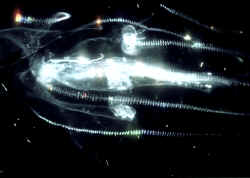
| A thaliacean "Salp". The (Class)
Thaliacea include about seventy barrel-shaped pelagic animals that
filter feed (like all urochordates), but from one end opening to
the other exiting as they locomote through the water. This Class is
further subdivided into three subclasses. The Pyrosomida are
colonial and the Salpida and Doliolida are not. |
|
The Ascidians on the other hand are a major part
of the "cryptic fauna" of live rock... often making up
a sizeable proportion of this material (second only to sponges). Though
they may not be easily recognized, tunicates are among the most common
marine invertebrates, and an important functional component, for
aquarists as well.
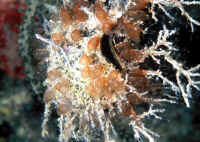
| Clavelina sp. Bulb Tunicates. Grow in
clusters. These ones common in Florida, Bahamas, the Caribbean.
Here attached to a clam which is in turn attached to a
gorgonian. |
|
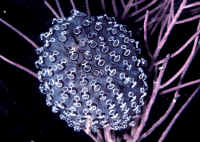
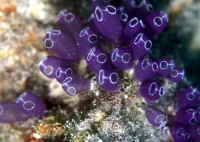
| Clavelina picta, the Painted Tunicate.
Florida, Bahamas, Caribbean. Frequently found in clusters of
hundreds of individuals hanging on to gorgonians, black coral,
sponges. Translucent bodies of variable cool colors. Siphon rims
reddish to dark purple. A colony in the Bahamas on a Sea Fan, and
one off St. Thomas. |
|
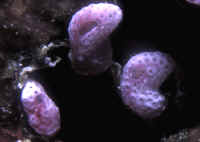
| Distaplia corolla, Button Tunicate. Small
(1/4" or less) oval individuals with one larger outflowing
opening. Generally grow in small clusters as these are in Cozumel.
Tropical West Atlantic. Found growing on dead coral. Orange or
purple in color. |
|
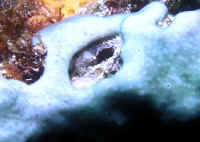
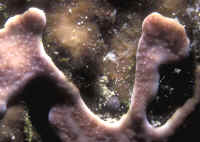
| Trididemum solidum, the Overgrowing Mat
Tunicate. 3-12 inches. Tropical West Atlantic. Small individuals
embedded into a heavy communal mass. Gray, blue, green or white.
Cozumel images by Di. |
|
To: Part 1, Part
2, Part 3, Part
4, Part 5, Part
6, Part 7, Part
8, Part 9, Part
10, Part 11, Part
12, Part 14, Part
15,

