|
Related FAQs: TWA
Invertebrates, Fishes of the Tropical
West Atlantic, Tropical West Atlantic
2,
Related Articles: Algae,
Vascular Plants, Introduction
to Fishwatcher's Guide Series Pieces/Sections, Lachnolaimus maxiumus/Hogfish, Hogfishes of the Genus
Bodianus,
Invertebrates, Algae and Vascular
Plants of The Tropical West Atlantic: Bahamas to Brazil, Part
8
To: Part 1, Part 2, Part 3,
Part 4, Part
5, Part 6, Part 7, Part 9,
|
|
| Bob Fenner |
Lesser and Greater Starlet Coral
|
Family Siderastreidae, Vaughn & Wells 1943.
Though hard to make out exactly with a live specimen and nothing to
magnify the view, this widespread family's members are unified by
characteristics of their individual polyp skeleton (corallite)
structure. These are flush with the surrounding carbonate mass
(coenosteum) by thick septo-costae, with the septa fused in the middle
to form a fan or star-like grouping.
Genus Siderastrea de Blainville 1830. Starlet Coral. Perhaps
the most widespread coral genus. Found most everywhere corals are found
around the world.
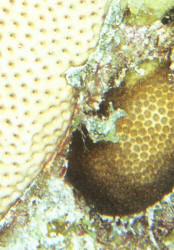
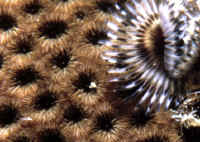
| Siderastrea radians. Lesser Starlet Coral.
Encrusting plates or irregular domes. Colonies 4-12 inches in
diameter. Corallites small (2-3 mm in diameter). Tropical West
Atlantic. Bonaire pix. |
|
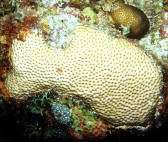
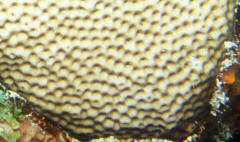
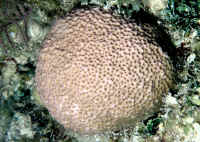
| Siderastrea siderea (Ellis & Solander
1786). Massive or Pink Starlet Coral. Encrusting to
massive/boulder-like. 1-6 feet in diameter. Corallites small (3-4.5
mm in diameter). Tropical West Atlantic. Bahamas images. |
|
Family Agariciidae, Gray 1847. All utilize endosymbiotic
algae, all colonial. Individual coral polyp skeletons have poorly
formed walls, prominent/thickened septo-costae, are immersed in their
larger skeletal mass, randomly oriented, spaced, often resembling
rough, wrinkled skin. Six living genera.
Genus Agaricia Lamarck 1801. Species are mostly thin vertical
plates (sometimes horizontal).
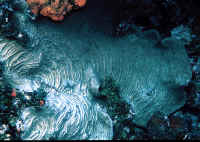
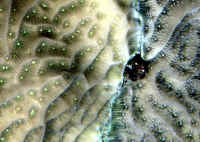
| Agaricia grahamae, Graham's Sheet Coral.
Looks like thin sheets to thick plates, often as piled up shingles
on a sloping reef. Polyps appear star-like in valleys. Septa
alternate in size (Lamarck's are equal in size). Bahamas pix.
Second pick, Graham's on left, Lamarck's on right for
comparison. |
|
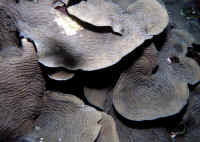
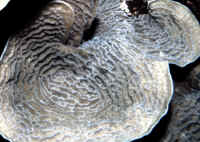
| Agaricia lamarcki Milne Edwards & Haime
1851, Lamarck's Sheet Coral. Colonies are flat one-faced plates
arranged in whorls. Usually brown rust in color with whitish
mouths. Belize images. |
|
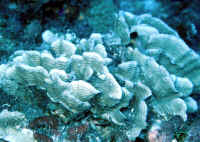
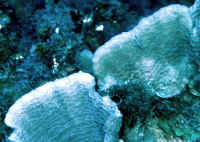
| Agaricia tenuifolia Dana 1848. Thin upright
colonies, joined at angles at their base. Corallites in valleys,
arranged concentrically with low ridges. Bahamas images. |
|
Family Mussidae Ortmann 1890.
Variously called Meat and Brain corals for obvious common
characteristics: large "meaty" polyps, wandering valley-like
arrangement of corallites like the sulci of grey matter. All have
distinctive thick columellae and corallite walls with toothed
septa.
Genus Isophyllastrea
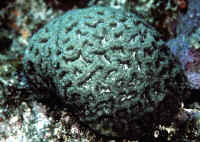
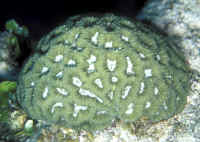
| Isophyllastrea rigida, Rough Star Coral,
Polygonal Coral. Tropical West Atlantic. Dome-shaped. Ridge along
midline of septa. One each in Cancun and Cozumel,
Mexico. |
|
Genus Isophyllia Milne Edwards and Haime 1851. Small colonies
(typically under eight inches in diameter), flat to slightly
dome-shaped. Thin septae and columnellae (on dead skeleton appearance).
Found only in the tropical West Atlantic.
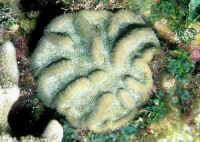
| Isophyllia sinuosa (Ellis and Solander
1786). Distinctive for its range. Meandering valleys. Not common.
Bahamas image. |
|
Genus Mussa Oken 1815. Monotypic, only found in the tropical
West Atlantic.
| Mussa angulosa (Pallas 1766). Large, fleshy
polyps that are well-separated. When retracted, skeletal
elements/septa appear spiny. To two feet in diameter. Below:
Bahamas images of larger, smaller colonies and a close-up by
Di.F in Cozumel. |
Genus Mycetophyllia Milne Edwards and Haime 1848. Flad
colonies with outward radiating valleys. Poorly developed columellae.
Septa-costae are outward facing. Found in the Caribbean
only.
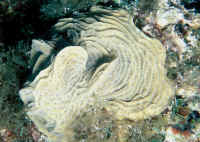
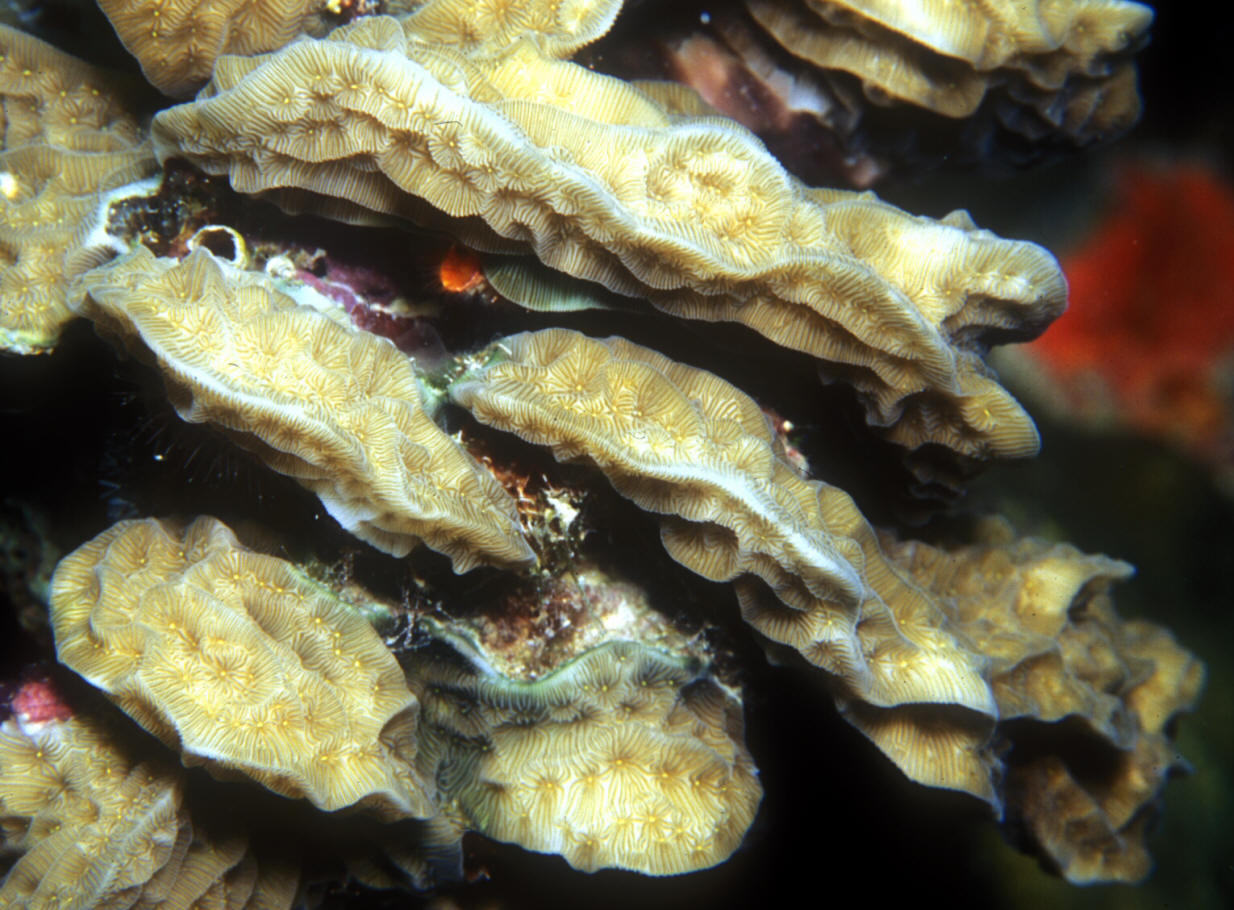
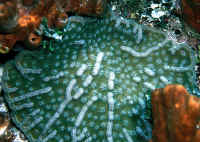
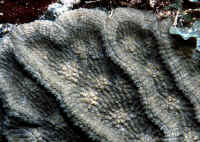
| Mycetophyllia aliciae, Knobby Cactus, Thin
Fungus Coral. Usually found as thin convex plates, with distinctive
raised star-shaped polyps. Bordered by ridges that run inward,
though less pronounced, common than others of the genus in the
region. Bahamas pix. |
|
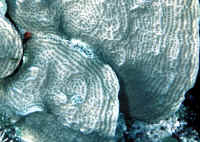
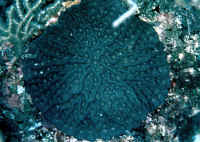
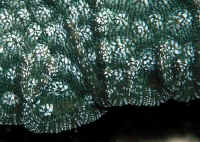
| Mycetophyllia danaana, Low Ridge Cactus
Coral. Colonies as flat plates, mounds, domes. Ridges about edge
turn to the inside, often crossing center, intertwine (definitive
differences from M. lamarckiana in the same area). Occurs in
green, brown, gray. Six to fifteen inches across. Bahamas pix. |
|
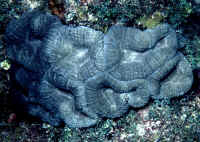
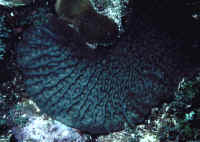
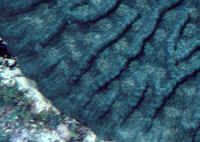
| Mycetophyllia ferox Wells 1973. Colonies
mainly as rounded plates, covered with sinuous valleys/mazes.
Bahamas images. |
|
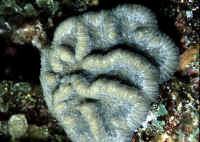
| Mycetophyllia lamarckiana, Ridged Cactus,
Large Cactus, Fungus Coral. Colonies as flat, wavy-edged plates.
Ridges fleshy, don't extend to centers. Wide, shallow valleys,
usually fleshy. Color variable: browns, greens, grays. 6-12 inches
in diameter. Bahamas pix. |
|
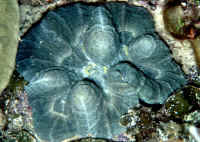
Genus Scolymia Haime 1852. Singular, circular polyps.
Indistinct walls beneath their septa-costae. These are difficult
species to discern one from the other. The three occurring in the
tropical West Atlantic may be told apart by the shape of their septal
"teeth".
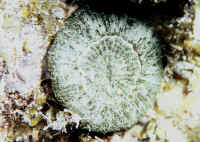
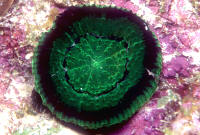
| Scolymia cubensis (Milne Edwards and Haime
1849). Septa in 2,3 orders as spikes, pick-shapes. Found in the
Caribbean and off of Brazil. Bahamas and Bonaire
pix. |
|
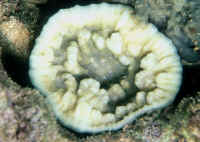
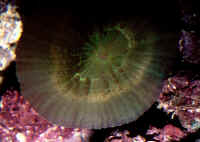
| Scolymia vitiensis Bruggenmann 1877. Septa
slope up from the columellae, costae slope down to the perimeter.
Look like fungiids with a depressed center otherwise. One in Fiji,
another in an aquarium. Below, two in Nuka Hiva, Marquesas,
Polynesia. |
|
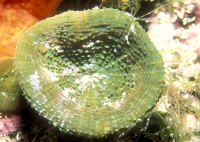
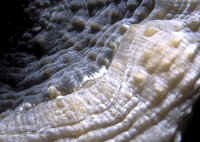
| Scolymia lacera, Atlantic Mushroom Coral.
Tropical West Atlantic. To six inches in diameter, most a couple of
inches. Have prominent triangular septal teeth ridges. Cozumel
image by Di.F. |
|
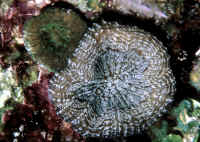
| Scolymia wellsi, Solitary Disk Coral.
Radiating, raised lines on polyp. Occur in greens, grays, browns.
Has rough, irregular cylindrical, thin septal teeth. Bahamas
pic. |
|
To: Part 1, Part
2, Part 3, Part
4, Part 5, Part
6, Part 7, Part
9, Part 10, Part
11, Part 12, Part
13, Part 14, Part
15,