|
Related FAQs: TWA
Invertebrates, Fishes of the Tropical
West Atlantic, Tropical West Atlantic
2,
Related Articles: Algae,
Vascular Plants, Introduction
to Fishwatcher's Guide Series Pieces/Sections, Lachnolaimus maxiumus/Hogfish, Hogfishes of the Genus
Bodianus,
Invertebrates, Algae and Vascular
Plants of The Tropical West Atlantic: Bahamas to Brazil, Part
4
To: Part 1, Part 2, Part 3,
Part 5, Part
6, Part 7, Part 8, Part 9,
|
|
|
Bob Fenner
|
Gorgonians, Sea Fans
|
Gorgonians, Order
Gorgonacea: What the deuces are sea fans anyway? Those scraggly
stick things you see in fish stores or hanging on the wall at The
Seafood Restaurant? Well, sort of; those are actually only the vestiges
(skeletons) of what were sea fans. Looking at a
human skeleton, have you ever heard, "What a babe/hunk!";
probably not. If you think sea fans are attractive as dead remnants
"you ain't seen nothing yet".
Most everyone has seen sea fans on the boob tube; even
had a sea fan in their hand, Order Gorgonacea, as a skeleton turned
into a piece of jewelry. If you've been diving in tropical seas,
you've brushed by them "waving" in the current.
Encrusting Gorgonians
Family Briareidae:
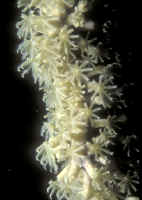
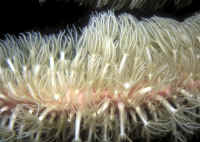
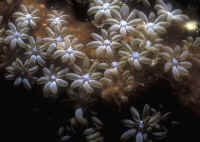
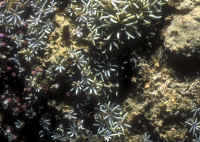
| Briareum sp. Blainville 1830. Briareum Soft
Coral. Family Briareidae. Colonies to 10 cm. N. Sulawesi (Lembeh
Strait) pic. These are encrusting species with off white
tentacles and bright white centers. Easily cultured in established
tanks with strong current and intense indirect lighting. Important
to isolate from stony and soft corals as these gorgonians can
overgrow and smother them. |
|
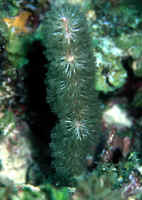
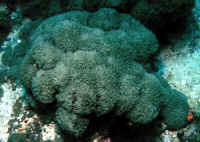
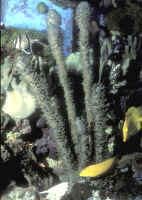
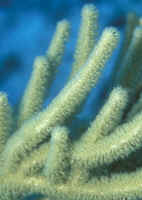
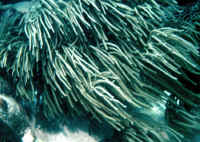
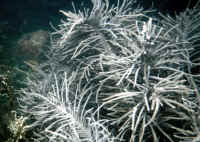
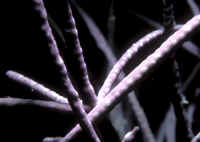
| Briareum asbestinum, Corky Sea Finger,
Deadman's Fingers. Colonies made up of one or more erect
cylindrical columns, with large "hairy" polyps,
occasionally encrusting. Rods purple to gray in color, polyps
lighter. Images below: An upright colony in the Bahamas and a more
encrusting form in Tobago. Colored purplish rind of encrusting
colony in Bahamas and close-up by Di in Cozumel. |
Family Anthothelidae
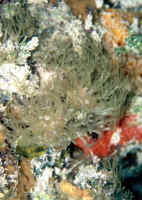
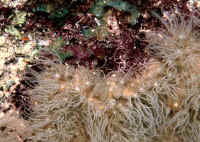
| Erythropodium caribaeorum, Encrusting
Gorgonian. Form encrusting mats that look hairy when polyps are
extended, smooth, light colored, like leather when
retracted. |
|
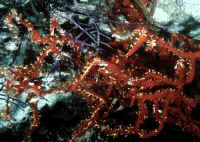
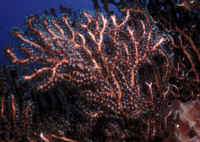
| Diodogorgia nodulifera, Colorful Sea Rod.
Occurs as branched and rod forms. Polyps in cone-shaped
calyces on red to orange rinds/stalks. Polyps white. Bahamas and
Tobago pix. |
|
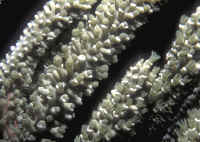
| Eunicea mammosa, the Swollen-Knob
Candelabrum. Tropical West Atlantic. To about a foot in height.
Closely packed tubular calyces. Candelabrum like in appearance
overall. Have tube-like calyces and candelabra-like colonies. Most
are light gold in color. Exist in many types of reef environments.
High to low light, water movement. Di pix in Cozumel. Below:
Aquarium and Cozumel images. |
|
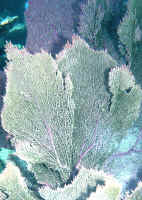
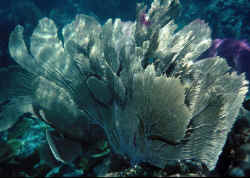
| Gorgonia flabellum, the Venus Sea Fan.
Large fans of one plane whose branches are interlaced and roundish
to squared off at angles to the fans surface in profile. Below:
Bahamas, Belize close ups and big colony. |
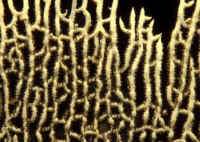
| Gorgonia ventilana, the Common Sea Fan.
Similar to the Venus Sea Fan (above), but with branches that are
flattened in profile, not roundish. A close up of the skeleton of
G. ventilana on the left, B. flabellum on right in
the Bahamas. Both mainly purple, but varying to whites, yellows, as
second close up (Bahamas) shows. |
|
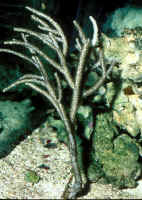
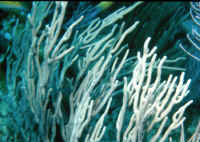
| Muricea laxa, Delicate Spiny Sea Rod. Tall
colonies that are bushy, branched in many planes, with hard
calcyces (proturberances, spines...) that extend out and upward
with branches. Whitish, yellowish. Aquarium photos. |
| Muriceopsis flavida, Rough Sea Plume. Bushy
colonies made up of tall branches or many small branchlets that
extend in all directions (not uni-planar). St. Lucia pic. |

|
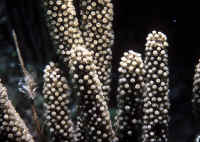
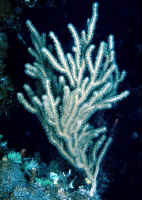
| Plexaura homomalla, Black Sea Rod. Bushy,
planar colonies. Usually branch laterally (versus dichotomously).
Have light brown to yellow polyps against dark brown/black
stalks/rinds. Bahamas pix. |
|
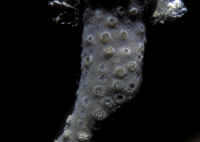
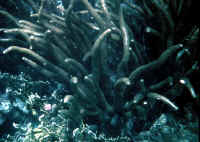
| Plexaura nutans, Giant Slit-Pore Sea Rod.
Tall colonies with thick stalks, not much branching. When closed,
polyp openings like small open, raised slits. Tobago
image. |
|
| Pseudoplexaura sp. Porous Sea Rods.
Definitive genus detail are small openings in rind when polyps are
retracted. Variable in appearance, color. Mostly dichotomous
asymmetrical branch division. Brown, grey, tan to light purplish in
color. Below: Tobago and two Cozumel images. |
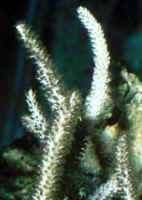
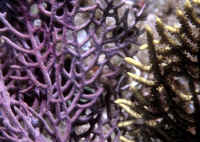
| Pseudopterygorgia sp., Sea Plumes. Tall (to
seven feet), bushy plumes of branches that are pinnately branching
in single planes. Often purple, other times brown to yellowish.
Tobago, Belize and Cozumel close-up (Di.F) pix. |
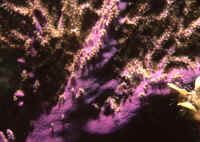
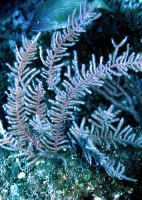
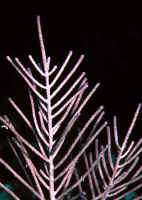
| Pseudopterygorgia bipinnata, Bipinnate Sea
Plume. Colonies as single planes of bilaterally arranged
branchlets. Usually purple, sometimes yellow to white. One of the
most popular aquarium Sea Fans due to its beauty, small size (to
two feet tall in the wild) and relative hardiness (when collected,
held, shipped properly). Bahamas photos showing open and closed
polyp colonies. See above/top for aquarium image at
title. |
|
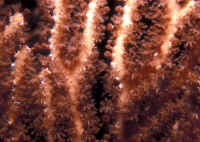
| Pterogorgia citrina, the Yellow Sea Whip.
S.O. Holaxonia, Family Gorgoniidae. Tropical West Atlantic;
abundant at times. Smallish, bushy colonies whose branches are
flat, narrow, polyps along lateral edge . Branches variable in
color. Di.F pic in Cozumel. |
|
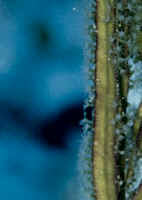
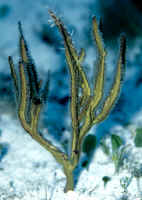
| Pterogorgia guadalupensis, the Grooved-Blade
Sea Whip. Tropical West Atlantic. To two feet in height, branches
to 1/2" diameter. Appears uniplanar in view, with branches
bearing a distinct groove in middle, tapering toward ends. Polyps
extend from a common groove along edges. Di.F pic in Cozumel. |
|
To: Part 1, Part
2, Part 3, Part
5, Part 6, Part
7, Part 8, Part
9, Part 10, Part
11, Part 12, Part
13, Part 14, Part
15,
|
|