|
|
| Home | Marine Aquariums |
Freshwater Aquariums |
Planted Aquariums |
Brackish Systems |
Ponds,
lakes & fountains |
Turtles & Amphibians |
Aquatic Business |
Aquatic Science |
Ask the WWM Crew a Question |
| Please visit our Sponsors | ||||
I'm back in the hobby! Query re stocking, mixing sand gobies
12/9/18 Fish addition in refugium
5/31/14 Goby compatibility
1/21/12 Diamond Goby Pair Acquisition
1/9/12 Sand-Sifting Goby (Starved Due To Old Age?) --
04/07/10 R3: Sand-Sifting Goby (Starved Due To Old Age?)
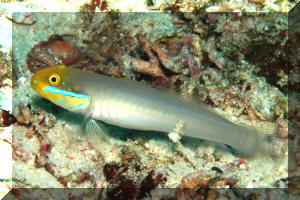
-- 04/09/10 Need A Sand Sifting Goby 1/22/09 Hi guys, <Hi Dan> I need your advice. <OK> I need a goby to clean my 1-1.5 inch sand bed. Is Amblyeleotris guttata gonna be a good choice? Do they even sift sand? <They will sift sand near their burrow but don't count on this species for doing the entire tank. They form symbiotic partnerships with nearly blind Alpheid shrimp and are known as Shrimp Gobies more so than sand sifters. With an Alpheid shrimp present, and a partnership forms, they are even less likely to venture too far from their shared burrow. I witness this behavior on a daily basis in my system.> I need something smaller, which would be also able to eat some frozen/flake food. My other choice is: Sleeper Goby - White (Valenciennea sp.) but I heard they are very messy, I don't need sand all over my corals. Tank is 100gal, LPS reef. Any advice would be great. <All Valenciennea species are not easy to keep due to their feeding habits, and are pretty good at covering corals with sand. Two I would recommend that are fairly easy to keep would be; Valenciennea helsdingeni (Sleeper Railway Glider Goby) Valenciennea wardii (Tiger Watchman Goby) Keep in mind that these fish will fight among themselves unless a mated pair, so is best to keep just one. I'd opt for the Tiger Watchman Goby as it would likely be the least messiest as far as sand blasting. You might consider a Sand Sifting Starfish. They would be better in that regard but would put no more than one in your tank. Do read here. http://www.wetwebmedia.com/valenciennea.htm And FAQ's here. http://www.wetwebmedia.com/sndsftstrfaqs.htm> regards' <Cheers, James (Salty Dog)> Daniel Sleep On It! (Should He Keep A Sleeper Goby?) Dear Robert, <Actually- Scott F. in for Bob today, who's in New York> I was doing some internet searching for information on Valenciennea muralis and found your contact information. I have my eye on a pair at the moment which appears very healthy. For me it is not a cheap fish to obtain costing $50 for the pair. I was hoping to get some information on how easy are they to keep in aquariums and whether they will eat aquarium food. The shop keeper claims Yes, but my readings suggest that many of such species will starve to death in aquariums. <Unfortunately, I have to agree with the authors whose work you read about. I would not classify them as "easy". Most of the "Sleeper Gobies" seem to waste away in captivity, despite our best intentions and efforts. These fishes are highly dependant upon infaunal life forms; most sand beds in closed systems simply don't have the density and/or diversity of life forms required to feed sustain these fishes for a natural life span. Some hobbyists have achieved a greater degree of success (or is that a lesser degree of failure?) with these fishes by feeding them foods such as black worms and mysis. An very well established aquarium with a productive refugium is also helpful> The intention is to put the pair into a quarantine tank with minimal gravel and no rock for at least 3 weeks, so that I can observe their health and eating habits. <I commend you wholeheartedly for that! A great habit to have> There is no microfauna in this tank. Once I am certain that they are doing fine, I will transfer them into a 50G tank with a deep sand bed and a good microfauna that is growing out of control at the moment. I don't want to rely on the microfauna though as their sole diet as I am not sure how quickly will they reduce the population. What is your experience with them specially with respect to feeding. <As outlined above- I have found them quite difficult to sustain for extended periods of time. If you do have success in weaning them to prepared foods during the quarantine period, this may help them by the time they are introduced into the main tank. Another problem that I have encountered with these guys is that they tend to become somewhat shy in community tanks, and may stop feeding, or at least, display great hesitation. I would try to "target feed" them once they are introduced to the display tank.> The goby will share the tank with a bicolor angel and a green Chromis. There is no intention to have any other bottom dweller in the tank. Any information would be helpful. Cheers, Ashraf <Well, Ashraf, I'm not trying to be negative about these fishes, but I have to tell you that you're in for a challenge, should you decide to obtain a pair. If you are up to the challenge, and are willing to do all that you can to assure these fishes' survival- it's all your call. You certainly sound like you have done your homework, but it's really a matter of personal preference as to whether or not they're worth keeping. Good luck! Regards, Scott F> Twin-spot Goby <Hi Kylee, Mac here> I was talked into getting a twin-spot goby without doing the proper research and now that I've researched it I see that they need to be kept in pairs. My question is should I go get one from a store that isn't a mated pair and see if they will pair up? or should I take back the twin-spot goby that I have. <In all honesty I kept a single twin spot goby for two years by itself. I know that it is recommended that you keep it as a pair but mine did quite well on its own. I will say that it paired up with a shrimp goby. It was probably one of my very favorite fish ever but it did constantly eat in the sand. Constantly sifting sand through its gills. Was nice for keeping the sand stirred up but was tough on the sand critters.> Also will the twin-spot goby compete with the mandarin for food? <Both eat pods so it will provide some competition for the mandarins food source. You might consider supplementing your pods production with some type of refugium where they can breed without being eaten or consider renewing your pods with some type of outside pods that you bring in.> Thanks, Kylee Sand surface cleaner versus sand sifters 1/25/06 Hello again to the best Crew around!! With the help you all gave me when I first got started, the great website and the awesome books, I have usually been able to find just about any info I need without having to bug you with any questions in quite some time. But I have a question this time that is a different twist than what I see on the website. I am wanting to find a "sand surface cleaner" versus a "sand sifter". Most everything I find on the FAQs deal with something to do deeper cleaning than what I am after. Here's the background. I have a 210-gal reef tank that is just about a year old. Livestock and such so far has been slowly built up to now consist of: - 5 Blue-Green Chromis - 1 Blackcap Basslet - 5 Lyretail Anthias - ! Coral Banded Shrimp - 5 or 6 Peppermint Shrimp - 1 Brown Brittle Star - 1 Feather Duster - Small Xenia patch - some Button Polyps - 1 small Torch Coral - 1 Cynarina (button/meat coral) - small patch of brown star polyps - large patch of neon green star polyps (lush and fast growing) - 1 Leather Coral, ~ 7" diameter - 1 Cabbage Coral, ~ 6" long - -1 Small blue/white Acropora - 1 brown Acropora - a couple of stalks of Shaving Brush - a couple of Emerald Crabs - several blue and scarlet hermit crabs - some mini hermit crabs - several Nassarius, Cerith, and Turbo Astrea snails - 5 large Mexican Turbo snails - 4" or so of aragonite substrate - roughly 300 lbs of LR - Feedings take place every 2-3 days with a mix of flakes, Spirulina, Cyclop-eeze, frozen Mysis shrimp and frozen meaty variety pack with Selcon drops added, occasional Marine Snow and/or DT's Phytoplankton I will soon be adding some Hawaiian Zebra Crabs, some more Astrea snails, and probably some more Nassarius just to help keep the sand stirred up more. Eventually, I would like to add a Naso Tang, a Yellow Tang, and probably another Tang, like Sailfin or Kole maybe. That will be it for fish. Then I'll be adding more corals, and eventually maybe a clam. But all that will come after I get my Chaetomorpha refugium going. <Good> Right now I am looking for something to keep the sand surface cleaned up. Not so much for stirring up and cleaning the bed but for cleaning the sand surface. Stirring would be good but the snails and weekly vacuuming help with that. But I am looking more for something to keep the brown stuff (diatoms?) from collecting on the surface in between weekly water changes. . Also, something to clean up any occasional Cyano that may decide to start up. Eliminating the need to vacuum would be awesome, but is not really the goal here. I just want to keep the sand surface looking clean in between vacuuming. The Snail and Crab Teams keep the rocks and glass pretty clean, but the sand surface still gets a light brown coating after a few days, especially along the back edges of some of the rock caves where the flow is low and the vacuum can't reach. Based on readings at WWM, along with your CMA and Reef Invertebrates books, I have thought about a Diamond Goby (Valenciennea puellaris), but want to make sure it would not decimate the sand bed of organisms the way a sand sifting star or horseshoe crab would. At least I think he wouldn't starve in this big of a tank. I have also started reading on the WWM website about spaghetti worms as an alternative. But I don't much about them yet and need to re-read about these in the Reef Invertebrate book again. <Valenciennea species would be my choice here> Your thoughts good or bad about spaghetti worms? <Mmm, often get eaten...> If I decide to add some of these, would you forego any other sand cleaners to avoid over-cleaning the bed? <Likely not a problem here with the gobies> If I go with the Diamond Goby to clean both the surface and upper layer, should I just surface-skim vacuum the top weekly and not do the normal inch or so into the bed? <Up to you> Any other suggestions you might offer about a sand cleaner? <I'd avoid most other types as too invasive and possibly predatory.> Thanks again for all your patience and great information. I know you hear this a lot, but I am quite sincere when I say there are a lot of us 'learning aquarists' out here that owe a great deal of the little we have learned, and the successful joy of this hobby, to your efforts and assistance. Many may not still be in this hobby if not for your help. Tnx, Rick Morris <Glad to share, help. Bob Fenner> Re: Sand surface cleaner versus sand sifters 1/25/06 Thanks for the fast reply, Bob. Last follow up questions on this, I promise. The more I read your book and web today, the more concerned I get about the Valenciennea puellaris' reputation for jumping out of even well covered tanks and deep digging, plus his need for live Mysis. <Mmm...> So, I thought I should ask if you would recommend the Yellow Headed Sleeper (Valenciennea strigata) as an alternative? <Is a good choice as well... about the same nutritional needs, propensity for jumping...> Should he do almost as good a job cleaning the sand surface with less chance of a rock slide and jumping out of the tank? <About the same...> Also, what is the recommendation on quarantining gobies like these? Since they are primarily substrate feeders, how do you keep them from starving during a full quarantine? <Good question. Mainly a matter of more careful feeding, paying close attention that they don't get "too skinny"...> Will they possibly take frozen Mysis and/or other meaty variety while in quarantine, <Almost always, yes> or do you recommend going with a short quarantine of a couple day and then move into the main tank? <Shorten if necessary... with a pH adjusted FW dip twixt the move> My quarantine tank is a separate 10 gallon bare-bottom system, so I could add a little aragonite from my main tank if that is your recommendation. <Should do fine> Thanks again for your help. If you and the Crew ever get down to Atlanta, let me know. I owe you a trip to the new Georgia Aquarium and lunch at the best BBQ in town!! <Some folks live just North (in S. Carolina...). And I do like BBQ! Both the Texan varieties and more south. Bob Fenner> Rick Which Sand-Sifting Goby? 6/19/06 Hello help crew, <<Vincent>> The sand in my sand bed is roughly 1mm to 1.5mm sized. What kind of goby will fit to that? Thanks, Vincent <<Most all of the sand-sifting/sleeper gobies will do fine. My favorite is Amblygobius phalaena... Regards, EricR>> Which Sand-Sifting Goby? II - 06/19/06 Hello Eric, <<Hello Vincent>> I saw a beauty white goby and I think there is a little black dot in his back, and he swallow the sand in his mouth then released it to the back (I don't know how to call that). <<It's referred to as "sifting" the substrate>> It was so interesting!! Wonder will he do that if my sand is bigger size? <<You don't give me much to go on here for an ID Vincent. If this was a Yellow Headed Sleeper Goby (Valenciennea strigata) then yes, it will handle your substrate just fine. I suggest you do a keyword search of our site, and the "net" in general, for "sand sifting goby" and see if you can identify what you saw/view the different species available...most all can handle/will do fine with a substrate grain size of 1mm-1.5mm as you have stated you have>> Thanks, Vincent <<Regards, EricR>> Which Sand-Sifting Goby? III - 06/21/06 Valenciennea sex...(Valenciennea 1837), I think that what it is. Thanks. Vincent <<Valenciennea sexguttata...or Sixspot Goby. Not widely seen/available in my experience, but I would expect it do fine with your substrate all the same. Regards, EricR>> Survival of gobies, Sel. 3/28/07 Hi there, <J and G> I'm about to order a sleeper goby and read on your site that the Valenciennea puellaris frequently dies of starvation due to a lack of fauna in the substrate. Would you say that the Valenciennea strigata has got better survival chances in the aquarium? Thanks for your advice, regards, Jana.. <I "score" these two congeners about the same for utility in captivity... Both easily suffer for a lack of suitable infauna, substrate to sift through/for. Bob Fenner> |
|

|
Features: |
|
| Featured Sponsors: |