|
FAQs about Yellow Tang
Stocking/Selection
Related Articles: Yellow
Tangs,
Related FAQs: Best
Yellow Tang FAQs, Yellow Tangs 1,
Yellow Tangs 2, Yellow Tangs 3, Yellow Tangs 4, Yellow Tang FAQs: Behavior, Identification, Tang ID, Systems, Feeding, Disease, Reproduction, Black Spot Disease, Purple Tangs, Striped Sailfin Tangs, Zebrasoma Tangs, Zebrasoma Identification, Zebrasoma Behavior, Zebrasoma Compatibility, Zebrasoma Selection, Zebrasoma Systems, Zebrasoma Feeding, Zebrasoma Disease, Zebrasoma Reproduction, Surgeons In General, Selection, Tang Behavior, Compatibility, Systems, Feeding, Disease,
|
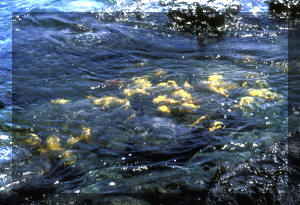
Very social in the wild... need room in captivity
|
Surgeonfishes: Tangs for Marine Aquariums
Diversity, Selection & Care
New eBook on Amazon: Available here
New Print Book on Create Space: Available
here
by Robert (Bob) Fenner |
 |
Advice please... Y Tang stkg., comp.
3/1/16
Greetings, Recently I set up a reef tank 265 gallon and I got the
aquarium design from a book called “ Aquarium Model Designs” by John
Tullock. In one of his designs, he called for 9 yellow tangs in a 180
gallon. This design is called “ Cheerful Yellow”. I am sure you know of
this book.
<Yes; have a copy; know JohnT>
I have a 265 gallon fully cycled tank so I added 9 young, small Yellow
tangs, a medium size purple tang and 20 azure damsels. After a day of
calm, the YTs started fighting and 2 weeks in, all develop a severe case
of Ich.
<Mmm; yes... and this picking is very likely to continue. Yellow Tangs
need to be much more or less crowded than this... else you'll suffer
slow attrition...>
However all YTs are eating like machines. The PT also had Ich but now no
signs of Ich is seen now. I have had him for 7 years in my old 210
gallon and he had recovered from ich in the past w/o treatment. Please
tell me if this plan is a good plan:
- Remove all the yellow tangs and treat them/sell them to LFS.
- Leave the azure damsels and PT in the tank if they do not show signs
of Ich.
- Let the tank be for 6 weeks. If there is NO signs of Ich on the
damsels and the PT, then add a school of true schooling fish such as
Chromis and the nicer blue reef type.
I believe 9 tangs in a 265 is not doable as the author led me to
believe.
<I do agree>
Please tell me if my anticipated plan is appropriate.
<It is one route to go... you will have a resident, residual Crypt
infestation... most if not all systems do... With challenges like poor
water quality, dips in nutrition... bringing on clinical signs>
I have few corals in the tank so treating the disease in the tank is not
possible. Thank you and I look forward to your reply. Dai
<MUCH more could be stated; IS archived on WWM re. I'd spend some time
reading... re Crypt; parasitized systems, Tangs and Protozoans.... Bob
Fenner>
Re: Advice please... Yellow Tang (in)comp., stocking lg. SW sys. f's
3/22/16
Greetings,
<Salud. Have re-read our correspondence. Thank you for including>
Let me update you on my tang situation. Now I have 6 remaining yellow
tangs and they all are eating and very active, No signs of ich anywhere
but I lost 4 due to ich. (40% loss). Now all the damsels (20 +), the
purple Tang and 6 YTs are doing well. Some days they fight with each
other but no fish seems to be bullied/sulk into a corner and some days
they don't mind each other at all. Now I have 2 questions:
1. I would like to add medium sized hippo and a medium Naso. I had them
with the PT in my previous 210 without any issues. However they did not
make it in the dealer tank (too small tank) when I was getting my new
tank cycled. When would be a good time to add them?
<Mmm; any time; however; there is a good chance of bringing back
(clinically) the Crypt/Ich on at least the new Tangs; due to stress...>
I understand there are still active ich but they cannot infect the
current fish because these are healthy and not stressed. Should I wait 3
months or add now?
<Later would be better>
2. Is it a bad idea to add 2 more same size YTs?
<Likely so; yes. I would NOT add more>
I am concern about disrupting the equilibrium now that may bring back
onset of ich. I believe it is a bad idea but I thought I run through it
with you.
Thank you Mr. Fenner for all you do! Thanks again Dai
<Glad to share Dai. Bob Fenner>
Introducing New Fish? (Selection/Order) – 08/07/14
I have a relatively new saltwater tank (6 mo.s) and have 5 small peaceful fish.
I have more small fish on my list such as Carpenter's Wrasse, Firefish etc., but
am having trouble obtaining them.
<<Mmm, indeed…I have noticed some of the larger online providers (i.e. –
LiveAquaria) are presently ‘out’ of a lot of their stock…time of year maybe>>
A Yellow Tang is also on my list and is available now. Should I wait for
the other fish before adding the Tang? I'm getting a little impatient.
<<In my experience Zebrasoma flavescens is not overly aggressive toward small
fishes such as you have listed as they are not perceived as direct competitors
(but there can always be exceptions)…but I also feel this has much to do with
the size of the system. If the tang feels cramped already, then adding more fish
behind it may well be problematic. If your tank is 100g or more I don’t think
the risk is very high…too much smaller than that, well, in my opinion you’re
getting in to the realm of being too small for the tang at all. EricR>>
Re: Introducing New Fish? (Selection/Order) – 08/08/14
It's a 75 gallon reef tank with a decent amount of coral. Marginal or no
on the tang?
<<Marginal for sure…and only then if you feed well to further help
mitigate aggressions, and resist the temptation to add any other
large/tang-size fishes. EricR>>
Re: Introducing new fish?
Thanks for your help, I will.
Yellow Tangs in a group/Tang Compatibility/Perculas Behavior
7/30/12
Hi Crew,
<Hello Ranjith>
Are 3 yellow tangs in a 4’x4’ too much?
<Yes.>
Total fish are
1x Blue Tang
3x Yellow Tang
1x yellow tail Anthias
2x Perculas
I see territories being assigned with 2 individuals assigned a corner
each and the third roams around the place.
<The Alpha fish.>
If they come out, he charges them. Once in a while one of the corner
boys refuse to get dissuaded by his charges and he does not really bite
them. A little bit of a peck though.
Am a little concerned because one of them is assigned a corner there the
skimmer outflow is there and it keeps getting bubbles all over its body.
<Remove two of the tangs or you will eventually have one. This
scenario only works out in very large systems of 500+ gallons and even
then there may be issues.>
Please share your thoughts.
<I've tried this many many years ago in a 240 gallon tank and like your
case, the Alpha fish hunts down the weakest preventing it from eating
and it soon dies, then it's on to the next least dominant tang, and on
and on.>
Also, my 2 Perculas do not seem to want their BTA. Anything I can do to
persuade them?
<Not really, if the fish are tank bred/raised, it's very likely they
haven't seen an anemone and will never associate with one. If they
are wild caught, the BTA may not be acceptable to them as their favorite
anemone in the wild are Carpet Anemones and these are very difficult to
keep for any length of time in a captive system. James (Salty
Dog)>
Cheers
Ranjith
Re Yellow Tangs in a group/Tang Compatibility/Perculas Behavior 7/31/12
Hi James
<Hello Ranjith>
Thanks for Sharing your experience.
<You're welcome. James (Salty Dog)>
Thing is, they are assigned a corner but not there always, they do sneak
in and out a few times.
Since tangs are used to grazing all the day, the sneak visits would not
be enough?
<No, and hiding in corners is not normal behavior for tangs, they are
stressed.>
Had tried Anthias group and ended up with one pretty fast.
Any suggestion on some fish that I can have in a group in this size
tank?
Is a reef tank, mixed but primarily focused on softies, Zoas and LPS.
<Three or four Kaudern's Cardinal fish would be attractive. Avoid
larger groups of these fishes as the tendency to fight increases.
James (Salty Dog)>
Cheers
Ranjith
Coral Magazine; Y. tangs, lies
1/20/12
Good morning Bob,
<Hey James>
Saw this today......."FEAR, LIES, and VIDEOTAPE: Anti-aquarium
activist Rene Umberger at a recent protest that resulted in Petco
deciding not to sell Yellow Tangs: "40 percent of Hawaii's
Yellow Tangs will die before reaching the hobbyist," she says, and
cites the source: R. Fenner, September 2010, on
www.Wetwebmedia.com."
<Yes...>
Did not realize it was that high......6 out of 10 make it to hobbyists
tanks? I felt the major losses were due to inexperienced
aquarists, and something like 3% didn't make it to the dealer or
died in the dealer's tank.
Cheers,
James
<The incidental mortality in the trade for this species has never
been this high... Think on this; the fish would be extremely expensive
to the end-user if so. The folks here have "lifted" my name
(FWIW) and attached a fictitious value (an even numbered one no less!)
to a "factoid" of their making/use. BobF>
Re: Coral Magazine 1/20/12
Mmm, have you done anything about this? I have had about all I
want to
read about this dude Snorkel Bob.
J
<Have written both BobW and ReneU and the trade re... they persist
in
mis-using my name, statements. B>
Re: Coral Magazine 1/20/12
Good!
Yellow Tang 8/29/11
Dear WWM,
<Dez>
I have a very well established 85 gallon reef tank with a refugium and
the following fish: 1 Candy Basslet, 1 Male Lyretail Anthias, 1 Female
Lyretail Anthias, 1 Male Bartlett Anthias,
<... thought you were going to arrange summat re the
Anthiines>
and 1 Midas Blenny. I would like to add a Yellow Tang as my last and
final fish, and I could really use the
algae grazing in the tank the fish would provide.
<Mmm, a small/is Ctenochaetus species would be better... Perhaps a
Tomini or Kole/Yellow-eye...>
My tank, although 85 gallons, is 36" long. I have a tremendous
amount of live rock in the tank, lots
of crevices/hiding places. Good skimmer, also. Tank parameters are
Nitrates: 0, Phosphates: 0, Calcium: 440, Alk: 9, Magnesium: 1400. I am
concerned about the tang having enough swimming room.
<Me too>
Many sources of information stress minimum gallons for this fish, but
some also specify 48" in width
is just as important. Want to do the right thing here.
Welcoming your opinion.
Laura Rothbaum-Garmizo
<Well, as you state, you're on the smallish dimensions and
volume wise...
again, I'd switch to a Bristletooth species. BobF>
Re: Yellow Tang 8/29/11
Hi Bob,
<Designer>
Let me tell you what happened with the female lyretail anthias...
<Please do/Pray tell>
I have a Vortech Wavemaker in the tank. It was creating a vortex, and
subsequently many bubble flying across the length of the tank as well.
I shut it off two days ago, wondering if that was part of my problem
with the female lyretail. The minute I did, she swam around the tank,
par normal.
She is now joined up with the male again, swimming throughout the tank,
and has not been up on the right corner since. It was like she was OCD
with the Wavemaker or something.
<Heeeee!>
I don't know how else to explain it. She just STOPPED like a light
switch went off.
Appreciate your thoughts on the yellow tang. I value your opinion far
more than anyone on these matters. Will not add the yellow tang if you
feel long term it would be to the detriment of the fish.
Laura
<Likely you wouldn't have troubles for quite a while placing a
"mid-size" Z. flavescens here (3-4" overall)... it being
the last fish... but likely w/in a year there could well be dominance
issues. Much less likely with the other Acanthurid genus. B>
"Koi" Zebrasoma flavescens
2/20/11
Hey Bob,
<Chris>
I hope that you are well. Odd duck question for you, but what have you
seen recently for pricing on the white/yellow aberration of Z.
flavescens in the US?
<Usually hundreds of dollars... do realize that "small"
(under 3" let's say) specimens of such "Koi"
varieties do change to "normal" quite often>
I've an importer that is looking for one for me, but I want to make
sure that pricing is "market".
Many thanks,
Chris
<Are rare in the wild, and seem smarter, harder to catch; and if
caught smallish as "koi" marked, often revert to total yellow
w/ age/growth. Bob Fenner>
Re: "Koi" Zebrasoma flavescens
Thanks Bob!
<Welcome!>
Stocking Question for 180 gallon reef, Z.
flavescens 10/16/10
Hello Crew,
I have a 3 year old 180 gallon reef tank with an approximately 40
gallon sump/refugium/that is stocked as follows: a 6" Regal Tang,
a 5" One-Spot Foxface Rabbitfish, a Pink Spotted Goby, a pair of
tank bred Ocellaris Clownfish, a Green Spotted Mandarin, a Serpent
Star,
<Mmm, what species? Or, are you aware that some are quite
predaceous?>
two cleaner shrimp, three peppermint shrimp, and various hermits and
snails. I had planned on the following: a Flame Angel and Coral Beauty
(placed at the same time), a Tail Spot Blenny, and some other small
rock dweller who pokes in and out of the rocks (maybe a Royal Gramma or
some other small, interesting fish...suggestions?).
<To keep looking, investigating>
Of course, I went to the LFS, and my plan seems to have changed.
<Heeee! Of course!>
In my quarantine tank, I now have a Flame Angel and the deviation from
my stocking plan......a Yellow Tang. The LFS had numerous healthy
looking specimens for a great price, so I ended up buying one. Sigh.
Now I'm wondering how to proceed. I read Bob's comment in
regards to a 150 gallon tank that "strange as it may seem, small
odd numbers of this species (amongst other shoaling fishes) are best
kept together... " Then Eric Russell said in regards to a 150
gallon, "This tank is too small for three yellow tangs...in my
opinion."
<I do agree w/ Eric's statement>
Should I proceed with getting the Coral Beauty, Tailspot Blenny, and
other small rock dweller or get two more Yellow Tangs to make
three?
<I'd stick with the one here. If you're interested in
another Tang, get a different species>
If you suggest three, should I leave out any of the other fish in my
stocking plan?
Thanks,
Casey
<Welcome! Bob Fenner>
Yellow "Koi" Tang Availability - 09/23/08
Do you know where can I find/purchase a "Koi" yellow tang?
<<These are extremely rare (an abnormality/xanthic variation)
though Bob does have a couple pics of them off the Big Island of
Hawai'i (http://www.wetwebmedia.com/YellowTang.htm scroll down near
the bottom of the page). A good place to start I think would be The
Marine Center (http://www.marinecenter.com/)... contact them and make
an inquiry. I'll also ask Bob to add anything if he has any
ideas/thoughts on this tang morph. Regards, EricR>> <Mmm, just
got to ask around... are found as you say, only on rare occasion in the
wild... and IME seem to be very wary, wily in terms of avoiding
collectors... Much more than "other" "normal"
Yellow Tangs. BobF>
Re: Yellow "Koi" Tang Availability -
09/24/08 Thank you. <<Quite welcome. Please do let us
know how your search turns out. EricR>>
Stocking Question: 75 Gallon Reef Tank. Tang and Wrasse?
Stocking Question For A 75G Reef…A Little Paranoia Can Be A
Good Thing - 09/01/07 Hello Crew Member, <<Hello Skot>>
Awesome site. <<Thank you>> You've turned what was
potentially an expensive and frustrating hobby into a rewarding and
very expensive hobby ;) <<Ha, indeed!>> Seriously though,
your site has kept me from "giving up" through a series of
unfortunate events including a leaky tank, leaky protein skimmer and
suspect stand… All problems I've solved with the help of your
site. Thanks. <<We are pleased to know this>> Now for my
Question. I have a 75 gallon acrylic tank. Around 80lbs of live rock. 3
inches of sand. Euro-Reef RS 80 skimmer. <<Good skimmer>>
30 gallon sump with refugium (incidentally I'm completely
fascinated by the refugium. When my main display lights go out and the
refuge lights come on I sit and stare at all the life in there. Really
cool.) <<Oh yes…much interesting life to be observed in
these "protected" environments that is overlooked/not
seen/even missing, in the main display tank>> This setup is about
3 months old and I plan to make it a reef tank. A majority of the
water, sand and rock are from a 1 year old 55gallon system I was
running. I've got 20 misc snails and another 20 misc hermits. I
purchased the Indio-Pacific Sea Farms Refugium Starter Kit about 6
weeks ago for my refugium which also contains some Miracle Mud, sand,
and live rock. I've 2 Percula Clowns, 2 Banggai Cardinals and 1
Orange Sleeper Goby (all from my previous tank). I also have a small
patch of mushrooms and a small patch of zoos. Levels are: ammonia 0,
nitrite 0, nitrate 5ppm, <<Do strive to keep this from climbing
any higher>> 79 degrees, pH 8.2, sg 1.22. <<This last
should be at NSW levels (1.025/1.026)>> I'm paranoid about
overstocking. <<Mmm, yes…this will prove to be to your (and
your livestock's) benefit>> There are two additional fish I
have my eye on for down the line. First I'm interested in the six
line wrasse. <<Can be nasty little buggers>> My research
suggests I have room for this fish as it stays relatively small and
appears compatible with my current livestock. Is my assessment correct?
<<In this instance, yes, I believe so…but addition of this
wrasse will likely mean you won't be able to add any other
similarly sized/shaped fishes after it becomes established>> Next
I'm interested in a Yellow Tang. <<Mmm…I knew there was
going to be a "tang in the mix">> I realize my tank is
the minimum recommended size for this fish. <<Yes>> Would
it be wiser for me to steer clear of this guy?
<<Hmm…considering the size/number of tankmates, the fact
you don't have a "tank full" of rock which will allow
this fish room to move around, and considering the refugium…yes,
I think adding a Yellow Tang will be fine here>> Is my tank
already reaching capacity? <<Not "right now"…but
will be close once you add the tang>> Will my additional
(sump/fuge) 30gallons of water flow help provide a good home for this
tang? <<That…and the other considerations I
mentioned>> If the tang is a "no" do I have room for
another smaller fish or am I at capacity? <<Adding the tang will
be fine>> Sorry to bombard you with questions. <<No
worries>> I've been at the hobby for a little over a year now
and I consider myself a fairly disciplined person. I have no desire to
irresponsibly overstock my tank or make a foolish misstep that can be
avoided. Having said that, there's a whole lot I don't know.
<<Ah well then…there's much reading/research ahead of
you my friend>> Thanks for the help, Skot <<Happy to
assist. EricR>>
Yellow tang... mainly selection, sys.
issues 11/24/06 Hi crew, <Howdy, JustinN with you
tonight.> I've recently set up a 55gallon tank and have been
finding your site very helpful so far. <Thank you for
the praise.> My tank has been cycled for a few weeks using live rock
and readings have been ammonia=0, nitrite=0, nitrate 10, sg=1.022 and
ph 8.2. for over a week now. <SG is a little low, I would raise this
to NSW levels, 1.025> I added my first fish at the weekend which was
a very nice yellow tang about 3 inches. <This was a poor
choice in my opinion, for several reasons. To begin with, tangs are
typically sensitive fish, that require a well established aquarium to
maintain life. Less than a month is not nearly long enough, six months
would have been more appropriate. Secondly, a 55 gallon aquarium simply
does not afford enough room for growth or movement for proper life of a
tang, even the smaller Zebrasoma species. These smaller quarters will
eventually lead to the physical retardation of growth, and potentially
psychological crowding issues as well. Most people consider 75 gallons
to be borderline for tangs, usually a minimum of 90 is suggested. I
would agree with this suggestion. Finally, you absolutely should have
quarantined the specimen before adding to the display, these problems
would have then presented themselves in a more controlled
environment.> For the first two days he ate frozen brine shrimp
without a problem, but today and yesterday he just wont eat. I've
tried Nori and sea veggies but he doesn't even acknowledge them nor
the brine shrimp any longer. He's been hanging behind
what seems to be his favorite rock and doesn't come out that often
and when he does he's very easily scared. <Mmm, sounds
environmental to me. Could simply be adjusting to the tank still, or
the not-quite-established surroundings, or perhaps toxins in the water.
Have you tested water parameters since adding the tang?> He still
looks good and is a very nice colour although his stomach looks pinched
in now, probably from not eating. I'm hoping you can
help me with my problem as I would hate to lose him. I have
a Prizm skimmer (unfortunately) <Hehe, I'm in the process of
phasing out my own Prizm in exchange for a Tunze DOC 9002, so I
completely understand this sentiment.> hopefully upgrading to a
deltecMCE300 soon, an external Eheim filter and 20kg live rock. <Do
keep that Eheim clean, canisters can become nitrate farms without
proper maintenance. It sounds like you've got a good handle
equipment-wise, I would just reconsider your stocking plans. Please
have a thorough read through these links: http://www.wetwebmedia.com/tangs,.htm http://www.wetwebmedia.com/zebrasom.htm http://www.wetwebmedia.com/YellowTang.htm Hope
this helps you! -JustinN>
Yellow Tang Blues? (Selecting
and Caring For Z. flavescens) 8/24/05 Good Day! <Hello there!
Scott F. at your service today!> I have a small (45 gallon) reef
set-up. It's been up and running very successfully for 3 years now.
I have a question - I have several fish that have lived very peacefully
and apparently healthy for most of the 3 years. I vary the food given,
since some of the fish are herbivores (Yellow Tang/Zebrasoma flavescens
& Hippo Tang/Paracanthurus hepatus) and some are carnivores
(Percula Clownfish/Amphiprion ocellaris). I feed dried Omega One flake,
frozen brine, Emerald Entr? & Mysis shrimp (not all at once...lol)
All of the fish seem healthy but I've lost several Zebrasoma
flavescens over the past few years. The Hippo tang is doing well as are
all of the other fish. The Yellow tang appears healthy until I find it
dead or almost dead. I figure it must be the diet since I can see no
parasitic clues and all of the other fish are doing well. I feed
sparingly once to twice per day and all of the fish seem to eat
voraciously. I say sparingly since I know the uneaten food will feed
all of the unwanted items in my tank. Any clues to what I'm
doing/not doing? Thanks for the assistance. J.T. Craddock <Well,
before we look at the possible causes of your bad luck with the Yellow
Tangs, I have to get up on the soapbox for a minute. I'm sure that
you are aware, but the P. hepatus Tang will require much larger
quarters in the very near future if it is to live anything close to a
natural lifespan. These fish can and will get quite large, and they
require very large amounts of physical space to live a long, healthy
life. I'm sure that a larger tank is in the future, right?
Anyways...off the soapbox and on to the problem! I think that there are
a few potential issues here. First, these fishes are often subject to
shipping traumas. The majority of the Yellow Tangs collected for the
trade come from the best source, Hawaii, and are collected well and
shipped quickly. Yellow Tangs from other sources don't always fare
as well. These fishes need to eat constantly, and typically, by the
time they reach the LFS, they are already quite deprived of food. When
selecting specimens from the LFS, be sure to choose fish that are not
showing signs of malnutrition, pinched-in stomachs, faded color, red
marks on the fins, etc. Additionally, make sure that you employ a
quarantine regimen for all new fish, particularly Tangs. Not only does
the quarantine period give you the opportunity to observe the fishes
for signs of infections and to treat them before introduction to your
display-it gives your new fish the chance to eat and recover from their
journey to the LFS. These fishes are voracious consumers of algae, and
should have a regular "supply" of algal-based foods available
constantly. You should utilize fresh macroalgae, such as Gracilaria
parvispora ("Ogo"). You can order Gracilaria from e-tailers
such as my favorite, IndoPacific Sea Farms (www.ipsf.com). Last, but
not least, make sure that you maintain very high water quality at all
times. Employ aggressive protein skimming, regular, frequent water
changes, and common sense husbandry practices. Hopefully, these tips
will point you in the right direction. It really sounds like you're
doing things right...just consider a larger tank down the line! Good
luck! Regards, Scott F.>
Zebrasoma flavescens Query 4.30.05
Hi, its me Dillin again here, you guys are great and so is the site by
the way. Well I have come once again to seek your outmost wisdom about
the beautiful world of marine fish keeping. I really wanted help on the
yellow tang my most favorite fish in the hobby! First off, I have
always loved tangs but I have often read that certain types are
difficult to keep. But with the exception of the yellow tang I have
read and found that these magnificent fish are a good hardy beginner
choice for the novice aquarist. But I really trust your opinion is
there any truth to that? <Yes, the Yellow Tang is a hardy aquarium
specimen, given adequate room and lots of current.> Also they are
herbivores and require large amounts of algae in your tank well what if
your aquarium cannot produce algae? Could they eat off fish flakes,
pellets or commercial brand products? <Yes, you will clip a square
of algae, called Nori, to a clip. This should be offered daily. You can
also buy red and brown varieties.> And as you know sadly these
delicate beauties suffer from marine ich all too common in the tang
family, are the yellow tangs just as likely to catch it? <Yes, they
will be infected by the parasite if exposed...But NO fish will be
infected if unexposed.> And why do the tangs catch marine ich so
easily? <Fishes with a high metabolism, such as this one, seem to be
more prone to the parasite than others. Nevertheless, all will die
without proper treatment.> Well I will leave these questions to the
professionals and I look forward to hearing back from you people.
Thanks Dillin. <Read up a little more here, Dillin. http://www.wetwebmedia.com/YellowTang.htm
Great job making sure you are ready for a Tang. Ryan>
Surgeonfishes: Tangs for Marine Aquariums
Diversity, Selection & Care
New eBook on Amazon: Available here
New Print Book on Create Space: Available
here
by Robert (Bob) Fenner |
|

