|
FAQs about Figure Eight Puffers,
Identification
Related Articles: Alone But
Not Lonely: The Importance of Keeping Puffers
Individually by Damien Wagaman, Figure Eight Puffers,
Freshwater/Brackish
Puffers, Green Spotted Puffers
(GSP's), The Arrowhead Puffer,
Tetraodon suvattii, miraculously malicious, True
Puffers, Puffers in General, Burrfishes/Porcupinefishes, Tobies/Sharpnose Puffers, Boxfishes, Puffy & Mr.
Nasty, Puffer Care and Information, Pufferfish Dentistry By
Kelly Jedlicki and Anthony Calfo,
Related FAQs: FAQs,
FAQs 2, & FAQs on: Figure-Eight Puffer Behavior, Figure-Eight Puffer Compatibility, Figure-Eight Puffer Selection, Figure-Eight Puffer Systems, Figure-Eight Puffer Feeding, Figure-Eight Puffer Disease, Figure-Eight Puffer Reproduction, &
BR Puffers 1, BR Puffers 2, BR
Puffers 3, BR Puffer
Identification, BR Puffer
Compatibility, BR Puffer
Selection, BR Puffer
Systems, BR Puffer Feeding,
BR Puffer Disease, BR Puffer Reproduction,
|
White "tummies"
|
| Figure eight or green spotted???? 1/27/08 Hi
again. Sorry bother you again Bob. <'Tis I, Neale.> This
time it will take a little more than a second of your time. I
recently bought a puffer from a LFS and it was labeled leopard
spotted puffer. <It's Tetraodon biocellatus. The specific
epithet, "biocellatus" literally means "two
eye-spots", and if you look at the back half of the body, you
will indeed see two sets of yellow-ringed eyespots. One pair on the
caudal peduncle, and the other pair a little further forward, on
either side of the dorsal fin. The common name for this fish in the
aquarium hobby is Figure-8 Puffer, though other names get used, as
in your case. Needless to say, I prefer Latin names because,
frankly, they're easier to use (if not always easier to
say!).> And after reading through your website I found out that
leopard spotted puffers are green spotted puffers and they need
brackish water. <Yours is most certainly not a Green Spotter
Puffer, which is either Tetraodon nigroviridis or Tetraodon
fluviatilis, depending.> I am such a fool!!! I should have
researched before buying it. But I couldn't resist, it was soo
cool. However, after looking through pictures of the green spotted
puffer, it didn't look like the puffer I had. It looked like a
figure eight puffer to me. I wasn't sure however. <It
is.> Then I researched you website again and found out that
figure eight puffers can live in freshwater. <Not they
can't. The maintenance of this species is curious. Wild fish do
indeed seem to be reported mostly coming from freshwater habitats,
albeit coastal rather than inland ones. However, under aquarium
conditions they do not do well in freshwater. They are more prone
to disease and do not live as long. Optimal aquarium conditions
appear to be low-end brackish water, around SG 1.005, with a decent
level of carbonate hardness and a pH around 7.5-8.0. It is
difficult to know precisely why their aquarium requirements are so
different to their preferences in the wild, but they are, and the
aquarist needs to allow for that.> So I was sooo happy to see
that I may be able to keep it. <Don't get too happy. It
won't live for long in freshwater. Since it is DEFINITELY not a
community tank fish, there's no harm done. This species is best
kept on its own (either alone or in a group) or, oddly enough, with
bumblebee gobies, which seem to do very well with them. Other small
gobies should do well, too.> However, I am not 100 percent sure
if it a figure eight and not a green spotted. <It is Tetraodon
biocellatus.> So I wanted to see if you could tell. I have an
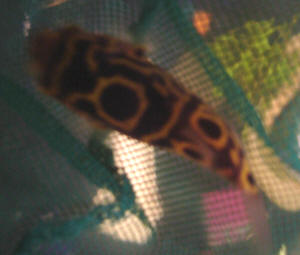
attached photo of my puffer. Can you please tell me what type of
puffer it is and whether it needs a brackish water or not????
<Yes, needs brackish water.> Thanks again Bob and crew. Mikey
ps. I apologize for the blurry image. It is a picture of my puffers
top side. His design. I hope you can see it. If you can't email
me back and I will try to get a better pic. Thanks again.
<Cheers, Neale.> |
|
|
Palembang puffer <Now synonymized as T. biocellatus> Hi
Crew, I've a question.. (but don't we all) I just got a
Palembang puffer, and the tank I got him from had probably 2 dozen of
them all swimming happily... but I put this little chappy in a tank on
his own, and he seems rather distressed, swimming up against the glass,
even trying to jump.. and he looks like he's trying to escape.. is
this just due to him being in a new environment? or is there something
wrong with the water? I checked the ph and it seems ok... the only
other fish is a tiny Pleco. Thanks for your help <Hey Marcus,
it is very possible that this is just a reaction from the stress of
being moved into a new environment. I would also test my
water for ammonia, nitrite, and nitrate, just to be
sure. Best Regards, Gage.> Marcus Tan
Figure 8 Puffer in SW? 7/25/04 Hello!
Thanks for responding yesterday! <Hi, you've got Pufferpunk here
today to answer your puffer questions.> Along with the other fish I
mentioned earlier, could a clown trigger, Malu anemone, and a crocea
clam live together? Also, the puffers I've had my eye on looks like
a brackish figure 8 puffer, but with much more white on the belly and
live in saltwater. What are they? <I'm not sure which puffer you
are describing. The F8 should have a white
tummy. Some folks have had short-term success with keeping
F8 puffers in SW, but we don't know the long-term affects of this
yet. we do know of folks keeping them over 18 years in light
BW. There is a larger puffer that resembles a cross between
a F8 (Tetraodon biocellatus) & a green spotted puffer (T
nigroviridis). It is called a Ceylon puffer (T
fluviatilis). It has a similar pattern on it's back as
an F8, with black spots on it's sides &
abdomen. This fish is in BW when young & prefers SW as
an adult. It grows to 7-8". Also, I
don't suggest keeping puffers with clams (puffer food) &
anemones. I recently heard of a puffer biting into an
anemone & dying. ~PP>
|
|

