 |
|
| Home | Marine Aquariums |
Freshwater Aquariums |
Planted Aquariums |
Brackish Systems |
Ponds,
lakes & fountains |
Turtles & Amphibians |
Aquatic Business |
Aquatic Science |
Ask the WWM Crew a Question |
| Please visit our Sponsors | ||||
Danio swimming in circles... 01/18/09 Hello and a belated happy fishy new year to you all! Once more instead of working I am reading WWM most days, and have nice fishy background on my desktop. I have a question about a zebra Danio. For background my current set up: 180lt with possibly a little too many little fish: 12 x 5 banded barbs 2 x 1 Ã'½ inch long Ancistrus 3 x 1 Ã'½ inch long golden Gouramis 4 x adult female platies, 1 adult male, 1 small male 5 x approx. 2 month old platy fry 9 x adult zebra / leopard and one horribly long finned) Danios 10 6 week old Danio fry (My plan is to give some Danios to a friend as soon as they are big enough) I have one zebra who I notice has been swimming in a circle for most of this week. It is kind of twitching occasionally moving the fins on one side more than the other, and listing very slightly to one side. Still feeding well, but now resting occasionally on the bottom (unless there is food, or me with a net in the tank, in which case it can swim very very fast) I have removed this Danio to my QT set up and have examined it carefully and cannot see anything physically that may be wrong. It is now swimming about the QT (mostly in circles, quite big ones, but def. circles) with a slight list to one side. I do a 30% water change around every 10 days in the 180 tank, water temp is 26 C, Nitrate: 5 , Nitrite and Ammonia at 0. Fish are fed sinking algae pellets (allegedly for the Ancistrus, but they all eat them), TetraMin crisp, and supplemented every other day with frozen bloodworm / brine ship / mosquito larvae (tropical sextet). Occasional cucumber slice is enjoyed by all. Any ideas? I am sure this fish isn't right, but it didn't sound like the description I read of shimmy? <Unfortunately Neale is out for the time being, and I'm certainly no Neale. But this sounds like a swim bladder problem to me... as to the cause? ...I can't be sure. It could be any number of things (genetics, trauma, disease, stress, etc.). But if this is the only fish having these problems, I wouldn't panic. Here are some links that might help: http://www.wetwebmedia.com/fwsubwebindex/fwdistrbshtart.htm http://www.wetwebmedia.com/AqBizSubWebIndex/fishdisho.htm Thanks for your assistance once more Sarah (Here's a brief aside for Christmas my husband, who thinks he is funny, in response to my request for fish for Christmas, got me: a wind up fish for the bath, a flashing fish for the bath, a cuddly fish that sings, an Murano glass pendant fish, and finally, fisherman's friends throat sweets. Oh how we laughed. Fortunately mother in law got me a fab book Fishlopedia, and my mum a spare heater and filter pads for the tank..!) <That's a sweet story, thanks for sharing. Cheers, Sara M.> Danios and Cherry Barbs Wasting Away 1/13/09 Hi!
First, I must say, you are the most excellent web resource available
for aquarium troubleshooting. However, I have a particularly elusive
problem with my tank - or at least I think of it as such - that I
haven't been able to solve or find an answer on any web site,
including yours, after hours of extensive research on the internet. My
fish (Danios and cherry barbs) very slowly waste away, and eventually
die. My water quality seems good, and there are no visual external
signs of parasites. I have tried several internal/external
anti-parasite medications, without any real success. Below I have
outlined my original tank and stats, it's problems, how I attempted
to remedy them, and the current results. I probably included too much
information, but I attempted to be as through as possible. I hope you
might be able to shed some light as to what might be going wrong, as I
am about to move up to a 37 gallon tank. I would like to save the fish
and plants that I still have, but would not want to move this problem
with them to the new tank. Thanks in advance for any advice you can
give me! Lizzy Original Setup Revised Setup & Results Tank/Size
BioCube 9 gallon BioCube 9 gallon (original) Period of Operation 9/08 -
7/08 7/08 - current Stock 2 Glolight and or Zebra Danios added per
month (final 8 fish total), various pond snails 2 Glolight Danios (1
original), 1 Zebra Danio, 2 Cherry Barbs, various pond snails Plants
Unknown Sword variety, several Myrios, Wisteria. All plants rotted out
and died within a month or two, with the exception of the sword. Sword
(original), 3 Wisteria, 2 Dwarf Water Onions, lots of Java Moss, an
unknown bulb (sends leaves up that sit in the surface like a lily). All
plants doing well, but not stellar. No added CO2. Algae/Other
Observations Significant amounts of brown algae on tank walls, other
surfaces. Periodically thousands of tiny Planaria (1/32" in
length) on the walls. An occasional detritus worm seen. Small amounts
of brown algae on tank walls, some hair algae on plants. An occasional
tiny Planaria or two spotted on walls near substrate. An occasional
detritus worm seen. Decorations Composite plastic log with holes for
hiding. 1 piece of driftwood, two 3" stones (jasper and red
slate?) Food TetraMin Tropical Flakes. Fed 2 times every day. Freeze
dried blood worms, AquaSelect Tropical Menu Mix, TetraMin Tropical
Flakes (in random rotation). Fed once per day as much as can be
consumed, 4-5 times per week. Filter Under Gravel, (3" dia) with 2
tablespoons of carbon/Zeolite mix and coarse sponge. Filter functioned
via air stone centered in a 1" dia tube creating a minor suction
from air bubbles rising in tube. Eheim Ecco 2232 external canister bio
filter, for max tank capacity 36 gal. No carbon, unless needed after
meds. Air stone at back of tank. Substrate 1" dia Reef One ceramic
gravel (overall depth 2") CaribSea Eco-Complete Planted Aquarium
Substrate, 20 lb. (overall depth 3") Lighting 10 watt halogen. This
fixture recessed down into the water (reducing the water-to-air surface
area). On timer, 12 hrs./day Coralife Mini 7" compact fluorescent -
1-9w 6500K bulb, 1-9w 10,000K bulb. On timer, 12 hrs./day. Temp
(unheated) 79-81 summer, 64-67 winter (F) 79-81 summer, 64-67 winter
(F) Water Changes 45% plus filter change and vacuum gravel every 2-4
weeks Week 1, 10% Week 2, 20% plus vacuum gravel Week 3, 10% Week 4,
20% plus clean filter Water Treatment TetraAqua AquaSafe Seachem Prime
& Seachem Neutral Regulator Water Quality Mardel Quick Test Strips:
Nitrate NO3: 0 Nitrite NO2: 0 pH: 7.6 (stable) Alkalinity/Buffering
cap. : 80ppm Total Hardness : 120ppm API Master Test Kit: Nitrate NO3:
0 Nitrite NO2: 0 NH3/NH4: 0 pH: 7.4 (stable) Mardel Quick Test Strips:
Alkalinity/Buffering cap.: 180ppm Total Hardness: 120ppm General
Problem From approx. 3.5 months after setup, the fish (usually one at a
time) would begin to waste away slowly, over the course of a month or
two, even while eating well, eventually stop eating, and die about a
week after rejecting food. Occasionally, a fish would recover, regain
weight, be fine for a few months, and then the process would start
over. A continuation of original problem. Specific Symptoms Losing
weight slowly. Fins clamped some of the time. Sometimes had white or
clear poop. While ailing, some fish would spit out food repeatedly.
Sometimes fish move their mouths as though trying to spit something
out. Swimming normally, but not as lively as I would expect (with the
exception of the week or two before dying, when they would just hover
in one place). A continuation of original symptoms. New symptoms for
Barbs only. Barbs occasionally flashing on plant leaves, and sometimes
swimming with head down approx. 30 deg. Healthy Signs No external signs
of parasites. No flashing. No fast breathing or gasping. No darting or
erratic swimming. Good color. Lots of spawning activity while healthy.
No external signs of parasites. No flashing (Danios only). No fast
breathing or gasping. No darting or erratic swimming. Good color. Lots
of spawning activity while healthy. Medication 5/08 -- Jungle
Anti-Parasite medicated fish food . Full 3 week treatment (no
noticeable improvement) ( most fish, especially the ones not doing
well, would eat very little if at all.) 7/08 -- Jungle Anti-Parasite
medicated fish food full 3 week treatment (no noticeable improvement).
9/08 -- Jungle Parasite Clear, tablets 2 treatments 48hrs apart w/20%
water change (1 pink GloLight Danio recovered significantly after this,
but not others). 10/08 -- Jungle Anti-Parasite medicated fish food full
3 week treatment (no noticeable improvement). 10/08 -- Quick Cure every
day for 5 days, 20% water change before each treatment,. (no noticeable
improvement). 11/26/08 -- Jungle Parasite Clear, tablets 2 treatments
48hrs apart w/20% water change (no noticeable improvement). Total Fish
Loss 7 Danios 2 Danios, a third Danio very close to dying, 3 Cherry
Barbs. <Hello Lizzy. To cut to the chase here, the problem is that a
9-gallon tank just isn't viable for Danios or Barbs, or indeed most
other fish. End of story. While we can fuss over the precise reasons
each of the fish have died, neither of us have that kind of time. So
long as you keep Danios and Barbs in a 9-gallon tank, they'll
sicken and die. They might be okay for a while, but as sure as God made
little green apples, something will knock each of them down as the
weeks pass. Even small Danios like Zebra Danios need a 20-gallon
system, and Cherry Barbs about the same. As/when you graduate to the
37-gallon system, provided you install an adequate filter containing
(in part) the mature media from the 9-gallon tank, I would fully expect
your fishkeeping to become a lot easier and more successful. You seem
to be maintaining good water quality and steady water chemistry, and
your choices in terms of things like food and filtration are sound. But
I simply cannot state this strongly enough: beginner aquarists should
buy tanks 20 gallons in size and larger, and aquarists generally should
avoid anything in any shape other than a long, shallow rectangle,
however attractive it might look. These spherical, cylindrical or
hexagonal tanks are a triumph of style over substance, and 99% of the
time are a waste of money (and fish lives). They aren't good for
anything short of holding water and producing bubbles. In terms of
keeping fish alive, they suck big time. So save your money. Bigger
tanks will hold more oxygen and provide more stable conditions, and
even at a social behaviour level, species apt to bully one another
(like Danios) will coexist more amicably. It is not uncommon for Danios
to systematically harass each other to death in too-small tanks, until
eventually only one dominant fish survives. Indeed, in the old days
when people often kept 10 gallon systems, it was pretty typical to see
people with just one big, old Danio after all the others had died years
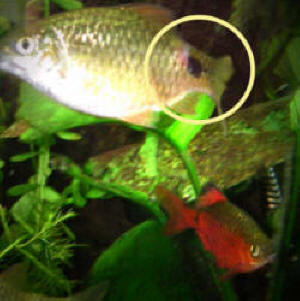
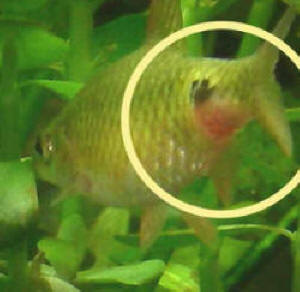
before. Cheers, Neale.> Re: Scares... white spots on the mouth of my Danio's 07/07/08 Bob, thank you so very much for your response to the white spots on the mouth of my Danio's I totally agree with you since they have in fact gone away on there own the livingstoni has completely cleared up. I cant tell you how nice it is to have someone at hand to help answer questions about the aquarium I live in a small town in Wyo. and have no one to ask anything you and your crew truly are great to have on hand I will be asking again whenever there seems to be a problem or just a curiosity that I have no idea about I am a novice only had an aquarium when I was young but love these African cichlids. Thank you again Wes Taylor <Thank you for this follow up Wes. BobF> Flipping Rosey Barb - 6/20/08 Hi, My Rosey barb will be swimming normal, then just start flipping and spinning, then go back to swimming normal again. Sometimes it's just 1 or 2 flips, other times it goes on for about 15 seconds. She (?) appears to be fine otherwise. Her appetite is good. I thought maybe she was constipated, so I tried giving peas for the dinnertime feedings for a week. (Morning feedings are either flakes or shrimp pellets.) She loved the peas, but it didn't stop the flipping. She shares the 40 gallon tank with a Pleco, 4 adult platies and 12 baby platies. The platies and Pleco are all fine. The water temp is 80, the nitrate is 0, nitrite is 0, water is soft, alkalinity is 80 and the pH is 7.0. I change the filter and 25% of the water weekly. The flipping has been going on for about 2 months. Any suggestions? Lisa <Hello Lisa. There are diseases that can make fish swim in odd ways, such as the 'Whirling Disease' caused by Myxobolus cerebralis, but to be honest these are rather uncommon, and usually introduced via live foods (especially Tubifex) and don't get "caught" by jumping between fish in aquaria. That's why they don't just appear out of nowhere. Also, given this fish has exhibited these symptoms for 2 months and remains otherwise healthy, I'm more inclined to put this down to (perhaps) genetics or nervous system damage. If she remains happy, then just assume she's a bit quirky, and love her all the more because of it. Cheers, Neale.> Zebra Danio acting strangely 5/6/08 Hello, <Sarah> I have an established hexagon tank, I believe it is 35 gallons. I had e-mailed last Sept when some of my fish died suddenly after a heater malfunction. Since that time, I have not added any other fish, we had 1 zebra Danio and 2 Cory cat. This weekend I picked up 5 very small zebra Danios at PetSmart (where the other fish came from as well) and 2 more Cory cats. I have checked the water daily, it still shows zero nitrites. All the new fish seem to be active and happy. The coloration on the new Danios brightened from a pale brown to bright stripes almost immediately. All the Cory cats are happy. However, the one original Danio is acting strangely. It seems to be swimming in a labored fashion, moving his tail constantly, as if it cannot keep itself straight in the water. Its tail is lower, and its head is high. He has had a bloated look for a very long time, so not sure if it could have some sort of problem. Any suggestions? I had wanted to get more Danios so he would have someone to school with, as he was just hiding in the plastic plants all the time. Now he's out and swimming, but not looking good. Also, he has a large bright red spot on one side behind the eye- is this normal coloration for zebra Danios? Thanks, Sarah <Mmm, is not... could be most anything at this juncture, description. Please do send along a well-resolved image if you can. Bob Fenner>
Rasboras, hlth. 3/6/08 Hello Neale, I have a question about one of my harlequin Rasboras. About 6-7 months ago I bought 6 harlequin Rasboras for my 20 gallon planted tank. About 4 months ago I noticed that one of my Rasboras has a big white spot on the forehead. Now this fish is very dull in color and very skinny. It eats well but looks like it has difficulty to swim. All other 5 Rasboras look very well: bright colors, strong swimmers. I have also in the tank school of cardinals(9 fishes) that are doing great. Do you have any idea what is that? Thank you for your help Mark <Hello Mark. Identifying diseases like this is very difficult without a photo. It could be something as harmless as a cyst, or more dangerous, like a tumour or parasite of some sort. Given the fish has lived for several months already but is noticeably less active than the others, I'd tend towards thinking this is some sort of tumour or perhaps a viral infection. It isn't likely to spread so there's no reason to isolate it. My guess is that it will eventually die, perhaps because the infection will spread to other parts of the body, much like cancers in humans. Anyway, if you want to send a photo, please do. Cheers, Neale.>
My ever-dwindling Danio population (Danio Illnesses) 12/23/07 Hello out there in the wonderful world of Wet Web Media, <Brian> I am writing out of a combination of consternation and desperation. I am new to fishkeeping (February 14 will be my one-year anniversary) and I have two tanks: one is a twenty-nine gallon planted tank and the other is a ten gallon planted tank. In this post, I am writing about the twenty-nine gallon tank. First, a little background... My tank is about eight months old and I added fish slowly (though I might add, without quarantining - that is what the second tank is for, but I bought it mid-way through stocking the first one). My ammonia and nitrite are both zero. My nitrate is greater than 20ppm but less than 40ppm <Both too high...> (hard to tell with the color based tests). I do a 25% (about 5 gallons which is 25% since there is only about 25 gallons of water in the tank accounting for the displacement from the substrate, rocks, wood, and plants) water change once a week. I do NOT use a C02 machine, but I do put in Excel (one capful) every other day. <I would hold off on this for now...> The plants in the tank include: a ton of Blyxa japonica, a hearty Anubias, two flourishing (melon?) swords, crypt spatulata, java moss, and Myrio which grows like weeds. The non-fish fauna in the tank include: Amano shrimp (2 males, 1 female), 5 cherry red shrimp (and about 20 babies across three generations), and green shrimp (not sure how many because they hide, but at least one no more than four) and various snails. The fish in the tank include: one Bristlenose Pleco (sans bristles - grumble!), two honey dwarf Gouramis (one definitely male, one either female or passive male); one flame dwarf Gourami, one Oto negro, one Siamese algae eater (too big for its britches - not sure what to do with this voracious eater), <Keep your eye on... move if too aggressive> one pregnant female platy (who has never once -visibly- given birth but is a fat blimp), one chocolate Gourami (named chip, short for "chocolate chip"), and two male Rainbowfish (dwarf praecox), one zebra Danio and one leopard Danio. So here's the problem. My tank population has recently dwindled. In the last two weeks, I have lost two zebra Danios. About a month before that I also lost a zebra Danio (when I started my tank I had four). About four months ago, my fattest (alpha?) female Danio seemed to get sick - her spine started to curve and she was "hiccupping", having these strange convulsions that looked like she had a neurological disorder. Over the weeks, she got progressively worse until she was swimming funny (she almost seemed like she was no longer buoyant - she kept sinking and was swimming in this weird diagonal pattern). I tried to look it up online (even on this site) and from what I could glean - the fish was constipated. The cure seemed to be quarantine and no food for 2 days. After six hours in the quarantine tank she seemed improved and after three days, I returned her to the main tank. She was fine for about six weeks and then she died. Four weeks later, one of my Danios had a pinkish sore on its side. I am not sure but I think it was "missing a scale" (not even sure if this possible, but it is my best estimation). About two weeks later, I came home and a different zebra Danio was dead (at the bottom of the tank) and the one with the sore, well it was ... well, I am not sure how to describe it. It looked as thought it was being eaten alive. One side of its body it was fine and silvery and the other side was raw - pink/red as though someone had been munching on it. Oddly enough, the fish was swimming around just fine, but it looked nasty. I put it in one my larger fish nets (I know not the best idea, but it was a contingency plan) and tried to isolate it from the other fish after I found my dwarf flame Gourami trying to nip at it. Sadly, the Danio didn't make it. Two days ago, I came home and my leopard Danio was swimming at an angle and well... I also don't know how to describe this but it looked like had exploded. Pardon the description - from the front and sides it looked fine but most of the bottom 1/6 of the fish was ... well gone and looked pink and fleshy. If it were possible for a fish to "explode" from eating too much, this is what I would hazard it would look like. The good news is that after two days, the fish is still alive (not visibly being harassed by other fish ... ) and seems to be healing. The fleshy part has actually gone from a reddish pink to a paler pink. It looks less like it is "throbbing". Now that you have heard my story, here are my questions: 1. Does this sounds at all like "whirling disease"? I just started reading about this (by the way, your link to www.fishdiseases.net on the whirling disease FAQ is broken) <Does read as some sort of internal bacterial complaint... particular to Cyprinids...> 2. If not, what does it sound like? I have not had any luck finding anything that fits these symptoms (if they are all related). 3. What do I do? Are my other animals in danger? <I would skip using Danios and their relatives in this system... Really. Not worth trying to treat, remedy here. The list of other livestock... that is more sensitive to general areas of poisoning let's say, is telling> I am not sure if you can tell from my post, but I have taken being a fishkeeper really seriously. <Yes... you 'read' as a very earnest individual of intelligence, tenacity> I have been reading a ton (subscribe to two fishkeeping magazines, read this site, joined my local aquatic plant society). Every time a fish or other animal dies (3 Otos, 1 bamboo shrimp, 1 white dwarf Gourami, 1 bumble bee goby [which would have done better in a brackish environment, I found out after] and 2 female Amanos), I spend hours trying to figure out why they die. My water is clean, my nitrogen cycle is fine, I feed regularly, and my plants are thriving. Any help would be useful. <As stated... many Danios perish "consequent" to the conditions in which they were reared in the Far East...> 4. I read somewhere that if a fish has whirling disease, the fish should not be flushed. ACK! I didn't realize that - is that true for all dead fish? I am a city boy and I don't really have a "plant" to bury the fish in. Can you please give me some suggestion for appropriate means of disposing dead fish? <Best to freeze all in a plastic bag... toss out with solid trash service> Sorry for the long post. I look forward to your reply. Brian in San Francisco <Bob Fenner in Key West> Fish illness, Rasboras -12/14/07 Hello, I am a bit puzzled since not sure if I should be concerned or not about my juvenile harlequin Rasboras. I originally bought 6 baby Rasboras for my cycled but new (1 month) old 10g tank. Now it has been a total of 1.5 months that I had them, 3 died right away and 3 were left. Out of the 3 one of them had a white colored anal fin even from the time I brought it back from the LFS (didn't notice until a few days after). I thought it was fin rot so treated the tank with Jungles fungus eliminator for 2 weeks. <Mmmm...> It neither went away or got worse. The fish is acting and swimming normal and eats fine. The other Rasboras and tankmates are unaffected. Recently within the past week the whiteness has spread to the pelvic fin. It is not cloudy nor appearing as a cotton fuzzy growth. Its like the entire fin is actually opaque white made up of white pigment (e.g. not just a surface coloring). The finnage is smaller than it should be, yet has not progressed to complete deterioration. One side of its body looks like it has cloudy streaks or haze on it. He does not scratch or have trouble breathing, I don't think its Trichodina nor fungus... <... not so sure> is there something else it could be or is it Trichodina or Costia and they take a long time to develop? <Yes, could be> Is this contagious? How should I treat? He is acting normal otherwise... <Could be catching... depending on what "it" is... Do you have a microscope? Can be blindly treated for with protozoacides...> Tank: 4 Neons 2 Rasboras 4 baby Corys 10gallons pH 7.8 <High...> ammonia 0 nitrite0 nitrate15 weekly 30% water changes Temp 74 <A bit low> thanks so much cheers t <Please read here: http://wetwebmedia.com/FWSubWebIndex/fwmaintindex.htm the sixth tray down... on FW Disease... There is not much, enough here to "go on" to suggest much in the way of specific treatment... If it were me/mine, I'd likely start working on lowering the pH of the water through modifying the change-out water (over time that is), and raise the temperature to the upper 70's F... and leave all else as it is. Bob Fenner>
Please Help: are my Scissortails Rasboras sick? 10/14/07 Hello Wet Web Media Crew, <Hello.> I have 2 male yellow Lyretail mollies, 7 Neons, 3 scissortail Rasboras and 1 Otocinclus catfish in my 20G tank (5 months old). <Some nice fish, though personally I'd not keep mollies in this collection nor in a 20 gallon tank; Mollies need hard (and ideally brackish) water, and they also get quite large and sometimes (often) the males become very aggressive.> Today, all the 3 Scissortails have become pale, their stripes are gone, and are swimming mostly at the bottom, but they are still active and hide behind the plants and come to the front when I watch them closely. <As always: check water chemistry and quality! At the least, check pH and check nitrite.> Last night when I saw them they were all fine. I have no clue what happened. So I checked the water parameters and they (ph, hardness, alkalinity, nitrates, nitrites) are in the safe range, with no ammonia and no chlorine. <Define "the safe range". And sometime it isn't so much the value of something that matters, but how much it changed. Your Neons are fine anywhere between pH 5.5 and 8.0. But, if the tank pH suddenly goes from pH 8 to pH 6 overnight, then the Neons will be severely stressed. This is why we test water on a regular basis, especially early on in the lifetime of the tank: because we need to know *how stable* the water conditions are, as well as what the actual water chemistry values are.> The temp is 78 deg. I do weekly 30% water changes and feed the fish flakes and Tubifex worms. <Mollies need green foods, so don't forget to use algae-based flake instead of regular flake for at least 50% of the dry food meals. I'd never use live Tubifex worms: they are collected from filthy waters usually, and can be a serious source of disease.> The mollies and the Neons are doing fine so I don't know if the Scissortails are sick or stressed out or what. <Difficult to know. A good test is to do a nice big water change, say, 50%. If the fish perk up, then chances are the water quality was in some way the problem. If this makes no difference, then start looking for other factors. Review the needs of your Scissortails in terms of pH, general hardness, and carbonate hardness and then see if that matches the conditions in your aquarium. Another things you might look for is signs of aggression between the Mollies and Rasboras.> Your help is greatly appreciated. Thanks. Pallavi <Good luck, Neale>
Ich and the scaleless barb 8/14/07 Dear WWM Crew, <<Dear Claire. Tom here this afternoon.>> Congratulations on your fantastic and informative site - it has been an invaluable resource as I set up my first tropical tank. <<Very glad to hear it, Claire.>> Unfortunately that tank has now come down with Ich (due to an unquarantined new arrival - long story, and I've learned my lesson...) - I saw one or two spots on fins this evening. <<An Ich infestation is a pain in the backside to have to deal with but its a far cry from other problems that might have occurred. Sorry you learned the hard way but all of us have learned something in this hobby the hard way so welcome to our club.>> I have Nox-ich to treat it with but would like some advice on dosage, due to the presence of a 'mutant' fish. The tank contains 6 female rosy barbs (rescued feeder fish), five tetras and a Bristlenose catfish (gradual stocking still in progress). One of the rosy barbs has no scales. <<Hello? Haven't heard of that one, Claire. Interesting>> She is in all other respects a perfectly healthy (before the Ich) and active fish. I assume the lack of scales means that I should treat the tank at a lower dosage level, but would like your input before I do. <<Not to send you back to the LFS unnecessarily, Claire, but neither your Tetras nor your Bristlenose Pleco are going to appreciate the Nox-Ich formula which contains sodium chloride (salt) and malachite green as its active ingredients. Even at half-dosages you'd really be putting yourself on aquarium watch for signs of stress with your pets. Additionally, as I see below, you have a planted tank. Plants don't much care for salt, either. I don't want you wasting time here nor your money but Kordon's Rid-Ich may be the better choice of medications given the circumstances. Its a combination of malachite green and formalin but, in combination, at lesser concentrations than would be found with other medications using one, or the other, exclusively or nearly so. In combination with each other, these are very effective even when dosing down (one-half the prescribed) because of scaleless fish.>> Tank stats: 150 litres, live plants pH 7.4 ammonia and nitrites nil nitrates 5 Thanks! Claire. <<Tank stats look quite good, Claire. Be sure to read the directions of any medication carefully and followed them to the letter. Best of luck. Tom>> Tiger barbs hlth. 05/05/07 Hello. <Hello!> I found you website very informative and thought I would throw out a question for you. <Okeley dokeley.> I currently have a 29 gal. aquarium that is stocked with 3 tetras, 3 tiger barbs, 4 speckled mollies, a large Pleco, a small Chinese algae eater and a bumblebee catfish. <Too many fish for such a small tank, and many incompatible with each other for water chemistry and behavioral reasons. Please research fish *before* buying them.> My question is pertaining to my tiger barbs. I had three tiger barbs for approximately 2 years, and about 6 months ago I noticed that they began developing facial deformities, mostly to the mouth. One of them had a jaw that appeared to grow swollen over a period of weeks until he could no longer eat. They have since died. <Mouth fungus more than likely. Very common when fish are kept in overcrowded aquaria or tanks with poor water quality.> About 4 months ago I purchased 3 baby tiger barbs. They were all healthy when purchased and were purchased from a reputable fish dealer. One died in the past few weeks, and I noticed today that the other two also have some sort of jaw problem. The one appears to have lost the tip of his upper lip, and the second one appears like his jaw is swollen. They both continue to eat well, as did the other before they died (until the mouth was to closed up to allow food in). <If you can't explain why a species fails to survive in your aquarium, it is pretty foolish to go buy some more specimens of that species. Identify the cause, fix the problem, *then* go buy some more.> Now that I think of it, I did have a zebra Danio that had a tumor growing in his abdomen until he died, and I also had a molly that was quite healthy for over a year before growing small tumor like lumps to her face and dying. <Far too many sick, dead fish. Tiger barbs should be living around 4 years, Danios about the same.> I do basic water tests and everything seems to come out within normal ranges. <What's the "normal range" in your opinion? There is no normal range for ammonia or nitrite for example -- these should be zero, period, end of story. For your fishes, the pH should be around 7.2-7.5, given you have mollies that despise acidic water conditions. I'd also want "moderately hard" water using whatever scale you are measuring hardness by. Frankly, the mollies shouldn't be in this tank because they do best in brackish water, and the Plec and Chinese algae eater certainly shouldn't, the first because it is far too large (30-45 cm) and the second because it is both large (30 cm) and nasty-tempered.> Do I just seem to be having bad luck with fish and tumors/deformities? <Not bad luck. Bad fishkeeping. Please read some more about the hobby before killing any more fishes.> Or do you think there could be something in the water that is actually causing this? <Yes, two things are in the water: [a] pollution of some type and [b] too many fishes.> Are tiger barbs predisposed to anything? <Nope.> As all mine seem to be affected. I would love to hear your opinion on this!! <You have it. Now, before going forward, measure the nitrite, ammonia, pH and hardness, and then get back to us. What type of filter are you using? What is its turnover? Baseline, you need a filter offering turnover of around 4x the volume of the tank per hour, so the filter should be 120 gallons per hour in your case.> Thanks so much. <No problems.> Julie Rutt <Cheers, Neale> Headstanding barbs - usually a sign of nitrate poisoning
3/1/07 Hello <Hi Rick, Jorie here> I have tiger barbs and
green barbs. Both are doing what I would call head stands (i.e. they
are nose down). The green barbs are losing their colour. They seem to
hide for a while and when they come out they are doing these head
stands. Any idea of what I can do? Is there a cure? Water has been by
the local pet store and they suggested I contact you. <This behavior
is usually a sign of too-high nitrates. Did you by chance ask the pet
store who tested your water what the actual ammonia, nitrite, nitrate
and pH readings were? "Acceptable" can be a very subjective
term when it comes to water parameters. Better yet, I suggest you
invest $15 in a quality liquid test kit, something like the one put out
by Aquarium Pharmaceuticals. It's not too complicated and truly, it
is better to have the kit and home and at your disposal, so you can
test when you need to without relying on anyone else. How long has this
tank been established? How large is it, and how many barbs are in it?
Are there any other fish? My educated guess is this is a water-quality
problem. Without more info., I'd suggest doing a water change ASAP
- it can't hurt, and may indeed help. Thank you in advance Rick
McInnis <You're welcome. Best of luck, Jorie> Tiger Barbs Dying 2/22/07 Hi, <Jasmine> This is the first time I have ever written anyone about anything, but here goes. I have a 29 gallon community tank which originally consisted of: 1 paradise fish, 1 rosy barb, 1 gold barb, 1 cherry barb, <Mmm, a comment as we go along... these barbs are better kept in small groups... are social animals> 1 Australian Rainbowfish, <Ditto> 1 gold Gourami, 1 red-tail Botia, 1 rainbow shark, 1 Pleco, & 1 freshwater snail. <Very surprised to find the Botia hasn't killed this snail> This tank has been set up for 3 months now with no problems whatsoever. 2 days ago, I decided that I wanted to "spice" up my tank with some tiger barbs. I went to PetSmart and bought 2 tiger barbs, 1 green tiger barb, & 1 albino tiger barb. <And this species best kept in small, odd-numbers... three, five... to "keep each other busy"> I know that I shouldn't have, but I introduced them to my community. (I'm sort of new at this and now know that I should have quarantined them for at least 2 weeks) The fish seemed happy and healthy with no signs of problems. The next morning, one of the tiger barbs was swimming on its side in circles and breathing rapidly. I removed him from the tank, but needless to say, the tiger barb died. I checked my water levels and everything seemed fine, even added some fish-pen <? don't know what this is> just in case. The other tigers seemed to be fine. I had my husband take the dead tiger barb back to the store and exchange him for another one. We brought him home and introduced him to the community. Again, there seemed to be no problems. This morning, my albino tiger barb was exhibiting the same sort of actions. Swimming on it's side in circles, all over the tank, very erratically. I removed him from the tank, but needless to say, the albino now has died. The other 3 tiger barbs seem fine, but I am worried that maybe this is a parasite? <Maybe> I am also worried that it could be spread all over my tank and I may lose other fish as well. I don't know what to do. I don't think this originated in my tank, because all my other fish seem healthy. Please help?!?! Again, neither of the 2 fish that I've lost have exhibited any sign of illness prior. I do weekly 30% water changes and add 1 tablespoon aquarium salt per 5 gallons and as I said, I checked my water levels, and they are fine. Thanks in advance, Jasmine <Well... it may be that these new barbs really just died due to "stress"... most are raised, shipped from the Far East... hormone-treated... Though sometimes they are parasitized... most notably with Octomita/Hexamita (which you can search)... At this junction I would do nothing to guess, treat the system... but as you state, I would be careful re quarantining new livestock going forward. Bob Fenner> Gold Barb injury 2/12/07 Hi Crew, I have learned so much from reading your site, and you have helped me have several beautiful and healthy tanks. I have a problem I just can not figure out. I have a 95 gallon tank with an assortment of barbs, Rasboras, and a red tailed minnow shark. Ammonia 0, Nitrites 0, Nitrates 5. The tank is heavily planted, with 12 hours of light a day. I have 6 golden barbs, which all were roughly the same size. One day I noticed one had an injury. S/he was missing scales on ones side, almost like s/he'd gotten scraped on a rock. I isolated it in a 10 gallon cycled hospital tank until the injury healed, and put it back in the big tank. By this time it was bigger than the other barbs. A day later the wound was back, and other fish were picking at it. I isolated the fish again for longer this time. I though maybe the wound hadn't healed enough and another fish had re-opened it. The fish looked perfect for about a month before I put it back in the big tank. This time is was much bigger than the other fish. Yet again the wound had reopened. This happened one more time. Now I have an extremely large golden barb by itself in a ten gallon tank. I would really like to put it back in the display. Do you have any idea what is happening here? <Mmm, perhaps a guess or two... Could be the minnow shark is harassing this one fish (and the others to a lesser degree)... Such aggression can be easily missed in a large/r setting as yours. Another possibility, though secondary, might be an underlying tumor that the other fishes are picking at... irritating here> Any suggestions on how to stop it? <Might require the permanent isolation of this one individual, perhaps trading it in...> I think it is terribly odd that a perfectly healed wound would re-occur within a day as soon as the fish returned to its tank. I do not think the other fish are opening it because there does not seem to be aggression, and the gold barb is large enough to take care of itself. Thank you so much for any insight you can provide, and all the hard work you do. Nicole <Mmm, a tough one... I would likely exchange this larger specimen at your LFStore. Bob Fenner> Tiger barb sick or just stressed? 1/7/07
Crew: <Karen> I have searched the internet and your website for a
solution to my current problem but haven't come across much good
information about tiger barbs. <A neat species... many beautiful
"sports" nowadays> I have 46 gallon moderately planted
bowfront dedicated to tiger barbs. It's been up and running for a
couple months now with 9 barbs (3 tiger, 3 albino, and 3 green). The
tank parameters as of yesterday were ammonia 0, nitrite 0, and nitrate
10. All the fish have been active until recently one of the tiger barbs
has been hanging out in a top corner of the aquarium. It is probably
the smallest of the 9 barbs in the tank. It just doesn't seem to be
thriving very well. <Mmm, and should do fine here... enough space,
good water quality...> I try to watch at feeding time to see if it
is eating. It will ignore feeding time at first then start to seem
interested. It swims over to the food with the others but as soon as
another barb comes along it hurries back to it's corner. On the
occasion it gets to some food, it just spits it back out. It will try
this a few times then just give up and hide in it's corner. I have
been observing the feeding behavior for the past few days. The hiding
in the corner behavior has been going on for 1-2 weeks. <Likely a
social/psychological component at play here... the one may be a smaller
male, with other males badgering it a bit> I wondered if it was just
a stress/getting picked on situation as there is one albino barb that
seems to be the dominant one chasing the others around the tank.
<Mmm, yes, possibly> I have had more barbs in quarantine waiting
to go into the tank, so yesterday I added 4 of those to try to divert
the dominant one's attention and give the "runt" a
chance. <Good idea> Last night I removed the ailing or stressed
barb to a divided portion of the quarantine tank (the fish are disease
free, just waiting to be added slowly to the main tank) to give it a
chance to rest and get food without competition. <Also good> Do
you suggest I just wait and see if it starts eating or could there be
some sickness going on? <I would do the former, not worry re the
latter... Next trial, I'd move the alpha fish... to the quarantine
for a week or two> The only reason I would think it might have some
kind of infection is the taking food in and spitting it back out
behavior. All the other barbs it's been living with seem to be
fine. <With this much time having gone by (since setting up,
stocking) there is very little chance of this being an expression of
infectious or parasitic disease. Could be genetic, developmental...>
I do have medicated food I could offer it but since it's not really
eating currently I don't see how that will help. I have other
medications but I don't want to go dumping them in when I'm not
even sure if it is sick or not. Any suggestions you may have on what
course of action I should take would be appreciated. Thanks! Karen
<I would do as you have thus far... Do you have a bit of greenery
present for multiple purposes? Food, making cover, improving water
quality? I suggest adding a "bunch" (un-tied) of a grass type
plant... my pick would be Elodea/Anacharis. Please read here re:
http://wetwebmedia.com/PlantedTksSubWebIndex/elodea.htm Bob
Fenner> Hello, hello, my Tiger Barbs are going oh! 11/27/06 Dear fish experts please help, <Will try> I tried to take pics of my poor poor tiger barbs...but none turned out well enough to bother. My tank is a 40 gallon, I have to <two?> very old golden Gouramis and 2 old silver dollars and two new ones, a Plecostomus, and I had 6 tiger barbs, I'm down to 4... I'm new at the whole aquarium thing I didn't know about water changes, I wished I had done more research.. <How about now?> anyhow my tiger barbs were great happy and brought so much life to my tank. after having them for 3 days I wake up to see 2 of them with their mouths and little faces all red and puffy and swollen. No white fuzz or any fin or body problems. but their mouths in very bad shape over night! so I ran immediately to the pet store and told them my fishes faces looked terrible like they were falling off, they the women told me to put malefix <... Melafix? The Melaleuca "tea" leaf extract product from AP> in the tank and this would fix them up <No> and to do a water change before and after 25%. <Good idea> I did this 3 days go by. None of them die and they are still trying very hard to eat and seem pretty active, but no change and I notice now 4 have this. so I call a couple pet stores ask when this will start to improve tell them the situation, and they say a week or two, and read the same thing on line. (though I still keep hearing that they should have some white fuzz on them, and they must have been fighting - which neither is the case), anyhow I get worried and they look so horrid, that I risk the worst one to stress and take him and some water into the pet store to test it and look at him. I have one guy look at my poor fave fish and make a disgusted face and get the other guy. He says to add Maracyn 2 <Better "shot in the dark" here> to the tank and keep doing the MelaFix (that all the MelaFix was doing is keeping it from spreading to other fish)... <Not even this> he didn't tell me what my fish had and I had to chase him to ask questions... so disappointed and 25$ later I get my fish home and they didn't do a water test he said there was no point and it happened because I didn't do a water change soon enough...which he was so condescending I wanted to cry I feel bad enough... well I get home return the very ill fish and add the 8 tabs of Maracyn like the guy said, and an hour later my fish died. I knew the stress may get him... <Yes> but then within the next 2 hours another one died, and now I have another I'm sure will be dead soon. I'm sorry, but my question is, what do I do to try and save my poor 4 remaining tiger barbs, and what the heck is this and what can I do to save them, I'm so at a loss! I don't want this to happen ever again to any fish I get (which will be a long time). please any info, thx so much, I hope you return my email, I need answers. Tammy <Well... let's start somewhere toward a beginning here Tam... You need to know, supply information re your water quality... pH, ammonia and more are really the likely root cause of your problem here. Please take the time to read on WWM re... starting here: http://wetwebmedia.com/FWSubWebIndex/fwdis3setsfactors.htm and the linked files above. Bob Fenner> All fish out ... Rambling re... cichlid, livestock/human responsibility, old tiger barbs? 10/3/06 Hello, I had a cichlid that got to <Too> big for my 20 gal, No one told me when I bought it at the pet store how big it was going to get. <... Don't hold yourself in bad faith... The onus is upon you to investigate such matters...> Now I try to do my own research before I buy. <Yay!> I gave him to a place that I thought would attract serious fish keepers, he was up to around 6 inches, (a peacock) <Beautiful animals> and was in that tank a couple of years by himself. He was in hard water with a ph at or above 8.4. I put 3 young tiger barbs in immediately after the cichlid was given away , then a week and a half later I put three more young tigers in. This tank is at my mothers' house so I was able to check 4 days later and 3 died one from the first group and two from the second. I have a ten gal. up and running so I put them in this tank. I see one looks to have fin rot on the caudal and anal fin, so I put in Nitrofurazone and Furazolidone in yesterday, all is o.k. so far. My question is, was the pH. to high for them or was the water to hard? <Mmm, not for this species... or shouldn't have been should I state. To some extent depends on the conditions these fish were kept, reared in... but likely had stress et al. issues...> One of those barbs from the first group was a couple year old tiger from that ten gal. that there in now, where he lived in not so hard with lower p. h. <Ahh!> He seemed a little frantic as time went on but his color was good. Over the 2 weeks or so his color is still good but he looks gaunt( if fish can look gaunt). <Oh yes, can> He is the one that has the fins that look ragged. Its not bad yet but his over all appearance is not healthy, and he is not eating well. Another question is the tank that the tigers were in that is now empty and has been for 2 days, are the bacteria in that tank still active or do I need to start from scratch with this tank if I am going to put fish in it again? <Yes to the bacteria still being there, useful...> Thank you Sherri <...? Maybe the Barbs are/were just "old"... Please read here: http://www.wetwebmedia.com/FWSubWebIndex/BarbsDaniosRasborasArt.htm and the linked files above. Bob Fenner> Minnow behaviour & health 10/3/06 Hi <Hello there Charlotte> I have four pairs of minnows (2 zebra Danios, 2 coldwater, 2 long fin and 2 yellow ones: apologies for the lack of description by proper name but I can't remember). <Perhaps a small journal you can keep...> They all get along quite happily with four fancy goldfish and a coldwater Plec and all seem in general good health, having joined the goldfish approx. 6 months' ago. On Sunday, I purchased 3 very tiny fantails (one smaller than the zebra minnows!) and all seem well. Today I have noticed that the yellow and long-fin minnows seem to be displaying to each other by opening their fins wide and synchronized swimming! I have been trawling the internet and my books but none give any indication as to what this behaviour means. <Perhaps reproductive behavior... maybe just dominance displays> Is it possible that it's due to the slightly reduced territory now there are 3 new fantails (albeit very small ones) or is it a breeding thing (one of the yellow ones looks a bit portly)? <How large is this system?> As a secondary point, on reading various articles relating to minnows I noticed in one of yours reference is made to a bent spine indicating TB infection. <One possible cause of several... covered on WWM.> This concerns me as one minnow has a very bent spine. He's always looked like this, has grown well since purchase, as have all the other fish. As mentioned above, all of the fish in the tank seem in general good health and water quality is fine. Should I be concerned about TB or do I just have a minnow with a wonky back? Your comments would be greatly appreciated. Many thanks, Charlotte <Please read here: http://www.wetwebmedia.com/FWSubWebIndex/gldfshsystems.htm You may need more room, less fish livestock. Bob Fenner> Tiger Barbs and fin recovery 7/20/06 Great web page, we have really enjoyed it and learned a lot. I think you have saved a lot of fish! <Aye, yes> I have a twenty gallon tank with six Tiger Barbs. We started with three Tiger Barbs and added three more after they spent time in the quarantine tank. The three / three idea was courtesy of the LFS. Both tanks have cycled and water tests look good. We added the second three barbs a week ago and last night I noticed one of the Barbs had a damaged tail fin. <Not uncommon... nippy species> He appears well otherwise, so I suspect he was "nipped" by a tank mate. One of the barbs is VERY dominant. <Very common> I quickly moved the injured fish to the quarantine tank. Because the damage doesn't appear to go too far into the fin, will the fin heal? <Likely so, yes> How is the little guy going to fare on his own during recovery? <Should be fine> I hear Tiger barbs don't care to be alone. Should I have removed the aggressive Barb? <Keep observing... you should be able to discern who the culprit is... I would "switch out" the mean one for the nipped one in a few weeks when the latter is healed... And consider adding or removing one to maintain this batch in an odd-numbered school... Much better for dynamics...> (I'm not sure he's the guilty one) Thanks Tom <You will be. Bob Fenner> Mass Tiger Barb deaths - 5/5/2006 Hi Crew! <<Greetings, Steve. Tom here.>> Thanks in advance for your wonderful work. I've been a fan for a long time, and find your site very helpful when Googling for answers. This time, though, I'm at wit's end and am moved to write. <<Thanks for the kind and encouraging words, Steve. Now, let's see what's going on...>> My setup is a freshwater 72 gallon bow. Tank is planted with hornwort and has a gravel substrate. Two AquaClear 50 (the new designation; not the old) filters, two four-foot daylight fluorescents, one three-foot actinic, and one-three foot daylight fluorescent; all lights on timers. A few natural rocks. Tank is kept at 77 to 78 degrees. 14 percent water changes are performed every ten days using tap water and chorine/Chloramine remover/conditioner. Water quality has always been consistent since cycling: Ammonia = Zero, Nitrites = Zero, Nitrates <5, pH = 7.6. Aquarium salt is added occasionally, but never enough to register more than a flicker on my specific gravity tester, which has as it's lowest reading 1.010 (the needle rests at what would be 1.008). I also have an adjustable aerator which comes on when the lights go off. I keep it at a very low setting. <<Good filtration (I'm a fan of these filters), conditions exceptional, good-sized tank. All seems very good, so far.>> The current population consists of 9 diamond tetras, 11 cardinal tetras, 4 Bloodfin tetras, 3 red velvet swordtails, 3 Siamese algae eaters (definitely not Chinese), one silver molly, one black Sailfin molly, one Otocinclus, and, until yesterday, 7 tiger barbs. All fish were added over an initial 2 or 3 month period after cycling, with the exception of the diamonds which were used after the first week of cycling (no losses ever with them). <<I confess to being a proponent of fishless cycling but, no harm here. Definitely no over-stocking issues.>> I keep a running log of absolutely everything that happens to the tank; whether changing water, cleaning a filter, or scrubbing algae. And the tank finished cycling 8 months ago. <<Love this; an excellent practice!>> Losses over that 8 month period have been occasional. Two cardinals at widely separated intervals (one died about a week after coming home from the LFS, and the other died about 6 weeks ago colorless and bloated), three Bloodfins also at widely separated intervals (two were obviously weak sisters from the LFS, another died within a month after coming home and had a deep internal whiteness to the flesh just behind the dorsal; thought perhaps it might be tetra disease, but no problems since), and one swordtail which was lost about a week after she gave birth five weeks ago (she had developed an internal lump on one side about where an ovary or womb would be and was extremely lethargic after delivering fry until her death). <<These occurrences go, sadly, with the territory - hopefully minimally, though.>> The swordtails seem to require more brackish water than I'm willing to keep. Every two months or so, they develop a very thin whitish film (not grainy at all) and will flash a bit, and I transfer them to a quarantine tank where I slowly add salt to a brackish level. They remain there for a day or two or three, perk right up, film gone, whereupon I do one partial water change before putting them back in the tank. <<Interesting treatment of the Swordtails. I would typically expect the need for higher salinity levels with Mollies rather than Swordtails or Platys. (The three are so closely associated I sometimes start thinking of them as one fish with different names.) :)>> I feed flake three times a day; about as much as can be consumed in a minute. Every other day I substitute thawed bloodworms for one of the flake feedings. So, I see these fish quite often (I work at home). <<Again, good feeding practice.>> Getting to the point: Yesterday afternoon I found that four of the tigers had died. No obvious signs of distress or disease. At that time, I noticed that one of the others was breathing very rapidly and pointing up (normally they point down when resting or displaying). The other two were fine, chasing each other normally. I bagged the four dead ones (two males, two females) and refrigerated for later transport to the LFS. By the time I was ready to leave, the distressed one had passed, and I bagged him too. <<I'm sorry and, amazed, to hear this.>> A note on the LFS: This is a large aquarium store which distributes fish to some of the chain stores in the area. Fish and aquarium supplies only; no other pets. The personnel there have always been a knowledgeable group. <<Okay.>> I took the fish and a bottle of water for testing. Their test kits are no better than mine (I use chemical-type tests), and their results matched mine. No answers there. He noted that my tigers were a bit fat, but not too much. In counter-point I mentioned that the tigers know no limits when competing with the other fish for food, which is why I feed the way I do. He suggested also that I do more frequent water changes for the time being, with which I concurred. By the time I got home, another tiger had died. This was about three hours since the one before; three hours which go from no symptoms to death. <<In your case, the more-frequent water changes would be placebo-like in nature. Not bad advice, at all, and frequently recommended by me/us. However, I still don't see a "connection" here.>> The only change I've made to the normal tank routine of the past several months is one which coincides with the death of the fish. I added a second aerator the night before all these fish died, mostly for the attached night light. It's an Ario 4. Like the first aerator, I keep this one on the lowest power setting. I mentioned that to the LFS guy, and, while we're both thinking that it's in the realm of possibility that the new device is leaching something into the water, it's highly unlikely. <<Agreed.>> So, I did a partial water change last night, and rinsed the new light/aerator and sponge thoroughly and put it back in the tank. This morning the final tiger was symptomatic and then died a short time later. Up until this point, all the other fish have been fine. As I started writing this, I went to check again. One of the cardinals has died. No symptoms, and his color was still vivid, which is unusual in a dying cardinal. <<Agreed once more.>> To sum up, I don't want to lead me or you down any paths, but for all the tigers to have died in 24 hours with no other fish affected seems unusual in the extreme, especially since tigers are not an animal given to delicacy when compared to some of the others I have. That one of the cardinals has died just outside that 24 hour envelope may be construed as related, but inconclusive given their more delicate nature. I put all this to you. <<Steve, you don't mention whether, or not, any of your fish were quarantined (two weeks minimum) prior to being introduced into the display tank. Frankly, while I would highly recommend this, to the point of being a "given", I don't believe your Tigers necessarily came from the distributor sick. Certainly not sick enough to die in such a short period of time without any symptoms. Something going on in your tank killed these fish and the only thing that "jumps out" at me is stray electrical voltage from the new night light/aerator. Am I doing some "grasping" here. Oh, yes! But, the coincidence of adding the new equipment with the sudden death of these animals is pretty compelling. If your power source isn't on a "ground fault interrupter" (GFI) circuit, please rectify this immediately. At the minimum, there are "plug-in" GFI's available at Home Depot, Lowe's, et. al., that can be plugged into your electrical outlet. (These resemble plug-in surge suppressors.) As to why the Barbs were the only fish affected (except for, potentially, your Cardinal) under my hypothesis, I can't, honestly, give you a good answer. Stress from being handled/moved leading to susceptibility, perhaps? Relative size? Does the aquarium salt without acclimation play a factor? Unknowns, unfortunately.>> Thanks again for your time. Steve in Ohio. <<Wish I had a "silver bullet" answer for you, Steve. Tom>>
Danio with bubble-like growth 4/3/06 Hey Crew. My zebra Danio has recently developed a small, bubble-like growth on it's bottom lip. I've had this fish for a just over a month, and this has developed perhaps within the last week or so... just after the fish was added to the main tank. I would have liked to attach a picture, but I'm sure you know how difficult it is to get a zebra Danio to sit still. The bubble is grey/clear in colour, and probably about 1mm in diameter. I'm fairly sure it's not Ich, as it isn't white and has a well-defined round shape. The fish is otherwise swimming, eating, and behaving normally. <A good clue... very likely this is "just resultant from a bump"> Here's the data on this fish's environment: 20 gal. tank with live plants, heated to 23-24c. Tankmates are two other zebra Danios, two dwarf Otos, and four Cory cats, all healthy. The tank is cycled, readings are ammonia 0, nitrite 0, nitrate approx. 15 ppm, pH stable at 8.0-8.1. <A bit high...> In my own research to determine what this growth is, I saw references to lip fibroma, but I only read of it occurring in angel fish. Could this be what's afflicting my Danio, or is something else afoot in my tank? <Could be an "oma", tumorous... but doubtful here... And assuredly nothing one can treat... nor would I risk excising it. Likely will "go" of its own accord. Bob Fenner> As always, thanks in advance for any help you can offer. JM Green Tiger Barbs - at a loss... 3/16/06 Bob, <Ralph>
I've a 90 gallon that I recently switched back to freshwater.
Original intent was to have mostly cichlids, again. Only real
aggressive fish was to be a Green Terror ( my last was essentially a
peacekeeper who bothered no one except feeders though he got to be
10"). <Yikes!> Looking at some other sites I found a couple
decent compatibility lists and have also ended up with some barbs as
well. <Easygoing ones/species I trust> The only problem I keep
having is the loss of green tiger barbs. I've lost seven from three
different batches from the same LFS. <Mmm, know that these are
sometimes "wanky" from dealers... are raised in the Far East,
often "hormone treated" to boost color... That this degrades
their health otherwise... often lost on/near arrival anomalously...>
I've currently 3 more from another store - one has nipped fins and
is acting a little odd. As for the goners- two for sure had nipped fins
especially dorsal tail. The last two had upper fins that looked like
they were flaying/separating - like a feather and for a week or so I
would catch the one upside down as if dead until another fish would
come near! No signs of any Ick, Fungus, rot or anything else apparently
wrong. I am at a loss as to what is going on- the goners were the
largest of the Barbs.. I've two Albino Tiger Barbs, four Tiger
barbs, <And these are the same species... mixable> two rosy, one
gold and four longer (tigerish) barbs. They have been doing great and
most have been in the tank since the beginning (@3 months). Ammonia,
Nitrites, Nitrates are great. Ph and Temp acceptable for all. I've
also two Giant Danios, one Plecostomus, one Green Terror, one Jewel
Cichlid, a pair of Rainbow Cichlids, one small Firemouth, a Cat, and a
couple 1/2-3/4" Africans. ( .99 cent sale). <Mmm, well, the
cichlids might be working the new Green Barbs woe...> They are feed
a variety of dried, pellet, flake, frozen and live food. Today I bought
more live Brine shrimp and some feeder guppies. The largest fish are
one of the Danios and the Rainbows 3" - 3 1/2". Other than
feeder guppies I've lost no fish other than the aforementioned
Green Tiger Barbs. Plenty of caves, plants and wood for hiding. Thanks
for your time. Ralph L Thieleman <I encourage you to
"harden" a new batch of these barbs... buy, place them in
another tank, moving water from your ninety for water changes... for a
few to several weeks. When transferring to your main tank, do move
about the decor items there (to disrupt territories, impose a new
dynamic)... If there is "psychological" as well as metabolic
room for them all, this should do it. Bob Fenner> Wasting symptoms in Zebra Danio 3/15/06 Hello, <Sharon>
I had a 30L freshwater BiOrb containing 3 White Cloud Minnows, 2 Zebra
Danios and a living plant. Water condition is good - Ammonia 0,
Nitrates 0, Nitrites 0 and pH 7.6. About 6 weeks ago I lost one of the
Minnows. Symptoms included enlarged abdomen (I initially thought it may
have been pregnant) followed by (48 hours before death) bent spine,
floating near surface and lack of appetite. In recent weeks I have
noticed: * one of the Danios appears to be wasting away i.e. is very
skinny (although it is still eating normally and active), * one of the
Minnows appears to have an enlarged abdomen (also eating normally and
active). I lost a second Minnow last night - not the one with the
enlarged abdomen. I had been away for a couple of days and returned to
find it with looking skinny with a bent spine. It also had swim
difficulties (probably due to bent spine), lack of appetite and was
floating near surface. I quarantined it immediately in salt water, but
to no avail. I have searched your website and come to the conclusion
that my fish may have either an internal parasite (bad) or TB (really
bad). What do you think? <Could be... perhaps from just
"initial" troubles (you bought them with this)... But could
be environmental to a large extent... or nutritional. What do you feed
your fishes?> And, if you could provide some advise for on my next
course of action that would be much appreciated? Regards, Sharon Bell.
<Mmm, I would ask your stockist/LFS if they've been having
trouble with their minnow fishes... You can/could become involved in
sequential antimicrobial "trials"... in the hope of blocking
something at play here. My first choice would be a Furan compound
(likely Furanace). Bob Fenner> Zebra Danio with strange caudal fin 1/16/06 Hello there! I've been breeding zebra Danios for a while, and recently, after my fry matured into full grown adults, I noticed that a few of them have a different colored caudal fin. All them, except these few, have the lines going through their body, go into the fin, ending when the fin stops. However, for these few, it stops where this fin is attached to the body, and on the fin, it has blotches of like black lines and black dots all mixed up on the tail randomly, that really sticks out, and sort of reminds me of a guppies tail. I tried to take pictures so I could attach it to this, to show you what i mean, but i couldn't get the camera to focus on the Danio and everything kept coming out blurry and unfocused so you couldn't really tell what was going on. I looked all over the net but i couldn't find anything about Zebra Danios with tail fins like this, and I thought this might be something new going on, because I've never seen any other Danios like this before until now. What do you think? Thanks, Tyler Ross <Mmm, likely just part of the randomness of genetic mix... This is how the vast majority of sport mutations are "developed"... e.g. long tails... Bob Fenner> Danio troubles 1/14/06 Hi Crew, <Jennifer> I enjoy your site immensely and suddenly my tank is giving me fits! I am just starting to get over a case of Columnaris (I think) with my black molly and all of a sudden I noticed today that one of my Danio's has a growth (some kind of lump) right on the top of his head. Both Danios had a small bald spot there which I attributed to being rubbed off by darting through decorations. The other Danio still has just the tiny bald spot. I have a twenty gallon tank with good water quality (everything's testing normally) and an undergravel filter as well as a bio-wheel, temp. is at 80. Currently we have two mollies, two guppies, two Danios and one platy baby. The tank had been medicated last week with Maracyn and Maroxy. When the molly wasn't showing improvement this last Saturday we did a 90% water change, rinsed all the decor, did a thorough gravel vacuum, and added a tablespoon of extra salt (usually I add 4 tablespoons). The pH tested a little low on Sunday (6.4) so I raised it and it is now at 7.6. <Good move... but too quick> I then started using Maracyn and Quick Cure <This last is too toxic... this would cause the change in the Danio/s> which is now doing the trick for the molly. The Danios are still eating well and darting around like crazy and except for my ailing (but much less fungus-y looking) molly, everyone else seems fine. Any ideas about my poor Danio's head?? Thanks in advance, Jennifer <Perhaps just resultant as you state from rubbing, maybe some reaction to the formalin in the QuickCure... I would hold off on such further treatments. Bob Fenner> Toxicity of Formalin Hi Crew-- Thanks for the advice but sadly, my Danio's both died. It seems that the "lump" was really a growth that seemed to push through my Danio's skin! Also, they both became really aggressive with the other fish. The fungus or whatever it was has cleared up on the my molly so it seems that the Quick Cure was the answer for him but for future reference, what other fish could Quick Cure be harmful to (besides tetras)? Keep up the good work! Jennifer <... this product is a combination of malachite green and formalin... the latter is a biocide... "kills life", by cross-linking peptides... amino acids... the building blocks of life on this planet. BobF> Ich Treatment, Cherry Barbs - 12/10/2005 Hi, <Hello.> I
have a 29 gallon planted aquarium with CO2 injection and high light. I
am almost done curing case of Ich with heat at 88 degrees Fahrenheit, 1
tablespoon per 10 gallons of aquarium salt and Maracide. <Malachite
green.> All my fish are doing exceptional except my cherry barbs.
For some reason they stopped eating after I raised the temperature and
started showing signs of stress (sitting listless on the bottom, one of
them has clamped fins and one of them is at the top gasping), I
don't see any visible signs of Ich and my last treatment of
Maracide is tomorrow. I assume this stress was caused by the heat so I
decided to return the temperature to normal and started lowering the
thermostat by 2 degrees every 12 hours. <Probably a good move.... I
imagine the combination of medication, salt, and heat was enough to
really stress these smallish, somewhat delicate fish.> Right now the
temperature is down to 83 degrees Fahrenheit from 88 degrees Yesterday
morning and the thermostat is set at 82 degrees. Anyways one of my
cherry barbs died and the entire school is showing signs of fin rot
(ragged fins with white edges eating away at them). My water quality is
exceptional with: Ammonia: 0.0 Nitrite: 0.0 Nitrate: < 10 ph: Steady
7.2 Alkalinity: 140 Fish load: 6 cherry barbs (now 5) 6 gold barbs 6
Widow Tetras (Albino Black Widow) 1 Rainbow Shark The rest of my fish
are doing fine and eating well. <Sounds good.... The Finrot is
probably also a result of medicating/treating these guys, and likely
will subside as you end the treatment regime. I think I'd also
start doing water changes to remove the salt at this point.> They
are looking very happy and healthy. I added some Melafix even though it
is not a real medication, it did stimulate an immune response when my
goldfish had an ulcer a while back. <I have seen this do more harm
than good, in some cases - do be quite cautious, here.> Is there any
non antibiotic regimen of treatment or way to help my school of cherry
barbs? <A good question - and for the most part, completing/ending
treatment with the raised temp, salt, and Malachite Green will probably
do the trick - but you've got a bit of a tough spot here, as you
must complete treatment for Ich, as well.... I would at least restore
the temp (as you are doing) and lower/eliminate the salt.> A
hospital tank is a little difficult to set up <But a quarantine tank
would have saved you from even having this happen in your main tank in
the first place. Think on that a bit.> because of my CO2 injection
lowered the pH from about 8 to 7.2 but I do have an empty 10 gallon I
could use if necessary though my tap water stinks and contains 0.25 ppm
NH3, > 0.5 NO2 and 7 ppm NO3 and I can't use that in the
hospital tank without an established biofilter for it which I don't
have. <Indeed. You'd need to run your tap through an RO filter,
or use bottled water. Crazy!> Anyways do you have any suggestions?
<Just as above.> I just find it strange to see only many cherry
barbs affected by this weird ailment. <Not strange, really - it
strikes me that they're the most sensitive species in your system,
and so are showing affects of treatment before the others. Remember,
you're poisoning them to kill the parasites, and also have changed
the properties of their water (heat, salt).... Most fish won't be
affected that adversely, but it seems your cherry barbs are just tender
enough to be troubled.> Robert <Wishing you well,
-Sabrina> Tiger Barbs, No Info - 12/11/2005 Hi, <Hello.> We have four tiger barbs, and two currently appear to have patches of missing scales. One also has some sort of growth beginning above one eye. Thoughts? <Mm, not without a great deal more information.... Details on your system, the affected fish, their tankmates, water parameters, and much more are pretty important. Try searching on WWM regarding tiger barbs as a starting point.> Greg <Wishing you well, -Sabrina> Zebra Danios With TB 12/05/2005 Hi, We have 10 gallon tank and have started the tank 4 months from now. We bought 3 Danios to start with, and they did very well for first 2.5-3 months. We used to do weekly water change. Our local pet store suggested to not to change water for first month to have fully cycled tank. We stopped the water change. I am not sure if this is the cause or something else, but we lost our smallest fish during this time. Rest two fishes has lived fine for some time and they started slowing down. They used to eat a lot and swim around in whole tank that is filled with natural plants. They stopped eating with that eagerness. They stopped playing. We noticed that their spine is also got curved. First we were thinking that they are getting old. After reading FAQ section in your website, we are scared about fish TB. I have been touching the water to clean up the tank. Though I don't have any wounds, but still I am scared and wanted to know what measure we can take to diagnose if we got infected or not. About the fishes, now they both are dull and during the night they lie down on the bottom of tank. Actually till light is off mostly they lie down on the bottom. If light is on, they try to swim. We can see they have hard time swimming. They most stand still at one place. I have also read on internet somewhere that when they are at the end of their life cycle, then also they develop curve in their spine. So how do I know if my fishes have TB or they are just old. In summary these are questions I have. 1) What measures can we take to find out if we have infected ourselves with the fish TB? < Fish TB is very very rare. If people were getting infected and it was a problem I think you would see warnings all over the place. As a precaution I just wash up after having my hands in an aquarium.> <Rare in people, yes.... but I have seen many, many cases in fish lately - many of which were Betta splendens.... -SCF> 2) how do I find out if my fish's spine is getting curved because they are old or they have fish TB? < More than likely your fish are getting old. Usually these little guys don't last more than a couple of years tops and the contouring of the spine is one of the signs of a fish getting older.> 3) In case of fish TB, how do I sterilize the whole tank? Do we have to start from scratch for the new fishes? < I think you fish may have gotten ill due to poor water quality. Check the nitrates. The lower the better. These little guys like clean well oxygenated water.-Chuck> Tiger Barbs And Exophthalmia - 11/15/2005 Hey guys, <And
gals - Sabrina with you today.> I have a question about what seems
to be an eye infection in one of my tiger barbs. <Alright.> I
have a lightly stocked 72 gallon planted community tank. My parameters
are all good, pH 6.8-7, nitrites, ammonia all 0. <Great.
Nitrate?> Recently one of tiger barbs developed a cloudy, popped out
eye. Only one eye developed this. I've had them for a couple of
years with no problems, and as no other fish, tigers or others,
displayed this, I decided to watch and see if it was a sign of natural
age related disease. <It actually may be injury-related.> I do
weekly or biweekly water changes and since my parameters are fine I do
not think it is a water quality issue. <Check those nitrate
readings. This can impact exophthalmia/pop-eye.> If it was, then
other fish would display signs of stress as well most likely. I just
noticed that the barb died and a second one developed the same popped
out, clouded eye (though it isn't as developed yet). Otherwise it
also seems fine, as do all of the other fish. Does anyone have
experience with this? How would I definitely diagnose and treat it?
<I would first suspect injury, here.... Fish have a natural tendency
to bite at eyes. Tiger barbs are nippy animals. Try watching them for a
bit and see if you see any aggressive behaviour among them, or if
perhaps one fish specifically is causing the others extraordinary
amounts of stress.> All help is appreciated. At this point I
wouldn't bother quarantining because if it has been transmitted
than most likely it is in the water already, unless the treatments
would kill the plants. <Mm, better to pull the affected fish....
Even if it is a bacterial infection of some sort, it may not have
transmitted to other fish as yet. Furthermore, if the animal HAS been
injured, it will give it time to recover.> Thanks, -Eric <Wishing
you well, -Sabrina> Sudden Unexplained Barb Death - 11/06/2005 Hi Whoever, <Sabrina, today.> I was wondering if anyone here could provide some thoughts on what we experienced today. Tonight after feeding with a standard commercial food, that we have been using for a couple of months, one of our Tiger Barbs immediately started to look pretty bad and stopped swimming. Within 5 minutes it was dead. We checked the body but there were no obvious signs of any damage or bloating. We guessed it may have injured itself while feeding, although we don't know how. <Any chances some sort of toxin or contaminant got into the food? Had you been handling anything highly toxic prior to feeding them?> Prior to this all had seemed well and through the day no problems were observed. We have/had 7 barbs in a planted community tank with Cardinal tetras, Harlequin Rasboras and 2 Flying Foxes so the barbs are mainly the dominate inhabitants. Ammonia is nil and Nitrates at 15ppm (No test kit for Nitrites). <As nitrite is highly toxic, I recommend you think about getting a kit to test it.> So not much to go on I know and not much we can do now but.... <True.... just enough to grasp at straws. It does sound as if it could have been injury-related, or perhaps from some sort of toxin, but again, there's just not enough evidence for anything specific.> Thanks for your thoughts. <Very sorry for your loss, -Sabrina> Barb, odd growth 9/5/05 One of our tiger barbs has developed an odd, pink growth over one of his eyes. It's difficult to get a good look at, because he's still behaving normally (i.e., never sitting still) but from symptoms I've read it doesn't sound like it's pop eye, because it's not the eye itself but a growth above the eye that is sticking out. In addition, the scales midway down his length on the same side as the growth appear to be developing a sore or irritated patch. Any thoughts? By the way, you guys are the best, you've helped us out a bunch in the past. Greg and Debbie. <Likely resultant from a physical injury... Please read here: http://www.wetwebmedia.com/FWSubWebIndex/BDRDisFAQs.htm Bob Fenner> Ill Tiger Barb - 08/26/2005 My name is Mark. <Hi Mark, Sabrina with you today.> I got your name off of a Tiger Barb website I came across. One of my barbs is sick and has a white stomach and is swimming in circles. What can I do to help it? <Mm, too vague a description.> I read iodized salt??? but how much if that is true? Any help would be greatly appreciated. <Do a search on "whirling disease" and "Myxobolus".... Be testing for ammonia, nitrite, and nitrate, and keep ammonia and nitrite at ZERO, and nitrate less than 20ppm.... Beyond that, there is not enough information here to go off.> Thanks, Mark <Wishing you and your barb well, -Sabrina> DYING DANIOS Hi, I love your site and have been performing
research here. I need to ask a question about what's happening and
see if there are any ideas. I have a 5 gallon future quarantine tank in
which I placed about 1.5" of Danios I purchased from PMart. I have
been performing daily ammonia tests (beginning of cycle). The bigger
one was bullying the smaller one, and the smaller one began to hang
around at the bottom of the aquarium and inside the resin rock cave
I'd purchased from Drs. foster smith. The small one stopped eating.
The ammonia levels never got above .25 ppm but I ended up doing daily
water changes (25 - 50%) to see if that helped. To try and defray the
bullying, I went and got a third small Danio from a small local
aquarium/fish/pet store that has been here almost 30 years. The next
day, the first small one was dead. I took it out and did about an 80%
water change. I treat the incoming water with Tetra Aqua Safe and try
to match existing aquarium temperature within 2 degrees. Although I
live in Phoenix AZ and the water is quite hard, I make no other water
quality adjustments in an effort to keep them in stable water like in
store. The big one died the next day - another large water change. The
new Danio looked fine except for a small red area near/in his right
gill. I went and got two more small companion Danios for him (don't
know sex actually) from the small aquarium store. Two days later, the
Danio w/red spot began gasping - I did about a 30% water change and
added about 1 tsp. salt to the aquarium (I was too paranoid to add the
recommended 1 Tablespoon per 5 gal amount). I put the ill Danio in a
small refugium with a small diameter flex hose as a bubbler. The
refugium hung inside the main tank but no water exchange was possible.
The ill Danio was dead the next day. I did another large water change.
The other two are still eating, but I'm afraid I saw one beginning
to gasp. Any ideas? Thank you very much. Jane < Your water is indeed
hard and alkaline. Since you only have a 5 gallon aquarium, I would
recommend that you drain all the water out of your tank and replace it
with bottled or filtered water instead. Add some Bio-Spira by
Marineland to get your tank cycled right now. Make sure that the water
temp is up around 80 degrees. Add six or more Danios from the store and
add some live or plastic floating plants so they have somewhere to hide
from the more aggressive fish. Feed only enough food so that it is all
gone in two minutes once each day. Change 20% or one gallon once a
week. That should work out fine and get you going.-Chuck> BOOK 'EM DANIO Good morning Chuck, quick note before going to work - last night I did 50%water change using distilled water for the new water - this morning I have two [of] what appear to be very happy, active Danios - you rescued them. Thank you thank you thank you!!! Jane < Your water is too hard for most aquarium fish. I am glad that the bottled water has helped.-Chuck> Spinning Barb Crew: I have a rosy barb that began spinning
wildly in the tank. I took him out and moved him into a tank by
himself. My pet store told me that he probably had an intestinal
infection and would probably die. He's still alive after a few days
and stopped his wild spinning but now stays in a corner near the
heater, doesn't seem to be eating, gasping. I've also noticed
he mostly swims in place and drifts backwards quite a bit, and when I
tried to put a live plant that he might eat into the tank, he started
pinging around the tank then cowered in the corner gasping. Any
suggestions please? <The spinning is not good. Keep him in the QT
and watch his old tankmates. Sorry to say, but Whirling Disease is
usually fatal. If he does die make sure you bleach the tank and
anything in it. I would destroy the plant. Just not worth the risk.
Don> Rasbora Discoloration/Disease? - 08/18/2005 Hi. <'Ello.> I have two scissortail Rasbora and have had them for a few months now and everything has been fine; however, this morning I noticed the smaller of the two has developed a blood red colour at the base of its dorsal and anal fins and the black stripes on its tail are paler than normal. It still seems to be swimming and feeding ok. Should I be worried? <Perhaps, yes. I would first look to water quality - the symptoms you describe suggest irritation, possible reaction to ammonia or nitrite in the water. Maintain ammonia and nitrite levels at ZERO, nitrate less than 20ppm, with water changes.> Thanks in advance. <Wishing you well, -Sabrina> Rosy barb 3 years old,, turned gray,, acts normal should isolate? <if acquired as an adult, the change may be "old age". Else diet related. Unlikely that QT is necessary, but do so if convenient if and until further symptoms are observed. Also try some color enhancing food pellets. If your diet for the fishes has been dry food only, this is a problem. Do add a variety of frozen fare as well (bloodworms for example... but never brine shrimp... nutritively poor!) Best regards, Anthony> Barb Sickness I have a ten gallon tank. I have two rosy barbs, three guppies, three platys, one snail, one Otocinclus, and two African dwarf frogs, two plants. After a bad start, everything is going well. Three days ago one of my barbs turns up with what looks like a big red zit near the base of his back bone near his tale. No other fish are sick and he seems to be fine eating and all that. Do you have any idea what it is? I think it's probably a parasite. What's your take and what do I treat with? I am pretty much limited to anything from Mardel. Annie M. <Could be several things. Probably not parasitic although it could be an anchor worm. Do you see something coming out of the eruption? Anchor worms are more common is pond fish, though. More likely bacterial in nature and a broad spectrum antibiotic is your best course of action. -Steven Pro> Tiger Barb Question Hi. Been checking out your site since we
started keeping tropical fish. Very informative!! <Thank you!> My
question; I've had a couple tiger barbs for a couple of months. It
almost looks like there is a very, very light film on them at times.
The black bands don't seem as "black" as they used to.
When I looked at them with a flashlight, I could see a green color on
the scales in the black bands. I don't know if that is the normal
color or not. <This sounds as if it may be Costia (Ichthyobodo),
Please see http://www/wetwebmedia.com/FWSubWebIndex/fwfshparasites.htm
for more info on the disease and for treatment.> The tank they are
in is just about done cycling. They seem to be doing very well
otherwise. Eating, chasing, etc. <This is very good.> Is this a
fungus or disease? Or have I just been staring at the fish too long?!?
<Most likely a parasitic disease> Appreciate your help!! Jan
Emerson <You're welcome! Ronni> I need help fast for my zebra Danio I'm not really sure what the problem is. <Sabrina here, to try and help> He or she, I can't tell, has just over the past few days shown any of the listed symptoms. swollen belly, hunchback tail, head pointed upward, won't eat, but he swims normal hangs out at the top with the rest of the zebras. <Hmm, this isn't a lot to go off.... Can you give us some more specs about your tank? How big is the tank? What other fish are in with the Danio? Do you test your water for pH, ammonia, nitrite, and nitrate? If so, can you let us know the values? What you describe could be a number of things, but what sticks out most to me is the swollen belly - are his scales sticking out, pinecone fashion? I'm afraid you *might* be dealing with dropsy, which is extremely difficult to cure at best, but perhaps there are other possibilities, too. Let us know more about your tank, and we'll be more able to help you figure out what's wrong.> Thank you for your time. <No problem - I wish you the best.> Sick tiger barbs? Hi. First thanks so much for this website. I have just started to taking care of some tiger barbs and your site has helped ease much of my worries. <Great to hear, thank you for the kind words!> My two 20 gallon tanks have just finished cycling (one took a full month while the other took two weeks) and thankfully, I did not lose any of the barbs. (7 and 6 barbs on each tank, I only found out about the odd number tip last week.) This past week however, I noticed that in my new tank, two of the tiger barbs looked like their black markings are slightly green. I noticed this in some of the tiger barbs on my first tank as well but now, these greenish stuff are gone without any treatment. In one of the posts here, one of you said that it may be Costia (Ichthyobodo). <Costia/Ichthyobodo/Chilodonella/other 'skin slime disease' causatives really don't fit what you're describing. That would appear more gray and be visible all over the sides of the fish, not restricted to only where the black is, and it would appear as though the skin were sloughing off. It sounds to me like normal coloration for tiger barbs, truly. There is even a green morph of the tiger barb, in which the black bands run together and are quite green instead of black. I do not believe this is anything for you to worry about.> Because of what happened to the tiger barbs in the first tank, I am thinking of waiting and see if it will disappear especially since the water conditions are much better now, but I am concerned that they might not be feeling too well. I am not sure if it is normal behaviour for two fishes to rub together (looks more like jostling for a ball, or trying to squeeze into a tight door but without the door). <Hmm, this is probably just dominance struggles, trying to establish their pecking order.> My first thought was that one of the fish was feeling itchy, and second thought was one of them (actually, Prince, the most playful one in the 2nd tank) was just trying to play with Spot (one of the "sick" fish) but Spot didn't want to. <This probably isn't a concern, just keep an eye on them, and watch for any other issues.> What do you think I should do? I am afraid of treating Spot and his/her other friend needlessly and subjecting them to stress again. <Agreed. I would not do anything until you see strong evidence convincing you of a particular illness. All sounds well so far, just keep observing and enjoying your fish.> I am thinking of getting a hospital tank but I can't seem to find info on what size is ok to use. Due to space constraints, I am thinking of getting the smallest one without being stingy on the comfort of the fish. <Just about anything can be used in a pinch, so long as it is inert and watertight. If you can swing space for a 10g, great, go for it.> Another...How do you check if the fish are bloated because of overfeeding or if they are sick? I still haven't figured out how much to feed them that I am afraid I may be starving them (I feed them 3x, they seem to eat more though if I give them bloodworms so I am not sure if I am feeding them enough of the pellets). <Oh my.... feeding them three times *daily*? Well, if they're fat, consider that the reason. Cut back to once daily. While you're getting them back down to 'normal' sizes, it would be fine to skip a day here and there.> Lastly, any recommendation on what materials I should be reading? I want to buy some more books but since they can be expensive (and some are not value for money) I'd like to check first before I buy. The aquarium books in the library are checked-out! <Well, a couple of good beginners' books are "Setting Up a Freshwater Aquarium" by Gregory Skomal and "The Simple Guide to Freshwater Aquariums" by David E. Boruchowitz. In the Boruchowitz book, the only thing that I wholeheartedly disagree with are his stocking suggestions in the back of the book; I really, REALLY disagree with some of his suggestions (such as keeping an Oscar in a 29g tank). Beyond that, these are both decent books. If you're up for a challenge, you might consider "Tropical Fishlopedia" by Mary Bailey and Peter Burgess; an excellent book, but I don't usually recommend this to children or beginners, it's really quite a lot of info to bombard oneself with when just starting out.> Thanks so much and sorry for the long email. <No apologies necessary, this is why we're here. Wishing you and your barbs well, -Sabrina.> Jade Danio deaths Hi Sabrina! <Hi again, Tom, hope
the algae battle is going well!> It's me again. Today I
discovered that I had three deceased Danios! I've also noticed that
the rest of the fish seem to be breathing awfully heavily. I am
worried! <Understandably so.> My NO2 = 0.3 (maybe a tad higher),
<Eek, that's not a good thing; nitrite is toxic to fish, can
burn gills/skin, generally not fun. Some water changes will help get
this down to zero.> my NO3 = 2.5 ppm, my NH4 = 0, my KH = 5, my pH =
7.0 my O2 = 12. Upon closer examination, I noticed the gills on the
Danios were red. I'm clueless as to what's going on.
<I'm assuming that the nitrite is (at least partly) to blame.
Though, Danios (if I recall rightly, yours are zebra Danios?) are very
sturdy fish. Are any of your other fish having trouble? Have you added
anything to/stopped adding anything that you usually use to the water?
Any possibilities of any toxins getting into the system (cleaning
stuff, anything un-fish-ish)? Or possibly, are any other fish harassing
the Danios?> Help! Thanks! Tom Lenzmeier <Hmm, hope some of this
helps find a direction for you to look. -Sabrina> Barbs, something bunk with their environment Hello, wanted to now could you tell me what this is my barbs keep dying they have there mouths stuck open no function? then they get some sort of fungus its been going on for about two months started treating with MelaFix no results then done everything to clean that up waited then did Ick meds. still sick repeated clean up then waited then hit them hard with paragon by AquaTropics for wide spectrum anti-parasitic and anti-bacterial control.. still have new case of the mouth open stuck?????? i really don't now what else to do but dispose of these two so others wont get sick??? what could i do. thanks < Barbs need clean well aerated water. Check your water for ammonia and nitrites, both should be zero. Nitrates should be below 25 ppm. If you are convinced that it is not bacterial or Protozoans then you could try and treat for gill flukes with fluke tabs or clout.-chuck> Kat.. Sick harlequin Rasboras Help! I have a 10g tank, fake plants, with 2 guppies, 2 Corys, and 4 harlequins. Came home tonight and the harlequins were hiding, one at the bottom, kind of twitching. I did a 40% water change, and at first they were all flipping out, but now they seem better. Just not totally okay. They don't seem to have Ick, no white spots, but aren't swimming about like they usually do. Someone said they are depressed because they need more to school properly. What could be wrong with them? What could I do? < It is true to some extent that schooling fish are less stressed in a large group but I don't think that this would cause the sudden reaction that you are seeing. When an entire group of fish come down with something at the same time it makes me think of the water quality. I suspect if you checked the ammonia, nitrites and nitrates you may find that the nitrates have exceeded 25 ppm and the fish were stressed from the poor water quality. This can weaken the fish and cause disease. I suggest that you check the water quality and try to keep the nitrates below 25 ppm by servicing your filter, occasionally cleaning the gravel, not overfeeding, and change the water to reduce nitrates as needed. -Chuck> Thanks, New Fish Owner Rosy Barb Gasping for Air I have a 44 gallon tank with 4 rosy barbs (2 male, 2 female) 6 Danios, 2 keyhole cichlids, and 3 Otocinclus. <Sounds like a fairly balanced tank, not to overstocked.> In the last couple of days I've noticed one of the barbs constantly gasping and moving its gills which are bright pink inside . . . normal? <No, that really isn't normal.> She keeps hiding out at the bottom and isn't eating anything. All of the other fish seem active and fine. ph was 7.6. Ammonia and nitrite were 0, but I don't know about the nitrate. <You can always have your Local Fish store test the water for you, most nicer places do it for free if you really want to know about your Nitrate. I think that you might have a bit low oxygen level in your water. Which happens quite frequently during the warmer summer months. Higher temp means less amount of diffused oxygen in the water. I would add an air stone and air pump and see if that makes a difference with the fish. If not, you should start setting up a hospital tank and allow it to cycle so if the fish should get worse you have a separate tank to treat it in.> Thanks, Julie <Good luck. -Magnus> A question about harlequin Rasbora hi, one of my harlequin Rasboras died overnight (why do they always die overnight..?) without a mark on him that I could see, except maybe the area around his gills was a little red. what might cause that? this fish has been well established and healthy since late January or February. I did recently add six cardinal tetras to the tank a week, week and a half ago of which two died in the first couple days (poor little guys) and were removed promptly, and the rest seem to be on their way to being well adjusted. None of the other fish in the tank (5 additional harlequins and three Scissortails, and two Otos and a Cory) seem to be unhealthy in any way. pH reading is very slightly low (maybe 3-4 tenths off at the most, the color is 'between' two readings) - maybe from fish waste? I haven't done a water change recently. But the pH is usually too high anyway (8.4). The fish that have been there for a while seem to be completely well adjusted to it though so I don't think high pH would've killed the Rasbora. Well, any suggestions of what I could look into would be much appreciated, I really don't like my old fish dying suddenly :( < Most of the fish you are keeping come from soft acidic water from rainforests. At the high pH you are running it is hard for these little fish to adapt. I don't think your cardinals will last too long at that high a pH. The high pH will not kill your fish off directly but they are definitely being stressed to the point that they are breaking down. Start looking at some websites and articles to bring down the pH of the water to at least the 7 range with 6 being better. I would start by looking at Marineland.com and look at Dr. Tim's library. These articles are very informative and will give you some direction.-Chuck> thanks, ~Anna PS: mailing a separate email with a question for your freshwater snail folks. Scissortail Rasbora - constipation? Hey, Noticed today that
one of my Scissortails has a swollen tummy :/ It's the very last
part of the fish that's swollen (at least the last part that still
has innards, before the tail) Scissortails almost have two
"sections" to their bodies to me and it would be the farther
back one. (usually when they have overeaten a bit the first one will be
big for a while) <Understood> I'm thinking it may be
constipated. Otherwise seems happy and healthy. Tried to chase it into
a cup to move it to a quarantine tank but between all the plants in the
way and it being still active I couldn't manage it in 5 min.s,
figured it would probably be more stressful than it was worth to keep
up the chasing. So I thawed 3 peas and squished them into the tank, it
ate a few little bits (as did the other fish) but mostly the peas sank
to the bottom and became ignored. <Good try, but as you noticed not
much of a vegetarian.> How much pea does it take to help with
constipation? <More than he will eat. Try a small piece of a garden
worm, if possible. Or frozen blood worms. Not meal worms. Nothing with
a "shell".> Is there anything else I can do for this
scissortail without being able to catch him? <A little Epsom salt
may help, about 1 Tbls per 5 gallons> (saving my quarantine setup
for now in case I can catch him later - it's not very good, just a
1 1/2 gal plastic tub that ice cream comes in <What flavor? :) >-
but I can't afford a real quarantine tank yet. Hopefully soon.)
<Is it heated?> Do you think it is really constipation?
<Maybe. Any chance it's a female filling with eggs? A big
problem would be if you see the fish start to develop a curved spine.
That would be a sign of TB.> I'm also wondering if the fish is
pregnant or something but that seems pretty unlikely to me! <Why?
Commonly bred fish. A well kept, healthy female should fill up. Usually
more in the midsection though.> Thanks for your help, <No
problem> ~Anna <Don> Making the Hard Call Hello, A few weeks ago I mailed you guys about a scissortail Rasbora (Rasbora trilineata) with an oddly swollen abdomen in the back. I was wondering if it was maybe constipated, your reply suggested maybe the fish was pregnant. Since then the fish has gotten much more swollen and doesn't seem right at all. (even if it is gravid something is definitely not right) <Agreed> The entire abdomen is now swollen and the fish hangs funny in the water (nose up). It's colors are brighter than I have ever seen the Scissortails in my own tanks (which is odd). The spine seems slightly curved throughout due to the swelling. <OK, bent spine is the key here> This fish spends most of its time hiding in the back behind plants, or in my castle ornament which has a large cave in the interior. I don't usually see it with the other two Rasboras but then again, ever since I put them in this tank it's hard to find more than two at a time. I don't know if they have always been the same two. I haven't seen this fish eat in a long time. When I feed, I do see it grab food and spit it back out again pretty often, at least when it bothers to come to the front at all. What could be wrong with my fish? <I'm afraid he has TB> I'm leaving Tuesday for a 4 week trip to visit some friends and family, leaving my immediate family here to take care of the fish. Do I need to do something with this fish beforehand? <Yes, there is. Very sorry to say that you need to remove him from the tank and put him down. Do not flush him, living or dead. The only cure is the month long treatment of a three drug cocktail. Success rate is less than 10%. It's can spread to other fish, especially if he dies in the tank. In fact it can spread to humans through breaks in the skin coming into contact with the water. Many well respected people here suggest putting down all the fish and sterilizing the entire system. A hard call to make, but harder to argue against. Don> Please help.. ~Anna Hunchback Danio I am a fairly new aquarium hobbyist (1 year) and keep having a problem with "hunchback" Danios in my one of my tanks. <Not good> The tank in question is a small Eclipse Hexagonal 5 gallon with a small pebble base, plastic rock formations and a couple of small live plants that was cycled about 4 months ago. There are currently 3 Zebra Danios, a Chinese Algae Eater and many small snails (from the live plants) in the tank. My current readings are Ammonia 0, pH 7.0, Nitrite at 0 and Nitrate is 20. <Thanks for testing your water and sharing the results. But not the problem here.> I have had two other Danios run through the same symptoms as the current one, hunched back, decreased size, hover at the top of the tank, don't play with the other fish, don't eat and then finally end up as floaters that get flushed. I would like to avoid flushing anymore of the little guys if at all possible, symptoms just started a few days ago, can you help? Shelly <Hi Shelly, Don here. I saw where you posted this in our forum and strongly agree with Steve and others that this is a situation where the fish should be put down safely. The hunchback Danios have TB that can spread to humans. I know it's hard, but this is one of those times that as responsible pet owners we must act in order to keep ourselves and our other fish safe.> Humpback Danios I did not explain correctly on the bio-filter, it is a bio-wheel. Can it be sterilized? <Yes. Soak it in a bleach solution then rinse well and soak in dechlorinator. Good to go. Boiling would also work, but may warp the wheel. Don> Shelly Humpback Danios Okay, I think I have come to the realization that I need to put my good little fish down and sterilize the tank but one more question. This tank has a bio-filter; do I need to get rid of it too? <No need to throw it away, but it must be sterilized like the tank. You will need to recycle it. Just refill it and throw in a small cocktail shrimp or a pinch of food. When both ammonia and nitrite have spiked and crashed you're good to go. Figure 3 to 6 weeks. Don> Shelly Humpback Danios Okay, I think I have come to the realization that I need to put my good little fish down and sterilize the tank but one more question. This tank has a bio-filter; do I need to get rid of it too? <No need to throw it away, but it must be sterilized like the tank. You will need to recycle it. Just refill it and throw in a small cocktail shrimp or a pinch of food. When both ammonia and nitrite have spiked and crashed you're good to go. Figure 3 to 6 weeks. Don> Shelly Danio Problems Hi, I started off with 5 Zebra Danios and 4
Peppered Corys in a 70 litre tank and I'm now down to 2 Danios.
About 5 months ago one of them got really bloated overnight and I found
him the next day looking like his stomach had burst. Last week another
one bloated up and then dropped dead within two days. Last night
though, I noticed another one carrying what looked like a bruise on his
side, he looked red beneath his skin then this morning he was dead on
the substrate with what looked like two, small skin bubbles protruding
from his underside. <Hi Dave, Don here. Two things come two mind.
Let's hope it's a water quality issue. Do you check your water
for ammonia, nitrite and nitrate? Any amount of the first two could be
the cause. But, if you see any Danios showing a bend in their spine you
have TB in your tank. If so, then the fish will have to be put down and
the system sterilized. TB can spread to humans with a break in the
skin. Be careful and wear gloves. There are also other bacterial
infections that can cause this. If the spines are straight, try a good
broad spectrum antibiotic. Oxytetracycline may help. Like I said,
let's hope it a water quality issue> I replace 5 <less than
10%> litres of the tank water every 7 days and the tank looks clean
but there is obviously something going wrong somewhere. Any advice
would be more than appreciated as I really don't want the fish to
suffer any more. <First thing I would do is test the water. If you
see any ammonia or nitrite, or if nitrate is over 20ppm, fix it with
large (50%+) water changes daily. I would also up your normal water
changes to around 20 to 30%> Thanks and best regards, David More sick Harlequin Rasboras... Don, Sorry to bother you again... well, I decided to try what you suggested with one Rasbora. The water he came in tested at 7.0, my tank tested at 7.4. I floated the bag and then added about 10% tank water to the bag. I did this again 20 min later and checked the pH in the bag, and-- surprise! The pH was 6.4?? Here's my speculation. I'd been adding acid buffer to the tank pretty much every day up until 2 days ago, in a futile attempt to keep the pH down. There were enough alkalines in my tank to check the acid, so the tank basically found homeostasis at 7.4. However, when I added the tank water to the bag, the acids were no longer checked by the alkalines (presumably the water from the store wasn't as well buffered), so the pH shot way down. Sound about right? << Yes (BobF here), very easy to make these sorts of changes w/o careful understanding of alkalinity AND an alkalinity test kit>> Well, to make a long story short, I continued to do 10-20% water changes in the bag, this time with fresh, un-pH-adjusted water. But after a few of these I realized that what was happening was that the acids I'd added were continually bringing the pH down, so basically I was just bouncing the pH all over the place. Once I realized this, I gave up, pH was around 7.0, I added the fish to the tank, and he is well on his way to dying. Same symptoms as the others. So now I know what pH shock looks like. I could do what you suggested, i.e. do water changes until the tank pH matches the tap pH. The problem is, my tap water comes out at 8.2. If I add enough acid to neutralize the water to 7.0 before I add it to the tank, then my tank seems to hold stable at 7.4. But if I add no acid at all, then eventually my tank will be at 8.2, right? And that seems awful high for most fw fish. So what's a guy to do? <I think you got it right. I was unaware your tap was at 8.2. The easy suggestion is to stock fish that like your conditions. In your case Mollies or African Cichlids. But I'm going to ask Bob to comment on this. I'm blessed with pretty good water (soft at a steady 7.2) here in the Philadelphia area. You could always move. Don> <<Best to use whatever method to adjust pH outside your system, in preparation for use... if it has sufficient buffering capacity (which at a starting/tap of 8.2 I strongly suspect it does) then lowering (eating up the alkaline reserve) with an organic or inorganic acid will result in an adequately buffered (i.e. stable) pH at some "point"... that will tend to slowly lower over time... due to the reductive (acidic) activities of small aquatic systems... Please read here re: http://www.wetwebmedia.com/FWSubWebIndex/fwph,alk.htm and make it known that you (both) understand the concepts of pH, alkalinity/acidity, and their relation to each other. Bob F>> Dying Danios Hi, We've had our tank for about 3 months now. Among the second batch of fish we got were three Zebra Danios. All three have since died, one after the other. The first one experienced a bloating and a dullness of his color a few days before dying. Both the others seemed to waste away, becoming very thin over a period of about two weeks. All refused to eat after the symptoms set in. It took all three of them about a month and a half to die total. All the other fish in the tank seem to be doing fine. Is this something that we should be concerned about either for the other fish or for ourselves, or was this just a "bad batch" of fish? -Greg <Hi Greg, Don here. I do think you got a batch of bad fish. The question is bad with what? They had some sort of internal infection. It could have been anything from bacteria, protozoa, even worms. Knowing what type of infection it was would set the risk to the other fish and yourself. If the Danios spines curved as they wasted away then they had fish TB, which humans can catch through breaks in the skin. I would just watch the others at this point. If any more get thin, email us back with details> Question: my Danio's tail is gone Hello! I'm hoping you can help me. I noticed yesterday that one of my Danio's tail was mostly gone (long finned Danio). I have zebra Danios and plain Danios in my tank. I thought they were a non-aggressive fish so I didn't think that anyone else would've bitten his tail. His spine doesn't look bent. He spends more time hiding in the foliage than he used to and seems a bit sensitive, but swims around with everyone some and eats fine. Any ideas what is going on? The tail nubbin' looks healthy as far as I can tell. < If the tail was not actually bitten off by a fellow tankmate then chances are that it was damaged and may have developed a bacterial infection that slowly ate it away. Do a 30 % water change, clean the filter and treat with Furanace to prevent any further damage.-Chuck> Thank you so much! Megan Re: Question: my Danio's tail is gone Thank you for the info. Can the Danio grow a new tail fin? < If the damage is limited to the fin portion itself then it may grow back. If the damage has reached the caudal peduncle, The meaty portion of the tail then probably not.-Chuck> Megan Lumpy Danio Hi Bob, <Don here today, Hi back> We have a 10 gallon tank and have managed to keep 4 zebra Danios and one golden algae eater alive for 10 months. We have a carbon filter and change the filter every month. We perform water changes every 2-4 weeks (2 gals per time - treated with AquaSafe). We added a small aerator (bubbler) about six weeks ago. The bubbler is not adjustable so it runs constantly and seems noisy. <Get a 3 way valve for the airline. Open the valve to the bubbler all the way. Close another. Open the third to slow the air flow to the bubbler. Adjust the blank valve until you get a good air flow. If it hisses, add a foot or so of airline as a muffler> Lights are on from 8 am to 8 pm daily. <Good> Recently one Danio started developing a lump on its spine. Over the course of two weeks the Danio became listless and spent much time on the bottom of the tank. We removed him to a temporary place and tested the aquarium water. <Good to remove him. Is the spine bending? Or does it look like a small pea under the skin> Temp 74 degrees <Ok, but 76 to 78 better> Ammonia 0 <Great> Nitrate 40 <Good, but a little high. Try to keep below 20ppm> Nitrite 0 <Great> Hardness 25 <Hard> Alkalinity 300 (high) <Very> pH 8.4 (high) <Very, very> Do you know what the lump is? <Could be a tumor, in which case there is nothing to do. Sorry> Can the fish be saved? Right now he's sitting at the bottom of the temporary shelter, barely moving but still breathing. <This could be just about anything. I would try a good broad spectrum antibiotic. However, if the spine is bending the fish must be put down. Bury or put in trash. Do not flush. Wear gloves> Is the pH or alkalinity to blame? <Could be. Danios will adapt to a wide range of water conditions, but yours are extreme. You could try peat moss in the filter. It will stain the water a rich tea color. Charcoal will remove the color> Should we take corrective action? <As above> Did the bubbler cause anything? <No> Thanks, Peg Speckled Tigers I got 4 new tiger barbs a week ago, and 1 hour later 2 Guppies died. Now 2 of the Barbs swim fine if they are darting about, but when they are all together being still, the 2 swim nose down or upside down. Now, I just noticed tiny white specs on their fins (all 4 of them). Ammonia is perfect in tank. Thanks a lot <Your Tiger barbs have Ick. Use salt to cure. Read here on it's proper use to kill Ick. http://www.aquariumadvice.com/showquestion.php?faq=2&fldAuto=32 Take note of the life cycle and continue treatment for at least two weeks after the last spot drops. The ammonia in your tank is only perfect if at zero. You should be testing for ammonia, nitrite and nitrate. Do water changes to keep the first two at zero, nitrate below 20ppm. Read here on establishing bio filtration. http://www.wetwebmedia.com/FWSubWebIndex/fwestcycling.htm Pearl on Bottom of Tank My pearl Danio is staying at the bottom of the tank. It eats well and looks normal otherwise. It seems to have claimed a corner of the tank and sometimes stops swimming and lays on the gravel. The pH is 7.4 and the temperature is 75 F. Is this normal? Should I be worried? <Did you check for ammonia and nitrite when you tested the pH? Either could cause him distress. They also do much better in a group. If he is the only Pearl in your collection he may be being harassed by tankmates. If you have the room a group of five or six would make a nice display. Don> Sick albino tiger barb Morning everyone. One of my albino tiger barbs is sick and I'm not sure what is. She can't swim straight anymore. She swims upside down and in circles and it looks like she's wobbling when she swims. <Yikes> Her backend looks really weak as well. She also has what looks like two red sores on either side of her back right under her dorsal fin. She also spends a lot of time laying upside down in one of my plants like she's exhausted. As of yesterday she was still eating. Ant ideas of what it is or is there anything I can do for her? <Maybe trouble with an all dry food diet... likely not a biological disease if your other barbs are not affected... maybe a congenital defect...> I have her in a 35 gallon community tank. I always add aquarium salt when I do a water change. Oh and I do two water changes a month, and the water is kept at 77-78 degrees. There's an Emperor bio-wheel for filtration. The tank has been up and running for two years. Thanks for your help. -Heather <Sounds like a nice system and that you know what you're doing... What do you feed your fishes? I would try some fresh/frozen food, like brine shrimp, Daphnia once a day... perhaps a teaspoon of Epsom Salts per five gallons of water... Bob Fenner>FATS DANIO Hi! Ok, my Danio has a swollen belly. At first I thought she was preggers, but it's been at least 2 months and no eggs! She doesn't seem like she's in distress or anything. She seems perfectly healthy. What do you think the problem could be? < Could be egg bound or have an internal bacterial infection. I would guess the latter and treat with Metronidazole after doing a 30% water change and servicing the filter.-Chuck> |
|

|
Features: |
|
| Featured Sponsors: |
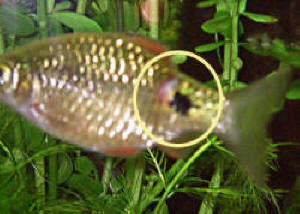

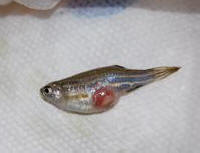
.jpg)