|
Related FAQs: Freshwater Puffers 1, FW Puffers 2, FW
Puffers 3, & FW Puffer
Identification, FW Puffer
Behavior, FW Puffer
Selection, FW Puffer
Compatibility, FW Puffer
Systems, FW Puffer Feeding,
FW Puffer Disease, FW Puffer Reproduction, BR Puffer
Identification, BR Puffer
Selection, BR Puffer
Compatibility, BR Puffer
Systems, BR Puffer
Feeding, BR Puffer
Disease, BR
Puffer Disease 2, BR Puffer
Reproduction, Puffers in
General, True Puffers,
Burrfishes/Porcupinefishes,
Tobies/Sharpnose Puffers,
Boxfishes
Related Articles: The Nice Puffer: Colomesus asellus , the
South American Puffer by Neale Monks, Alone But
Not Lonely: The Importance of Keeping Puffers
Individually by Damien Wagaman, Inside the mind of a puffer;
Understanding pufferfish behaviour for better pufferfish
husbandry by Neale Monks Puffers in
General, True Puffers, Burrfishes/Porcupinefishes, Tobies/Sharpnose Puffers, Boxfishes, Puffy & Mr. Nasty, Puffer Care and Information by John
(Magnus) Champlin, Things That My
Puffers Have Told Me by Justin Petrey, (Big) Pufferfish Dentistry By Kelly Jedlicki and Anthony Calfo
Small Puffer
Dentistry By Jeni Tyrell (aka Pufferpunk)
Freshwater to Brackish Puffers, Part of
the Family Tetraodontidae
|
|
|
By Bob Fenner
|
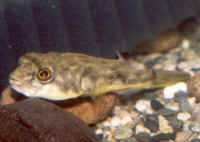
Juvenile
Tetraodon lineatus
|
Freshwater Puffers by Genus, Species:
|
Carinotetraodon salivator Lim & Kottelat 1995.
Found in Asia: Sarawak, Malaysia, in relatively fast-moving
streams, around and burrowing in the substrate.
|
No pic
|
|
This genus of pufferfish includes a
number of small, strictly freshwater pufferfish from South and
South East Asia. Apart from their size, the most characteristic
feature of this genus is pronounced sexual dimorphism: the makes
are usually much more brightly coloured and invariably posses
erectile ridges along the belly and back. In fact, the scientific
name of the genus, Carinotetraodon, comes from these
structures, karina meaning 'keel' in Greek. When
males are displaying to females, or threatening one another, they
raise these keels, presumably to make themselves look more
imposing. Both sexes can puff themselves up in the normal manner
when alarmed, just like other pufferfish.
Although Carinotetraodon spp. are
territorial and snappy towards one another, like most other
pufferfish, their small size makes it possible for multiple
specimens to be accommodated in a sufficiently large aquarium.
Under such circumstances, males and females will eventually pair
off, and following some fairly rough courtship behaviour they
will spawn, often in a thick mass of Java moss. The male will
then drive off the female and guard the eggs until they hatch,
which normally takes about three days. Once the fry are free
swimming, after another couple of days, they will accept tiny
lived foods, such as microworms, and after a week or two they can
be weaned onto newly hatched brine shrimp and small
Daphnia.
There are three species of
Carinotetraodon regularly traded, of which the most common
is probably Carinotetraodon travancoricus, an Indian
species often simply called the dwarf puffer. It is indeed a tiny
fish, barely 2 cm long when mature, and a densely planted
40-litre (10 gallon) aquarium will comfortably house a single
make and three females without much risk of aggression between
them. Unfortunately, males and females are very similar when
young; so sexing the fish in your retailer's tanks is
difficult. However, once mature, sexing them is quite easy: while
both fish have a dark band along the ventral surface, the
male's is much darker. Males may have stronger overall
colouration as well, particularly when spawning, but this is an
unreliable indicator because there is so much variation in the
colouration of these fish anyway. Besides variation between
specimens, individual fish can also change their colours
depending on their mood.
Carinotetraodon travancoricus are
confirmed fin-nippers, and keeping them with tankmates such as
small tetras or barbs is a bit of a gamble. On the other hand,
they generally get along well with dwarf suckermouth catfish
(Otocinclus spp.) and freshwater shrimps (Caridina
spp.). As far as feeding goes, these fish are very adaptable, and
will take all kinds of live and frozen foods, including small
snails, bloodworms, clean Tubifex worms, and
Daphnia. Brine shrimp are a good treat and willingly
taken, but their nutritional value is low so they shouldn't
be used as a staple. One nice thing about Carinotetraodon
travancoricus is that it is predominantly day-active, and is
in fact remarkably outgoing given its size. It is also very
tolerant of water chemistry, doing equally well in both slightly
soft and acidic conditions and moderately hard and alkaline ones.
As with all pufferfish though, it does not appreciate rapid
changes in pH and hardness, and is very intolerant of nitrite and
ammonium. Provided they are kept in a well-filtered, mature
aquarium, these are lovely fish, and excellent oddballs for the
aquarist with only limited space.
Less commonly encountered is the red-eye
puffer, Carinotetraodon lorteti. Found throughout much of
South East Asia it has been known to the hobby for decades, often
being traded under an old name, Carinotetraodon
somphongsi. Though well know, its availability has been
patchy, almost certainly because its high level of aggression and
persistent fin nipping make it impossible to keep in a community
tank. In terms of basic requirements, this species is
comparable to the dwarf puffer in most respects, though being a
larger fish it does need a bigger aquarium. A matched pair may be
housed in a 40-litre (10 gallon) aquarium. Males are easily
distinguished from females by their colours; males are basically
brown with mustard yellow stripes across the head and back. The
belly is cream-coloured belly except for a reddish stripe across
the keel running from just behind the mouth to the base of the
anal fin. The tail fin is greenish-blue and fringed with a thin
white band. Females are attractive but in a different way,
sporting a mottled pattern of light and dark brown above and
off-white below. Both sexes sport red irises, from which comes
their common name.
The least widely seen of the three
popular Carinotetraodon species is the red-tail puffer,
Carinotetraodon irrubesco. It is sometimes muddled up with
the red-eye puffer, and females of the two species are virtually
identical, the only obvious difference being that female
Carinotetraodon irrubesco bear thin brown stripes on the
belly that female Carinotetraodon lorteti lack. Male
Carinotetraodon irrubesco can be immediately recognised by
their red tails, but they also have red dorsal fins and the
lighter bands on the dorsal surface are tan coloured rather than
yellow. While it is a toss-up which of the two species is the
more attractive, Carinotetraodon irrubesco definitely has
the advantage as far as personality goes. It is relatively
peaceful and can be kept with a variety of other fish, provided
slow moving species with long fins are avoided. My own species
seem to get along well with cardinal tetras, gobies,
Otocinclus, and juvenile halfbeaks.
Two additional species of
Carinotetraodon are traded very occasionally, the Borneo red-eye
puffer, Carinotetraodon borneensis, and the banded red-eye
puffer, Carinotetraodon salivator. Male Borneo red-eyes
are similar to C. lorteti but the with greenish-yellow
banding instead of bright yellow and they also have a distinctive
blue tail. Female Borneo red-eye puffers are essentially
identical to female C. lorteti, though the colour banding
on the back may be a trifle more yellowy. Banded (or striped)
red-eye puffers are easy to recognise because of the vertical
banding on the head and body. These bands vary in intensity,
being most obvious on spawning males, but even on quiescent males
should be apparent. Female striped red-eye puffers look a lot
like female Carinotetraodon irrubesco. Unfortunately,
males of these two species are extremely aggressive, both
towards females and other fishes in the aquarium. Aquarists
intent on spawning these fish, should they be lucky enough to
obtain them, will almost certainly need to condition the female
apart from the male, and only introduce the male when she is
carrying eggs. Even then, there are no guarantees that they will
spawn, and separating the fish if things turn nasty will be
essential.
|
|
Chonerhinos amabilis Roberts 1982.
Indonesia. To three inches in length. Feeds on aquatic insect
larvae.
|
No pic
|
|
Chonerhinos modestus (Bleeker 1851). Asia:
Thailand, Malaysia and Indonesia. To four inches in length. Eats
insect larvae, fish scales...
|
No pic
|
|
Chonerhinos nefastus Roberts 1982.Asia:
Indonesia and Indochina. To three inches in length.
|
No pic
|
|
Chonerhinos remotus Roberts 1982. Asia:
Indonesia. To two and a half inches in length.
|
No pic
|
|
Chonerhinos asellus Roberts 1982. Asia:
Indonesia. To three inches in length.
|
No pic
|
Tetraodon (22spp.) Some brackish... to
marine as adults, others totally freshwater, a few travel between
both
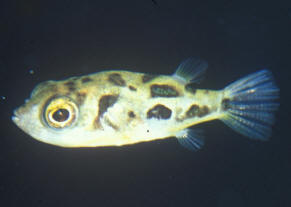
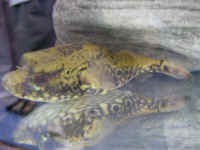
| Tetraodon duboisi Poll
1959. To 8.7 cm. Known only from the Stanley Pool area of the
Congo. Aquarium photo. |
|
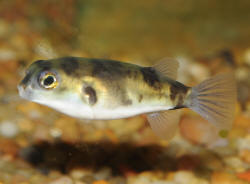
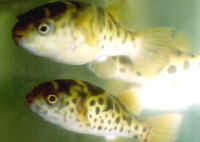
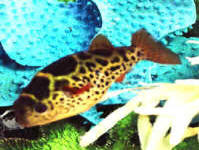
| Tetraodon fluviatilis
Hamilton 1822, the Ceylon Puffer to aquarists, Green Puffer to
science. Asia: India, Sri Lanka, Bangladesh, Myanmar and Borneo. To
six inches in length. A common Puffer in the aquarium trade, but an
aggressive fish fin and scale nipper as adults. A freshwater to
brackish species (higher spg as adults). Feed on crustaceans,
worms, mollusks, algae and detritus in the wild. Second photo
on right by Jeni Tyrell/PufferPunk
http://www.fishbase.org/Summary/Species
Summary.cfm?ID=11270&genusname=Tetraodon&species
name=fluviatilis |
|
|
Tetraodon leiurus Bleeker
1851, Asian Freshwater Puffer. Asia: Sundaland, Indochina.
Freshwater, brackish; pH range: 7.0; dH range: 12.0. Sometimes
imported and sold as an aquarium fish. A terror in the way of
being a fin nipper.
|
No pic
|
|
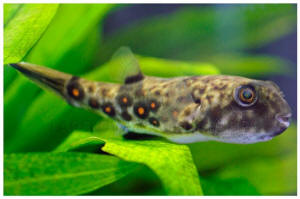
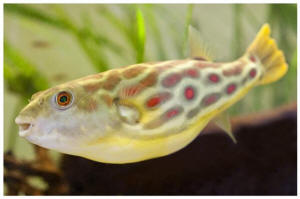
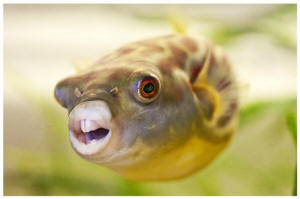
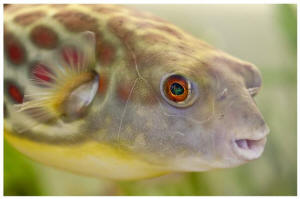
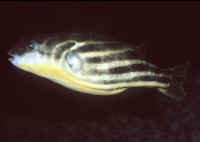
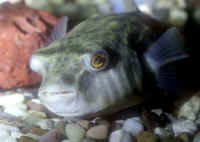
Tetraodon lineatus
Linnaeus 1758, the Fahaka, Lined Freshwater Puffer. Africa:
Nile, Chad basin, Niger, Volta, Gambia, Geba and
Sénégal Rivers. Freshwater, brackish; pH
range: 7.0; dH range: 10.0. Infrequently imported. To seventeen
inches in length.
|
|
|
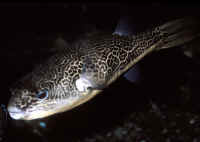
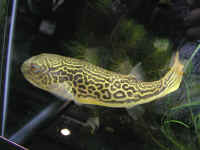
Tetraodon mbu Boulenger
1899, Mbu Freshwater Puffer. Africa: widely distributed in Lake
Tanganyika and the Congo basin. Freshwater, brackish. To some
twenty six inches in length in the wild. The most commonly
imported freshwater puffer from Africa. This one in the London
Aquarium
|
|
|
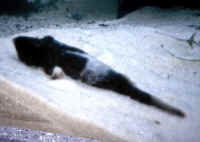
Tetraodon miurus
Boulenger 1902, the Congo or Miurus Freshwater Puffer. Central
Africa: Congo basin. To seven inches. Lays in the sand, waiting
to snatch something for food.
|
|
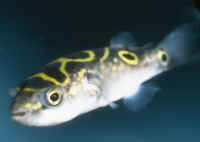
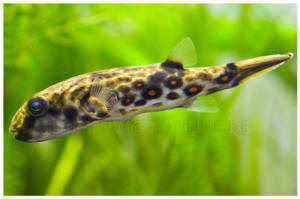
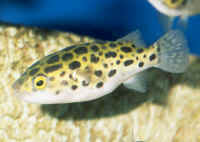
| Tetraodon nigroviridis
Marion le Proce 1822, the Leopard or Green Spotted Puffer (aka
GSP). Freshwater only as young, small juveniles, to Brackish; pH
range: 8.0 - 8.0; dH range: 9.0 - 19.0. Tropical: 24-28 C. Asia:
Sundaland, Indochina, Myanmar, Sri Lanka, Philippines, Malaysia and
Indonesia. Probably found in India. Often seen in the trade, but
very aggressive. Should be kept solitarily. Feeds on mollusks,
worms, algae and other fish's scales!
http://www.fishbase.org/Summary/Species
Summary.cfm?ID=7763&genusname=Tetraodon
&speciesname=nigroviridis |
|
|
Over a dozen species of Tetraodon
have been imported as aquarium fish, though as mentioned earlier,
only a few have become staples of the hobby. Besides the species
mentioned about, Tetraodon lineatus, the fahaka puffer,
and Tetraodon miurus, the Congo puffer, are both
regularly, if infrequently, traded. One newcomer to the hobby
actually has quite a familiar name, Tetraodon
palembangensis. For many years, figure-eight pufferfish were
sold under this name, and many aquarium books continue to
describe them as such. In fact, Tetraodon palembangensis
is a quite separate fish, and a freshwater rather than brackish
water species to boot. Known under a variety of names include
'humpback puffer' and 'dragon puffer', this is a
fairly large, piscivorous species distinguished by its very
unusual shape. Where most puffers have a flat or slightly arched
back, this species has an almost triangular back, giving the fish
the appearance of having a deformed spine. It is also somewhat
flattened from top to bottom and has a distinctly upturned mouth.
The result is a terribly ugly, or wonderfully endearing fish,
depending on your tastes.
Tetraodon palembangensis is a
predatory, territorial species that is best kept on its own.
Given its 20 cm adult size, a single specimen probably needs a
180-litre (40 gallon) aquarium, and should either be kept alone
or possible with some type of armoured catfish. Aggression
towards conspecifics is limited to threats and the odd bite, but
provided the aquarium is sufficiently roomy and the fish have
plenty of hiding places -- thickets of robust plants are ideal --
the fish will settle down and tolerate one another. Feeding
presents few problems, as they can be weaned onto a variety of
dead foods, including bloodworms, prawns, and mussels. Live river
shrimp, snails, and earthworms can also be used as
well.
Tetraodon suvattii, the Mekong
puffer, is very similar in habits to Tetraodon
palembangensis, though it is a bit smaller and doesn't
have such a humped back. It is a piscivore, and while not
especially aggressive, it cannot really be combined with anything
except others of its own kind. Even with conspecifics,
territorial aggression can flare up, especially when the fish
become mature and think about spawning. This species has,
incidentally, been bred in home aquaria a number of times. As
with other puffers, the male guards the eggs, and the fry, once
free swimming, are fairly large and can take newly hatched brine
shrimps at once. Both the humpback puffer and the Mekong puffer
are rather inactive fish that spend most of their time hidden in
caves or among the leaves of large plants.
Our final newbie pufferfish is
Fang's puffer, Tetraodon cochinchinensis. A waspish
fish, it is a confirmed nipper and cannot be kept in a community
tank despite its small size. Some aquarists have kept these fish
in groups, but they are very territorial, and will attack any
conspecifics that swim by their lair. Under such conditions this
species can be spawned, and some of the specimens sold now are
said to be tank bred, but even so, it is most easily kept on its
own in a 90-litre (20 gallon) tank. When not feeding or fighting,
these fish are barely more active than humpback or Mekong
puffers, and mostly just hide inside their chosen cave.
These new pufferfish are not for
everyone, but if you can work around their specific needs, these
could be very interesting and rewarding fish. The dwarf puffers
in particular, and perhaps Fang's puffer as well, are small
enough that their antisocial behaviour can be easily accommodated
by simply setting up another aquarium just for them. That so many
of these smaller species are breedable makes them even more
tempting. All pufferfish are demanding though, needing tip-top
filtration and frequent water changes, but if you can provide the
care they need, these are fish you are sure to enjoy.
|
Disease:
| Unfortunately the majority of
"freshwater" puffers sold (which are actually brackish to
marine) are quite susceptible to infectious and parasitic disease.
Without good water quality (consistent, partial marine conditions)
the non-freshwater tetraodonts frequently succumb to ich (white
spot disease, ichthyophthirius), or become plagued with unsightly
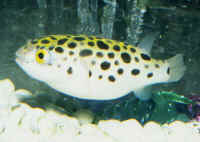
lymphocystis. They respond well to common therapies for all. Shown:
an otherwise healthy Tetraodon nigroviridis with
ich. |
|
Bibliography/Further
Reading:
Aquarium Link Suggestion 5/14/12
Hi Bob,
<AJ>
I was hoping that you would consider linking to my website under your
puffer category. The URL is
http://www.freshwaterpufferfish.org
Thank you for your time,
<Will do... a very nice site, offer of paid help... Odd that you don't
list your name. Bob Fenner>
AJ
http://www.geocities.com/rubentolon/index.html
Burgess, Warren E. 1983. The Amazon
puffer, Colomesus asellus (Not C. psittacus). TFH
12/83.
Feigs, G. 1957. Tetraodon
schoutedeni (Fresh-water puffers spawn). TFH 9-10/57.
Frank, Stanislav & Jaroslav Elias.
1974. Chonerhinus naritus. TFH 4/74.
Glass, Spencer. 1997. Freshwater
Puffers. TFH 9/97.
Jackson, Lee. 94. Puffers of the genus
Chonerhinos. FAMA 7/94.
Jensen, Christopher. 1993. Pufferfish.
FAMA 10/93.
Ladiges. Undated. Puffer Fish. ADI
#27.
Nelson, Joseph S. 1994. Fishes of the
World. John Wiley & Sons, NY. 600pp.
Noshnow, Anatoli. 1987. Puffer
production: Spawning Tetraodon cutcutia. TFH 10/87.
Ralf, Ricke. Undated. The striped
pufferfish (Tetraodon palembangensis). ADI #31
Thomas, Scott B. 1985. Those practical
fresh-water puffers. FAMA 5/85.
|
|


.jpg)