|
FAQs about Freshwater Puffer
Identification
Related Articles: The Nice Puffer: Colomesus asellus
, the South American Puffer by Neale Monks, Freshwater Puffers, Freshwater to
Brackish Puffers, Puffers in
General, True
Puffers, Family Tetraodontidae,
(Big) Pufferfish
Dentistry
By Kelly Jedlicki and Anthony Calfo Small Puffer
Dentistry By Jeni Tyrell (aka Pufferpunk), Puffer Care and Information by
John (Magnus) Champlin, Things That My
Puffers Have Told Me by Justin Petrey,
Related FAQs: FW
Puffers 1, FW Puffers
2, FW Puffers 3, FW Puffer Identification, FW Puffer Behavior, FW Puffer Selection, FW Puffer Compatibility, FW Puffer Systems, FW Puffer Feeding, FW Puffer Disease, FW Puffer Reproduction, BR Puffer
Identification, BR Puffer
Selection, BR Puffer
Compatibility, BR Puffer
Systems, BR Puffer
Feeding, BR Puffer
Disease, BR Puffer Disease
2, BR Puffer
Reproduction, Puffers in
General, True
Puffers,
|
Many, MANY "Freshwater" puffers sold to
aquarists are slightly to moderate brackish... to full
strength marine species... Know the species you're
dealing with AHEAD of buying.
To ID the puffer you
have & the one you are interested in, look
here: http://www.pufferlist.com/
|
|
Puffer identification 8/23/18
Hi Neale
<Hello again,>
How are you
<All good!>
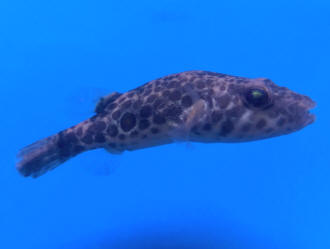
I am looking to buy a puffer that has just come in stock, though struggling to
identify it. Is it a dubiosi? Looks like the ones I have seen in pictures but I
know it’s very rare, no idea what else it could be based on the pattern! Please
can you make an educated guess as to what it may be?
<Does indeed look like Tetraodon duboisi to me. Certainly so if it's an African
import. There are some similar Southeast Asian species though, notably Tetraodon
turgidus. Telling them apart is hard. However, Tetraodon duboisi is a 'lurker'
that burrows into the sand given the choice. It has a slightly upwards pointing
mouth (when viewed from the side) at the end of a rather triangular snout (when
viewed from above). These modifications help it launch itself up from the
riverbed towards any unsuspecting fish or insect that it can then eat. Tetraodon
turgidus is more globular in shape, with a shorter snout with the mouth pointing
forwards. It's less of a burrower and more an active explorer like other
puffers, nibbling at whatever if finds. Many Tetraodon turgidus have a one
particular round spot between the dorsal and anal fin that has a red centre,
something never seen (to the best of my knowledge) on Tetraodon duboisi. Hope
this helps, Neale.>
|
 |
|
Takifugu poecilonotus... ID, care...
2/17/12
I had some puffer problems and on the pufferfish.net forums
it was suggested to me to see if i could contact Neale
Monks or Bob Fenner at WWM for the care facts of the
Takifugu Poecilonotus.
<Fire away.>
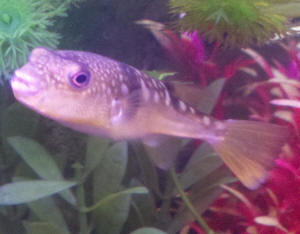
(The pic attached is one of my puffers around 2.5 inches a
week before he died)
<Wow, this species is the spitting image of Chelonodon
patoca. Amazing that they should evolve almost identical
colouration.>
Long story short, I went to a fish store around 5 months
ago to get 3 dwarf puffers, tiny thumbtack size at the
time. I had a nice ten galleon tank set up for them with
lots of vegetation (real and fake) to hide in. 1 Puffer
died within the week, but four months later i had two
really active, healthy puffers that were around three
inches in length and most definitely NOT dwarf puffers.
<I see.>
I absolutely loved those puffers. I fed them brine shrimp
daily, once a week they had snails and every other week,
glass shrimp. Towards the end of the fourth month they
started to show signs of distress and become agitated. I
became worried that they weren't getting everything
they needed and started to brows through lists of aquarium
puffers to see if i could find the species.
<Ah, now, how sure are you that these are Takifugu
poecilonotus? I've never seen that species in the
trade, though I admit they both have very similar colours.
By contrast, Chelonodon patoca is an occasional import.
There aren't any obvious differences, though Chelonodon
tends to have a more angular head and boxy body, whereas
Takifugu are more streamlined and have a more tapering
body. All this said, oddball Takifugu species do turn up
very occasionally.>
Last week their energy levels dropped dramatically and they
just laid around on the bottom of the tank and hardly even
ate. I continued to look for what species they were and
even posted my puffer's picture online on a forum and
no one knew what species they were.
<I see.>
The 13th of Feb I started just going through the list of
puffer species that Wikipedia had and Google searching each
name of every individual puffer on that list. Feb 14th,
when i woke up and checked on my puffers.. they were dead.
Yesterday I finally found what my puffers were, Takifugu
poecilonotus, and that they were brackish-marine fish, only
freshwater as fry.
<In common with many other Takifugu spp.>
I would love to have a second chance with this species, but
i can't seem to find any info on them. Are they
freshwater as juveniles then brackish water? High end
Brackish or Marine? If anyone on this site has info on this
particular puffer it would be much appreciated. I feel
horrible about the death of the two I had.
<Hmm… do download, read "Takifugu obscurus is a
euryhaline fugu species very close to Takifugu rubripes and
suitable for studying osmoregulation", a good
laboratory-based primer on Takifugu species including
Takifugu poecilonotus. The gist of their study is that
apart from T. obscurus, none of the other Takifugu species
adapts to freshwater successfully. They further note that
Takifugu poecilonotus adults are seen in the sea, spawning
occurs in the sea, and it's the "fingerlings"
found in river estuaries. Bottom line, treat these as
temperate (~18 degrees C; i.e., a cool room temperature)
high-end brackish to marine (SG 1.010+) fish. A chiller may
be needed in summer to prevent overheating, but certainly
ensure a spacious tank with lots of water current and
oxygenation.>
Thanks,
Jessie
<Hope this helps. Cheers, Neale.>
|
 |
|
Re: Takifugu poecilonotus
2/17/12
Thank You :)
<Most welcome. Neale.>
|
|
Re: Could this be a Tetraodon
pustulatus 3/18/09
Hi Rob,
<Lars>
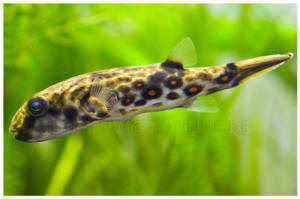
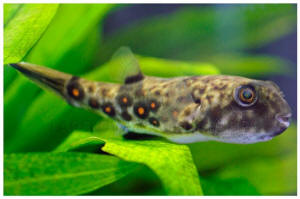
today our arrived, what a beautiful and neat fish ...
Attached please find 2 pictures, feel free to post them on
your site.
Best,
Lars
<Ahh! Will do so; with credit to you. Danke,
BobF>
Hi Bob,
I´ve made a third picture that shows him/her from the
side ...
Viele freundliche Gruesse ... :)
Lars
<Thank you for this Lars. BobF>
|
|
|
|
|
Tetraodon nigroviridis
(identification)
10/25/08
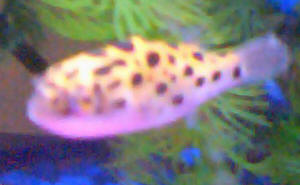
Ok, here's my puffer he's
small freshwater, what kind is it? since No one knows.
Also I looked closely there's absolutely NO green on
him. just yellowish gold black and white.
<This is the brackish water species Tetraodon
nigroviridis. It is not a community tank species and is
known in the wild as well as in aquaria to bite at the
fins of other fish. Other than that issue, when kept on
its own (or with its own kind) in a large (40+ gallons)
brackish water aquarium it is hardy and easily
maintained. Maximum size is about 15 cm/6". Make
sure the water is hard and alkaline, and ensure the
specific gravity is upwards or SG 1.005 by adding marine
salt mix (not "aquarium salt" or "tonic
salt") at a dose of 9 grammes per litre. Will not
stay healthy in a freshwater aquarium for long. Sadly too
many aquarists buy this fish without doing their
research, and the result is a lot of sick, stunted
pufferfish. Don't be one of them! Much written about
this species here in the Brackish Water section of WMM;
read. Cheers, Neale.>
|
 |
| Re: Tetraodon nigroviridis
(identification) -10/25/08 Thanks! <Most
welcome!> Now I must get another tank for him! He would
Of died if you didn't inform me of the right species.
<Do read Jeni's article on the very similar species
Tetraodon fluviatilis.
http://www.wetwebmedia.com/brackishsubwebindex/gspsart.htm
Temperament, care, etc. are identical.> Infact I'm
going to name it after you! <Ooh!> but one thing how
do you pronounce your name? <Like "Neil", just
spelled the Irish way... a family tradition going back
beyond my great grandparents. But there are much better
names for Puffers out there, so take your time to find
something that reflects his personality.> And THANK YOU
SO MUCH! other websites kept calling me a newbie and said
find out for your self. My gratitude is off the charts, I
LOVE my puffer and I'd cry if he died. <Looked after
well, these fish live a long time and become VERY tame.
There's no need to do anything drastic just yet.
He'll be fine in a freshwater tank for some months, so
feel free to shop around, buy a good aquarium at a good
price, set it up, cycle it, and then put the puffer in.
Over the course of a few months, gradually raise the
salinity, first to SG 1.001, then next month to 1.002, to
1.003 the next month, and so on up to SG 1.005. Go slow,
watch his behaviour, take care of the little guy.>
Thanks soo much! <More than happy to help,
Neale.> |
African
Yellowtail Puffer... ID, fdg... FW? 10/26/07 Hi
Guys, I bought a 2 inch African Yellowtail Puffer about a month
ago. I have been feeding small live fish which he would eat
voraciously. One day, almost overnight, it seems like he could no
longer eat properly. For the last week he has been hanging out on
the bottom and occasionally swimming around looking like he is
very weak. I noticed that it looked like he had problems trying
to eat anything. What could be the problem?? Thanks Peter
<Hello Peter. I have absolutely no idea what an "African
Yellowtail Puffer" is. Perhaps Tetraodon mbu, since
that's from Africa and has a yellow tail. I just hope not
though, because it is a very difficult (read: almost impossible)
animal for the home hobbyist to look after. For one thing, it is
extremely sensitive to poor water quality. Zero ammonia and zero
nitrite go without saying, but nitrate needs to be as close to
zero as possible, and certainly not above 20 mg/l. Next, it's
huge. I mean gigantic. In the wild, these fish get to over 60 cm
(about 24") in length (excluding the tail fin). Some captive
specimens have grown even larger. In terms of aquarium
conditions, this demands a tank of the largest possible size,
probably something upwards of 1000 litres (over 260 US gallons).
Admittedly, yours will take a few years to get to full size, but
still, you do need to have a plan. I'd actually argue they
aren't aquarium hobby fish at all. Anyway, when a puffer
stops feeding, you know something is very, VERY wrong. Normally
they are swimming dustbins that will eat until they can't
move. Your first problem is feeding the wrong food. Never, EVER
give feeder fish to a puffer. Not only is it not required, but it
is actually hazardous. Goldfish and minnows, for example, contain
thiaminase (which breaks down Vitamin B1) and large amounts of
fat (that cause problems with the internal organs). The correct
diet for all puffers, repeat ALL PUFFERS, in captivity is a
variety of the following: mussels, pond snails, krill, unshelled
prawns, bloodworms, earthworms, river shrimps, and clams. Many
also enjoy (and probably need) some amount of green food too.
Tinned peas seem to go down well with many pufferfish. Puffers
also need to be fed in small amounts. The goal is to feed once a
day, or every other day for big (~10 cm/4") specimens. Each
time, the fish should eat no more than enough to slightly fill
out the belly to a gently convex shape. Puffers will eat until
they swell up like bowling balls; that is not good for them! Also
check water quality. With Tetraodon mbu especially, any amount of
ammonia, nitrite or nitrate will sicken the fish. So instead of
trying to ram more food down their throats, when these fish go
off their dinner, do a 50% water change. And then another! Give
it a couple of days, and then try something small and tasty, like
a river shrimp or half a mussel. Above all else, worry more about
water quality than food. When the water conditions are right,
your fish will start feeding again. Hope this helps,
Neale>
Puffer
fish ... ID, disease/env./sys. 11/16/06 Hi
<<Hello>> I just bought 2 spotted puffers a couple
days ago. Did they look like this?: http://www.pufferresources.net/puffer_profiles/viewtopic.php?t=19>>
They were completely normal until yesterday when I noticed that
one looked like he had ick. First of all what can I do about the
ick. I am putting some medication in the water. <<Please
dont before you know what kind of puffer you have, what ails it,
and have them in a cycled, aquarium. If these are
indeed GSPs, (Tetraodon nigroviridis) then they need 30 gallons
of water each minimum, and require full marine conditions as
adults.>> Second, the same puffer sits in this one corner
all the time while the other puffer is swimming around the tank.
Is this normal? <<No. Please get back to me, and visit
www.pufferresources.net.>> Thanks <<Glad to help.
Lisa.>>
Keeping a
Puffer in an Uncycled 1G Bowl 8/16/06 Researching
Puffers <Hi Steve, Pufferpunk here> I have a puffer
that has been pretty cool. I did have to separate him from the
rest of the fish due to his nipping. <No surprise
there. Did you do any research on this fish before
buying it?> I put him into a small tank (1 Gal) and he was
fine until lately he started to discolor. I am not sure if the
tank had not cycled yet or maybe he has become sick. <Nothing
belongs living in a 1g bowl. You cannot cycle a tank
with a puffer! It will be poisoned by it's own
waste. In addition, even a small juvenile puffer
(1") needs at LEAST a 10g tank & a 30g tank when a
6" adult.> He has now begun to look fuzzy and his color
continues to darken. What will happen to him from being in a 1
gallon tank? <He will probably be dead within 24 hours.>
Can he be brought back to health?? <You could buy him a larger
tank TODAY (10g minimum but expect to upgrade to a 30g when he
gets over 2"). You will need to add Bio-Spira to
cycle the tank. If you can't get a hold of that
product, you could add into the new filter some of the filter
media from your established tank to help the tank along w/a
cycle. Do 50% water changes on the tank DAILY (use a
water conditioner, like Prime), while testing for ammonia,
nitrites & nitrates, to see how the cycle is doing (ammonia
& nitrites need to be at 0 at all times [highly toxic!],
nitrates <20). Here is an article on them: http://www.wetwebmedia.com/BrackishSubWebIndex/gspsart.htm> You
can also go to www.thepufferforum.com & post there about your
puffer. I really hope you can save
him! ~PP> Thank You, Steve West Re: Green
Puffer. Researching Puffers at Wal-Mart??? 8/16/06
This Puffer is a Dwarf Puffer but no, I had no prior knowledge on
how to care for a puffer nor did I have time to research
him. <What do you mean "no
time"? If you see a fish at a store you know
nothing about, you go home, get on the computer & find out
about it. Then you may or may not go back to buy
it. It's hard for me to believe that they are
selling dwarf puffers at Wal-Mart. They are known to
be selling tons of GSPs lately though. I've gotten
literally hundreds of letters just like yours...> I have had
several years experience with the standard types of fish with
good success. This is a very new type of fish to me
and he is really cool. I was only informed by the
attendant at Wal-Mart that he may be ok to put with
others. <And you believed him?> I really want
to keep him and care for him so I will take you advice and try to
help him. <Check out the Gallery at the forum I
linked you to, for proper
ID. ~PP>
Proper Puffer ID 7/25/06 <Hi,
Pufferpunk here> I have a Tetraodon schoutedenti (think that
is how it's spelled) <Spelled: schoutedeni> and he has
had a dark grey belly for several days now. He doesn't
see as interested in his food as he used to be, doesn't seem
active like he used to be. He has a variety of food to
choose from, live ghost shrimp, freeze dried brine shrimp, freeze
dried krill and snails. The PH is 7.5, and I add a bit of
salt every week. Mostly he seems to nestle into the plants
and stays grey. Any ideas on what is going on with him?
<Yes, I can tell you exactly what's wrong with him,
he's not a T schoutedeni, he's a T
nigroviridis. There has not been a schoutedeni sold in
the aquarium trade in over 20 years! You have a
brackish water fish & are keeping it in
freshwater. See: http://www.wetwebmedia.com/BrackishSubWebIndex/gspsart.htm
Also, check out: www.thepufferforum.com. Be sure to
test the water parameters for ammonia, nitrites, nitrates &
pH. ~PP>
Misidentified T.
schoutedeni 7/9/06 Sab., put in FW/Brackish tetraodont
ID f' <<Done. -SCF>> <Hi ,
Pufferpunk here> We bought the above puffer fish and have been
doing web searches for it all day to figure out which kind, if
any, fish we can put with him. On Google they also
called him a leopard Congo or Congo leopard fish, if that's
the kind we do have is that freshwater? we stupidly bought it at
Wal-Mart and they couldn't give us any information other than
the fact that they thought it was freshwater. They
couldn't even tell us what kind it was or what it ate and
told us to buy tropical fish flakes for it but later went to a
different store and bought frozen krill which it seems to love
and ghost shrimp. Any help would be greatly
appreciated! <The fish you bought from Wal-Mart is a green
spotted puffer (T nigroviridis) See: http://www.wetwebmedia.com/BrackishSubWebIndex/gspsart.htm There
hasn't been a schoutedeni seen for sale in the aquarium trade
for over 20 years. Also see
www.thepufferforum.com. Many good articles on care
& feeding of puffers. (Please use proper
capitalization in your letters. I have to fix, before
we can post it in the FAQs.) ~PP>
Bronze Puffer, Lack of Info - 3/1/2006 I have a bronze
puffer in a 55 gallon tank. When I first got him I noticed a
small pink spot on the tail. I asked the guy at the pet store
what it was and he said it was like a scab, and it would go away.
Well it never went away; it just spread all over its tail. Its
tail is now really swollen and puffy, and kind of a pink, white
color and it looks like its fraying at the ends. It seems to be
spreading up to his body. I'm wondering what medications I
should use. He still swims a lot and eats but his whole tail is
just a mess. Please help. I want to save the little guy. Thanks,
Jess <<Hi Jess. Do you know the species name of
your puffer? Is it fresh/brackish/saltwater? Without knowing what
kind of puffer it is, I can not tell you how to fix the
problem. Please email me back, and include this
correspondence in your email. Thanks,
Lisa.>>
Do I Have a Miurus or Suvattii
Puffer? 2/2/06 <Hi, Pufferpunk here> I
recently bought a 3-inch puffer from my LFS, who sold it to me as
a "Miurus puffer." Of course I did a small amount of
research before buying it and figured it would make a perfect
addition to my heavily planted 55 gallon. pH 6.8, KH 5, temp 78
degrees F, NH4 0, NO2 0, NO3 10-20, PO4 .5-1 ppm. I use fluorite
as my primary substrate, mixed with 20 lbs of sand and another 20
lbs of pea gravel. <Sounds like you could use at least another
20lbs of sand in there for comfortable burrowing. It
may try to dig up many of your plants in the process> The tank
offers little room for the puffer to bury itself but it has found
its way to the floor, beneath the Ammonia gracilis, where there
is more space between the stems. <It would be happier if it
could burrow up to it's eyeballs, for a better ambush on
it's food.> The tank has about two dozen various tetras,
another 40 shrimp, two dwarf frogs and many Ramshorn and
Malaysian Trumpet snails. <All future puffer food!> I'm
hoping the fish can fend for themselves, especially the Siamese
Algae Eaters, which I absolutely require for obvious reasons;
also, that the shrimp, snails and white clouds will breed fast
enough to sustain their numbers ... they're all reproducing
already. <Not a chance in Hades. All will be in
your puffer's tummy in now time!> My question: Can a
Miurus "Congo" puffer have an arrowhead? Isn't that
a trait of Tetraodon suvattii or the "arrowhead
puffer"? I think I have an arrowhead puffer, not a Congo
puffer. <You are correct. The Suvattii will also
have a longer snout. See: www.pufferlist.com, for
pics.> Seems their behavior/requirements are similar. Good
thing. No need for a picture. It definitely has a bold, black
arrow on its head. <If you value your other fish, I'd get
that puffer into it's own tank ASAP!> Whomever I get this
time, Wet Web's the best! I use your site, as well as
Bob's and Anthony's books as absolute references for my
reef and it's good to see your freshwater sections are
growing substantially. If you need a plant/discus guy ... I know
someone who really likes what Wet Web's all about!
<Thanks! If you're interested, send us an email with your
bio & we'll see if we can get you
started. ~PP> Thanks, Adam Fresh or Brackish
Puffers? 2/09/04 Thanks for all the great info!
<No problem!> I've visited aquariumfish.net before but
I hadn't heard anything good or bad about them. Their site
seems extremely informative. Unfortunately, their
"potential" customer service is lacking. I will explain
my experience with them a little later. <OK, now you've
got me curious!> I visited the other sites you recommended.
http://www.aaquaria.com/aquasource/intropuffer.shtml
seems promising but I can't get the links to the other pages
to work. I tried accessing it through both Explorer and Netscape
without luck. I have no idea why. I'll try again on another
day. <Hmmm, that's strange, I can still link from your
letter here. I have Explorer. Did you try to copy
& paste in your address bar?> I think
http://www.pufferfish.co.uk/aquaria/species/pufferfish/index.htm
is an excellent site! Love it! <I agree> You asked if I
know what kind of Puffers I would like. I would prefer a
freshwater type that will grow more than 0.5" and less than
6". The only ones I can find to purchase via Internet are at
www.aquariumfish.net. They are the true red-eye, common red-eye,
figure eight, and dwarf puffer. Do any of these fish have a
"fin up" on the others? (Sorry, I just had to).
<cute!> I thought the Avocado or Congo would be nice to
have but I can't find any for sale. <I saw both the
"avocado" (could be the Ceylon--T fluviatilis or the
bronze/golden puffer--C modestus. Both are known by that common
name) for sale at www.aquabid.com. F8 puffers are nice
beginner puffers, although they are light BW
species. Not very difficult though. See:
http://www.aaquaria.com/aquasource/8puffer.shtml These
fish are not as aggressive as other puffers, so you can actually
house them with other fish, like gobies.> Jumping back to the
"potential" customer service issue with
www.aquariumfish.net... Basically, as I mentioned before, I have
had a big problem with nitrates for several years and have tried
everything I can think of to fix it. Their website has an email
address that is set aside for "questions &
feedback". So, I emailed them about the nitrate problem. I
also told them I was thinking of purchasing from puffers from
them. I got no response at all. A week or so later I tried
emailing them again. This time they answered but their response
was for me to listen to their recorded radio shows by utilizing a
Window's based computer "...at a neighbor's house,
school, or library. Those of us that answer emails are not so
qualified to answer difficult questions like yours..." Not
quite the expertise I was expecting. Hopefully, the actual
purchasing of the fish will go a little smoother. <I guess it
comes down to the fact that they just are interested in your
$$$.> My nitrates started rising again -- sigh --
so I added some live plants and replace my Whisper Power Filter
with an Emperor 400 Bio-Wheel Power Filter. (I am using the old
filter media). <good> The Emperor is for aquariums up to 80
gallons so there is a bit of overkill, but I figured it
couldn't hurt. There isn't anything else left for me to
do but wait and see if it helps. <You can never over filter a
puffer tank. On my 125g I have 2 Aquaclear 500s &
an Eheim 2217. The AQ 500 cycles 500g/hr & is
recommended for a 150g tank. In addition, I do 50%
weekly water changes & cleaning the gravel at the same
time.> I also picked up some "nuisance" pond snails
from our local PetSmart. The www.pufferfish.co.uk site had
directions on raising them as food for the puffers so I am going
to give it a try. <You're on the right track!> Again,
thanks for you advice and I will let you know how things turn
out. Karen Smith <Sounds like you are going to have some
happy, healthy pets for a long time! ~PP> True
Freshwater Puffer Anthony, hope I'm not being too much of
a pain... <not at all...information exchange, a wonderful
thing> but the puffers are Tetraodon travancoricus (which is
neither figure eight or spotted green). <ah, yes... and indeed
freshwater. My apologies... 99 out of one hundred people with a
question about "freshwater" puffer have a brackish
species that the LFS did not know/inform them about> They are
Dwarf Freshwater Puffers, <from freshwater in India>
although difficult to find on the web, <have you had the
pleasure of browsing Puffernet? (http://puffernet.tripod.com)...
a haven for you <smile>> they DO exist and from what
I've seen they thrive and belong in freshwater.
<agreed> They only reach the size of about one inch. SO
since the frogs will still be larger than them, and the fish is
known to be a fairly docile puffer (for a puffer),
<actually...everything I have read on the species details them
as serious fin nippers with the males being especially
territorial as they mature. Males have a pronounced ventral line
(dark line on body flanks...where females have none... easy to
sex)> do you think the frogs will still get eaten? They seem
to co-exist fairly well at this time. <at least harassed
eventually...more so if you have male(s)> I also notice that
the puffers (although they are fed blood worm) eat quite a bit of
the live plant in the tank also. <excellent food matter to be
encouraged. Thank you for clarifying, and again...my apologies
for assuming. Kindly Anthony>
| Mystery puffer <Hi! Ananda here
today...> Hi crew, I believe I sent you these pictures
last week, but something may have been screwed up because I
did not get an answer. <Must have...I've
not seen these pix before, nor a request from you about this
particular puffer.> Anyway, I was wondering if you knew
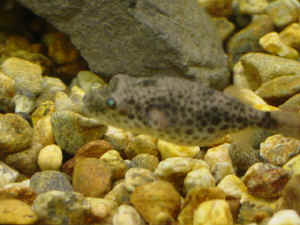
what this guy was? <Hmmm. It's the second
picture that does the trick. I see a dark spot on his head,
and it appears to be sort of arrow-shaped. If it is, you have
an "arrowhead" puffer, Tetraodon suvatii. Check
here:
http://www.fishbase.org/Summary/SpeciesSummary.cfm?ID=50301&genusname=Tetraodon&speciesname=suvattii
and we also have a really cool discussion about a breeding
pair here:
http://wetwebfotos.com/talk/thread.jsp?forum=91&thread=8676
> If it makes a difference, he can change color from
almost white with brown spots to brown with white spots, and
his eyes can go from clear to a very cloudy
blue. The pet store said he was a brackish black
spot river puffer, but I can find no such reference online or
in any books of a black spot river puffer. Thanks,
Dave <I'm not finding anything on "black spot
river puffer", either. But I think you have an arrowhead
puffer. Let me know if that dark spot isn't
arrowhead-shaped, and we'll look around more.
--Ananda> |
|
|
| Re: Bob... pics of wacky fishes
(Tetraodon suvattii) attached again here, bud... and as a
side note: among the many glitches with our WWM crew mail
program... if you close and reopen messages with multiple
pics attached (when not all come through)... you can get the
pics to "appear" in various combinations. No
joke... I checked these very message last night to see if it
made it... opened once and saw only the piranha, opened a
second time and saw only the puffer... opened two more times
and got both. Heehee... too funny. <Bizarre... I do HATE
computers at times... Let's see, first you put the key
in, then ten jumping jacks, but not too exuberant...
Bob> |
|
|
Puffers Hi Guys! Hope you are all keeping well. You
have helped me with various queries in the past. I have just seen
the cutest little pygmy puffer fishes in my LFS. I would dearly
love to give a few of them a home but know nothing about them.
You may recall that we currently have a small tropical tank and a
large reef tank, so we are not new to fish, just to puffers.
Unfortunately, I cannot find any information about pygmy puffers
in any of our books although I am guessing that the care for them
is similar to that of their larger cousins. I want to make sure I
can make them happy before bringing them home. I do understand it
will require a species only set up. Any advice you can give
regarding these mega cute little fishes would be much
appreciated. Many thanks! Lesley <Not sure if you are talking
about freshwater, saltwater, or brackish, but these links will
give you a start
http://www.wetwebmedia.com/FWSubWebIndex/fwpuffers.htm
http://www.wetwebmedia.com/puffers.htm
http://www.wetwebmedia.com/tobies.htm and then follow onto the
linked FAQ files. -Steven Pro>
Pygmy Puffers Hi Steven Thanks for the very prompt
response. The links you provided are very helpful - thanks. To
the best of my ability, I think the pygmy puffers are T.
travancorius (sp?) and/or cf. travancorius. It would appear that
they are freshwater but can "survive brackish". They
are about the size of my thumbnail! From further reading, I
understand that they eat bloodworms and snails (which is handy
since my tropical tank has an abundant supply it seems), but are
there other foods they might like? I don't want them to
suffer from any malnutrition etc. <Do archive the site looking
for additional food recommendations. Also, try the chat forum
http://wetwebfotos.com/talk/ for ideas from your fellow fish
keepers. -Steven Pro> Again, as always, many thanks.
Puffer Dear Mr. Fenner, Before I ask my question I must
say what an awesome site you have. It is truly remarkable. Well
on to my question... I bought what I believed to be 3 Green
puffers, Tetraodon fluviatilis at my LFS in mid November. I kept
them in a 20 gallon long tank with good water quality, ph, GH...
etc. I also kept them in brackish conditions of .007 salinity
(The hydrometer was hard to find, since most start at .01).
<Sounds good so far> Well all was well with all but one of
the puffers. He constantly kept trying to chew on the glass and
would use bursts of energy to shove his face on the glass. I
thought it may be because of the slight difference in the water
quality (I tried to match the water quality of the LFS as best as
I could). The salinity they were kept in was about .004; I
gradually raised it to .007 within a few days. After a few weeks
their color turned brighter and they have come to know and
"tolerate" me. Except for one of the puffers, he never
ate food off my hand and would only eat the food when I dropped
it. His odd behavior with the glass did not change till now,
though no discoloration or irregular swimming has occurred. I
have checked your site and others and have come to the conclusion
that the 2 puffs that like me are t. fluviatilis, though the
glass eating one is a t. nigroviridis. The nigroviridis has a
much rounder face and mouth compared to the other 2, and the
coloration on the other 2 puffs is much darker brown than the t.
nigroviridis. I went to the LFS to check where these 3 puffs
originally came from but he didn't know. <Not
surprising. These Puffers are wild-caught, and frequently mixed
species... and as you know, not easily told apart> I was
hopping I would be wrong so I was wondering if this can happen?
Can LFS' retrieve two different breeds of puffs?
<Yes... you ought to see some of the "miscellaneous"
mixes of Corydoras, small Tetras I've helped put away (from
import) years back... hard to tell what was intended to be in
which box/bag!> I really don't want to return any of them,
nor do I want the nigroviridis to remain in an environment he
cannot tolerate for long. Can I keep them in freshwater with a
little salt or keep them in a salinity of about .003 - .004?
Please help Thank You <I would keep your spg at near 1.005
here. Be chatting. Bob Fenner>
Black river puffer question Hi, I have been having some
problems trying to identify my new puffer. The most common names
I have found are: the black river puffer, humpback puffer or red
dragon puffer. Puffernet identifies it as a common freshwater
puffer. I do not know whether this fish is strictly freshwater or
if it's brackish or what. I am also wondering about
compatibility with other fish. I have noticed nocturnal behavior
also and I was wondering if there are any special steps I should
be taking to provide for a nocturnal species. thanks <Mmm,
please take a look on WWM here:
http://www.wetwebmedia.com/fwpuffers.htm and the FAQs files
linked... and FishBase.org with your common names... or peruse
the family Tetraodontidae there. Bob Fenner>
Re: black river puffer question I checked there, but
none of those match. I am attaching a picture that is definitely
the same species. <Mmm, no pic attached> I believe
the correct scientific name is Tetraodon palembangensis. The real
problem I am having is identifying the behaviors and requirements
of this fish. I have exhausted the sites I know of. thanks <Do
keep searching the Net... with different search engines... for
brackish water fishes as a search term. Bob Fenner>
Re: black river puffer question Ooo sorry about that,
here it is! >I checked there, but none of those match. I am
attaching a picture >that is definitely the same
species. ><Mmm, no pic attached> >I believe the
correct scientific name is Tetraodon Palembangensis.
>The real problem I am having is identifying the behaviors
and >requirements of this fish. I have exhausted the
sites I know of. <Looks more like a Tetraodon leiurus to
me... about same requirements for both. Bob Fenner> >thanks
><Do keep searching the Net... with different search
engines... for >brackish water fishes as a search term.
Bob Fenner>
Query regarding my new Indian puffer fish Hi there
<Howdy> I have recently bought four Indian puffer fish,
which I have housed in their own new aquarium, and they seem
quite happy and alert, they are also feeding well. My
question is this, two of them have white underbellies, and the
other two have slightly reddish underbellies.....is this normal?
<Mmm, not likely> They are only tiny, and I believe they
only grow to about 4cm (ah bless), and I would hate them to
become ill because of my incompetence. I carry out
water changes (about 20%) every two weeks, as the tank is custom
built to fit in my last remaining space, and they are fed on
frozen (defrosted) blood worm every day. If it helps
further, they are the green kind with black spots, sorry I
don't know the scientific name! <Please do take a look
through the family Tetraodontidae on fishbase.org for an
identification. These may be more brackish species than
freshwater... and hence the discoloration might be partly due to
inappropriate water conditions. Are these fish in a small system
(like twenty gallons or less?). If so they may well be negatively
interacting with each other... Bob Fenner> Regards, Kim
Re: puffer question? Hello everyone at WWM, <Hi
there> I was walking in a LFS that I usually buy my fish at
and came across something very interesting. I saw what
appeared to be a green spotted puffer. To my
understanding these guys get no bigger than
6". 7" if you're lucky and you raised
him in a big aquarium. Now when I saw this magnificent
specimen it was in brackish water and the label read "green
spotted puffer". It had the spots and the green
on the top of its head but, the only difference was this was as
big as a full size Mbu puffer. Yes, that's right
it was maybe 13" long and was pretty well fed. I
have kept puffers for a while and never have I seen a GS puffer
this Huge. Is there a species that looks exactly like
a GS but grows to 13" long? Any logical
explanation for this would be great thanks <Likely a
"Mbu" puffer specimen. Please see here:
http://www.wetwebmedia.com/BrackishSubWebIndex/fwbracpuffers.htm
Bob Fenner>
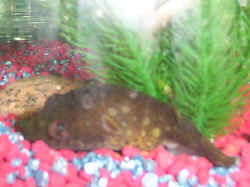
| "Black River Puffer" again
<Ananda here answering the puffer questions> I sent a
message on a black river puffer (the name I got from the
store ) and I finally got a decent pic. could you help me
better identify it and tips on sexing them. <From your
photo, I think I have narrowed it down to a couple of
candidates: Tetraodon leiurus, or possibly Tetraodon
cutcutia... the former is actually called the "black
river puffer" on occasion. Puffernet has a good photo
here: http://puffernet.tripod.com/leiurus.html
(or for the T. cutcutia, here: http://puffernet.tripod.com/cutcutia.html).
However, your puff is quite dark, in comparison with these
photos, so I'm not 100% sure of this ID. Sexing either
species is tricky at best.> also he never moves around
much, he's only been in my tank for 2 days but even at
the store where I got him from he didn't move much.
<Hmmm. Generally, a puff that has darker-than-normal
coloring is not a happy/healthy puff. Do feed him good I
don't think he's sick because I been watching him at
the store for about 2 weeks before I bought him and I asked
if the were giving any medication and they said no. pat |
|
|
A newly acquired cutcutia puffer
(03/07/03) <Hello...Ananda here on the puffer
patrol...> Hi, my name is Jessica and I've recently
acquired what I believe is a common
puffer. (cutcutia) The people I bought him
from said he was a clown-nosed puffer but I've not found that
name online. I believe based on research that he is a
cutcutia. <Okay...> Right now I have him in a
completely freshwater ten-gal aquarium with a filter, a
underwater heater, a couple of fake plants, and some
gravel. I'd like to know everything about this
fish if possible. <Hmmm... My usual research about
fish starts at www.fishbase.org, entering the species name... the
search results should give you several possibilities. Check them,
and you can get some information. Then check the list of common
names and note those down. Next, hit Google and do a search using
the genus and species and check out those results. Follow that up
with a search using some of the common names. Do that and
you'll know as much or more about this particular species
than I do. :-)> In particular I want to know if this is an
optimum set-up for him. He is I believe around 3 1/2-4
inches long right now. I'm feeding thawed frozen
blood worms and am considering adding the occasional feeder
goldfish and some possible small salad (for human consumption)
shrimp. <Skip the feeder goldfish -- they can be
carriers of disease. Further, the scales aren't good for the
puffers. Do feed him snails: the little roundish (not
cone-shaped) snails, usually available free at the fish store,
since they come in on the live plants. For a real treat, put a
live ghost shrimp in his tank.> All I've really had
experience is with bettas so this is a huge change for
me. <Yup. Puffers have very different requirements
than bettas -- but both like bloodworms!> I am very excited
about this fish and would love to know as much information about
his care as possible. <Search the web. You should
find anecdotes from people who have kept this fish. Also check
out the WetWebMedia chat forums ( http://wetwebfotos.com/talk);
we have a bunch of puffer fans on the boards.> Also, I do not
know how old he is but I was told he should mature at 5 inches in
length. <Fishbase agrees...well, in metric.>
How old might he be and how old is the average lifespan of a
cutcutia? <I am not sure. I have green-spotted puffers that
are smaller than yours, and I think they are about 2 years old. I
have read of some puffers living into their teens.> Also, will
I need to increase the size of his tank? (I'm a
student with limited funds for tanks, etc.) <I
understand. I think he would be okay for a while in a 10 gallon.
I would like to see him in at least a 15 gallon standard tank,
which is a bit longer than a 10 gallon tank. Better yet, a 20
gallon long tank would give him more room to swim. (I've seen
these for about $25 at the chain stores.) You might want to set
up a small tank or other container -- a five-gallon bucket or
even a new plastic trash can would be fine -- as a snail farm.
When you change the water in your puffer's tank, put the old
water into the snail farm.> Thanks so much, Jessica
P.S. Is there any way to tell whether my puffer is
male or female? <Not really.> Plus, any and all
odd/interesting facts would be much appreciated. <Someone
should write a book on puffers... meanwhile, search the web.
--Ananda>
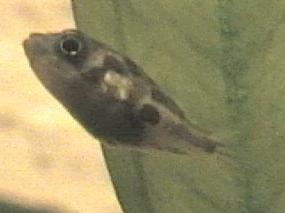
| Dwarf Puffers
4/24/04 Hi there! <Hi, Pufferpunk
here> I have two dwarf puffers (T. trav.) in a small
tank (aprox 40 ltrs), which I actually bought especially for
them. I took them off my local fish retailer as they
couldn't sell them, not knowing anything about them.
Obviously, being such a small tank its a little (approx
17"x12"x10") difficult to clean, so to help me
along I bought 4 Bronze Corydoras. These cleaned the tank
well, but were getting nipped by the puffers. I thought this
might be a risk, and ended up transferring them to my large
96ltr. <That makes your tank only about 3 1/2
gallons. Your puffers really require at least 2-3 gallons
each. No wonder they were picking on the Corys!> The
question I have for you is this: is there a bottom feeder I
can safely keep in the tank with the puffers that wont get
its fins eaten that won't outgrow it? <No way,
in a tank that size. You really need a larger tank for those
puffers. As you can see, the tank cannot support 2 messy
eating, heavy waste producing fish (even for tiny guys) in a
tank that small. That's why it's so hard to keep
clean. If overfed slightly, the water would foul quickly
enough to wipe out your puffers in a very short time. At
least 5gal is necessary to support 2 dwarf puffers & that
would be without any tank mates.> Also, I believe that
both puffers are female, would introducing a male (as I
intend) stop them being so anti-social? I know puffers are
fin-nippers, but they chase each other about quite a lot.
I've included photos of both, in case it helps. I was
also wondering if you could just confirm the
identification. <I'm sorry, but to ID your
puffers I would need a clear, bright photo of their tummies.
Here's a great site on them & how to ID: http://www.rr.iij4u.or.jp/~kohda/en/en-dwarfpuffer.htm
& a site just for dwarves: www.dwarfpuffercom.>
Many thanks, Liam <Good luck with your puffy
friends! ~PP> |
 |
 |
New FW Puffer Mystery species/husbandry... Hello, I
just bought a fresh water puffer and have never heard of or scene
this one it is about three inches long and on bottom it is white
on top it has big stripes going back from black to goldish light
green color the name they said it was is a Belem puffer but I see
it nowhere on your site. <Only know of one place to send
you here. www.fishbase.org... search their under the genus
Tetraodon for descriptions, images that match your specimen> I
have this one in a 20 gallon long now do you know of any other
fish that will go with it? <Not without knowing the
species...> He is very aggressive from what I have scene I
have a Plecostomus in a different tank can I put him in their he
is about 7 " long. Also I was thinking something like an
Oscar or convict will any of these work with the puffer?
<Maybe... would investigate the types of life this animal is
found with in the wild... and NOT buy livestock ahead of such
investigation in future... You know better. Bob Fenner>
My 3 Puffers Hello. I am hoping that you will be able
to help me with my puffer fish. I have 3 of them, in a 6 gallon
tank. They are pretty small still, and I think that they are MBU
Puffers. <Yikes... a very small volume of water for this
species... hard to maintain stably... and these can be very
"mean" toward each other> They are the green
one's with the black spots on them. <Hmm,
actually... this may be another species. Please see our site:
www.WetWebMedia.com and in turn Fishbase.org for identification
of this "freshwater puffer".> Lately I have noticed
that their colors are changing. Sometimes the green is a deeper
green and sometimes it is a more fluorescent green. But then
sometimes there is some brown coloring between the white area and
the green. What is this caused from? <Could be simply
"mood" changes, nutrition, water quality, even
communication amongst them> I was reading some of the other
people's problems with their puffers and one person said
their puffers turned brown and then died. Are my fish sick?
<Maybe... most likely from "water quality" issues...
may well be "brackish", needing some regular
concentration of salts...> I feed them blood worms, and all 3
of them eat them aggressively, so I don't think that it's
from lack of food. <Solely this one item? Their diet needs to
be expanded my friend. How healthy would you be only consuming
your one favorite food?> I have also noticed that one of them
is always trying to jump out of the tank. Is the tank too small
for them. <Yes, for sure> I have heard that the
puffers will do okay in either a large or medium size tank, and
like I said before, they aren't very big. What does it mean
when they don't have their tail flared compared to when they
do have it flared? <Once again, a number of
possibilities: the beginning of a rapid flight/swimming due to...
aggression, fear... communication?> I have also noticed lately
that one of the fish is hanging out in the very top corner of the
tank where he is cornered in behind the heater and the filter. Is
there something wrong? <Possibly... likely this is the
more subdominant individual and it's finding solace in
staying out of the way of its nippy conspecifics... do look into
either a larger system, making it brackish, and/or trading in all
but one of these fish.> Sorry for all of the questions, but I
am new to this and I love my puffers and don't want them to
die. Thanks - Kari <I appreciate this... extend your caring to
investigating proper husbandry of your wet pets. Bob
Fenner>
Unidentified puffer Hi, I have been racking my brain
trying to figure out what puffer I have. None of the pics look
quite right (juvi Fahaka, juvi MBU)....that is until I stumbled
across your page. You have a fish at the top of
http://www.wetwebmedia.com/fwpuffers.htm labeled as an
unidentified puffer. Do you know what it is yet? I have that very
same fish and I am not sure what species it is. Anyway, get back
to me, I am rather interested to know what info you have on it.
Clayton <Well, thanks for causing me to get off my duff re
this photo/specimen... think this is a Tetraodon lineatus (see
fishbase.org for another image, info.)... though not as
distinctly "lineated" as some smaller individuals I
have seen. Perhaps check out the other twenty one species of the
genus on fishbase as well... Bob Fenner>
Puffer confusion!!! (brackish id) Dear Robert, First of
all I'd like to thank you for a great website. I'm in the
process of putting together my second website at the moment, and
I'm running into some difficulty with classifying pufferfish.
My confusion lies in the fact that there exists t. fluviatilis
and t. nigroviridis. I have been researching and trying to
differentiate the two the best I can, since I'm going to be
profiling them in my website, "Puffernet". If I'm
not mistaken, the two are from the same part of the world
(southeast Asia) but are brackish and freshwater, respectfully.
Is this correct? <Both these Tetraodons are brackish and
fresher water... take a look at the coverage of nigroviridis
(note spelling) and fluviatilis offered on the fishbase.org
site> I don't seem to be the only one confused on this
matter, as many genome sites (you'd hope they would know the
difference) are calling them the same fish when there's two
different species (as per you and fishbase). It would seem to me
that t. fluviatilis has a more torpedo-like shape and is
brackish, while t. nigroviridis exhibits a more club-like form
and is freshwater. <Like, agree with your morphological
assessment> If I am correct in my nomenclature, are there any
other distinguishing characteristics for these two fish? I do
realize that t. nigroviridis is an inhabitant of freshwater
streams and rivers, and wish to pass that information onto the
masses so these fish can be properly cared for. Once again, I was
wondering if you could shed a little more light on
differentiating the two fish. Thanks so much for your time. Fred
<Both fishes do best in water with some consistent salt mix
make-up... both pugnacious, nippy toward unwary tankmates, both
require meaty foods in their diets... fluviatilis
"shinier", more discrete, consistent, smaller dots...
Bob Fenner>
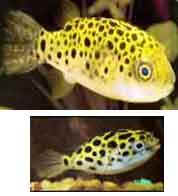
| Interesting puffer observation Hi Bob,
I was wondering if you could give me your opinion on
something that has been puzzling me regarding the green
spotted puffer. I have spoken to you before, I have a large
tank with 15 puffers, a mixture of figure 8's (Tetraodon
Biocellatus) and Green Spotted (Tetraodon nigroviridis.) I
have been keeping puffers for a long time and have a keen
interest in them. On observation of my puffers I notice that
there is a distinct difference between the green spotteds and
for some time I have been convinced that some of them may be
a slightly different species. I have attached a picture
(scanned for viruses-don't worry) for your to view. I
find that some of them are rounder in the face with large
spots and black eyes and a more 'cartoony'
appearance. Others have a longer nose with very reflective
blue eyes and a wiser look about their face and more
erratically patterned spots (as in the top picture.) Do you
think there could be a slight difference? I have looked up
all the literature I could find and they all seem to be
labeled as the same species. Only one of my specimens
displays these blue eyes and it is very young, perhaps this
goes with age? <Have noticed these differences at times as
well... think they may be due mainly to size, geographic
variation... perhaps developmental history (winners, alpha
types versus not)... Worth investigating the root papers
dealing with the morphometrics of the species. Could be
searched through fishbase.org to start bibliography. Bob
Fenner> |
|
A Puffer by any other name would smell... Hi! <Hi,
Trish... Anthony Calfo here answering Bob's mail while he is
away on a fantasy fish collecting trip, as we are told, wearing
nothing but a natural bikini made from the hide of a capybara
that he caught himself, and armed only with a buck knife clenched
between his teeth> I recently bought 4 baby puffers - the
spotted green kind. <AKA: Green Puffer, Spotted Puffer,
Leopard Puffer, etc.> However, different websites seem
to give it different Scientific names. Some say it's
TETRAODON FLUVIATILIS, others say it's TETRAODON
NIGROVIRIDIS. <I'm not certain...Bob can confirm, but it
is my understanding that they are one in the same and that T.
nigroviridis is the valid name> The pictures of both species
on the internet look the same so I can't tell which species
mine is. My puffers have an iridescent green background with
round spots. What is the difference between Tetraodon fluviatilis
and Tetraodon nigroviridis? Would really appreciate it if you can
clear up my confusion...Thanks, Trish <I'll borrow your
confusion and add it to my own cerebral clutter... best of luck
to you, Anthony> <Are two, separate species... please see
Fishbase.org re.
|

