|
FAQs on Mormyrid Fishes Disease/Health
Related Articles:
Mormyrids, Elephantfishes,
Electrogenic Fishes,
Related FAQs:
Mormyrids, Elephantfishes,
Mormyrid Identification,
Mormyrid Behavior, Mormyrid Compatibility, Mormyrid Selection, Mormyrid Systems, Mormyrid Feeding, Mormyrid Reproduction, Bony Tongue Fishes, Electrogenic Fishes,
Aba Aba Knifefish,
African Butterflyfish,
Arapaimas, Arowanas, Featherfin Knives, New World Knifefishes,
|
|
Elephant Nose and Iron
4/16/17
A few weeks ago, I wrote to you about a baby elephant nose that I got
from my neighbor that I felt was extremely emaciated. He was keeping it
with quite a few tetras and rasboras and had a powerhead plus two hob
filters on the tank but was indifferent to the condition of the elephant
nose. I talked him into selling it to me, brought it home and put it in
my 10 gallon plant tank (cycled for over a year), and tried to help it.
The little elephant nose put up a valiant fight, but ultimately passed
away.
I'm heartsick as I really fell in love with the little guy and I've been
searching your site to try to find out what I did wrong. I came across
articles in which you state that elephant nose are sensitive to iron. I
use RO/DI water (you might remember me from other posts - I live in
Idaho, have human remains in the water, among other toxic junk) and I
add Equilibrium to bring the mineral content back up. I was looking at
the bottle today and it says Equilibrium does contain iron that they
list as 0.11% Water Soluble Iron (Fe). Would that have been enough to
affect the elephant nose. Also, I used to put Excel Flourish in the tank
(though I had not added any for at least three months prior to this
incident) and it says it "...has iron reducing properties which promote
the ferrous state of Iron (Fe+2)...." Could this have harmed the little
elephant nose? My roommate wants to get a black ghost knife fish, but
now I'm worried as the BGK is a mormyrid the same as the elephant nose.
Even though we're setting
up a tank specifically catering to the needs of the BGK, with filtering
and powerheads providing more than 1,000 gph of water flow in a 72
gallon tank, I need to keep using the Equilibrium (I don't have to use
the Flourish) and
I'm afraid that if the iron in these products harmed or killed the
elephant nose that it might also harm the BGK. (Please don't
misunderstand, I think a great deal of SeaChem and love their products,
but not every product of
any manufacturer is right for every species of aquarium animal).
<I'm sorry this story had a sad ending, and thank you for trying so hard
to save this fish. The short answer is that aquarium iron supplements
are unlikely to harm this/any fish; at least, not if used as directed.
More likely, this Elephantnose was "just too far gone". They are not
easy fish to keep, as we've probably discussed before. While relatively
adaptable in terms of water chemistry, they can be finicky feeders, and
like all Mormyridae, they are acutely sensitive to chemicals like copper
and formalin widely used in aquarium medications. On top of that, being
wild-caught, it's not impossible for them to arrive infected with
parasitic worms, which means that however much they eat, they lose
weight. Deworming wild-caught fish isn't mandatory by any means, but if
a wild-caught fish
fails to thrive despite eating plenty of food, it's a good next step.
Anyway, you will find Black Ghost Knifefish very similar to
Elephantnoses in terms of care and feeding. You could probably argue
that these Knifefish and their relatives occupy the same ecological
niche that Mormyrids do in Africa. Soft substrate, micro-invertebrate
prey including worms and insect larvae, and plenty of oxygen are all on
the to-do list, while formalin and copper are just as toxic to Black
Ghosts as they are to Elephantnoses.
Given Black Ghost Knifefish don't need bright light -- they actually
prefer deep, shady conditions -- you will probably find iron-based
substrates redundant, even detrimental (they can cause algal problems in
the absence
of fast-growing plants). So I'd be taking the Excel Flourish out of the
equation, and sticking with silica sand, water worn pebbles and roots,
and so far as plants go, low-light tolerant species for the bottom
(Anubias for
example) and an over-storey of fast-growing species like Amazon Frogbit
to keep algae under control. None of these plants needs any more iron
that the usual top-up with fertiliser added to the water every few
weeks. Cheers, Neale.>
Re: Elephant Nose and Iron
4/17/17
Thank you Neale, you made me feel a little better.
<Glad to have helped.>
I still wish I could have helped the little fella, but some things are just not
meant to be. I've nervously agreed to try the black ghost knife fish (my
roommate's all time most wanted fish - mine too if I can keep it healthy and
happy).
<They are nice, if demanding, fish. Not really for casual aquarists, but
certainly not impossible to keep either.>
The local store that sells them has fish that are about 3 inches long, they look
healthy, and the store owner demonstrated to me that all the BGKs in the tank
are hungrily eating blood worms.
<Good. These sound VERY small though! Not necessarily a bad thing -- especially
if they're feeding well -- but do be careful not to expose them to sudden
changes in temperature or water chemistry when you bring them home.>
I knocked down and completely re-worked my 72 bow front. I have put on a Fluval
405 canister filter (340 gph) and added two Hydor Koralia powerheads (one is
1,200 gph and the other is 850 gph). I know this is a little bit
excessive for a 72 gallon tank, but I have also put in two very large fake
plants (for hiding spaces) that hang down from the top all the way to the bottom
and I want to be sure the current is sufficient to move the water past those
plants.
<Understood. BGKs appreciate current, and overall water turnover rates around
8-10 times the volume of the tank is ideal. So anything between 500-700
gallons/hour should fine. But I would turn down the powerheads so that they
don't produce too much current. While the Fluval by itself won't be enough, the
two extra powerheads -- operating be full blast, anyway -- could be much too
much current. Use some common sense here.>
I have pool filter sand as a substrate and a smooth glass candle chimney wrapped
with a fake ivy plant for the fish to feel safe. I have placed it diagonally
across the water flow so the current inside the chimney is significantly less.
<Wise.>
Since the fish is still very small, I've also added a small cave and a small
terracotta strawberry pot (placed diagonally to the water flow as an alternate
hiding and refuge away from the strong current). It will be the only fish in
this tank.
<Might actually look into some suitable dither fish at some point.
Peaceful, medium-sized tetras would be ideal. Dither fish help bottom-dwellers
feel more secure. Some placid bottom-dwellers would be a plus, too, consuming
uneaten food. I'd choose something like Brochis catfish that handle deep water
better than Corydoras, but share with Corydoras the fact they won't steal food
too quickly, leaving your Black Ghost plenty of time to feed.>
Since I had knocked the entire tank down to the glass, I am currently recycling
it. I started back on 3/28/17 using Seachem Stability to supply the bacteria and
Mysis shrimp to feed them. As of today, my ammonia is down to zero, but my
nitrite is now quite high (> 5ppm - really super dark purple), and my nitrate
has only climbed to 40, so it will be another week, maybe two, before I can
start thinking about bringing the fish home.
<Agreed.>
I also have assurance from the fish store that I can bring the fish back to them
if it starts to show any signs that something may be wrong.
<I think in a tank this size, with such a small fish, the risk of "new tank
syndrome" after 4-6 weeks of cycling should be very low.>
They're very good and will help me to work out any problems that may come up and
will "board" the fish until I get things worked out. Or, worse comes to worse,
they will keep the fish and find it a better home if I can't make this work. My
roommate has built a large aquarium stand to support a larger tank, so we are
currently shopping for a 150 gallon tank along with appropriate filtration. I
know it is not a concern right now as the fish is still small, but I want the
big tank up, cycled, planted, and fully established before the fish needs it.
<Wise. If this were me, I'd get something else settled in first, to bed the
filter in. The Brochis for example, or failing that, a small, harmless
Loricariid catfish such as Ancistrus. Sometime to "stress test" the filter
before you add anything too delicate. Make sense?>
So, can you think of anything I've left out or forgotten?
<Hope the above helps! Neale.>
Re: Elephant Nose and Iron
4/17/17
Ok, will add the Brochis first, after the tank has finished cycling, if I can
find them. I did a quick search and came up with the emerald catfish (Corydoras
splendens), is that the species you were referring to?
<Yes; used to be called Corydoras splendens, then became Brochis splendens, and
now seems to have switched back. An excellent, inexpensive catfish.>
The selection of freshwater fish in my area is limited and I've never heard of
this fish before.
<Very similar to the common Bronze Catfish, Corydoras aeneus, but a bit chunkier
and with a dorsal fin that has a much longer base than on typical Corydoras.
Quite commonly traded and not expensive. Keep at least 5 specimens.>
Everyone carries the Cory Cat's, but I can't remember seeing an Emerald Catfish.
<Oh, it is out there. Should be available to order. Just make sure you
don't get it muddled with the Bronze Catfish. The dorsal fins are VERY
different.>
If I can't find one (or six to 10 as my quick Google search recommends), would 6
- 10 Congo tetra (Phenacogrammus interruptus) be appropriate or should I stick
with bottom feeders?
<Congo Tetras are excellent fish, and good companions for Black Ghost Knifefish.
They will provide good "dithering" but won't do much to clean up leftover food.>
I understand those types of tetra would appreciate the strong current and higher
oxygen levels and I know I've seen them at my fish store.
<Cheers, Neale.>
Re: Elephant Nose and Iron
4/27/17
Exciting news! Our new BGK is home! OMG! What a stunning fish!
<Quite so.>
Every time I walk past the tank and catch a glimpse of her, I have to stop and
watch her for a while. Anyway, things seem to be going great! I see her swimming
through the plants night and day and she seems healthy,
strong, but awfully skinny. Now, the aquarium store where I bought her had her
there for almost 3 weeks while I was cycling the tank (and I know its fully
cycled because I tested daily and watched it go from ammonia to
nitrite and then to nitrate. BEFORE I brought her home, I knew from my own
testing that the ammonia was 0, nitrite was 0, and nitrate was 5 ppm before I
went down to pick her up, but regardless of my own testing, I took a
water sample down with me and had them test to confirm my results. We were all
good. But I digress! Anyway, the aquarium store where I bought her demonstrated
to me that she was robustly eating bloodworms when I expressed concern for her
looking so thin.
<I would be tempted to deworm, using an aquarium dewormer.>
They told me that many fish arrive from the supplier in a very thin condition.
But she was with them for 3 weeks eating bloodworms and is still very skinny,
but she shows no other outward signs of any problems. Also, since I've had her
home, I've found that she LOVES Cyclops and daphnia (frozen) a lot more than
bloodworms, Mysis shrimp or catfish from the grocery store (I still include
those foods, but she ignores them until she's eaten all the Cyclops and
daphnia).
<Do also try newly hatched brine shrimp; these are economical and very
nutritious (unlike adult brine shrimp, which are basically popcorn for fish) if
a bit of a hassle to rear. Frozen lobster eggs are also worth trying -- some
marine aquarium stores sell them, and they're very calorie-dense, making them
useful for "fattening up" new fish.>
So now I'm in a quandary. I don't like using chemicals or medicines unless I'm
sure they're warranted, so I wanted to ask you if you believe it would be wise
to worm this fish now or give her more time (and Cyclops, and daphnia) and see
if she starts putting on some weight?
<Assuming she doesn't have worms, patience and numerous (relatively small) meals
is the best way to return fish to healthy conditions. One or two big meals is
less good than five or size small meals because fish have short digestive
tracts, so tend to poop out a lot of the food they've eaten if "overfed".
Deworming is a good idea though, such as Prazi Pro, if a fish is eating plenty
but failing to put on weight. Cheers, Neale.>
Baby Elephant Nose with a damaged nose
3/28/17
I recently came across a baby (1 1/2 inches tops) elephant nose in the
possession of an acquaintance that looked frighteningly thin to me.
<Very/Too common... under and mis-fed; stocked w/ incompatible life>
When I asked him about it he said the fish's proboscis was damaged but didn't
elaborate on how it got damaged. I looked closer and could see that the animal's
nose looks "different" but there was no sign of any external damage - it just
doesn't look straight. It seemed to be trying to forage for food, but this guy's
tank has a heavy current (29 gallon with two hob filters and a powerhead) and he
has what seems like a lot of tetras and Rasboras in the same tank. I told him
the elephant nose was starving and that if he didn't do something it was going
to die - he just shrugged. So I offered him $10 for the fish and he took it. The
little guy/gal, that I've named Finley, is now (as of 15 minutes ago) in my 10
gallon by himself. This tank is heavily planted tank with only a 10 gallon
filter on it. I've put in rotifers, daphnia, Cyclops, and mashed bloodworms
(small amounts) and he seems to be trying to eat it. My question is, is there
any chance this fish's nose will heal as it grows if I can just get and keep him
eating?
<It may well do so under your good care. Mormyrids have "remarkable powers of
regeneration". Bob Fenner>
*Renee *
Re: Baby Elephant Nose with a damaged nose 3/30/17
Thank you! ��
<Welcome Renee. BobF>
Re: Baby Elephant Nose with a damaged nose 3/30/17
Hi Bob - the little elephant nose is still fighting, but its not looking good
(lying upside down in the tank, not really swimming) but he's going to have to
call it quits - and I'm going to keep going until he does. But I've never kept
this kind of fish before so I was hoping to share my plan and get your opinion
and suggestions.
<Ok>
The tank he's in is my hospital tank for plants, no fertilizers or anything,
just my normal water additives (Equilibrium, Alkaline buffer, Acid buffer, and
Stability) and a cup (in a ten gallon tank) of waste water from another tank per
week for food for the plants.
But he's the first fish to be in there in 3 years. The water parameters show
only yellow (no ammonia), blue (no nitrite), and yellow (no nitrate). I've read
on your site that this species is sensitive to many common products used in
aquariums such as salt, Prime, etc., and I haven't used anything like that in my
efforts to help this fish. But I did a 20% water change this morning (I don't
want leftover food hanging around in there), changed the filter medium, and
that's about all I've done. I'm keeping the tank temp at 77 and keeping a towel
over it to keep things dark and quiet for him.
I'm dropping small amounts of food near him, leaving it for half an hour, then
vacuuming it out. Does all of that sound ok to you?
<I'd try the food only twice per day>
Is there anything else that I could be doing that would help?
<Not really; no. There are downsides to trying most everything. Bob Fenner>
Re: Baby Elephant Nose with a damaged nose 3/30/17
Ok, thank you. Whatever happens it means a lot to know I didn't miss anything.
<Ah yes. B>
Mormyrid - safe medicines 1/2/16
Before I devote a tank to a group of Mormyrids, I want to know beforehand which
medicines I should have in case there is a problem with disease. The tank will
be large and based around their requirements, I just want to be
prepared if there's a complication.
<Ah!>
I see that salt and heat is recommended for Ich, and copper and formalin are
unsafe. Malachite green and Acriflavine are also dangerous?
<Acriflavine is relatively safe; Malachite, no. And no metal dyes... most
antibiotics, antimicrobials are fine... Sulfa drugs; anti Protozoals... as well>
Furan for fin rot and Maroxy for fungus have been called Mormyrid safe, I don't
know if it's the truth.
<Tis so>
Which diseases are they usually vulnerable to, and which medicines can be used
to treat them?
<Please see WWM re.... what little I know is archived there>
Thanks.
<Welcome. Bob Fenner>
Mormyrid - safe medicines /Neale 1/2/16
Before I devote a tank to a group of Mormyrids, I want to know beforehand which
medicines I should have in case there is a problem with disease. The tank will
be large and based around their requirements, I just want to be
prepared if there's a complication.
I see that salt and heat is recommended for Ich, and copper and formalin are
unsafe. Malachite green and Acriflavine are also dangerous?
Furan for fin rot and Maroxy for fungus have been called Mormyrid safe, I don't
know if it's the truth.
Which diseases are they usually vulnerable to, and which medicines can be used
to treat them?
Thanks.
<Short answer: anything safe for Stingrays should be safe for Mormyrids. So if
the packaging says "not suitable for stingrays and Elasmobranchs" then avoid.
Antibiotics, salt/heat, dewormers should all be fine. Would avoid anything with
metals (copper sulphate, potassium permanganate, etc.) and organic dyes only if
the manufacturer says they're safe with stingrays. Make sense? Oh, to be clear,
copper and formalin are both (a) toxic to fish and (b) toxic to you! Question of
dosage and exposure, but by no means are these chemicals "Safe". Cheers, Neale.>
Elephantnose parasite treatment. Dis. and stkg f's
7/18/14
Hello,
I have greatly enjoyed your website, and have in fact found it so
comprehensive, and helpful I have never had to write until now.
I have a school of small Peter's Elephantnose fish in a
quarantine/holding 75g tank right now. In a couple days they will be
moving to moving to their final home, a 160g (+ big sump) tank, which
they will share with some Ropefish, Congo tetras, a pair of
Pelmatochromis Ocellifer, and later possibly an African knifefish, some
African Butterflyfish, and some other rarer West African cichlid and/or
Ctenopoma species. (I probably will add the fish on second half of the
list later, because for the next year or two
I'll be growing out a fire eel, an Astronotus crassipinnis (rare,
smaller cousin of the Oscar), a Paratilipia polleni, and some
Paretroplus maculatus
(hopefully) in the 160g before they move to the 300g tank. So that is
for the vision for the tank in he next few years.)
I find Elephantnose fascinating, and that was my main motivation to
design a tank around them, and to keep them in a group like in nature. I
started out with nine, expecting that being a bit sensitive I might lose
one, and I have had them for two months now. I had one die for no
discernible reason not long after I bought them, but until a couple
weeks ago, all the others were fine. They were all eating very well on
live Blackworms (rinsed well), frozen bloodworms, frozen Mysis,
frozen krill, and chopped earthworms.
During that first month most of them started to get nice and fat, and
lose that thin look they come in with, however a few kept getting
skinnier, even though they were eating well, and then eventually they
stopped eating as well, and got even skinnier, and then ate less...
etc., you get the picture. I am sure it is parasites, rather than
competition for food, because there are not other fish with them yet (I
wanted to get them
eating well before introducing them even to a sedate community tank) and
also because one of the very skinny ones was one of the largest, most
dominate of the ENs.
I hesitated to treat them all for parasites, because I know they are
sensitive to many meds, and I didn't want to risk the ones who were
healthy for the skinny ones. I eventually separated the two skinniest
ones to try to treat, but by that time they were too far gone and I lost
them. I want advice on what anti-parasitic to use on the six who are
left, because I really want to treat them all, just to be on a the safe
side. I have a couple still alive who aren't gaining weight like the
others. It is very similar to the "wasting disease" wild caught loaches
often come in with. I have available to use PraziPro, API General Cure
(Prazi and Metronidazole) and Levamisole. What would you recommend?
<The combination of the Praziquantel and Metronidazole... either as a
mixed product as you list from Aq. Pharm., or blended together
yourself... delivered via foods>
Also a separate question, but do you think I should add a couple
more Elephantnose once they are moved to the 160g? Six
seems to me to be on the low side for a group of them.
<Six is fine... and what I would stick with. As having more adds to the
possibility of the "last one" getting picked on, doing poorly>
Thank you so much, and sorry that it was a bit long!
--
*Ariel Johns*
<Cheers, Bob Fenner>
Re: Elephantnose parasite treatment
7/18/14
Thanks so much for the prompt reply!
Quick follow-up question: the API General Cure's instructions are for
mixing in the water, so what would be a good amount to use mixed with
the food?
<Mmm, IF you using the API in the water, realize almost NONE of it is
going to get inside the fish/es (FW fish don't drink their
environment... unlike marines). IN ORDER to treat for internal
parasites... Let's just have you read on WWM re:
http://wetwebmedia.com/FWSubWebIndex/fwmaintindex.htm
scroll down to Disease, read re the compounds involved here>
Each individual packet contains 250mg Metronidazole, and 75mg
Praziquantel. Should I mix one packet with water (how much water?), and
then soak their food in it? How long should I treat them with the
medicated food?
Thanks again!
<Do the reading. BobF>
Re: Elephantnose parasite treatment 8/4/14
Hello, and sorry to bother you again!
<Never a bother>
Thanks for the info on how to dose the API General Cure orally for the
fish. After a lot of reading to make sure I understood the amount to
use, I mixed 1 tsp of the API in 1 cup of water, and soaked the food in
it for a few hours. I fed this two days in a row using a fresh mixture
each time. I treated not only my Elephantnose fish, but also a number of
wild caught cichlids I had in quarantine that weren't thriving.
<Good>
Everyone seemed to improve... EXCEPT my skinny Elephantnose,
unfortunately. Initially the treatment seemed to improve its appetite,
but it is just as skinny, perhaps skinnier after several weeks. Is there
any point in repeating that same treatment again?
<Mmm; yes; to some extent>
I know Metronidazole is toxic if used too much...
<Yes>
Which I guess brings me to my main question. Is it worth the risk to try
Levamisole?
<IMO/E, yes>
I know that it kills some types of parasites that Prazi and Metro don't,
so it may help where they didn't. Do you have any idea how Mormyrids
react to it?
<Unfortunately I do not; nor see any reference to it in my in-print
works here>
Is there a way I could dose it orally like I did with the API General
cure, and if so, would that be safer for them?
<Can be dosed as you state... and is safer administered thus>
Or could I do a Levamisole "bath" for the skinniest Elephantnose? What
would be the procedure on that?
<The bath will not likely be efficacious... VERY little of the material
will get into the fish>
Thanks so much!
Ariel
<Welcome. Bob Fenner>
Re: Elephantnose parasite treatment 8/5/14
Thank you!
The problem I have is that the Levamisole I have doesn't say how many
milligrams are in each treatment, all it says is to use "4 drops
per gallon". If this is the dosage to put in
the tank, what dosage would be a
safe to soak the food in?
<Mmm; much more. Do you want to pay fro 2d. ed. of Noga's Fish Disease
book? He gives units for:
Prolonged immersion: 10 mg. HCl/l...
Feed: 2.5-10 mg/kg
Injection....>
1 drop in a Quart of water, or should it be higher than the amount to
treat the tank? Like 1 drop in a Cup of water?
Thanks!
<... can't say/state a comparison w/o knowing what the concentration of
the product actually is. B>
Re: Elephantnose parasite treatment 8/5/14
I emailed the distributor of the Levamisole I have, and they said
concentration in the directions are for about 2 ppm (=~2mg/l). What
would be a way to judge my Elephantnoses approximate weight? They are
4-5inches long, but obviously much slimmer than, say, a cichlid that
same length.
<Mmm; likely guessing will be good enough (an ounce each let's say). IF
you had a gram scale, you could (I would) weigh out a given weight of
water with container (tare); add the fish to this... the difference
being the fish's weight>
Thanks for all your help! I will let you know how it goes after
treatment, so others will know what to do for their Mormyrids!
<I thank you, Bob Fenner>
|
Re: Dolphin Fish, Mormyrid; hlth., sys., fdg f's
2/1/14
Hello again WWM Crew!
Thanks for your response, I really appreciate it! I am actually having a
dilemma with the dolphin, though I'm not sure if it's serious. As stated
before, I noticed less activity with these dolphins. What concerns me is
that now it seems like the larger dolphin is breathing differently when
sitting at the bottom on the tank. I asked before about the breathing rate
of this fish because it seemed like they naturally had a very fast rate.
<Yes; agreed. Some 90 gill movements per minute is not unusual in my
experience>
The worry I have now is that the dolphin is having trouble breathing. It
seems to be gasping so instead of a steady constant movement of the gills,
it stops then they flap a few times, then stops again.
<Not good. Water changes, activated carbon, PolyFilter or such I'd be adding
to the filter, water movement path>
The mouth also seems to be opening and closing with this, which I've never
seen it do. I also noticed besides the inactivity and breathing issue that
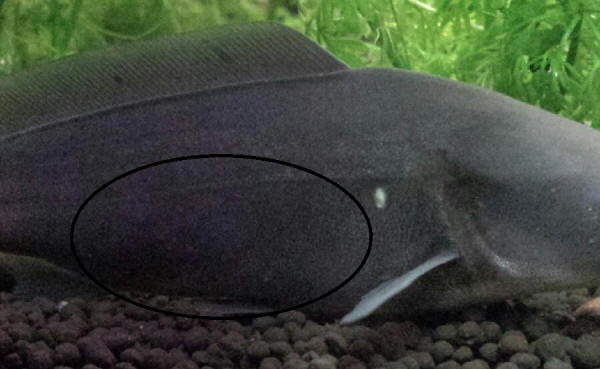
there looks like a few little bumps on the side of the larger dolphin. They
don't look like Ich or have any color, they look like they are part of the
skin.
<Still.... worrisome. S/b smooth>
I've continued to add more plants to the tank, but I'm unsure if the two
correlate. I have a 50g sponge filter as of right now, and was turning down
the intensity occasionally due to the air pump making a horribly loud hum;
but I don't know if this is the culprit as I have kept it going at full
strength since I noticed this problem and it seems to continue.
<You do have other filtration and water movement I hope/trust. I'd be adding
more... outside power filtration; hang on and/or canister>
I am heading into work today to replace it as well as getting a new
sandstone/airstone to see if that helps. I noticed some very mild flashing
about a week ago so after a w/c and plant trimming I added a low dose of
Seachem StressGuard and Seachem Stability since I cleaned the sponge filter
also. I rinsed the sponge filter with tank water to make sure I didn't
kill any bacteria, but when I turned the filter on a cloud of dust came out
of it. I waited 2 hours after cleaning the filter before I did my water
change/trimming and did not notice any stress from the fish. The only odd
thing I did notice that was different about this w/c was that the water had
an unusual amount of air bubbles in it making everything look foggy. I
discussed it with my fiancé and I suspect that the water may have been
cooler than the tank water, though he swore that it was warmer. The bubbles
made the tank look milky and the Otos were covered in bubbles afterwards.
Is it possible that the bumps came from the air bubbles? I'm unsure if the
products I used were a problem either seeing that both are extremely mild
and have been used before. The itching is only occasionally, but it's enough
to have me concerned.
<Me too... Act, now; re the above stmt.s>
They both still have moments of activity and do swim about chasing their
tankmates and they both have healthy appetites. I've got different foods as
stated before, but I've mostly been feeding live black worms. They seem to
be doing VERY well off of it and are both a healthy weight. Even the smaller
dolphin who looked frail and skinny, is starting to put on actual weight and
looks wonderful, though still tiny compared to the other. I keep the black
worms clean with a nightly cleaning before I feed them and don't seem to
have any losses with them. Even though I seem to have great results off of
blackworms, I'm aware that they can hold parasites
<Not really if they're cultured (vs. wild-collected). Ask your supplier re,
or wean them on to frozen/defrosted meaty foods (rinsed ahead of offering)>
so I'm wondering if there's a way to ensure my worms are parasite free i.e.
rinsing in Epsom salts or something; or is it safe to PraziPro these fish if
I did see any infection?
<I would not>
I'm looking into culturing my own live worms such as white worms as well,
hoping to try to reduce risk as much as possible.
<Ok>
Just did a quick strip test a moment ago
My temp is 79F Ph: 6.8-7.0Nitrate: .10ppm-20ppmNitrite: 0ppmKH: 40ppmGH:
180ppm
Ammonia: 0ppm (did API vial test)
linking 2 videos from my photobucket of examples of the breathing, the
smaller dolphin flashing, and hopefully you can see the bumps though they
are near impossible to pick up on my phone. I saw some white specks on the
larger dolphin in the videos, but I believe they were from the sand since
they weren't consistently there even an hour before or an hour after. Black
spot still on the dorsal, and attached photo of the small bumps, forgive me
if they are hard to see, I could barely make them out in the photos but they
look like "chicken skin" like humans get. The white blobs in the photo are
baby apple snails. Excuse the messiness of my tank, they kick up the soil
onto the sand and I haven't planted the new plants, leaving algae for
Otos
and baby snails.
http://s65.photobucket.com/user/Lo2theJoe2/media/public/20140129_224142.mp4.html
http://s65.photobucket.com/user/Lo2theJoe2/media/public/20140129_215751.mp4.html
Thank you again for your time and I hope you'll be able to answer some of my
worries.
<Do please keep us informed. Bob Fenner>
|
Re: Dolphin Fish, Mormyrid 2/2/14
Hi WWM Crew and Mr. Fenner,
As of right now I only have the 50g sponge filter on this tank,
<Ahh! I definitely WOULD be upgrading, at least adding a good sized outside
power filter here. The improvement in water quality, reduction in
maintenance will be discernible>
I haven't been a huge fan of it's bulkiness but didn't realize it was a
problem since my water parameters have always tested well. I'm going to take
off one of my Eheim canister filters (80 gallon) from my 125gallon tank then
tonight. I'm going clean the entire filter with bleach then have it run
overnight in heavily dechlorinated water (prime) in a 5 gallon bucket as a
precautionary since I don't want to mix equipment between tanks.
<You are wise here>
I'll run both the sponge filter and the canister until I've got the canister
seeded enough. If the problem was indeed a filtration issue, I'll gladly
purchase a more suitable filter if necessary.
<Eheim's are excellent. I use them; have used them for decades, personally
and commercially>
I'm keeping my fingers crossed that this was the issue. In the meantime,
do you have any solutions to "disinfecting" my live blackworms?
<The continuous, long-term (hours) rinsing in slow, cold tapwater is about
all I would do>
I always grab my worms from fresh stock that just arrives and I clean them
nightly, but I doubt that it's enough to not be at risk still. I'm going to
speak directly to my wholesaler to see how they cultivate their stock, but
I'm weary knowing that PraziPro isn't an option if they have a bad batch.
I'll keep you posted, thanks again!
Have a wonderful evening, Lauren Saunders
<And you Lauren. Bob Fenner>
Re: Dolphin Fish, Mormyrid; hlth.
2/6/14
Hello Mr. Fenner and crew!
Giving you an update on the tank. After 15 minutes of running in bleach
water, 24 hours of running in heavily dechlorinated water, followed by a
thorough rinsing; I added the 80g Eheim canister filter to my tank. The
fish seemed fine with it for a few days, but now 2 Otocinclus just died
leaving me with one,
<The genus Otocinclus members are social... live in shoals>
though they stopped cleaning the algae and glass 2 weeks ago,
<? Something wrong here... low DO?>
unsure of the cause. Dolphin do seem more active though they always were
for the most part, but I still catch the larger resting on the bottom on
occasion, hard to tell with the smaller since it hides under the
driftwood when it's not searching for worms. The breathing rate doesn't
look as labored, but it is still an on and off motion (hard to explain)
rather than a constant flutter of the gills, though I did see similar
breathing patterns of dolphins via YouTube. Unsure which is the normal
pattern at this point. There are still weird discolorations on the skin
of the dolphin, unsure of the cause or if it's possible the Oto's were
sucking on their skin.
<Possibly>
I noticed the Otos "attacking" when I had first gotten them, but haven't
seen it happening recently. Found it unusual since I thought this wasn't
a typical behavior of the Oto. Haven't witness any flashing from the
dolphin, but did see my blue gourami flash against the filter once last
night. Appetites are still healthy.
Water test: Nitrates: 10ppmNitrites: 0ppmPh: 6.8KH: 40ppmGH:
180ppmAmmonia: 0ppm
Will keep you updated if anything changes, but unsure if there's
anything I should be doing at this point. Doing my best not to mettle as
much as possible.
Have a wonderful day! Lauren
<And you. B>
|
Re: Dolphin Fish, Mormyrid
2/17/14
Hello again WWM Crew!
I've had the Eheim Ecco pro (80gallon) and the sponge filter running in my
37gallon tank now for about 2 1/2 weeks now and I haven't noticed too much
of a difference. Both dolphin have still been active, though they both still
rest on the bottoms of the tank from time to time throughout the day.
<Improvements in behavior, health et al. with increased filtration take more
time>
I would chalk it up to "rest" time but I'm still noticing the gasping. Is
the dolphin's breathing pattern a consistent and constant flutter or they
flutter and stop?
<Off/on>
They definitely both breath consistently in a pattern but it's 3-7 flutters
then stop, then 3-7 flutters. The mouth on the larger one opens and closes
with each "breath" though, which is my biggest concern.
I haven't noticed much itching or flashing except on rare occasion, however
right when I started filming this video the larger ended up doing it
immediately. Very frustrating.
Water Parameters Ammonia 0ppmNitrate 15-20ppmNitrite
<Keep under 20 ppm... Read on WWM re NO3 control>
0ppmPh 7.0ppmKH 80ppmGH 180ppm81F degrees I've added in some newer plants
and since they were grown immersed the new ones are browning out their old
leaves and sprouting new ones, could any of that be affecting the dolphins?
<Yes; decomposition can reduce DO quite a bit>
They aren't really decomposing much, just browning. I've been feeding
blackworms, bloodworms less than once a week and last night I fed daphnia
(can be seen in the photos)
Here is a link I just took of the dolphin this morning. I only have a low
light plant on right now so it's not as harsh for them, hopefully it doesn't
make it too difficult to see their breathing.
http://s65.photobucket.com/user/Lo2theJoe2/media/public/20140217_113706.mp4.
html
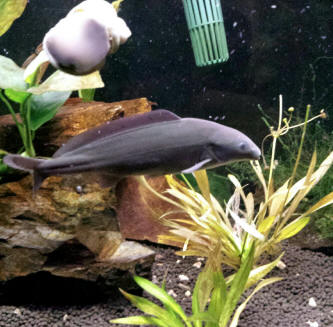
attached are 3 photos I took last night, you can see how the mouth opens and
closes. They seem happy enough, I just want to ensure that what they are
doing is normal for them or if it isn't what I can do to resolve it.
<Appear fine>
Thanks so much again!
<Welcome. Bob Fenner>
|
 |
|
My Elephant Nose Fish Won't Eat; rdg.
9/18/13
Hi,
<Ryan>
I have a 120L tropical tank with about 30 various friendly fish
inside.
<... Need to know; have you list, what these are... useful information
in determining compatibility and your system capacity>
I recently bought an elephant nose fish which started to eat, and
then unfortunately died.
<... Mormyrids are often lost in too crowded, too competitive settings...
have you read re the family on WWM?>
I then bought another one and have had him/her for about a week but
he/she hasn’t eaten anything and I'm quite worried as I don't want it to
also die.
<... too likely so>
I understand that buying another 2/3 may help,
<... don't do this>
but I don't want to waste the money and the life to try and make it
better. I always try and feed it bloodworms and other live foods but it
doesn't eat anything. I've just began to notice it sitting in the corner
of the tank looking as if it will die soon. Please help as I don't want
to risk any more fish.
Thanks,
Ryan.
<Read here:
http://www.wetwebmedia.com/FWSubWebIndex/mormyrids.htm
and (all) the linked files above. This species, these species can be
"touchy"... but most all are lost due to inappropriate placement in
terms of environment, tankmates and feeding. Bob Fenner>
|
Elephant Nose Question
8/22/11
Hi there Bob and Crew
I've been coming here for a few years now for a lot of more
specialized information about things for my tanks and now I find
that I'm a little bit stumped as to what to do next.
My mother has a 55 gallon set up in the kitchen that has: 5
female and 1 male Congo Tetra, 5-6 Buenos Aries, 3 Gold Mystery
Snails, and 2 Elephant Nose. Lots of Java Fern as well, with a
few small pieces of Hornwort and Hyacinth that are just
temporarily growing in there.
Parameters are as follows:
NH3 - 0
PH - 7.0
No2 - 0
No3 - 20
Temp - 80F
Now, here's the problem I've got here; The larger of the
two elephants has what looks almost like a pimple on its right
pectoral fin, right at the base of the gill plate. I noticed it
yesterday, but it was never there before. It's not spreading
to other fish, nor is it spreading on the fish in question. I
pulled it up with a net to just get a closer look at is as it
looked like a piece of sand at first, though with closer
inspection it does not look like Ich or crypto. Tried to just
gently rub it and it held firmly to the flesh. I have been trying
to get a good enough picture to send in to you, but alas, even in
the net my camera's macro setting isn't good enough to
take the shot. There's only the one spot, but my mother is
worried about it spreading. I've never kept Elephants, so I
am not entirely certain as to the best course of action.
I raised the temp from 78 to 80,and getting some Brine Shrimp
eggs today to hatch for some live feed because I read that the
salt in the water from Brine Shrimp won't bother the
Elephants too much? Just don't know what else to try right
now. So any ideas you may have regarding this would be awesome. I
will try and post a picture for you later if I can manage to get
one, but I don't see it happening with my camera sadly.
<Hello. I'd probably "wait and see" here but the
salt/heat option for treating Whitespot is safe with Mormyrids,
and indeed pretty much the only way to treat them without causing
problems. Mormyrids are sensitive fish, so do be alert to the
fact formalin and copper can be quickly toxic to them. They are
easily damaged by sharp sand or gravel (indeed, I'd argue
they should never be kept in tanks with gravel anyway) as well as
by sharp rocks and ornaments. Two specimens rarely get on -- they
are highly hierarchical, and need to be kept singly or in large
groups. So be sensitive to the fact they may damage one another,
perhaps indirectly, by the stronger one forcing the weaker one
against rocks or whatever. Sorry I can't offer more help. A
photo would help, to be sure! Cheers, Neale.>
|
|
|
Re: Elephant Nose Question
8/22/11
Funny thing is, it's actually the larger and more aggressive of
the two that's got the spot on it.
<Odd.>
I told her a while ago when she got them that there would be issues
eventually.
<Yes.>
They killed off the 3rd that was in the tank a few months back.
<There you go.>
I don't know how well you'd be able to see it, but I'm
attaching a photo that somewhat shows the afflicted area.
<Yes, I see.>
Hard to get a good macro shot of these guys. So I picked it up
another degree and a half since last night when I brought it up to
80. Sitting at 81.5 now and adding the salt to the water now.
<Okay.>
Just a matter of waiting now. Thanks for the advice, Elephant Nose
aren't something I normally keep.
<Glad to help.>
I forgot to ask how much salt I should add, and how long I should
leave the water salted for?
<2 grammes/litre is the usual dosage, but I'd recommend you
make up a brine solution for that amount in a jug, and then add to
the aquarium across at least an hour -- these are sensitive fish.
So if the aquarium contains 200 litres, then make up a jug of water
with 200 x 2 = 400 grammes of salt, and pour that brine into the
aquarium across an hour or two. This may sound like a lot of salt,
but it's really not; full seawater is 35 grammes per litre, so
a 200 litre tank would need 7000 grammes (i.e., 7 kg). In other
words, less than one-seventeenth full seawater salinity! If you
want to be doubly sure, add half the brine solution on the first
day, and only add the other half if the fish seem lively and happy.
A dosage of 1 gramme/litre isn't a sure-fire cure for
Whitespot, but may help.>
Should I QT the one with the spot and salt him there so I don't
salt the main tank?
<A very good idea.>
My mother is freaking out about the salt killing her fish if I salt
the water.
<See above.>
How long are the elephants able to take the salting for?
<You typically dose with salt for at least a week, ideally
two.>
Sorry, like I stated, a bit out of my norm.
-Nathan
<Cheers, Neale.>
Re: Elephant Nose Question 8/22/11
One last question for you, when I'm adding the brine shrimp to
the tank should I be adding them with the freshwater salt or marine
salt?
<You can hatch brine shrimp in either plain salt or marine salt,
though marine salt may well be better because it buffers against pH
and contains potentially useful trace elements. Once grown on to
the desired size, or if you buy live brine shrimp, you want to
decant as much of the salty water as possible, and ideally net them
out and feed them to your fish that way. If you can, use wet-frozen
Spirulina-enriched brine shrimp -- while newly hatched brine shrimp
are quite nutritious for baby fish, live adult brine shrimp have
very little nutritional value at all, and shouldn't be used for
anything other that a weekly treat. Since Mormyrids feed from the
bottom, they are quite good about taking wet-frozen foods on the
substrate, provided nothing competitive is kept with them. Indeed,
settled specimens can be very greedy, forward feeders!>
I have both. Marine salt I have is H2Ocean, from when I was running
my reef tanks. Otherwise I've got that basic Nutrafin salt.
I'm raising them with the H2Ocean right now at a SG of 1.018,
just wasn't sure which would be a better idea come time to add
them to the system.
<Cheers, Neale. |
peter's elephant nose, hlth. &
more 10/14/10
Hi;
I currently have a 55 gallon tank.
Residents;
1 med size Discus
1 Cory cat
1 lacy Pleco
1 2" Pleco
I would hand feed the elephant nose and discus. I've had him for at
least six weeks. He was very friendly and curious. Yesterday he was not
eating his blood worms, and this morning he was clearly to sick to
rehab. My water parameter are excellent. Can you think of what I did
wrong? I would hate to get another one and have the same thing happen.
Any info helpful. No meds given while he was in the tank.
Thank you;
Linda
<Hello Linda. Gnathonemus petersii is a difficult fish to keep.
There are several issues to consider. The first is its diet. Bloodworms
are fine in their way, but not very nutritious. You do need a more
varied diet than just bloodworms. Wet-frozen and/or live invertebrates
of all types seem to be accepted, but Elephantnoses are poor at
competing for food, so I would not keep them with catfish or loaches.
They feed at night, so if you put out food for them at nighttime, they
should fine and eat that food themselves if there's nothing
stealing it first! Secondly, they are very sensitive to water quality.
Since you've got Discus, I imagine you understand the basics of
water quality management. Just as with Discus, you must maintained zero
ammonia and zero nitrite at all times. Thirdly, Elephantnoses are very
sensitive to copper, formalin, and many other medications. These should
NEVER be used in tanks containing Elephantnoses.
Also make sure you use a water conditioner that removes copper from
your tap water. Fourthly, they are easily killed by secondary
infections, in part because they are so difficult to medicate. NEVER
keep them in tanks with gravel, abrasive sand or sharp rocks; ALWAYS
provide a soft substrate of either smooth silica sand or peat. Hope
this helps. Cheers, Neale.>
Mormyrid Problem 12/31/08 My elephant
nose has red cheeks (ulcer?) on both sides and his brain seems larger
than any other I've seen (almost swollen looking). Could it
possibly be internal parasites? I have 5 tanks and am not new to
keeping aquariums but have never encountered this and cannot find an
explanation anywhere to what may be the cause of these odd symptoms. He
eats well and dominates the tank (tank mates are: 3 honey gouramis
& 6 African mini frogs & a Betta in 60 gal) Water quality is
excellent. Any input or advice would be greatly appreciated. <Hello;
it's very unlikely "internal parasites" are to blame, but
Mormyridae are very prone to systemic bacterial infections. Aquarists
sometimes make the mistake of keeping them in tanks with gravel rather
than smooth silica sand; the gravel damages their sensitive
"trunk" allowing bacterial infections to get started.
It's really pointless trying to keep them in tanks with gravel. As
you hopefully know, it's impossible to treat Mormyrids with
anything containing copper and formalin, so you're limited to
things like Maracyn in this instance. Do see here:
http://www.wetwebmedia.com/FWSubWebIndex/mormyrids.htm Cheers,
Neale.> Elephant Nose Skin 12/27/08 Peeling/Fin
Deteriorating Happy Holidays WWM Crew! I will make this as short and
sweet, yet detailed, as possible. I have a 55 gallon tank with a
heater, Whisper60 power filter, and a single airstone on the opposite
end of the tank as the filter. Water Parameters: Ammonia: 0, Nitrite:
0, Nitrate: 10, pH: 8.3 (Very hard water where we live) <In itself,
this water chemistry should be acceptable though not ideal for
Mormyrids; water quality seems good.> Stock includes: Approximately
25 Mollies (Here's the story on the excessive number of mollies: A
year ago we started with 6 of them, one female was constantly pregnant.
The others died throughout the year for various reasons and finally a
few months ago our pregnant female died as well. However, in her last
months in the tank she had 3 different batches of fry. Most survived
and thrived. I take a bag of them to Petco every now and then, whenever
it becomes difficult to keep up the cleanliness of the water. So at
this point we've got approx. 25 1.5" mollies. Possibly too
many for the tank, but as of 20 minutes ago the water read as stated
above.) 1 Elephant Nose 1 Shrimp (last seen in March, but with no
ammonia spikes having occurred, I'd imagine he's found a nice
spot to hide) 1 Guppy Here is our issue: While all the mollies and the
guppy (and the shrimp, too, I hope) are acting and looking perfectly
well, I noticed peeling skin on the Elephant Nose late yesterday.
Additionally, his dorsal fin looks slightly deteriorated. It
doesn't look ragged or torn, but more like melted plastic (sorry...
it's the best I could come up with). This Elephant Nose is about
6" from nose to tail, and the area that is peeling is nearly
1.5" long down its back and goes down its sides just slightly. If
you look at it closely it looks like there are 4 different tiny spots
down his back that are each surrounded by a circle of damaged skin...
and all areas are connected. So far its acting more or less normal, but
I've noticed slightly less activity tonight (he's out of sight
during the day and becomes active as the day ends). He is eating
normally, as well. <The "melted" fin does sound like
Finrot; while usually caused by water quality-induced opportunistic
infections, it isn't beyond the realms of possibility for
mechanical injury or even damage from other fish to be responsible.
Mollies for example can be aggressive, though in all honesty I doubt
they're the problem. But that said, I have seen seemingly harmless
fish cause harm to one another, for example Otocinclus catfish damaging
the skin of large gobies. Mollies are expert "raspers", and
it's not impossible they're sucking the mucous off the
Elephantnose, allowing a secondary infection.> The only thing I can
imagine that could have caused this would be stress. We recently had to
move the entire tank/stand to the other side of the room and had to
drain most of the water to reduce the weight of the set-up. We did not
have to remove any of the fish during this process. While this may have
been stressful for the Elephant Nose, we've had it for over a year
now and had to move to a house 20 mi. away about 8 months ago. During
this process we drained all but enough water to keep the gravel
submerged in order to keep at least part of our bio-filter during the
move. All the fish were bagged and put into a dark cooler during the
trip. All survived!! But the Elephant Nose was especially stressed out
by the time he got back into the tank. So much so that his color
temporarily faded to being a very light gray/white. But he recovered
almost instantly and was always very healthy up until now. And in fact,
his skin is looking slightly better today then it was yesterday (when I
first noticed it). But his fin is still the same. <Stress is of
course a possible but I'm always keen on aquarists differentiating
between the (quantifiably dangerous) stress caused by poor water
quality compared to the (much less measurable) stress caused by being
unhappy. In other words, while fish clearly become sick when exposed to
the wrong environmental conditions, it's much less clear that fish
become sick because they're exposed to something we'd perceive
as being troubling or stressful. So while I wouldn't dismiss the
idea that a schooling fish would be stressed if it was kept singly, or
a female Molly might be harassed by a male, that a fish would develop
serious sickness weeks or months after being moved is, to me, less
likely. I'd focus on reviewing the environment. Mormyrids have
small scales and are likely to be damaged by things like sharp gravel,
coarse plastic plants, bleached or replica corals, coarse nets, and so
on.> So... what can i do? <Initially at least, even without
understanding the cause, I'd be treating for Finrot. Use a
medication that doesn't contain either copper or formalin; Maracyn
would be ideal, or Maracyn 2 if the former doesn't work. The point
is to put a stop to whatever the bacterial infection is, even without
identifying it.> What is this? <Not sure.> What caused it?
<Difficult to say.> Thank you so much for your time. -CB <Good
luck, Neale.>
Ich elephant nose 10/23/07 I have had my elephant nose
Approximately 8 months. He has been happy and healthy. He has developed
tiny white spots on his pectoral fins and anal fin that look like ich.
Is there any medicine I can treat him with that won't kill him?
Thank You Karen <Hello Karen. With Mormyridae, the things to avoid
specifically are Formalin and Copper, both of which are widely used in
anti-Ick medications. So you need to treat Mormyridae in the same basic
way as, say, Clown Loaches (see here:
http://www.wetwebmedia.com/FWSubWebIndex/clnlchdis.htm ). Anyway, the basic
trick is this: raise the temperature to 30 degrees C (around 86 F). Oxygen level
goes down as temperature goes up, so you need to compensate for that. Add
additional aeration if you can, but failing that, adjust the water level and/or
filter so there is lots of splashing and circulation. Now make up a brine
solution in a jug, with about 2-3 grammes of aquarium salt (not marine salt) per
litre of water in the aquarium (in other words, a salinity of 2-3 PPT). There's
almost exactly 6 grammes of salt per teaspoon, so estimating how much you need
should not be too difficult. Stir the salt into the water thoroughly until
dissolved, and then slowly add the brine a little at a time into the outflow of
the filter so that it quickly disperses around the tank. After a few days the
parasites on your fish will mature and die, but the mobile parasite larvae will
not be able to re-infect your fish, and the disease will go away. This takes
quite a few days, but it does work. Increasing the salt concentration to as much
as 6 grammes per litre of water can be used to deal with stubborn infections,
but the higher the salinity, the more gently you need to adjust your fish to it,
and the higher the degree of osmotic stress placed on the fish. Conversely, once
you're done treating the fish, do a series of relatively small water changes
over the next few days to gradually bring the salinity down to zero. As ever, do
establish why the Ick became a problem. It doesn't come from nowhere, and is
either brought in by unquarantined fish or else provoked into action by stress
or lapses in water quality. With Mormyridae, prevention is FAR better than cure.
Good luck, Neale.>
Baby Whale & Fish-Tail Rot
Medication - 06/27/07 Neale, <Hello Michelle,> Thank you for
your wonderful advice regarding the baby whale. Maracide is a 5-day
treatment (today will be day 4), so far the baby whale and the snails
are fine and the ick vanished. Every night I siphon-up about 3 gallons
of water (38 gallon tank) from just above the gravel, where I read ick
parasites inhabit. I thought about moving the baby whale, but he seems
to have made a home for himself under driftwood and our hospital tank
is now housing my one remaining gourami... who seems to be doing ok.
<Very good. Siphoning up the baby Whitespot parasites sounds a bit
unlikely to work to me, but it can't do any harm I suppose.>
Also, we have a new challenge; it seems that the lovely rainbow fish
contributed not only ick but fin-tail rot. The betta finnage was
devastated seemingly overnight. Next in line are the Panda Corys
(primarily the dorsal fins). I am a bit concerned because about a year
back I had one Panda Cory be consumed by some kind of fin-tail rot
bacteria that seemed resistant to everything, and in the end there were
no fins left... It was the saddest thing I've seen happen to any of
my fish, doubly so because I'm particularly fond of Corys (there
about 3 years old). <Now, Finrot is almost always caused by water or
fin-nipping issues. Sometimes it does come in with new fish, but only
very rarely. 99 times out of 100, it's either the environment or
persistent nipping by other fish in the tank. Given the baby whale is
OK, water quality is likely to be good, but water chemistry might not
be. Mormyrids aren't fussy about water chemistry (they're found
in habitats as varied as blackwater streams and Rift Valley lakes). But
rainbows like neutral to slightly alkaline, moderately hard water. That
the dorsal fins of the Corydoras are rotting immediately suggests fin
nipping though. I've seen this when keeping Corydoras with
pufferfish (not a good combo!). Ditto with the Betta; these fish are
notorious targets for fin nippers. So, what's in the tank? Anything
likely to be nippy?> I've started treating with Maracyn II
(although, I've never had much success with this medication). Today
will be the third day. The fin-tail rot doesn't seem to be
progressing... I think, but I can't detect re-growth either. Would
you suggest I continue, or stop treatment with Maracyn II. <Unless
there are compelling reasons not to *always* finish off
medications.> On hand I have, Mardel's TriSulfa and Maracyn
Plus. I've never tried a sulfa-based medication before. I could
also go & buy whatever you suggest. Again a concern is the baby
whale (who seems fine.. still slurping up worms). <Like you, I'm
pleased the baby whale is happy, and that strongly suggests the basic
conditions in the tank are sound. I'd personally be spot-treating
the fish with Finrot by dipping them into baths of some sort. Even
saltwater (marine salt mix or uniodized cooking salt added to a litre
of aquarium water) dips can work to slow down mild Finrot (seawater
strength, for 2-20 minutes depending on the size and species involved).
An adult Corydoras, for example, would probably be safe dipped for
around 3-5 minutes. They are not very salt tolerant. Freshwater
livebearers and cichlids, on the other hand, are often much more salt
tolerant so you can be more aggressive with the dips. The idea is to
dehydrate the external parasites and clean the wounds while not harming
the fish. Provided the fish being dipped stays upright and stable,
you're fine, but if it loses balance or starts thrashing about
wildly, pull it out. Repeat daily until things are better. Finrot is an
exceedingly aggressive disease, and untreated spreads to the body,
resulting in septicaemia, which is basically untreatable (and
fatal).> Cheers, Michelle <Hope this helps, Neale>
Ick treatment & a Baby Whale
6/23/07 Hello, Thank you kindly for your prognosis on the Dwarf
Gourami. I'll keep them isolated and cross my fingers.... and not
re-stock with Dwarf Gouramis. Another question: Today I noticed that
one of the rainbow fish (Red Rainbow female) has 2 tiny white spots...
sweet mother of science, I fear ick. She's a relatively new
introduction to the tank (4 days) but was quarantined for 8 days prior
to being introduced. If ick, I've previously had success with
Mardel's Maracide Concentrate... but what about the Baby Whale who
lives in the tank (I've had him for about 8 months now... a healthy
happy 4 inch Mormyridae) can he withstand an ick treatment like
Maracide. Many thanks, Michelle <Happy to help. It's a shame
that Dwarf Gourami Disease is so common. Anyway, as for the Ick in your
aquarium, be extremely careful when treating the tank. I am not
personally familiar with this medication, but I'm a bit concerned
that its web page says it "may be harmful to amphibians and some
snails". Anyway, before using it, check that the carton said it
was safe with invertebrates and stingrays. Anything safe with those
should be safe with Mormyrids; if it doesn't say it is safe for
those, then assume it is not. If your retailer doesn't know, then
checking the web site (or telephoning) the manufacturer can help. The
safest thing is move the Mormyrid to a quarantine tank, treat the main
tank, use carbon and water changes to remove leftover medication, and
then return the Mormyrid. With luck, your Mormyrid will not be
infected. Since you've had the baby whale 8 months, he's
obviously settled in and feeding -- so I wouldn't take any chances
risking such a lovely animal. Cheers, Neale>
Sick Elephant Nose 4/10/07 Hi! <Hi
Ashley, Pufferpunk here> I have an elephant nose that I purchased
about two to three months ago. He was doing well until
today. I turned on the lights and found him resting in the
plants near the bubble wall at the back of the tank.
<Unless you have some kind of plastic tube to observe this fish,
that's what it will do mostly--hide. They are generally
not open-swimming fish & only come out to eat.> I thought he was
dead! I used my net to try to get him and he moved in the
tank. He looks a little thin, doesn't seem to eat much
and is very unbalanced. <Probably starving to
death. This is the #1 cause of death in these
fish. They will only eat worms & prefer live.> Since
he was resting near the bubbles, he had small bubbles on his body but
after they "popped" I noticed that he had a small yellow-ish
spot at the base of one of his "side" fins (I call them the
swimmer fins... or arm fins... whichever is more
helpful). He is about three inches and the spot is about the
size of an uncooked couscous ball and roughly the same in
color. All of the other fish seem fine (Mollies, Gouramis,
Pleco and two Iridescent sharks). <You don't mention the size of
your tank but do you have any idea yow large iridescent sharks get???
[IMG] http://img.photobucket.com/albums/v345/Pufferpunk/Other%20Fish/iridescentsharks.jpg[/IMG]
> The water quality is good and partially changed
weekly. <Good means nothing to us. Best to
post exact parameters, when asking for help.> What would you say is
the diagnosis? What are possible methods of
treatment? Having accidentally used "quick cure",
I am scared to use most medications. (He survived without
incident in this case). I did increase the water
temperature, added a "therapeutic" amount of aquarium salt
and performed a water change. <These fish will not
appreciate any amount of salt. They come from soft water
conditions. The Quick Cure may have irritated his
skin. I'd do a 50% water change & add
Melafix. Go to your LFS & get live
blackworms. Rinse thoroughly in a brine shrimp net &
throw out any that look dead. Put them into a worm cone feeder,
he'll find them. All your fish will love them too! You
can store the worms in a shallow container with holes on top &
1/4" of water. Rinse daily. Hopefully
it's not too late. Some fish, once in starvation mode,
won't eat.> My nephews are attached to "Big Al", as
are my husband and me! Please advise! <Good luck with Big
Al, I hope he makes it! ~PP> Thank you, Ashley
Monogeneans from the gills of Mormyrid fishes Dear Professor,
<Blahoua> I hope you will understand this message easily; my
English is quite poor. <No worries> I am called BLAHOUA KASSI
Georges. I am a doctorate of the university of Cocody-Abidjan (Ivory
Coast). I undertake my research in Laboratory of Hydrobiology. I just
red in the internet one of your publications which title is: The
Elephantfishes, family Mormyridae, in Aquariums My topic concerns the
Monogenean from the gills of Mormyrid fishes. Concerning the
bibliography, I have some difficulties because I don't have any
previous publications. I will be duly grateful you send me publications
on Gills Monogenean parasites from Mormyrid fishes. You can also give
me names and e-mails of some persons who have worked on my topic that
you know. Doing so you will help me a lot in my research works. Best
wishes in 2005. Sincerely yours. <I suspect you don't have easy
access to large library collections as well do here. Where would I send
this material? Bob Fenner> BLAHOUA KASSI GEORGES Address postale :
University of Cocody, UFR Biosciences, LABORATORY OF HYDROBIOLOGY 22 BP
582 Abidjan 22 (Coast of Ivory)
Dead elephant nose I bought an elephant nose
about a month ago and lost him 3 wks ago, after reading your
information on them, I wish I would have had the feeding test done,
then I would have known not to buy him, he would not eat and got
skinnier and skinnier, it was horrible, I brought him to the pet store,
and he wouldn't eat for them either, they treated him for internal
parasites for a wk in a half and he still didn't look good.
<Likely too far gone from the process of (likely chemical)
collection in the wild, starving, poor water quality from there through
shipping, handling... Happens to whole shipments at times> So from
what I read what you have wrote, do you have any ideas in what I could
do to keep my elephant nose alive, when I buy one in the near future.
Do you have any idea to why he wouldn't eat, because I did ask them
how long was he here before I bought him and they said 3 wks, and he
look good, apparently not or he would have ate. Also my water was good
where it should be, so I can't figure why he wouldn't eat?
<Morymyrids find aquatic worms almost irresistible... try
blackworms, Tubificids... if the specimen/s don't take these, I
would leave them at the shop> If you could help me it would be
appreciated, I don't know any where else to turn to there is not a
lot of people that know about these fish. <There is considerable
known about their esoteric biology, but not much popularized re their
practical husbandry... Many die from jumping out (for lack of an
adequate aquarium cover) and metal poisoning from errant medicine
treatment for instance... Easily avoided> Thanks, Sincerely Shelley
<Bob Fenner> Elephant Nose With His Trunk Bitten Off
Thank you so much for letting us know. We will set up a
dedicated tank for the turtle. As for the elephant-nose, we
could use a little further advice. He looks
pretty bad - he has a big red splotch next to his nose on
one side, and the nose itself is white and
fuzzy. It is so sad. So, based on
what you wrote, I guess he has both a bacterial as well as
a fungal infection. How can I treat him and help
him to get better? < Put him in a hospital tank with clean water and
a place for him to hide. Not too bright. Treat with Nitrofuranace as
per the directions on the package. This medication treats both
infections.> I know many medicines are not good to put in a tank
with an elephant- nose. Is there anything we can do to ease his pain
and help in heal? < These fish are sensitive to the copper in many
ich medications. This is not a problem with antibiotics. Keeping the
water clean will help a lot.-Chuck> Thanks in advance. Rebecca and
Sal
|
Elephantnose trtmt.... 3/24/06
I found some Furan-2 Capsules, so do you think this is safe for
my little Elephantnose? Should use full dose as per directions?
<Yes> (Furan-2 Directions - Contains 2 furan based
compounds to combat a variety of gram positive and negative
bacteria. Effective against gill disease, mouth fungus, fin and
tail rot, dropsy, furunculosis and black molly disease. Use one
tablet per 10 gal. daily for up to four days.) <250 mg. per
ten gallons of system water, yes> Also, I have 4
DAY and 6 week old Boesemanni Rainbow fry in the tank (waiting
for their tank to finish cycling) can I use this med or should I
just wait until they are moved out. <I'd move these
first> (Mr. Elephantnose is getting the spots bacterial
gray-wht spots- he started to break out the other day, I use
Melafix, which only held for a few days- this morning it is back
and bigger. And I think this all came from one of my large
Rainbows,- see pic - he has Gill Disease and he has been treated
8x's just can't kill it all off. (any ideas, already
tried PP, but he just did more damage to himself but trying to
jump out the holding tank and ramming into the lid. FYI - My
Tank:60 3 - Rummynose Tetra 2 - Cardinal Tetra 2 -Yoyo Loach 3 -4
Boesemanni Rainbowfish (1 female, 2 males) 1 5 Elephantnose 1
Candy Striped Pleco 1 Golden Algae eater Eheim pro 2026,
1-Ebo-Jager 250 watt heaters,1 Coralife Turbo Twist 6x 18w,1 Rena
400 air pump, sand/gravel mix bottom, with live plants, drift
wood, and stones. PH 8.0 No2 0 <Should be zip... this is way
toxic> No3 0 - .05 NH4 0 KH 161 GH 35 I
do a weekly water change of 1/3 or more water along with cleaning
filter. What am I doing wrong? <I would not use the
"Fix"... and you should investigate the water quality
needs/ranges, compatibility of these fishes... not a good mix>
Thank you again for all of your help. Lesley <Bob
Fenner>
|
|
|
|
Furan compounds - 03/14/2005 I must ask
one question if I may. Where does one fine
Nitrofuranace? I have looked all over the internet and
I would love to have some on hand just in case it is
needed. I didn't know you had a post until just
now, and I am not sure how to post on it if/when need to ask for
advice. Thank you again. Lesley <Ahh, search for either
Nitrofuran or Furanace... or even "Furan compounds".
Bob Fenner>
|
|
Thank you for your help, I will rush out and buy
some. PS. I was also reading up on some of what people
have to say about their Elephantnose being a bully, my experience
is yes, typically when they are coming into
adolescences. As you can see from my pictures, my guy
is very small. He was only 3" when I got
him. He is about 5" now, two years later. As he
is getting older, he bullies my large 6" Rainbow around,
yoyo loaches, and others. He will boot their behinds
right out of there own hiding spot or just boot/ram them
because. However, I don't see it as any big deal,
they are territorial and I think it comes with any
fish. Sometimes my yoyo loach won't even budge;
after a while, Mr. Elephantnose moves on. During
feeding the same thing will happen, he knows when food is coming.
(As you saw in pictures) and he is not going to starve because of
some big fish. LOL. Anyhow, finding out that you know a lot about
Elephantnoses, I am very excited about finding a med that will
work. Right now, when needed, I use Melafix, which
works just ok. I used to use ECO-Revive - just
can't seem to find it on-line any longer through Fish-vet.
One of my fishes in my tank I believe has gill flukes and Mr.
Elephantnose may have contacted them. <Mmm, usually these
trematodes don't span so far twixt host groups> He has
been flashing and then the spot where he is was rubbing (on his
backside) he breaks out in white fluff. Melafix has
only helped with the fluff I am sure. He hasn't been rubbing
since, but this is the second time it has happen in all of the
two + years I have had him, and both outbreaks were within 6
weeks time, so I am only waiting. (2 weeks to
go?) This is how I found you. Anyhow, I am just
rambling, Thank you again for the info, and if you have any other
info you can help me with, wonderful, I will take it. Lesley
<My little knowledge re Mormyrids rests mainly at either ends
of the spectrum of commercial/wholesale handling and
physiology... Bob Fenner>
|
Elephant nose with white patches -
03/09/2006 Hi I have had an Elephant Nose for four
years. In the past couple of months he has been developing white
patches which do go away after a couple of days, but then reappear
after a couple of weeks. The white patches go from his nose and head
all the way down his back, and a small patch on the underside. They are
smooth and not dotty or raised at all, and the strange thing about it
is that the patches always appear the same, the edges are very regular,
and symmetrical to both sides of the fish. He doesn't appear to
behave a lot differently when he has it, although he tends to hide away
behind his rock a lot less than when he doesn't have the white
bits. <Have seen such recurring issues...
invariably they are rooted in inappropriate environment>
The closest information I can find is that the patches
appear where I think the fish has electrical receptors for mating, but
not sure if this is connected. Do you
have any idea what this could be and why it's happening?
Thanks, Jenny. <Is your water
quality suitable for this species? Is stress otherwise minimized? Bob
Fenner>
|
|


