|
FAQs on Rosy Barbs
Related Articles: Barbs, Danios &
Rasboras, A
Barbed Response; Wrongly maligned for being fin-nippers, barbs
are in fact some of the best fish for the home aquarium by
Neale Monks
Related FAQs: Barbs, Danios, Rasboras 1, Barbs, Danios, Rasboras 2, B,D,R Identification, B,D,R Behavior, B,D,R Compatibility, B,D,R Selection, B,D,R Systems, B,D,R Feeding, B,D,R Disease, B,D,R Reproduction,
|
|
|
Tetras with white mouths (and a bit about rosy barbs)
3/19/15
Hi Crew,
I'd like to thank you once more for your previous advice, last time I wrote
about a suspected case of Ich which is now resolved. I've had no more fish
deaths since losing the last of the extra rosy barbs that I bought from the LFS,
sadly Pinkie succumbed to his saddle ulcer in the end. I had him quarantined for
the last week or so of his time, and whatever he had does not seem to have
affected the rest of my fish. I still see the occasional white or clear stringy
droppings from the rosy barbs but I am starting to suspect this is a result of
them accidentally ingesting sand then excreting it in mucus as there are plenty
of green and brown droppings too and they all seem healthy otherwise.
<Mmmm; what re water quality, foods/feeding, maintenance practices?>
Currently my 30gal tank has one head and tail light tetra, three adult
rosy barbs, and all 16 of the barb offspring (ranging from 1cm to 2.5cm).
I'm aware that this will be far too many rosy barbs when they grow up
so I'm hoping to find a home for them in the big aquarium at work which
currently only has a single small fancy (ugly) goldfish.
<Should be moved elsewhere>
I'm not sure that this will be a compatible mix though since even if 5+ barbs
are added to keep them well behaved and not nippy, I think they might dominate
at feeding time due to being more able-bodied and they might starve out the
goldfish. Thoughts?
<All should get along w/ the GF removed>
The other option I have in mind is to set up better filtering in the backyard
pond and to put some back out there. A lone
stray barb fry survived 2 weeks out there during the hottest part of summer, he
was too good at hiding and got left behind when I brought the others that had
hatched out there inside, so I think the pond does get enough shade to
keep the temperature down. Winters here are mild too.
<Good... barbs might live there; but not the Tetras likely in the winter>
With the threat of Ich and columnaris gone I have bought four more head and tail
light tetras to keep my singleton Mr. Beacon company.
<Good name>
I've been trialing different plants in the main tank and do intend to keep it
heavily planted (despite the best efforts of the barbs to eat/uproot everything,
I've been finding this constant battle part of the fun of keeping fish) so I am
hoping the HATL tetras will be happy in the environment. The LFS does not stock
these tetras so I bought them online and besides, I hoped to
avoid a known source of diseased fish. When they got here, two of them had white
coloured patches on their mouths, and one of them was very sickly, limp and
skinny looking.
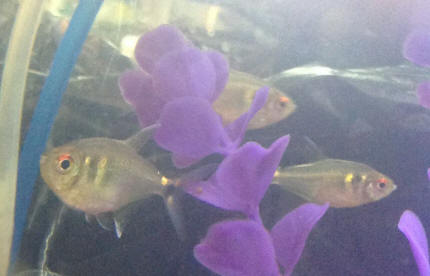
<I see this in your excellent pix>
My initial thoughts were that they may have scuffed their mouths against the
plastic bag in transit, or gotten feisty with each other since they were all
together in the one small bag, and gotten injured while fighting. The bag wasn't
a breather bag and the skinny fish did perk up once out of the bag and in
quarantine, he hides a bit but his appetite seems okay and his belly is filling
out a bit more; he could have been underfed or oxygen starved maybe but I'm a
little suspicious that he could have fish TB or some other disease that could
cause skinniness. I've treated them with Praziquantel so far just in case they
were skinny due to worms.
<Mmm; possibly>
I'm using the tank that the baby fish used to be in, the tetras have been in
quarantine for a week now and I think that in two of them the white mark has
gotten smaller but noticed today that a third one has a white mouth too. I'm a
little worried it could be columnaris not a wound, or a wound that got infected
with columnaris.
<Maybe>
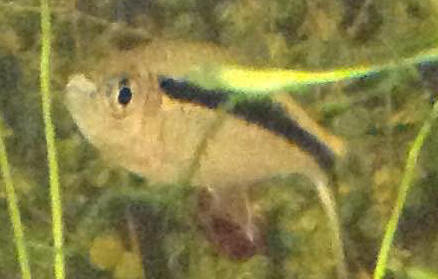
I've attached some pictures, and also a picture of one of the friends I got for
the false penguin tetra (they have their own tank now due to being too rough!)
who has a similar mark. I don't know if it is just that these tetras fight or
swim into things a lot; the quarantine tank that the four HATL tetras are in is
too small and I know they aren't happy with the amount of space they have. I'm
wary of treating with anything beyond a little bit of salt for now
<Good>
and I'm just hoping after another week or two in quarantine nothing will have
worsened and I can get them into the bigger tank. Anyway I just don't have the
experience to tell whether these white mouthed fish are injured or diseased or
both. Hope you can help.
<Not w/ the data (or lack of it) provided>
I did end up getting a RO/filter system which has a mixer tap and a TDS inline
meter allowing adjustment for both drinking water and aquarium water. I still
don't quite have my head around converting TDS ppm to general hardness degrees -
I did read somewhere that dividing ppm by 10 will loosely approximate French
degrees but then I don't know whether French or German degrees are more commonly
used.
<German... the D in these measures is for "Deutschen">
I haven't had any further shrimp deaths due to failed moults since I've started
using 50-70ppm water for my shrimp tank so it's definitely helping. I'm
wondering whether I should still be letting my RO-mix change water stand
before I use it;
<Yes I would... at least a day; better, a week>
I haven't been, because I thought that it was only necessary to allow time for
water treatment chemicals to do their work but is letting water stand useful for
other reasons?
<Mmm; yes.... settling, combination.... of metals, non-metals... outgassing of
undesirable gasses>
I have a 20lt plastic jerry can which I store the water in, this doesn't allow
much exposure to atmosphere so should this
water be agitated? Or just tipped into buckets?
<Tipped is fine, aeration/circulation better>
Ok sorry this got to be a lot longer than I originally intended! I really
appreciate the time you take with educating new hobbyists like me and reading
our rambling emails.
<We appreciate the opportunity to interchange w/ intelligent, sensitive folk
like you>
I've still got a lot of reading that I want to do regarding Corydoras as I have
decided I'd like a biotope tank rather
than putting them in the community and making them compete with greedy barbs,
and I think it would be easier to manage water softness and ph if I start again
and do things differently in a new tank.
Thanks once again and I hope you have a great day.
Bronwen
<Welcome. Bob Fenner> |
 |
|
Re: Tetras with white mouths (and a bit about rosy barbs)
3/20/15 /Neale
With regards to the barbs occasional odd dropping, they are fed once daily or
twice if I don't have time to watch them in the morning. If I am in a hurry they
get a quick pinch of flake and then I take a bit more time in the evening feed
to watch how much they are eating.
<Fine. Barbs are omnivores that will eat algae, some plant matter between
"proper" meals.>
I have some frozen community blocks which contain both meaty and plant
materials, I usually give this two to three times a week (slicing off a small
amount and feeding little by little trying to avoid over feeding). I have some
Spirulina sinking pellets (also contains other ingredients) that I bought for
the shrimp but proved to be very popular with the barbs, they will carry the
pellets around spitting them out and sucking them up again, gradually working on
them until they soften up.
<Quite so, and an excellent staple for your fish... good nutrition, plenty of
exercise, economical. My Cherry Barbs are fed these alongside the Limia they
cohabit with.>
I crush some up for the younger fish but they seem to manage okay on full sized
pellets, worrying at them until they break into smaller bits. I have some
meatier pellets, with a higher protein content but they are not as popular so I
don't feed those very often.
<Indeed. These fish are omnivores, and plant material is a significant part of
the diet of most/all barbs in the wild.>
They get smushed up frozen peas, thawed and peeled, every few days which they
love. If I find a patch of snail eggs I will knock it off the glass and the
female adult barb in particular loves munching on those.
Occasionally I net some mosquito larva from either the pond or the snail tub and
these make a popular snack.
<Sure.>
I believe they have eaten some of the Ramshorn snails that were in their tank,
there are a growing number of empty shells visible on the bottom, and they
definitely rip at the Java moss, Hydrilla, Rotala, and Hydrocotyle plants
constantly. I'm pretty sure they ate 90% of the fissidens moss I added too, and
almost all of the hair grass is gone too now that I think
about it. I was worried at first that they were doing this because I wasn't
feeding them enough but they were still doing it when I tried feeding them twice
a day which I decided was too much. I think if they like eating fresh plants
then they should be allowed to eat fresh plants so I've been growing more
Hydrilla in a tank outside for them since that's the one they stripped
to bare stems first of all.
<Indeed. Try floating Indian Fern and Amazon Frogbit, two favourites with many
barbs.>
I don't often see the tetra eat, he hangs back while the barbs feed so I always
attempt to get a pinch of flake to his part of the tank. He doesn't like me
scrutinising him though and moves front on so that he's hard to see. He does get
interested in the frozen food and will test and spit out various particles of it
until he finds one that he likes, I'm hoping he gets a bit more confidence once
his fellow tetras join him, I've been feeding them a small amount of flake daily
and they get quite excited at
feeding time so I think in a group his instincts will kick in if he sees a lot
of feeding action going on around him.
<Tetras are frequently more carnivorous, especially the smaller ones Neons,
Penguins, various Hyphessobrycon species and so on. They often enjoy Daphnia and
the like. On the other hand, do bear in mind some tetras are much more retiring
than Barbs. Put another way, many South American tetras come from blackwater
streams with very little productivity. They've evolved to expend as little
energy as possible between meals. Barbs typically come from ponds and streams
with much more productivity and a lot more for them to eat. They've evolved to
be more "busy" and expend their energy in all sorts of foraging and social
behaviours. In other words, tetras wait for food to come to them, while barbs
seek it out and if necessary push competitors away. Funnily enough, those barbs
from blackwater streams (like Pentazona Barbs) are much more like Neons and
other tetras in personality.
In any event, if you understand the environment the barb or tetra species come
from, cohabiting different species from among them will work better.
Tiger Barbs are bolshy, so mixing with pushy characins like Black Widows makes
sense. Rosy Barbs are subtropical to boot, so you'd choose only low-end tropical
tetras for life with them, perhaps Buenos Aires Tetras.
Does this make sense?>
I haven't measured my water parameters for a while but for a long time I was
getting pH steady at 8 (despite driftwood and almond leafs) ammonia 0, nitrite 0
and nitrate 5-10. I do weekly water changes and fortnightly rinses of the gunk
from the filter. I try weekly to vacuum the gravel in the gravelly parts of the
tank and skim the surface of the sand in the sandy parts of the tank but I don't
know how effective a job I do. I always see gunk being sucked up the tube but
everything looks even messier than when I started once I've tipped the new water
in.
<Sounds good. Cheers, Neale.>
Tetras with white mouths (and a bit about rosy barbs)
/Neale 3/21/15
Hi Crew,
I'd like to thank you once more for your previous advice, last time I wrote
about a suspected case of Ich which is now resolved. I've had no more fish
deaths since losing the last of the extra rosy barbs that I bought from the LFS,
sadly Pinkie succumbed to his saddle ulcer in the end. I had him quarantined for
the last week or so of his time, and whatever he had does not seem to have
affected the rest of my fish. I still see the occasional white or clear stringy
droppings from the rosy barbs but I am starting to suspect this is a result of
them accidentally ingesting sand then excreting it in mucus as there are plenty
of green and brown droppings too and they all seem healthy otherwise.
<Smooth silica sand should be fine... but anything abrasive or sharp, like some
of the glass-byproduct sands (Tahitian Moon Sand for example) could be risky.>
Currently my 30gal tank has one head and tail light tetra, three adult rosy
barbs, and all 16 of the barb offspring (ranging from 1cm to 2.5cm). I'm aware
that this will be far too many rosy barbs when they grow up so I'm hoping to
find a home for them in the big aquarium at work which currently only has a
single small fancy (ugly) goldfish. I'm not sure that this will
be a compatible mix though since even if 5+ barbs are added to keep them well
behaved and not nippy, I think they might dominate at feeding time due to being
more able-bodied and they might starve out the goldfish. Thoughts?
<It can work, in big tanks with robust Comet-type Goldfish and decent sized
schools of Rosy Barbs. But fancy Goldfish are less able to keep out of trouble.
It really isn't predictable. Worth trying but keep a Plan B in case it doesn't
work out.>
The other option I have in mind is to set up better filtering in the backyard
pond and to put some back out there. A lone stray barb fry survived 2 weeks out
there during the hottest part of summer, he was too good at hiding and got left
behind when I brought the others that had hatched out there inside, so I think
the pond does get enough shade to keep the temperature down. Winters here are
mild too.
<Rosy Barbs are subtropical and could thrive down to about 15 C, but below that
would be risky.>
With the threat of Ich and columnaris gone I have bought four more head and tail
light tetras to keep my singleton Mr. Beacon company. I've been trialing
different plants in the main tank and do intend to keep it heavily planted
(despite the best efforts of the barbs to eat/uproot everything, I've been
finding this constant battle part of the fun of keeping fish) so I am hoping the
HATL tetras will be happy in the environment. The LFS does not stock these
tetras so I bought them online
and besides, I hoped to avoid a known source of diseased fish. When they got
here, two of them had white coloured patches on their mouths, and one of them
was very sickly, limp and skinny looking. My initial thoughts were that they may
have scuffed their mouths against the plastic bag in transit, or gotten feisty
with each other since they were all together in the one
small bag, and gotten injured while fighting. The bag wasn't a breather bag and
the skinny fish did perk up once out of the bag and in quarantine, he hides a
bit but his appetite seems okay and his belly is filling out a bit more; he
could have been underfed or oxygen starved maybe but I'm a little suspicious
that he could have fish TB or some other disease that could
cause skinniness. I've treated them with Praziquantel so far just in case they
were skinny due to worms.
<Fish TB is difficult to diagnose and impossible to treat. It's less contagious
and more like an epidemic that breaks out when fish get stressed (diet, poor
water quality, lack of oxygen, etc.). So I tend not to worry about Fish TB but
instead focus on optimising living conditions for the fish. Usually "mystery
deaths" either sort themselves out or else all the vulnerable fish die. Adding
medications randomly is a bit hit and miss, and while PraziPro isn't
particularly risky, do be careful about medicating
without diagnosis.>
I'm using the tank that the baby fish used to be in, the tetras have been in
quarantine for a week now and I think that in two of them the white mark has
gotten smaller but noticed today that a third one has a white mouth too. I'm a
little worried it could be columnaris not a wound, or a wound that got infected
with columnaris. I've attached some pictures, and also a picture of one of the
friends I got for the false penguin tetra (they have their own tank now due to
being too rough!) who has a similar mark. I don't know if it is just that these
tetras fight or swim into things a lot; the quarantine tank that the four HATL
tetras are in is too small and I know they aren't happy with the amount of space
they have. I'm wary of treating
with anything beyond a little bit of salt for now and I'm just hoping after
another week or two in quarantine nothing will have worsened and I can get them
into the bigger tank. Anyway I just don't have the experience to tell whether
these white mouthed fish are injured or diseased or both. Hope you can help.
<Well, the photos look more like fighting damage, perhaps a bit of Finrot or
Columnaris thrown in. Another option: swimming into solid objects (like the
glass) when alarmed. So for this one turn the lights on more carefully and see
what happens. So far as fighting goes, watch your fish, add more of each species
to dilute aggression (if an option) and medicate as per Finrot
and Columnaris.>
I did end up getting a RO/filter system which has a mixer tap and a TDS inline
meter allowing adjustment for both drinking water and aquarium water. I still
don't quite have my head around converting TDS ppm to general hardness degrees -
I did read somewhere that dividing ppm by 10 will loosely approximate French
degrees but then I don't know whether French or German degrees are more commonly
used. I haven't had any further shrimp deaths due to failed moults since I've
started using 50-70ppm water for my shrimp tank so it's definitely helping. I'm
wondering whether I should still be letting my RO-mix change water stand before
I use it; I haven't been, because I thought that it was only necessary to allow
time for water treatment chemicals to do their work but is letting water stand
useful for other reasons? I have a 20lt plastic jerry can which I store the
water in, this doesn't allow much exposure to atmosphere so should this water be
agitated? Or just tipped into buckets?
<Bob's a big fan of overnight "resting" of water, ideally with an airstone, but
not essential. I'm less fussed, and just avoid changing huge amounts of water.
Basically, if you just change 20-25% of the water at a time, and use a water
conditioner, you shouldn't need to worry too much about resting the tap water.
Freshwater fish are very much more adaptable than marine fish. Think about rain
falling into a pond.>
Ok sorry this got to be a lot longer than I originally intended! I really
appreciate the time you take with educating new hobbyists like me and reading
our rambling emails. I've still got a lot of reading that I want to do regarding
Corydoras as I have decided I'd like a biotope tank rather than putting them in
the community and making them compete with greedy
barbs, and I think it would be easier to manage water softness and ph if I start
again and do things differently in a new tank.
<Possibly. I'm a big fan of sticking with the water chemistry you have, and
choosing your fish accordingly. That said, a 50/50 mix of RO water and liquid
rock tap water should produce a happy medium that suits most community fish.>
Thanks once again and I hope you have a great day.
Bronwen
<Most welcome. Neale.>
Tetras with white mouths (and a bit about rosy barbs)
3/21/15
Hi again Crew!
Thank you for your replies Bob and Neale. My heart says that I should move the
head and tail light tetras into the main tank to give them space and stop them
from squabbling or bumping into things, but my head says to give them another
week of quarantine to see how their mouth lesions develop.
<Agreed.>
I slept on this idea and this morning while one HATL tetra is still without
mouth issues, two of the other three look worse and the white patches seem to be
protruding more than they were yesterday. Although, having said that, I did use
a brighter light so that I could see them better, maybe the lesions were like
that all along and I just didn't see - normally they have half the tank in shade
c/o a black plastic garbage bag and the other half lit by a strip of dim LEDs. I
don't really think the lesions look fluffy, more so a bit ragged like the edge
of some peeled skin in places, and warty in others. However this fluff free
finding doesn't relax me at all, as Pinky's back ulcer was never fluffy either
and that evolved from a small lesion to a large fatal ulcer over the
Christmas/New Year break (I didn't have anything available except topical
treatments until it was too late). I
don't really want to give infection a chance to set in again, but I am mindful
also that these are different fish, from a different supplier, in a different
tank, with different looking lesions that are in a different location on the
fish, so I shouldn't expect a similar outcome to last time!
I want to wait a bit longer and observe them tomorrow with the same bright light
so that I can get a real idea if there is any progression. I do have
tetracycline (Bio-tet) or Metronidazole (generic looking yellow tablets)
available now for if the lesions worsen, although I'm not sure if I want to
treat all the fish, or only the ones that are showing visible lesions.
<I do think these mouth lesions are either plain vanilla dead tissue from
fighting or crashes into solid objects, or else incipient Columnaris.
Either way, treat with a suitable antibiotic, while also review conditions in
the tank.>
An observation on a different front, I would be hard pressed right now to pick
out which of these fish was the skinny sickly one from a week ago. All of them
have good colour and healthy looking bellies now. I am really looking forward to
seeing them school together in the big tank once they are done in quarantine! I
have discovered that my dad's compost heap has
Whiteworms in it as well as the big pink compost worms so I want to set up a new
clean worm culture for some tasty occasional snacks for the fish, which I hope
the tetras will like.
<Sounds a great idea.>
Speaking of which, the other fish haven't been eating my Ramshorn snails at all!
I found three snails fatally jammed in the filter inlet grille today.
I am guessing as the grille becomes more clogged with plant matter it becomes a
tempting place to graze for the snails but the increased suction as they clear a
blockage pulls them in to the inlet pipe and traps them there, where they die
since their shells can't follow. I have seen snails "hanging around" the inlet
pipe before but didn't realise this was happening. The filter pipe has probably
been slurping snails out of their shells all along as the barbs seem content to
bite their eyestalks off then
go back to ripping at the plants. I've adjusted the sponge that I put over the
grille so that only the most suicidal snails will be able to force their way in
there, and I will just have to remember to rinse the debris out more often.
<Hmm... some folks would endorse a filter with snail-killing properties...>
I've decided that it will probably be more humane to leave the fancy goldfish in
peace in the aquarium at work and to get a nice pond filter going to allow
rehoming the excess rosy barbs outside, I probably wouldn't be able to provide
adequate supervision to stop any possible mayhem that could occur with the work
goldfish. It does get a smidge under 15 deg C here over winter, but the pond
should get winter sun.
<Definitely worth trying, I reckon.>
If I can't work something out using either a solar pond cover or something
similar to harness solar warmth, I can always bring everyone back inside in a
temporary plastic crate for the coldest months.
<Both approaches make sense. Cutting down wind chill in winter with, say, a
bamboo cover of some sort might work nicely. On the other hand, bringing in some
or all of the Rosy Barbs before the coldest months start can work great, too.
Have known many aquarists do this, even in places like Ohio where the summers
are nice and hot but the winters rather severe. They had fish that bred
prolifically during the summer, but snuggled up indoors for the winter. It's an
ideal approach if you're careful, and I found Corydoras for example easily bred
this way.>
Thanks again for helping me sort through these problems!
Cheers,
Bronwen
<Cheers, Neale.> |
|
New to fish, Rosy Barbs
1/7/15
An update on my rosy barbs: I've completed a treatment of
Praziquantel and the remaining fish have brightened up a lot, became
very friendly and happy to explore the tank. They're still flashing
every now and then and still doing occasional stringy white droppings
and I should be getting some Metronidazole in the mail (assuming customs
don't confiscate it) so I hope to be able to try that fairly soon.
<Indeed.>
I switched to rainwater for water changes, not sure whether they are
flashing less and doing less white droppings since I did this but it
definitely hasn't stopped completely. I have a heater and an extra
airpump/airstone now so if I ever need to warm the tank up I can.
Everyone's appetite seems good and I think I may have over fed a little,
one fish got very bulgy and I was worried it would be another dropsy
victim however I cut back feeding, tried giving some mashed up pea and
the bulginess has gone down.
<Good.>
Alternative theory is that the bulgy fish was female and laid some eggs,
but I didn't see any proof of this.
<Probably very common in community tanks.>
They all fight over the mashed pea when I feed it to them and have also
taken to following my algae scraper around and eating any clumps of
algae that fall off.
<Quite so; Barbs are very much omnivores and enjoy green foods.>
I noticed last night one of the new fish has a light coloured patch on
his back where the front of the dorsal fin joins his body. It looked
pinkish/greyish and a bit fuzzy but I couldn't tell if it was mucus or
fungus; I thought about trying the Protozin for it but I've read more
about the ingredients (formalin, malachite green, copper sulphate), they
sound very harsh and I'm hesitant to get any copper in my tank for the
safety of future more sensitive inhabitants.
<Prudent. But used carefully can be safe, especially if the more
sensitive species are removed (catfish and loaches, for example). Barbs,
tetras and livebearers generally tolerate these "old school" medications
reasonably well. Prudent to do serial water changes afterwards to remove
copper, and if in doubt, use a copper-removing medium in the filter for
a while too --
your local retailer will stock these for use in marine tanks.>
Today the patch looked bigger but it also looks more like an ulcer or
wound than a fuzzy fungus so I decided to try painting a little bit of
iodine on the area to hopefully minimise the stress to just one fish.
<Iodine can work, but obviously gets washed away in the aquarium water.
So it's a case of dab onto the fish while the fish in a net, wait 10-30
seconds as appropriate, then return the fish to the water. Nonetheless,
there are better medications out there.>
I've got a net with a very fine mesh so I felt like I could do it
without damaging his skin further. I had a bit of trouble netting just
the fish I wanted, every other fish wanted to see what was going on and
was convinced that the net would have some food in it whereas the actual
target fish worked out I wanted to catch him and was hiding. Once I'd
netted him I painted the iodine on with a little brush then let it sit
for maybe 5-10 seconds before I put the fish back in. Pretty sure I
didn't get any in his eyes or gills but it's hard to tell. I didn't
think to rinse the fish before putting him back so I hope the excess
iodine doesn't hurt anything!
I put some carbon back in the filter temporarily in case it removes
iodine.
Not sure if I should repeat this treatment or just wait and see if he
starts healing himself?
<More the latter, optimising water quality. But in the UK as a "general
purpose" first shot at mystery illnesses, I recommend a product called
eSHa 2000 as superior to Protozin, which as you observe is quite old
fashioned in its formula, with lots of chemicals we don't like to use
nowadays if possible.>
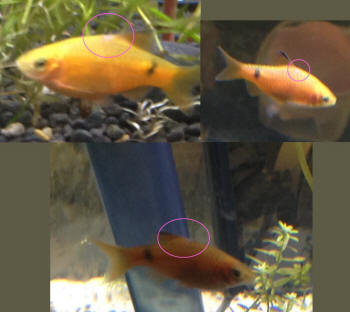
I'll include a picture to show the location of the spot, sorry I
couldn't get anything in focus. The affected fish was obviously very
stressed after he got back in the water and has been hiding (but
swimming normally when he can't see me) - I do think the spot looks
better already.
Originally I thought I had 3 females and 2 males but closer examination
suggests that I have 3 males and 2 females. I saw one male this morning
had staked out the java moss mesh and was "defending" it vigorously from
the other males, then desperately trying to entice the females to come
and have a look so it is possible there has been some territorial
fighting. I can't see anything that the fish could have caught himself
on to get an injury like that, unless he hit the edge of the java moss
mesh or got stuck in some plant roots? Anyway if there is anything else
I could be doing for the fish with the sore on his back, let me know.
<I think you're doing pretty much what I'd do.>
The baby fish are mostly doing well; some of them are still tiny but
seem correctly formed, a couple either have deformed tails or are
clamping their fins very tightly and I think one of the fish has a
humped spine.
<Normal. Mutations and deformities are common, but given these fish
produce hundreds of eggs at a time, presumably natural selection "weeds
out" those faulty fish very quickly. In the aquarium you may "take pity"
on these fish, but oftentimes such fish don't have nice lives, being
easily bullied or unable to feed normally, so balance kindness against
practicality.
Euthanising fry this small can be easily achieved by immersion in
ice-cold water, something I don't recommend for adult fish.>
The rest are growing at varying rates, with some looking like miniature
adults while others still are forming their organs and scales.
<Normal. Ideally, segregate by size, otherwise the smaller fish often
tend to lag behind so much, because they're getting pushed away from the
food, and so end up stunted.>
All but one are active with good appetites. Not too bad considering I
still have 10 of the 13 I thought I had; I was expecting more losses and
from what I've read, I understand a few runts/deformities are to be
expected.
Possibly some are due to injury since I was roughly agitating the gravel
to clean it before I realised there were fish fry in there! I'm
intending to move them to a new clean tank fairly soon so I will
probably separate out the runts then. I don't intend to euthanize any of
them yet since they don't seem to be suffering and they will probably
benefit from less competition from their fitter siblings.
Thanks in advance for your advice!
Bronwen
<Most welcome. Neale.> |
 |
|
Re: New to fish, Rosy Barbs 1/15/15
I've finally received the Metronidazole that I ordered. I am still seeing
stringy white droppings from the newer fish so I would like to try dosing
some in their food.
<A good idea. Do read here:
http://www.wetwebmedia.com/metranidazole.htm
Full instructions are given.>
The tablets are 200mg so would I be correct in dissolving half of one in
10ml of water to get a
<...??>
After I separated the biggest fry from the smallest fry, the "deformed" ones
unclamped their fins and now look normal. There is one fish whose tail lobes
aren't evenly proportioned and have a gentle curve but this one is one of
the larger of the
<A good result. As stated before, segregating fry on the basis of size will
improve your results when breeding fish. Cheers, Neale.>
Fwd: New to fish, Rosy Barbs 1/15/15
The largest of the baby fish has become a vicious hunter, patrolling the
tank for worms and trying to bite off the eyestalks of the poor snails in
his tank. He uses the same motion that the adult fish use to rip leaves off
the plants in their tanks. I've noticed the adult fish eating their plants
quite often but I haven't taken this as a cue to feed them more; perhaps it
is helping them with their digestive issues though because most of the fish,
most of the time, are producing normal droppings and the stringy stuff seems
to mostly be affecting one fish.
<Indeed, but fry do have large appetites, and can/should be fed 6-8 times a
day where possible. Barbs are equipped with short barbels, and it is in
their nature to snuffle about at the bottom for anything edible.>
Thanks for your continued assistance!
Bronwen
<Welcome. Neale.> Re: New to fish, Rosy Barbs
1/21/15
Hi Crew,
Me again! So far I have had no more barb fatalities although the fish
with the sore on his back seems like he may have a columnaris skin
infection. It healed slightly after the iodine swab but then got worse
so I have been using a peroxide bath to treat him as per
http://edis.ifas.ufl.edu/fa157
as I figure that even if it isn't columnaris it will help keep the wound
clean. He is on his second bath after a day off yesterday and I think it
is working, the wound does look better. The bath seems to stress him a
lot less than any other treatment I've tried, he's still active and
eating and hasn't died yet. It makes me wonder if the other fish I've
had that died had columnaris in their gills or internally. It would have
had to be one of the slow acting strains as I've had this fish for weeks
now and he hasn't died, or maybe it is less fatal if he only has it in
his skin?
<Would seem so.>
The injury is in the same position as the classic saddle ulcer. It is
still small compared to pictures I've seen, no more than 3mm square but
maybe 1mm deep.
I've inherited two more fish from my sister, she heard someone was
giving away some tetras and took them but it ended up being three
guppies, a head and tail light tetra and a penguin (hockey stick) tetra.
The latter two were not happy in her tank so I've taken them in. The
penguin tetra is very bossy and is even giving my barbs a run for their
money so I will most
likely try to find a new home for it and get some more HATL tetras so
that the singleton feels happier.
<I'd reflect on this a moment. The "False" Penguin Tetra (actually the
commonest species) also known as Thayeria boehlkei is an excellent
aquarium fish for casual hobbyists. It's undemanding, lives a long time,
tolerates hard water even though it prefers soft, and generally resists
disease well.
Singletons are bound to be pushy, but six or more specimens generally
behave themselves very well. Head-and-Tail Light Tetras are somewhat
more demanding, and do need soft, slightly acidic water to thrive. Their
colours are situation dependent too, whereas Thayeria boehlkei is
basically an in-your-face kind of fish. Head-and-Tail Light Tetras
really do need a shady, well planted tank to work well.>
He has some greenery to hide in and sometimes tries to school with the
barbs, they don't mind him too much but he'd be better with his own
kind.
He seems to have a single spot of what could be Ich on his tail so I am
trying the heat/salt method (2g per litre, 28C) for now as a precaution
before it spreads everywhere else. Hopefully the salt part of that will
counteract the heat side of things and not make the possible columnaris
infection worse.
<Salt/heat won't normally interact with other medications.>
I'm treating my main tank as a sick/hospital tank now as I haven't got
any tanks left with two lots of fry in my spares! The tank I'm using to
do the baths in has a crack in the acrylic and I would not trust it as a
long term tank, or else I would use it for isolating the sick fish. I
can see how in this hobby it is easy to end up with more and more
aquariums, necessary for
spares/quarantine/separating bullies and so on.
I would still like to get some Corydoras one day too, I'm thinking
Corydoras habrosus instead of paleatus as they are smaller and I'd like
to avoid overstocking, but as with the extra tetras I am not going to
get any more until I have resolved the illnesses and injuries in my
current fish.
<C. habrosus is a nice fish, but very small. For casual aquarists, the 5
cm/2 inch Corydoras species tend to be the best bets. Corydoras panda
and Corydoras trilineatus are two smallish species for community tanks.>
Thanks again for all the great info!
Cheers,
Bronwen
<Most welcome. Neale.>
|
|
New to fish, Rosy Barbs /RMF
12/18/14
Hi All,
This will be a bit of a long message as I'd like to describe the history
of these fish.
<Good>
A couple of months ago I inherited 3 rosy barbs from my sister,
who had bought them when tiny but found them too aggressive in
her tank as they grew. I was able to house
them in a planted tank which I had set up,
which was probably way too small, but they seemed happy and healthy and
liked exploring in the plants. I've been feeding them flake,
frozen
"tropical community" food and sometimes mosquito larvae from my backyard
pond.
<So far...>
As they grew I removed plants from half of the tank to give them more
room to move. As their tank was so small I did daily partial
water changes and the fish followed my efforts
to vacuum the gravel with great interest; I
really fell in love with their inquisitive nature! I did a lot of
reading to learn about how to give these fish
a healthy life (frequently ending up at WWM,
thanks for the great info).
<Welcome>
This led me to buy a bigger tank (120lt/35gal approx.) for them as soon
as I could, and I started cycling it using
waste water from the small tank. I planned to
get at least 3 more rosy barbs to let them school properly, then
once everything settled down maybe some Corydoras. I set up
plants in the new tank using ones removed from
the smaller tank, and bought a few extra for
more cover. By the time I obtained a water test kit, I was getting
readings of 0 ammonia and 0 nitrite and around 10 nitrate. I
decided it was time to move the fish into the
larger tank as it was bordering on cruel
keeping them in the small tank as they kept growing and growing. They
took to the new tank with glee and were soon
swimming up and down the lengths,
exploring the new plants, seemingly quite happy.
Well that only lasted a couple of days until something happened to spook
them and from that point they spent the whole time hiding in the
corner under their cloud of java moss or
zigzagging about in a panic. I tried turning
out the lights and then covering part of the tank, which helped a
little, but as soon as they notice anyone looking at them they go
and hide again. I resolved to set the small
tank up as a quarantine tank and get some more
barbs ASAP to let them be confident in a school; however when I
was cleaning that tank out I found my original three had spawned
at some point and there were 7 baby fish
living there. So, that became a nursery tank
and I had to set up yet another tank for the new fish. I had both a
sponge filter and hang on back filter so the HOB went to the
quarantine tank while the sponge filter stayed
in the nursery - the big tank has a trickle
filter built into the top.
<Am familiar... likely a Marineland product>
I bought the last 4 rosy barbs in the store, they seemed healthy and
active and acclimated to the quarantine tank
okay. I had planned to quarantine them for a
week or two at least but after a couple of days of continued
appearance of health I thought it better to put them in with the
stressed/spooked fish to try and reduce the stress levels in the
big tank; the idea being that being in a
larger tank in a larger school would be less
stressful for the new fish too and better all round, additionally I
didn't
have any other "established" fish that I needed to protect.
However this is when I noticed problem number one: one of my original
rosy barbs was doing strange white tear-shaped
droppings and seemed irritated while trying to
pass them. It made me think of tapeworm segments
<Did you look at these... proglottids... under a 'scope?>
as I saw a few droppings that seemed the same
size each time, and they seemed a meaty white,
not transparent. I started to wonder whether it wasn't worth
quarantining the new fish in case they caught something from the
old fish, however I really didn't want to
prolong the stress of the spooked fish and
ended up transferring the new arrivals across on the evening of Day 2.
Problem two: three of the four new fish started schooling with
the original three straight away while the
fourth one went off by itself. The final fish
still seemed active, healthy, no clamped fins or listless
behaviour, it just seemed to hang back from the others. However
the following morning this fish had died and
was floating belly up. I had a look but
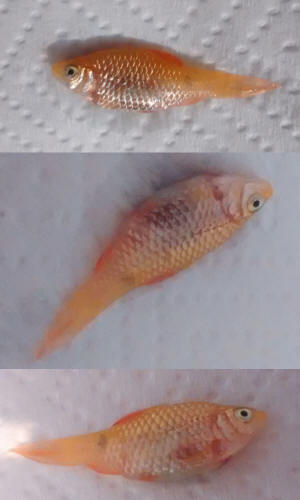
couldn't see anything too obvious beyond a little bloating and the
abdominal discolouration (see pic), which seemed to line up with
how the dead fish was floating. This was the
largest of the new fish so perhaps it was
already a little bloated when I got it, I'm not sure. I was a little
worried that this was something bacterial which would affect the
other fish but the remaining fish are still
alive and still seemingly healthy. I'd rather
not throw random possibly wrong medicine at fish who might not need
it but if there is value in treating the rest then I'd be
interested to know what I should do.
<Nothing so far>
The other fish do still spook very easily and hide in the corners,
although the two smallest new fish venture out
more than the rest. I'm being more careful
with how I move near the tank, and trying to make changes in their
lighting levels a bit less abrupt but I'm not sure what else I
can do to help them calm down and not stress
so much. Maybe they'll settle down with
time?
<What is the water temp. here?>
In fact if I stand in the doorway where they can't see me, I can see
them swimming around and picking at the bottom like normal, and
when I fed them some more wrigglers just now
they forgot to be shy altogether.
My water currently is 0 amm, 0 nitrite, 5 nitrate, pH is a little higher
than I'd like at 8-8.2 but the fish spawned successfully in it so
I haven't worried about pH very much apart
from trying to keep it around 8. Water
comes out the tap at pH 9.5 here
<Wow; I'd be using an RO device for my potable needs and blending about
half
of this RO with your source water for your aquarium>
and is a bit hard, I use a water ager to treat
chlorine/chloramine and API pH down to get the new water ready for
use.
<I see>
Back to the weird white droppings, its been about four days since I
noticed them and the same fish is still doing
them (and wasn't doing it back in the small
tank). I have had a sponge over the filter inlet strainer but when I
noticed one of the other fish pick at one of the weird droppings
that was stuck on the sponge to see if it was
food, I decided to take the sponge
off in hope that these droppings would get
sucked away properly and not eaten by my other
fish.
I've read that white droppings can be from stress, or
constipation as well
as worms.
<Yes>
I haven't seen any stringy or threadlike droppings; and I tried
feeding some smushed up pea which the rosy barbs all loved and
fought over but the same fish has still done
white droppings since then. I had the idea
that they might have caught something from the mosquito larvae that I
have fed them from the back yard, although at
this stage my pond doesn't have
anything but plants and snails in it so not sure where a parasite would
come from. I am not sure but I think one of the newer fish might
have done a similar dropping since they've
been in the tank together. Unfortunately I
haven't been able to get a picture but I would say these
droppings are the same length as a grain of
rice, about a quarter of the width, and are
tapered for almost the whole length. If you have any ideas as to what
this could be and whether it needs treatment
I'd be interested to know. I'm thinking about
putting a UV sterilizer in this tank to try and help
sanitize the water a bit, hard to find non-sales information on
whether these are worth the effort or not. Any
opinions?
<Mmm; yes. Though I'd like to see some images of the fecal material at
400 power, I'd likely try lacing their
food (to get a dose inside them) with both Metronidazole AND an
anthelminthic (Prazi/quantel likely). You can read re both and this
procedure on WWM>
A final word: I wasn't expecting any baby fish so soon, especially since
I'd read rosy barbs prefer acidic soft water to breed in not
alkaline hard water; and as far as I knew, my
fish were too young or too small to breed,
being about 4-5cm long. I already had a jar with some hornwort,
Ostracods, copepods and snails in and I assume
probably infusoria as well and have
been using water from this plus some powdered fry food to feed the baby
fish.
<Very good>
I've noticed previously that copepod nauplii and paramecium seem
attracted to light so I have a little LED light pointed at the
side of the tank to hopefully attract all the
food and the fry into the same place to help
them feed. I'm keeping water movement low to keep it easy for them to
move around.
Is there anything else I should do to successfully raise these
fish?
<Can't tell w/ the information provided>
If they all survive and I end up with a big school of 13 rosy barbs I
won't mind if there is no room for anything else in the main
tank. The local fish shop kept trying to sell
me tiger barbs instead of Rosies and didn't
seem to know much about them, seemingly only keeping them as feeder
fish but I love their personalities and think it's a shame that
people don't buy rosy barbs to keep instead of
goldfish as a first fish.
Thanks again for your time and your great site,
Bronwen
<Thank you for sharing. Am sending your note on to Neale here for his
independent assessment. Bob Fenner>
|
 |
|
Re New to fish, Rosy Barbs
12/19/14
Thanks for your quick reply Bob. The tank is unheated and sits
between 23C overnight and 25 C during the day.
<Ahh; I would definitely add a thermostatic aquarium heater here.
On hot days I add an extra air bubbler and prop
the lid of the tank ajar to allow for better cooling, so far this
has kept it under 26 C. I am going to try a fan on the waters surface
for hotter summer days (the room will be cooled as
well), and the tank should be cooler for the rest
of the year.
I haven't yet successfully retrieved a suspect dropping from the tank. I
turned the filter off for a bit during/after feeding time today
hoping to catch one, and two were produced but
before I could get them out they were eaten by
other fish (ugh). I don't have a scope but I've had some success
using a reversed webcam lens for magnified photography so I will
forward a
picture if I ever manage to get a specimen.
<Good>
I'll have to do some reading to work out dosages for food, I was
worried I might
not be able to get those medications in Australia but I have found
somewhere that sells Praziquantel (liquid) and
Metronidazole (powder) for
aquariums, and also conveniently stocks RO units. I
had suspected RO water would be necessary for
keeping anything beyond the most hardy beginner fish
so your advice helped me make my mind up on that front.
<Well; there are not surprisingly some fishes and
non-fish livestock (e.g. Rainbowfishes there, Malawi, Tanganyikan cichlids
and more.... that really enjoy hard, alkaline waters of high pH... but
better for many others to mix/blend as I state, and for your cooking,
drinking uses... RO is MUCH better. What I/we've used for decades here in S.
Cal. w/ our "liquid rock"
potable>
Thanks again for your help!
Bronwen
<Welcome. BobF>
New to fish, Rosy Barbs
/Neale
12/20/14
Hi All, This will be a bit of a long message as I'd like to describe the history
of these fish. A couple of months ago I inherited 3 rosy barbs from my sister,
who had bought them when tiny but found them too aggressive in her tank as they
grew. I was able to house them in a planted tank which I had set up, which was
probably way too small, but they seemed happy and
healthy and liked exploring in the plants. I've been feeding them flake, frozen
"tropical community" food and sometimes mosquito larvae from my backyard pond.
As they grew I removed plants from half of the tank to give them more room to
move. As their tank was so small I did daily partial water changes and the fish
followed my efforts to vacuum the gravel with
great interest; I really fell in love with their inquisitive nature! I did a lot
of reading to learn about how to give these fish a healthy life (frequently
ending up at WWM, thanks for the great info).
This led me to buy a bigger tank (120lt/35gal approx.) for them as soon as I
could, and I started cycling it using waste water from the small tank. I planned
to get at least 3 more rosy barbs to let them school properly, then once
everything settled down maybe some Corydoras. I set up plants in the new tank
using ones removed from the smaller tank, and bought a few extra for more cover.
By the time I obtained a water test kit, I was getting readings of 0 ammonia and
0 nitrite and around 10 nitrate. I decided it was time to move the fish into the
larger tank as it was bordering on cruel keeping them in the small tank as they
kept growing and growing. They took to the new tank with glee and were soon
swimming up and down the lengths,
exploring the new plants, seemingly quite happy.
Well that only lasted a couple of days until something happened to spook them
and from that point they spent the whole time hiding in the corner under their
cloud of java moss or zigzagging about in a panic. I tried turning out the
lights and then covering part of the tank, which helped a little, but as soon as
they notice anyone looking at them they go and hide again. I resolved to set the
small tank up as a quarantine tank and get some more barbs ASAP to let them be
confident in a school; however when I was cleaning that tank out I found my
original three had spawned at some point and there were 7 baby fish living
there. So, that became a nursery tank and I had to set up yet another tank for
the new fish. I had both a sponge filter and hang on back filter so the HOB went
to the quarantine tank while the sponge filter stayed in the nursery - the big
tank has a trickle filter built into the top.
I bought the last 4 rosy barbs in the store, they seemed healthy and active and
acclimated to the quarantine tank okay. I had planned to quarantine them for a
week or two at least but after a couple of days of continued appearance of
health I thought it better to put them in with the stressed/spooked fish to try
and reduce the stress levels in the big tank; the idea being that being in a
larger tank in a larger school would be less stressful for the new fish too and
better all round, additionally I didn't
have any other "established" fish that I needed to protect.
However this is when I noticed problem number one: one of my original rosy barbs
was doing strange white tear-shaped droppings and seemed irritated while trying
to pass them. It made me think of tapeworm segments as I saw a few droppings
that seemed the same size each time, and they seemed a meaty white, not
transparent. I started to wonder whether it wasn't worth quarantining the new
fish in case they caught something from the old fish, however I really didn't
want to prolong the stress of the spooked fish and ended up transferring the new
arrivals across on the evening of Day 2.
Problem two: three of the four new fish started schooling with the original
three straight away while the fourth one went off by itself.
<Hexamita and other intestinal parasites cause the gut lining to secrete extra
mucous. That's the clear to off-white stringy stuff that you see from the vent
of affected fish. It binds together the faeces, creating the classic 'stringy
faeces' associated with Hexamita and certain other parasites. Normally fish
faeces are short (few mm) and discrete pieces of brown material (or red, if fed
colour-enhancing foods) that falls away quickly from the vent of the fish.>
The final fish still seemed active, healthy, no clamped fins or listless
behaviour, it just seemed to hang back from the others. However the following
morning this fish had died and was floating belly up. I had a look but couldn't
see anything too obvious beyond a little bloating and the abdominal
discolouration (see pic), which seemed to line up with how the dead fish was
floating. This was the largest of the new fish so perhaps it was already a
little bloated when I got it, I'm not sure. I was a little worried that this was
something bacterial which would affect the other fish but the remaining fish are
still alive and still seemingly healthy. I'd rather not throw random possibly
wrong medicine at fish who might not need it but if there is value in treating
the rest then I'd be interested to know what I should do.
<Swelling of dead fish tells you nothing. Pretty much all dead fish do this.>
The other fish do still spook very easily and hide in the corners, although the
two smallest new fish venture out more than the rest. I'm being more careful
with how I move near the tank, and trying to make changes in their lighting
levels a bit less abrupt but I'm not sure what else I can do to help them calm
down and not stress so much. Maybe they'll settle down with
time? In fact if I stand in the doorway where they can't see me, I can see them
swimming around and picking at the bottom like normal, and when I fed them some
more wrigglers just now they forgot to be shy altogether.
<When fish becoming nervous or easily spooked, it's often a clue there's
environmental stress. Extreme pH and non-zero ammonia and nitrite are two common
causes. Review, and act accordingly.>
My water currently is 0 amm, 0 nitrite, 5 nitrate, pH is a little higher than
I'd like at 8-8.2 but the fish spawned successfully in it so I haven't worried
about pH very much apart from trying to keep it around 8. Water comes out the
tap at pH 9.5 here and is a bit hard, I use a water ager to treat
chlorine/chloramine and API pH down to get the new water ready for
use.
<Water conditioner is good, essential in fact. But pH down products are
pointless if you aren't also softening the water. Fish don't "feel" pH except
insofar as they react to changes in it. But what does affect them is the osmotic
pressure exerted by the medium around them -- in other words, the general
hardness. Adding pH down products uses up carbonate hardness
(similar to an acid + alkali neutralisation) but the product is a non-carbonate
salt, in other words, more general hardness! Do use your general hardness
(degrees dH) test kit and see what you have in the tank -- it won't be "soft
water" by any means.>
Back to the weird white droppings, its been about four days since I noticed them
and the same fish is still doing them (and wasn't doing it back in the small
tank). I have had a sponge over the filter inlet strainer but when I noticed one
of the other fish pick at one of the weird droppings that was stuck on the
sponge to see if it was food, I decided to take the sponge off
in hope that these droppings would get sucked away properly and not eaten by my
other fish.
I've read that white droppings can be from stress, or constipation as well as
worms. I haven't seen any stringy or threadlike droppings; and I tried feeding
some smushed up pea which the rosy barbs all loved and fought over but the same
fish has still done white droppings since then. I had the idea that they might
have caught something from the mosquito larvae that I have
fed them from the back yard, although at this stage my pond doesn't have
anything but plants and snails in it so not sure where a parasite would come
from. I am not sure but I think one of the newer fish might have done a similar
dropping since they've been in the tank together. Unfortunately I haven't been
able to get a picture but I would say these droppings are the
same length as a grain of rice, about a quarter of the width, and are tapered
for almost the whole length. If you have any ideas as to what this could be and
whether it needs treatment I'd be interested to know. I'm thinking about putting
a UV sterilizer in this tank to try and help sanitize the water a bit, hard to
find non-sales information on whether these are worth the effort or not. Any
opinions?
<UV filters do reduce certain problems, and prevent infections, but they
rarely/never cure already infected fish, and are expensive to run as well.
In freshwater tanks, outside of retail situations, they're almost never
worthwhile.>
A final word: I wasn't expecting any baby fish so soon, especially since I'd
read rosy barbs prefer acidic soft water to breed in not alkaline hard water;
and as far as I knew, my fish were too young or too small to breed, being about
4-5cm long. I already had a jar with some hornwort, Ostracods, copepods and
snails in and I assume probably infusoria as well and have been using water from
this plus some powdered fry food to feed the baby fish. I've noticed previously
that copepod nauplii and paramecium seem attracted to light so I have a little
LED light pointed at the side of the tank to hopefully attract all the food and
the fry into the same place to help them feed. I'm keeping water movement low to
keep it easy for them to
move around. Is there anything else I should do to successfully raise these
fish? If they all survive and I end up with a big school of 13 rosy barbs I
won't mind if there is no room for anything else in the main tank. The local
fish shop kept trying to sell me tiger barbs instead of Rosies and didn't seem
to know much about them, seemingly only keeping them as feeder fish but I love
their personalities and think it's a shame that people don't buy rosy barbs to
keep instead of goldfish as a first fish.
<Indeed. Rosy Barbs are great fish. However, they do need space (maybe
30 gallons upwards?) and they won't do well at high temperatures, 18-22 C/68-72
F is about right. So they aren't really tropical fish by any means.
They're also fairly boisterous and can be nippy. They don't like hard water.
I wouldn't mix them with Goldfish, though it has been done with the
more briskly moving varieties such as Standards and Comets. In any event,
rearing the fry isn't especially hard, but as with all baby fish, you have two
key issues: Small portions of food multiple times per day (ideally, 6-8)
otherwise starvation sets in very quickly, and secondly, frequent water changes,
since nitrate is much more toxic to fry than adult fish.
Most early failures with baby fish (first week or so) come from starvation,
while delayed failures (over the succeeding 6-8 weeks) come from poor
environmental quality.>
Thanks again for your time and your great site,
Bronwen
<Not sure there's an obvious answer to your woes. Bad luck aggravated by the
wrong water chemistry would seem likely. Wait and see what happens would be my
advice, treating as per Hexamita-type protozoan parasites rather than bacteria.
Good luck, Neale.>
Fwd: New to fish, Rosy Barbs 12/20/14
Thanks for the extra input Neale. I am definitely going to pursue RO water but
not with the company I thought I would. I did a bit more research and they have
a reputation for being a grey market importer with occasionally very poor
customer service. They have been the only supplier I could find for
Metronidazole based medication and from what I read, I believe they tamper with
the labels to get around the Metronidazole approval issue here in Australia. I
used the "choose your weapon" page to try for a substitute.
I didn't have much luck finding similar products to those listed so I took a
stab and guessed Protozin might be okay
<Possibly, but never found it much use myself.>
I found an alternative source for Praziquantel and in case Protozin doesn't work
on Hexamita I've read that Epsom salt soaked food can help. Protozin's
manufacturer Waterlife (I think?) don't publicise
their ingredients but they claim it is good vs. Protozoans and fungus so I hope
I was on the right track.
<Worth a shot anyway.>
As a temporary measure while I don't have RO water, would rainwater be a better
(softer) source for water changes? I was hesitant to use it due to the
possibility of dissolved metals from the tank or the plumbing but my sister has
a polyresin rainwater tank which should not have this problem. I do think you
are right and the hardness is an issue, I have been a bit lax
measuring the TDS of the tap water and was more concerned with pH thinking that
9.5 was too high and could burn the fish's gills or something. Our water comes
500km via pipeline from the treatment plant so it has plenty of time to dissolve
solids before it gets here.
<Indeed. Certainly worth using rainwater. I use rainwater myself. There are
variables and risks, but it can be economical and safe. Do read:
http://www.wetwebmedia.com/fwsubwebindex/fwsoftness.htm
Essentially, provided the water is collected from a non-toxic roof (slates or
tiles rather than chemically treated flat roofs for example) and channeled
through clean gutters and into a non-toxic barrel, you should be fine.>
I have had success doing a water change in my nursery tank using a spare
airstone in the tank for a kind of fry proof strainer on the front end of the
airline as the siphon hose. I think I read about this somewhere so I can't take
credit for this trick but I don't remember where. Every time I look there seem
to be more fry appearing, the latest count is 12. They seem to be developing
okay, some faster than others and I have been worried about starvation and have
probably ended up in over feeding territory. I will keep in mind that it is
important to keep their water clean.
<Quite so. Within a batch of fry it's often the case male fish grow faster than
females, and if the smaller females lose out on food, you'll end up with very
skewed sex ratios in the final batch of youngsters. Some hobbyists segregate fry
as they age, successively moving the biggest fry to alternative quarters.>
Cheers once again for your excellent assistance.
Bronwen.
<Glad to help. Neale.>
Re: Fwd: New to fish, Rosy Barbs
12/21/14
I still have not been able to retrieve a sample of the white material from a
fish yet but I have managed to film 3 fish showing white material dangling,
which I have uploaded to YouTube.
https://www.youtube.com/watch?v=OI5VI4XuJ28
<Indeed. Definitely white, stringy faeces. Irritation of the gut could be from
any number of causes. But treating as per intestinal protozoa makes some sense;
cf. Hexamita.>
The olive coloured, orangey/green and yellowy green fish in this video are the
oldest three, and the two yellow and one slightly more orange one are the
younger ones. The first fish shown is not the original fish I noticed with the
problem but seems to have picked it up too. It seems irritated by the dangling
material and does a bit of a flip to knock some of it off. In the second half of
the video the two fish are the younger ones from the new batch who have started
having the same white droppings and when one manages to lose a piece, you can
see the other one go for it as if it is food. I think in these 3 other fish the
pieces that are coming out are not as uniform as they were when I saw it from
the first fish, so it does look
less like uniform tapeworm packages coming out. Thought I should send this
update while I'm waiting for the medication I ordered to arrive in case it helps
narrow things down at all. I can't tell if the fish have irritated gills, they
do look red to me but I have no comparison to known healthy gills.
<Healthy gills are bright red, crimson. Damaged tissue will be off-white.
Post mortem gills turn burgundy. Pretty much as you'd expect for oxygenated
blood or otherwise.>
I have seen some worms free floating in the tank today, they seemed to wash out
of my filter when I turned it back on after doing a gravel clean. I believe they
are a kind of worm I have had before I ever had fish, in the water column they
hang in a C shape and occasionally oscillate one end wildly in an ineffective
attempt to swim. When stationary they use the hairs on each side of their body
to hold onto a surface, and then probe around with a narrow proboscis-like part,
or oscillate this end in the water I assume catching small food items. I also
spotted some barrel shaped flatworms, a hydra floating about, something very
tiny that inched along like a leech, and there are many odd little things stuck
on the glass. In fact it will be easier to link another video than trying to
describe these things to you, I have filmed this all through a reversed webcam
lens so it is magnified but I am not exactly sure by how much. At some point
some grains of sand are visible and the scale is about the same for everything I
filmed.
https://www.youtube.com/watch?v=nsbzniixUqk
I assume most of these things will die off when the tank is treated.
<I wouldn't assume that at all. Aquaria are host to any number of
benign, harmless flatworms and roundworms. These likely play a useful role in
aerating the substrate and breaking down organic material into soluble
nitrogenous compounds the filter can process. The assumption an aquarium should
be devoid of other animals beyond fish is akin to thinking a garden should be
without worms, ants, birds, etc.>
Cheers,
Bronwen
<And likewise. Neale.>
Re: New to fish, Rosy Barbs 12/21/14
Agreed, I like seeing other life in my tank and if it is all benign I would like
to save some and put it back in after medicating the tank. Not sure if this is
possible without re-contaminating things though.
<It's almost impossible to prevent re-contaminating an aquarium, hence
medicating the whole tank often makes more sense than isolating a fish and
medicating it in a hospital tank. On the other hand, many/most medications are
toxic themselves. So it's all about balancing risks, as with human health.
Cheers, Neale.> |
Rosy Barb pacing glass 11/2/14
Hi,
My name is Hayley i am writing you as i have 1 rosy barb left i did have 3 but
in my old tank my cat killed one and the second got some sort of swim bladder
issue now this last guys who looks very healthy ..constantly paces the glass
there is a jit of a mirror so the glass could this be stress or
due to him being the last rosy barb in my tank it is 35-40 gallon with about 9
other barbs he is about 2 inches i also have another type of striped barb that
is his size and sometime they hang out, the other fish are 1inch approx. as they
are newer any info would be great cant seem to find much when searching
Thanks Hayley
<Hello Hayley. Not quite sure what your question is. A singleton Rosy Barb won't
be very happy on its own, so yes, stress may be an issue. Other kinds of barbs
aren't going to be good company for it. Rosy Barbs need more Rosy Barbs,
certainly at least 5 in the group, preferably more females than males. Do also
note Rosy Barbs are subtropical, and don't do well (i.e., get sick) when kept
too warm. 18-22 C/64-72 F is ideal, and certainly no higher than 25 C/77 F. If
you must keep them in tropical conditions up to 25 C, then do at least ensure
they have plenty of oxygen. "Swim Bladder issues" isn't a thing. All it really
means, in a very hand-waving sort of way, is "my fish got sick, couldn't swim
properly, then died". So go back and review the aquarium. In particular, water
temperature and water quality. Rosy Barbs are usually quite hardy, but they are
(a) sensitive when kept too warm; and (b) highly social, prone to nipping other
fish and generally being bad if kept in too-small a group. Cheers, Neale.>
Re: Rosy Barb pacing glass 11/2/14
Hi Neale, thanks for all the info the fish stores here really don't have
employees that know much
<Unfortunate.>
i was planning on getting more rosy's but wanted to make sure something wasn't
spreading through my tank.
<Usually very hard to say. Waiting a couple weeks after a fish dies is a very
good idea, and problems should become obvious within that time. If, after two
weeks, everyone is basically fine and eating properly, you can go buy some more
fish with more confidence.>
i brought a water sample after doing my own basic test and they said it was
great.
<Good.>
So i was not to worried that it was a water quality issue i was told they like
temp of 75-80 :(... i have just turned my heater down after your info, i raised
the temp last month when told it was better if higher temp it was around 78
<Temperature depends a lot on the fish you have. Not all "tropical fish" come
from the tropics, and even in the tropics there's variation. Most aquarium books
will provide this information. A good default is 25 C/77 F,
but with the understanding that some species (Danios, Rosy Barbs, Swordtails,
Platies and almost all Corydoras for example) prefer cool water around 22-25
C/72-77F, while a few, such as Discus, are healthier a little warmer, say 28
C/82 F. As you can see, there's no happy medium for all these fish in the same
tank, but 25 C/77 F is usually a good starting point.>
but that is when shortly after my other rosy was sick and died the store told me
"some sort of swim bladder" problem that why i had said that but i really didn't
trust most of what they had said then i found your site and
it has way more helpful info so Thanks!! :)
<Glad you could find some useful information that helped.>
1 more question is there a good # off fish for my size of tank 35-40gal?
<Depends on the size of the fish! You could have maybe 30 Neons in there or just
one Humpbacked Pufferfish! The old "inch per gallon" rule isn't a bad start
though; it's a bit conservative, and only really applies to small fish in the
1-3 inch range, but you're unlikely to go too far wrong using it.>
I was told up to 35 but that seems crazy i have 9 barbs, 1 s.lucipinnis cat
fish, 2 smaller loaches and a pretty large Pleco about 4in to tail tip...and
that already seems like a lot to me?
<Well, let's see. Nine barbs, assuming these are around 3 inches each, that's 9
x 3 = 27 inches = 27 gallons. The Synodontis lucipinnis is another 3 inches, so
30 gallons. Couple small loaches at, say, 3 inches each, 6
inches together, for running total of 36 gallons. Another 4 inches for the Plec,
that's 40 gallons now. So assuming my estimates for the size of yours fishes
hold true, yes, your tank is probably more or less full now. If you wanted to
add different fish, perhaps to ensure schools of 6 barbs per species, you'd
probably want to rehome some of the livestock you have.
Alternatively, you could rehome some of the barbs that aren't in schools of 5-6
specimens, making space to add different species if you wanted, or to allow
growing room for the fish you have. Your Plec, if it's a Common Plec rather than
a Bristlenose Plec, will easily exceed 12 inches, likely up to 18 inches within
2 years, and in all honesty needs a much bigger tank than you have.>
I turned my oxygen up and he has stopped pacing for the most part! :) the temp
has started to come down a touch too.
<Cool. Note also that Synodontis lucipinnis prefers cooler water (22-24 C/72-75
F according to Planet Catfish) as do most barbs and loaches. Common Plecs will
do fine in that range, too.>
Thanks
Hayley
<Most welcome, Neale.>
Re: Rosy Barb pacing glass 11/3/14
Thanks again i did re-home my Pleco as after looking online his is a common
Pleco ....i have had him 3 years and didn't want him to go but know its better
for him... i actually got him when i had only a ten gallon tank :(
sad that the store said that tank size was good,
<Not uncommon situation. Bristlenose Plecs (which get to 10 cm/4 inches) should
really be the default. It's a shame Common Plecs are so widely sold. Not a good
choice 90% of the time.>
also re-homed some of the bards that were singletons?...
<May be sensible. A few barbs are okay on their own -- Spanner Barbs for example
-- but most are group animals.>
and got more rosy's and tigers for the ones i already had they all seem very
happy now in their schools :)
<A good result!>
glad i emailed you!!
Take care, Hayley
<Thanks for the kind words. Cheers, Neale.>
Rosy barbs 7/19/12
Hi Neale, how are you?
my aquarist brought 11 Rosy Barbs (instead of Cherry) what is your
opinion, I still have them in the bag, should I let them in my 2
Angelfish tank?
<I wouldn't. Two factors. The first is that Rosy Barbs are fin-nippers.
Perhaps not quite as notoriously as Tiger Barbs, but nippy nonetheless,
and Angels are classic targets. Secondly, Rosy Barbs are subtropical
fish.
They're much happier (and prettier) if kept at around room temperature,
maybe down to 18 C/64 F in winter, around 22 C/72 F in summer. As such,
they're great companions for subtropical fish like Bearded Corydoras,
Weather Loaches, some of the danios, etc.>
Thanks,
Lorena.
<Cheers, Neale.>
Redtail shark chasing rosy barbs
6/3/12
Hi, I have been in the aquarium hobby for four years now. I
upgraded tank size every year. Now I have a 60 gallon show tank,
which is 4 feet long, 13 inches deep and almost 2 feet tall. I
have had this tank for 8 months. It has 3 long veil angels (that
are 2 years old, so big and beautiful), 5 long finned and 4 short finned
rosy barbs (3 years old), 12 Rasboras (almost a year old), a Corydoras
nanus that is four years old and three peppered Corydoras (6 months
old), five blackskirt tetras (three years old), two Bristlenose Plecos
(one year old) and one Redtail shark (4 months old). The reason I
am giving you their age is because I want you to know that these fish
have been living peacefully together with no fin nipping.
<Real good.>
All your conversations about rosy barbs include fin nipping and I have
never seen my fish bother each other.
<If the comments were mine, they'd be about Rosy Barbs being nippy at
times. Not all Rosy Barbs nip at their tankmates, and those that do,
usually do so towards slow-moving fish, such as fancy Goldfish (being
subtropical rather than tropical fish, Rosy Barbs, there's the potential
there to mix them with Goldfish).>
It may be that my angels are so big that the Rosies and the blackskirts
won’t try anything because of that.
<I see. Do be aware that Rosy Barbs can get to a fair size, though
aquarium specimens do seem to top out at 8-10 cm, versus 15 cm in the
wild.>
But I recently (three weeks ago) added two small angels and no one
bothers them either. My question is about my Redtail shark.
When I introduced him, he entered the tank slowly going down, looking
everywhere and making his presence known; a real shark!
<Yes.>
The other fish looked at him but didn’t get close like they knew HE was
a shark.
<Well, not sure that's really what happened, but anyway…>
My Rosies are really curious and they usually go see who is new but they
didn’t with him. It was cool to see the hierarchy in the fish!
Anyway, he was peaceful and hiding before but since about a week, he has
been chasing my rosy barbs all over the tank. I am wondering if he
will stop that behavior when he gets bigger than them.
<Possibly. Red-Tail Sharks essentially view anything of similar size and
shape as a rival, and chase it away. That's why they're often fine with
Angels but less good with barbs or danios. Sometimes Red-Tail Sharks do
indeed settle down and all is well.>
They are about the same size right now but I know he will get bigger.
I had read about sharks before buying him because I wanted a compatible
shark.
<An unreliable choice in this case. The Rainbow Shark is generally less
aggressive than the Red-Tail Shark, though I admit, there isn't a huge
amount in it!>
He was described as the kind that would go in my peaceful tank and he
was in the beginning.
<Definitely not! Red-Tail Sharks are not "easy" community fish by any
means.>
Now my Rosies keep to the top half of the aquarium when they used to
swim all over. Will things improve or get worse?
<Impossible to say. Your tank is only just big enough for the Red-Tail
Shark (they hold territories that fully occupy 50-60 US gallons). With
luck, the Rosy Barbs will settle down and learn what part of the tank is
theirs, and the Red-Tail Shark likewise. But no guarantees! You could
try removing the shark, moving the rocks and plants about, and then
after 20 minutes or so, putting the shark back. Sometimes that resets
the hierarchy and minimises bullying. While you're at it, if your shark
has a favourite cave, move that cave into a corner, and break up
lines-of-sight as best you can with tall rocks and plants.>
Thank you for your time. Nicole
<Welcome, Neale.>
|
Worried about my rosy barbs /Neale
4/29/12
Hello, Crew!
<Mindy,>
I'm writing today because I am worried about 2 of my 4 rosy barbs.
Currently I have them in a 10 gallon quarantine tank with one small Pleco.
All of these fish were in the same tank at my fish supplier and I bought
them at the same time. I got them with the intention that they'll be placed
in my 50 gallon community tank after 30 days. [The Rosy barbs are to replace
several large tinfoil barbs that I had to give away when they out-grew the
tank, The Pleco replaces one that died at 26 inches (I'm guessing old age He
was about 18-20 years old)]
<Well done!>
The 10 gal. is heated and kept at 70 degrees.
<About right for this subtropical species.>
The filter cycles the water at 100 gallons per hour (it was the cheapest
carbon-cartridge I could find when my old filter crapped out.) I do not
have an aeration system. The tank is planted with two large leafy plants,
and I have several small/medium river rocks, some natural (cleaned)
sea-shells, and 3 tiny clay pots for decoration/hiding places.
<Okay.>
My concern is about my two female rosy barbs, They're both what a lot of
"pet stores" are calling "Lemon Rosies" because of their bright yellow
color, they have almost no silver sheen at all.
<I can see this. Very odd. To be honest, I'm not convinced this is Puntius
conchonius at all. The shape looks "off" to me, and I wonder if these are
some sort of hybrid.>
My supplier said this was normal for females in season.
<To be fair, Rosy Barbs do colour up in the summer when the water warms up,
and during the cooler winter, their colours do become fainter.>
I got the group about a week ago. I've been feeding them the same diet I
feed my other tank. (floating flake food in the morning one day, frozen
blood worms, mosquito larva or Beef heart in the morning the next, then back
to the flake) But Yesterday I noticed my females are "turning transparent" I
suppose. Their sides are getting see-through and I can see, for lack of a
better term, their guts. I have two photos, In one you can see very clearly
two dark spots inside the fish along with her swim bladder, In the other
it's not as clear but still visible (as these girls wont hold still.) If you
have any idea what this is from, I would appreciate an answer.
Thank you,
-Mindy
<I don't think there's anything "wrong" here as such, and your barbs look
perfectly healthy. I would simply watch and enjoy them for now. I agree,
they aren't classic female Puntius conchonius. I do feel these are a variety
produced on some fish farm in Southeast Asia, quite possibly a hybrid, and
right now you can't know what they'll end up as. Cheers, Neale.>
Worried about my rosy barbs. /RMF
4/29/12
Hello, Crew!
I'm writing today because I am worried about 2 of my 4 rosy barbs.
Currently I have them in a 10 gallon quarantine tank with one small Pleco.
All of These fish were in the same tank at my fish supplier and I bought
them at the same time. I got them with the intention that they'll be placed
in my 50 gallon community tank after 30 days. [The Rosy barbs are to replace
several large tinfoil barbs that I had to give away when they out-grew the
tank, The Pleco replaces one that died at 26 inches (I'm guessing old age He
was about 18-20 years old)]
<I'd get/use a much smaller species... perhaps of the genus Ancistrus>
The 10 gal. is heated and kept at 70 degrees. The filter cycles the water at
100 gallons per hour (it was the cheapest carbon-cartridge I could find when
my old filter crapped out.) I do not have an aeration system. The tank is
planted with two large leafy plants, and I have several small/medium river
rocks, some natural (cleaned) sea-shells, and 3 tiny clay pots for
decoration/hiding places.
My concern is about my two female rosy barbs, They're both what a lot of
"pet stores" are calling "Lemon Rosies" because of their bright yellow
color, they have almost no silver sheen at all. My supplier said this was
normal for females in season.
<About right>
I got the group about a week ago. I've been feeding them the same diet I
feed my other tank. (floating flake food in the morning one day, frozen
blood worms, mosquito larva or Beef heart in the morning the next, then back
to the flake)
<I'd drop the Blood/Sewer "worms" and beef>
But Yesterday I noticed my females are "turning transparent" I suppose.
Their sides are getting see-through and I can see, for lack of a better
term, their guts. I have two photos, In one you can see very clearly two
dark spots inside the fish along with her swim bladder, In the other it's
not as clear but still visible (as these girls wont hold still.) If you have
any idea what this is from, I would appreciate an answer.
Thank you,
-Mindy
<Don't think this is anything to worry re, and naught you can do...
genetic/developmental... Not a problem. Bob Fenner>
|
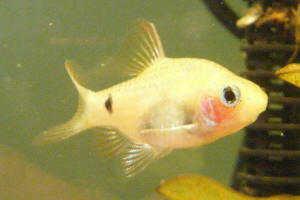
|
'Lazy' the Long-Tailed Rosy Barb,
mis-stocked barbs
2/23/12
Hello! First off, let me say how incredibly helpful your site has been
for me thus far! My question concerns one of my new long-tailed rosy
barbs, whom I've nicknamed 'Lazy'. I purchased him
yesterday along with another rosy,
<Mmm, best in groups>
2 tiger barbs,
<These too>
and 2 African dwarf frogs.
<Not compatible... will have a hard time feeding>
All have been doing well thus far in the 10 gal. aquarium.
<Yikes... too small a volume for these barb species. I'd trade
them in for smaller species: Cherries, Golds, Checkerboard...>
The current pH is at 7.4, and the temperature is a steady 76
degrees F. However, I found Lazy laying on the bottom of his tank when
I came home this afternoon. His respiration seems normal, and he still
swims to the top of the tank to eat, but will return to the gravel
right after. (I've been feeding them fish flakes and blood worms
for snacks). I can't help but be worried about him, Is this a
normal habit, or should I seek out some medical attention for him?
Thanks!
-Cammi
J.
<Not normal... again, you're mis-stocked here... Read re these
species needs on WWM and here:
http://www.wetwebmedia.com/FWSubWebIndex/stkgSmFWSysF.htm
and the linked files above. Bob
Fenner>
eye
condition afflicting one of my Rose Red Barbs
11/8/11
Hi Crew, got a question for you, on my Rose Red Barbs has an eye that
doesn't look right, The left eye looks fine but the right eye is
sunk in a little and the pupil is almost completely closed. any
ideas?
<Likely a physical injury... Really naught to do other than the
usual good conditions and nutrition. Bob
Fenner>
Bronze
Cory Help!!! 10/17/09
First off I want to say that your site has been a great deal of help.
As a first time fish owner I have used your site as a resource in
having a happy and thriving tank.
<Thanks for the kind words.>
I have had my 35 gallon fresh water tank since end of April. I followed
the beginner guidelines in circulating the tank before I put in any
fish. Right now I have four Rosey barbs, a rainbow shark, Pleco, and
three bronze Corys and so far haven't had any problems until
today.
<Sounds an interesting mix. While the Rosy Barbs and the Corydoras
both appreciate somewhat cool water, Rosy Barbs can be "fin
nippers" and work best in large groups (six or more specimens, a
mix of males and females) so they busy themselves chasing one another
around rather than other fish.
Rainbow Sharks can be feisty, and the Plec will get far too large for
this aquarium. So you will have some problems to fix before too
long.>
Icky, one of my Corys went missing this week. I searched the tank and
he was no where to be found. Today, we did a 60% water change and put
in some Columbian drift wood. After picking up a rock that was, until
today, thought to be a safe tank decoration - out zooms icky the Cory
catfish looking pretty rough. For the first couple of minutes of being
free from his confines he was laying on his side. After a little more
time passed he's sitting in his natural stationary, but upright,
position. It looks as though the barbs made a meal of a few of his
fins, and he has several spots that have been worn from trying to
wiggle out from beneath the rock.
<Yes: Rosy Barbs will indeed nip at fish. For whatever reason,
Corydoras are "sitting ducks" where nippy fish are concerned.
I find that whereas Plecs and Synodontis keep out of the way, every
time I've kept Corydoras with, say, Puffers or Ameca splendens,
they've had their dorsal fins nipped.>
It looks as though he's on the track of pulling through, but you
never know with fish. Do you have any advice on how to treat this
situation?
<Beyond clean water, I'd not do anything else apart from
separate them.
Corydoras fins heal very quickly, and like many catfish, they're
likely to react badly to copper or formalin, so I wouldn't use
either unless I absolutely had to. So move the school of Corydoras to
an aquarium of their own, something 20 gallons upwards, and let them
settle down and be happy.
Rosy Barbs sound like a poor choice of tankmate here. You might even
get rid of the Rosy Barbs; when all is said and done, they're big
fish (up to 15 cm/6 inches) not suited to 35 gallon tanks.>
I'm worried that icky may not make it.
Thanks!!!
Kristin
<Cheers, Neale.>
Re:
Bronze Cory Help!!! 10/17/09
The Rosey barbs and the Corys get along, they really mind to themselves
or get chased every once in a while by the shark. Luckily the only
issue we have had with the barbs is that they chase and nip at each
other.
<What they do. If kept in large groups, six or more, and ideally
more females (yellow-green) than males (pink) then they tend to settle
down. In the right tank, a spacious subtropical system, they're
superb fish.>
We are fairly certain that the reason why icky the Cory cat has had a
good amount of his fins nipped off is because he was literally stuck
under the rock but the barbs could still get to him.
<Whether he got stuck under the rock, or was hiding to avoid being
nipped, is difficult to answer. Both explanations are
possibilities.>
Right now the rough looking Cory looks as if he is acting normal, but
he really looks rather rough.
<Indeed. Usually, Corydoras heal very well. The common species like
Bronze and Peppered Corydoras have become so popular precisely because
they are so durable.>
We know of the issue with the Pleco out growing our tank. We have a
home for him when he gets big enough in a 300 gallon brackish cichlid
tank at a restaurant that we frequent.
<A home perhaps, but a bad one. Plecs ARE NOT brackish water
fish.>
There is also a home for him at the koi fish pond at the local
botanical gardens.
<Unless this Koi pond is somewhere tropical, then that's not an
option either. These fish die when exposed to water temperatures below
20 C (68 F) for any length of time. In the US for example, Southern
Florida is the only place where these fish are likely to survive
outdoors in an unheated pond.>
We've made sure that he will have a place to go when we can no
longer care for him.
<Hmm... not impressed so far with the options.>
Looks as if we'll just have to wait and see how icky fairs. Keep
your fingers crossed for us! Thanks for the tips!
<Happy to help.>
Also, about the barbs - we'll definitely consider trading them in
for more suitable tank mates. Any recommendations??
<Depends, and the thing with many schooling fish is that if you
don't keep enough, many species can become nasty, even Danios. One
of the single best schooling fish species in the trade is the X-Ray
Tetra (Pristella maxillaris). This species is very hardy and very
peaceful; it is also rather pretty. I don't care much for the
albino form, but it exists if that sort of thing amuses.>
Much appreciation, Kristin
<Cheers, Neale.>
Flipping
Rosey Barb - 6/20/08 Hi, My Rosey barb will be swimming normal,
then just start flipping and spinning, then go back to swimming normal
again. Sometimes it's just 1 or 2 flips, other times it goes on for
about 15 seconds. She (?) appears to be fine otherwise. Her appetite is
good. I thought maybe she was constipated, so I tried giving peas for
the dinnertime feedings for a week. (Morning feedings are either flakes
or shrimp pellets.) She loved the peas, but it didn't stop the
flipping. She shares the 40 gallon tank with a Pleco, 4 adult platies
and 12 baby platies. The platies and Pleco are all fine. The water temp
is 80, the nitrate is 0, nitrite is 0, water is soft, alkalinity is 80
and the pH is 7.0. I change the filter and 25% of the water weekly. The
flipping has been going on for about 2 months. Any suggestions? Lisa
<Hello Lisa. There are diseases that can make fish swim in odd ways,
such as the 'Whirling Disease' caused by Myxobolus cerebralis,
but to be honest these are rather uncommon, and usually introduced via
live foods (especially Tubifex) and don't get "caught" by
jumping between fish in aquaria. That's why they don't just
appear out of nowhere. Also, given this fish has exhibited these
symptoms for 2 months and remains otherwise healthy, I'm more
inclined to put this down to (perhaps) genetics or nervous system
damage. If she remains happy, then just assume she's a bit quirky,
and love her all the more because of it. Cheers,
Neale.>
|
Mysterious ailment, Rosy Barbs 1/15/08 Hi
Crew, <Leah,> I've been researching the internet for
hours trying to diagnose my new fish. You guys (well mostly
Neale) have helped me a lot in the past, so I'm hoping you
can give me some advice now as well. I recently purchased 10 rosy
barbs, 3 of which are a gold colored variety. They were labeled
gold rosy barbs in the store, and they are identical in all
respects to the regular rosy ones except for the coloration, and
these 3 were housed in a different tank in the store. <Hmm...
sure these aren't just females? Male Rosy Barbs are
orangey-pink, females greenish-gold.> Having learned from my
numerous past mistakes, I am quarantining all my new barbs before
moving them into my main 55-gallon tank. I bought them last
night. As of this afternoon, one of the gold rosy barbs seems
ill. It hovers in one place, either near the bottom or middle of
the tank, and does not interact with the other fish (all of whom
are, so far, active and healthy looking). It moves its gills
rapidly and--here's the weird part--its mouth seems stuck
open. <Have seen this before. Sometimes caused by the jaws
being dislocated, but other times genetic: these fish are bred in
ponds, and often with little by way of quality control. Do check
to see if the jaw is deformed (e.g., too short) rather than stuck
open. On the other hand, given the hyper-ventilation of the gill
cavity, it is entirely possible we're looking at a fish that
is "suffocating" in some way.> That is, it is not
gasping for water; rather, it does not move its mouth at all. I
read online that barbs are susceptible to velvet, so this is my
first guess. <Few fish aren't sensitive to Velvet;
regardless, problems with breathing are a typical early symptom
because the velvet parasite often attacks the gill membranes
before it attacks any other part of the fish. So you can have a
fish suffering from Velvet but not exhibiting any other external
symptoms, such as the icing-sugar powder we typically associate
with the disease.> However, there is no flashing among any of
the fish, and the sick one does not have clamped fins. It moves
its tail and fins actively, although it does not move from the
spot where it hovers. It does not appear to have any visible
velvet patches, but this fish is already a metallic gold color,
so the velvet might be hard to see. <Indeed. I'd treat for
Velvet anyway, just to be on the safe side. Barbs aren't
sensitive to copper or formalin, so this should work fine.>
The only symptoms seem to be the gill movement, the open mouth,
and the staying in one spot. No other fish is (again, so far)
showing these symptoms. Ammonia, nitrite, and nitrate are 0. What
should I do? I have CopperSafe as well as salt on hand. Should I
leave the sick fish alone or treat the tank? <Treat all the
new Barbs. If one has it, the others will have it by now, even if
they are not yet showing symptoms.> Should I remove the sick
fish? <Not yet. With schooling fish especially, moving sick
fish often stresses them, reducing the odds of a good
recovery.> The problem with that would be that I don't
have another filter for another hospital tank. Your advice is
greatly appreciated. --Leah <Hope this helps,
Neale.>
Re: Mysterious ailment
1/15/08 Hi Neale, thanks for the help. Unfortunately the one
little gold one didn't make it, but I've treated the
quarantine tank with CopperSafe, so now I'll just have to
wait and see how the others fare. <Hi Leah. Sorry about the
loss.> Thank goodness I quarantined. <Indeed.> I have
one follow up question about the gender of my fish. You suggested
that the gold ones are females, and after looking at photos
online, I agree. I did actually research this before going to the
pet store, because I wanted a group of fish containing about 2
females per every male, after reading numerous sites saying this
grouping reduces aggression. When I got to the store and saw the
2 types of barbs in 2 different tanks, I asked the guy working
there if they were the same fish, and if they would school
together. He answered no to both questions. <Then probably
doesn't know very much about fish! Rosy barbs of both sexes
have a very distinctive look to them, in particular the big,
metallic scales. While there are "true" Golden Barbs in
the hobby of various species, to the best of my knowledge, they
don't have the big scales.
http://www.fishbase.org/summary/speciessummary.php?id=4714 The
black spot close to the base of the tail is typical of the
species, at least in its wild state.> When I told him I wanted
more females than males, he told me that the "duller"
rosy barbs were females. Now that I've got them home and
thought about this, I believe the duller one are simply younger
males. <This much is certainly true: Rosy Barbs don't get
their full colours until they're mature, and that's well
up to 14 cm/5.5" in length, much bigger than you see them in
the shops.> I also believe this pet store guy didn't have
a clue about the fish he was selling :) <Quelle surprise.>
Anyway, I bought 7 rosy barbs, plus the last 3 of the gold rosy
barbs the store had, mainly because I knew they are a schooling
fish and I felt sorry for the remaining 3. I hoped they would all
school together, contrary to what the employee said. And, of
course, they do because they are all the same species. But will I
have aggression problems with my group of 7 males and 2 females?
Are such problems inevitable, or does it depend on the
individuals' temperaments? <Depends on many factors other
than sheer numbers, though I dare say trying to swap some males
for females, or add some more females as and when, would
help.> I don't believe these guys are sexually mature yet,
but do you think the dead female was already the victim of male
aggression? <Unlikely.> Thanks again. (PS - I was browsing
magazines in a bookstore last week, flipping through Tropical
Fish Hobbyist, and there you were! Good article!) <Thanks, and
happy to help.
Neale.>
Re:
Mysterious ailment, new long-fin rosy barbs
1/25/08 Hi Neale, <Hello again,> I have a follow-up
question regarding my new long-fin rosy barbs, who are still in
qt. Back on Jan. 15, after one fish died and I suspected velvet,
I added CopperSafe at the recommended dosage (5 ml per 4 gal).
Since then I've been doing a 20% water change every day, or
every other day, to keep the water quality high, and I've
been replacing the CopperSafe accordingly. <Hmm... this
isn't usually what you need to do. Copper-medications break
down very quickly, typically within 24 hours. If you "top
up" the amount when you do a water change the next day,
you're effectively adding an extra dose rather than replacing
what's already there, because the stuff you put in earlier
has broken down. Hence you have to be very careful. It's
normally recommended you lay off water changes through courses of
medication so that the precise dose is as per the
manufacturer's intentions. Copper is toxic to everything,
even fish, so you need to balance the dose between toxicity to
the pathogen and toxicity to the fish.> I have the API copper
test kit, which tests for chelated copper such as what's in
CopperSafe, but of all the hard-to-read color scales, this one
takes the cake. However I do believe that I am between 1 and 2
ppm, which is within the levels CopperSafe claims to produce.
<OK.> As of today, Jan. 24th, there have been no other
symptoms of velvet. However, I have been seeing what may be Ich,
although it is very difficult to tell on these fish since they
are iridescent. There are two fish with one white spot each, one
on a tail fin and one on a stomach fin (not the scientific name
for that one, I know), <It's the anal fin if unpaired, and
the pelvic fins if paired.> but neither of these spots are
unambiguously Ich spots, and I've been noticing them now for
at least 6 days. <Ick/Whitespot looks like grains of salt;
velvet tends to be golden rather than white, though not always,
but the cysts look like icing sugar.> They could just be the
fishes' coloration. My question: How long is it safe to keep
the CopperSafe in the water? I've read online that it's
potentially very toxic, especially when improperly dosed.
<Correct. You want to use the minimum amount. I'd
recommend doing one course of the medication, then at least two
50% water changes before beginning a second course. Do remember
Velvet and Ick/Whitespot are only killed once the parasites
become free swimming -- the cysts on the fish are
untreatable.> I measure accurately, but that test kit gives me
no peace of mind. I've considered switching to Rid-Ich+,
which I've used successfully in the past, but I haven't
because 1) I'm not sure it's Ich; and 2) I don't want
to lose time on the Ich cycle trying to remove the CopperSafe
before using the Rid-Ich+. <I tend to choose (and recommend)
medications that work against Velvet and Ick equally well. There
are several such medications.> I should add that I also have 1
tsp of salt per gallon in the tank, which I added because I read
that it was ok to use with copper, and because some of the
long-fin barbs have torn fins. They came from the pet store this
way. I'm not sure if it's fin rot, but I read that salt
and clean water may do as much good as antibiotics, so I added
the salt to be safe. <Hmm... not sure salt is "as
good" as antibiotics, but salt will (perhaps) inhibit
infections from getting started and it does moderate any osmotic
stress caused by the break in the epidermis.> (I should say,
too, that, so far, my biological filter has been ok, and ammonia
and nitrites are 0, nitrates around 10). So now I'm just
wondering how long to keep my barbs exposed to the copper.
<I'd run one full course -- no water changes during it --
and then wait a few days. If no result, run a second course with
the same brand of medication. There are some resistant Ick
strains that need two course to be dealt with. Wait a few more
days. If *still* no improvement, try a different medication or
therapy, perhaps the salt + warm water option described elsewhere
on this site.> I don't want to harm them with the
medication. Thanks for your help! Leah <Cheers,
Neale.>
Re:
Mysterious ailment 1/25/08 Hi Neale, thanks for the
information. I'm a bit worried now about the amount of water
changes I've been doing. The CopperSafe package says that its
chelated copper is very "stable" and that one dose of
CopperSafe will treat the water for over one month. <Hmm...
I'm not familiar with this medication, so I'd tend to be
cautious here. Add the required amount. Wait a week. Do 25-50%
water change as per normal. Since you have a copper test kit,
test the copper level. If it's within the safe zone, add
another dose. Repeat as required. In a tropical aquarium, the Ick
cysts mature in about 3 days; after that point, the parasites are
vulnerable to the copper and should be killed quite quickly.>
Other than that, it doesn't recommend a set
"course" of treatment. Would one course be, then, just
what I observe when looking for signs that the Ich cycle is
complete? <Pretty much.> It's the "treats water
for one month" claim that's confusing me, because I
don't want to just leave it in the water indefinitely when
the symptoms of any illness are still unclear. I'll wait to
hear from you, but I'm thinking that since the water's
been treated for 10 days now, I may run some carbon today and
start removing the CopperSafe. <Sounds fair to me. Actually,
remind me again what fish we're talking about here. Rosy
barbs? I'd probably go with heat + salt and be done with
CopperSafe. 2-3 teaspoons of salt per US gallon, with temperature
at least 82F. Make the water and temp changes gradual (couple
days) and leave running thus for at least 7 days. Then slowly
return things to normal. This is the standard approach for
dealing with Ick on things like Clown Loaches which tolerate
copper poorly.> I'll then wait and see if what may or may
not be Ich materializes any further, and then switch to a
different treatment if it does. Thanks again. <Cheers,
Neale.>
|
Type of Catfish Compatible with Rosey Barbs
1/5/08 Hello, <Hello Vera,> First of all, thank you for being
such a wonderful information source! I've been reading the web site
for some time now although I cannot find any exact advice regarding my
issue. <Oh...?> I have a 14 gallon tank with 4 Rosey barbs that
has a brown algae outbreak. Two days ago, I returned home to find the
heater "cranked up" to 90 degrees F. Luckily, the barbs all
survived but the brown algae is becoming worse. <Hmm... 14 gallons a
bit small for Rosy Barbs (Puntius conchonius); maximum size is 15
cm/6", though typically only about half that in aquaria.> I
purchased an Emerald Corydoras but the barbs attacked him so bad that I
moved him to another tank with 3 bronze Corydoras. <Very unusual
behaviour. Usually these barbs are quite well behaved. Ordinarily,
I'd expect subtropical Corydoras (e.g., Peppered, Bronze, Bearded
Corydoras) to do well with Rosy Barbs.> Do you advise getting an
algae eater for this issue or attempting to treat the algae. <The
easiest way to treat algae is to improve the growth of live plants by
adding more light. Floating plants are easiest for this, but any
fast-growing plants will do. Algae-eaters generally have moderate to no
effect, and in the long term only increase the pollutants in the water,
helping algae grow faster. Besides, your tank is a bit overstocked
already.> I have performed a 50% water change; and turned the
temperature down to 76 degrees F. <Too warm: these are subtropical
barbs. Aim for 20C/68F.> The tank has plastic plants, a resin tree
stump, a "real" rock from an established tank and light
colored medium river stone. Thank you so much for the assistance!! Vera
Have a good day! <Happy to help. Cheers, Neale.>
Ich and the scaleless barb
8/14/07 Dear WWM Crew, <<Dear Claire. Tom here this
afternoon.>> Congratulations on your fantastic and informative
site - it has been an invaluable resource as I set up my first tropical
tank. <<Very glad to hear it, Claire.>> Unfortunately that
tank has now come down with Ich (due to an unquarantined new arrival -
long story, and I've learned my lesson...) - I saw one or two spots
on fins this evening. <<An Ich infestation is a pain in the
backside to have to deal with but its a far cry from other problems
that might have occurred. Sorry you learned the hard way but all of us
have learned something in this hobby the hard way so welcome to our
club.>> I have Nox-ich to treat it with but would like some
advice on dosage, due to the presence of a 'mutant' fish. The
tank contains 6 female rosy barbs (rescued feeder fish), five tetras
and a Bristlenose catfish (gradual stocking still in progress). One of
the rosy barbs has no scales. <<Hello? Haven't heard of that one,
Claire. Interesting>> She is in all other respects a perfectly
healthy (before the Ich) and active fish. I assume the lack of scales
means that I should treat the tank at a lower dosage level, but would
like your input before I do. <<Not to send you back to the LFS
unnecessarily, Claire, but neither your Tetras nor your Bristlenose
Pleco are going to appreciate the Nox-Ich formula which contains sodium
chloride (salt) and malachite green as its active ingredients. Even at
half-dosages you really be putting yourself on aquarium watch for
signs of stress with your pets. Additionally, as I see below, you have
a planted tank. Plants don't much care for salt, either. I don't want you
wasting time here nor your money but Kordon's Rid-Ich may be the better
choice of medications given the circumstances. Its a combination of
malachite green and formalin but, in combination, at lesser
concentrations than would be found with other medications using one, or
the other, exclusively or nearly so. In combination with each other,
these are very effective even when dosing down (one-half the
prescribed) because of scaleless fish.>> Tank stats: 150 litres,
live plants pH 7.4 ammonia and nitrites nil nitrates 5 Thanks! Claire.
<<Tank stats look quite good, Claire. Be sure to read the
directions of any medication carefully and followed them to the letter.
Best of luck. Tom>>
|
Breeding Kribs, aggressive/sick
barb 4/26/06 Greetings Staff- FYI - I have a 54
gallon tank with UGF (I'm old school), AquaClear
300, and a Penguin BioWheel 200 (I might be old school, but I
love redundancy). Temp 78, water conditions good - Tap water here
in Portland, Oregon is great for our fish - they
LOVE IT! <Ah, good.> General
community tank with tetras, loaches, a pair of angelfish, and
some white clouds, etc. I vacuum once a week and clean out one of
the two hang-on filters once a week (oh yeah, and change 10 -15%
per week). It's planted with Anubias, amazons, Bacopa (for
the fish to eat), and Cabomba (I LOVE saying that:
CA-BOMB-A). <Heh!> 1. I have a pair of
Pelvivachromis pulcher who were a 'mating pair' when we
bought them. I don't know if they successfully
bred at the LFS; but they were clearly pair bonded. After an Ich
outbreak last fall their pair bond deteriorated. I am sure 16
days in quarantine was not romantic. We think the Ich was due to
a dip in tank temps one day we had the window next to the tank
open and it got chilled; I am now really careful about opening
the window when it is not warm enough. The female still displays
for the male, but he seems uninterested in her shameless
flirting. We provided several 'condos' for
them to select for their boudoir. Would adding another female
excite the male? <Possibly, yes.> If a new girl was added
would we have to remove the other? Could they just
work it out with time? I am not really looking set up
a breeding tank; just to see them restored to their original
state. Sure it would be cool if they raised a few fry;
but I am not trying to go nutso or anything. <Once
the pair is bonded, the "leftover" female would likely
have to be removed.> 2. I had a very naughty male rosy barb (
http://www.fishbase.org/Eschmeyer/EschPiscesSummary.cfm?ID=4714
) who harassed one of his girlfriends into her grave (we had a
set of three females and one male). After she died he
became the bully of the tank - taking off one of the rays of an
angelfish and scales off of anyone who got too close to
him. We went to our LFS and asked them for a larger
female who might help calm him down. We came home with
Brunhilda, named at the LFS because of her size (a hefty 3.5
inches nose to tail!) <Holy mackinaw!> and because she was
a favorite of the staff. She, to put it lightly
(hah!), is huge. She definitely seemed to school the
male - yes another bad pun (although he still always wears his
full mating regalia) and things have been peaceful for several
weeks. <Ah, good.> Overnight she developed a large (7 mm
square) wound on one flank just above the tale - I have some OK
pictures of it - it looks larger and scarier in real
life. <Yeeee-ikes! I am given to think
you didn't quarantine her prior to adding her to the
tank??> It was initially bloody and swollen. I also
discovered that another of the harem had a similar (though much
smaller) wound near her anal-genital area - photos also
included. I have set up a QT, out as yet both seem
healthy and happy aside from their wounds. Other than keeping
water quality as perfect as possible and keeping a weather eye on
them, is there anything else I can do? <I would consider
medicating this.... it's pretty significant. If
you cannot remove the injured animals to a quarantine system for
treatment, please consider a food medicated with Oxytetracycline
rather than medicating your main tank; an online store called
"Florida Guppies Plus" (Google that) sells one such
product.> Would adding additional females diffuse his
aggression or give him more targets? <Possibly.... but no
guarantee. He doesn't read the books,
y'know.> Our QT would be a bucket with a small BioWheel,
heater, and some shelter. I do not want to medicate,
or traumatize them by netting and QTing them unless
necessary. <Either risk it, or obtain a medicated
flake food for them.> Could it be that Mr. Rosy Barb (his
common name in our house is unprintable) <HAH!!> got up his
gumption and made a run at these two females <Possibly, though
it is also possible that Brunhilda brought a bacterial infection
with her and shared it with the other damaged female.> that
resulted in some rough sex - was it rape??!!? <Likely not, no
worries.> Should I report his randy behavior to the
authorities? <CSI Aquarium?> Photo of
Brunhilda's and other female wounds attached and I am also
including my photobucket link: http://s33.photobucket.com/albums/d98/leahfranceswade/Brunhildas%20trauma/
<Good, clear images. Thank you for sharing
these.> (I included one pic of my Krib female (I think
she's a kinke, she's so pretty). <Pretty
indeed.> PS the female rosy barbs have been decimating the
Black Beard Algae (Audouinella?) that grows in our tank in the
winter (lower sun angle = more direct sunlight on the
tank. They keep it totally in check.
<Excellent!> Thanks and keep up the good work.
<And thank you for your kind words.> And I forgot to say,
"Long time reader, first time emailer." <Glad to
hear from you.> Sincerely, Leah Frances Wade <Wishing you
well, -Sabrina>
|
|
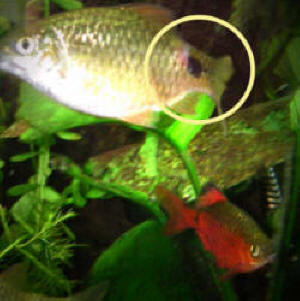 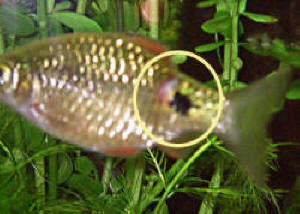 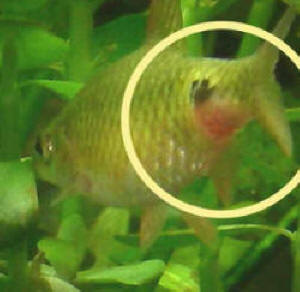
|
Rosy Barbs and Tiger Barbs Oh My! I am new to fishkeeping and
I have questions about the tiger barbs. I have started with 4 tigers to
cycle the tank and I discovered that I like them. <A very nice fish,
a little nippy at times, but pretty.> At the instruction of my
dealer I have 3 rosy barbs in my quarantine tank waiting to go in the
main tank <Be still my beating heart! You have a quarantine tank for
your freshwater display. God bless you sir! You will surely be
rewarded!> instead of buying 2 or 3 more tigers as most books
suggest. <I would be happy as long as you have three or more.> He
says its because I have only a 29 gallon tank and there won't be
enough room for other fish if the schools are too big. <A fair
point.> He also says that since they are in the same family the
Rosies and the tigers will not harm each other. <I would prefer to
put it as they will be able to put up with each other's abuse.>
I am a little skeptical. Is 4 ok for a school of tigers? <Sure>
Is 3 ok for Rosie's? <Yes, these are a little less prone to
school, at least not as tightly as the Tiger Barbs.> Is it boring to
have just 2 or 3 schools swimming around? <You will be able to fit
more than these seven fish in your tank.> I don't want the tank
to look too "busy". Also, what other fish do you suggest
adding for variety? Stephen <Giant Danios are another of my
favorites. Various Gouramis would work, too. -Steven Pro>
Rosy Barbs and Tiger Barbs Oh My! II Hey Steven, thanks for
replying so fast! <No sweat, you caught me at a good time.> Do
you think fish look better in larger schools? <I think schooling
fish should be kept in schools. Depending on the size of the tank, a
large, tight school of fish is impressive to me.> About the
quarantine tank: My dealer is reputable. Their tanks look great and the
Rosies looked healthy all 4 times I visited the store in the past
month. How long do they need to be in my quarantine tank? <Two weeks
in perfect condition minimum for QT to be effective.> I see that you
find various Gouramis compatible with tigers. Most books say the same,
but the stores all say not to do it. Why? <You would have to ask
them.> I would love to have one. Is it the blue and gold Gouramis
(Trichogaster trichopterus) that are tough enough to deal with the
barbs? <These are the most common ones and the ones I use often.>
Thanks! Stephen <You are welcome. -Steven Pro>
Rosy barb 3 years old,, turned gray,, acts normal should
isolate? <if acquired as an adult, the change may be "old
age". Else diet related. Unlikely that QT is necessary, but do so
if convenient if and until further symptoms are observed. Also try some
color enhancing food pellets. If your diet for the fishes has been dry
food only, this is a problem. Do add a variety of frozen fare as well
(bloodworms for example... but never brine shrimp... nutritively poor!)
Best regards, Anthony>
Barb Sickness I have a ten gallon tank. I have two rosy
barbs, three guppies, three platys, one snail, one Otocinclus, and two
African dwarf frogs, two plants. After a bad start, everything is going
well. Three days ago one of my barbs turns up with what looks like a
big red zit near the base of his back bone near his tale. No other fish
are sick and he seems to be fine eating and all that. Do you have any
idea what it is? I think it's probably a parasite. What's your
take and what do I treat with? I am pretty much limited to anything
from Mardel. Annie M. <Could be several things. Probably not
parasitic although it could be an anchor worm. Do you see something
coming out of the eruption? Anchor worms are more common is pond fish,
though. More likely bacterial in nature and a broad spectrum antibiotic
is your best course of action. -Steven Pro>
Long-Finned Red Rosie Barbs vs.. Peaceful 29 Gallon
Community Dear Bob Fenner, <Anthony Calfo in your
service> I was delighted when I found your WetWebMedia website
yesterday. I found it very informative and very helpful. I thank you!
In trying to locate it again today I found that I had best be more
careful to have the absolute correct address for future reference
(don't leave off the media -- good grief!). <hehe... how about
setting the WWM page as the default homepage in your browser
<wink>> In a nutshell, I have had fresh water tropical (and
cold/goldfish) community fish aquariums on and off since I was a kid. I
am now in my fourth decade with four kids who have each tried their
hand at same. Most recently, we moved our 29 gallon aquarium from one
end of our home to the other at a point when it was fishless and only
had a few plants. I've restarted it. It is in pretty good shape
except that the Ammo-Lock that I put in it (that I was told I probably
never needed since it sat there for at least a couple months in only a
few inches of previous aquarium water with only plants and no fish)
causes any readings to show high ammonia content; <you can get
an accurate ammonia test reading if you use dry tab reagents
instead> and the ph is bit high; about 7.8. I put some PH Down in
there today. We'll see how it reads tomorrow. What I have now are
three (3) beautiful Long-Finned Red Rosie Barbs.
<yes...gorgeous> I purchased them at PetSmart eight (8) days ago.
They seem in very good health. However, two of the three have come to
have some shredded fins. One of them I figure to be the champ. He looks
great! After doing some more extensive reading after the purchase, I
realize that I purchased some fish that are more aggressive than I
wanted for this tank. I phoned PetSmart. They said I may return them
within 14 days of the purchase. I figure I have six (6) more days to
decide whether or not to return these beautiful Barbs and go for some
more peaceful fish. My 15-year-old, 10-year-old (the two of my four
kids that are still at home), and my 49-year-old (my husband) have
expressed that they would like to see Angelfish in our tank. I know
these beautiful Barbs won't get along with Angelfish. I also know
my ph is way too high for Angelfish. I'm told my ph should be 7.0
for Angelfish. I would like a peaceful, yet interesting aquarium. I
think my best bet is to bring down my ph, and return the beautiful, yet
too aggressive, Long-Finned Red Rosie Barbs to PetSmart. <I
hate to see them go too... but, yes... I agree> I believe what I
would eventually like to see in my aquarium would be some Angelfish,
Red Sunset Gouramis, Corys, White Long-Finned Tetras (?), maybe a
Pleco.. (Rock Fish) (?), more plants, and some Mystery Snails. I'm
not sure what else might fit well into this type of tank. I am open to
any good suggestions and advice. <harlequin Rasboras, gold tetras,
dwarf ram cichlids...so many choices> I do have a couple more
questions. I wonder if you would know why I actually have a hard time
keeping snails alive in my tank. For some reason they never last long.
I live in the northern Maryland suburbs of the Washington-Metropolitan
area. Could it have anything to do with my water? <sure lack
of minerals...too much of a given metal/mineral, etc> I do use
dechlorinator, and I do let the water sit for a day or two before
putting it in the tank. <not really necessary. Just dechlorinator is
fine> My last question (for now) pertains to Corys. I love Corys --
any kind of Cory. I lean toward the less expensive, less popular kind.
I have always had at least (and usually) one in any tank I've ever
kept. I never knew this before, but I am told they like to school. I am
told I should have at least three. <absolutely> The problem
I have experienced (more than just a couple of times over the years)
with Corys is that whenever I added a second Cory to my one, the first
one (that had usually been there for months to years) has always died
very shortly thereafter (days to weeks). Can you think of any reason
why this would happen? <a bit odd if there are no other new
fish deaths> Maybe one is okay, two is bad, three is better?
I've never tried having more than two Cory's in my tank at a
time. I never heard before last week that they liked to school.
<even three may not be enough if you get too many males. more than
three would be nice for a shoal> Thank you very much for any help
you can be. Yours truly, Marianne db <best regards, Anthony>
| Gender of my rosy barbs I bought 3 rosy
barbs and am trying to figure out their gender. I have looked
at different sites and find conflicting information. So I
thought I would ask. Two of my fish have many of the same
characteristics, and one is a bit different. So I think I
might have one female and two males. The possible female has fins
that have barely any black on them, just a small strip on the top
fin. The other two have quite a bit of black on their fins.
The possible female gets chased the most even though it is the
biggest. The top fish is the one that might be a female. The
bottom one is a male and my other one looks like him but with
almost completely black fins. Even thought the possible
female looks as rosy as the other one in this picture, it usually
looks more pale and not as of a bright rosy color as the others in
person. They all may just be males, but it would be nice to know
either way! thanks a bunch Liz <Hey Liz, from the picture they
appear to be the same color, the male Rosy Barbs have
red/rose bodies and the females are more orange
colored. Hope this helps, Gage> |
|
|
Rosy Barb Gasping for Air I have a 44 gallon tank with 4 rosy
barbs (2 male, 2 female) 6 Danios, 2 keyhole cichlids, and 3
Otocinclus. <Sounds like a fairly balanced tank, not to
overstocked.> In the last couple of days I've noticed one of the
barbs constantly gasping and moving its gills which are bright pink
inside . . . normal? <No, that really isn't normal.> She
keeps hiding out at the bottom and isn't eating anything. All
of the other fish seem active and fine. ph was 7.6. Ammonia and
nitrite were 0, but I don't know about the nitrate. <You can
always have your Local Fish store test the water for you, most nicer
places do it for free if you really want to know about your
Nitrate. I think that you might have a bit low oxygen level in
your water. Which happens quite frequently during the warmer
summer months. Higher temp means less amount of diffused oxygen
in the water. I would add an air stone and air pump and see
if that makes a difference with the fish. If not, you should
start setting up a hospital tank and allow it to cycle so if the fish
should get worse you have a separate tank to treat it in.> Thanks,
Julie <Good luck. -Magnus>
Rosy Barb Aggression Hello, I learn a lot from your
site. I couldn't find the answer to the following
problem I'm having, so I thought I'd send along a question. I
have a 150 gallon pond in my backyard. I live in Southern California,
so the water temp tends to stay in the 60s (probably mid to high 50s in
the wintertime). The pond is densely planted--the bottom is
covered with Anacharis; water hyacinths cover about 60% of the surface;
and watercress grows in the waterfall that feeds the
pond. The pond was built about 10 years ago (by previous
homeowners, who left it as a "water feature," without fish or
plants). I have set it up for plants and fish over the last
3 months: plants have been in for about 2 1/2 months, and
fish have been introduced over the last 2 months. I now have
9 Gambusia (introduced 8 weeks ago), 24 white clouds (introduced 5
weeks ago), and 6 rosy barbs (2 males and 4 females, introduced 2 weeks
ago). The guys at the LFS claim all these species will
survive the So. Cal winter outdoors, but we'll see. Here is my
problem. All was very peaceful in my pond until I added the
rosy barbs. They never pick on the other fish, but the 2
males can't seem to get along. The pond is large enough
that they often stay apart, but whenever they see each other, they end
up going at it, and this lasts sometimes for 30 minutes at a
stretch. I have not noticed any injuries on either of them
(although it is difficult to get an up-close view), and it also seems
that neither of them clearly has the upper hand. When they
fight, they spin around in circles, with one going after the side of
the other one, and they often end up flapping around sideways at the
height of the conflict. The female rosy barbs often come out
to watch the proceedings and sometimes even swim right next to or
between them. This doesn't seem to have any effect on
the males. Is this normal competition between male rosy
barbs? I didn't realize they would be so aggressive
towards each other in a school of 6. If this isn't
normal, is there something I can do to make them settle
down? I'm worried that one (or both) of them is going to
end up dead or maimed. For their part, the females are very
peaceful, as are the white clouds and Gambusia. My pond test strips
register no ammonia, no nitrites, and no nitrates. The water
is crystal clear. At present, all the fish seem alert and
healthy, including the male Rosies. Thanks very much for your advice,
Darius <<Dear Darius; It sounds perfectly normal to me, good ole
fashioned males fighting for females. I would not worry much about it.
Even though it is a "school of six" there are not
six males, and the two males will surely fight for the four females.
And with females present, the males have something to fight over. For a
second, I entertained the thought of telling you to add more males, but
then I had a thought... in a normal aquarium, the addition of other
males would spread the aggression, but in a large pond it may not help
at all, since the fish have so much room, they may only run into each
other once in a while, with the ensuing half-hour skirmishes as each
male runs into each male. If the aggression truly bothers you, you
could leave the males, and remove all the females. (Good luck catching
them!) However, if it was MY pond, I would simply leave things the way
they are, chances are you may end up with rosy barb fry :) Let nature
take its course. -Gwen>>
Rosy Barbs mistakenly mixed with another species? I have a 29
gallon tank with (among others species) 5 Rosy Barbs (1 male and 4
females). One of the females is considerably smaller than
the others (she is also younger, so at first this did not bother me)
and she is a different shape. Rosy Barbs are more or less
symmetrical from nose to tail; she is shaped like a Rosy in her top
half, but nearly flat along her bottom half (she's almost shaped
more like my clown loaches, although much smaller!) <Interesting>
I became alarmed when, in addition to being smaller, I noticed that she
was behaving oddly. She swims listlessly, and then will
suddenly perform a series of aerobatic maneuvers in just a small area
of the tank. (upside down, sideways, back and forth, loop-de-loops,
etc.) After a few minutes, she goes back to being listless.
She doesn't race to the top of the tank to eat like the other Barbs
do either. I looked online, wondering if she was another species
accidentally mixed in with Rosies, and her behavior was as a result of
being a schooling fish with no "friends", and found this
photo: http://www.jjphoto.dk/fish_archive/aquarium/puntius_bimaculatus.htm
which is similar, but not quite identical to my fish. <Okay...
another Puntius species> When I researched this fish, I found they
are native to Sri Lanka, and not much else. But I thought
Rosy Barbs were native to Indonesia, which makes my accidental theory
not very likely. <Mmm, likely both or at least the Rosies were
cultured... so not wild-collected in the country of their origin> So
my question is, is it possible that she is a different species, and if
so, any theories on which one? And, is she sick, lonely, or
simply nutty, (or perfectly normal for her species), and how do I deal
with it? Thanks, Paul PS: Wonderful website!! <Thank you Paul. Yes
to being (likely) a "contaminant"... an accidentally mixed in
species... not able to say of course, which species... but likely
another minnow/barb... can/will live with the others very likely. You
can trade in, look for others of its kind, or keep and enjoy. Bob
Fenner>
Re: Rosy Barbs mistakenly mixed with another species? Thanks.
About the behavior, (assuming she is a Puntius species of Barb) is that
likely a sign of illness? Or possibly normal? <Possibly
normal, but if illness, not contagious, but genetic, developmental in
nature> "She swims listlessly, and then will suddenly perform a
series of aerobatic maneuvers in just a small area of the tank. (upside
down, sideways, back and forth, loop-de-loops, etc.) After a few
minutes, she goes back to being listless. She doesn't
race to the top of the tank to eat like the other Barbs do
either." Thanks again, Paul Lord <Welcome. Bob Fenner>
|
|

