|
FAQs about Marine Crab Identification
14
Related Articles: Crabs, Hermit
Crabs,
Related FAQs: SW
Crab Identification 1, SW Crab ID
2, SW Crab ID 3, SW Crab ID 4, SW
Crab ID 6, Marine Crab ID 7,
Marine Crab ID 8, Marine Crab ID 9, Marine
Crab ID 10, Marine
Crab ID 11, Marine
Crab ID 12, SW Crab ID 13,
SW Crab ID 15, SW Crab ID 16, SW
Crab ID 17, SW Crab ID 18,
SW Crab ID 19,
SW Crab ID 20,
SW Crab ID 21,
SW Crab ID
22,
& Marine Invertebrate
identification, Marine Crabs
1, Marine Crabs
2, Marine Crabs 3,
Marine Crabs 4, & Crab Behavior, Marine Crab
Selection, Marine Crab
Compatibility, Marine Crab
Systems, Marine Crab
Feeding, Marine Crab
Reproduction, Marine Crab
Disease, Micro-Crustaceans,
Amphipods, Copepods, Mysids, Hermit
Crabs, Shrimps,
Cleaner
Shrimps, Banded Coral
Shrimp, Mantis
Shrimp, Anemone
Eating Shrimp, Crustacean Identification, Crustacean Selection, Crustacean Behavior, Crustacean Compatibility, Crustacean Systems, Crustacean Feeding, Crustacean Disease, Crustacean Reproduction,
|
|
|
Pls forgive me 6/30/09
Lynn... have placed yet another very generic "whatizit"
invert. query in your in-folder...
BobF
Hi Bob!
Heheee! No worries, I'm working on it right now. One looks
like a sea spider...the other crab(s) I can't quite tell.
Right now I'm manipulating the photos every way I can think
of trying to determine whether there are 3 walking legs on each
side or four and whether there are antennae just distal to the
eyes. It's not going too well so I'm about to call it a
day - or at least a crab!
Take care,
-Lynn
<Mmmm, yumm, I wish we were having spicy crabs in Bali right
now... Oh, the mess! Worse than any/all Olde Bay incidents!
BobF>
<<Heeee - now that's something! Just eating blue crabs
with all the Olde Bay seasonings, etc on them is a gigantic mess
- I can't imagine trying to eat crab covered with a thick
spicy sauce! What a mess indeed, but I bet it's well worth
it! -Lynn>>
<Oh yesssss! Then you can eat the juice et al. as a sort of
soup/compote at the end! BobF>
Re: Aiptasia? Now, ID's: Sea Spiders and Crabs --
6/30/09
Hi Bob,
<Hi Peter, Lynn here today>
Thanks for the help ID'ing those.
<On behalf of Bob, you're very welcome!>
Since my peppermint shrimp isn't going for them, I may try
some Joe's Juice or something of that sort.
<Aiptasia-X reportedly works well along with the standard
Kalk/water method (Google for more info at WWM:
http://www.wetwebmedia.com/Googlesearch.htm).>
Wondering if you could help me out with ID'ing these things
and crabs from my new 46 gallon tank.
<I'll sure try.>
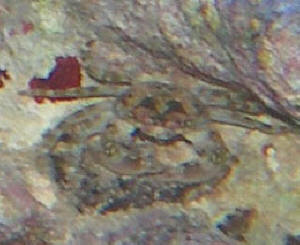
The tank is about three months old and I have some new hitchers I
haven't seen before. There are some tiny spider-like animals.
I have at least three of these. They are about 1/4 inch across.
Not sure if they are small arrow crabs?
<I don't think so. I can't quite see the body, but
overall they look more like Pycnogonids/sea spiders to me
(carnivorous marine arthropods). Please see the following links
for more information:
http://www.wetwebmedia.com/pycnogonids.htm
http://www.wetwebmedia.com/seaspiderfaqs.htm
http://en.wikipedia.org/wiki/Sea_spider >
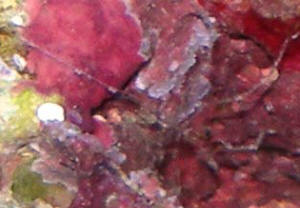
There are also some larger crabs, at least three, all with the
same coloration. The largest of these is an inch across.
<Gotcha. Unfortunately, I can't quite see enough detail to
ID but with your help I think we can narrow down the field of
possibilities. First of all, do the crabs have 3 walking legs on
each side or four (not including claws)? Also, do you see any
long antennae just behind the eyes (they may be fairly clear so
look closely)? Those two factors alone can help us determine how
safe these crabs will likely be around your fish. Generally
speaking, if it looks like a crab but has three pairs of walking
legs + long antennae positioned behind the eyes, it's a
false/'porcelain' crab (Family Porcellanidae). These are
primarily filter feeders but they also scavenge. The good news is
that they don't pose nearly the risk to fishes that true
crabs do. True crabs have four pairs of legs (most adapted for
walking, some species' for swimming) and fairly short
antennae placed in front of (between) the eyes. These are
opportunistic creatures that will, if given the chance, make a
nice meal of any fish, fellow crustaceans, etc. This risk
increases with size, competition/lack of sufficient food, and
ease of access (especially small bottom dwelling or sleeping
fish, crustaceans in molt, other benthic invert's). For more
information on porcelain crabs and true crabs, please see the
following links (as well as associated links at the top of each
page):
http://www.wetwebmedia.com/marine/inverts/arthropoda/crabs/swcrabs.htm
http://www.wetwebmedia.com/galatheids.htm >
I guess I was wondering if they will be hazardous to my 1-inch
ring-eyed goby or yellow clown goby. There are the only fish in
there so far.
<See above. If those crabs have 4 legs on either side, I'd
get them out and find them a new home. Small Gobies and crabs are
not a good combo!>
Thanks again for the previous early response!
<Again, on behalf of Bob, you're most welcome!>
Peter
<Take care, LynnZ>
|
 |
|
Follow-up: Re: Aiptasia? Now, ID's:
Sea Spiders and Crabs -- 7/15/09
Lynn
<Hey there Pete!>
Thanks for the help!
<You're very welcome!>
These are four-legged so I guess they are true crabs.
<Uh-oh. I knew the chances were slim, but I had hopes that
these would be of the safer Porcelain crab variety.>
After reading your article it looks like a Grapsid.
<Gotcha>
Not sure which I like better, the crabs or the gobies!
<Heeee! It's just unfortunate that crabs like to snack on
gobies!>
But I think I will take your advice and maybe put these in my
refugium.
<Well, just keep in mind that once you put them in there,
it's no longer a 'refuge'. It'll be a nice little
hunting ground for the crabs, but not such a safe haven for
everything else! You could always set up a nano tank for the
crabs. That way you'd be able to see more of them. It
doesn't have to be anything fancy. Just make sure they have
plenty of hiding spaces and that they're well fed so they
won't get cranky and kill/eat each other!>
Thanks again,
<It was a pleasure.>
Pete
<Take care, LynnZ>
|
|
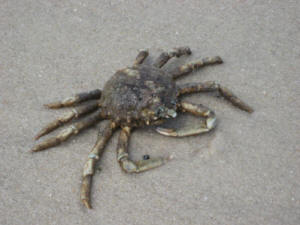
Crab Identification: Spider Crab from New Jersey Beach
-- 5/30/09
<Hello Eleanor, Lynn here today.>
I've been searching all over the web and would really
appreciate your help in identifying the crab in the attached
photo.
<Sure thing>
He has such slender claws and an interesting snout.
<I'll say!>
I found him on the shore of Long Beach Island, NJ.
<It looks like Libinia emarginata, a scavenger commonly
referred to as a spider crab (family: Majidae). For more
information/photos, please see the following links:
http://njscuba.net/biology/sw_crabs.html
http://www.biology.lsu.edu/webfac/jbelange/completed_files/dreamweaver/Libinia.html
>
Please email me back when you get a chance.
Thank you,
Eleanor
<You're very welcome. Take care, LynnZ>
|
 |
|
I Need help with an ID, please 05/27/09
Lynn... would you give the attached pic a look/see?
<Sure thing, Bob>
Do you have ref.s re what sort of Decapod this is?
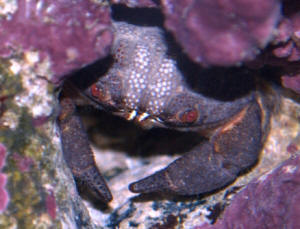
<It looks like a Xanthid in the genus Paractaea -- possibly a
fairly cosmopolitan species: Paractaea monodi (Monod's round
crab):
http://www.sebald.com/fotoalbum/downloadfoto/10638-2/20080112_monodi-krabbe_3.jpg
http://www.aquaportail.com/uploads/aquabdd/photos/invertebres/eau_de_mer/paractaea_monodi.jpg
Several photos half-way down the page and another good one at the
bottom:
http://www.ivanov.ch/redseaMax/crabes.html
The next closest thing was another Xanthid: Eriphia ferox (aka
the red-eyed reef crab). It's similar, but the carapace edges
look jagged/spiny instead of smooth.
http://www.wildsingapore.com/wildfacts/crustacea/crab/eriphiidae/ferox.htm
Thank you, BobF
<You're welcome. Hope you're having a great time and
enjoying your trip! LynnZ>
<<Thanks much Lynn... have forwarded the resp. to
Ultramarine Mag/UK for their posting, with credit to you.
BobF.>>
|
 |
|
Can you help ID a small crab for me?
4/25/09
I'm sorry to bother you with this, I'm sure you get these
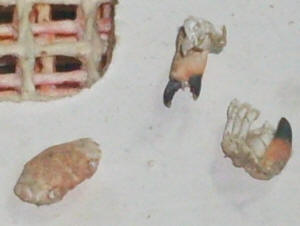
way too often, but this little guy has me stumped. I have not
been able to get even a semi-decent picture of him in the water,
and am hoping most of a shed will be okay. I am unsure where the
rock that he came on is from, he was at one of the local stores
where they get in multiple types and rock from tanks that
customers are breaking down. The crab is still quite tiny, and is
grey with a black stripe down his back, black claws, black eyes
and hairy legs. Most of that would usually indicate a
"bad" crab, but he also seems to have the claws of a
Mithrax family crab, with spoon shaped tips.
<Would be my best stab too, not that these are good crabs
either!>
He tends to stay tucked away in a piece of rock while the lights
are on and comes out at night to munch on algae that is growing
on the rocks. I'm sorry I could not get better
pictures, but I hope that they are good enough (for reference,
the holes in the canvas in the box are about 1/2") Besides
trying it and hoping it does not fail, is there any way to tell
if he would be fish-safe?
<Sure, it is a crab, they are opportunistic feeders. It will
eat fish given the chance.>
My tank is a nano(10 gallons) and I would like to get a clown
goby for it, assuming I can find one that is eating at the store
to add some "movement" to it. So far in the year the
crab has been there, I have not experienced and coral loss, my
solo hermit crab is fine and I have not seen any damage to the
hitchhiking sponges or feather worms(a few are recognizable by
their markings) that are near his lair.
<Clown gobies and these potentially large for aquarium crabs
rarely do well together, especially in cramped quarters.>
I also have a question about the goby. It seems like one of those
would be about the best fish choice for a tank my size. I have
read that they tend to nibble on Acroporas, but have not seen any
information about other species of SPS.
<A negligible concern.>
I have a plating Montipora in my tank now and am looking for a
Seriatopora and possibly an encrusting Montipora. Would the clown
be likely to bother any of those, or is just the Acroporas that
would need to be worried about?
<Well, if the particular fish is an SPS nibbler it will not
differentiate.
But I really would not worry about this with this fish.>
Thank you for being there to help people like me to not kill
everything in
our tanks!
<Welcome, Scott V.>
|
 |
|
Re: Can you help ID a small crab for
me? 4/26/09
<Sure, it is a crab, they are opportunistic feeders. It will
eat fish given the chance.>
That's what I figured, unfortunately. I really would hate to
kill the little guy.
<Me too, don't!>
Do you suppose if I could find a powerhead small enough for it I
could keep him in a 2.5 gallon tank that is
dedicated to just him and possibly some macro algae and a few low
light corals?
<Hmmm, well you could...do search WWM re "Sharks in the
living room". It is one of my personal fave queries.
Basically you could, but it does not mean that you should! Better
to just meet some fellow aquarists and find it a more suitable
home! Scott V.>
|
|
Help? Pocos... Decapod id
4/20/09
Background: I purchased two Pocos
<Pacus? Colossoma sp.?>
about three weeks ago. The first week or so, they were doing
well. Then the green one started to go white at the base of where
the arms
<?>
would branch off. Figured it was too high in my tank, so I
lowered it. The pink was doing great. Suddenly the pink began
showing similar issues.
<... What are/is this?>
Today I went to look at my tank and I saw this strange growth on
the pink poco. It moved. Upon further investigation it was a
crab-like creature and it was clearly picking at the coral. I
removed it and placed it on a bucket lid to photograph.
It looked like a baby emerald crab with extra legs. MY wife said
it looked like a spider. I didn't see any "claws"
but it clearly used the fronts to scrape at the coral. The
scrapers are on the raised part of the bucket in pics posted
below.
Can anyone ID this ugly thing? Do they only attack SPS?
http://s288.photobucket.com/albums/ll176/Simms1017/?action=view¤t=preeaster031.jpg
http://s288.photobucket.com/albums/ll176/Simms1017/?action=view¤t=preeaster035.jpg
http://s288.photobucket.com/albums/ll176/Simms1017/?action=view¤t=preeaster040.jpg
<... is a small crab of some sort... Might be a commensal that
causes, can cause some damage. Bob Fenner>
|
 |
|
Crab ID 4/14/09
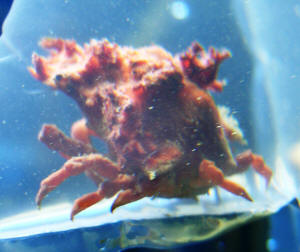
I bought this crab at my LFS. They said he is reef safe, and a
sponge crab.
After looking up a sponge crab, I realized that he is certainly
something else... but can't determine what.
He has very small pinchers, like a shrimp might.
Any ideas?
<I concur that it is unlikely a sponge crab. With not much
detail in the pics, my best guest would be a Stenorhynchus
species, commonly known as decorator crabs, and they are not
entirely reef safe. Like all crabs, they are opportunistic
feeders and will eat what ever they can catch/find. Caution
here
my friend. Since Mr. Fenner's second home is on the reefs, I
will ask for his input here.><<My Standard Spiel here re
Decapods period... Cave Crabem! (beware the crab).
RMF>>
Thanks so very much!
<You're welcome. James (Salty Dog)>
|
 |
|
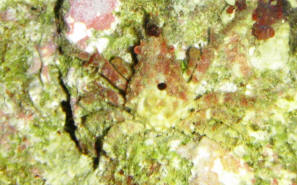
Another creature from the deep
4/10/09
Hi there guys,
I want to thank you for your prompt reply the other day. You have
really helped me.
Now, I have another quandary for you. I have found this crawling
monster in my tank. It looks like a giant underwater louse.
Surely there cannot be such a wondrous thing?
<It is not a louse; while there are numerous marine animals
called lice, they're not insects but usually crustaceans of
various types.>
It is about 2x2cm, flat, crawling rather slowly, at a snail's
pace instead of a crab scrabbling away. It is camouflaged, but
I'm not sure if that is its natural colour or if it is just
so slow that algae started to form on
it.
<It's surely one of the Majidae, the spiny spider crabs.
Generally slow-moving scavenger/predators, famous for becoming
covered in algae, sponges and other things that camouflage them.
Hence aquarists often call them "decorator crabs".
Mostly very small, though the biggest crustacean of all is a
coldwater spider crab. Would expect your specimen to be largely
harmless.>
Here is a photo of the Thing.
Can you please help me here?
Thank again.
<Cheers, Neale.>
|
 |
|
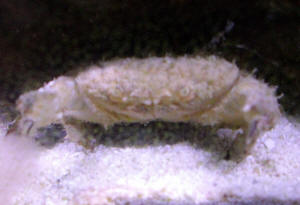
Crab ID - 3/19/09
<Hello>
I need help trying to identify this crab. I've done hours of
looking at photos and descriptions but can't seem to find
anything that looks like this one.
<That's frustrating, I know, but understandable. There are
an awful lot of crab species out there and not all are
represented on the internet. Do you have any idea where this
little crab came from, as far as locale? Also, what is the
size?>
If you need more or better pictures, I will be glad to get them
for you.
<Thanks, I appreciate it. A good photo taken from directly
above the crab, showing the entire carapace and all the legs
would be super if you can get it. Also, a good detailed shot of
at least one the claws, would be helpful as well. I have to warn
you though, even with new photos and more information, the
chances of getting the ID narrowed to species level is
unfortunately very slim. Most of the time, the best you can hope
for is to narrow it to family level, much less genus. Just
remember that crabs are opportunistic feeders and can potentially
damage the livestock within a reef system. Small crabs pose less
risk than the larger individuals, but they're by no means
harmless/trustworthy. The best thing you can do (if you wish to
keep this little crab) is to make sure it gets enough to eat.
This will help deter the little critter from viewing its fellow
tank mates as food. You can offer meaty bits of marine origin
(clam, shrimp, etc), as well as sinking pellets and the like.
Personally speaking, I like crabs. I think they're neat
little creatures that add to the biodiversity of a system.
However, it's imperative that you keep an eye on them and be
prepared to remove, if/when you see any signs of damage.>
Thank you
<You're very welcome. Take care, Lynn>
|
|
|
|

